







Abstract
Russia’s invasion of Ukraine precipitated a swift reversal in Western attitudes toward oligarchic wealth: Russian elites, long embraced by Western institutions, became subjects of rapid sanctioning and deliberate estrangement. Drawing on expert interviews and primary documents, we argue that targeted sanctions against Russian oligarchs created a new form of global deviance. Such deviance is not permanent but contingent on geopolitical priorities; reflects ties to authoritarian power rather than individual wrongdoing; absolves sanctioning bodies of their own complicity with autocrats; is inconsistent across even allied countries; and enforced by private rather than state actors. We conclude that targeted sanctions operate as performative exercises of Western authority that draw moral boundaries and police access to global markets, further entrenching existing geopolitical asymmetries.
Keywords
For decades preceding Russia’s full-scale invasion of Ukraine, ultra-wealthy Russian elites, commonly known as oligarchs, had been deeply embedded in Western financial, social, and cultural life (Bullough, 2022; Hale, 2014; Winters, 2011). Their capital coursed through major European and American banks, their children attended top British and US universities, and their names appeared on football clubs, art institutions, and philanthropic foundations across London, New York, and Geneva (Markus, 2017; Schimpfössl, 2018; Sharman, 2017). For Western policymakers, financiers, and cultural elites, ubiquitous presence of Russian money in Western institutions was a winning proposition: in addition to being highly profitable, it appeared to symbolize the political unity and cooperation between the East and the West.
Yet, in 2022, after Russian troops crossed into Ukraine, the attitudes toward oligarchic wealth shifted dramatically. What had been seen as constructive engagement with Russia, was suddenly recast as a strategic liability and complicity in authoritarian aggression (Appendix, 1-2). Faced with mounting public outrage and determined to align their condemnations of the Kremlin with concrete action, Western governments and private institutions moved quickly to sever ties with Russian money. Targeted, or “smart,” sanctions emerged as the primary instrument through which such rapid dissociation could be achieved. These sanctions allowed to freeze assets, restrict mobility, and symbolically excommunicate Russian elites from the global financial and social order.
While trade sanctions and restrictions on strategic industries and capital flows have a long history, targeted sanctions on individuals accused of proximity to ostracized power networks are comparatively recent and therefore poorly understood (Moiseienko, 2019; Van Bergeijk, 2022). The idea that wealthy private actors long legitimized by Western institutions could be reclassified as international pariahs virtually overnight in such numbers is historically unprecedented. Such rapid inversion raises important questions about how deviance is constructed in international politics, and how boundaries between acceptable and unacceptable ways of participation in global capitalism get defined and negotiated.
In this article, we draw on interviews with experts on the US, EU, and UK sanctions regimes as well as an in-depth analysis of documentary sources to argue that smart sanctions gave rise to a qualitatively new type of a global deviant. For one, sanctions-based deviance is provisional because the designations can be imposed or lifted by states at any moment, reflecting shifting geopolitical priorities rather than permanent legal judgment about their targets. Second, such deviance is relational, since the oligarchs’ liability arises not from proven acts of wrongdoing but from individuals’ ties to political, economic, and social networks of authoritarian power. Third, this deviance is absolving insomuch as targeting oligarchs helps redeem Western states and elites from their own complicity in sustaining authoritarianism. Fourth, it is discretionary as states are selective in their designations in ways that reflect their unique costs-and-benefits analyses. And fifth, such deviance is delegated because the consequences of designation are administered not by police, prisons, and other criminal justice institutions but by a network of private actors such as banks, insurers, wealth managers, real estate agents, shipping companies, and many others. Sanctions thus operate through delegated enforcement, in which punishment is enacted through market institutions rather than the criminal justice system.
We argue that understanding this emergent type of global deviance is especially important at this historical moment. As the world moves away from a rules-based order and toward a fragmented system where great powers like the United States, China, and Russia increasingly act unilaterally, the authority of the international law and courts is likely to continue eroding. In this shifting landscape, attending to the new category of sanctioned oligarchs focuses our attention on how coercion and stigma operate through regulatory and financial channels rather than traditional criminal justice institutions, and how power flows through targeted exclusion, reputational damage, and strategic disruption of economic networks.
Although criminology has long examined political crimes, it has been far less attentive to geopolitical conflict as a site where new forms of deviance and punishment emerge and become institutionalized. Existing work in the criminology of war has focused primarily on battlefield violence, mass atrocities, and other violations of the established international criminal law (DiPietro, 2016; Green & Ward, 2004; Hagan et al., 2009). By contrast, this article examines how contemporary warfare reorganizes global social control through regulatory instruments.
We argue that targeted sanctions constitute a crisis and wartime mode of deviance-making that operates outside criminal courts yet profoundly reshapes the boundaries of legitimate elite participation in global capitalism. Furthermore, by contrast to the literature on elite crime that theorizes high social status as a basis for impunity and privileged treatment in the criminal justice system (Hagan, 2012; Sutherland, 1983; Whyte, 2014), our argument suggests that under the extraordinary conditions of geopolitical conflicts, this very status may transform from a shield into the very basis for deviant designation and punishment.
Methodology
Our main methodological strategy in this article is to derive the characteristics of the new form of global deviance generated by targeted sanctions from the analyses of social processes through which targeted sanctions are designed, implemented, and enforced. This follows a core principle of grounded theory that concepts must “earn their way” into the analysis through sustained engagement with empirical data (Glaser & Strauss, 1967, p. 7, pp. 2-4). As Glaser and Strauss argued, theory is most powerful when it grows out of empirical analyses of social processes rather than being imposed from above. Inductively developed concepts, they argued, capture how social life actually unfolds, not just how it appears.
Later grounded theory scholarship further developed this argument. Strauss (1987) and Strauss and Corbin (1990), for instance, emphasized that theoretical categories must reflect ongoing negotiations among actors as they construct and contest meaning. Charmaz (2014, p. 14) similarly urged researchers to build concepts that “embody the doing of social life.” We draw on this tradition to conceptualize the sanctioned oligarch as a category produced through geopolitical choices and administrative routines. Our aim is not simply to describe a fixed class of global offenders, but, rather, trace how this emergent category of deviance is assembled, disputed, and enacted across different sites of authority.
To that end, we pursued a two-pronged research strategy that involved expert interviews and analysis of primary documents. First, we conducted 21 interviews with specialists involved in sanctions policy, practice, and analysis in the United States (in Washington DC, New York City, and Chicago) and the United Kingdom (in London and Exeter), as well as in Brussels, Belgium, which is the seat of the European Union and NATO. In selecting our respondents, we intentionally sought diverse professional vantage points across the sanction ecosystem. Our sample included former and current government officials involved in sanctions design (two in the United States, one in the United Kingdom, and one in Belgium), two intelligence professionals contributing to target selection (one in the UK government, and the other one working for NATO and based in Brussels), three compliance and de-listing lawyers in the United States, investigative journalists (one in the United Kingdom and one in the US), four NGO advocates monitoring sanctions and advocating for their expansion in the UK, academic experts studying sanctions and illicit finance (three in the United States and two in the United Kingdom), and one oligarch in exile. Participants were recruited using stratified snowball sampling technique. We began with academic specialists and asked them to connect us to other relevant actors. Our semi-structured interview guide focused on how authorities identify sanctions targets, assemble evidentiary files, weigh political considerations in designation decisions, and implement sanctions in practice. We conducted these interviews between March and September of 2025.
Our second source of data consisted of primary documents that trace the legal and institutional processes through which sanctions operate. These sources included legal and policy instruments governing the US, UK, and EU sanctions regimes, such as U.S. Executive Orders issued under International Emergency Economic Powers Act (IEEPA), the Magnitsky Acts, the UK’s Sanctions and Anti–Money Laundering Act and Russia sanctions regulations, as well as relevant European Union Council Decisions and Regulations. We also examine designation notices, official government guidance for compliance actors, and court documents from de-listing challenges in the EU and UK. Together, these documents, described in the Appendix, allow us to reconstruct the formal criteria for designation, the legal rationales invoked by sanctioning authorities, and the institutional processes through which evidence is assembled and reviewed. We treat these documents as windows into the bureaucratic reasoning that underpins smart sanctions and as evidence of how states articulate the boundaries of acceptable political and economic conduct. We also complement this legal and institutional material with an analysis of policy reports, investigative journalism, and data resources produced by think tanks, investigative consortia, and NGOs, including materials from the Atlantic Council, Proekt Media, and other watchdog organizations. These sources show patterns of enforcement and allow us to map the relational networks that situate oligarchs within Russian political and economic power structures. They also provide insights into ownership structures, business linkages, and evidence of wartime economic support that informed our case studies on specific oligarchs.
Using our data, we also analyze and highlight below several specific cases of sanctioned oligarchs that make different aspects and consequences of sanctions practice visible. We trace the sequence of events within each case, from the identification of sanctionable ties and designation decisions to their public justification, the implementation of restrictions by private intermediaries, and the responses of sanctioned individuals. These trajectories reveal recurring patterns in how sanctions regimes construct a new type of a global deviant status.
Background: How “Smart” Sanctions Are Designed and Enforced
The international community first began systematically deploying sanctions against the Kremlin in response to Russia’s annexation of Crimea in 2014. Early rounds of international sanctions sought to limit Russia’s future access to Western capital and technology, especially in energy, defense, and dual-use sectors. Following the February 2022 escalation of the war, the US, EU, UK and other allied governments quickly moved to block much of the remaining Russian exports of natural gas, oil, and coal, freeze Kremlin-controlled foreign currency and gold reserves, and incapacitate Russia’s key organizational players across the energy, banking, and tech industries. At the same time, Western governments ratified waves of targeted sanctions on individuals who were believed to be tied to the Kremlin’s war effort. According to the Atlantic Council’s Russia Sanctions Database, between the full-scale invasion and the end of 2024, more than 1,700 Russia-related individuals have been placed on the U.S. Specially Designated Nationals list alone, and thousands more have been sanctioned across the G7 countries, Australia, and Switzerland. Even Vladimir Putin, typically dismissive of Western attempts to pressure Russia, acknowledged the scale of this retaliation. In mid-2022, he described the sanctions as “unprecedented” in their severity and geopolitical impact (Appendix, 3-11).
Targeted or smart sanctions rely on an expansive legal architecture that empowers executive agencies in Western governments to restrict business dealings, curtail geographic mobility, and freeze assets of foreign citizens without criminal conviction. Most contemporary US sanctions programs, including those concerning Russia, Iran, North Korea, global terrorism, cyber operations, and corruption, are implemented through Executive Orders issued under International Economic Emergency Power Act (1977) authority. Moreover, the Sergei Magnitsky Act of 2012 specifically authorized asset freezes and visa bans against Russian officials implicated in human rights abuses, while the Global Magnitsky Act of 2016 further widened this authority to target individuals worldwide (not only in Russia) and expanded sanctionable conduct to include “significant corruption”. Unlike the earlier Foreign Corrupt Practices Act (1977), which criminalized the US actors’ involvement in overseas bribery, the Global Magnitsky Act enabled the U.S. to punish the instances of corruption that had no direct connection to American persons or interests (Nephew, 2017). Policy leaders in the United States eagerly embraced the Act as a flexible tool to exert pressure, signal moral leadership, and shape global governance norms. By 2018, the State Department described Global Magnitsky Act as “a central tool of U.S. foreign policy.” Parallel instruments in the UK (Sanctions and Anti-Money Laundering Act 2018; Russia [Sanctions] Regulations 2019) and the European Union (Council Regulation 269/2014) created a transatlantic framework that enables states to penalize non-citizens tied to authoritarian regimes and geopolitical aggression (Appendix, 12-18).
Across jurisdictions, targets of smart sanctions are selected in collaboration between the executive and the intelligence agencies, although the specific procedures differ by country. In the United States, for instance, the Treasury Department’s Office of Foreign Assets Control (OFAC) and the State Department, draw on intelligence and diplomatic sources to identify individuals whose wealth and political activity are linked to hostile state power. Once potential targets are identified, officials assemble evidentiary files, conduct legal review, and draft designation notices imposing asset freezes, travel bans, and commercial prohibitions, after which names are added to official sanction lists that trigger compliance obligations around the world (Appendix, 19-20). Although governments typically issue brief public justifications for these designations, the evidentiary basis and internal deliberations behind designations are opaque and inaccessible to the public. A number of legal practitioners who we interviewed for this project noted that even those with formal access (for instance, the legal counsel of designated individuals) struggle to obtain case-specific information.
While sanction designations originate in executive agencies, their effectiveness depends less on direct state enforcement than on compliance by the private sector organizations who stand to be penalized if they continue doing business with individuals on the designation lists. In other words, once an individual is listed as sanctioned, banks, insurers, shipping companies, law firms, real estate agents, and a myriad of other intermediaries are required to block transactions, freeze assets, and discontinue services that involve them, often under a threat of heavy penalties (Appendix, 21-23). Nikolas Rose described this form of statecraft, whereby authority is exercised through market actors and dispersed institutions, as governing through networks (Rose, 1999; Rose & Miller, 1992). In such an arrangement, instead of relying on a criminal justice system, the state embeds its objectives into the regulatory environment, creating a cascade of compliance obligations for private actors.
Once designations are announced, the most immediate impact is on sanctioned individuals’ economic well-being. Freezing assets held in Western jurisdictions disrupts oligarchs’ lifestyles, while their exclusion from international markets and businesses curtails their ability to grow their wealth (Jermano, 2023). Beyond material pressure, sanctions also delegitimize and isolate their targets socially. Once designated, individuals become pariahs in the circles of international elites, stripped of the possibilities to rehabilitate their reputations through informal networking, political contributions, and philanthropic giving (Appendix, 24-25). As one interviewee from the UK NGO sector put it, sanctions can produce a sort of a “civil death” for their targets.
This institutional backdrop reveals that targeted sanctions operate through legal, bureaucratic, and geopolitical logics that differ sharply from conventional criminal justice processes. It is within these logics that a distinct form of sanctions-based deviance takes shape. In what follows, we identify the key features of this emergent deviant category, beginning with the provisional quality of sanctioned status.
Characteristic # 1: Sanctions-Based Deviance as Provisional
Sanctioned oligarchs represent a novel form of global deviance, in large part, because their deviant status arises not from judicial adjudication or application of shared standards of the international law, but from the administrative and political processes that do not require the sanctioning state to follow due process. Thus, targeted sanctions empower executive authorities to curtail financial flows, interfere with business operations, and limit individual mobility without the evidentiary standards or procedural safeguards that typically accompany criminal prosecution. In fact, several of our interviewees noted that sanctions tend to be used by the states when legal proof of individual deviance is insufficient for conviction in the court of law, yet some political action is deemed necessary. In the words of one UK-based investigative journalist, who has long pondered the selectivity of designations, “sanctions seem to be especially convenient in some instances. It is something they can slap on quite quickly and then remove just as quickly. They [sanctions] are nimble like that, a lot more nimble than criminal charges. So, they are good for showing resolve, making it clear that Russians are not getting away with what they are doing … especially in cases that will not actually hold up in court.”
Because of the relatively low bar for designation, as well as for the removal from sanctions lists, the deviant status of oligarchs is characterized by inherent impermanence. Designations are imposed or lifted without the need to establish guilt or innocence according to legal standards but, instead, based on shifting geopolitical priorities and positions of the sanctioning countries (LeClercq, 2023; Moiseienko, 2024). At any moment, and without any specific action by sanctioned individuals, their status may change dramatically.
Sanctioned individuals, therefore, exist in a liminal space, whereby they are neither fully criminalized nor exonerated, but suspended between the law and politics, with their status being contingent on the volatile dynamics of international politics. In the words of one interviewee from a UK-based NGO, “today you are a hero, tomorrow you are a pariah… but there is always a chance that you can go back to partying with Boris Johnson.”
The case of Oleg Deripaska, once Russia’s richest man and a key node in Vladimir Putin’s patronage networks, offers a telling illustration of provisional deviance generated by targeted sanctions. Deripaska rose to prominence in the 1990s aluminum sector, which was one of the most violent and contested arenas of post-Soviet privatization. After gaining control of key smelters and trading networks during the so-called “aluminum wars,” Deripaska consolidated his holdings into Basic Element and later En + Group, becoming one of the most powerful figures in the global metals industry. His economic ascent was made possible by political patronage. Deripaska developed a reputation as a loyal member of Vladimir Putin’s circle, participating in Kremlin-backed economic projects, accompanying Putin on foreign trips, and even serving as Russia’s informal economic envoy in relations with Western investors. Students of Russia, in fact, describe Deripaska as emblematic of the country’s “neo-patrimonial” political economy, in which elite fortunes are contingent on personal loyalty to President Putin and service to his regime (Appendix, 26-31).
In April 2018, the U.S. Treasury Department designated Oleg Deripaska and several of his companies under Executive Orders 13661 and 13662, issued pursuant to the International Emergency Economic Powers Act (IEEPA), citing his close ties to the Kremlin and longstanding allegations of criminal activity. As is common with targeted sanctions, these allegations were never adjudicated in court; rather, they established an administrative basis for restrictions on Deripaska’s property and mobility. The oligarch’s designation immediately destabilized global aluminum markets. Rusal, which is one of the world’s largest aluminum producers and a core part of Deripaska’s corporate network, was suddenly barred from trading with US and European firms, causing a substantial contraction in the global supply of aluminum. Prices for the metal spiked by as much as 30% within days and futures markets swung wildly, throwing manufacturers across Europe and Asia into panic. Governments scrambled to assess the risks to aviation, automobile, and construction industries, all of which depend heavily on Rusal’s exports. The scale of the market shock made clear that sanctioning a single oligarch with deep industrial holdings could trigger systemic negative consequences far beyond its intended political target (Appendix, 32-37).
In part due to these massive ripple effects of sanctions on Deripaska, his status as global deviant proved neither absolute nor permanent. Following months of intense lobbying and negotiations by corporate intermediaries, the US government lifted sanctions against Deripaska’s companies in January 2019. In exchange, the oligarch, who remained sanctioned himself, agreed to reduce his direct ownership stake and relinquish control over the appointments to his companies’ boards. Yet, Western authorities have continued to periodically reignite the scrutiny of his business and personal activities. In 2022, for instance, the FBI raided the US properties linked to the oligarch as part of an ongoing sanctions–evasion investigation, carried out, yet again, without criminal indictment. Deripaska’s trajectory of being designated, partially rehabilitated, and intermittently re-targeted illustrates the liminality of sanctioned oligarchs who tend to oscillate between the status of pariahs and potential rehabilitation. Sanctions-based deviance, therefore, is less of a final judgment than a flexible instrument of geopolitical management (Appendix, 38-40).
Characteristic # 2: Sanctions-Based Deviance as Relational
Another defining feature of sanctions-based deviance is its relational nature. In stark contrast to international criminal law, which typically individualizes guilt (Milanović, 2020), sanctions are operationally based on the logic of collective responsibility, whereby the culpability of their targets stems from their ties and relationships to other individuals rather than their individual wrongdoing (Chang et al., 2023). Thus, sanctioned oligarchs are targeted not for their discrete acts of wrongdoing but for their embeddedness in networks of wealth, patronage, and power that surround and enable the Kremlin. They are punished not for what they have demonstrably done, but for who they are linked to within authoritarian power networks.
According to our interviews, the theory of change behind smart sanctions rests specifically on the oligarchs’ relationship to political elites, and their presumed ability to impact the Kremlin’s decisions. It holds that, by putting limitations on the use of wealth, mobility, and reputations of strategic economic elites, the sanctions will generate discomfort among the oligarchs. Such discomfort, then, will propel the elites to put pressure on the authoritarian state leaders to change their geopolitical conduct. In this framework, punishment is displaced onto those who are accessible within transnational systems (the oligarchs), in the expectation that their disgruntlement will ripple upward to affect the regime behavior. In the words of a high-level US official working on sanctions, “this is just one tool that we have to get to malign actors. When we cannot influence them directly, we try to exploit any pressure points that are available to us. Putin depends on his rich friends, and we can make sure that they are not happy.”
Another interviewee, a sanctions lawyer, made a similar point: “my colleagues who are involved in challenging sanction designations for high-profile clients […] it’s difficult for them. You have to defend the client but the person who is really on trial is not him, it’s Putin […]. And everyone understands that your client just happened to be there, and that he did what he had to do to do business in Russia, and that everyone else did the same… How could they not? […] So, ultimately, it is not at all about your client, that he is just a conduit of the message we are sending to Russians politicians, that he just got caught up in it, and that that’s too bad for him. Yes, it’s too bad. […] In fact, they want my client angry because they hope by doing this to him and others, they think they’ll get to Putin.”
The relational logic of sanctions is clearly illustrated by the case of Mikhail Fridman and Petr Aven, who are the two of Russia’s most prominent financiers. Neither man has been accused of participating in the invasion of Ukraine, financing military operations directly, or engaging in any other defined criminal conduct. Instead, like many others’, their designations rest on their embeddedness within elite Russian power networks and their longstanding proximity to Vladimir Putin (Appendix, 41-42). Having amassed their fortunes in the post-Soviet banking and oil sectors due to state patronage and regulatory favors, the two men came to symbolize the interdependence between Russia’s private capital, concentrated in the hands of few individuals, and Kremlin’s authority.
While both Fridman and Aven had cultivated reputations as technocratic, West-oriented businessmen, they had also maintained direct access to Vladimir Putin and other members of the presidential circle. Their regular meetings with Russian president were, for instance, later cited by the EU and UK authorities as evidence of Fridman and Aven’s ability to influence high-level political decision-making. Aven reportedly participated in informal consultations with the Kremlin on economic policy, while Fridman was known to attend gatherings of business elites convened by Putin himself. In its designation notice, the European Union emphasized the businessmen’s “particularly close ties to Vladimir Putin and his inner circle,” describing them as being among the “most influential oligarchs in Russia” with “friendly relations with the main actors supporting the Russian regime.” The UK Government similarly justified its actions by citing Fridman’s and Aven’s “strategic significance to the Russian economy” and their leadership roles within institutions that are believed to operate in alignment with Kremlin priorities (Appendix, 43-49).
Interestingly, unlike many of his sanctioned compatriots, Fridman publicly denounced Russia’s war against Ukraine as a “tragedy” in a high-profile interview with the Financial Times soon after the full-scale invasion. He also insisted that he had held no sway over Russian policy and pointed to his philanthropic work and business footprint in Europe as evidence of his integration into the Western life and distance from the Kremlin politics. In their legal challenges before European and British courts, both Fridman and Aven also argued that they had been punished not for any act of wrongdoing but for the relationships they could neither control nor sever because they operated in a political economy in which proximity to the state was a structural condition of doing business. As plaintiffs, they contended that targeted sanctions against them amounted to guilt by association rather than evidence-based attribution of culpability. Despite these arguments and Fridman’s public disavowal of the war, both men remain sanctioned by the Western governments. Other oligarchs who challenged Western sanctions made similar arguments. For instance, Alisher Usmanov’s lawyers also denounced his designation as based on the logic of guilt by association, insisting that the oligarch was punished for connections he could not control and for wealth accumulated in a political context where proximity to state elites was structurally unavoidable. Their deviance is relational and stems first and foremost from their position within elite networks of an authoritarian aggressor-state (Appendix, 50-54).
Characteristic # 3: Sanctions-Based Deviance as Discretionary
Next, by contrast to most other forms of global deviance, sanctions-based deviance is discretionary as states exercise singificant latitude in their decisions to impose or lift designations, creating a variegated and inconsistent landscape of sanctions across and within individual countries (Timofeeva, 2020). Unlike criminal convictions, which rely on public procedures, codified norms, and universalistic understandings of guilt, sanction designations are grounded in classified intelligence, country-specific diplomatic priorities, and cost-and-benefit calculations. In fact, many of our interviewees repeatedly emphasized that sanctions are selective by design. With a large pool of potential targets and limited resources, governments inevitably make choices that reflect their political and strategic priorities. As a result, while some oligarchs are sanctioned, others with comparable ties to the Kremlin remain untouched.
Russia’s Top Twenty Wealthiest Oligarchs’ Sanction Status, by Country (as of 12/10/2025)
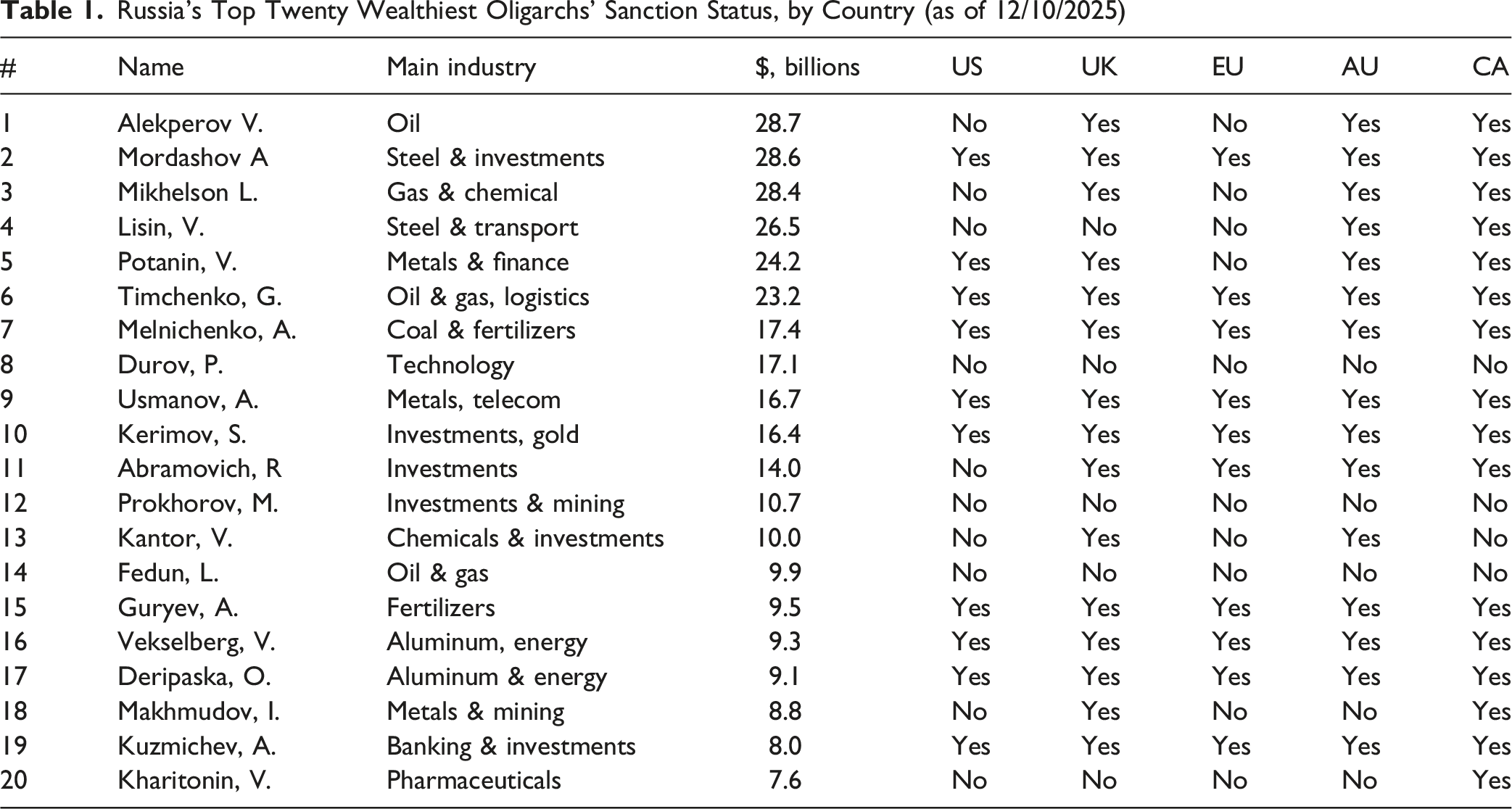
All of the men on this list had amassed immense fortunes in an economy deliberately structured to keep Vladimir Putin in power for more than two decades. Political scientists and investigative journalists contend that Putin has positioned himself as a central node in a network of Russia’s richest elites, ensuring that none could become independent enough to threaten the regime’s well-being (Markus, 2015; Taylor, 2018). According to an investigative report by Proekt Media, the war has further deepened the Kremlin’s reliance on oligarchs, whose resources are now used to cushion the domestic economic impact of the war while also ensuring the steady supply of military equipment to the front. The report estimates that, in the past year, more than eighty of Russia’s wealthiest individuals were “openly involved in supplying the Russian army and the military-industrial complex,” facilitating some of the war’s bloodiest battles, including Bucha and Mariupol, where hundreds of civilians were brutally murdered (Appendix, 57).
There is, therefore, little doubt that all ultra-rich Russians are complicit in sustaining the Kremlin and, in principle and in according with West-specified criteria, should be sanctioned by all members of the anti-Russian coalition. In the words of one interviewee, long involved in the intelligence services, “you have to be a crook in Russia if you want to be anything at all. Of course, the guys with billions… they are all complicit.” Yet, as Table 1 suggests, even at the very top of the wealth distribution, there exists significant variance in who is targeted and who remains unpunished. This variance is likely to increase significantly for less wealthy Russians. The more tenuous the linkages between the individuals and the regime, as is necessarily the case with non-oligarchs, the more discretionary the designation decisions are bound to be.
So, why do different countries make widely divergent choices when it comes to who is and who is not included on their smart sanctions list? The first factor contributing to uneven sanctioning concerns the evidentiary basis for designations. Sanctions law formally requires governments to establish a connection between the individual and the proscribed conduct, such as financing the Russian state, supporting military aggression, or profiting from state contracts. Yet, the level of evidence sufficient to persuade policymakers often falls short of the threshold needed for legal defensibility, particularly in jurisdictions where designations are subject to judicial review (Nephew, 2017). This is especially salient in the EU, where the Court of Justice of the European Union has repeatedly annulled listings on procedural or evidentiary grounds. Moreover, sanctions frequently face legal challenges from targeted individuals, which has led states to adopt increasingly cautious approaches to evidentiary substantiation to avoid reputational and financial costs associated with losing in court (Biersteker et al., 2016; Appendix, 58-60). This tension between political imperatives and legal defensibility generates pressure on policymakers to sanction individuals for whom ample open-source evidence exists instead of those whose links to the targeted behavior are less easily documented. The secrecy of intelligence sources often used in designation decisions complicates their admissibility in courts, especially in the European Union (Portela, 2016). In practice, this means that some oligarchs who are politically obvious targets escape designation simply because building a legally defensible case is too costly, time-consuming, or risky for the designating government.
The second factor shaping the selectivity of sanctions is the deep economic interdependence between Russia and the West. Since many Russian oligarchs control vast portfolios of assets embedded in Western markets, sanctions risk destabilizing domestic industries, harming allied economies, and unsettling global commodity markets (Connolly, 2018). This structural entanglement creates what Farrell and Newman (2019) call “weaponized interdependence,” whereby the coercion by powerful states is constrained by potential economic costs.
The third factor contributing to selective designation is geopolitical strategy. As Andreas, 2011 argues in another context, criminalization through sanctions is often shaped by political trade-offs rather than legal consistency. Our interviewees likewise suggested that policymakers deliberately refrain from designating certain oligarchs to preserve backchannels for negotiation, encourage intelligence cooperation, or even incentivize potential defections.
A further driver of selectivity in designation is the sheer resource intensity of the process. Each designation requires extensive intelligence gathering, legal vetting, and inter-agency coordination. With limited institutional capacity, sanctioning bodies must triage their efforts, focusing on a small subset of oligarchs who are most visible, symbolically resonant, or geopolitically strategic, while leaving many others untouched despite their comparable ties to the Kremlin. In our interviews, resource deficiency came up repeatedly. Civil society activists in the UK, for instance, complained about the lack of specialized judges who have the necessary expertise to adjudicate the complex international finance cases that involve sanctioned oligarchs. A high-level intelligence officer explained that some major figures are excluded from sanctions lists simply because there is limited expertise in the government (as opposed to the private sector, where there are a lot more opportunities to make money). In his words, “we see just as much ignorance as conspiracy in terms of who gets sanctioned and who doesn’t.”
The discretionary nature of sanctions-based deviance is clear in the case of Vladimir Lisin. In 2025, Forbes ranked Lisin as Russia’s fourth wealthiest man, with an estimated net worth of over $26.5 billion. Rising from humble beginnings as a technician in a Siberian coal mine, Lisin built his fortune in the steel industry and now heads NLMK (Novolipetsk Metallurgical Plant), which is one of Eurasia’s largest steel producers. Despite investigative reports showing that NLMK is a major supplier for the Russian Ministry of Defense, Lisin remains unsanctioned by most Western powers (with the exceptions of Australia and Canada). Analysts suggest this omission is tied to Lisin’s extensive business footprint in Europe: NLMK owns or co-owns production facilities in Denmark, Belgium, and Italy, employing hundreds of workers and anchoring regional supply chains. Sanctioning Lisin, therefore, comes with politically unpalatable costs, such as disrupting domestic industries and destabilizing local and global commodity flows (Appendix, 61-64).
Characteristic # 4: Sanctions-Based Deviance as Absolving
Deviance generated by targeted sanctions is also purposefully absolving for the designating authorities. State-orchestrated punishment, of course, is never purely instrumental but always also expressive: it defines unacceptable conduct and projects virtue and moral clarity on behalf of the punishing authority (Garland, 1993; Glasgow, 2015). In the context of Russia’s invasion of Ukraine, this expressive function is particularly pronounced. When asked about the theory of change behind targeted sanctions, most of our interviewees emphasized that while the instrumental impact of such sanctions on Kremlin’s behavior is hard to ascertain, their symbolic impact is clear. Importantly, not only do these sanctions allow Western governments to express opposition to aggression and corruption, but they also distance Western elites from their Russian counterparts and the wealth networks that they had once courted. The dramatic acts of freezing assets, impounding yachts, and restricting travel reaffirm and broadcast moral boundaries and resolve on behalf of the Western allies. As one of our interviewees put it, sanctions operate as a “state-level PR exercise” which “makes it clear who the bad guys and who the good guys are at that particular moment, even if all of them had worked together before.” This quote highlights that by projecting culpability onto high-profile Russian individuals, Western states symbolically absolve themselves of complicity in the very financial architectures that had enabled their fortunes in the first place.
The case of Roman Abramovich offers a particularly vivid illustration of the absolving dimensions of smart sanctions. Abramovich, like many oligarchs, had amassed his fortune during Russia’s chaotic privatization throughout the 1990s, primarily in the oil and aluminum sectors. With significant investments in the UK and deep integration in the most elite of London social circles, Abramovich has long attempted to position himself as a global businessman and philanthropist rather than a Russian political actor. Despite issuing a public call for peace and reportedly seeking to act as a mediator between Kyiv and Moscow in the aftermath of Russia’s invasion, Abramovich was sanctioned by both, the UK and the EU. In justifying Abramovich’s designation, Western powers emphasized not his personal involvement in Russia’s military aggression, but his structural proximity to the Russian political regime and his “preferential access to the Kremlin” (Appendix, 65-70).
Perhaps even more germane to Western interest in sanctioning Abramovich was the fact that his designation triggered dramatic and highly visible consequences, including the forced sale of Chelsea Football Club that Abramovich owned, the freezing of the oligarch’s sprawling London property holdings, and the global scrutiny of his yachts and offshore financial assets (Abely, 2023; Appendix, 71-72). These measures can be understood as ritualized acts of disavowal, whereby Western elites extricated themselves from a relationship with an oligarch who had once flourished at the very center of London’s social and financial networks.
Characteristic # 5: Sanctions-Based Deviance as Delegated
The final distinguishing characteristic of this new form of global deviance is that it is delegated: the implementation and the oversight of real-life consequences of the designation is delegated to sprawling networks of private professionals and organizations. Once a designation is issued, private institutions including banks, insurance companies, shipping agencies, law firms, wealth management institutions, and art dealerships, among others, are legally obligated to freeze assets, block transactions, and deny services to targeted individuals (Jamshidi, 2023; Appendix, 73). Social control and punishment of sanctioned individuals is, therefore, co-produced by state and private actors.
In practice, the responses of the intermediary institutions often extend well beyond formal requirements. To avoid regulatory exposure and reputational harm, companies routinely adopt “de-risking” practices that preemptively sever ties with anyone who might be adjacent to sanctioned individuals (Early & Peterson, 2024). Such over-compliance amplifies the punitive effects of sanctions far beyond what the law mandates. As one respondent, a lawyer, explained, “No one wants to be the bank or firm that made the wrong call.” Another interviewee added that “it is a classic example of the government outsourcing its regulatory obligations onto the private sector.”
The case of Alisher Usmanov offers a clear example of how sanctions operate through the delegated network enforcement rather than direct state coercion. One of Russia’s wealthiest businessmen, Usmanov accumulated his fortune in metallurgy and telecommunications investments. In what by now should be a familiar pattern, the European Union designated Usmanov in 2022 on the grounds that he was a “pro-Kremlin oligarch with particularly close ties to Vladimir Putin.” Following his designation, the implementation and enforcement of Usmanov’s punishment unfolded largely through the efforts of private institutions. Usmanov’s super-yacht Dilbar, for instance, was immobilized in Hamburg as shipyards, insurers, port authorities, and management companies froze their services for the vessel amid uncertainty over ownership structures that involved offshore trusts.
Although German state authorities eventually raided the properties associated with Usmanov, it was the actions of private intermediaries, including trustees who were distancing themselves from his assets, the banks freezing his accounts, and legal counsel withdrawing from representing him, that made the impact of sanctions real for the oligarch. Reportedly, several firms curtailed ties with entities linked to Usmanov even before their formal ownership was established, reflecting a logic of preventive distancing common in the sanctions ecosystem (Appendix, 74-79). Usmanov’s downfall thus underscores the hybrid character of targeted sanctions, which are initiated by the states but enacted through private bureaucracies that interpret, extend, and often intensify exclusion.
Discussion
Sanctioned Oligarch as a Theoretical Innovation
Viewed through the lens of criminological theory, sanctioned oligarchs are neither conventional war criminals nor ordinary economic offenders. Rather, they constitute a distinct form of wartime deviance produced through administrative and market mechanisms. While criminological scholarship on war has traditionally focused on battlefield violence, mass atrocities, and violations of international humanitarian law (e.g., Degenhardt & Wilkinson, 2025; McGarry & Walklate, 2019), the case of sanctioned oligarchs highlights how contemporary warfare reorganizes punishment far beyond the theater of combat. In this sense, war operates not only as a generator of new types of violent crime during and after the conflict itself, but also as a catalyst for new regimes of social control over non-violent offenses, which operate through corporate compliance and elite social worlds. Attending to sanctions as a wartime technology of punishment thus expands criminological understandings of how war reshapes the boundaries of deviance, responsibility, and exclusion on the global arena.
Whereas traditional criminological work on crimes of the powerful has long demonstrated how political and economic elites produce social harm while remaining insulated from criminalization through their influence over law, regulation, and enforcement (Hagan, 2012; Pearce, 1976; Tombs & Whyte, 2015), we argue that war may generate a rare but theoretically revealing moment, in which elite status itself becomes grounds for punishment. In the literature on elite crimes, power is typically understood as producing impunity: the “haves” commit extensive social harm while remaining protected from criminal sanction by virtue of their structural position. The case of targeted sanctions, however, reveals a partial reversal of this familiar dynamic. Rather than serving as a source of protection, elite status, manifested in wealth, notoriety, and embeddedness in political and economic networks, becomes the very basis for designation and punishment. Sanctioned oligarchs are targeted not despite their elite position, but because of it. This inversion complicates established criminological assumptions about elite crime and impunity, suggesting that under conditions of geopolitical conflict, power can become a liability instead of a shield. Attending to sanctions therefore extends the crimes-of-the-powerful literature by highlighting moments in which elite status facilitates selective criminalization, even as such punishment remains deeply shaped by political interests.
The emergent category of sanctions-based deviance as provisional, relational, discretionary, absolving, and delegated shares some characteristics with, but also departs from, the earlier iterations of global deviance. Historically, the pirate was the paradigmatic “enemy of all mankind,” criminalized not only for his violent acts at sea but also for the challenge that he posed to the very notion of sovereign states (Harding, 2007). Like pirates, targets of smart sanctions are framed in popular and political discourse as enemies of the entire international order. Russian oligarchs, for instance, are believed to undermine global stability by enabling hostile geopolitical action (Appendix, 80-81). At the same time, in contrast to pirates, their deviance is not tied to direct acts of predation but to their vast resources, structural proximity to authoritarian power, and embeddedness in the global markets.
A more recent prototype of a global criminal, the terrorist, also shares several characteristics with a sanctioned oligarch. For one, terrorist deviance is also delegated, insomuch as it is enforced through bureaucratic technologies such as watchlists, organizational proscriptions, and no-fly ledgers, not a traditional criminal justice process (De Goede & Sullivan, 2016; Jarvis & Legrand, 2018). Similar to oligarchs, terrorists are also often declared deviant based on association, suspicion, and relational proximity to other actors whose deviance had been confirmed. Yet, while the terrorist designation often aims to directly preempt violence, the oligarch’s designation functions more indirectly to degrade state capacity of the adversarial regimes, put pressure on their political leadership, and dramatize moral condemnation on the geopolitical arena.
An international criminal charged with crimes against humanity, mass atrocities, genocide, or war crimes, and prosecuted before international courts or tribunals offers yet another point of contrast. The crucial distinction between sanction law and international criminal law is that the latter presumes the universality of justice (Clarke, 2019; Schabas, 2011). The war criminal or the perpetrator of genocide, therefore, is cast as permanently outside the international community and subjected to a lifetime of condemnation, unless she is acquitted in the court of law. Their deviance is neither discretionary nor provisional. By contrast, the sanctioned oligarch inhabits a liminal space whereby his status can be reversed, and he can be re-absorbed not only into legitimate society but into the very circles of global elites based on political developments largely outside of his control.
Relative to other global deviants in history, sanctioned oligarchs occupy a category marked by striking absence of due process. In liberal capitalist democracies, criminal defendants are guaranteed rights such as presumption of innocence, access to counsel, the ability to view and dispute evidence, and the possibility of appeal before independent courts. By contrast, the opacity of the designation process, combined with the shield of secrecy surrounding intelligence evidence, means that those targeted through sanctions cannot meaningfully contest the allegations against them. This contrasts sharply with international court proceedings, where charges must be clearly articulated, evidence presented, and judgments delivered in public (Clarke, 2019; Schabas, 2011). The sanctioned oligarch thus exemplifies a global deviant produced outside the ordinary boundaries of law, in what Agamben (2008) calls “the state of exception,” deprived of procedural guarantees that are non-negotiable in domestic contexts.
Geopolitical Implications of the New Type of Deviance
Rothe & Friedrichs (2013) argue that crimes of globalization often escape punishment when they align with the interests of powerful states. Smart sanctions illustrate the exact opposite: when actions of the global elites contradict or simply do not align with the interest of those who wield power in geopolitics, they run the risk of being reframed as deviant. As Bullough (2022), Sharman (2017), and others show, financial centers such as London, Paris, New York, and Geneva not only offered permissive regulatory environments, but also provided the legal structures, professional services, political access, and social prestige that helped build, protect, and legitimize Russian oligarchic wealth. This same wealth had all long helped sustain authoritarian governance in Russia and elsewhere. The recent recasting of Russian fortunes and the individuals who amassed them as deviant reflects, above all, a broader geopolitical realignment, in which the benefits Western elites once derived from proximity to these networks no longer outweigh the mounting political and reputational costs of association.
Our analyses therefore suggest that targeted sanctions function as performative acts through which powerful states draw symbolic boundaries between the “civilized” and the “corrupt,” the legitimate capitalists and the deviant oligarchs. This performativity has deep colonial antecedents. For centuries, Western powers disciplined the “unruly” elites in the Global South in the name of maintaining international order, while leaving extractive economies and racialized hierarchies intact (Anghie, 2004; Branch, 2011; Kentikelenis & Seabrooke, 2017). As Anghie, 2004; Orford (2011) show, the very architecture of international law emerged from colonial projects that defined non-European sovereignty as conditional on conformity with Western norms. Similarly, Mann (2012); Getachew (2019) trace how postcolonial governance mechanisms, ranging from trusteeships to structural adjustment policies, have extended imperial logics of tutelage into the modern development and human rights regimes. Contemporary sanctioning practices reproduce these hierarchies by designating certain non-Western elites as embodiments of corruption or disorder, thereby reaffirming Western moral authority (Pahuja, 2011; Zarakol, 2010).
So, what are the broader implications of the emergence of this new type of global deviance? Much like the “anticorruption” and “good governance” campaigns analyzed by Anders (2010) and Brown and Cloke (2004), targeted sanctions serve as rituals of moral boundary-drawing that legitimate the continued centrality of Western oversight in global political and economic life. By selectively designating non-Western elites as pariahs, Western states reaffirm their role as guardians of global norms and market ethics, even as they continue to rely on the same tax havens, secrecy jurisdictions, and offshore infrastructures that sustain global inequality. In this sense, sanctions operate as rituals of purification through which Western powers curate moral legitimacy and deny their own participation in and contributions to transnational corruption and authoritarian governance.
Targeted sanctions help reproduce global hierarchies by controlling who is allowed to participate fully in international finance, trade, and cultural life, and by defining the terms of such participation. Sanctions thus work as a contemporary form of gatekeeping: they tie market participation to geopolitical obedience and push designated individuals to the margins of global capitalism. In this sense, sanctions do more than punish: They reaffirm Western authority over the very conditions of legitimate economic life. Sanction regimes function as mechanisms for managing and entrenching existing power asymmetries into the international order.
Conclusion
In this article, we argued that the recent sanctions against Russian elites created a fundamentally new type of a global deviant – a sanctioned oligarch. By foregrounding sanctions as a mode of wartime social control, this article contributes to emerging efforts to expand the scholarly understanding of how geopolitical conflict impacts the production and treatment of crime and deviance, as well as the effort to bring the war back into the core of criminological theory. Not rooted in judicial adjudication or universal legal norms, sanctions-based deviance is provisional because it is meant to be temporary and reversible based on changing geopolitical context; it is relational because it stems from structural proximity to other actors; absolving because it seeks to exonerate Western elites from their complicity; discretionary because it reflects the states’ subjective considerations of costs and benefits of designation; and delegated because its enforcement depends on diffuse private networks. Unlike pirates, terrorists, or perpetrators of mass atrocities who are criminalized through legal frameworks claiming universal jurisdiction and offering some, if variable, degree of due process, sanctioned oligarchs inhabit a liminal space between the law and politics.
Understanding this emerging form of deviance is crucial in the current geopolitical moment. The international system is shifting away from familiar norms of multilateral legal coordination based on shared legal principles toward a more fractured landscape in which major powers such as the US, China, and Russia exercise authority through unilateral action. As formal international law becomes less and less powerful, and international courts that had enjoyed broad support since the Fall of the Berlin Wall gradually lose influence, new mechanisms of global social control are taking place of multilateral institutions. The category of the sanctioned oligarch makes this shift visible. For one, it reveals a world in which coercion, discipline, and stigma are enacted primarily through financial regulation, markets, and risk-management regimes, which, quite obviously, operate according to very different institutional logics than criminal justice institutions. Connected to this is the global retrenchment of due process. While the rise of extreme right-wing politics within individual countries is threatening the rights of their citizens at home, the geopolitical discord leads to the loss of these rights on the international arena. Understanding the workings of surveillance, social control, and punishment within this new terrain of global governance represents an important frontier for criminological inquiry.
Supplemental Material
Supplemental material - Sanctioned Oligarchs and the Emergence of a New Kind of Global Deviance
Supplemental material for Sanctioned Oligarchs and the Emergence of a New Kind of Global Deviance by Marina Zaloznaya and Elisabeth Schimpfoessl in Journal of White Collar and Corporate Crime
Footnotes

Funding
The authors received no financial support for the research, authorship, and/or publication of this article.
Declaration of Conflicting Interests
The authors declared no potential conflicts of interest with respect to the research, authorship, and/or publication of this article.
Supplemental Material
Supplemental material is available online.
References
Supplementary Material
Please find the following supplemental material available below.
For Open Access articles published under a Creative Commons License, all supplemental material carries the same license as the article it is associated with.
For non-Open Access articles published, all supplemental material carries a non-exclusive license, and permission requests for re-use of supplemental material or any part of supplemental material shall be sent directly to the copyright owner as specified in the copyright notice associated with the article.
