







Abstract
This paper is an attempt to understand the psychology of the senior managers of a large acquiring bank in the recently announced merger of public sector banks in India through a case study. The data revealed that contrary to the conventional wisdom, which suggests that employees of the acquiring organisation are likely to have a sense of ‘conquest’ or ‘pride’, the senior managers, in this case, did not display any such feelings. Rather, they had concerns regarding the merger, which are discussed. A few had apprehensions and some showed confidence that the process will be a success. We conclude that each case of merger is impacted by its unique history, HR practices and cultural moorings and needs to be understood in its unique background. The interventions for successful mergers will therefore need to be designed with this uniqueness in mind.
Introduction
The Government of India announced a consolidation of state-owned banks, which will merge 10 such banks to form four, each with substantial financial muscle. The banking sector has been struggling under the pressure of non-performing assets. ‘We want to create next-generation banks’ the finance minister announced on the 1 September 2019. ‘You need big banks with enhanced capacity to increase credit…. You need banks with strong national presence and global reach’ (https://economictimes.indiatimes.com/news/economy/policy/big-bank-mergers-government-turns-ten-psbs-into-four/articleshow/70918585.cms?from=mdr).
According to the Government, the move was meant to strengthen the banking sector and enable the banks to have enough financial strength to compete with global lenders and help the Government’s ambitious plans for the economy of the country. As the economy has been facing a slowdown, this was one of the measures the Government came up with in order to revive the economy. The number of state-owned banks will thus become 12 in 2020 from 27 in 2017. According to the Government, this will make balance sheets stronger, giving them greater capacity to lend (https://www.thehindubusinessline.com/opinion/is-there-much-to-gain-from-bank-mergers/article29385214.ece).
The financial history of the world reveals that bank mergers have often been used to tide over financial crises. The year 1997 rocked the economies of Asia and close to more than 700 banks merged in Asia, Latin America and Eastern Europe during 1997–1999 (https://www.thehindubusinessline.com/opinion/is-there-much-to-gain-from-bank-mergers/article29385214.ece).
In the six years following the financial crisis of 2008 in the USA, the number of banks declined by 20 per cent from around 8,500 to 6,900 (https://www.thedailybeast.com/banks-really-are-different-five-years-after-the-financial-crisis).
In India, many banks were merged post liberalisation of the economy in 1991. However, the efficacy of such mergers resulting in financial benefits for the banks has been questioned. The experience in India of merging banks, either through market forces or through mandates have been mixed. PNB had to grapple with the effects of the merger of New Bank of India for quite a few years. United Western was merged with IDBI Bank, but the fortunes of IDBI Bank have dwindled since then. However, HDFC Bank and ING Vysya Bank that chose to grow inorganically by merging other banks have been doing well.
The new decision appears to be an effort to help the banks boost the health of major public sector banks which is under stress. Pre-tax profits for banks slipped to 3 per cent in 2014–2018, as compared to around 12 per cent in the years 2010–2014. Returns on equity are sliding whereas operational costs are rising.
The high percentage of bad loans seems to be affecting most of these banks. The question remains whether a larger balance sheet size with a goal to increase the ‘benefits in distribution, productivity, and capabilities’ will increase the efficiency of the banks. The decision has also been criticised by some quarters as this is not a market-driven decision but a mandate of the Government. Critics have also made observations about the choice of acquired and acquiring banks, where some of the acquired ones are seen to be more efficient and profitable than the acquiring, or having less bad debts than the acquired and also on the ground that banks with a sufficiently high capital adequacy ratio are being made the target of mergers.
This paper attempts to view the recent decision of the Government of India in the light of various theories in the literature that explain the motives for mergers. We then go on to the case study we conducted in a large bank which is set to acquire others. The study was an effort to understand the concerns the top management of the acquiring organisation may have regarding the merger. Based on the data received from the senior management (N = 107) of a large acquiring bank, we present psychological aspects that might be impacting the employees of the acquiring organisation. We then discuss the implications of the same and suggest some actions in the concluding part of the paper.
Literature Review
Motives for Takeover
The rationale for takeover activity has been discussed many times in past years (see Brealey et al., 2001, p. 641; Ross et al., 2002, p. 824). Among the many theories that explain the motives for takeovers, the predominant are efficiency, agency, market power, free cash flow and diversification theories (Piesse et al., 2013). A brief look at them will help us understand the Government’s motives behind the mergers.
Efficiency
Mergers are often resorted to with a view to increasing the efficiency of the acquired firm. The first type of such theories, the Inefficiency Management Theory suggests that the inefficiency of the firm being acquired is publicly known and that the efficiency of the firm can be improved by the firm acquiring it. The acquiring firm may belong to the same industry or any other industry and is expected to improve the efficiency of the acquired firm. Differential Efficiency Theory implies that if the acquiring firm is more efficient than the acquired firm, both being in the same industry, the acquiring firm can raise the efficiency of the acquired firm to the level of its own efficiency. Differential Efficiency Theory may explain horizontal takeovers while Inefficiency Management Theory provides explanation for conglomerate takeovers (Copeland & Weston, 1988). It is expected that the merger would lead to optimum allocation of resources reducing redundancies and leading to synergy (Leigh & North, 1978). Synergy can also emerge from ‘operational’ and ‘financial’ economies of scale (see Brealey et al., 2001, p. 641; Ross et al., 2002, p. 825). Successful mergers may improve efficiency as a result of the birth of new company culture through merger. A successful takeover requires the integration of both company cultures in a positive and harmonious manner (Stallworthy & Kharbanda, 1988).
Agency
Sometimes an inefficient management is sought to be replaced by an efficient management. The theories which use this explanation are called Agency Theories. The perceived threat of takeover may compel managers to maximise the value of the firm and thus keep their jobs intact.
Cash Flow
Sometimes companies retain cash flow in order to acquire and grow (Easterbrook, 1984; Rozeff, 1982). On the other hand, companies with a huge amount of cash may also become targets of takeover (Jensen, 1986).
Market Power
Inorganic growth by way of mergers offers the possibility of extending control over a wider geography and with greater reach in the market (Leigh & North, 1978). Mergers thus expand the scale of operations and offer the possibility of higher control over both pricing and placement of products. Thus, the company has a greater hold in the market. Increasing market power is a known strategic tactic among competitors. The smaller players may be intimidated from entering the market by the sheer size of the existing companies. Industrial consolidation is partly explained by the market power hypothesis (Utton, 1982).
Diversification
As a strategy to reduce risk and ensure income from various sources organisations often diversify their businesses, that is, enter into core businesses of different industries. It is expected that the value of the conglomerate with diversified business will be higher than the sum of individual values of the firms (Lewellen, 1971, 1972). A suitably diversified firm can mitigate the risk of failure (Kim & McConnell, 1977).
Information Led Pricing
When takeovers are announced, the parties release some information which might not have been made public so far. Therefore, the information gives cues and signals about firm-specific financial policies. This kind of information and resultant signals may impact the market value of a firm, resulting in revaluation, which may in many cases be higher than the existing market value (Jensen & Ruback, 1983; Sullivan et al. 1994, p. 51).
Bankruptcy Avoidance
The authors suggest that takeovers may be resorted to as a measure to avoid bankruptcy, (Altman, 1971). Appropriately planned takeovers have been noted to save organisations from bankruptcy (Shrieves & Stevens, 1979). Although there is disagreement on this, we have actually seen a lot of bank mergers happening in order to avoid bankruptcy. Prima facie, it appears that financially unhealthy firms may not be desirable acquisition targets; however, the acquirer may have the advantages of buying the target company at a discounted price and may not need to fight off other competitors in the bidding process, thus saving time and cost (Walker, 1992, p. 2). On the other hand, in case of a single owner of different companies, the decision may just come as a mandate to save a company from going bankrupt.
The Government announcement of merger of public sector banks may have been motivated partly by some of the above theories. To our mind, the motivation appears to have been increased efficiency and market power. Although a debacle like the 1997 Asian crisis or one like the 2008 US subprime crisis is not in evidence, banks in India are under definite stress. High percentage of NPA, and low-efficiency ratios are the leading causes for concern. The slowdown in the economy is an added worry which might be compounding the problem. Whatever the motives of merger, the expected end result is one of success, efficiency and power of the merged entity. However, the herculean task of making the merger a success starts after the mandate has been given. In fact, a large number of merged entities to fail to reach the expected levels (Cartwright & Cooper, 1996, 2000; Gomes et al., 2011; Weber et al., 2011).
Merger and acquisition literature had traditionally kept its attention on strategic and financial factors. In the recent years, however, research shows significant impact of socio-cultural and human resources integration processes on the performance of merged entities (Stahl et al., 2013). Among the reasons for failure of mergers, one of the major reasons may be a lack of integration at the socio-cultural and human relations level.
In the area of socio-cultural integration in the merger processes, various theories have been propounded to explain the performance of firms. Some explain it through the difference in national and corporate cultures (Ahammad & Glaister, 2011a, 2011b; Chatterjee et al., 1992; Weber et al., 1996; Weber & Tarba, 2012). Trust between the companies merging has been found to be a variable of significant impact (Graebner, 2009; Stahl et al., 2011, 2012). Leadership is considered another impactful variable (Nemanich & Keller, 2007; Vasilaki, 2011a, 2011b) and so is identification (Amiot et al., 2006; Rouzies, 2011). Politicisation and ambiguity may lead to an integration vacuum (Colman & Grøgaard, 2013).
Trust and Identification Issues
Hambrick and Cannella (1993) note that typically an atmosphere of conquest and low relative standing for acquired employees during mergers and acquisition result in inter-group conflicts. Workers from acquiring and acquired groups are likely to form hostile groups and distrust each other (Loh et al., 2010).
The employees of the acquired organisation find themselves sold as a commodity. Their expectations from the past are violated and they suffer from feelings of worthlessness. The culture of the acquiring organisation, its expectations for itself and its expectations for the acquired organisation are not known. The absence of knowledge about the acquiring organisation’s expectations produces uncertainty and doubts regarding the future. There may be concerns about continued employment. Loss of self-esteem may occur for managers of acquired organisations if they see themselves in not so powerful positions in the merged entity. As the merged organisation would have been on direct competition with the acquiring one, feelings of antagonism and hostility may exist towards management or marketing practices (Blake & Mouton, 1985). The feelings of the managers of the acquiring organisations are likely to be significantly different from that described above. The acquiring organisation’s managers may feel proud of their managerial finesse in accomplishing the merger. This kind of pride is quickly communicated to the members of the acquired organisation, which exacerbates their feelings of insecurity. Members of the acquiring organisation often think that they have a far greater understanding of the workings of the acquired organisation than they actually do. They do not realise that they are considered to be uninformed and ignorant by the members of the acquired organisation. When those in the organisation being acquired remain reticent, hesitant or remote, they may be viewed as withholding help when spontaneous contributions should be forthcoming (Blake & Mouton, 1985).
As organisational life unfolds, group members come to share a history. A group’s history provides its members’ continuity and stability—an anchor in space-time. History helps the members understand how they got where they are now. A longitudinal perspective on accomplishments gives greater meaning to assessment of current group performance and provides a context for setting goals and objectives. Yet for all its positive contribution, history is often a formidable barrier to progress and effective resolution of conflicts. Whether it transpired yesterday, last year or a decade ago, history may exercise counterproductive influences on members’ perceptions, attitudes and behaviours.
Antagonism and Hostility
Relations at the interface between groups that have a functional relationship tend to be tense and to move towards mutually experienced antagonism and hostility. Every group has their own norm and values. Significant departures from group values and attitudes or accepted patterns of behaviour are rarely tolerated. Members who think or act differently are either punished, persuaded, rejected or excommunicated.
Under conditions of high cohesion, group members often place loyalty above logic. Judgement becomes distorted and no matter what the issue, group members see their position as right, valid and just. Contrary positions are viewed with disfavour and suspicion. Tension and feelings of antagonism lead to misperceptions and distortion of objective facts. Group identity is maintained and further strengthened through attitudes and behaviours that distinguish us from them. This we versus them mentality is operationalised in any number of invidious comparisons. Members of each group come to the jointly held opinion that we are ‘better, smarter, harder working, more dedicated and more honest’ than any of them.
Where previously tense relations between groups have prevailed, win–lose competition replaces shared expectations and it is often difficult or impossible for groups to engage in effective teamwork.
However, outcomes are disappointing when a corporate culture is imposed on another firm following takeover conflict. The resolution can take some time and the members of both organisations may take a while to adjust. Unfortunately, in the changing business environment of today, no firm gets enough time to manage this adjustment. This clash of corporate cultures often results in corporate failure. Stallworthy and Kharbanda (1988, p. 93) found, ‘it is estimated that about one-third of all acquisitions are sold off within five years … the most common cause of failure is a clash of corporate cultures, or “the way things are done round here”’.
The Case Study
We approached our study with the broad attempt to understand the attitudes and beliefs of the top managers of the acquiring banks and the specific question to know whether in this case, the members of the acquiring organisation were feeling what the literature suggested. The decision had come from the owners as a fait accompli and was not guided by market conditions and the unions of banks had already protested against the merger.
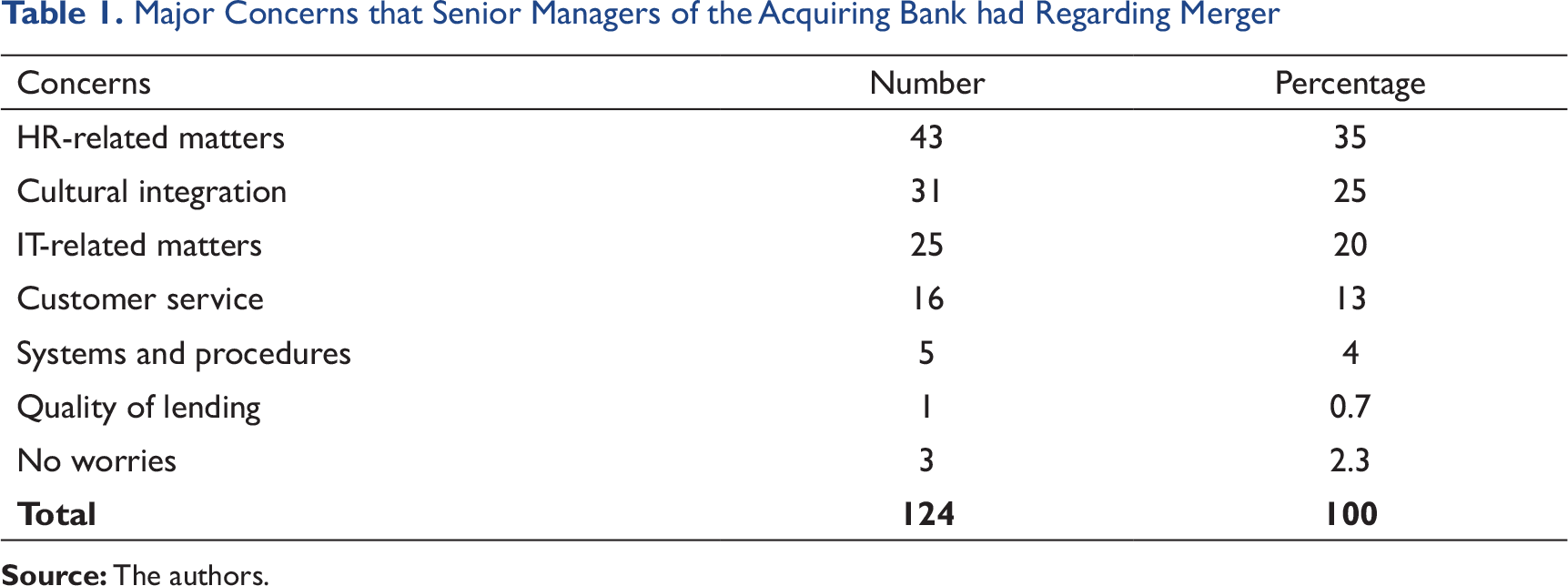
An open-ended questionnaire was sent to all the members of top management teams of a large acquiring bank. Out of the two questions on merger, the first was about concerns regarding the upcoming merger and the second question enquired about their personal strengths which they felt might facilitate the merger process. A total of 124 responses (from 102 interviewees—a few citing more than one concern) were received and a qualitative data analysis was done. Table 1 provides an analysis of the concerns expressed in the written interview responses.
Table 1 indicates that the senior employees of the organisation are more concerned about people issues like HR and cultural integration. Sixty per cent of the survey responses indicated that these were the matters of concern whereas only 24 per cent responses considered IT and systems and procedures-related matter to be a major concern.
A few of the respondents expressed the fear that younger people from acquired organisations would take senior positions and they would promote and favour ‘their own people’ from their original organisations as they would know them better. They, being a smaller group, will work more cohesively and serve one another’s interests. As a result, employees of the larger organisation will feel alienated and would start remaining aloof. As the banking industry is under stress, morale of the people is already low and this will bring further woes. Apart from cultural and HR integration, concerns regarding smooth transition on IT platform and customer service were evinced by the respondents.
At least nine of the respondents said they were looking positively towards merger or were not ‘concerned’ or ‘worried’ about it. They felt it would be good for acquiring as well as acquired organisations.
Major Concerns that Senior Managers of the Acquiring Bank had Regarding Merger
Result of the Measurement Model
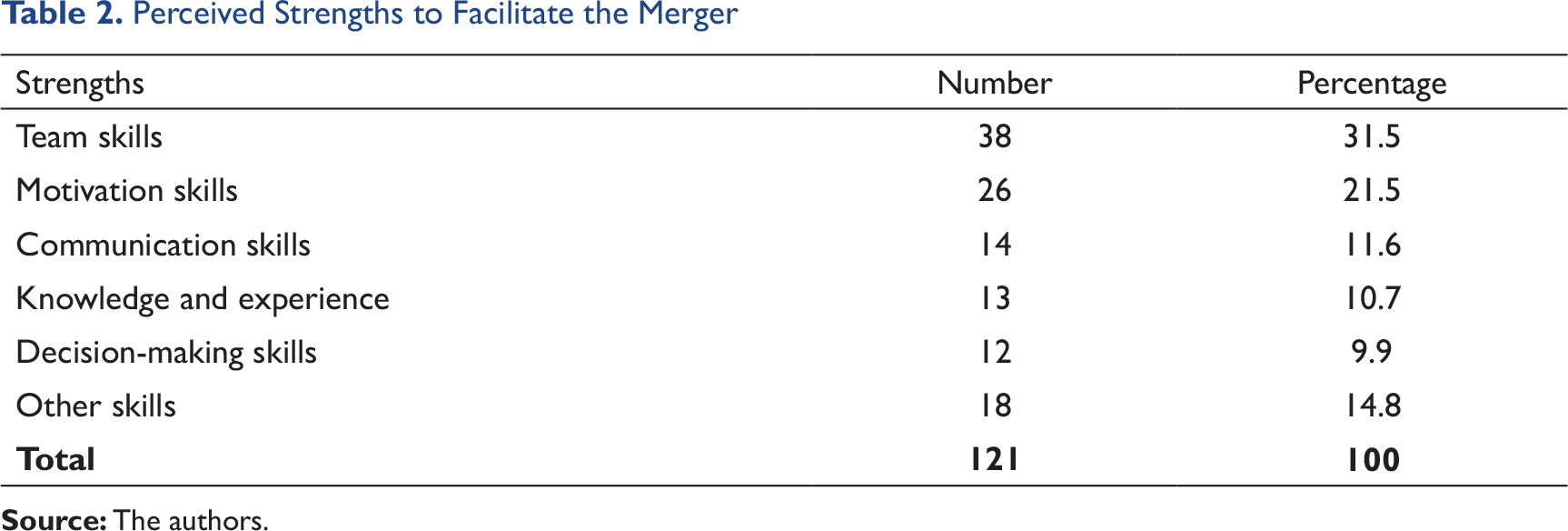
It is interesting to note that while the respondents felt maximum issues to be related to cultural and human resource integration, they felt that their strengths also lay in that area. Table 2 presents an analysis of the top managers’ strengths to handle the process. (A total of 121 responses (from 102 interviewees—a few citing more than one strength) were received and analysed.)
Team skills polled the highest number in this (31.5 per cent), followed by motivation skills (21.5 per cent) and communication skills (11.6 per cent). If the three are put together as people skills, this would account for about two-thirds (65 per cent) of the responses. The next important factor cited is knowledge and experience (10.7 per cent). This means a vast majority of executives feel that they have the requisite skills to handle people and teams. Knowledge and experience, along with decision-making skills were cited by many as strengths that would help them tide over the hurdles of the amalgamation process and emerge successfully.
The written interviews were followed by interactions with the interviewees, which revealed further data in greater depth and richness.
Discussion
The above investigation revealed that fear of merger may be there not only in the employees of the acquired organisation but also in the employees of the acquiring organisations. The merger decision had come to them as a fait accompli and the senior management was perceiving it with apprehension although there were efforts on their parts also to make the merger effort a success. While a small percentage of them (2.3 per cent) felt very confident that there was no need for concern, others felt that there definitely was a concern. Majority of the respondents (60 per cent) felt that the concerns were on the people issues, i.e. HR integration and cultural integration.
The feeling of us versus they was quite evident from the study.
A deeper analysis of the history of the organisation revealed that it did not have very positive experience in the case of some of the previous mergers, and it had to struggle for quite a few years under the impact. Although the bank had emerged from the shocks of previous mergers, the process had been tough and arduous. The employees felt that they had personally suffered because of the previous mergers. Due to the past experience, there were apprehensions about the upcoming merger. The literature generally propounds that the employees of the acquiring organisation are likely to be in a psychological state where they have a feeling of ‘conquest’ and ‘pride’. Literature suggests that these feelings of conquest and pride are quickly communicated to the acquired organisation. Our finding in case of this organisation was somewhat contrary. The acquiring organisation was also questioning the decision.
The reasons for this might be many. One being that the decision for merger was not market guided but a mandate by the Government. The feeling that the decision was forced, was shared by the respondents. There were HR-related issues that were bothering the senior management of the organisation. They apprehended, for example, that the way promotions had taken place in the acquiring and acquired organisations, the employees of the acquired organisation may become more powerful in the new entity.
There was a definite feeling of they versus us. A number of group members felt that the powerful and ‘cohesive’ group from the acquired organisation may work to promote their own interests while the interests of the employees of the acquiring organisation may be side-lined.
A study of the financials of the acquired and acquiring organisations also showed that while the business volume of the acquiring organisation was bigger, the acquired organisations had better performance in terms of some productivity parameters and NPAs.
The acquired banks have a predominant presence in geographical regions of the country which are very different from the regions of predominance of the acquiring bank. This fact partly explains the high number of respondents expressing concern over cultural integration.
The data and its analysis, therefore, suggest that although they and us feelings may be there when two organisations are coming together through merger, it is not necessary that the acquiring organisation will have the feeling of ‘conquest’ and ‘pride’. Generally, the concerns regarding HR issues after merger were observed among the respondents of the acquiring organisation but the feelings of ‘conquest’ and ‘pride’ were not displayed. In this case, a small percentage (2.8 per cent) of the participants of the acquiring organisation felt that they may become less powerful in the post-merger scenario. However, 8.4 per cent of the respondents felt that it was only a matter of time and effort for smooth merger to take place.
Therefore, the historicity of each of the organisations appears to be a significant factor, which impacts each merger process differently. As in this case, the feelings of the employees of the acquiring organisation are not seen to be what is propounded by literature in the merger and acquisition field. Our point of view is that each case of merger and acquisition is unique and to make the process successful, the history and culture of each of the organisations need to be understood. Our point of view agrees with Weber and Talba who observe that the reason for the dismal performance track record of the acquiring companies can lie in their failure to adopt and apply the right post-acquisition integration approach required in each particular case (Weber et al., 2009, 2011).
The organisation’s Executive Education Programme was focusing on merger issues and this provided the executives the opportunity to discuss their feelings both negative and positive.
While the Government has chosen banks on the same technological platforms to be merged, the banks need to be prepared to handle the challenges that mergers present. The banks are from different regions of the country. They might therefore have cultural differences both in terms of being from different regions and also in terms of work culture.
Organisations use various HR practices to control integration risks and maintain positive attitudes among employees.
Interventions provided conditions that made the quick establishment of functional contact possible and through interface modelling, subordinate goals rapidly emerged. The collaboration between the counterpart group members demonstrated to both organisations the benefits of using cooperation to bring the merger to fruition.
Authority in the sense of controlling outcomes is replaced by shared participation based on logical and psychological reasoning about the dynamics of the total situation. The acquiring organisation’s leadership justifies its approach by rationalising that if the total situation were opened up to shared examination and co-planning, the leadership might lose control. The potential gains from involving the acquired organisation to help in the merger’s optimal development is much more than the perceived risk of losing control. The acquiring company was willing to share leadership in exchange for the acquired company’s freely given expertise and cooperation.
Conclusion
Whereas the investigation reveals that the concerns are predominantly in the socio-cultural area, the managers also perceive their strengths to lie in the same area. Researchers note that organisations use various HR practices to control integration risks and maintain positive attitudes among employees. In this case too, the organisation has started taking HR initiatives and started focusing on issues. Apart from town hall meetings for all the employees, learning interventions are also focusing on the issues of merger. This research will contribute to the merging organisation by making explicit the feelings of the senior managers of the organisation and helping in designing suitable interventions for the organisation’s successful merger.
Limitations of the Study
This study has one particular organisation in focus, which is the acquiring organisation and involves its top management only. Similar study at different levels may be required in acquiring as well as in the organisations being acquired to come to a more comprehensive understanding and design suitable interventions.
Footnotes
Declaration of Conflicting Interests
The authors declared no potential conflicts of interest with respect to the research, authorship and/or publication of this article.
Funding
The authors received no financial support for the research, authorship and/or publication of this article.