







Abstract
Industry experts estimate that there could be over 15 million gig economy workers in India. Despite its massive potential, India’s gig economy is still at a very nascent stage. Due to the recent pandemic, many companies were forced to trim staff and hire gig workers due to uncertain market conditions. This has dispelled many reservations about the dependability and long-term viability of a gig workforce. India can emerge as one of the largest markets for flexible staffing globally. It is therefore apt that a research article traces the Indian gig economy and draws valid inferences for the human resource (HR) function. The objective of this article is to review and synthesise themes and narratives around gig economy from the perspective of people’s function.
The study analyses the concepts in two phases. In phase I, we summarise the key concepts from academic research. We, further, extract the opinions of business professionals; in phase II, using text mining techniques in SPSS Modeler Text of qualitative data discussed in the Indian context is used to come up with the gig economy narrative in India. This inductive research draws inferences from secondary data available in newspapers, magazines, blogs, research journals and comments posted on social media like LinkedIn and Twitter.
The findings of this article reveal how gig economy has shaped the employer–employee relationship. While doing so, we present the opportunities and challenges for the gig workers, the influence of the pandemic in fuelling the gig economy and perception of the organisations. There is more positive sentiment and optimism around the gig economy in India. The role of the managers will transform in this model, and functions like learning and development and performance management will undergo vital changes. Creating a sense of inclusion and belongingness among the gig workers will become a priority. Therefore, to become a stable employment model, there is a need to create a robust gig ecosystem where expectations of all the important stakeholders are understood and met.
Currently, India has 15 million freelance workers engaged in various projects across sectors. Bengaluru tops the chart with the highest number of blue-collared workers related to gig economy, followed by Delhi, Mumbai and Pune. Most of the gig workers are in the 24–38-year age group. The gig economy will be US$445 billion by 2024, increasing at a compound annual growth rate (CAGR) of 17%. One million jobs can be created, and gig economy will contribute an incremental 1.25% to India’s GDP over the long term (ASSOCHAM-Primus Report, 2020; BCG, 2021; Business Standard, 2021, March 31). The current study synthesises the themes and narratives around gig work both from the perspective of the worker and from the organisations to give a more accurate picture of the gig economy in India from the HR’s perspective. In the first section, we discuss secondary research from newspapers, magazines, blogs and research journals about the landscape of the gig economy in India, the opportunities and challenges of the new employment model, the profile of the gig worker and the impact of the pandemic on the gig economy. In the second section, we present an analysis of the perception of gig economy from the perspective of the Indian corporation. Using machine learning, we analyse the comments posted in social media like LinkedIn and Twitter, etc., and draw inferences. We integrate these themes with the concept of psychological contract and build a case for decoding the new psychological contract expectations in the gig ecosystem.
Landscape of the Gig Economy in India
ASSOCHAM defines gig economy as a free market-based system where temporary, flexible jobs exist in abundance. Companies prefer to hire independent contractors and freelancers for short projects instead of full-time employees for an organisation.
According to the Boston Consulting Group (BCG) (2021), gig economy is not a new concept in India. The farm workers, household help and daily wage construction labourers across rural and urban India, which constitute the informal sector, have always been an equivalent of the gig economy. It is the use of technology to match and deliver on-demand services at a scale that has been the game changer.
Gig economy can be categorised into a low-skilled and high-skilled ecosystems. The medium- to high-skilled job is mainly delivered virtually by a gig worker without any physical operation just like freelancers and independent consultants or direct contractors. These are like white-collared jobs in the traditional economy. The low-skilled job offered through various on-demand platforms require a physical operation to complete the task. There has been a sudden rise in the gig employment due to the influx of aggregators seen in the low-skilled jobs.
The low-skilled workers perform manual labour and earn on the basis of every task they perform. Mid-skilled workers are good with administrative skills, and to augment their overall income, they look for gig work. The highly skilled category includes the most experienced and qualified professionals. To create a personal brand beyond their regular work, they take up short-term work outside their organisation. About 39% of mid-skilled workers work for large enterprises, and 15% work for start-ups. Due to the government’s initiatives like Skill India, Start-up India and Digital India, the Indian gig economy is growing rapidly from a less skilled service to more skilled jobs. Digital transformation, an aspiration to work independently, a large unemployed population and an increased demand for independent services have fuelled this growth. Sectors like information technology (IT), content creation, social media marketing, communications, food and beverages, art and design, construction, manufacturing, transportation and logistics, retail and personal services sectors have been using this work model. Internet penetration and smartphones have created a huge demand for e-commerce. All major e-commerce companies, food and cab aggregators like Ola, Uber and Swiggy need gig workers, thereby creating one of the largest markets for flexible staffing.
In India, a mid-skilled gig economy has the potential to create job opportunities, boost industrialisation, increase income and improve the living of people from tier 2 to tier 3 cities. (ASSOCHAM-Primus Report, 2020; ASSOCHAM National Conference, 2020; Business Standard, 2021, March 31; Gig India, 2021; Mckinsey Global Institute, 2016).
The New Employment Model: Opportunities and Challenges
A full-time work, which was the norm for decades, is changing slowly into independent work, characterised by a high degree of autonomy, task-based payment and a short-term relationship between the worker and the client. Workers are paid for each individual gig that they do such as a food delivery or a car journey instead of a monthly salary, day wage or an hourly wage (ASSOCHAM National Conference, 2020).
A study by Mckinsey way back in 2016 developed a model for independent work. They identified four key segments of independent workers: free agents who earn their maximum income from independent work. Casual workers supplement their income by independent work. Reluctants who make their primary living from independent work but prefer a traditional job and, finally, financially strapped who do supplemental work out of necessity. The study concluded that free agents and causal workers have greater satisfaction in their work lives than the other two category. A study on women workers’ engagement in the domestic work, beauty work, cab delivery and food delivery found that there is no one model of gig economy in India. There is an app-based model, followed by Uber, Zomato and Urban Company, where workers are independent contractors with commission-based payments for specific work that they do. This model has built in flexibility at its core along with ease of entry and exit, low asset requirement, higher job risk and more ability to earn. The other is a hybrid model, which borrows features from both the traditional and platform economy. Here, workers working as full-time workers get salary, social security benefits like provident fund, health insurance and, in a few cases, maternity benefits. Safety of women workers is of utmost importance when selecting gig work (Ghosh & Ramachandran, 2020).
Gig workers are called partners in many platforms. The prerequisite for hiring gig workers includes a bank account, proof of identity and a prior experience in the related area of professional work. There is background verification carried out by a visit to the home of the independent worker. There is generally no written contract with the platform and it is mostly a verbal agreement. The workers are expected to buy a kit, which contains all products and appliances, uniform, etc. This costs ₹25,000–30,000 and is seen as an initial investment for the business. There are easy loans available in case the worker is unable to pay, which usually takes 2–3 months to repay back. An induction training is mandatory for about 10 days, which is not only related to work but also includes the usage of mobile and the online platform. There is mandatory retraining every 6 months for workers, and they are also paid a small amount on the days of the training. The travelling cost to the client location is borne by the worker. The platform charges a percentage commission of the value for which services have been rendered. They have a generous incentive system in place especially for the beauty segment. They are given certificates and complimentary meals based on their performance. There is penalty for arriving late at the customer’s location and in the case of not attending to the service. The safety of the professionals is taken care of by the app, which has an save our souls (SOS) feature, a helpline number and possibility of connecting directly with the police station. The partners can also rate the customers, which ensures that, in the future, partners do not service indecent clients. It is not possible to unionise these workers as they are invisible and do not get opportunity to interact with each other, which leaves them vulnerable to exploitation by the companies (The Asia Foundation, 2020).
The new employment model has generated plethora of opportunities. Workers get autonomy and a flexible work environment, work in their area of interest and global postings. One can work for self rather than for someone else. The companies can hire freelancers at lower costs, fewer obligations, talent on demand and higher unit pay. Freelancing provides work and livelihood to millions of new and young entrants to the workforce. It provides an opportunity to work to the vast pool of informal labour, especially women. Educated skilled women who could not work earlier in a full-time employment have now reaped benefits of flexible work through these platforms. It also reduces cost as employers can eliminate inefficiencies with the introduction of a dual job market within their organisation. The right work is allocated to the right person, thereby improving productivity.
The online platforms have constantly tried to increase the participation of freelancers by providing them training on technology. Therefore, gig work reduces unemployment, improves labour participation, stimulates demand and raises productivity (ASSOCHAM National Conference, 2020; BCG, 2021; Banwari, 2018; Kathuria et al., 2017; Mckinsey Global Institute, 2016; Roy & Srivatsava, 2020).
There are both social and regulatory challenges in the gig sector. In the Indian society, a freelancer is still treated as a second-grade individual as compared to a permanent employee, and corporate culture is not very welcoming of part-time work. This is reinforced by the irregular income of freelancers, lack of social security benefits, pensions, sick pay, holiday entitlement and parental leave. The gig economy also bids down the wages, offering few or no legal protection against discrimination and harassment for the workers. All these create more chances of stress and mental health issues. Mortgage companies are wary about lending out to people without job security. With reduced power of collective bargaining, there are more chances of abuse of individual contracts. In addition to these, the platforms acknowledge problems related to payments, bidding and navigating websites. Data security, information privacy, intellectual property rights (IPR), digital ecosystem, safety of gig workers and customers, dispute resolution, low skill development and career growth, lack of standard practices and lack of regulation are other issues thrown up by this new employment model. It has also raised some questions around consumer rights and minimum wages (ASSOCHAM-Primus Report, 2020; ASSOCHAM National Conference, 2020; Tyagi, 2017; Banwari, 2018; BCG, 2021; Jacob & Shaikh, 2021; Kathuria et al., 2017; Roy & Srivatsava, 2020).
Pandemic as a Catalyst of Change
Pandemic has accelerated the gig economy. Nirmit Parikh of ‘Apna mobile app’, which is India’s largest professional networking platform, believes that platforms can bring more workers into the organised paid economy. It ensures that the gig worker has access to hyperlocal opportunities, large markets for sales and a secured livelihood. With the pandemic, the entire recruitment process got digitised with digital assessments and direct connect with HR via the app itself. The Coronavirus Disease 2019 (COVID-19) pandemic led to the creation of twice the number of jobs in e-commerce, delivery logistics and the healthcare sector with the rise in demand in these essential services. Companies such as Apollo Hospital, Columbia Asia Hospital, 1Mg, PharmEasy, Swiggy and Zomato have used this platform to hire talented resources. Soon, this will create more jobs than the pre-COVID era in tier 2 and tier 3 cities. With the rise in work from home jobs, gig workers have become a normal in most organisations. The workers have also got used to splitting their time across various jobs. Their partnership with National Skill Development Corporation (NDSC) aims to create a professional network of gig workers and enhance collaboration within the community (Sarkar, 2021). During the COVID-19 pandemic, Urban Company spent millions of dollars to offer personal protective equipment (PPE) kits to the employees and trained them on safety and hygiene. They offered the workers soft loans and payout structures to build confidence among the gig workers and to show that the company supports them. (Dewan, 2021).
The platform economy has been one of the worst hit by the pandemic. The gig workers faced problems during the lockdown, but the platform owner was not expected to provide them any socio-economic support. This became a pan-India phenomenon in the presence of informal work and lack of clear policy. When the government imposed the lockdown, these workers had no protection at all. While some of the workers went back to their villages, others who had taken loans to buy their vehicles had to stay back in the cities to pay off their loans and were not getting enough work. Though the platform economy boasts of autonomy, the payment is mostly decided by the management. Post the COVID-19 pandemic, the platforms reduced their prices to get work, and the workers had no say in it. The worker is at the mercy of the platform for allotment of the task, setting up of prices and getting a minimum guarantee. The platform owners have always been more considerate of their customers and not the workers. During the COVID-19 pandemic, they took measures like temperature check, to wearing gears and installation of the Aarogya Setu app for the customer, but no steps were taken to prevent the spread of COVID-19 from the customers to the workers. There were examples of platforms, which forced the workers to deliver in containment zones. The workers, therefore, had to make a tough choice between economic survival and physical survival. There have been examples of gig workers who agreed to take a pay cut and were retained, and those who raised concerns were asked to leave. Standardisation of work and services and time taken to perform a task led to more exploitation of the workers. Gig workers have faced unprecedented challenges currently of falling income, lack of safety and security, and dispensability. There is a great need for the Indian gig workers to push for legislation and protect themselves (Behera, 2020).
According to the ASSOCHAM-Primus study (2020), COVID-19 impacted cab drivers and delivery staff the most who did not have any alternate means of livelihood and had to return to their native. It slowed down the revenue growth for the freelancers. These frontline delivery workers were out there servicing the customers when movement was restricted during the lockdown. However, they were not provided any social security benefits. Penalties for late delivery were waived off by some companies; others gave medicine toolkits and interest-free credit. With many employees being laid off due to the business uncertainty created by the pandemic, many people who lost their jobs have become gig workers in the interim. The number of average daily tasks per gig workers has also increased after the pandemic. Many experts believe that due to COVID-19, more people will join the gig economy in India. COVID-19 has accelerated its growth by a decade, with employee and employers both becoming comfortable with the work-from-home option. Companies are now looking at developing dedicated policies for gig tech workers and piloting projects with freelancers. Some IT companies have also adopted a new hybrid model planning a permanent work from home for employees in the future. This model will decongest “Big cities” as many employees may like to work from tier 2 and tier 3 cities. COVID-19 has also led to design of new forms of services such as contactless delivery, sanitisation practices in cabs and increased digital transactions. Online grocery stores, brick-and-mortar stores offering home delivery, medicine delivery apps and food delivery apps, all have seen a boost. The gig economy can provide an alternative and more sustainable model to a traditional workplace in the future. With new social security code being notified by the Government of India, there is now a formal recognition for the gig workers. More clarity on the guidelines and social security code is needed for its widespread adoption and implementation. The union budget for 2021 extended the social security benefits to the gig workers. The government also proposed the setting up of a portal to collect information on gig workers so that health benefits and easy credit could be provided to them (Business Standard, 2021, February 1).
The Gig Worker
As per the BCG (2021) report, gig workers in India typically work for 7–8.5 hours a day. They have lower education levels, with many of them studying only till the ninth grade. Gig workers are more often secondary contributors to the household income. Gig work has the potential to create livelihood opportunities for these lower-income workers. It is expected that more women, youth and students will participate in gig work, which may lead to the creation of a more inclusive workplace.
These workers are mostly male, and usually in their 20s, taking up gig work to support their university education. Most of them work for a single platform. Those who work for food delivery like Zomato and Swiggy platforms and ride companies like Ola and Uber have long work hours. While many workers do indicate that they get work based on their qualifications, some also find themselves overqualified for the job. Their payment is based on the number of tasks performed. Most of them who are satisfied with the platforms and their salaries prefer to continue working for the same platform. However many workers have expressed their concern for not getting paid for sick leave and for overtime work. They are not part of any trade union, and there is a need to protect the exploitation of such workers and ensure that they get decent pay and benefits (Wage Indicator, 2020–21).
Gig workers placed great importance on transparent, timely and assured payments. Flexible timings and higher earnings were a high priority for them than salary increments and personal development. Non-monetary benefits like medical and life insurance were not big motivators for them. A study on the state of contractual workers in the IT sector found that young employees were more attracted to this flexible system of work. Most of the workers found an extension on their work tenure. The non-permanent employees were satisfied with the learning and development programmes offered by their organisation and feedback from their managers. However, they were not satisfied with their appraisals, rewards and incentives. They viewed their skills were in demand in the market, and they could get similar jobs elsewhere. Creating their employee brand was important in a gig economy, and they relied on their skills and domain knowledge for it. They looked for meaningful work experiences. To stay relevant and to get work, the individual gig workers had to reskill and upskill themselves (BCG, 2021; Sobhit, 2020).
ASSOCHAM National Conference (2020), highlighted the following aspects of the gig economy. There are higher chances that gig workers from Zomato, Urban Clap and Uber are likely to unite and demand better terms and work conditions in the absence of a union. Based on the experience of governments across the world—in USA, Canada, the UK, New Zealand and Australia—the Indian government has circulated the draft of a social security code, which includes employee provident fund, employee pension scheme, employee state insurance, gratuity to workers on completion of 5 years and maternity benefits. There is also a proposal for life insurance and disability cover for the gig workers. These schemes will be funded by contributions from the employer, employee and the government. The code also provides for social security schemes to be administered by various bodies headed by representatives from central and state governments. The appropriate government may appoint inspector cum facilitators to inspect establishments covered by the code and advise employers and employees on compliance. The code also specifies financial penalties and imprisonment for various offences. In the lack of such legislation, the gig workers face the risk of being socially insecure. However, since the nature of work in the gig economy is temporary and there is no guarantee on the duration of work, the organisations are unwilling to take any liability.
Bhal from Urban Company believes that the average service professional makes ₹10,000–15,000 a month in India, sometimes even less in tier II and tier III towns. Since this sector is unorganised, informal and fragmented, their platform is not just a technology platform to give them access to customers but has also formalised and transformed the gig economy and the gig workers. The company offers extensive training and background verification of every service professional. The company has 40,000 gig workers out of which 35,000 are in India. More than one-third of them are women working as beauticians and massage therapists. Historically, the gig sector was never respected. This has been the biggest change that is being seen now, and it will go a long way in creating a sustainable business model (Dewan, 2021).
Workers, employers and the government need to embrace online economy and accept that work arrangements of the future will be a combination of full-time jobs and gig work. This will enable the creation of policies and processes to support this new model of work.
Indian Corporate Script
One of the focal points of our study is to understand the perception of the corporates who are either engaging these gig employees or are offering their services under this structure. Using machine learning, we have analysed practioners’ opinions about gig economy shared across various social media platforms, including LinkedIn, Twitter and in business magazines.
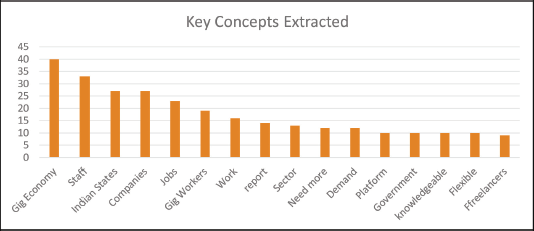
The analysis reveals themes and key concepts, which summarise their opinions. Figure 1 presents the key concepts, which are the focal points of their discussion. They have expressed their views about the gig economy and its demand, challenges and job opportunities of freelancers. They opined that Indian states need more of Gig workers across industry sectors as these staff are flexible, yet they are knowledgeable.
Furthermore, we studied the correlations between these key concepts using a concept web map, which is presented in Figure 2.
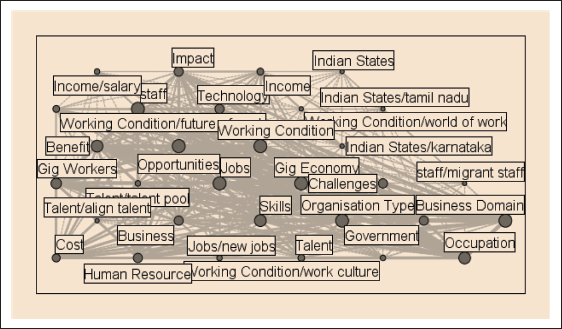
The analysis reveals that benefits and challenges, working conditions, various job Opportunities for gig workers, occupation of gig staff across organisations and business domains, and importance of technology are highly correlated issues. The major themes in their opinions are highlighted with larger bullets, and the connector lines highlight the association between the various themes.
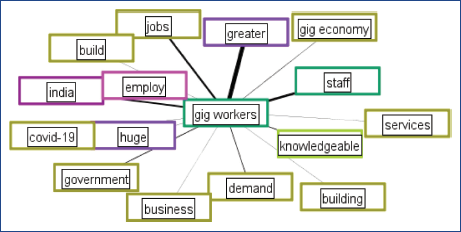
We have pulled a concept map, presented in Figure 3, with respect to gig workers, which clearly showcases the huge demand of gig economy in India created by the COVID-19 pandemic by moving multiple knowledge-based jobs and services across businesses. As expressed in the comments on Twitter:
We now present certain challenges of gig economy as expressed by the professionals:
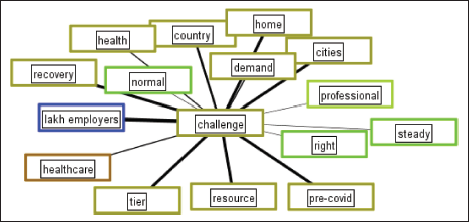
Based on the concept map in Figure 4, we can infer that the key challenge of the gig economy identified by the Indian corporates is that lakhs of employers are in need of the right professional talent, but they are unable to receive it. The current availability of resources during the pre-COVID-19 era has reduced as many workers were forced to return to their homes in tier 2 and tier 3 cities. With the country bouncing back on its feet from the second wave of COVID-19 and improvement in the health of people, the economy has recovered, things are slowly getting back to normal, and this has caused a rise in demand in cities for gig services once again.
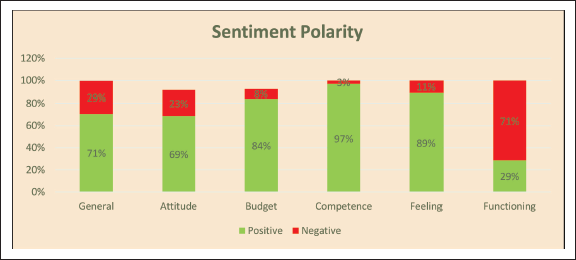
While analysing the overall sentiment of these comments, we first categorised all the opinions into six groups, including attitude, budget, competence, feeling, functioning and general.
As presented in Figure 5, the sentiment analysis reveals both positive and negative sentiments across all the groups. When it comes to the functioning of the gig economy, there are more negative than positive sentiments, while, for all the other categories, the positive sentiments outweighed the negative sentiments. This reconfirms the optimism and future potential of the gig economy in India.
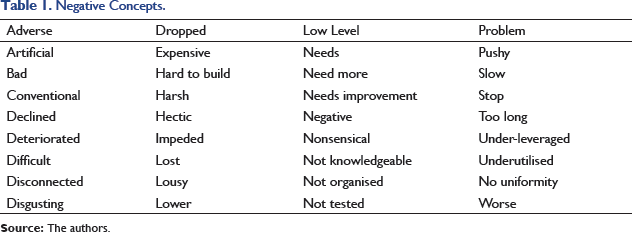
Negative Concepts.
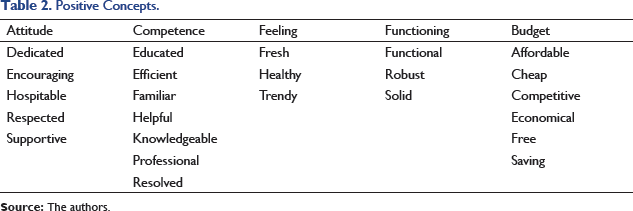
Positive Concepts.
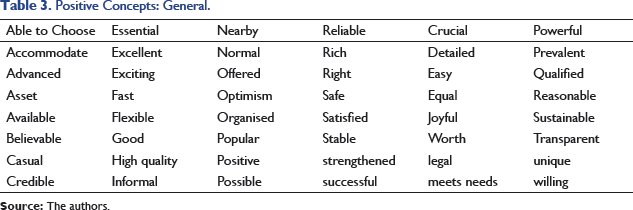
Positive Concepts: General.
The negative concepts expressed by the professionals essentially provide the challenges of gig economy and the need for such structures in India. A few of such contexts are presented as follows:
We have carried out a similar analysis for the positive concepts as well.
On a positive note, the employers feel that they can use the dedicated platforms to accommodate the gig workers into organised sector, and the workers will have access to the larger heterogeneous employment market. The firms take the responsibility to convert these human resources into an asset of the organisations. The organisations have become more profitable, using the temporary workforce hired on a need basis, saving costs for the firms. High-quality gig workers are available who are flexible. The organisations have found this model reliable, stable and successful. It is a more transparent and sustainable way of finding workers. The following comment from an executive summarises the perceptions of corporates.
At present, India has a pool of ∼15 million freelance workers staffed in projects across IT, HR and designing. In addition, India’s workforce is growing by ∼4 million people annually. And as most of them are young millennials, they are showing an increasing preference for gig contracts.
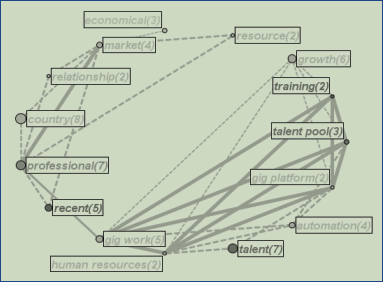
We further examined the associations between clusters of themes and opinions and the result is presented in Figure 6. We observe that country, talent, professional, growth, gig work and training are important as reflected through the size of the nodes. It is clear from the correlation cluster that gig work has got augmented with the use of gig platforms, where talent and talent pools are directly connected with the human resources of the organisations. Rise in automation has pushed up the demand for gig employment. In recent years, more countries have viewed adopting this model as it is more economical and more aligned to the needs of the market. Here, professionals are treated and employed as resources based on market demand, and there is no long-term employment relationship.
Psychological Contract Expectations and the Employment Relationship
Psychological contract is the implicit contract between the individuals and their organisation, which specifies what each expects to give and receive. It is an important tool to understand the employment relationship. When organisations are unable to fulfil the psychological contract expectations of its employees, it impacts their job performance, attendance, productivity, in-role duties, loyalty and intention to stay. Talent management and retention strategies must focus on strengthening the psychological contract, and the HR must regularly assess the changes in it (Aggarwal & Bhargava, 2009; Bal et al., 2010; Bhatnagar, 2007; Bunderson, 2001; Chrobot-Mason, 2003; Johnson & O’Leary-Kelly, 2003; Lester et al., 2001; Robinson, 1996; Robinson & Rousseau, 1994; Rousseau, 1995; Zhao et al., 2007). In the traditional contract, the employers expected hard work, loyalty and sacrifices in exchange for high pay and job security (Rousseau, 1990). Over the years, these expectations have included fair treatment in promotion, employee development and support, good management, leadership, appropriate remuneration, rewarding performance and good relationship at work (Krivokapic-Skoko et al., 2009). The expectations of the younger generation of employees in India can be broadly classified into expectations from the managers, expectations related to career growth and development, and expectations related to job and work environment (Pant & Venkateswaran, 2019).
Gig work, by its nature, is temporary and short term. Since workers come here only to perform their gig and then move to the next gig, the role of the manager will undergo a complete transformation. Instead of building long-term relationship with the employees by giving constructive feedback to the employees, mentoring and coaching them, and being friendly and approachable, the managers will have to now focus on sharing a clear role and job responsibilities, getting the work done with quality, ensuring high productivity, building accountability, safeguarding intellectual property of the parent organisation and trying to align workers to the goal of the organisation. Performance feedback will be instant and related to the technical aspect of the job. We hypothesise that expectations related to long-term career growth and development will not be very relevant in the gig economy. There will be a greater focus on the induction training of the gig workers to align them to the vision and mission of the organisation. More than technical training, training on soft skills will become the priority for the learning and development function. As far as work environment is concerned, the safety and security of the workers will still remain a priority. Challenging work may be an important factor while accepting work for high-end gig workers but not much for low- and medium-skilled workers. Gig workers will be driven by high wages, work that matches their skills sets, health and life insurance coverage, culture of respect and monetary incentives for better performance.
The gig economy has challenged the fundamental psychological contract between the employee and employer and the associated expectations. Companies will prefer workers with good credentials and references from past work history. Employers will look for commitment to completion of the task, the quality and reliability of the output and products, transparency, safety, ability to be on-demand and repeatability of the worker for tasks that require a long period of work. The households using services of gig workers will look for background checks and safety assurance (BCG, 2021).
Gig workers bring diversity to the workforce. Their needs and expectations from the organisations are different and need to be understood and respected. A study by Chrobot-Mason (2003) lent support to the idea that minority employees have unique elements in their psychological contract, with fewer promises fulfilled for them, leading to a breach of their contract, higher job dissatisfaction and lower organisational commitment. It remains to be analysed whether these differences would pose serious challenges and barriers in creating an inclusive workforce. There is a need for companies to create an inclusive environment for the independent contractors. Pant and Venkateswaran (2016) propose that understanding the psychological contract expectations of minority employees such as women, people with disability and employees from non-metro geographical background can manage them more effectively. In the same vein, gig workers must be integrated with the rest of the organisation. Companies can set up counselling, mentoring and reskilling centres to support laid-off workers and help them develop into gig workers. This will enable them to bring their full self to work and contribute to their best potential.
For a gig economy to be adopted on a large scale and to see it succeed as a stable employment model, it is important to understand the needs of the workers, the employers and the platform owners (BCG, 2021). The HR needs to be aware of these changing expectations of both these parties to be able to create relevant policies for the gig workers and successfully manage this new employment model.
Conclusion
Despite its massive potential, India’s gig economy is still at a very nascent stage. In the pandemic, due to uncertain market conditions, many companies were forced to lay off their permanent employees and hire gig workers. This has given confidence to many companies about the long-term viability of a gig workforce. India can emerge as one of the largest markets for flexible staffing globally. To unlock the potential of the gig economy in India, there is a need to understand the expectations of the various stakeholders and come up with a set of standards, inventories and registries—protocols that can be used across platforms. This will enable us to create a conducive public policy, which will ensure that the rights of the workers are protected. It will also help us innovate and use our demographic dividend globally. India has already in place some elements that are at different levels of maturity (BCG, 2021). It now requires the creation of a robust gig ecosystem where expectations of all important stakeholders, such as the public sector, government and investors, private sector, managers, HR and the gig workers, are understood and fulfilled.
Footnotes
Declaration of Conflicting Interests
Funding
The authors received no financial support for the research, authorship and/or publication of this article.
Bio-sketch
Jyoti won the Best Research Paper Presentation Award at IRC Singapore in January 2017 and the Best HR Research Paper Runner’s Up Award at NHRD National Conference, Bengaluru, 2016. She has published her research in leading international and national journals on diversity and inclusion, people with disability, millennials, regional diversity and psychological contract. She is a reviewer for reputed journals and also serves on the editorial board. Her expertise lies in facilitating corporate training programmes for multinational companies (MNCs) and reputed Indian companies like Mercedes Benz, Infosys BPO, McDonalds, Bosch India, Biocon Limited, State Bank of India (SBI), Titan Industries and Hewlett Packard (HP) to name a few. She is an alumnus of Lady Shri Ram College, New Delhi, and T. A. Pai Management Institute, Manipal.
Her current research is based on diversified areas, including knowledge management, financial management, employee engagement and consumer analytics. She has published many research papers in national and international refereed journals. She serves editorial board of reputed journals and has established herself as a reviewer of ABDC journals. She offers outstanding organisational and cross-functional leadership with a strong track record of creating business models for the organisation.