







Abstract
The article embarks upon its investigation with the help of multiple case analysis to benefit some perspectives on organisational control. It studies certain generational cohorts of employees who engage with organisations that do not represent the usual spectrum of economic interests namely government organisations. The cases belong to generations that temporally lie closer to each other and the employees have retired from service. The case analyses the perception of evolving nature of control on employees. Direction, evaluation and discipline being the three areas that are increasingly discussed in control literature, the case particularly concentrates on revelations under these focal points as it journeys through their work lives. The article unearths a curious inversion of relationship between the employee and employer on account of increasing strengthening of knowledge of the employee. It also explains the apparent hesitation/delay in adopting new and upbeat technologies largely by the government structure.
Keywords
Introduction
Control exerted by the employer/organisational structure over an organisation’s human resources as well as its interplay with agency of the organisational man have been theorised widely in industrial/organisational psychology as well as in social sciences literature. The study acknowledges the scope for more discourses on the impact of control on different types of organisational structures with multifarious ownership/interests. The impact of such exchanges on the multiple generational cohorts (employee generations that lie in close proximity with each other would be identified in the article as cohort) of human resources in diverse structures is an area that needs closer analysis too. ‘The notion of generation is widely used in the everyday world to make sense of differences between age groupings in society and to locate individual selves and other persons within historical time’ (Pilcher, 1994). However, Mannheim says,
Were it not for the existence of social interaction between human beings - were there no definable social structure, no history based on a particular sort of continuity, the generation would not exist as a social phenomenon: there would be merely birth, ageing and death. (Mannheim, 1952, p. 291)
Mannheim acknowledges that our organic existence has effects, not limited to physiology, but that which permeate the social world. This permeability could only be illuminated through a qualitative investigation—a lens the researcher adopts here.
Government-owned organisations that have a mandate for public policy making, its implementation, servicing, evaluation and maintenance are being studied here to understand the nuances of control in organisations which do not have a strict profit/economic motive. The study concentrates on exploring Government organizations which by design are less profit centric and more socially driven with a public policy mandate guiding their functioning. In such organizations where permanency of employment is binding, what is the implication of control particularly for humans who engage in work from similar/dissimilar generational spaces? Conversely, does the temporal distribution of humans across generations exert significant influence on the life and times of workplaces? The study is contextualised to the state of Kerala, India, and focuses on employees who have retired from government services. Multiple case studies were conducted to illuminate the study and its perspectives.
Theoretical Standpoints
The article explores the themes through some theoretical standpoints raised by Karl Mannheim in his seminal work on ‘the Problem of Generations’ (Mannheim, 1952, pp. 276–322) in close alignment with the paper ‘Review of Algorithmic Control as a Contested Terrain’ (Kellogg et al., 2020). This essay of Mannheim has been described as the most systematic and fully developed theoretical treatment of generations as a sociological phenomenon. It is a part and parcel of the wider sociological theory of knowledge and hence the research pivots on knowledge oftentimes. The paper seeks the lens of Labour Process theory to make sense of the problems of control, conflicts and regulation in workplaces.
Review of Literature
Organisations and Control
It has been widely discussed in literature that humans have a strong tendency to control the environment within which they are located: ‘Man’s primary motivation propensity is to be effective in producing changes in his environment. Man strives to be a causal agent, to be the primary locus of causation for, or the origin of, his behavior; he strives for personal causation’ (DeCharms, 1968). Similarly, Adler (1930), Zimbardo and Miller (1958), and White (1959) vouch for such an impact that an individual seeks to exert over his environment. Although the causative factors are unclear, largely theories have been developed from assumptions rather than empirical evidences in many cases (Rodin et al., 1980). The literature revolving around industrial/organisational psychology on control dynamics in organisational settings speaks also of the effects of control on psyche of the employee actors. One such effect is alienation about which the work of Blauner (1964) speaks thus:
Alienation exists when workers are unable to control their immediate work processes, to develop a sense of purpose and function which connects their jobs to the overall organization of production, to belong to integrated industrial communities, and when they fail to become involved in the activity of work as a mode of self-expression.
Control was also traditionally used in understanding its implications on task design and figured among the factors which influenced it (Hackman & Lawler, 1971; Herzberg et al., 1959; Turner & Lawrence, 1965; and many others). However, if one seeks to problematise control further in the context of its implication on work and labour, labour process theories throw some interesting light.
Labour Process Theory and Control
The labour process theory considers control as a contested terrain. Marx (1976) explains that the labour process consists of three elements: First, ‘the work’ itself, which is described and considered as a purposive productive activity; second ‘the object(s)’ on which that work is performed; and third, ‘the instruments’ which facilitate the process of work.
Labour is, in the first place, a process in which both man and nature participates and in which man of his own accord starts, regulates and controls the material reactions between himself and nature. (Marx, 1976)
Harry Braverman (1974) seems to have revived the interest in the labour process theory through his work. The work lies at the intersection of sociology and economics as it attempts to unearth the monopoly capitalism while raising concerns on the deprivation of skill in the context of ‘managerial’ processes. It became the standard text for many basic areas of sociological inquiry, including the science of managerial control. In short, labour process theorists are particularly concerned with the social relations of production and issues of workplace conflict, control and directives. This article employs its lens to explore the issues of control specifically. Furthermore, a paradigm that gets naturally touched is the implication and manifestations of control on the skill and knowledge of employee in the context of generations.
Karl Mannheim and the Problem of Generations
Mannheim posited that the problems of generations were better addressed by the sociological standpoints and readings than pure positivist or romantic historical formulations approaches. His approach is often considered the most rigorous, orderly and wholesome consideration of the nuances of generations from a sociological perspective (Bengtson et al., 1974). The most elementary facts which have guided this study, are given hereunder.
Concrete Group: Social Location (Lagerung)
Often based on vital, existential ties of ‘proximity’ or on the conscious application of the rational will, concrete groups are created for specific purposes. The family, tribe, sect can be considered as examples of such concrete groups. By a concrete group, the union of a number of individuals through naturally developed or consciously willed ties is meant. In terms of consciously willed ties, the organisation is counted as one such concrete group. Just like classes in social structures, Mannheim considers the ‘common location’ held by individuals in any structure as an interesting place to begin exploration. This also bestows economic and often actual powers to those in a certain pedestal in a structure like organisation. It is also explained that one almost always represents a certain profession or a vocation as he is constantly aware of where he lies or what is his specific location in the social structure.
The Biological and Sociological Formulation of the Problem of Generations
Merely categorising humans belonging to similar year of birth wouldn’t suffice for a robust observation in a socio-historical analysis. The social interaction between human beings at any point in time is equally important to understand the continuum in which an individual lies when born in a particular era. ‘The sociological problem of generations therefore begins at that point where the sociological relevance of these biological factors (like birth, aging and death) is discovered’ (Mannheim, 1976).
The Tendency ‘Inherent In’ a Social Location
‘The concrete form of an existing behaviour pattern or of a cultural product does not derive from the history of a particular tradition but ultimately from the history of the location relationships in which it originally arose and hardened itself into a tradition’ (Mannheim, 1976).
Globalisation, Algorithms and Control
Some readings from Kellogg et al. (2020) were adopted to further extrapolate the sociological angle into the questions on newer forms of control. The authors say,
Based on a detailed review of algorithmic studies, we argue that employers can use algorithms particularly to control workers through six main mechanisms, which we call the ‘6 Rs’ Edwards (1979): employers can use algorithms to help direct workers by restricting and recommending, evaluate workers by recording and rating, and discipline workers by replacing and rewarding.
‘In this view (of labour theorists), control is a dialectical process in which employers continuously innovate to maximize value captured from workers and workers inevitably engage in resistance to maintain their autonomy, dignity, and identity’ (e.g., Edwards, 1979; Jaros, 2010; Thompson & Van den Broek, 2010). The paper explores traditional and bureaucratic forms of control and in their context point out to the algorithmic form of control as well as its implications for workplace.
Conceptual Framework for Analysis
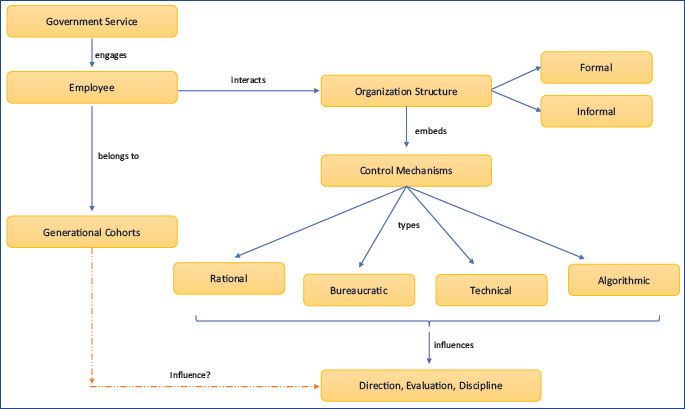
Problem of the Research
Often the mechanisms of control (formal/informal) are considered as machineries to direct, evaluate and discipline employees. The extremity of disciplining entails layoffs or termination. However, in Indian government service, permanency of employment is the hallmark of the nature of engagement. Of course, in extreme disciplinary cases, termination would be resorted to. However, largely permanency of employment until superannuation is a policy cover ensured by the service. In such a context, how do control mechanisms work or impact across generational cohorts and how does an employee understand control?
Research Design: Case Study
This study employs a multiple case study approach to learn the operational relationships of the themes over a period of time. There seems to be an embeddedness of the phenomena under study (control) and the context (government employees of certain generations) within which the phenomena is observed. Case studies are empowered to bring out the nuances through reflexive narratives of the actors that are learned from the original environment. The case studies focuses on primarily building a historical sketch of the work life of the veteran employees. Mannheim’s approach would come in handy when drawing inferences on the social being of the actor under study and the acculturation which would be a hallmark for generational study. It specifically brings out visions of the direction, evaluation and discipline that were enabled by the work environments.
Broad Research Questions
The article specifically works on a following questions:
How do employees of similar generational cohorts perceive control in the context of government service? How do these thoughts modify/alter/change over time? How do they envisage the traditional/established forms of control (rational, technical and bureaucratic) in contrast with the imminent algorithmic control?
Case Design: Theory Building from Cases
During the analysis, a set of relationships on the key themes emerged as a natural outcome. This when observed closely pointed in the direction of a plausible theory too. Further the strength and merit of approach was revealed by the seminal paper of Eisenhardt and Graebner (2007). Building theory from case studies involves using cases to ‘create theoretical constructs, propositions and/or midrange theory from case-based, empirical evidence’ (Eisenhardt, 1989). It is also meaningful to note that theory building serves as a well-formed bridge from robust qualitative substantiation to deductive reasoning. Since it is a theory-building approach that is deeply embedded in rich empirical data, building theory from cases is likely to produce theory that is accurate, interesting and testable. Thus, it is a natural complement to mainstream deductive research.
The broad questions of the research were used as pointers to gain insights from the cases. They were allowed and motivated to share their life as well as work story in a free-flowing manner. The researcher did not interrupt the narratives and sometimes asked follow-up questions. The inferences from the case discussions were manually coded, and critical insights were categorised into buckets of information. They were then interspersed in the article with reflections from theory to add to its robustness. Soon a basic theory was derived, and this could be further explicated with empirical evidence to add more meaning to the study.
Background of the Cases/Rationale for Studying These Cases
The cases that are being illustrated in the article have a few similarities as well as dissimilarities which are of critical importance to the study. The cases identify themselves as government servants who after over 30 years of service have retired from their respective positions. Both the cases belonged to closely associated generational category and were more or less similarly affected by the historical events. The generational limits could not be set on any particular pointer and hence they could loosely form a similar socio-historical timespan.
The two veterans were part of a bunch of pathbreaking changes in the government administration. The first major implementation was that of computerisation wherein computer education and its regular usage in day-to-day affairs was mandated by the government for all its employees. The next critical transformation was triggered by the digitisation campaign wherein they were inducted into the usage of e-governance software and e-modules. For both the employees, this government service was either their first or second job. They grew more or less with the system and adapted to the changes which were being hurled at them. They were both appreciated with meritorious service upon superannuation.
While trying to pin their location in the socio-historical perspective as propounded by Mannheim (1976), it is interesting to note that they began careers within a gap of 5 years and was more or less accustomed to similar systems and processes. Their location within the structure of government service was however different. One rose to the rungs from the clerical position (hereinafter referred to as Case A) to later head the respective administrative department of the institution while the other was part of senior administration who reported to senior administrators of the district/state even quite early in the career (hereinafter referred to as Case B). While one was largely limited to the institutional contours with sufficient bureaucratic powers at the promoted designations, the other had access to multiple stakeholders, had powers litigative as well as legislative powers and were answerable to general public all though the career. The nature of their vocations, hence, were different although they were largely bound by the governmental service rules of the state. Their personnel records, individual progress charts, performance appraisals, and salary- and entitlement-related notifications were however central and guided by the state government circulars issued from time to time. Although administration is the larger ambit under which both cases belonged, Case A was part of the institutional administration of state government’s medical colleges with network across the state while Case B was part of rural administration department of the district/state.
The consultative capacities of the roles also pin their locations at different spaces. While Case A had limited consultative capacity, Case B was widely acknowledged to be a resource person and a credible source for niche knowledge on rural development. This may also be owing to the fact that general administrative prowess often is treated ‘inferior’ to core hands on experience in identified themes.
The Detailed Narratives and Analysis
Interviews were individually conducted with both the veteran employees and their inferences were noted in the form of running narratives.
Narratives of Case A
Background
Case A largely began the monologue by sharing the life that was being led before the attainment of the employment and how that meant a lot to the family as well as personal confidence. Case A was a graduate and had applied for the state government service with the confidence from the spouse. The spouse nurtured the individual actor to gain sufficient knowledge and confidence to finally attain selection into the service. The pattern and nature of working changed over a period of time and with promotions coming the way of the employee, responsibilities were galore. The case notes ‘the kind of impact the work had on others also changed over time’.
Direction
After several years of service, promotions in service were attained by the individual and the responsibilities changed from clerical to managerial. It was at this juncture that the individual attempted to forge a path within the existing structure to manage or have fair control over at least parts of work. Bureaucratic control can lead workers to feel as if they are in an iron cage—a technically ordered, rigid, and dehumanised workplace (Weber, 1968).
When trying to understand the location of the individual in the structure, it is interesting to note the journey of the actor from one layer to another thereby being allowed more decision-making capacity. Case A notes thus:
I knew that I need to represent a set of values if I want them in place in my office. I worked on punctuality and ensured timely arrival of manpower, disposal of work files and institutionalised a cordial work engagement with polite exchanges. I had to be the role model and that worked well.
With fair bit of technical control exercised on the employees, the actor ensured that everyone was on the same page. There was some sense of reflection of fairness and how control was delimited with this value. With the change in location of the individual in the structure, the nature of manifestation of bureaucratic control changed too.
When asked about what creativity means in the organisation of engagement, the Case A believes in ‘being able to do something different each day within of course the constraints of the rules we have to abide by. If there is no scope to reinvent our day to day working, creativity would be out of question, and we will fail to find work exciting. Our generation is happy with the stability Government service provides but we always fight our way to doing things our unique way’. Within the boundaries set by the work environment, the actor seems to have found a way to embrace creativity. The meaning of creativity is apparently different for different generations and here the continuous engagement in a stable employment is of prime importance.
Evaluation
When asked about how their performance at work was evaluated and the implications of that on their career, it was explained that the state government service rules was the overarching methodology document on which they relied. It was also discussed that the greatest challenge in understanding rules is its uniform interpretation. Often the training programmes were not as effective as peer-to-peer learning opportunities. This helped the individual actor gain insights and utilise those skills regularly at work.
The employee notes that the peer pressure was pretty high enough to ensure fairness and often the control exercised by the senior actors was negligible. Although there was scope for technical control in the form of punching system of attendance, often the employees organised to campaign for flexible considerations here and there. A powerful parallel social system developed within the walls of the organisation ‘ensured dignity that is due to every employee’, says Case A.
The performance appraisals were not even considered a major exercise by the employee. When asked about the experiences, it was quite vocally stated that ‘appraisals were controlled and moderated by several layers of seniors. This helped us have enough cushion as we worked upon ourselves and represented our concerns to powerful senior machinery’. It was also described that ‘unless you vehemently pursue mischief, appraisals would never be a horrific experience’. Even when found guilty, the mechanisms allowed sufficient opportunities for representation which helped in employees getting a fair chance to present their side of the issue.
Discipline
The disciplinary mechanisms were a serious affair as the social pressures attached to falling into the radar of vigilante was not taken lightly. ‘The best and the worst part of state government service is this – your reputation goes before you. You need to have a strong reputation to get into positions that are part of your ambition. Even a wrong allegation could prove to be detrimental’ says Case A. A major concern was not in ensuring someone followed the regulations in letter and spirit but in being caught red handed. Discipline was a non-negotiable for the system and it could have repercussions for the future of employee.
It was also understood that political intervention from parties was a regular affair and one’s affiliation counted equally as pure merit. Every position had a stake-holding group who were attached to politics, and they almost handpick the actors who could be taken into certain positions. This proves to be a highly sensitive arena and definitions of discipline is quite different for different designations. ‘Discipline would mean sometimes agreeing to the political agenda or else there could be repercussions’. The actors seemed to be disciplined into a micro-structure which exists within the large formal structure.
Impact of Computerisation and Digitisation on Control Perspectives
Case A said,
Somewhere in the mid-1990s, computers came to our lives with a bit of worry for everyone. There was mass upgrading expected and not many were well versed with its operations. It was like a huge mountain that we had to scale. We were not sure where to start.
It was at this juncture that the state government understanding the challenges being faced by the employees launched a mass computer literacy campaign. Resource teams were identified in each district who were first trained (training of trainers) and then deployed into respective offices. The control mechanisms were hard to understand at this phase and the employees were focused on knowledge upgradation. Upon attaining the basic skills in managing computers, specific assignments were expected to be routed through ‘computer experts’ who were deployed in offices. These experts worked closely with the employees to manage their skilling and also helping them with preparing drafts, emailing them and receiving communication from their head offices which were geographically distant.
Soon, upon skilling themselves, the employees gained control over the knowledge that was then new and upcoming. With increasing familiarisation, they attempted to unleash creativity and became educators to the inexperienced employees. This snowballing of knowledge was promoted and facilitated by the structure too. ‘I felt it challenging to understand computers just because of a mental block that it was a threatening equipment. Soon, with several rounds of sessions and hands on work, I felt that I could try and draft a letter or two’. Those who had attained excellent skills in computers soon became something like a critical resource person for everyone in the picture. ‘And the stances of junior positions being submissive to seniors was non-existent. It was about who knew what and that moderated our behaviour’. This seems to reflect Mannheim’s (1976) identification that generational location was a key aspect of the existential determination of knowledge.
After about 20 years, the digitisation campaign was again launched by the state government.
This time, the same generation which once protested against Computers was welcoming the change that was being implemented. People, by now, knew that it was important for all of us. I think mobile phones have really helped in understanding that applications are not as difficult as one thinks. I tell my juniors to have an open heart. That’s all that matters.
Narratives of Case B
Background
Case B is a reflection of approaching control from a slightly altered dimension. The employee who forms Case B helped understand the manifestations of control at a different location in the governmental organisational structure. The managerial position of the employee and the relatively higher length and breadth of responsibility seems to pivot on a slightly different angle of control and its implications. Moreover, the organisational cultural contexts within which the narrative was embedded brings a fresh set of inferences on the ways in which the employee actors find their way through control mechanisms. Here the stakeholders of Case B are wider and numerous. This leads to the creation of multiple instances of power and powerlessness which could be felt across the lifetime of the employee thereby altering his conceptualisation of control. The value system of the employee also helps to unearth rather insightful observations on the ways in which governmental mechanisms exert their influence on the employee.
Direction
The directives of state policy are clear on the administrative rules and regulations to be followed by the employees. The handbook called Service Rules comes handy for individual actors to streamline their assignments and responsibilities. Having said that, the rules have been refined and finetuned to suit to the needs of the contexts in which they are depended upon. It was also interesting to note the range of state-sponsored training programmes that are made available for the employees to groom their careers. Case B, during a stint on deputation at a World Bank project, remembers the pan-India field studies and analysis which enabled their learning as programme heads of the district. Thus, they were skilled sufficiently to do justice to the assignments which were being given to them.
It is also important to understand that the induction/orientation for employees happen at a later stage of their joining and hence they are often guided by peers and seniors on the assignments. Decision-making and that too really quick decision-making is expected by citizens who approach them with their requests. This is facilitated by the expert manpower in respective offices who through socialisation agrees to guide the employee. ‘The equations are to be attained early on to ensure the activities happen smoothly in the office’, reflects Case B.
Evaluation
Performance appraisals and confidential (CR) are initiated and maintained to appraise the performance of employees, formally. Key resource persons in offices also serve as informal performance evaluators, and they tend to have an influence in helping to groom the junior manpower who join the system. They constantly guide, evaluate and give feedback on the efficacy of contributions made by a junior employee. This also helps one in aligning quickly to the broader expectations of the employer. ‘Earlier generations of employees took CR very seriously. There used to be interventions, local protests and strikes if good rating was not given to the employees’. This brought in additional weight on the shoulders of the evaluators who would not want to irk anyone in the system. This led to some form of dilution of performance appraisals and reduced the pressure on it as the sole way to evaluate performance. However, CR’s are considered very important and carries importance especially when it comes to inter-departmental transfers or movement of employees.
A factor that gets reflected in Case B, just like Case A, is the idea of reputation. Case B mentions that he received several intra-/inter-departmental transfers solely on the basis of the high reputation he had at all times.
We are certainly being watched; the sooner we realise the better. The way I speak to my colleagues, the way I manage work, the way I manage conflicts and other issues forms impressions in the minds of powerful employees who report about the character of us to Senior Political leaders who influence posting and transfers. The ethics that we hold goes before us and hence it becomes easy even when you join a new office. They somehow know a bit of what you stand for.
Reputation also has a very sacred connotation as it is often jointly evaluated by a group of people who are influential/senior or even juniors to the employee under discussion. This establishes ‘credibility’ and also helps to have a smoother manoeuvre between transfers/postings.
Another factor that evaluates performance is the kind of conflict resolution an employee has managed while in a certain designation. Information of this sort also gets circulated like wildfire and often almost all closely linked within the department would be privy to this information. In the same way, conflicts with political parties or ideologies are also evaluated constantly and there is no one judge largely. This seems to look like a very rudimentary 360-degree informal appraisal system which carries importance during the life span of employee. It also, thus, regulates/moderates employee behaviours more powerfully than the regular appraisal system in place.
Discipline
The employee actor reflects upon how discipline was largely a non-negotiable. Insubordination was the mostly commonly found form of resistance to disciplining measures.
Most of the young officers are well versed with the repercussions of lack of discipline and hence the efforts to be made to streamline their thoughts to the systemic interests are minimal. There are however instances of abuse of power and resultant insubordination which are dealt with the help of Departmental disciplinary procedures.
‘In good many inferences’, the employee reflects ‘the assignments of two subordinates are designed to not coincide unless they are working on a high magnitude event like Integrated Rural Development programme (IRDP), Elections or Census and the like. Even if they are stringed into a process, we assign them ownership over different parts of the process which ensures autonomy as well as accountability’. This effort has also helped minimise the need for external peer intervention except in case of very challenging contexts.
Case B, just like Case A, reflects how political intervention is a reality in local state government administrative departments. ‘I have been transferred in service several times owing to misunderstandings or contrasting ideological affiliation. Whenever there is a change in the ruling party at the state level, we see its ripple effect on the local offices too’. However, although political interventions are a reality, employees find a way to marry interests and manage their work lives. The control exerted by the bureaucracy is hence acknowledged, and the employees work around the ways to have a win-win equation.
Impact of Computerisation and Digitisation on Control Perspectives
Both computerisation and digitisation campaigns (read the narration of similar header by Case A) of the state government was considered highly influential by Case B. Case B also remembers how the local technology experts were approached as resource persons to guide the employees within each local offices to attain computer literacy. ‘The computer literacy programmes were a struggle, in comparison to the digitisation campaigns. By the time digitisation came in, people became aware of the basics of computers and how it can be a very user-friendly tool’. The initial hesitance to technology upgradation was also owing to the fact that computer was a strange device. However, when digitisation was launched, ‘people were already familiar with laptops, tablets and mobile phones’. The hiccups to understand the new usage of technology in regular office work was there. However, it was smoothened with the help of younger generation of employees who were well located within the structure now and they became for others.
Inferences and Theory Building
Eisenhardt and Graebner (2007) asserts in their paper:
The central notion is to use cases as the basis from which to develop theory inductively. The theory is emergent in the sense that it is situated in and developed by recognising patterns of relationships among constructs within and across cases and their underlying logical arguments.
The attempt hereunder is to develop an emergent theory which could help understand the themes of generation and control better.
The cases that were analysed belonged to closer lying generational cohorts with social-historical lives coinciding often. Their perceptions on control were reflective of a generation that transitioned across multiple landmark changes in the history of the country. While they witnessed globalisation in their mid-careers, they also experienced the technological upgradations which were a hallmark of modernisation of techniques with objectives of enhanced work efficiency. These generations thus locate themselves in similar places in the temporal distribution. Hence, illuminating perspectives from their work-lives has proved to be important for the study.
The traditional forms of control speak about employer–employee equations and how that remains sacrosanct over a period of time. Some of the reflections from the research point out to a mediation by skilling/knowledge on the employer–employee control relation. In one of the discussions, Case A speaks thus:
The seniors were depending on me to get their work done. With good experience in the system, I told them the history of a problem and how similar problems were dealt with previously. I brought them information on what could potentially go right or wrong in a certain scenario.
It was also surprising that the relationship has started to pivot to a certain unique direction over a period of time. Increasing familiarity with the knowledge resources that a structure held within it often bestowed rational powers to the employees. Case B reflects thus:
My senior consults with me to understand the issue at hand better. Also, he realises that soon I will be in his chair and maybe he may need me later for some other work. I, in fact have saved many of them from troubles by giving timely information on legacy data.
This also reveals a certain direction which was being given by the employee to the seniors in a system who are almost representative of the interests of the ‘management’ in management literature parlance.
Here, the relationship seems to invert itself and hence it is imperative to analyse the government-owned system a bit more closely. Although there seems to be rational, bureaucratic and technical forms of control ensured by policies and regulations, the employees seem to balance the control by attaining powerful knowledge which enables them to have an upper hand. When asked about what goes well for them, both the cases reflect in unison: ‘You do your job and I do mine. The boundaries are pretty clear’.
The employee seeks to exert control over the mechanisms which are embedded in the structure. The control mechanisms soon turn into a myth as the employees attain a sense of enhanced power over it. This also could be a reflection of the characteristics of the generational cohort too. With pathbreaking changes on their regular ways, they must have been forced to be more receptive of the changing environments they were engaging with. This could also be true when one considers their desires to inherently gain control over their immediate environment. It is accentuated by knowledge and the possibilities it has brought for the employee actor. Mannheim points out that social class, location and generation as the greatest determinants of knowledge. It is very well resonated in the insights of the study wherein one is bestowed with access to certain types of knowledge on the basis of their rung in the larger system. It was also pivotal to note the contribution of knowledge as the basis for inversions on control.
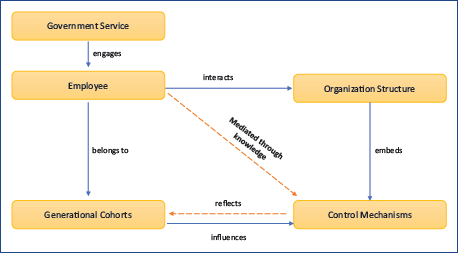
Employees tend to seek opportunities to be the directors of their own actions and hence often the feelings of surveillance are not taken very kindly. The thin boundary between feeling dehumanised and empowered is seemingly managed by this inverting equation as it gives space for multiple voices to exist. The employer tends to increasingly depend on these voices while making important decisions on policy and large-scale decisions. The loss of individuality, autonomy, and a lack of individual freedom (e.g., Whyte, 1956) simultaneously get effectively addressed by the inverse relationship that gets created.
This enables us to form a basic theorising of the conceptual frame that is emerging from the study.
Thus, the midrange theory that is developed from the case could be articulated as: With the certain generational cohort of employees (under study) gaining knowledge and growing in a structure, there seems to be an inversion of control dynamics leading to a toppling of the traditional forms of control. Employees in their attempt to control their immediate environment, seems to circumvent the control mechanisms established within the organisation’s structure.
Some of the concerns the employees had on algorithms was the lack of scope that it had to reverse this employer control over employee. They felt algorithms to be restricting because they could never control its nuances at any stage of engagement. Algorithms were considered more linear and the hope the employees have of engaging with workplaces which are more secular and flexible is out.
In particular, the connections between algorithmic systems and the data they draw on have become more complex over time. The algorithmic systems are not merely encoded with technical information embedded through rules and routines; instead, algorithms are often created and implemented based on the interests of powerful actors. The face of this unknown behind the codes which guide their work lives is one of the fears of the employee. Algorithmic systems will then continue to remain contested instruments of control until mechanisms to ensure its fairness and increasing participation of large number of employees who are affected by it are brought to existence.
Some further questions would be to understand if the nature of employer and employee relations have been similarly captured and felt by multiple generations of workers. There could also be questions on whether such phenomena repeat itself over a period of time regardless of generations within organisation structures that are similar. What could be some of the reasons for resistance to change and can that be ascribed safely to the premises of control and knowledge ownership?
Footnotes
Declaration of Conflicting Interests
The author declares no potential conflicts of interest with respect to the research, authorship and/or publication of this article.
Funding
The author has received no financial support for the research, authorship and/or publication of this article.