







Abstract
The article proposes a framework to redefine wealth management by replacing its underlying anthropocentric ethos and perspectives with divine ethos and perspectives. A multidimensional divine perspective of wealth as enunciated in the Ashta Lakshmi (eight forms of wealth) concept is examined to address the challenges posed by the wicked problems humanity is encountering. The article elucidates the correspondence of the framework with sustainable development goals (SDGs) and brings out the nuances of the Dhana Lakshmi (monetary wealth) obsession using the lens of Trigunas (primary three attributes/qualities of nature). The article further provides a phased approach to Ashta Lakshmi balancing and looks at Business Responsibility and Sustainability Report (BRSR) Principles which are interdependent and provides a mapping of BRSR Principles with SDGs and correspondingly with Ashta Lakshmi framework for holistic wealth management.
Introduction
The modern time we live in portrays a perplexing picture of evolutionary possibilities for the human species as well as existential threats to life on earth. The former is characterised by the advent of frontier approaches such as artificial intelligence, circular economy, Industry 4.0, additive manufacturing, and the like. The latter is characterised by poverty, wars, global warming, climate change, and the like. Transnational corporations and modern management practices are at the heart of this cauldron of possibilities and perils contributing to both sides of the paradoxical phenomenon.
Corporate Obsession with Monetary Wealth
With few exceptions, the global corporate scenario has been marked by an overriding focus on and even obsession with the maximisation of monetary wealth. Needless to say that this has been sought to be achieved at the cost of the welfare of fellow humans, the existence of other species, pollution and depletion of the commons, and degradation of the overall environment.
We live in a super-symbolic economy where knowledge monetisation is facilitated on an enormous scale, thus enabling more and more players to board the bandwagon of monetary wealth. As a consequence, the so-called democratisation of wealth creation through knowledge economy networks has further accentuated the fragility of human existence on planet earth.
One clear inference/lesson that could be discerned is that at the heart of ‘the tragedy of commons’ lies the obsessive worship of monetary wealth (read Money Wealth Goddess) by the human/corporate elites and a sizable majority of humankind at the expense of other forms of wealth.
How do we address/resolve this in a manner that is wholesome and sustainable?
As Albert Einstein posited, we cannot solve our problems with the same thinking we used when we created them. Hence, we need to discover or re-discover perspectives that lie beyond the confines of the modern mind.
One such alternate approach would be to re-frame/re-define wealth management by replacing its underlying anthropocentric/humanist ethos and perspectives with divine ethos and perspectives.
Why the Divine Perspective?
Divinity encompasses/permeates all living and non-living entities and also the ecology that nurtures them. Divinity by its innate disposition is plural, inclusive and equitable. It is also non-discriminant in its distribution of all natural resources to all beings including humans. ‘…the difference between divinity and humanity is that divinity seeks only to distribute, and humanity seeks only to gather’ (Walsch, 2011).
Perennial/timeless Vedic wisdom would be a rich source for unearthing a divine perspective that addresses the current corporate conundrum. This article taps into and examines the multidimensional divine perspective of wealth enunciated in the Ashta Lakshmi concept/framework to address the challenges posed by the wicked problems encountering humanity.
Ashta Lakshmi Framework
According to Indian divine ethos, Maha Lakshmi is the goddess of wealth and prosperity. As the consort of Maha Vishnu who is the god of governance/maintenance/sustenance, Maha Lakshmi supplies the operational energy/power in the divine governance of the universe.
Interestingly enough, Maha Lakshmi fulfils this important function not in a unidimensional or bi-dimensional way, but in a multidimensional manner. To be precise, the Maha Lakshmi fulfils this important operational/governance function in eight dimensions. In other words, the Ashta Lakshmi (meaning eight Lakshmis) concept/framework is an eight-fold depiction of the multidimensional manifestation of wealth and prosperity.
The eight Lakshmis are described below (Wikipedia, 2022).
आदि लक्ष्मी ‘Primeval Lakshmi’ धान्य लक्ष्मी Lakshmi as ‘goddess of grain’: Giver of agricultural wealth धैर्य लक्ष्मी ‘Courage Lakshmi’: Bestower of valour in battles and courage and strength for overcoming difficulties in life गज लक्ष्मी ‘Elephant Lakshmi’: Giver of animal wealth like cattle and elephants सन्तान लक्ष्मी ‘Progeny Lakshmi’: Bestower of offspring विजय लक्ष्मी ‘Victorious Lakshmi’: Giver of victory, not only in battles but also over conquering hurdles in order to beget success विद्या लक्ष्मी ‘Knowledge Lakshmi’: the bestower of knowledge of arts and sciences धन लक्ष्मी ‘Money Lakshmi’: for money and gold
From a corporate/management angle, the eight Lakshmis and the corresponding wealth dimensions could be broadly conceived as follows.
Ashta Lakshmis and Wealth Dimensions.
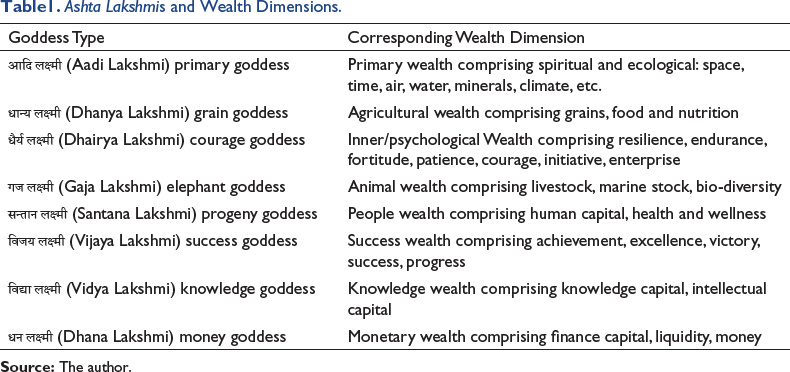
If we were to examine the framework carefully it comes across as both expansive and comprehensive in its conception of wealth.
On one hand, it encompasses the botanical, zoological and ecological aspects that support and sustain the existence of the human species on the planet. On the other hand, it includes the social, educational, organisational, managerial and financial domains of human endeavour. Curiously enough, the framework includes the inner psychological and spiritual dimensions of human experience as well.
Ashta Lakshmi SDG Correspondence
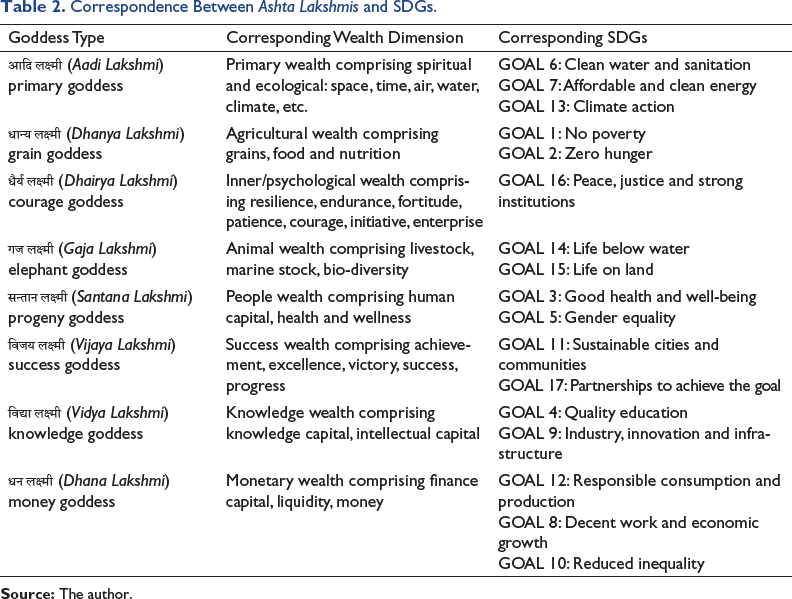
Owing to its expansive and comprehensive conception of wealth, the Ashta Lakshmi framework appears to share significant correspondence with sustainable development goals (SDGs) and the underlying wicked problems they are attempting to solve.
Listed below are the SDGs (United Nations, 2015).
GOAL 1: No poverty
GOAL 2: Zero hunger
GOAL 3: Good health and well-being
GOAL 4: Quality education
GOAL 5: Gender equality
GOAL 6: Clean water and sanitation
GOAL 7: Affordable and clean energy
GOAL 8: Decent work and economic growth
GOAL 9: Industry, innovation and infrastructure
GOAL 10: Reduced inequality
GOAL 11: Sustainable cities and communities
GOAL 12: Responsible consumption and production
GOAL 13: Climate action
GOAL 14: Life below water
GOAL 15: Life on land
GOAL 16: Peace and justice strong institutions
GOAL 17: Partnerships to achieve the goal
Correspondence Between Ashta Lakshmis and SDGs.
Ashta Lakshmi Balancing: A Harbinger of Enlightened Enterprises
As has been stated earlier the wicked problems have been primarily created by obsessive worship of monetary wealth (read Money Wealth Goddess) at the expense of other forms of wealth by the human/corporate elites and a sizable section of humankind.
Hence, the way out would be to embrace fundamental shifts in corporate/leadership mindsets, organisational processes, and managerial practices that foster the balanced pursuit of the eight forms of wealth in place of the unitary pursuit of monetary wealth.
For this to be undertaken one must understand the nuances of the Dhana Lakshmi obsession using the lens of Trigunas. The three Gunas are—Satva Guna, Rajo Guna and Tamo Guna. Respectively they connote luminant, kinetic and inert dispositions/qualities, which form the three primary attributes/qualities of nature.
Correspondingly, Triguna variation of the Dhana Lakshmi could be conceived as follows:
Satvika form of Dhana Lakshmi: characterised by a sustainable/generative approach
Rajasika form of Dhana Lakshmi: characterised by a consumptive approach
Tamasika of form of Dhana Lakshmi: characterised by a corrosive/extractive approach
Let us examine these nuanced forms and their planetary implications in detail.
Corrosive/Extractive Approach to Monetary Wealth
This approach to monetary wealth has been playing havoc for many centuries, especially, ever since European nations embarked upon colonial conquests across the globe. Its extractive and corrosive nature turned even destructive, culminating in the two world wars. The less said about this the better.
If we were to look at modern times with globalisation as the central theme of the world economic discourse, the extractive and corrosive nature of monetary wealth is exemplified by the military–industrial complex, pharmaceutical lobbies, fossil fuel cartels, conflict-ridden mineral extraction, greedy financial markets, and so on. What all havoc and miseries such a corrosive approach to the monetary wealth are inflicting on current generation and future generations of planetary inhabitants is anybody’s guess.
Consumptive Approach to Monetary Wealth
The consumptive approach to monetary wealth has been at the heart of globalisation with more and more people from across the globe joining the consumerist bandwagon.
Compared to the previous approach, the impact of this approach on other forms of wealth is more insidious. Consequently, this approach is causing more long-lasting damages such as global warming, ecosystem deterioration, environmental degradation, resource depletion and even species extinction.
Whether we like it or not, most of humanity is part of this problem. Many of us are unsuspecting participants either on the demand side or on the supply side. Worse enough, on both sides.
Sustainable/Generative form of Monetary Wealth
A sustainable/generative approach of monetary wealth is the new kid on the block. This approach has been seeded and fostered by rising awareness about sustainability. More specifically, the worldwide thrust around the SDGs has been at forefront of causing a shift in the corporate mindsets towards a more balanced approach to utilisation of natural resources.
Phased Approach to Ashta Lakshmi Balancing
What is the way out of the extractive, corrosive and consumptive approaches we have been used to and the consequent crises and conundrums they have unleashed?
The following phased approach could be considered for transitioning from the Tamasik and Rajasic forms to the Satvik form.
shifting away from the Tamasik form of Dhana Lakshmi (corrosive/extractive approach to monetary wealth) to the Rajasik form of Dhana Lakshmi (consumptive approach to monetary wealth, albeit, in a toned down version as responsible consumption) and eventually, to the Satvik form of Dhana Lakshmi (sustainable/generative approach to monetary wealth)
In other words, the shift would call for a phased and intentional transition from the worst form of imbalance, through moderate levels of imbalance towards balance and sustainability involving the following approaches.
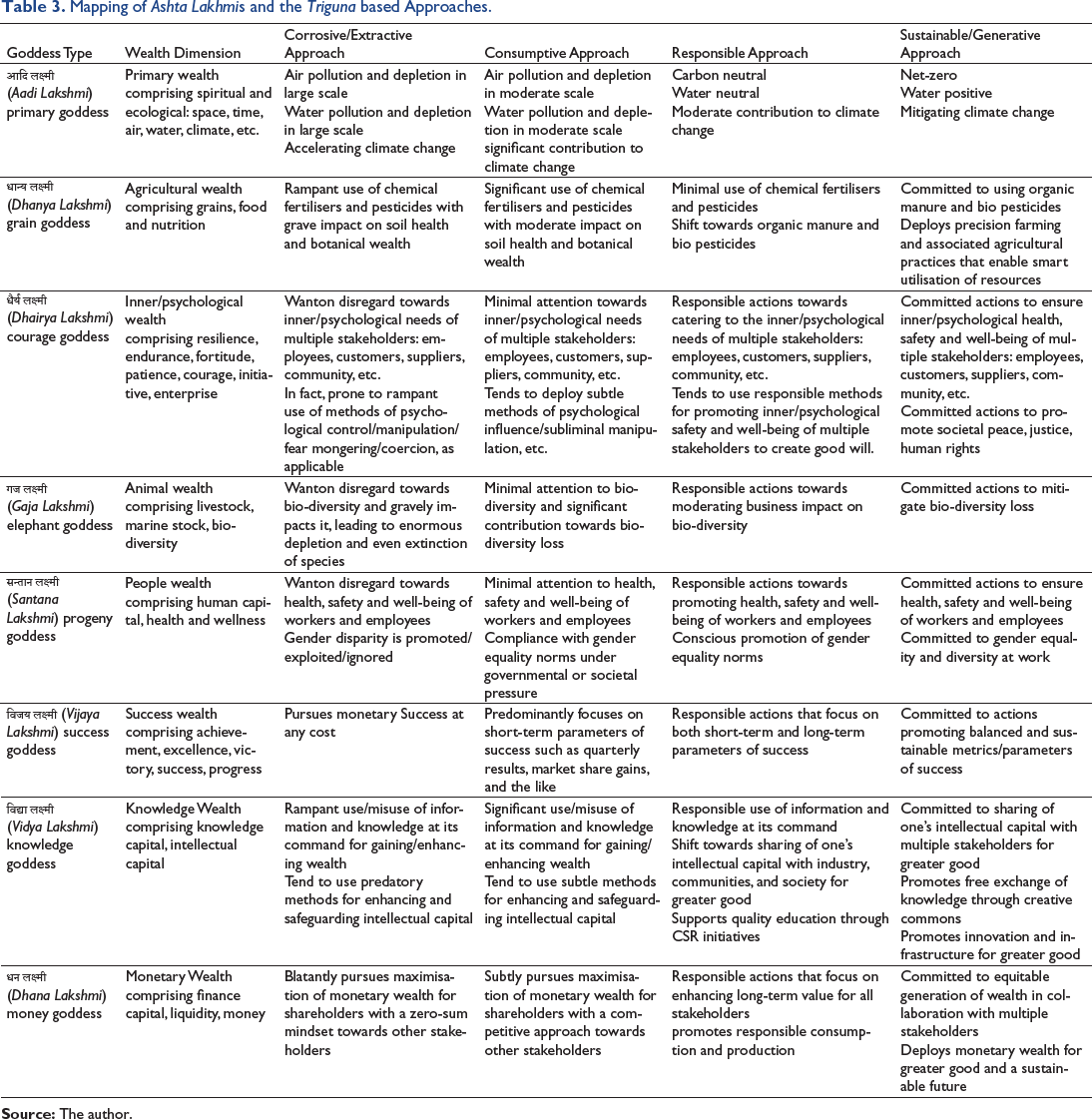
Corrosive/extractive approach Consumptive approach Responsible approach Sustainable/generative approach
The difference in the approaches is tabulated in Table 3 in a manner that highlights the varied imbalances and resultant impacts across the Ashta Lakshmis caused by the four approaches.
Mapping of Ashta Lakhmis and the Triguna based Approaches.
The Shift Towards the Responsible and Sustainable Approaches: A Snapshot
Fortunately, some of these shifts towards the responsible and sustainable forms have started. It is heartening to see that leading corporations from across the globe are adopting sustainable business practices. A couple of notable examples are.
The Unilever Compass (Unilever, 2021a) and Unilever Sustainable Living Plan (Unilever, 2021b). Tata Group’s two-tiered approach to sustainability governance through an apex level Tata Group Sustainability Council and operational level Sustainability Working Councils (Tata Sustainability Group, 2020).
Further, both global and Indian trends indicate that these shifts are gaining momentum.
According to a global level ranking, the ‘Top Ten Most Sustainable Companies in 2022’ (SG Analytics, 2022) are.
Schneider Electric, France Ørsted, Denmark Nvidia, USA Neste, Finland Stantec, Canada McCormick & Company, USA Kering, France Metso Outotec, Finland American Water Works Company, USA Cisco Systems Inc, USA
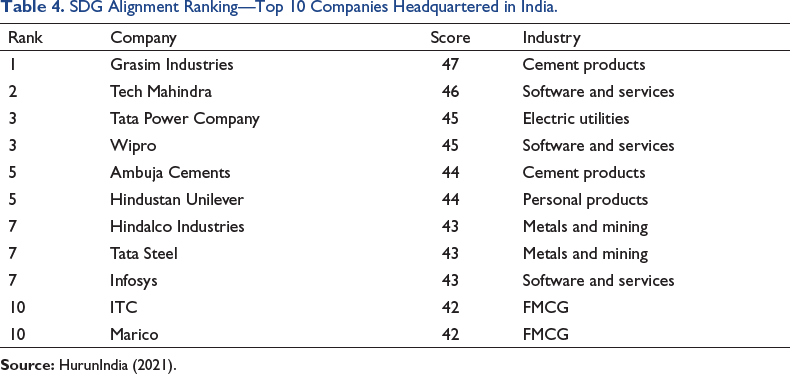
Closer home, listed below in Table 4 are the top 10 companies headquartered in India based on their alignment with the 17 SDGs (HurunIndia, 2021).
SDG Alignment Ranking—Top 10 Companies Headquartered in India.
Going beyond rankings, let us explore larger trends being reported both at the global stage and in India.
According to the KPMG Survey of Sustainability Reporting 2020, titled, ‘The time has come’, 80% of companies worldwide were reporting on sustainability (KPMG, 2020).
There exists an array of globally well-recognised sustainability reporting frameworks/standards, made available by independent third-party agencies, to enable voluntary disclosure by businesses. Listed below are a few standards based on the report of the committee on business responsibility reporting (Ministry of Corporate Affairs, 2020).
United Nations Global Compact (UNGC) Global Reporting Initiative (GRI) Integrated Reporting (IR) CDP (formerly Carbon Disclosure Project) ISO 26000 Sustainability Accounting Standards Board (SASB)
Nine principles of the National Guidelines on Responsible Business Conduct (NGRBC) have been enunciated by the Ministry of Corporate Affairs, Government of India (PwC, 2021).
These are popularly referred to as Business Responsibility and Sustainability Report (BRSR) Principles.
✓ PRINCIPLE 1 Businesses should conduct and govern themselves with integrity and in a manner that is ethical, transparent and accountable. ✓ PRINCIPLE 2 Businesses should provide goods and service in a manner that is sustainable and safe. ✓ PRINCIPLE 3 Businesses should respect and promote the well-being of all employees, including those in their value chains. ✓ PRINCIPLE 4 Businesses should respect the interests of and be responsive to all its stakeholders. ✓ PRINCIPLE 5 Businesses should respect and promote human rights ✓ PRINCIPLE 6 Businesses should respect and make efforts to protect and restore the environment. ✓ PRINCIPLE 7 Businesses, when engaging in influencing public and regulatory policy, should do so in a manner that is responsible and transparent. ✓ PRINCIPLE 8 Businesses should promote inclusive growth and equitable development. ✓ PRINCIPLE 9 Businesses should engage with and provide value to their consumers in a responsible manner.
These BRSR principles are interdependent and have overlapping correlations with the 17 SDGs.
Mapping of BRSR Principles with SDGs and correspondingly with Ashta Lakshmis would be interesting and insightful.
BRSR Principles and SDG & Ashta Lakshmi Correlations.
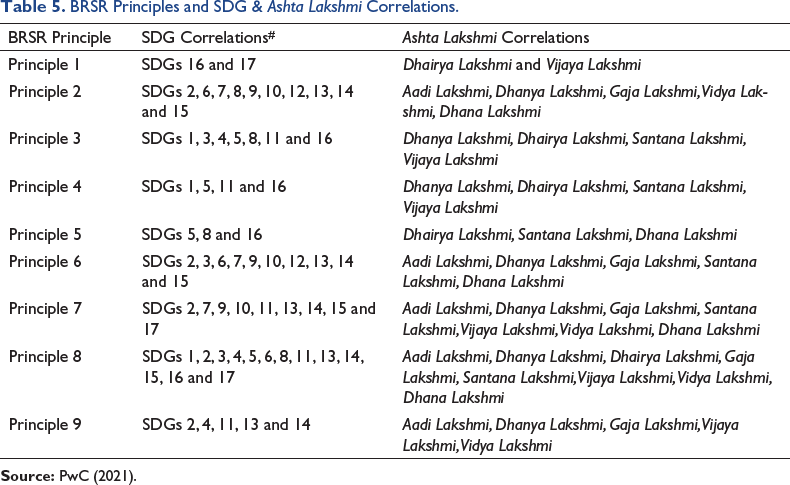
When we examine the correlations/correspondences of the Ashta Lakshmis with the nine BRSR Principles, the following pattern is discernible:
BRSR Principles Ashta Lakshmi Correlations
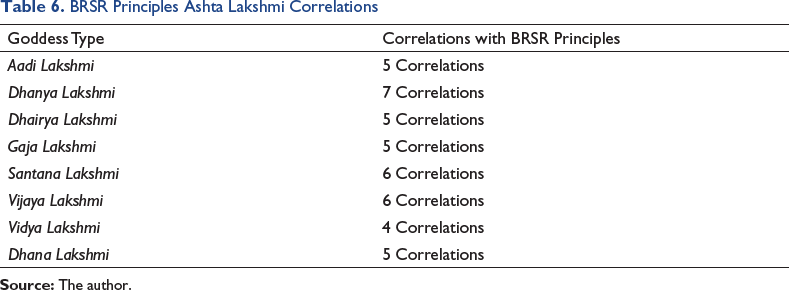
The BRSR principles comes across as addressing all the eight wealth forms in a balanced manner. Hence, we could safely infer that the companies in India will be in a position to contribute to the global efforts towards balanced utilisation of non-renewable resources available in our planet by complying with the BRSR guidelines. 1
Conclusion
The expansive and comprehensive conception of wealth under the Ashta Lakshmi framework not only provides a balanced approach for enterprise wealth management but offers a divine/inclusive perspective for holistic corporate governance as well. The significant correspondence between the eight Lakshmis and the SDGs makes it well suited to streamline enterprise efforts towards the attainment of the 17 SDGs.
The article brings out the need for more and more enlightened enterprises that embrace fundamental shifts in leadership mindsets, organisational processes, and managerial practices to foster a balanced pursuit of the eight forms of wealth. The high level of correlations between BRSR principles and the eight wealth forms makes it an appropriate template for the balanced management of enterprise wealth. Further, an examination of the BRSR guidelines using the Ashta Lakshmi framework could be undertaken to scope out the guidelines for enlightened governance of enterprises.
Footnotes
Declaration of Conflicting Interests
The author declared no potential conflicts of interest with respect to the research, authorship and/or publication of this article.
Funding
The author received no financial support for the research, authorship and/or publication of this article.