






Abstract
This article explores how emerging professionals in India are redefining career success. Based on survey findings, the study shows that career success for this cohort is progressively moving away from salary and job titles as primary indicators. Financial security remains important, scoring highest at 4.35 out of 5, but now shares equal importance with organisational culture (4.36), skill development (4.17) and values alignment (3.91) as key drivers of career satisfaction. There appears to be broad alignment between early-career millennials and Gen Z in how they conceptualise their career success. This article examines this shift and discusses its implications for HR professionals aiming to create organisations that evolving professionals genuinely wish to stay with.
Introduction
A subtle but discernible shift is underway in how budding professionals in India conceptualise their careers. Generation Z (born 1997–2012) now constitutes a large share of the active Indian workforce, while the preceding millennial cohort (born approximately 1981–1996) continues to shape organisational norms. Both groups are asking whether work is purposeful, whether organisational values align with their own, and whether the daily work experience is sustainable—questions that most traditional career frameworks were not designed to answer.
The dominant career success model for much of the 20th century was external and linear: performance and loyalty drove vertical advancement, with salary and hierarchical rank serving as both measures and rewards. Hall’s protean career model (1976) challenged this by placing individual values and self-direction at the centre, while Arthur and Rousseau’s boundaryless career concept (1996) described trajectories driven by mobility and learning rather than tenure. Generation Z has entered the workforce precisely when these theories have become actualities. In India, this transition has been especially sharp: a rapidly digitalising economy, the formative disruption of COVID-19 and unprecedented access to global career narratives have created a cohort whose career expectations differ markedly from those of earlier generations.
The Indian Context: Generation Z in Transition
India has one of the youngest workforces in the world, with a median age of approximately 28–29 years, indicating that Generation Z and younger millennials primarily shape it. Dokadia and Palo (2022) documented ongoing generational differences in career expectations, learning preferences, leadership aspirations and reward preferences within India’s multigenerational workforce, noting that Gen Z workers expect short-cycle projects, frequent feedback and lateral movement within organisations that are still governed by older norms of loyalty and tenure.
This generational contrast is layered on significant socio-economic and cultural heterogeneity. A first-generation Gen Z professional from a tier-3 city and an MBA graduate from a metropolitan centre may share a birth cohort but hold substantially different definitions of success and acceptable trade-offs. What they share is the formative experience of COVID-19, accelerated digital transition and access to global career narratives at an earlier career stage than any prior Indian generation. The current moment is therefore a productive context for studying how Gen Z specifically orients towards careers, which is the focus of this study.
Methodology
This study adopts a design that combines quantitative survey data with qualitative thematic analysis of open-ended responses. Eight career decision factors were rated on a five-point Likert scale: financial security, personal values alignment, workplace flexibility, skill development, organisational culture, social impact, geographic considerations, and recognition and prestige. Respondents also described probable career trajectories and responded to an open-ended question on what career success means personally.
The survey was administered digitally to budding and early-career professionals in India—comprising Gen Z postgraduate students transitioning into employment (65%) and early-career working professionals with 1–3 years of experience (35%). Purposive and snowball sampling were used across institutional contexts, predominantly in urban settings. Participation was voluntary, and responses were anonymised. Quantitative data were summarised using descriptive statistics. Qualitative responses were analysed thematically following Braun and Clarke (2006): initial coding, clustering into candidate themes and refinement against the full data set, yielding four themes.
Findings
Drives of Career Decisions
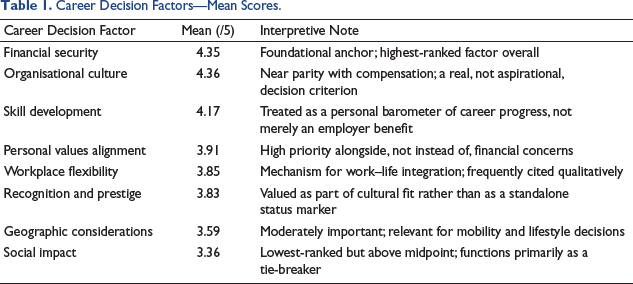
Table 1 shows the average scores for all eight career decision factors. Financial security (4.35) remains the main foundation; this group has not moved away from material concerns. The more notable finding is that organisational culture (4.36) holds nearly equal importance to compensation, serving as an active decision factor rather than merely an abstract preference. Qualitative data support this: respondents mention wanting environments where they feel respected, growth is encouraged and ongoing work pressure does not become the norm. Skill development (4.17) serves as a personal indicator of career progress, consistent with career capital theory. Social impact scored the lowest (3.36) but remained above the midpoint, serving mainly as a tie-breaker once fundamental needs are met.
Career Decision Factors—Mean Scores.
Evolving Definitions of Career Success
Table 2 illustrates the main directions in which millennial respondents report their definition of success has evolved since they began their careers. Three of the top five shifts focus on how careers are experienced rather than what they produce—a shift from achievement-based to experience-based metrics that aligns with this cohort’s values.
Shifts in the Reported Definition of Career Success.
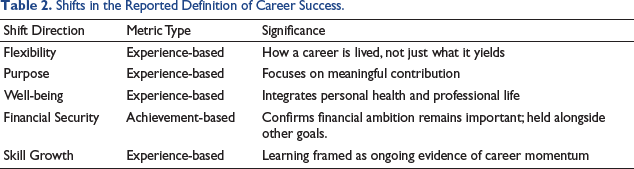
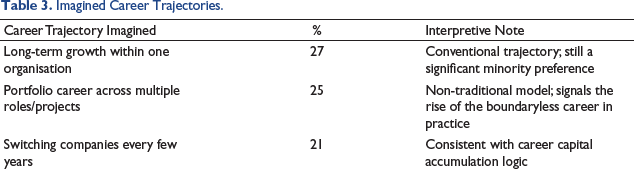
Table 3 illustrates diverse career paths followed. No single route prevails, and almost a quarter of respondents are actively pursuing a portfolio model that was rarely a mainstream choice for earlier generations.
Imagined Career Trajectories.
What Career Success Means: Thematic Analysis
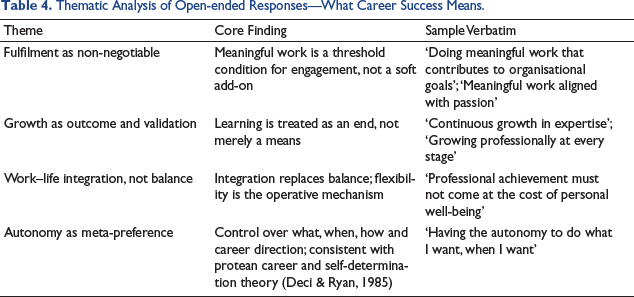
Thematic analysis of the open-ended responses yielded four coherent themes (Table 4). Career success is increasingly defined by fulfilment, which is treated as a non-negotiable condition instead of a discretionary aspect of work. Growth is regarded both as an outcome and a form of validation, with continuous learning valued as an end in itself rather than merely a means to advancement. The idea of work–life balance is being replaced by work–life integration, where flexibility enables individuals to align professional and personal domains without significant trade-offs. Underpinning all these dimensions is a strong preference for autonomy, reflecting a desire for control over work, time and career direction, consistent with self-determination theory.
Thematic Analysis of Open-ended Responses—What Career Success Means.
A Multidimensional Framework of Career Success
Drawing on the survey findings and available literature on contemporary careers, career success can be understood through five interrelated dimensions (Table 5).
Key Dimensions of Career Success.
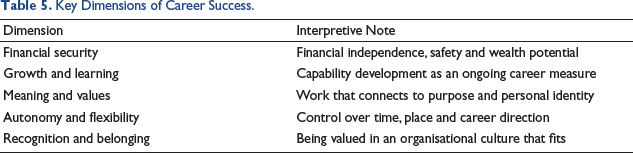
What distinguishes this framework from older models is that these five dimensions are not arranged in a stringent hierarchy. Financial security is essential—without it, the other dimensions often become irrelevant for most Gen Z professionals, especially first-generation earners. Beyond this baseline, individuals prioritise the remaining four differently depending on their career stage, personal circumstances and available opportunities. A 24-year-old Gen Z professional may focus on growth and autonomy; an early mid-career professional supporting a family might emphasise flexibility and belonging.
The key implication is clear: organisations can no longer assume that a standardised career structure will meet the expectations of a workforce that meets success differently at various life stages.
Implications for HR Practitioners
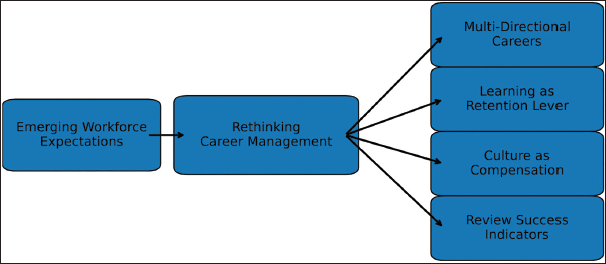
The findings point to four key implications for how HR leaders must rethink career management for the emerging workforce (Figure 1).
Conventional vertical progression does not align with how Gen Z conceptualises career advancement. These professionals assess whether organisations facilitate lateral mobility, project-based engagement and the accumulation of diverse career capital, signifying that the career lattice is a more suitable organising framework than the traditional ladder.
Access to continuous skill development is a baseline organisational expectation. Its malingering has been identified as a significant antecedent of voluntary turnover.
Adverse cultural conditions incur measurable costs in talent acquisition and retention. Psychological safety, perceived organisational support and developmental opportunity function as threshold conditions for engagement, not aspirational outcomes.
A structural misalignment exists whereby Gen Z professionals assess career success through a multidimensional framework encompassing growth, meaning, autonomy and belonging. However, organisations continue to assess performance primarily using outmoded metrics. Performance evaluation criteria should incorporate learning velocity, contribution quality and cultural alignment alongside the traditional metrics.
Rethinking Career Management for the Emerging Workforce.
Limitations
The sample was drawn primarily from urban India. It comprised Gen Z students and early-career professionals, restricting generalisation to the broader Indian workforce. The absence of a direct comparison group means that claims about generational distinctiveness rest on self-reported perceptions of change rather than intergenerational measurement. The cross-sectional design precludes causal inference; longitudinal data would be required to track how Gen Z career success frameworks evolve across career stages and life circumstances.
Conclusion
Generation Z and millennials have not redefined career success in a vacuum. It has been redefined by the conditions they entered: a labour market that no longer guarantees stability in exchange for loyalty; a digital economy that rewards adaptability over tenure; a pandemic encountered at the precise moment of workforce entry; and unprecedented access to global career narratives (Twenge, 2023; World Economic Forum, 2023). The survey data presented here represent a focused yet coherent slice of that shift. The direction is consistent: Gen Z professionals in India are moving away from external validation—title, hierarchy, institutional approval—and towards internally derived measures: growth, meaning, autonomy and the quality of daily experience. Financial security is not receding as a criterion; four equally serious dimensions are joining it. For organisations, this is not a culture change problem—it is a design problem. Career frameworks, reward systems, performance conversations, learning architectures and management practices must all catch up with how Gen Z is actually evaluating its working life. The defining career question of the previous generation was: ‘How do I climb?’ The question Gen Z is asking is: ‘How do I grow, contribute and build a working life I can recognise as mine?’ That is a harder question to design for. It is also the one that now demands a serious, urgent organisational response.
Footnotes
Declaration of Conflicting Interests
The authors declared no potential conflicts of interest with respect to the research, authorship and/or publication of this article.
Funding
The authors received no financial support for the research, authorship and/or publication of this article.