






Abstract
Careers are at a crossroads today, more than ever before; being reshaped by technological disruption, demographic shifts and evolving employment relationships, challenging traditional, linear, organisation-centric models that shape careers through individualised ownership. This article summarises the emerging themes in career management. Moving beyond the static models, careers are increasingly co-managed through the interplay of individual agency and organisational systems, requiring continuous learning, adaptability and alignment with personal values and well-being. Situated within global trends and the Indian context, careers remain socially embedded and multigenerational. This article provides conceptual insights and practical directions for how careers are evolving across contexts, enabling individuals and organisations to navigate nonlinear career paths, redesign career systems, and enable long-term employability and sustainability. Implications for human resources practice are highlighted too.
Macro Disruptions and the Shifting Context of Work
Rapid technological change, globalisation and the COVID-19 pandemic have fundamentally reshaped work and talent management, altering how careers are experienced and managed (Deming et al., 2025). In response, organisations are prioritising reskilling, digital learning and internal talent mobility, while shifting towards experiential learning, mentoring and the development of both technical and human skills. The global labour market is likely to undergo significant transformation by 2030, driven by technological disruption, economic uncertainty, demographic shifts and the transition to a green economy (World Economic Forum, 2025). Macro-trends such as changing global context, geopolitical shifts and climate change mitigation efforts are reshaping industries and job landscapes, leading to substantial career disruptions. According to the World Economic Forum (2025), between 2025 and 2030, about 170 million new jobs will be created, while 92 million will not exist. This results in a net gain of 78 million jobs worldwide. Most growth will come from frontline roles and technology-driven jobs, especially in artificial intelligence (AI), big data and green sectors. At the same time, many clerical and routine office jobs are on the decline. By 2030, nearly 40% of today’s skills may become outdated, making reskilling essential for many workers. Employers increasingly value skills such as analytical thinking, adaptability, resilience and digital literacy, while the need for manual skills is reducing. Organisations are also paying more attention to employee health, well-being and diversity to attract talent. Many employers plan to increase wages in line with productivity, even as AI reshapes jobs. Overall, careers are becoming more flexible, with greater use of gig work and sustainable career paths (World Economic Forum, 2025).
These shifts reflect a broader movement from a volatility, uncertainty, complexity and ambiguity (VUCA) 1 context to a brittle, anxious, nonlinear and incomprehensible (BANI) 2 world, characterised by fragility, anxiety, non-linearity and incomprehensibility—intensifying the need for adaptability, resilience and continuous skill renewal. Advances in AI and digitalisation are accelerating skill obsolescence while creating new opportunities, reinforcing the imperative for workforce agility and reconfiguration of career pathways. The article ‘Beyond Automation’ by Davenport and Kirby (2015) highlights how the future workforce will depend on continuous learning, adaptability and effective human-machine collaboration. Gratton and Scott 3 (2021), however, argue that people will work longer, continuously upgrade their skills, and focus not only on financial planning but also on intangible assets such as health, relationships and knowledge. The current Industry 5.0 scenario prioritises human well-being within manufacturing systems, aiming to achieve broader social goals and sustainable prosperity (Leng et al., 2022). It relates to the contemporary frameworks that emphasise self-directed, adaptive and lifelong career development. Generation Z (born 1997–2012) exhibits unique workplace expectations as digital natives, prioritising authenticity, diversity, immediate feedback, autonomy and work–life balance. The COVID-19 pandemic affected their social skills and enhanced mental health issues, leading to lower life satisfaction and heightened stress levels. They favour purpose-driven work, rapid learning, transparent career paths and flexible work arrangements, and tend to leave roles that feel misaligned with their values. Consequently, Gen Z is more inclined towards self-directed, networked and learning-focused careers, departing from traditional linear career paths (Mahapatra & Dash, 2022; Veloso et al., 2018). Career management is correspondingly moving away from organisation-driven pathways towards more flexible, self-directed models, where individuals take greater ownership of their development, and organisations act as enablers of continuous learning. AI-driven disruption is reshaping skill demands and amplifying inequalities, producing dual labour-market dynamics.
Reframing Careers in a Disrupted World
A career is a continuous journey that shapes an individual’s professional identity, originating from the Latin word ‘carrus’, which means ‘progression’. This etymology reflects the metaphor of a career as a journey or course along a path, emphasising progression and movement over time. Super’s lifespan, life-space approach conceptualises career as a combination of various roles (e.g., worker, spouse, citizen) played over a lifetime, emphasising multidimensional involvement and emotional commitment to these roles (Super, 1980). Sociological approaches integrate structural factors, such as social background and mobility, with individual agency, suggesting that careers are shaped by both personal choices and contextual influences (Ruhrort & Allert, 2021). Recent research stresses the importance of flexibility and diversity in careers due to economic uncertainty and organisational restructuring, moving away from the traditional linear career ladder towards protean (Hall, 1996) and boundaryless career models (Briscoe et al., 2006). Therefore, the concept of career also embraces the dimension of time, reflecting past experiences, current roles and future possibilities, making it a dynamic and lifelong process (Savickas et al., 2009).
Understanding career management as an evolving process reveals that traditional career theories are rooted in stable organisational contexts, assuming long-term employment and structured progression, both vertical and horizontal, within organisations. Over the years, newer generations have engaged in intelligent careers (DeFillippi & Arthur, 1994) that emphasise three keys ‘knowings’: ‘Knowing how’—the use of online learning tools to ease technology-related stress and enhance skills; ‘Knowing who’—the use of social media and networks for job opportunities and mentorship; and ‘Knowing why’—the desire for meaningful work aligned with personal values. Savickas’s (2011) 4 Actor–Agent–Author career perspective suggests that individuals shape their careers by expressing roles and traits as actors, pursuing goals and adapting to challenges as agents, and creating meaning from their experiences as authors. Contemporary career research indicates that young professionals increasingly favour non-traditional, self-managed career approaches over outdated models, emphasising the importance of transferable skills in a rapidly changing environment (Deming et al., 2025; Veloso et al., 2018). Career management involves self-reflection on personal values and skills, along with goal setting and strategising to navigate the evolving job market (Pinto, 2025).
Gen Z (Mahapatra et al., 2022; Veloso et al., 2018) emerges as the first cohort to enter the labour market fully shaped by digitalisation and AI, making their preferences, values and career behaviours early indicators of broader shifts in work and careers. More recently, individuals have begun to perceive their careers as self-directed journeys in which personal values, meaning and psychological satisfaction guide their choices, rather than employer loyalty, which reflects a protean orientation. 5 They approach career choices as evolving identity projects, expecting transparency, ethical alignment and employer support for self-directed learning and role customisation. The Gen Z workforce is also adopting platform work, freelancing and remote roles, embracing nonlinear career paths and flexible work arrangements. They leverage online portfolios and networks to enhance employability and engage in short-term developmental assignments. While they are technologically skilled in digital networking, they still need institutional support, such as micro-credentials and career services, for sustainable mobility (Mahapatra et al., 2022; Veloso et al., 2018). Herein, digital fluency as a vital career resource depends on support from organisations and educators.
De Vos et al. (2020) proposed sustainable careers, a broader integrative framework that connects protean, boundaryless and intelligent career models with long-term career well-being. Careers are best understood as evolving processes shaped by the interaction of the person, context and time, where long-term sustainability depends on maintaining health, happiness and productivity. Over time, contemporary career theory has shifted from organisation-bound trajectories to boundaryless and protean models, emphasising agency and adaptability (DeFillippi & Arthur, 1994; De Vos et al., 2020).
However, in India, careers remain socially embedded and multigenerational, negotiated amid family expectations and divergent cohort values. Baruch and Budhwar (2006) found that India’s career management systems remain more bureaucratic, collectivist and internal labour‑market–oriented than those in Britain and other Anglo‑Saxon economies, where careers are more individualistic, flexible and market‑driven. In contrast to most Western research on ‘new’ careers. Baruch et al. (2020) found that protean and kaleidoscope career orientations meaningfully predict Indian graduates’ employability and expected salary gains, extending contemporary career theory into a Brazil, Russia, India, China and South Africa high-power-distance context. Interestingly, Kumar and Devi (2025) observed that in India’s crowded management education market, institutions that offer structured career planning, mentoring and skill‑building activities produce graduates who are noticeably more confident, adaptable and employable than those relying solely on academics. Psychological resources such as resilience, adaptability and self-efficacy are critical for building sustainable careers in India’s complex and evolving context.
No doubt, continual skill updates, next-level digital literacy and human-centred skills such as creativity and emotional intelligence emerge as critical life skills. Balancing mobility and stability, ensuring mental well-being, and committing to continuous learning are vital for career fulfilment. Organisations, on the other hand, would need to rethink career management systems to accommodate nonlinear career paths, integrating project-based assignments and reskilling initiatives while focusing on diversity, inclusion and employee well-being. Cultures that promote experimentation and psychological safety further enhance adaptability to technological change. Human Resource Management would need to support career development through personalised pathways, integrated digital learning and flexible work arrangements. Continuous upskilling and career coaching are emphasised to meet generational expectations.
The Evolving Careerscape: A Conceptual Model of Careers as Co-managed Systems
In a rapidly evolving context, especially in India, career paths are increasingly seen as dynamic journeys that require continuous reskilling and networking. Organisations must therefore redesign career systems to foster flexibility, inclusivity and long-term employability, thereby supporting meaningful and resilient career paths in the complex global labour market. The authors propose the notion of an evolving careerscape, a dynamic interplay of individual agency, organisational systems and macro forces that maps macro-level technological and socio-economic changes shaping emerging workforce expectations. The conceptual model emphasises that individual psychological resources and organisational career systems jointly influence career outcomes. Employability, satisfaction and long-term career sustainability emerge as key themes. The transition from traditional to contemporary career paradigms requires individuals to actively manage their career development as ongoing, adaptable processes rather than as milestones. The framework is given in Figure 1.
Career Management: An Overview.
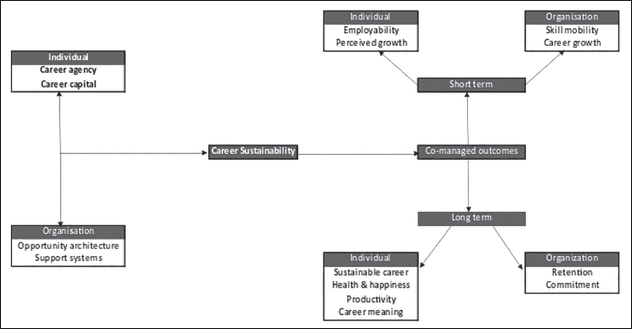
The model elucidates that careers today are produced through a co-managed cycle between individual career agency and career capital, and the opportunity structures and support systems provided by organisations, both under pressure from macro shocks, while retaining career sustainability as the criterion across time. Career agency and career capital are enabled through protean values-driven self-management; boundaryless mobility, supportive networks and cross-organisational movement; intelligent career capital drawn from know-why/know-how/know-whom; alongside psychological resources: agility, resilience, self-efficacy and emotional intelligence. Organisations, on the other hand, provide supportive opportunity architecture by activating internal talent markets/internal gigs; providing career pathways that are more lattice than ladder, enabling project-based moves; providing continuous reskilling infrastructure, mentoring and coaching; and, alongside inclusion and well-being policies, sustaining engagement and physical as well as psychological health. Together, career sustainability is nurtured. However, the degree to which organisational opportunities activate individual agency and capital, and the extent to which individuals can fairly access them, benefit from feedback and gain mobility, determine the success of co-managed careers.
The output has both short- and long-term career implications for the individual and the organisation. Short-term gains for the individual ensure employability, skill velocity and perceived growth, while the organisation gains from active engagement. Long-term benefits for the individual translate directly into nurturing sustainable careers that lead to health, happiness, productivity and, most importantly, career meaning. For the organisation, the gains are retention and commitment. Together, while individuals benefit from confidence, identity and future agency, organisations redesign systems using data on mobility and attrition, and are better able to bridge the ever-evolving skills gaps. Individuals and organisations are thereby better equipped to deal with VUCA and BANI. Alternatively, organisations can work with the next order of change that the environment demands of careers, as both self-managed and organisation-supported.
It is evident to us that macro disruption increases the value of co-managed careers, in which job roles shift as rapidly as the skills needed, and careers become sustainable only when agency and opportunity architecture align. Organisational systems amplify individual capital, such as internal gigs + reskilling, accelerate ‘know-how/know-whom’, improving employability and retention.
Finally, for us as researchers and practitioners of career management, it is in flux. Well-being and inclusion are being positioned as add-ons in many reputable organisations. Instead, we strongly believe that they are systemic conditions for sustainable careers in longer work lives and continuous, ongoing transitions. The human resources (HR) professional, with the support of their respective organisations and other stakeholders, could play a significant role in career management for organisations and help individuals as well.
Footnotes
Declaration of Conflicting Interests
The authors declared no potential conflicts of interest with respect to the research, authorship and/or publication of this article.
Funding
The authors received no financial support for the research, authorship and/or publication of this article.