






Abstract
Mid-career education programmes offered by India’s premier business schools are a key lever for upskilling working professionals, yet their career impact remains underexplored. This exploratory study examines a 2-year weekend MBA for mid-level executives at a leading Indian business school. The study explores enrolment motivations, perceived career outcomes and implications for programme redesign. Using a structured self-report survey and alumni discussions, the study finds that participants benefit significantly in managerial capability, professional networks and financial outcomes, in addition to personal brand. They view the programme as good value for money. Subjective benefits such as higher confidence, career clarity and improved work–life balance, alongside promotions and salary increases, were also reported. The findings offer actionable insights for HR leaders and programme designers: strengthen alignment with emerging skill needs, increase specialisation, embed real-world projects, adopt hybrid delivery and provide ongoing career support through mentoring and alumni networks to enhance the strategic role of mid-career education in career management. This exploratory research underlines the need for further studies, especially surveys of employers regarding the career benefits available to individuals. It can be challenging to get data because people in the programme might switch jobs later. A longitudinal study could provide more comprehensive insights into the programme. This kind of study can keep track of how people’s careers evolve over time. Thus, one can fulfil this by journaling. However, there might be fewer participants, with implications beyond that.
Introduction
The world of work is transforming rapidly due to technological advances such as artificial intelligence (AI) and the Internet of Things. In this ever-evolving world, the old definition of a career is no longer suitable or beneficial (Jain & Ranjan, 2020). Mid-career research over the past few decades has invoked significant interest (Mahapatra & Dash, 2021). It is expected that the rapidly evolving future of work will transform both jobs and careers. Leading Indian business schools have expanded executive education offerings since the 1980s, providing globally competitive programmes, including degree programmes and shorter certifications tailored to diverse stakeholder needs. It is important to identify the learning orientations of mature students, specifically practising managers in part-time postgraduate management courses (Webber, 2004). This study examines an executive education programme at one of the nation’s top business schools. It examines how participants perceive the programme’s benefits for their professional growth. The objective is to compare what participants actually received with what they anticipated from the programme, and to examine the implications for enhancing the curriculum to better align the programme with the expectations of a rapidly changing workplace.
Mid-career Education Context and Scope
Mid-career management programmes are crucial for transitioning technical specialists into effective managers and enhancing career advancement. They also fill vital gaps for those aiming for managerial positions in competitive industries.
As global awareness of human resources development increases, business schools are concentrating on executive education to meet the rising demand for top talent. This approach enables senior leaders to improve their global communication and leadership skills. It also helps them find and train global leaders by teaching them leadership, strategy, critical thinking and technology across various contexts (Innes-Taylor et al., 2019). Increased use of automation has transformed jobs and workplaces and poses a threat to future employment prospects (Davenport & Kirby, 2015). Technological progress, demographic shifts, societal changes and global integration profoundly reshape jobs (Gratton, 2010). The evolving workplace demands that managers acquire new skills to thrive in their careers (Laud et al., 2019). Mid-career professionals must invest in themselves, become their own managers for career growth and explore opportunities to showcase their talent (Webb, 2016). Additionally, within the current context of the pandemic, mid-career professionals are currently grappling with the challenges of skills obsolescence, lack of motivation and job loss (Akkermans et al., 2020; Mendenhall et al., 2008).
Since the late 1990s, the benefits from executive education programmes have supported mid-career professionals in personal development and career success (Hilgert, 1995). Mid-career education has made significant contributions to individuals and organisations, particularly in developing senior managers and executives in large organisations (Crotty & Soule, 1997). Executive development programmes focus on developing the leader’s’ behaviours, enhancing their ability to become change agents and better relationship managers through leveraging the principles of emotional intelligence, resonant leadership and executive coaching (Boyatzis et al., 2013). The general motivations for seeking an executive MBA contribute to understanding more about management and how company conditions can be evaluated (Thompson & Gui, 2000). Thus, the programme needs to be carefully designed first to meet participants’ expectations, as they promise, and second to integrate business theories and applications into its content. Changes in the external environment affect the significance of mid-career education, as well as its design and delivery. Therefore, the programme demands a regular rethinking and adaptation of curriculum and didactic strategies (Van der Meer & Marks, 2018).
Critical Research Gaps in India
Research within the Indian context is limited. Research so far has primarily focused on the context, the need and the objectives of mid-career education programmes. Hardly any have focused on measuring post-programme impact and effectiveness in the professional workplace.
According to Haskins and Shaffer (2010), in times of economic instability, companies are heavily investing in executive education for managers and leaders to learn new strategies applicable to their business contexts. To enhance their return on investment, organisations should implement systems to identify succession candidates.
Given the limited research on mid-career education in the Indian context, one part-time mid-career education programme at a premier B-school was selected for the study. Keeping in mind the emerging context of a rapidly transforming workplace, programme enhancement insights were solicited from those who are witnessing workplace transformation and are directly impacted by it. The study concludes with suggestions for how mid-career education could be redesigned to align with the evolving needs of these professionals.
The Study
India’s top business schools provide tailored management programmes for mid-career professionals. One such institution in South India has created a 2-year weekend programme, with input from industry leaders, to enhance the management skills of high-performing mid- and senior-level professionals amid rapid sector growth and a shortage of qualified leaders. The programme emphasises collaboration, fostering professional networks and is facilitated by renowned faculty using advanced pedagogical approaches. Core courses are taken in the first year, with electives in the second; participants also have opportunities for international exposure and engagement in a start-up environment, all structured to allow learning while working. A survey among alumni of the programme from across 25 years of the programme’s existence revealed empirical evidence on the impact and effectiveness of the programme.
Findings
The insights from the study, is summarised as a conceptual model linking participants’ expectations from mid-career education programmes with their experiences and the resulting career outcomes.
The model highlights how well-aligned programme elements mediate the relationship between aspirations and realised professional gains, offering a structured lens to understand programme effectiveness (Figure 1).
Design and Impact of the Mid-Career Programme: Bridging Aspirations and Outcomes.
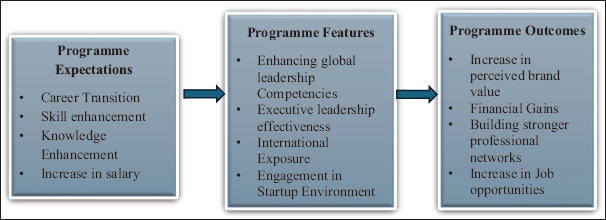
Foremost, the study revealed the key motivation for mid-career professionals pursuing executive education programmes alongside their employment. The main reasons being ‘growth aspiration’, which includes goals such as improving personal branding, advancing careers and earning more. At the same time, lifestyle-oriented intentions, namely better work–life balance, grow the family business, undertake career change and explore opportunities abroad. Key motivation was to enhance impact at work, indicating that learning new skills helps individuals do their job better and position them for next-level career growth. It is evident that executive education programmes help professionals pursue both objective career outcomes, such as promotions and salary increases, and subjective outcomes that contribute to personal fulfilment, such as work–life balance and intrinsic satisfaction (Thompson & Gui, 2000).
Post-programme evaluations show that participants reaped significant benefits from their mid-career education experiences. It significantly enhanced personal branding and image in the industry, equipping them for new next-level job opportunities. The skills acquired were viewed as extremely beneficial for meeting current industry requirements, helping develop stronger professional networks, vital for navigating the uncertainties of the future. Further, participants reported building a strong professional network as an important and unanticipated gain. Clearly, professionals who invested in such programmes were extremely satisfied with their personal and professional gains from the programme. The study provided evidence that mid-career executive education programmes met participants’ expectations. What participants believed the programme would do for their careers was manifested after completing it, reinforcing that investing in mid-career education paid off its worth in time and effort. Furthermore, the study emphasised professionals’ awareness of the transformation of workplace dynamics, underscoring the need for adaptability.
Some of the primary concerns that came up were growing global competition and challenges with job security. People suggested that the programme could be made more relevant by adding new skills and aligning the curriculum with the demands of the future workplace. There was also a strong demand for career counselling services and the creation of alumni networks to help people remain in touch with individuals within their field. Few batches had benefited from alumni groups for professional networking. During the focus group discussions with a few alumni, they reiterated the survey results and offered suggestions to enhance mid-career programmes in line with the industry’s evolving needs. Some specific suggestions were made to focus on skill specialisation, ensure that learning styles align with current trends, and include real-world experience through projects and case studies. The implementation of a hybrid model for programme delivery, including e-learning modules and MOOC courses in the curriculum. Clearly, the survey analysis findings and the focus group discussions reveal that mid-career programmes have inherent strengths and significantly benefit their participants. The programmes could benefit from making a few changes to design and delivery, given the changing workplace context. Mid-career education programmes need continuous alignment with current industry demands, and the use of action-learning pedagogy, which emphasises real-world projects, is essential to achieving better individual and organisational outcomes. The insights from the study can be used to re-craft the agenda for mid-career education. It holds special significance for India.
Implications and Future Research Opportunities
Given the current work scenario, the agenda for mid-career education is being re-set. Working professionals join part-time mid-career education programmes to enhance their skills and knowledge and move towards career switching (Shetti, 2018). The aforesaid ideas would be a moot point for the institution to sustain a competitive edge over others. The study highlights the need to enhance mid-career education to keep pace with evolving job demands. This can be achieved by making the curriculum more relevant to current industry trends and by using hybrid learning platforms such as MOOCs. It should encourage a range of specialised programmes rather than a one-size-fits-all approach, emphasising the need for career guidance and specific goals. Special lectures, seminars, webinars or workshops by notable alumni or domain experts would help participants understand industry trends and practices firsthand.
Mid-career education programmes are beneficial when they effectively manage participant expectations while delivering promised business skills. Continuous alignment with current industry demands and the use of action-learning pedagogy, which emphasises real-world projects, are essential to achieving better individual and organisational outcomes. The insights from the study can be used to re-craft the agenda for mid-career education. It holds special significance for India. Given the current work scenario, the agenda for mid-career education is being re-set. Working professionals join part-time mid-career education programmes to enhance their skills and knowledge and move towards career switching (Shetti, 2018). The aforesaid ideas would be a moot point for the institution to sustain a competitive edge over others.
Footnotes
Declaration of Conflicting Interests
The authors declared no potential conflicts of interest with respect to the research, authorship and/or publication of this article.
Funding
The authors received no financial support for the research, authorship and/or publication of this article.