






Abstract
In today’s workplace, career management has shifted from linear planning to an adaptive, psychologically driven process marked by uncertainty, identity changes and constant adjustment. This article argues that successful career navigation hinges on three factors: self-concept, self-efficacy and adaptability. It uses case examples and personal stories to demonstrate how cognitive biases, perfectionism and social pressures create obstacles to career growth. The discussion applies frameworks such as lifetime career development, transition theory and coaching models to show the necessity of managing internal psychological processes alongside external opportunities. The article concludes that sustainable careers demand not only new skills but also resilience, mental health and continuous learning. By uniting counselling and coaching, it proposes a holistic model that helps individuals connect personal meaning with professional action, supporting adaptive and fulfilling careers.
Changing Nature of Careers in the Contemporary World
Arjun, a 38-year-old professional, had spent over a decade in the technology sector before experiencing an unexpected job loss due to automation and restructuring. When he approached the process, he described feeling ‘stuck’ and uncertain about how to move forward. Although he possessed strong analytical skills and domain knowledge, he found it difficult to reimagine his career beyond his previous role. In our discussions, he oscillated between wanting to return to banking and considering adjacent domains like project management and fintech, but without conviction. There was a visible sense of loss not just of a job, but of identity. Sameera, a 29-year-old marketing professional, has changed multiple roles across organisations and industries in a short period of time. She said that her job was exciting, but through our conversations, it became apparent that she valued learning and new experiences and was comfortable navigating change. However, she also began expressing concern about the lack of direction in her journey. She questioned whether her frequent transitions might impact her long-term growth and stability.
In our career assessment and counselling practice, and in recruitment support for organisations, we notice a pronounced shift in how young people view careers. Today’s young individuals express more uncertainty about future career stability. Their thinking is more multidimensional and fragmented compared to the past. The traditional view of a career ensuring safety, security and long-term happiness is less relevant. Instead, young people pursue complex paths where opportunities, expectations and rapid changes abound. This requires moving beyond old models of career planning to a comprehensive psychological approach to career management. Individuals must now proactively design their career paths, adapt to changes, manage shifting identities and maintain psychological well-being throughout their careers.
Historically, careers represented identity, stability and long-term progression, offering both financial security and a sense of purpose (Bersin, 2017). They reflected one’s expertise and provided a structured path for growth and achievement over time. However, modern careers have shifted from linear, organisation-driven trajectories to fluid, boundaryless paths as shown in Figure 1, shaped by rapid technological change, automation and the gig economy. As routine tasks are automated, the emphasis has shifted toward uniquely human skills such as creativity, critical thinking and complex problem-solving. Increasingly, individuals engage in freelance, remote and flexible work arrangements. This evolving landscape demands continuous learning, adaptability, and a stronger focus on work–life balance and psychological well-being. The transition from ‘boundaryless’ careers to a fragmented professional landscape necessitates a shift from passive planning to active career management. In the traditional model, the external structure of a firm provided the scaffolding for an individual’s identity and security. Today, as seen in Arjun’s experience of identity loss following automation, that scaffolding has collapsed. When the environment is volatile, a career is no longer a path one finds but a construct built through constant internal regulation.
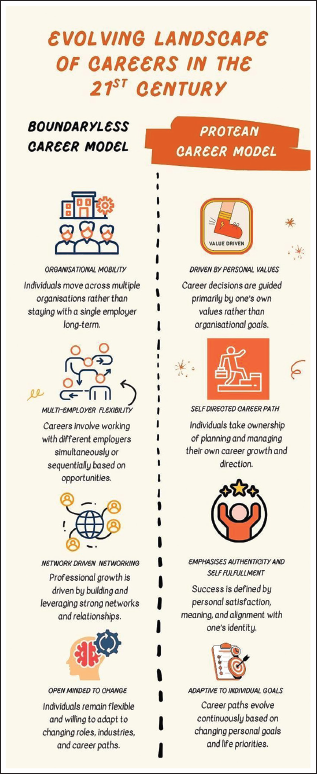
However, acting as the primary architect of one’s trajectory is cognitively taxing. The fragmentation observed among younger professionals is often a symptom of a psychological bottleneck, in which the pressure to make a future-proof choice triggers maladaptive responses. Sameera’s exciting but unclear journey highlights the tension between modern fluidity and the human need for a cohesive narrative.
Career decisions are rarely rational. Deep psychological factors guide choices for individuals like Arjun and Sameera as they navigate complex paths, either enabling or hindering exploration. Fear of failure and perfectionism intensify challenges in career navigation (Tian and Hou, 2024; Wang et al., 2020). To support people in this unpredictable market, it is crucial to move beyond surface planning and address the psychological drivers of successful career management.
Psychological Foundations of Career Decision-making
We must first acknowledge the theoretical shift from ‘person-environment’ fit models to developmental and constructionist frameworks to understand the psychological needs of the modern workplace. Early vocational psychology was dominated in structure by the matching model, which aimed to align a person’s static characteristics with job requirements (Parsons, 1909). This model provided a useful foundation, but it failed to adequately address the complex factors that influence modern occupational behaviour.
Donald Super’s Life-Space theory revolutionised the field by proposing that career development is a lifelong process of implementing an evolving self-concept (Super, 1953). As individuals encounter new environments, their perceptions of competence and values shift, necessitating a more flexible path. Recent studies confirm that ‘vocational readiness’ is not a static trait, but a state of cognitive and emotional preparedness that must be recalibrated at each major career transition (Hirschi & Koen, 2021; Super, 1980).
Career decision-making is deeply rooted in psychological processes. Self-concept, identity and personal values play a major role. A person’s view of their skills shapes the types of jobs they consider. Today, people face tension between multiple identities and competing values. This conflict drives modern career indecision. The pressure to optimise one’s identity leads to psychological stress and strain (Wang et al., 2020).
Learning from the Author’s Desk: Debarati Basak
In my case, my decision to pursue psychology was deliberate and well-considered. During my education, it brought a sense of satisfaction and alignment. From the start, I also aspired to build my own organisation. However, when I joined the profession, I realised there was a disconnect in how I wanted to approach my work. My goals matched organisational objectives in general, but my approach differed. This realisation became a turning point. It clarified my preferences and motivated me to start my own organisation, where I could shape practices and processes in ways that fit my values. Today, leading my organisation has given me clarity on what I want and what I choose to avoid. This journey has taught me something important. Career development is not just about choosing the right path. It is also about refining your approach through experience and self-awareness.
The core of career management is self-awareness as per Figure 2. Evaluating career opportunities depends on alignment. Career identity development involves forming a clear sense of self at work. In a dynamic world, a strong career identity provides direction and motivation to navigate psychological bottlenecks. Without self-identity, people make misaligned choices and face uncertainty and anxiety in high-pressure settings (Li, M., & Zhang, 2025; Li, X., & Zhang, 2025).
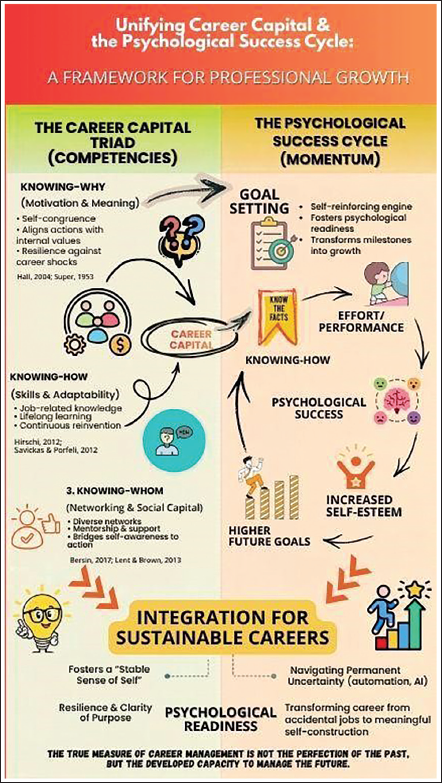
The protean career mindset emphasises self-direction and a values-driven approach. It prioritises internal factors, such as autonomy and personal development, over external ones, such as salaries and other benefits (Hall, 2004). This orientation is related to higher subjective success. But current-day research highlights the ‘autonomy paradox’, which is the increased psychological burden on individuals. This stems from a lack of organisational structure, thereby creating a situation of constant uncertainty (Hirschi & Koen, 2021). This uncertainty can only be addressed through career adaptability, a psychosocial construct that denotes an individual’s readiness to cope with developmental tasks and work-related transitions (Savickas & Porfeli, 2012). Adaptability fosters a future orientation, while resilience allows individuals to recover from setbacks, such as the automation-induced displacement seen in Arjun’s case (Hogrefe, 2024a, 2024b; Li, M., & Zhang, 2025; Li, X., & Zhang, 2025).
Psychological Barriers to Career Development
Psychological barriers to career development have become more evident in today’s fast-paced, unpredictable work environment. Limited self-awareness, low self-efficacy, or a lack of confidence in one’s talents are fundamental barriers that can keep people from investigating opportunities or pursuing ambitious goals, even when they possess the necessary potential (Hirschi, 2012; Lent & Brown, 2013).
Perfectionism and the fear of failing might make it difficult to move forward in work. Many people get stuck in ‘analysis paralysis’ rather than seeking a suitable fit. They perceive any choice that is not perfect as a major failure. Recent studies distinguish between adaptive and maladaptive perfectionism, with the latter characterised by an excessive fixation on errors, meaning elevated levels of career indecision and diminished occupational identity (Hogrefe, 2024a, 2024b; Wang et al., 2022). This behaviour aligns with the ‘Maximiser’ profile, characterised by an incessant evaluation of all possible alternatives to ensure optimal outcomes, leading to heightened regret and reduced life satisfaction (Schwartz et al., 2002).
This emotional resistance is reinforced by cognitive shortcuts, such as the availability heuristic, in which individuals rely on easily recalled information, such as high-status careers visible in their immediate social circle, rather than objective assessment data (Tversky & Kahneman, 1973). Recent studies indicate that in high-pressure environments, individuals are more likely to prioritise mentally accessible ‘prestige roles’ over data-driven career matches, a phenomenon that has intensified with the rise of social media-driven vocational visibility (Tian & Hou, 2024; Zhang et al., 2024; Zhou et al., 2023). Even when assessments point toward unconventional paths, confirmation bias triggers a mechanism of selective information processing, where individuals filter out results that challenge their existing beliefs to reduce cognitive dissonance (Nickerson, 1998; Peters, 2022). Clients frequently adhere to a prestigious anchor as a safeguard against risk, prioritising social currency over personal alignment to alleviate the fear of perceived social failure (Li, M., & Zhang, 2025; Li, X., & Zhang, 2025).
Case Analysis: Riya and the ‘Safe’ Trajectory
A typical case, we encountered a year or so ago, involves Riya, a 17-year-old Grade 12 science student with a history of strong academic performance. Riya entered the counselling process with a clear external direction: her parents wanted her to pursue medicine. While she possessed the cognitive capability for this path, she lacked internal alignment with it. Riya’s case perfectly exemplifies how the aforementioned psychological barriers manifest in real-time decision-making.
Riya’s case illustrates maladaptive perfectionism and decision-making anxiety, where her attachment to a medical career served as a ‘prestigious anchor’ (Li, M., & Zhang, 2025; Li, X., & Zhang, 2025) to satisfy social expectations rather than personal passion. Influenced by the availability heuristic, she viewed medicine as a guaranteed success metric, despite her interests in design and communication.
Her struggle reveals several key psychological barriers:
Deficient career-linked self-efficacy: A persistent need for parental approval and reassurance. Information overloading: Using excessive data collection as a defensive tactic to procrastinate on difficult choices and decisions. Emotional anchoring: Fear of failure and social risk-aversion overriding personal alignment.
Ultimately, Riya’s experience proves that career counselling cannot rely solely on cognitive data. To be effective, it must address the emotional and contextual undercurrents that trap individuals in prestigious but unfulfilling paths. These psychological patterns extend beyond a single choice; they fundamentally dictate an individual’s navigation of transitions and sustain long-term professional growth.
Lifelong Career Development and Continuous Learning: Navigating Career Transitions and Role of Mental Health in Career Sustainability
The modern-day career environment has made the notion of ‘I have completed my education’ obsolete. Career management in the 21st century is characterised by a non-linear progression that requires lifetime dedication to continuous learning and psychological resilience to navigate numerous, often disruptive, transformations. This process involves more than mere upskilling; it often requires an inward realignment of identity and purpose.
Career transitions are not merely external shifts in roles or environments; they are deeply psychological processes that require individuals to disengage from old identities and gradually embrace new ones. William Bridges’ transition model provides a valuable framework for understanding this inner journey, highlighting how change unfolds in three distinct yet interconnected phases (Bridges, 2004):
Ending, losing and letting go: Acknowledge and process the loss of old roles, routines and relationships, which requires acknowledging these losses rather than rushing toward the next objective. The neutral zone: A phase of uncertainty and transition that, while uncomfortable, fosters reflection and innovation. The new beginning: Embracing a new identity and direction with renewed clarity and energy.
Learning from the Author’s Desk: Vasundhara Kaul
Career trajectories are often portrayed as straight lines, but my journey through banking, education, and counselling has taught me they are, in fact, deeply personal journeys of the heart. I began in banking simply to follow in my father’s footsteps, a choice made more out of admiration than self-awareness. While it wasn’t my ultimate calling, those years built a vital foundation of discipline and professional grit that I still lean on today. The transition into education and mental health initially felt like a complete break from my past, as if my banking years had no place in my new life. However, I realise that no experience is ever wasted; the financial acumen and structure I gained in finance became the very fuel that allowed me to thrive as an educator and entrepreneur. I learned that career growth is cumulative, and even the most unrelated chapters of our lives eventually weave together to form a stronger whole. Navigating this path meant facing skepticism from those who couldn’t see how a banker could become a counsellor and overcoming rigid institutional barriers that forced me to find new routes to my doctorate. These obstacles weren’t dead ends but detours that deepened my perspective and reinforced my belief in continuous learning. Today, I see my career as a diverse portfolio of identities- educator & special educator, mental health practitioner and trainer, a dynamic journey that proves we are at our best when we are willing to redefine ourselves.
Career sustainability depends on protecting mental health over time. Within the sustainability framework, health, alongside happiness and productivity, rests on maintaining psychological well-being. Strong psychological capital (hope, self-efficacy, resilience, optimism) acts as a buffer against stress and career shocks, enabling individuals to stay healthy, balanced and productive across their careers.
Practical Strategies for Effective Career Management
Career-related struggles are rarely isolated from an individual’s broader psychological health; issues such as career paralysis, identity crises and chronic decision-making difficulties are often symptoms of deeper emotional barriers. If career coaching addresses the ‘how’ of professional manifestation, psychological counselling addresses the ‘why’ of the professional experience.
Role of Counselling
In a psychodynamic framework, a professional’s struggle with decision-making might be diagnosed as ‘choice anxiety’ or ‘dependence’, constructs that go beyond simple skill deficits. For instance, a client’s inability to commit to a career path may be rooted in a ‘fearful, defensive identification’ with an over-demanding parental figure. This approach emphasises that ‘working for change’ often requires a shift in personality or self-perception before meaningful vocational action can be taken.
One of the effective approaches rooted in behavioural theory is Cognitive-Behavioural Therapy (CBT), which focuses on identifying and restructuring the ‘dysfunctional thinking styles’ that impede current professional functioning. Perfectionist professionals often fall into a ‘vicious loop’ of procrastination and over-preparation. Research conducted in 2024 has confirmed that CBT is significantly effective in reducing anxiety and improving career path identity and career decision-making self-efficacy in perfectionist populations. CBT interventions are designed to dismantle this loop through a variety of evidence-based techniques, such as thought challenging, behavioural experiments and exposure hierarchies.
Acceptance and Commitment Therapy (ACT), another behavioural intervention, offers a unique lens for career management during periods of high industry volatility. Rather than attempting to eliminate negative thoughts or anxieties about career transitions, ACT focuses on increasing the ability to stay present and engage in values-driven actions, even in the face of difficulties. ACT involves accepting uncomfortable emotions without avoidance, while cognitive defusion helps individuals view thoughts as temporary events. Being present fosters non-judgemental awareness, reducing rumination and anxiety. Self-as-context separates identity from thoughts and roles, and values clarification guides meaningful, purpose-driven career decisions aligned with personal priorities.
Role of Coaching
Coaching plays a pivotal role in career management by helping individuals move from self-awareness to purposeful action. While individuals may have clarity about their interests, strengths or challenges, coaching provides the structure and support needed to translate this insight into clear goals, strategic planning and consistent progress.
In practice, career coaching supports individuals in setting realistic goals, identifying skill gaps, enhancing decision-making and building accountability. It also strengthens key competencies such as confidence, adaptability and problem-solving, which are essential in today’s dynamic work environment. By encouraging reflection, challenging limiting beliefs, and fostering a proactive mindset, coaching enables individuals to navigate transitions effectively and sustain long-term career growth. Ultimately, it helps individuals not just choose a career path but actively design and manage it in alignment with their evolving aspirations and contexts.
In the context of career management, counselling and coaching serve as complementary processes that address both the emotional and action-oriented dimensions of an individual’s journey.
Comprehensive Framework
The modern executive landscape embodies a state of permanent uncertainty, a volatility, uncertainty, complexity and ambiguity state that requires more than mere tactical proficiency. In response to this complexity, the Integrative Coaching Model (ICM) is a framework that is different from the traditional, surface-level ‘fix-it’ approach to continuous professional development. Unlike linear coaching styles that focus solely on goals, the ICM operates across three distinct yet overlapping ideas, that is, the behavioural, the cognitive and the unconscious, to ensure that workplace performance is rooted in deep-seated psychological stability (Passmore, 2007).
To guarantee that professional development is both psychologically rooted and practical, Passmore’s (2007) ICM operates through three synthesised pathways. The behavioural aspect emphasises tactical outcomes and quick wins by employing frameworks, such as the GROW model, to resolve immediate workplace obstacles (Passmore, 2007). The model then transitions to the cognitive stream because behavioural adjustments are frequently transient and lack internal alignment. Techniques help executives recognise self-limiting beliefs, ensuring their mental frameworks support rather than impede their workplace actions. What sets Jonathan Passmore’s (2007) model apart is its focus on the unconscious. It goes beyond actions to uncover hidden patterns, such as the fear of failure or the need for control, that quietly shape behaviour. By bringing these to awareness, individuals gain control over reactions, leading to self-congruence, where actions align with values, even under pressure.
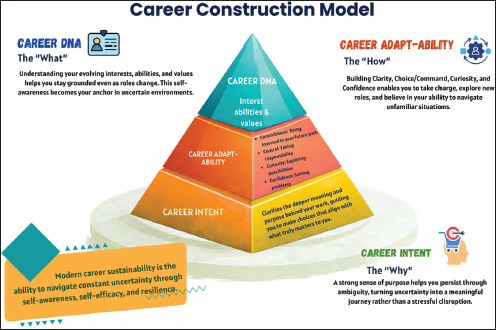
Ultimately, as illustrated in the Career Construction Model shown in Figure 3, this integrative approach reframes career management as a state of psychological readiness. By aligning the Career DNA or the professional identity, with the Career-Adapt-Ability or ‘how’ and the Career Intent, the ‘why’, individuals develop an internal anchor for long-term career sustainability. This alignment provides the internal stability necessary to remain composed and continue growing, regardless of how much the professional landscape shifts. By moving beyond tactical fixes to achieve true self-congruence, the individual ensures that their external professional actions are a consistent reflection of their internal values, identity and purpose.
Career Construction Model as Created by Basak and Kaul (2026).
Final Reflections
In an era of exponential technological and industrial change, a static skill set is no longer the primary professional asset; instead, the human capacity for reflection and adaptation takes precedence. Effective career management requires integrating inner clarity, often gained through counselling, to align values and identity with the tactical execution provided by coaching, thereby manifesting those insights in the marketplace.
The core of modern career sustainability is the capacity to navigate permanent uncertainty. This involves developing self-awareness of evolving motivations, strengthening self-efficacy to embrace unfamiliar roles, and cultivating resilience to persist in the face of ambiguity. As tools like artificial intelligence continue to disrupt traditional structures, the ability to stay proactive remains the only constant. Success is, therefore, defined not by mastering fixed skills but by the ‘psychological readiness’ to continuously learn, unlearn and reinvent oneself.
Ultimately, careers are non-linear constructions shaped by experience, choice and the meaning assigned to them. Every phase, whether planned or accidental, contributes to personal and professional identity. The true measure of career management is not the perfection of the past but the developed capacity to manage the future.
Footnotes
Declaration of Conflicting Interests
The authors declared no potential conflicts of interest with respect to the research, authorship and/or publication of this article.
Funding
The authors received no financial support for the research, authorship and/or publication of this article.