






Abstract
Dear Readers,
The subject ‘Career Management: The Emergent Theme’ is very close to my heart since I chose this area to pursue my doctoral studies many decades ago. Since then, I have witnessed many significant changes across the globe as well as in India in the way individuals and organisations have embraced them. This theme refers to the shift in how individuals and organisations approach career growth in a rapidly changing world. Rather than following a fixed, linear path (the ‘traditional’ career), the emergent theme currently is focused on adaptability, continuous learning and self-direction.
Let us try to summarise the core facets of career management trends.
From linear to non-linear:
Careers are no longer seen as a straight ladder within one company. Instead, they are ‘protean’ (Hall, 1996) or ‘boundaryless’ (Arthur & Rousseau, 1996), where individuals move between different roles, industries and even types of work (freelance, gig, full-time and so on).
It was Sagaria (1989) who first used the term career quilt instead of career ladder. Ashley Herd (2026a) builds on the concept and defines it as a non-linear, flexible approach to professional growth where individuals stitch together diverse experiences, skills and roles over time, rather than following a traditional, vertical career ladder. Herd (2026b) aptly summarised it as follows:
Today’s careers don’t always look like ladders. They look more like quilts. A career quilt is built from different experiences stitched together over time. Some squares are intentional—choices you decide to make to reshape your career. Others come from detours, pivots, or opportunities you didn’t plan for—from a layoff to unexpected life shifts. What matters isn’t whether the path is linear, but whether the pieces fit together in a way that shows who you are, what you want, and where you create value.
From organisation to individual ownership:
According to Schein (1978), since both individuals and organisations exist in the context of society, it is important to recognise that societal culture, through its value system, would ultimately influence both organisations and people in terms of what is considered to be a good career. The concept has meaning to both an individual pursuing an occupation (the internal career) and the organisation trying to set up a sensible growth and development path (external career) for the individual. Thus, the core of internal career is the individual’s self-concept within the context of organisations and occupations, whereas the core of external career reflects one’s own perception of organisational and occupational context itself.
Derr and Laurent (1989) defined the internal career as primary, subjective and owned by the careerists, and the external career as objective and reflecting a real world of constraints and opportunities in organisations and occupations. As aptly put by them, ‘…internal career is What do I want from work, given my perceptions of who I am and what’s possible?…external career is What’s possible and realistic in my organisation and occupation, given my perceptions of the world of work?’
The responsibility for career growth has shifted from the employer to the employee. Individuals are now expected to be ‘CEOs of their own careers’, actively seeking out skills and experiences. A very important concept that was researched in this context was ‘career anchor’ (Schein, 1996, 1978). The development of the ‘career anchor’ concept in assessing career orientation of individuals is a breakthrough in the direction of career research, in terms of shifting its focus from external to internal careers of individuals. According to Schein (1978), a person’s ‘career anchor’ is his or her occupational self-concept consisting of:
Self-perceived talents and abilities (based on actual successes in a variety of work settings), Self-perceived motives and needs (based on opportunities for self-tests and self-diagnosis in real situations and on feedback from others), and Self-perceived attitudes and values (based on actual encounters between self and the norms and values of the employing organisation and work setting).
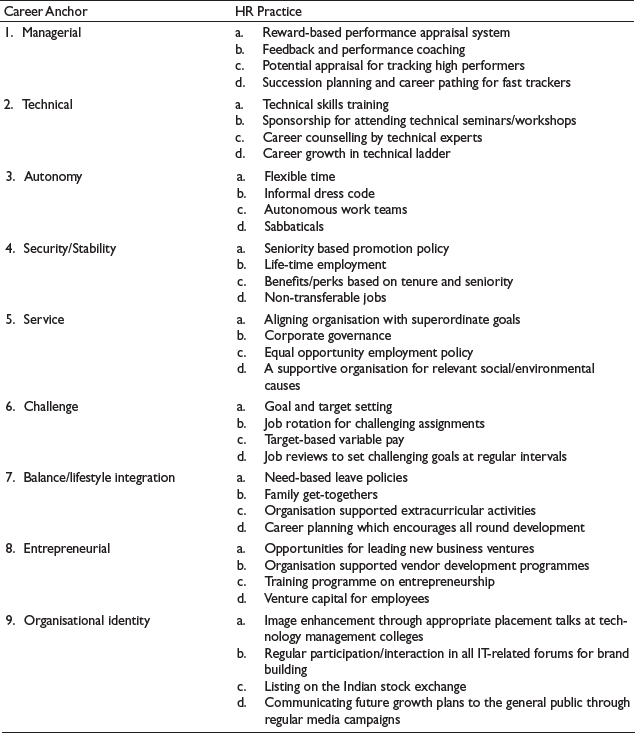
The most important thing to note here is that the anchor is a ‘stabilising force’—the values, motives and needs that an individual will not give up, if forced to make a choice. Starting his original research with Sloan School alumnus in the mid-1970s, Schein uncovered eight career anchors. Bandyopadhyay (2005, 2007) extended it to nine while adding an additional ninth anchor as organisational identity in the Indian context. Since then, many studies have related positive consequences for both organisations and individuals using this concept.
Kannabiran et al. (2016), in an empirical study with IT sector employees, reported the following; Most of the employees form a strong self-concept, a set of ‘career anchors’ that hold their internal career. Organisations need to understand such career anchors and be responsive to improve the employees’ intention to stay. It was found that the career anchors—service, identity, variety, autonomy, creativity and geographic security have a significant influence on the employees’ intention to stay. However, other career anchors, namely managerial competence, technical competence and organisational stability, have no influence on the employees’ intention to stay
Lifelong Learning as a pre-requisite for career growth:
With the rise of AI and automation, skills have a shorter shelf life. Continuous upskilling and ‘learning how to learn’ are central themes for remaining relevant. As aptly put by Ahuja (2026):
As learning changes, careers start to look different too. The old model was simple. Learn the basics. Move up. Eventually manage the people doing the work you once did. That ladder only worked because the bottom was wide. It depended on layers of repetition before responsibility. When that repetition disappears, the ladder changes with it.
According to Ward (2024):
In recent years, traditional career paths have given way to a more fluid and adaptable approach to professional growth. One of the key ingredients in navigating this ever-changing terrain is lifelong learning. Lifelong learning has become not just a desirable trait but a necessity for thriving in our careers.
Perna (2026) reiterates the same in a more profound manner when he said:
When learning is left behind, the effect isn’t as noticeable as a sudden breakdown. Rather, it’s a gradual erosion of capability: skills fall behind, teams rely on short-term output at the expense of long-term resilience, and the cost of catching up keeps increasing.
Ward (2024) pronounced:
In recent years, traditional career paths have given way to a more fluid and adaptable approach to professional growth. One of the key ingredients in navigating this ever-changing terrain is lifelong learning. Lifelong learning has become not just a desirable trait but a necessity for thriving in our careers.
Lifelong learning today is emerging as an important trait that organisations are also looking for while selecting employees. As Sunderland (2025) noted:
Employers are looking for candidates who are committed to personal and professional growth. Showing your dedication to skill development in the workplace can lead to promotions, salary increases, and job opportunities. Today, many organizations foster a lifelong learning culture and encourage employees to pursue ongoing education and skill development. Engaging in this culture enhances individual capabilities while contributing to overall organizational success.
Sunderland (2025) suggested the following innovative strategies to reinforce lifelong learning in current times. These are described as follows:
Microlearning
Microlearning involves delivering concise, easily digestible content in short bursts. This approach helps combat learner fatigue and cognitive overload, which is ideal for busy professionals. Peer learning and collaboration
Learning from colleagues through knowledge-sharing sessions or study groups can enhance retention and understanding. Collaborative learning fosters community and encourages diverse perspectives that lead to deeper insights. Gamification
Gamification incorporates game design elements into learning experiences to boost engagement and motivation. Some platforms implement badges, leaderboards and rewards for completing training sessions. Social media
Social media platforms can be powerful professional development and networking tools. Joining online communities and participating in discussions can give insights and resources. Independent studies
Independent studies—such as reading books, attending webinars or conducting research—allow individuals to tailor their learning experiences to their interests and goals.
Lifelong learning today is really emerging as a strategic career management choice. While commenting on it, Reyero (2024) wrote,
Today, several essential factors for career advancement have been “democratized,” including access to knowledge, self-awareness, contacts, and capital. These factors, when well-managed, can be what’s needed to advance to the next professional level and increase employability – a key factor for job competitiveness, which is essentially the ability to progress at work and successfully adapt to continuous transformations.
From single to multiple careers:
The traditional concept of a ‘job for life’ is rapidly evolving into a multi-career trend, where professionals manage several different income streams or career paths simultaneously rather than sticking to one linear progression. The shift from a single lifelong career to multiple careers reflects a modern trend where individuals embrace diverse professional paths, either sequentially or simultaneously. This transition is driven by increased life expectancy, a rapidly changing job market and a growing desire for personal fulfilment beyond a single speciality. We have seen various forms of multiple career which are in vogue today. These are described as follows:
Portfolio career: Integrating several different professional roles or projects at once that reflect your various skills and passions. Sequential careers: Moving from one distinct career field to another over the course of a lifetime (e.g., transitioning from engineering to management consulting). Slash careers: A term for individuals who identify as multiple things at once, such as a ‘lawyer/minister’ or ‘CEO/mom’. Poly-employment/moonlighting: Holding two or more jobs simultaneously, often for financial stability or to explore secondary interests.
So, what are the drivers for these shifts in career today? I believe there are three major drivers that are causing these transitions. These are: Increased lifespans: With people’s lifespan increasing, there is more time to explore careers in different life stages and professions. Technological shifts: Skills now become obsolete quickly (sometimes within 18 months), making skill diversification a survival strategy. Personal growth and aspiration: Many people have ‘multipotentiality’ tendencies—diverse interests that cannot be satisfied by a single career.
‘The trend of multiple jobholding is gaining momentum due to several economic factors. Rising living costs and the desire for financial security drive many to seek additional employment opportunities. This shift reflects broader changes in the labour market, where flexibility and adaptability have become essential traits for success’ is what Felicia Shakiba (2025) attributes to enhanced acceptance of multiple career choices in recent times.
According to her, in the USA, there are about 8.9 million people today who have multiple jobs. This figure underscores a growing trend towards multi-choice careers where individuals juggle more than one source of income.
Parris (2020) has given a more balanced view of portfolio career. According to her, the pros and cons of a multiple career are summarised as follows:
Pros: Work–life balance Diverse skill set Extra cash flow Passion pursuit Test drive careers No commitment required Protects your future
Cons: Balance may be elusive Lack of benefits Less chance for advancement Not widely embraced
Cohen (2015), while asking Gen Z employees to combine multiple careers, argued:
This career trend is growing bottom up, from the employees and workers, not so much from employers. Thus, it is dependent on the ability of a salaried employee to gain agreement from their employer for additional work beyond their job. It is still difficult to find information on employers who allow their employees to develop portfolio careers of this nature. However, we are likely to see this grow as more and more companies and industries will require increasing flexibility in accessing talent. In addition, as the on-demand economy grows, this flexibility will also be required by the talent itself, who will want to create portfolio careers and will choose to work with those employers, who support various forms of part-time employment in combination with freelance, consulting and entrepreneurship options.
Aligning value and purpose with career:
The trend of aligning purpose and values in individual careers marks a significant shift from traditional markers of success, like compensation and titles, towards long-term fulfilment and sustainable professional growth.
As Sinclair (2024) confirms, ‘Aligning your career with your values can lead to greater job satisfaction, improved mental health, and a stronger sense of purpose’.
This movement is increasingly focused on job alignment, where one’s unique motivations, work style and core values are in harmony with what the role and organisation offer.
So, what are the core pillars that help align value and purpose with career?
In many organisations, especially where there are significant numbers of employees who come from Gen Z, career planning typically revolves around integrating these essential elements to create a more resilient and rewarding professional career path: Purpose: This is your foundational ‘why’—the underlying reason one works and the impact one wants to have on the world. It provides a sense of direction and meaning, often acting as an anchor during challenging times. As Bhor (2025) puts it very simply, ‘First, let’s explore what purpose at work really means. It isn’t about doing something grand or ground-breaking. Purposeful work is simply the feeling that what you do matters—to you, to others, or to something bigger than yourself’. Values: These are the deeply held principles that guide your decisions and behaviours. Alignment here means your daily work actions and your company’s culture are congruent with what you believe is important, such as integrity, flexibility or social impact. As Kimmel (2025) says:
In today’s fast-paced world, career success is often measured by titles, salaries, and accolades. Yet, true fulfilment in your professional journey doesn’t come from external validation alone, it comes from alignment. When your career path reflects your core values, you create a foundation for long-term growth, satisfaction, and resilience.
Niles (2025) noted:
Personal and professional values serve as a foundation for long-term career satisfaction and success. By focusing on what truly matters to you, values-based career decision making helps create a path that is both meaningful and sustainable.
Another very interesting and deeper sense of value alignment is put forward by Strohmeyer (2024). According to him, well-being comprises two distinct categories: eudaimonic and hedonic. While hedonic well-being is an ordinary pleasure associated with quick dopamine spikes in the brain, such pleasures are fleeting and ephemeral, quickly forgotten once the experience has ended. When it comes to overall career satisfaction, hedonic pleasures end up meaning relatively little.
On the other hand, eudaimonic well-being refers to a deeper sense of purpose and fulfilment, a feeling of living virtuously in the world and flourishing over the long term. Strohmeyer (2024) sums up this concept very aptly as he proclaims:
Aligning your work to your values sets you up for more eudaimonic well-being, in other words. But it’s worth noting that, throughout our careers, the ratio of hedonic and eudaimonic satisfaction tends to shift. In my experience, younger workers seem to enjoy the perks and fun of hedonic workplace benefits, while mature workers tend to prioritise work–life balance and a sense of having contributed something of a legacy through their efforts.
Passion: This represents the activities or projects that ignite your energy and make you ‘lose track of time’. Integrating passion into your career significantly boosts motivation and daily job satisfaction. As Britts Imperial (2024) defines:
Before diving into whether your career is fuelling your passion, it’s essential to define what passion truly means. Passion is a deep-seated interest or enthusiasm that motivates you. It’s the driving force behind your willingness to learn, grow, and dedicate time to something you love, even when faced with challenges. When your passion aligns with your career, work feels less like a job and more like a fulfilling journey.
So, what are the benefits of a value-aligned career? Frederick (2025) sums up the following:
Increased motivation: Working on projects that align with your values ignites passion and drive.
Greater resilience: Staying true to your values can provide a sense of purpose and help you navigate challenges.
Deeper fulfilment: Knowing that your work reflects who you are makes your career feel more meaningful.
Lastly, how does a careerist actually align one’s career with his/her values? Here are the four simple steps suggested by experts (Frederick, 2025; Gemachaty, 2025; Kimmel, 2025; Smith, 2024; Strohmeyer, 2024) to achieve this alignment: Conduct a self-assessment: Identify your core values, natural strengths and non-negotiables like desired work environment or flexibility. Tools like the values assessment can help clarify your primary drivers. Evaluate current and future roles: Use your values as a filter for every opportunity. During interviews, ask targeted questions about company culture and how leadership communicates the mission. Balance passion with market demand: While purpose is vital, sustainable alignment often requires finding the intersection between what energises you and what the market currently values. Regularly reassess: Your priorities and values will likely evolve over time. Annual check-ins can help ensure your work continues to reflect who you are becoming.
Career management trends have significantly changed over the years to keep pace with the changing needs of both individuals and organisations. It will be very difficult to capture all those changes. However, I have tried to present a macro perspective so that the major milestones are captured. I am sure our readers will find it of use.
Before I end my piece, I, on behalf of my editorial board, extend my deep appreciation to both Professor Gopal Mohapatra from IIM Bangalore and Professor Sadhna Dash from IIM Indore for guest-editing this particular issue. They have curated a good number of articles from both academicians and practitioners on various aspects of career management that are emerging today.
Wish you all a great reading as well as a reflective experience.