






Abstract
The workforce is evolving faster than many organisations’ adaptive capacity. Technological disruption, generational transitions and rising employee expectations have fundamentally reshaped career planning and development. This article provides a practitioner-oriented analysis of these shifts, informed by direct experience within the corporate human resources function. It examines career planning and career development as distinct yet intrinsically interconnected processes, offering practical insights from the lived experiences of leaders and professionals in this fast-moving landscape. Beyond articulating the problem, the author proposes a framework for developing more resilient, human-centred career ecosystems.
Introduction
Over the past few decades, the traditional employment contract between employers and employees has eroded. Previously, individuals joined an organisation, advanced through a defined hierarchy, and retired with long-term security, but this model is now obsolete. Still, many organisational structures and cultures retain aspects of this linear progression. Today’s world of work is complex, fast-evolving and continuously redefining itself, with AI and automation reshaping roles in real time. According to the World Economic Forum (2025), 63% of employers cite skill gaps as the primary barrier to business transformation—a reality echoed in leadership boardrooms, where organisations struggle to access the capabilities needed to execute strategic priorities.
From an employee’s perspective, this environment often generates uncertainty. ‘HR analyses show that nearly 60% of employees lack clarity about their career paths, contributing to stagnation, and 41% explicitly report feeling stuck’, as per ADP Research Institute (2025). The study also notes rising uncertainty about employees’ ability to acquire future-relevant skills. While intent to grow exists, direction remains limited. Many organisations invest in Learning & Development; however, as the Society for Human Resource Management (SHRM) (2025a) observes, these investments have not consistently closed skill gaps, due to misalignment with workforce expectations. Emerging workforce segments emphasise flexibility and meaningful work over traditional job security (PricewaterhouseCoopers [PwC], 2025). Thus, a disconnect is evident: career planning has shifted to the individual, while development remains anchored in organisational systems. Workday Research (2026) adds that, despite digital transformation, employees feel underprepared to use new technologies. Addressing this requires a holistic, integrated shift; one that prioritises continuous learning, fosters adaptability and transitions from rigid job structures to dynamic, skills-based ecosystems.
Emerging Challenges: Career Planning and Development
Non-linear career pathways, rapid skill depreciation and evolving workforce expectations define the modern professional landscape in career planning and development. These complexities often make it challenging for organisations to offer truly personalised development paths for employees. Consequently, navigating this uncertainty requires a commitment to continuous learning and a model of shared accountability, where both the employer and the individual actively invest in building capabilities within an increasingly fragmented and dynamic environment.
1. Technology Disruption and Non-linear Careers
The straight-line career was already looking unstable before AI arrived, and now it is obsolete for many roles. In recent times, when the author asks early-career professionals, ‘Where do they see themselves in five years?’ Increasingly, the honest answer is, ‘I do not know if my job will exist’. AI and automation have forced a continuous cycle of reassessment. As it is evident, the ‘gig economy’ is no longer a fringe concept but a mainstream way of working (Wiernik & Kostal, 2019). To the author, in today’s career landscape, a 5-year plan is less about chasing a title and more about cultivating a portfolio of versatile, future-proof capabilities.
2. Skill Mismatch and Continuous Learning Pressure
The pressure to ‘upskill’ never stops. Unlike earlier generations who could coast on a university degree for decades, today’s workforce faces a lifelong learning mandate (World Economic Forum, 2023). However, organisations admit sparingly: predicting exactly which skills will be critical 12 months from now is genuinely hard (Succi & Canovi, 2020). Employees are often seen as chasing a moving target. The author, as a practitioner, sees employees exhausted by the demand to ‘learn faster’ while receiving inconsistent guidance on exactly what to learn.
3. Changing Career Expectations and Psychological Contract
The unwritten agreement between employer and employee has fundamentally changed in recent times. The new workforce expects meaning, flexibility and rapid growth. Historically, employers offered stability and slow, steady progression (Rousseau, 1995). When these two views collide, disengagement and turnover appear to follow. There is a misalignment of the organisational systems and values. Many organisations are using 20th-century retention strategies for a 21st-century workforce, despite emerging talent management strategies for the digital era.
4. Mental Health and the Pressure to Perform
Mental health and performance pressures are topics that organisational management literature has been rather slow to address. Gen Z is reportedly the most anxious generation in the workforce, dealing with economic precarity, social media comparisons and career instability (Seemiller & Grace, 2019). Career planning that ignores employees’ psychological well-being is incomplete. An employee who is on the verge of burnout is unlikely to be building skills or following a development plan. The two are inseparable. Organisations that provide mental health support as an optional benefit rather than a core part of talent management strategy may be misreading what it takes to achieve sustained performance.
5. Organisational Rigidity Versus Individual Fluidity
At the heart of most of these challenges is a mismatch in pace. Individuals adapt fast; organisations necessarily may not. Culture change, structural redesign and leadership development all take time that, from the individual’s perspective, feels like standing still. Some companies are finding partial answers through flatter structures, project-based work and internal mobility programmes. The ones making the least progress tend to treat Gen Z’s expectations as the problem to be managed, rather than an opportunity or feedback on how their systems are failing.
Career Framework: A Three-layer Approach
Ideal is a model in which career outcomes appear at the intersection of individual agency and systemic context. When these forces align, we get engaged and productive workers who build meaningful careers. When misaligned, which is currently the default mode, one gets disengagement, turnover and career fragmentation.
Practitioner’s Perspective: Past and Present
From Baby Boomers approaching retirement to Gen Z entering the workforce, a shared sense of uncertainty is evident across today’s talent landscape. This unease extends beyond economic volatility or technological disruption; it reflects a fundamental redefinition of what a career stands for. As an HR practitioner, the author has observed a significant shift in how professionals achieve success. Linear career paths and static roles have largely given way to dynamic, non-linear journeys that require continuous skill adaptation across functions.
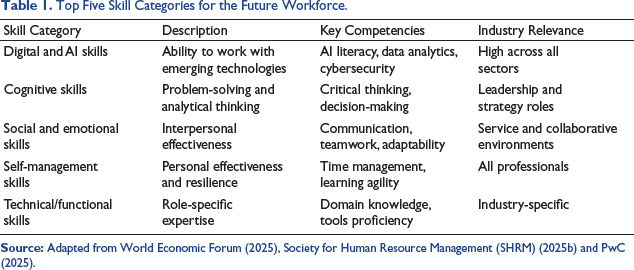
Adaptability, not necessarily rigid long-term planning, determines success today. Individuals who thrive are those equipped with a flexible skill set, critical thinking, commitment to lifelong learning and the ability to pivot towards emerging opportunities. This evolution extends beyond technical ability to include digital fluency, interpersonal effectiveness and data literacy. The ability to cultivate hybrid capabilities and transition seamlessly across roles or industries has become essential.
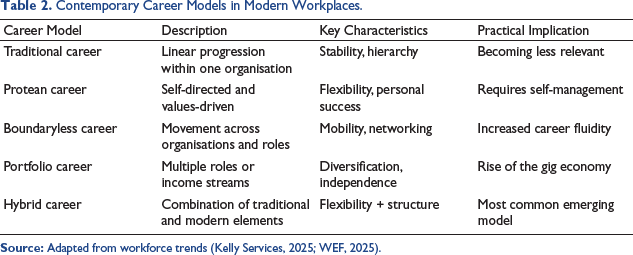
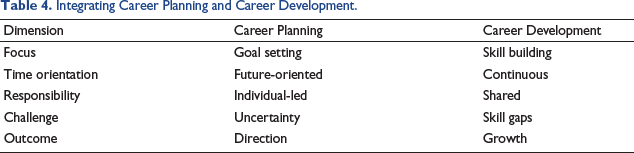
Career trajectories themselves are also transforming from structured hierarchies to self-directed pathways that value lateral movement, experimentation and experiential learning over traditional upward progression. In response, organisations must evolve by building agile teams through a balanced focus on internal talent development and strategic hiring. Integrating career conversations into ongoing talent management practices can enhance engagement, capability building and retention. The way forward lies in aligning career planning with career development as a unified, continuous process; one that connects individual aspirations with organisational priorities. This approach prepares the workforce to navigate uncertainty with confidence and resilience.
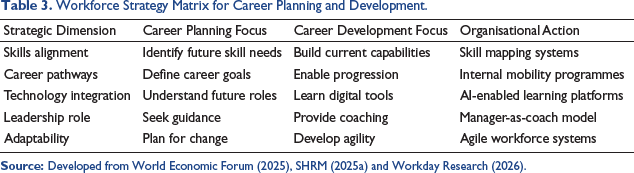
Tables 1–4 present the top five skill categories for future work, highlight transitions in career models and workforce strategies, and illustrate the integration of critical elements across multiple dimensions.
Top Five Skill Categories for the Future Workforce.
Contemporary Career Models in Modern Workplaces.
Workforce Strategy Matrix for Career Planning and Development.
Integrating Career Planning and Career Development.
Implications: From Concepts to Practice
Integrating diverse theoretical frameworks reveals that evolving workforce challenges cause a synchronised realignment of individual agency, organisational strategy and institutional curricula. Addressing these systemic complexities through cross-level integration is essential for fostering sustainable career development and resilient labour ecosystems.
Theoretical Framing
HR professionals can understand the evolving nature of workforce challenges by integrating Human Capital Theory, Career Construction Theory and the Boundaryless Career Perspective. Human Capital Theory emphasises investment in skills as a driver of employability, while Career Construction Theory highlights adaptability and agency. The Boundaryless Career Perspective explains the shift from linear careers to fluid trajectories. Collectively, these frameworks demonstrate that career development is no longer static or institutionally controlled, but a dynamic negotiation between people and systems.
Implications: Individuals
Workforce challenges cause a shift towards self-directed career management. Psychological resources such as resilience and self-efficacy are becoming just as critical as technical skills in managing career uncertainty.
Career adaptability positively influences individual employability in dynamic labour markets.
Continuous investment in human capital, skills and knowledge enhances career progression outcomes.
Psychological capital, for example, resilience and self-efficacy, moderates the relationship between workforce uncertainty and career success.
Individuals adopting boundaryless career orientations exhibit higher career mobility and satisfaction than those following traditional career paths.
Implications: Organisations
Organisations must transition from traditional career ladders to dynamic career ecosystems. Strategic workforce planning addresses skill mismatches and fosters a learning-oriented culture that integrates formal training with experiential opportunities.
Organisational investment in continuous learning and development positively impacts employee retention and performance.
Skills-based talent management systems are more effective in addressing workforce skill gaps than qualification-based systems.
Perceived organisational support for career development positively influences employee engagement and career satisfaction.
The integration of digital learning ecosystems enhances organisational adaptability to technological change.
Implications: Educational Institutions
Educational institutions need to redesign curricula to align with industry requirements, embedding employability skills and career guidance directly into the learning experience. The era of the ‘one-and-done’ degree is over; lifelong learning frameworks are the need of the hour.
Alignment between academic curricula and industry skill requirements positively influences graduate employability.
Experiential learning (e.g., internships, project-based learning) significantly enhances career readiness.
Access to structured career guidance services improves students’ career decision-making and outcomes.
Implications: Cross-level (Systemic)
When individuals, organisations and educational institutions are misaligned, the result is persistent skill gaps and underemployment. Effective collaboration leads to a sustainable career ecosystem.
Alignment between individual competencies, organisational requirements and educational outcomes reduces workforce skill gaps.
Collaborative partnerships between industry and educational institutions enhance workforce readiness and employability.
Integrated career ecosystems positively influence long-term economic and organisational sustainability.
Limitations
A primary limitation of this study is the volatility of the current labour market. Here, acute talent shortages and skill gaps may have influenced the perceived efficacy of career development initiatives. Furthermore, the rapid pace of technological disruption and macroeconomic instability poses a challenge to the longitudinal alignment between individual aspirations and organisational goals.
Conclusion
A significant insight the author has gained in talent development is: ‘Organisations that treat career development as a core business strategy, rather than merely an HR initiative, are the ones most likely to withstand disruption’. The forces shaping today’s workforce, including technological volatility, the erosion of psychological contracts and significant mental health pressures, are not temporary; they are the new operating conditions.
HR cannot view career planning and career development as independent constructs; they are deeply interconnected processes that require continuous alignment. Workforce challenges such as persistent skill gaps and evolving employee expectations call for a transition towards agile, skills-driven career systems. Organisations that effectively integrate planning and development will be better equipped to navigate uncertainty. At the same time, professionals who embrace adaptability and lifelong learning will be positioned to sustain long-term career success.
Footnotes
Declaration of Conflicting Interests
The author declared no potential conflicts of interest with respect to the research, authorship and/or publication of this article.
Disclaimer
The article is the personal opinion of the author and not that of the organisation.
Funding
The author received no financial support for the research, authorship and/or publication of this article.