






Abstract
Artificial intelligence, geopolitics, climate change and a multigenerational workforce are some of the daunting challenges faced by managers in organisations today. Companies need to proactively collaborate with top educational institutions to address these challenges effectively rather than responding reactively. The authors use the person-organisation fit framework to offer a comprehensive solution. The authors believe that the participants achieve a better fit between demand and abilities through co-creating a full-time curriculum with customised ‘top-ups’ and discussing both successful and unsuccessful real-life case studies. Professionals also achieve a better value fit by associating with like-minded top institutes that socialise students appropriately before they join the organisation. Finally, academic institutions can achieve a better need-supplies fit by offering each generational cohort what it needs.
Keywords
Introduction—The Challenges
Managers are facing daunting challenges today. First, digital transformation and artificial intelligence (AI) are creating a significant need for upskilling by expanding employees’ current job skills and reskilling through training employees for new roles. Second, geopolitics is affecting global supply chains. Organisations are exploring newer ways to be resilient and adaptable. New markets, suppliers and clients bring with them unique challenges that require more than just skills. Often, a mindset shift is required. Third, global and national concerns are driving organisations for large-scale, far-reaching policy decisions. These eventually drive stricter compliance and governance norms for organisations. For example, recently, India’s Nationally Determined Contributions have been updated by the authorities. India will now target 60% of its installed electric capacity (up from 50% in 2020) to come from non-fossil sources. Organisations will need their employees to be well-versed in sustainability and environmentally friendly practices to manage this transition. Finally, managers are finding it difficult to recruit and retain skilled Gen Z and Millennial employees, each generation with distinct needs.
The Typical Response
Managers are likely to react to the above complex problems in a knee-jerk manner, without a comprehensive plan. They might spend most of their time and effort on piecemeal efforts. Every time an employee quits, they will adjust workloads, hire again and cope with additional responsibilities until the new employee joins. However, with higher or regular attrition, this process would lack focus and direction. Such temporary measures do not necessarily ensure resource suitability at all levels, and eventually, teams do not reach peak performance. When teams fail, organisations suffer.
The Solution
The authors argue that the solution is a long-term, comprehensive strategy that involves organisations collaborating with top academic institutes. Traditionally, collaborations between companies and universities have been project-based and research-focused. In this article, however, the authors focus on the partnering role of top institutes in organisations’ long-term talent management efforts. While the authors focus on management schools and draw their examples from the Indian context, the lessons are likely transferable to other higher education institutions in India and abroad.
The Framework and Why It Matters
The authors use the person-organisation (P-O) fit framework to organise their suggestions. There are several types of P-O fit. Demand-abilities (D-A) fit ensures that employees have the abilities, for example, knowledge, skills and aptitudes, to perform the tasks required for the job. Need-supplies (N-S) fit ensures that organisations meet employees’ needs. Finally, a value fit implies greater congruence between the employee’s and the organisation’s values.
If the D-A fit is well met but the N-S fit is not, alignment issues could arise. On the contrary, employee productivity is likely to suffer in organisations if N-S fit is met but D-A fit is not. However, if D-A fit is met but value fit is not, employees might resist organisational priorities. Thus, it is important to address all these types of fit adequately.
The Finer Details: Demand-Abilities Fit
The authors start with the D-A fit. An employee whose abilities match the job demands is more likely to work towards the employer’s goals more effectively. The employee is also less prone to burnout and is likely to be more satisfied. However, ensuring better D-A fit is a dynamic, complex challenge for many organisations.
First, to meet sustainability mandates, managers need to perform multi-criteria optimisation, which leads to complex trade-offs. Hiring should then focus on skill sets that maximise both economic and ecological efficiency. Second, the digital world generates a lot of granular data. Managers can no longer rely on traditional experience-based decision-making. A more data-driven decision-making process increases the techno-functional role requirements in organisations. Third, research has highlighted the advantages of having a diverse workforce. For instance, a simple redesign of work can help people with disabilities (PwDs) contribute effectively to the organisation’s goals. Indeed, research also shows that having PwDs in teams improves the performance of non-PwDs by boosting their creative flexibility.
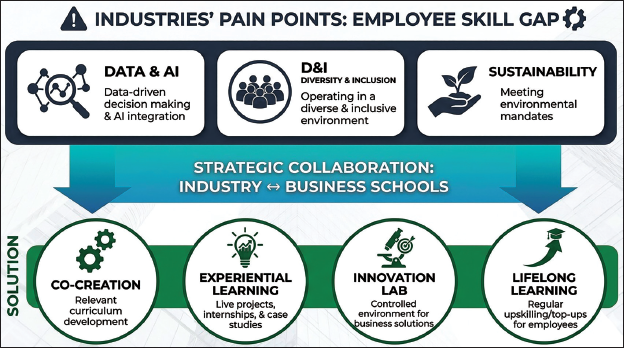
Amid such dynamic environmental changes, management schools are particularly useful for students who will be tomorrow’s employees, serving as controlled spaces to experiment with new ways of thinking and being. Companies can actively work to make these spaces even more effective. Co-creating curriculum is a critical area where industry engagement can enhance the quality of graduating students and improve student fitment, too. Strategic partnerships with top institutes can develop relevant course content and learning structures, helping students hit the ground running.
Further, rapid environmental change can force organisations to evolve quickly. Often, firms need proactive work redesign and sensitivity training. Change management efforts often fail, but leaders are reluctant to discuss them. Honest and open dialogues on the past and current problems faced by industry professionals, along with brainstorming on such practice-based cases, can significantly enhance problem-solving skills and improve the D-A fit.
Even with these efforts, a single-burst education would no longer be sufficient in a rapidly changing world. It needs to be followed by regular ‘top-ups’. The faster the industry’s pace of change, the more frequent the top-ups. Organisations need to partner with top institutes once again to co-create customised modules. Together, they can decide which employee to send to which programme, thereby ensuring a fine-tuned, dynamic fit between demand and abilities.
Figure 1 (based on AI prompts) captures the above arguments.
The Finer Details: Value Fit
Next, the authors share about Value Fit. Value congruence between the employee and the employer leads to enhanced communication and trust. However, value fit is increasingly becoming a concern in modern workplaces. Since the COVID pandemic, more organisations have adopted online and hybrid work models. Increasingly, this has made it harder for companies to socialise workers with organisational values without face-to-face interactions. It is hard to assess value fit during the hiring process, as candidates can convincingly fake it during interviews when they are desperate to get a job.
A better way to ensure value fit would be to associate with top institutes whose values align well with the organisation’s. These institutes can then socialise students appropriately before they join the organisation. An additional check for fit is possible for organisations when they hire students for internships and live projects.
The Finer Details: Need-Supplies Fit
An employee is less likely to change their job, career or occupation if the organisation meets their needs. Soon, Gen Zs and Millennials are likely to be the two largest cohorts in the workforce. Research suggests that Gen Zs are concerned about their mental health. Millennials, on the other hand, tend to have significant caregiving responsibilities, be it childcare or eldercare. However, because the above topics are sensitive, employees might not often speak very freely with their superiors.
Through leadership talks, guest sessions and workshops at management institutions, industry leaders get the opportunity to speak more freely and informally with Gen Z and Millennials and gain invaluable insights into these two generations. The insights allow organisations to offer these cohorts with psychological contracts and incentives that help motivate, retain and nurture talent.
Conclusion
The above steps, as outlined through the P-O fit perspective, provide a comprehensive approach to ensuring that organisations effectively manage the interests of all stakeholders. These collaborations require significant time and effort from the stakeholders. Hence, it would be advisable for the firms to collaborate with a few key education partners rather than visit several institutes. It would not only enhance the quality of the talent pool but also ensure its security. In these turbulent times, human resource development managers and educational institutions can be indispensable humsafar (partners) to each other.
Footnotes
Declaration of Conflicting Interests
The authors declared no potential conflicts of interest with respect to the research, authorship and/or publication of this article.
Funding
The authors received no financial support for the research, authorship and/or publication of this article.