







Abstract
Due to large backward and forward linkages, the manufacturing sector holds a key place in any economy of the world. The importance of this sector increases even more when the economy is at a developing stage, moving away from agriculture dominance towards industrial and services sectors. This article attempts to examine the impact of social security benefits on manufacturing productivity in India while controlling for wages and trade openness. Study has been carried out while using the autoregressive distributed lag (ARDL) bounds testing approach on annual time series data for the period 1982–2019. The results revealed that social security benefits, trade openness and wage rate have a significantly positive impact on manufacturing productivity in the short run as well as the long run, while manufacturing output uncertainty has a negative but insignificant impact. These findings highlight the significance of both economic and social policies in fostering sustainable productivity growth in India’s manufacturing sector.
Introduction
Achieving sustainable economic growth holds a central place in the economic planning of any economy of the world in recent times. Talking about India, its economic growth has been inspirational for developing countries worldwide. During the last four decades, India has witnessed tremendous growth, with an annual average growth rate of approximately 7%, making it one of the fastest-growing economies in the world. India’s growth took off especially after the 1990s’ reforms, which laid a solid foundation for the future growth trajectory of the country. Further, India is on track to become the third largest economy in the world, with an estimated stable growth of 6.5%–7% of GDP, after the United States and China, by the year 2030 (Global Ratings Report, 2024). A fundamental element behind any economic growth is productivity rise, which makes economic growth stable and sustainable. Productivity is defined as the ratio between production size and input size. Regarding the importance of productivity in sustaining economic growth, Krugman (1994) put it in his book ‘The Age of Diminishing Expectations’ as: ‘Productivity isn’t everything, but in the long run it is almost everything. A country’s ability to improve its standard of living over time depends almost entirely on its ability to raise its output per worker’.
Fundamentally, productivity fosters growth, which manifests as an increase in available goods and services within a country. As discussed in scholarly works, Young (1995), achieving a higher growth trajectory through enhanced productivity is considered more favourable than growth resulting from increased input utilisation. There is a substantial body of research confirming that disparities in per capita income among nations are linked to variations in total factor productivity (Ghosh, 2010). An optimal economic trajectory should combine productivity-driven growth with job creation, promoting sustainable economic development (Trivedi et al., 2011).
Given its importance, the factors having potential to impact productivity have been of substantial consideration for countries around the world. As productivity provides the basis for investment, output, socio-economic development and poverty reduction consequently, both researchers and policymakers have placed great emphasis on understanding the factors that contribute to substantial productivity growth (Supriadi, 2016; Tang & Wang, 2004).
The economic development of any country is characterised by the initial phases of agricultural dominance, the intermediate phase of industrial dominance and the later phase by service sector dominance. This conventional paradigm of economic development is said to have been defied in the Indian context, leapfrogging directly from the agricultural sector to the service sector. As the LPG model of the 1990s did not do much to the share of the industrial sector in GDP (Sikdar & Harikumar, 2023), the changing economic reforms of 1991 have been accompanied by improving productivity and profitability of the manufacturing sector.
Given the various challenges and strategies to improve manufacturing productivity, the focus has been diverted to emphasise the role of foreign sourcing of inputs and domestic capacity building. Despite various government initiatives like ‘Make-in-India’, India’s manufacturing sector has not significantly increased its share in GDP or employment. Krishna et al. (2020), in their study, suggest that improving infrastructure, skill development and technology adoption is crucial for enhancing India’s manufacturing productivity and competitiveness in the global market. To understand what determines productivity in manufacturing sector, Yean (1997) suggested that foreign direct investment, trade openness, capital investment, innovation and labour are some of the factors playing a potent role.
Given this context, the government of India has initiated various programs, such as ‘Make in India’ and the ‘Skill India Mission’, to enhance the sector’s performance and aims to increase its GDP contribution to a large extent. While manufacturing sector has shown improvements in labour productivity and employment, its growth has been volatile, particularly in the last two decades. Despite its potential, the manufacturing sector is still trailing behind some global competitors, necessitating further reforms and investments to unlock its full capabilities.
A crucial metric for evaluating the full productivity potential of India’s expanding manufacturing sector is the demographic dividend. With India now surpassing China as the world’s most populous nation, projections indicate that, by 2030, India’s working-age population will peak at 68.9%, whereas its dependency ratio will reach an all-time low of 31.2%. Furthermore, it is anticipated that India’s young dependency ratio, the proportion of children under 15 years of age relative to the total population, will exceed the old dependency ratio (the proportion of people over 65 years of age relative to the total population) by 2056.
Nevertheless, to fully capitalise on the demographic dividend, the nation must provide productive job opportunities for its growing working-age population (Kapoor, 2023). The potentially productive population in the age group of 15–59 years is projected to increase sharply in India from around 757 million in 2010 to 972 million in 2030 (World Bank, 2022). The working-age population is predicted to decrease during the same period in the majority of developed nations, including China, where it is predicted to drop from 913 million to 847 million. This will mean that India will be the main supplier of labour force to the world in years to come, giving India an opportunity to take advantage of this demographic dividend and achieve the status of a developed economy by the time the country starts ageing.
However, there is no guarantee regarding whether the fruits of demographic dividend will materialise. It critically depends, among other things, on whether nations can hire an increasing number of potential workers in a productive manner. This means that productivity growth will play an important role in the future economic dynamics of India. To this end, the current study aims to examine the drivers of manufacturing sector productivity. In particular, we focus on the role of social security benefits (SSBs), wages, and openness on the productivity dynamics of the Indian manufacturing sector.
The rest of the article is organised as follows. Section ‘Review of Literature’ holds insights into the literature, whereas Section ‘Data and Methodology’ provides information regarding data and methodology. Section ‘Discussion on Results’ presents empirical analysis and Section ‘Conclusion and Policy Implications’ provides the conclusion and policy implications of the study.
Review of Literature
Sustaining a consistent growth pattern requires continuous enhancement in productivity. The core of this discussion revolves around identifying the factors that influence productivity growth in the manufacturing sector. Previous research has established that several key elements play crucial roles in driving manufacturing sector productivity growth, including trade liberalisation, inward foreign investment, technological advancements, capital expenditure and workforce dynamics (Yean, 1997). The extent to which these productivity disparities can be attributed to various factors remains a subject of investigation.
Output Uncertainty and Productivity
The impact of uncertainty on productivity has been extensively discussed in the economic literature, starting from the early works of Ramey and Ramey (1991). This literature suggests that higher macroeconomic uncertainty is associated with lower long-term growth, indicating a potential negative link between output uncertainty and productivity. However, later research has refined this view, highlighting that the impact of uncertainty may vary by country characteristics, such as institutional quality and stage of development. In developing economies, greater output uncertainty often deters investment and innovation, thereby dampening productivity growth, while in advanced economies with robust financial and policy frameworks, firms may adapt more efficiently to shocks, mitigating adverse effects.
Comin (2000) and Oikawa (2010) based their argument on the notion that investment provides the channel through which uncertainty influences productivity (Dixit & Pindyck, 1994; Leahy & Whited, 1996). According to Dixit and Pindyck (1994), uncertainty exerts an effect on investment from the option involving delaying projects, which are irreversible once they have begun, and the uncertainty associated with future prices that will affect the project’s profitability. Abel (1983), however, shows that an increase in uncertainty may raise the value of a marginal unit of capital and hence the incentive to invest. Leahy and Whited (1996) argue that the degree to which uncertainty impacts capital efficiency is dependent on how flexible or inflexible the capital is. Comin (2000) contends that uncertainty has an impact on the rate of technological diffusion by offering an incentive to improve research and development (R&D), whereas Oikawa (2010) describes how uncertainty motivates R&D activities and hence influences productivity growth. The latter study also highlights how this could temporarily impede the growth of productivity.
Openness and Productivity
Openness can influence an economy’s factor productivity in a number of ways. Scholars (Sala-i-Martin & Barro, 1995; Grossman & Helpman, 1990; Mankiw et al., 1992) have posited that nations with higher openness are better equipped to assimilate technological advancements produced in the world’s top nations, thereby increasing their productivity. Coe and Helpman (1995), however, contended that only economies with higher and more sophisticated levels of education would benefit more from the transfer of technology and knowledge spillovers. Through economies of scale, exposure to competition and comparative advantage, openness may have an impact on productivity levels. Nonetheless, some research supports the opposing view. Grossman and Helpman (1990) contend that trade may reduce productivity in situations where there are barriers to entry and competition. A study by Krishna et al. (2020) examines the factors influencing productivity, with a specific focus on India’s involvement in global value chains (GVCs) and its utilisation of high-quality capital equipment. The research indicates that participation in GVCs has a positive effect on productivity, especially when interacting with developed economies. Nevertheless, India’s overall engagement in GVCs remains modest in comparison to other nations, such as China.
Many researchers have investigated the openness–productivity nexus at micro as well as macro levels. Most of the scholars have found a positive linkage between the two (Cameron et al., 1999; Coe & Helpman, 1995; Dollar, 1992; Edwards, 1998; Miller & Upadhyay, 2000; Sachs & Warner, 1995). The impact of openness on total factor productivity in Organisation for Economic Co-operation and Development (OECD) countries was studied by Coe and Helpman (1995); the results supported the view that trade openness encourages technology transfer and therefore causes productivity growth. Edwards (1998), using nine indices of trade policy and instrumental variable regression, found a positive correlation between openness and productivity growth (Dollar & Kraay, 2003; Rodriguez & Rodrik, 2000; Zhang, 2021) also demonstrated a positive impact of openness on total factor productivity.
Social Security Benefits and Productivity
The relationship between social security benefits and productivity has been gaining prominence as a field of study. Research indicates that the provision of social security benefits can enhance labour productivity by improving workers’ well-being and job satisfaction (Supriadi, 2016). Employees demonstrate increased productivity when they experience a sense of security regarding their employment and compensation. Moreover, social security provisions can mitigate employment-related risks, thereby motivating workers to enhance their skills and increase productivity (Supriadi, 2016). Nguyen (2009) demonstrates a positive correlation between SSBs, particularly health insurance, and labour productivity. In their study of small establishments with fewer than 100 employees, they observed a positive relationship between SSBs (such as health insurance offers) and productivity. Nguyen (2009) and Buchmueller (2000) provide a summary of studies examining how health insurance may indirectly improve productivity.
The conventional perspective posits that social security, functioning as a crucial mechanism for income redistribution and facilitating transfer payments, primarily aims to achieve equity. Consequently, this view suggests that an excessive social security system may result in a decrease in the efficiency of resource allocation (den Butter & Kock, 2003). According to Sala-i-Martin (1996), the accumulation of human capital through social security enhances labour productivity and contributes to the long-term sustainability of economic growth. The enhancement of human capital is a critical factor in increasing productivity, and this enhancement is facilitated by the benefits of social security (Lucas, 1988). ‘Quality of Work Life’ (QWL) is characterised as offering employees safety, basic living necessities and opportunities for social interaction and personal development. A work environment that ensures these aspects is likely to boost productivity and generate greater value for organisations. Zhang et al. (2019) support the view by arguing that social security can promote productivity growth by fostering human capital development.
Wages and Productivity
The relationship between labour productivity and wages is a crucial factor influencing workers’ quality of life and the allocation of income between labour and capital (Feldstein, 2020). This connection operates bidirectionally. Efficiency wage theory posits that higher wages can enhance productivity, as workers respond positively to the increased incentives offered by their employers. This theory posits that increased real wages can enhance labour productivity by raising the cost of job loss, thereby encouraging workers to exert more effort to retain their positions. From a broader economic perspective, higher real wages may lead to increased labour costs, potentially prompting firms to substitute labour with capital. As Wakeford (2004) notes, this shift towards capital can enhance the marginal productivity of labour. The positive connection between real wages and labour productivity can also be attributed to the fact that higher wages make job loss more financially detrimental for workers, thus motivating them to work more diligently and efficiently. Moreover, as larger capital stocks drive up demand, real wages increase, this in turn fosters further improvements in productivity. Conversely, neoclassical theory proposes that enhanced worker productivity leads to wage increases (Herman, 2020). Nigel and Stefan (2011) endorse the notion that wages are intrinsically connected to marginal productivity, aligning with microeconomic theory. As labour productivity rises, companies are more inclined to increase their workforce, given the potential for enhanced profitability. This concept reinforces the principle that wage increases ought to be correlated with enhancements in worker efficiency, thereby ensuring sustainable growth in both employment levels and corporate earnings.
Consistent with efficiency wage theory, research conducted by Erenburg (1998), Hsu (2005), Mora et al. (2005) and Klein (2012) have consistently demonstrated a positive link between rising real wages and improvements in labour productivity. These findings suggest that increasing real wages not only benefits workers financially but can also contribute to overall economic efficiency by enhancing labour output and effectiveness. However, increasing wages without considering other economic elements, such as demand and productivity, might not result in increased employment. Rather, for wage increases to be efficacious, they must be in harmony with enhancements in labour productivity (Hellwig & Irmen, 2001).
The existing literature on the drivers of productivity in the Indian manufacturing sector is diverse and lacks comprehensive analysis. The studies mainly focus on some aspects like micro level components and productivity, regional disparities and productivity, infrastructural development and productivity. However, a comprehensive analysis which includes the amalgam of these factors of productivity is underrepresented in the literature. Against this backdrop, this study attempts to examine the impact of social security benefits, trade openness, and wage growth in determining overall productivity in the Indian manufacturing sector.
Data and Methodology
Data
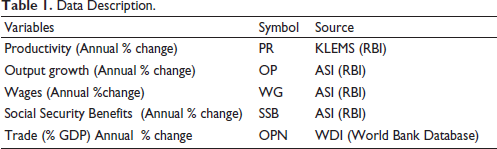
Current study uses annual times series data for the period of 1982-2019. ASI Data on registered industrial sector has been taken from RBI database. Data has been taken for productivity growth, wage growth, social security benefits, output growth and trade openness (Trade % of GDP). Data has been converted into growth rates before analyzing the data. Further information regarding the symbol and sources of data is provided in Table 1.
Data Description.
Methodology
The following model has been estimated to examine the determinants of manufacturing productivity.

Where PR represents productivity in manufacturing sector, SSB refers to social security benefits in manufacturing, WG refers to wage growth in manufacturing, OPN represents trade openness (trade % GDP), OP represents output in manufacturing sector and ε refers to white noise.
The nature of study variables makes it optimal to use ARDL model. This methodology has been used as the study variables were stationary at different orders. The Autoregressive Distributed Lag (ARDL) model is a dynamic econometric technique commonly used to analyze both short-run and long-run relationships between variables. ARDL (Pesaran and Shin 1999 and Pesaran et al. 2001) has an advantage over other econometric models, as it allows the incorporation of combination of I(0) & I(1) variables into the estimation. Further this model is also suitable when the study period is comparatively small (Pesaran & Shin, 1999). Additionally, ARDL allows the inclusion of lags, providing more detailed insights into dynamic relationships among variables. Following Pesaran and Shin (1999) and Pesaran et al. (2001), the model for current study is expressed as:

Here, parameters (
Upon confirmation of Cointegration from bounds testing approach, an error correction model (ECM) is constructed:

In equation 3, ECM denotes the error correction term, which represents the speed of adjustment, while the remaining coefficients capture short-run dynamics.
Empirical Analysis
Before moving for econometric analysis, we first examined descriptive nature of the study data using descriptive statistics. The results of this exercise revealed that data follows normality condition, with Jarque–Bera test probability exceeding 0.05 for all the variables. Further we tested for the unit root of underlying variables using augmented Dickey-Fuller (ADF) test. The results of unit root test are presented in Table 2.
Unit Root Results.
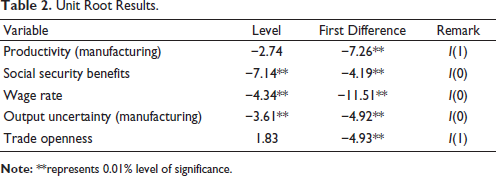
Unit root results presented in Table 2 reveal that study variables are stationary at different levels. Specifically, social security benefits, wage rate and manufacturing output uncertainty are stationary at level I(0), and productivity and trade openness are found to be stationary at first difference. So overall unit root results suggest that underlying variables are combination of I(0) and I(1), making ARDL as optimal model of empirical estimation. While estimating the ARDL model, the first step is to ensure that the model variables are cointegrated in the long run. To serve this purpose, the bounds test is applied.
Cointegration Test
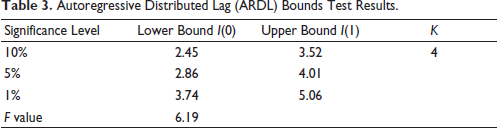
Long-run association is tested by conducting a bounds test of cointegration. Table 3 summarises the results of the bounds test. The results show that the F-statistic is greater than the upper critical bound at the 1% level of significance. This implies that the bounds test rejects the null hypothesis of no cointegration. Therefore, it is inferred that a long-run relationship exists.
Autoregressive Distributed Lag (ARDL) Bounds Test Results.
Long-run and Short-run Estimates
After the confirmation from bounds test that variables hold a long-run association, we estimated the ARDL model. Table 4 presents results of this step, with panel A representing long-run results and panel B representing short-run results. The long-run results signify that in the long run as well as in the short run, all variables except manufacturing output uncertainty are statistically significant and are signed in line with the theoretical background. Social security benefits have a significantly positive impact on manufacturing productivity, where a 1% increase in social security benefits aligns with a 0.253%. Wage growth also has a positive and significant impact on productivity in manufacturing sector in the long run, with coefficient of 0.55 along with a p value of .01. Further, trade openness has a strongly positive and significant impact in the long run, with a coefficient of 0.63, meaning a 1% increase in openness increases productivity in manufacturing by 0.63%. Lastly, manufacturing output uncertainty has a negative but statistically insignificant impact on productivity in the manufacturing sector.
Autoregressive Distributed Lag (ARDL) (Long-run and Short-run Results).
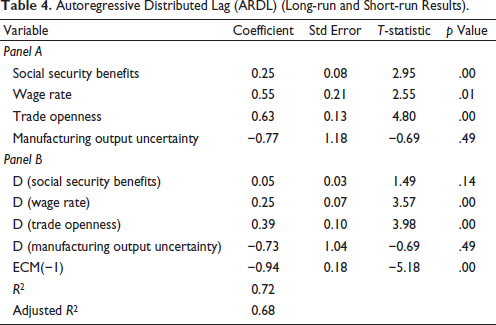
Similar to long run, wage rate and trade openness have a positive and significant impact on manufacturing productivity in the short run as well, with coefficient of 0.25 and 0.29, respectively. However, the strength of impact is weaker in the short run as compared to the long run. Further, social security benefits and manufacturing output uncertainty have statistically insignificant impacts in the short run. The coefficient of the error correction term is −0.94, with a p value of .00, and suggests an appreciably quick speed for establishing equilibrium in case any disequilibrium occurs. Further, model statistics like R2 of 0.72 and adjusted R2 of 0.68 suggest suitable model selection. These results are further discussed in the succeeding sections.
Discussion on Results
The results of this study provide valuable insights into the socio-economic determinants of factor productivity in manufacturing sector in the long as well as short run. The findings of current study extend the existing literature in several ways. The finding of positive impact of SSBs productivity in manufacturing contributes to the ongoing discourse regarding the interplay between social welfare and economic output. Whilst certain studies have proposed that generous social programmes might diminish work and innovation incentives, this outcome aligns more closely with research, suggesting that social security can boost productivity by offering a safety net that fosters risk-taking and entrepreneurial activities (Acemoglu & Hawkins, 2014; Shimer, 2007). Moreover, the results corroborate the conclusions of Nguyen (2009) and Supriadi (2016), who posit that social security benefits enhance labour productivity through improved worker well-being and job security. The marginal short-term significance also supports the notion that SSBs can yield immediate productivity gains. The negative lagged effect observed in the short run may reflect the perspective of den Butter and Kock (2003), suggesting that excessive social security benefits can lead to short-term inefficiencies in resource allocation.
The substantial long-term impact of trade liberalisation on manufacturing productivity corroborates the extensive research highlighting the productivity advantages of international trade. This observation aligns with studies demonstrating how increased trade can facilitate technological dissemination, increase competition and yield economies of scale and efficiency improvements (Coe & Helpman, 1995; Grossman & Helpman, 1990). The enduring positive effect of trade openness may be attributed to the spread of technology, whereby exposure to global markets enables the adoption of cutting-edge technologies and optimal practices. Additionally, open markets compel domestic firms to enhance efficiency to remain competitive, while allowing countries to concentrate on areas of comparative advantage, thus boosting overall productivity. Krishna et al. (2020) further suggest that engagement in GVCs positively influences productivity, which is consistent with these findings. The lack of significant short-term effects may reflect the argument put forth by Rodriguez and Rodrik (2000), who contend that the benefits of openness are not always immediate or uniform across different economies.
Manufacturing output uncertainty is revealed to have a negative but insignificant impact on workers’ productivity in the manufacturing sector. As suggested in the economic literature above, output uncertainty can potentially affect productivity by impeding investment decisions. Further, in times of uncertainty, workers are uncertain about their future employment position, which can act as a hurdle to their efficient working. In terms of the direction of the relationship, the results are in line with the studies of Abel (1983), Comin (2000), Dixit and Pindyck (1994) and Leahy and Whited (1996). The statistically significant long-term effect of wage growth on productivity is expected. This is in line with the efficiency wage theory, which asserts that workers’ effort is a positive function of the wage rate. Further this finding aligns with research by Erenburg (1998), Hsu (2005) and Mora et al. (2005), which demonstrates a positive correlation between rising wages and productivity, in line with efficiency wage theory. However, it contradicts with the work of Wakeford (2004), who recognises the possibility of a negative relationship, particularly in the short term, where wage increases without corresponding productivity enhancements may result in higher labour costs and potentially reduced efficiency. Feldstein (2020) has also identified mixed or weak associations between wage growth and productivity improvements.
The rapid adjustment to the long-run equilibrium, as indicated by the significant and negative error correction term, suggests a high degree of flexibility in the economy’s response to shocks. This robust ECM coefficient corroborates that short-term shocks to productivity are corrected in the long run, aligning with Nelson (2000) and the Solow growth model, which emphasises the importance of long-term factors (e.g., technological advancement) in restoring productivity levels after short-term fluctuations. The expeditious adjustment indicated by the error correction term suggests economic flexibility and efficacious policy transmission. These relationships highlight the complex interplay between the factors influencing productivity in Indian manufacturing sector, emphasising the importance of considering both economic and social policies in promoting productivity growth.
Diagnostic Test Estimates
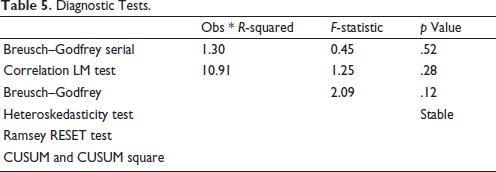
The results of the diagnostic tests confirm that the underlying model is free from the problems of serial correlation and heteroscedasticity. The p value of the F-statistic for both problems accepted the null hypothesis of no serial correlation and absence of heteroscedasticity. Additionally, Ramsey RESET test is applied in order to test check for model specification, the results revealed that model is correctly specified with no omitted variables and therefore appropriate for estimation. Lastly, CUSUM and CUSUM square test results suggest that model parameters are stable across the study period. The results are presented in Table 5.
Diagnostic Tests.
Stability Test Estimates
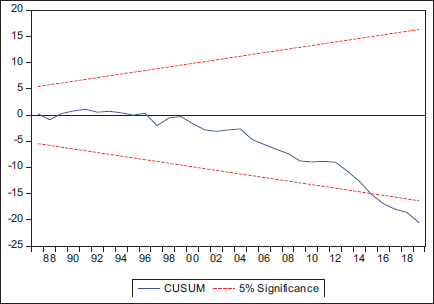
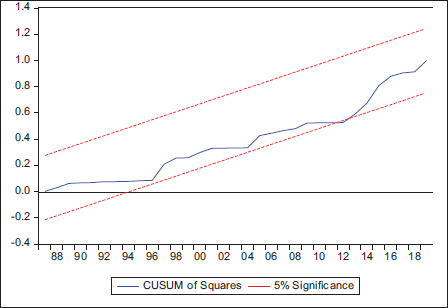
Cumulative sum and cumulative sum of squares tests were employed to check the stability of the underlying variables in the model. The rule is if the blue line stays within the red dashed lines, it represents that model residuals are stable across the study period. The straight lines depict the significant bounds at the 5% significance level in both tests. The results presented in Figures 1 and 2 validate the stability of the proposed model.
Cumulative Sum (CUSUM).
Cumulative Sum (CUSUM) of Squares.
Conclusion and Policy Implications
Sustained productivity growth achievements are vital especially for developing and underdeveloped economies in order to reach the development levels achieved by developed countries overtime. India being one of the fastest-growing economies of the world needs to nurture its productivity growth in order to be able to sustain high growth achievements. To this end current study has attempted to examine the impact of social security benefits on manufacturing productivity in India using wage rate, trade openness and manufacturing output uncertainty as control variables. Study findings offer significant insights into the short- and long-term connections between manufacturing productivity and socio-economic factors, including social security benefits wage growth, trade openness and manufacturing output uncertainty. The results reveal that social security benefits, openness and wage rate have a substantial positive impact on manufacturing productivity in India during the study period. The swift adjustment to the long-run equilibrium demonstrates the economy’s resilience and adaptability in response to shocks.
The study findings highlight that policymakers should concentrate on nurturing the interests of workers by providing more enhanced incentives like social security benefits, which will prove helpful in pulling the best out of manufacturing workers, thereby leading to appreciable productivity gains. Furthermore, by integrating Indian manufacturing into GVCs and increasing openness through trade and investment policies, competitiveness can prove vital for the enhancement of productivity in the manufacturing sector. Creating sustained growth through focused industrial policies may help support innovation, technology adoption and infrastructure development, leading to increased manufacturing productivity in India.
Footnotes
Acknowledgement
The authors are grateful to anonymous referee for useful comments. Usual disclaimers apply.
Declaration of Conflicting Interests
The authors declared no potential conflicts of interest with respect to the research, authorship and/or publication of this article.
Funding
The authors received no financial support for the research, authorship and/or publication of this article.