







Abstract
Quantitative social network research in prison contexts has largely overlooked cooperative practices, such as communal cooking. Remarkable, since qualitative prison food studies identify communal cooking as an important activity through which social bonds are formed and resources are pooled. However, little is known about how cooking partnerships are structured and which factors shape them. This study addresses this gap by analysing cooking networks among 119 incarcerated men across three prison units in The Netherlands. Using social network analysis, the study examines whether financial resources, cooking skills, status and socio-demographic characteristics are associated with the likelihood of cooking together. Findings show that communal cooking is structured by trust, friendship, social similarity and status, rather than by resources or cooking skills as was shown in prior research. Based on our results, we argue that prison food provisions should consider the impact of their institutional arrangements on social organisation and how to actively promote collaboration and constructive social interaction.
Introduction
Food practices in prisons have received considerable attention in recent qualitative criminological food studies (e.g. De Graaf and Kilty, 2016; Earle et al., 2012; Rouhan, 2012; Smoyer, 2014; Vanhouche, 2022). These studies focus particularly on how incarcerated persons engage in practical tasks related to food, such as communal cooking. They highlight how communal cooking promotes efficiency, by dividing tasks to reduce the overall workload, save time, and foster teamwork (e.g. Earle et al., 2012; Minke, 2014). They also demonstrate the importance of social relationships and collaborations. Cooking or handling food together has been shown to be a crucial social catalyst within the prison context, influencing incarcerated persons’ relationships, identities, and informal economies (Earle et al., 2012; Ifeonu et al., 2023; Minke, 2014). It reflects familial and cultural identity, improves relationships, and enhances skills needed for reintegration (Maruca et al., 2021).
Surprisingly, recent quantitative social network studies in prisons have not focused on with whom individuals collaborate on tasks. These social network studies often focus on with whom individuals get along (Kreager et al., 2024; Schaefer et al., 2017; Sentse et al., 2021; Wenger et al., 2023) or on peer integration (Kreager et al., 2016a). They primarily describe the structure of social networks in prison and test hypotheses about how social relations are structured by incarcerated persons’ social and incarceration characteristics (Kreager et al., 2024; Schaefer et al., 2017; Sentse et al., 2021; Wenger et al., 2023). However, social network studies have not examined with whom incarcerated persons collaborate, for example when preparing meals.
This study aims to combine insights from the qualitative prison food literature with the strengths of existing quantitative social network frameworks. It does so by generating and analysing social networks based on collaboration in communal cooking among incarcerated men. A quantitative social network approach was chosen because it complements existing qualitative research by providing a broader view of social interactions and structures within prisons (Kreager et al., 2016b; Kreager et al., 2024). This approach extends previous studies by measuring not only direct ties but also complex indirect relationships among incarcerated persons, thereby offering a more comprehensive understanding of the informal social systems at play (Smith and Christakis, 2008). Furthermore, unlike qualitative methods, network analysis allows for the quantification of associations between persons’ social and detention characteristics and the likelihood of communal cooking (Fleisher, 2005; Kreager et al., 2016b).
Using a quantitative social network framework, the current study aims to provide a detailed depiction of the complex social world within prisons and how it relates to collaboration in cooking. It does so, using data collected in 2025 from 119 incarcerated men across three units in a prison in the Netherlands. Based on the findings of qualitative prison food studies, the current study tested whether incarcerated men are more likely to cook with peers who share the same characteristics, such as age, educational level, unit tenure, type of offence, country of birth, and food preference. Similarly, the current study tests whether incarcerated persons with greater financial capital, cooking skills, and status are more likely to be cooking partners.
Insights from prior prison research
Insights from qualitative food studies
Qualitative criminological food studies routinely show that participation in communal cooking, particularly within a cooking group, is carefully considered by incarcerated persons and rarely occurs randomly (Avieli et al., 2024; Earle et al., 2012; Minke, 2014; Smoyer, 2015). Cooking with someone is often based on strategic or social advantages within the broader prison society. Moreover, these studies find that the likelihood of cooking together with other incarcerated persons is related to social and detention characteristics. Below we discuss several of these characteristics.
First, the choice of cooking partner is shown to be based on shared food preferences and dietary habits (Minke, 2014). People tend to collaborate on food-related tasks when they share a common goal or preference. Individuals who frequently ate pork would rarely cook with Muslim peers (Minke, 2014; Vanhouche et al., 2018; Woods-Brown et al., 2024). The same applies to differences in food preferences more broadly. Self-catering provides an opportunity to connect and to express one's cultural identity through the creation of culturally specific dishes (Ugelvik, 2011; Woods-Brown et al., 2024). A cooking partner who shares the same preferences may therefore be more beneficial than one whose tastes differ considerably.
Second, one study found that individuals who arrived in prison at the same time tend to gravitate towards each other (Weir, 2021). However, some longer-term incarcerated individuals are less willing to collaborate around food. For example, those serving longer sentences are less inclined to cook communally, as they seek to avoid the frequent turnover of short-term incarcerated individuals (Weir, 2021).
Third, the choice of cooking partner is also based on friendship and trust. Cooking together serves as an expression of trust, as it demonstrates that people rely on each other to ensure that food is prepared safely and hygienically (Vanhouche, 2019; Weir, 2021). Conversely, avoiding someone during cooking or eating is a powerful way to signal or negotiate distrust (Vanhouche, 2019; Weir, 2021).
Fourth, recent qualitative research has also highlighted economic factors that shape relationships in the context of communal cooking. Exchanging and sharing food, tools, resources, experiences, and ideas are often described as part of an informal food economy (e.g. Avieli et al., 2024; Bardelli et al., 2023; Earle et al., 2012; Vanhouche, 2022). Within this informal economy, a noteworthy concept may be at play: ‘financial capital’. Financial capital enables access to food through the prison commissary. Money can be earned through low-paying prison jobs, provided by family or friends, obtained via the illegal prison economy, or from employment prior to incarceration. Incarcerated persons who have financial means often enjoy better access to food, can obtain more desirable products, and are able to exert influence within the informal food economy (Avieli et al., 2024; Bardelli et al., 2023; Einat and Davidian, 2019; Irwin and Cressey, 1962; Montford, 2023). This unequal access to food-related opportunities reflects and reinforces social hierarchies within the prison environment, as those without the capital to participate in this informal economy remain vulnerable (Bardelli et al., 2023; Einat and Davidian, 2019; Minke, 2014). Food and its possession in prison serve as powerful tools for constructing and perpetuating exploitation and unequal power relations among incarcerated persons (Avieli et al., 2024; Einat and Davidian, 2019). Importantly, financial resources also shape participation in communal cooking practices. The ability to contribute financially to a cooking group, for example by purchasing ingredients or covering shared costs, may influence who is able to join or sustain these collaborative arrangements. Thus, financial capital determines not only access to food but also social organisation.
Fifth, in addition to financial capital, another form of capital in the informal prison economy is ‘cooking skills’. This refers to the skills and knowledge required to recreate dishes (Avieli et al., 2024; Minke, 2014; Smoyer, 2016; Vanhouche, 2022; Woods-Brown et al., 2024). In a prison context where money is scarce, good food becomes a new form of currency (Valentine and Longstaff, 1998). For example, Minke’s (2014) study of a Danish prison found that individuals with strong cooking skills enjoyed a higher social status, using their culinary expertise to gain respect and improve their position among peers. In contrast, those lacking such skills were relegated to lower social statuses (Minke, 2014). Acquiring and preparing food has thus become a means of renegotiating one's social position (e.g. Avieli et al., 2024; Minke, 2014; Smoyer, 2016).
Insights from quantitative network studies
Although quantitative network studies in prisons have not focused on communal cooking, the importance of social relations and organisation among peers within the carceral context has been widely acknowledged (e.g. Edison and Haynie, 2024; Haynie et al., 2018; Liebling and Arnold, 2012; Sentse et al., 2021). Prison studies in this area found that social relations serve various purposes, including alleviating the pains of imprisonment, gaining access to resources, and providing emotional support or improving health outcomes (Edison and Haynie, 2024; Haynie et al., 2018; Kruttschnitt and Gartner, 2005). However, studies also found that some incarcerated persons are sceptical of trust and relationships with their peers, viewing them as unnecessary given the potential for betrayal, mental distress, and the high cost of social investment (Crewe, 2009; Kreager et al., 2016a; Liebling and Arnold, 2012; Whichard et al., 2022).
Recent quantitative social network studies conducted in prisons examined social relations in terms of friendships (e.g. Dillavou, 2024; Hashimi and Schaefer, 2024; Schaefer et al., 2017; Sentse et al., 2021), and power (e.g. Hashimi and Schaefer, 2024; Kreager et al., 2021). These studies generally sought to identify the determinants of existing relations by asking incarcerated individuals ‘who they get along with’ or ‘who they trust’, as a proxy for friendship, since the term ‘friendship’ is contentious and individuals are often reluctant to use it to describe their relations with peers (Crewe, 2009). These social network studies found that many incarcerated persons do turn to one another, and that around half of incarcerated persons reported having close friends or someone in whom they confided (Kreager et al., 2016a; Lindquist, 2000; Sentse et al., 2021).
Furthermore, homophily, the tendency to form ties with those who share similar characteristics, is shown to be an important determinant of network formation and structure. Prior studies found that incarcerated persons are more likely to establish relations with those who share similar characteristics, such as ethnicity, age, religion, unit tenure, or offence type and offence severity (Hashimi and Schaefer, 2024; Haynie et al., 2018; Kreager et al., 2021; Schaefer et al., 2017, 2021; Sentse et al., 2021). Additionally, one study found that friendship within the prison context is primarily driven by individual attributes and less by network-based positions, such as popularity or being central in the network (e.g. Hashimi and Schaefer, 2024).
Social relationships can also be understood as an investment strategy, aiming to establish ties that secure material or symbolic profits (Bourdieu, 2011). Within Bourdieu's framework, social position is structured by a broader constellation of capital forms, such as economic, social, and cultural capital. These together shape everyday practices (Bourdieu, 1984). For example, persons with similar economic resources tend to share comparable routines and consumption patterns, which in turn creates conditions for social proximity and for the formation of social relationships (Bourdieu, 1984; Jackson, 2019). The tendency to form similar connections is also influenced by how close people are to each other. Persons with similar socioeconomic characteristics or backgrounds are more likely to meet and form social bonds, which is possible through both opportunity-based and value-based mechanisms (Girard et al., 2015; Lazarsfeld and Merton, 1954; McPherson et al., 2001).
Lastly, prison network studies compared the structural features of social networks in prison with those found in other contexts. Network effects such as homophily and transitivity (i.e. whether two persons are connected through a mutual friend), were found to be similar in prison friendship networks compared to those outside prison (Schaefer et al., 2017, 2021). Another network feature, reciprocity (i.e. whether network relationships are perceived as mutual), was found to be lower in schools, compared to the prison context (Hashimi and Schaefer, 2024; Schaefer et al., 2017).
Nevertheless, despite the numerous quantitative social network studies conducted in prison contexts, and the rich insights they provide, these studies have hardly focused on cooperative practices, such as communal cooking among incarcerated persons.
Current study
Aims
The current study therefore aims to fill this gap by combining findings from recent qualitative studies on food practices in prison, with a quantitative social network framework. Specifically, we tested whether incarcerated men are more likely to cook with peers who share certain characteristics such as age, educational level, unit tenure, type of offence, country of birth and food preference. Likewise, the current study tests whether incarcerated persons with greater financial capital, cooking skills and status are more likely to be cooking partners. We test these expectations using data on cooking networks of incarcerated persons residing in three units of a penitentiary institution in the Netherlands.
The Dutch prison context
In the Netherlands, the Custodial Institutions Agency (CIA) is responsible for all 25 penitentiary institutions. In 2024, the average national occupancy in these institutions was 9,417 persons, with a total incarceration influx of 22,152 persons (Dienst Justitiële Inrichtingen, 2025). Most incarcerated persons reside in units operating under a prison/sentenced regime with an average incarceration length of four months (Dienst Justitiële Inrichtingen, 2023). These shorter sentences create a prison context characterised by a dynamic and constantly changing population.
Prison food provision in Dutch prisons falls under the scope of the CIA, which in turn contracts meal suppliers responsible for providing meals (Van der Vlist, 2022). The meal suppliers provide ready-made meals as well as breakfast packages in almost all penitentiary institutions. In addition to this provision, incarcerated individuals can purchase ingredients from the prison commissary at their own expense and prepare their own meals which can often be prepared in unit kitchens (Groeneveld et al., 2025). However, since 2022, the CIA has implemented a new contract with meal suppliers which increased the quality of ready-made meals as well as allowing the suppliers to provide fresh ingredient packages for self-catering purposes (Nieuwbeerta et al., 2025). Fresh ingredient packages provide ingredients to prepare a warm meal for 2 to 3 days. Each week, incarcerated individuals can choose one of three packages: vegetarian, halal, or regular. For more information about food provision in the Dutch carceral system, see Visser et al. (2026), Nieuwbeerta et al. (2025), or Van der Vlist (2022). As a result, many prison units have the option to periodically choose between a ready-made meal, and a fresh ingredient package, or have the option to refuse food provision altogether, which often implies that they will use their own purchased products.
Participants
The sample and data used for this study were drawn from the Food-in-Custody project (FIC-study). The FIC is a biannually nationwide prospective study designed to examine the quality of prison food in all Dutch correctional facilities. This project is conducted by the University of Leiden and the Vrije Universiteit Brussel. Its purpose is to explore the experiences of incarcerated persons regarding prison meals. 1
The data used in this study were collected from three units in a large prison in the Netherlands. The units shared the same regime, physical layout and meal options. These units were selected based on several key criteria. First, units had to possess self-catering facilities. Second, a high percentage of active self-catering individuals had to reside within these units, as self-catering offers greater opportunities for food-related interactions. Third, units with a stable population were selected, since a stable population allows relationships and dynamics to develop (Sentse et al., 2021). This meant, that only units operating under a prison regime were selected, as these have a more stable population compared to units with a remand or other regimes. Fourth, units with a size greater than 20 residents were selected, to ensure that social network models could provide meaningful analyses. Lastly, only units with a response rate of at least 70% were included, as prior research has shown that social network parameters are reliable with up to 30% of missing data (Kossinets, 2006).
Data were collected following approval from the ethical committee from Leiden University (nr. 1326). The research staff from the Leiden University invited all incarcerated men in the selected units to participate in the study. All men were informed of the purpose of the study and of its voluntary nature, a small Dutch treat, specifically a stroopwafel, was given to all participants and non-participants. Data-collection consisted of two paper surveys. The first survey was based on the surveys used in the Food-in-Custody project, focused on self-catering and food experiences, with several additional questions regarding demographic characteristics and communal cooking. This survey was completed individually (with research staff sometimes assisting participants). The second survey consisted of the social network questions, which included the names and cell numbers of all incarcerated men on the respective unit. Due to the sensitive nature of this information, these questions were taken verbally together with the research staff and immediately put in a secured envelope to ensure confidentiality. At the end of each data collection day, the names and cell numbers of all men were removed from the questionnaire and destroyed. This data was replaced with an anonymised code.
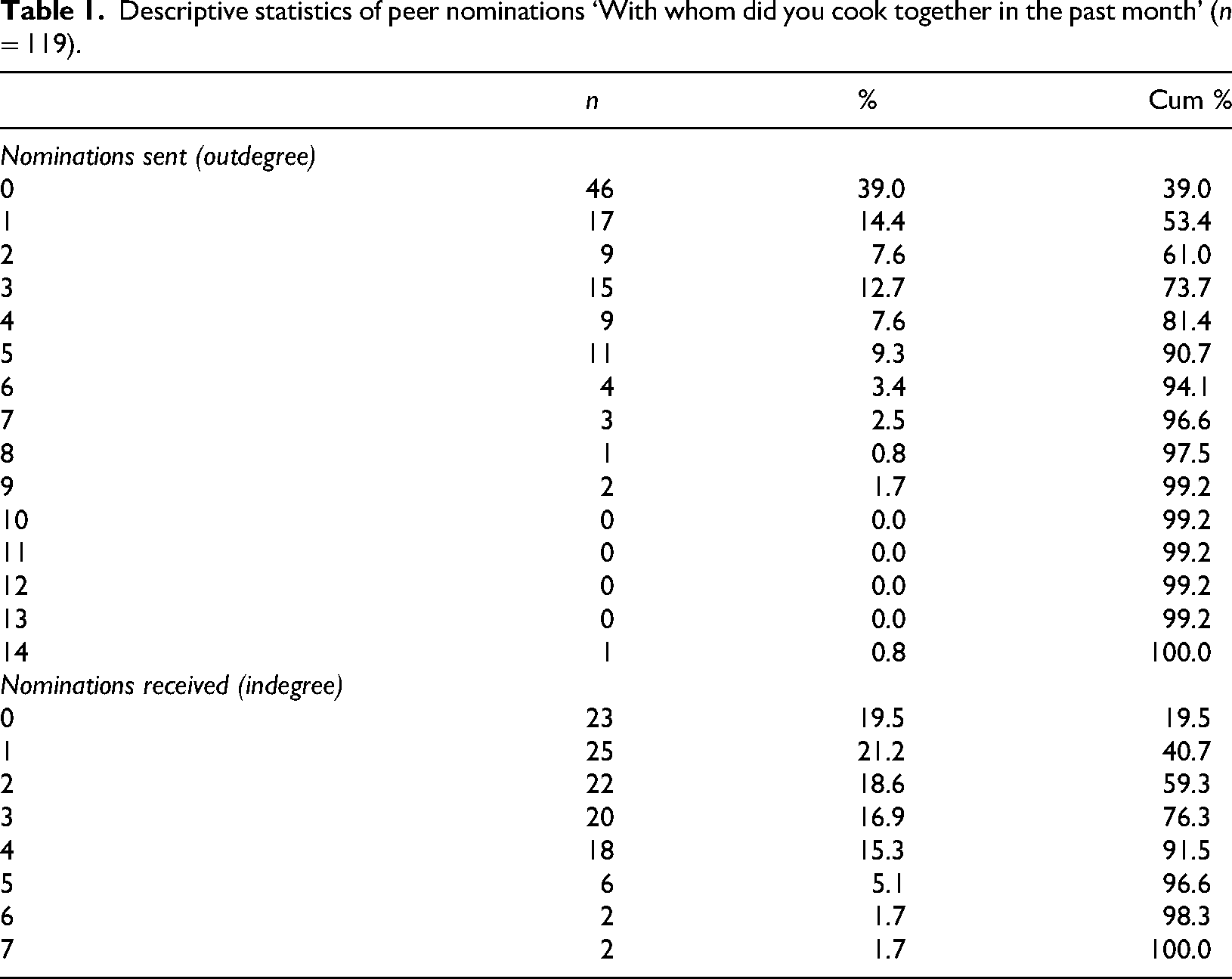
Two of the three included units had a maximum capacity of 48 incarcerated men, however, at time of data-collection one unit was at full capacity whereas the other housed only 47 men. The third unit was smaller, with a maximum capacity of 24 men. In total, 119 men resided in the three units of whom 90 (76%) participated in the network study and 83 (70%) completed the additional questions regarding demographic factors. The average network measurements for the three units are combined and presented in Table 1. The mean density across the three units was 6%, meaning that only 6% of all mathematically possible ties were present. This is comparable to the friendship network reported in the Dutch study by Sentse et al. (2021). Compared to that study, the average level of reciprocity, that is, the percentage of dyads in which both incarcerated persons nominated each other as cooking partners, was relatively high, with an of average of 32% of nominations being bi-directional.
Descriptive statistics of peer nominations ‘With whom did you cook together in the past month’ (n = 119).
Measures
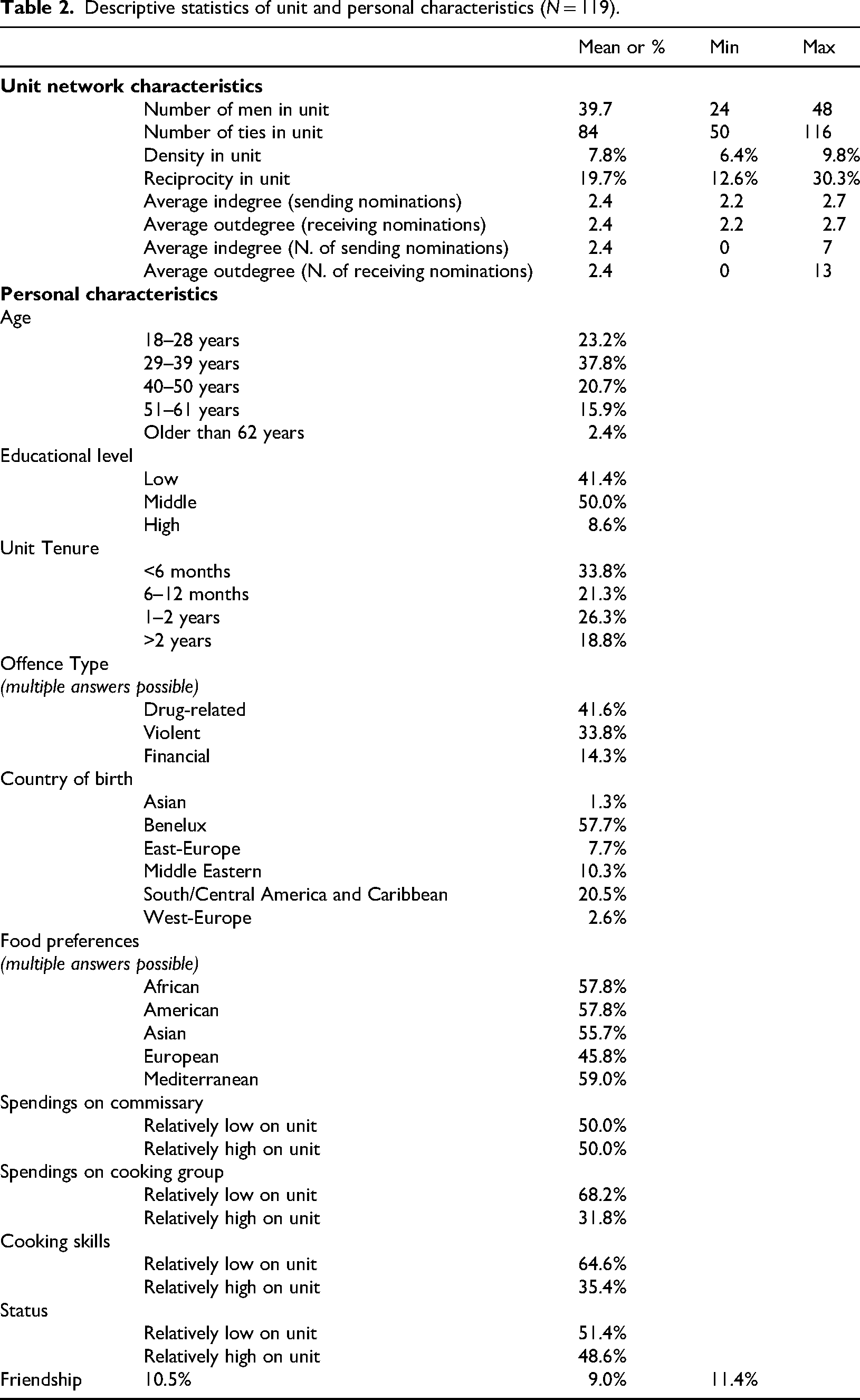
Tables 1 and 2 present descriptive statistics of the collected data on the number of incarcerated men who reported cooking together, as well as unit characteristics and the personal characteristics of the incarcerated individuals.
Descriptive statistics of unit and personal characteristics (N = 119).
Analytic strategy
The data were analysed using Exponential Random Graph Models (ERGMs), to examine the structure of the cooking network and the likelihood that two men in the same unit cook together is associated with their social and detention characteristics. ERGMs are statistical models designed to analyse how relations exist between individuals within a network. This model estimates the probability that a cooking partnership exists by taking into account, the characteristics of each participant, the characteristics of each potential cooking partner, and the pattern of relationships (ties) they share with other peers in the network. The resulting parameter estimates indicate how specific characteristics affect the likelihood that two individuals within the same network form a cooking tie. More information on the ERGMs can be obtained from prior studies which applied these models in social network studies conducted in prisons (e.g. Kreager et al., 2024; Sentse et al., 2021; Wenger et al., 2023), or in publications addressing the broader statistical background of these models (e.g. Holland and Leinhardt, 1981; Robins et al., 2007; Snijders et al., 2006).
For this study, we estimated two ERGMs using the statnet package in R (Handcock et al., 2008). One ERGM including all variables and one ERGM without the variable friendship. For both ERGMs, the cooking networks of the three units were pooled into a single block-diagonal network, in which ties between units were structurally impossible. These models included data from all incarcerated men housed on the units. So, men who did not participate in the study, were included as well, as they could have been nominated by others as cooking partners. A constraint was applied to restrict tie nominations to survey respondents only, providing a more realistic representation of the observed data, as is also done in comparable research (Kreager et al., 2024). The ERGMs were built gradually, adding one component of factors at a time to detect model degradation, as is done in similar studies (e.g. Hashimi and Schaefer, 2024; Sentse et al., 2021). Whenever the inclusion of an effect led to model degeneracy, its decay parameter was fixed, after which convergence and model fit were reassessed.
Since this network study relied on self-reported data, missing values occurred at the attribute level. This is uncommon in previous studies, which typically use administrative records, also from non-participants. Missing values on attributes are not supported in ERGM estimation. To address this limitation, missing values on sender and receiver characteristics were treated as a separate category in the analyses which are not reported in the results. For similarity effects (homophily), missing values were ignored by using the levels command in R. This means that the ERGM did not calculate the similarity effects between missing values and thus the only values in the similarity effects are based on filled in data. Consequently, the shown results have omitted and ignored missing values on attribute level and are based on filled in data. We reduced potential bias in the estimation of homophily (similarity), sociality (sender), and popularity (receiver) by treating missing values on the relevant attributes as separate (dummy) categories in the analyses; these parameter estimates are not reported in Table 3. Friendship, which can likewise be conceptualised as a network or matrix, was treated somewhat differently. Just as in the cooking network, men who did not participate in the study were included and could be nominated by others as individuals they got along with. However, these non-respondents did not have the opportunity to nominate others themselves Thus, their out-degree was set to 0, as is done in comparable network studies (e.g. Sentse et al., 2021).
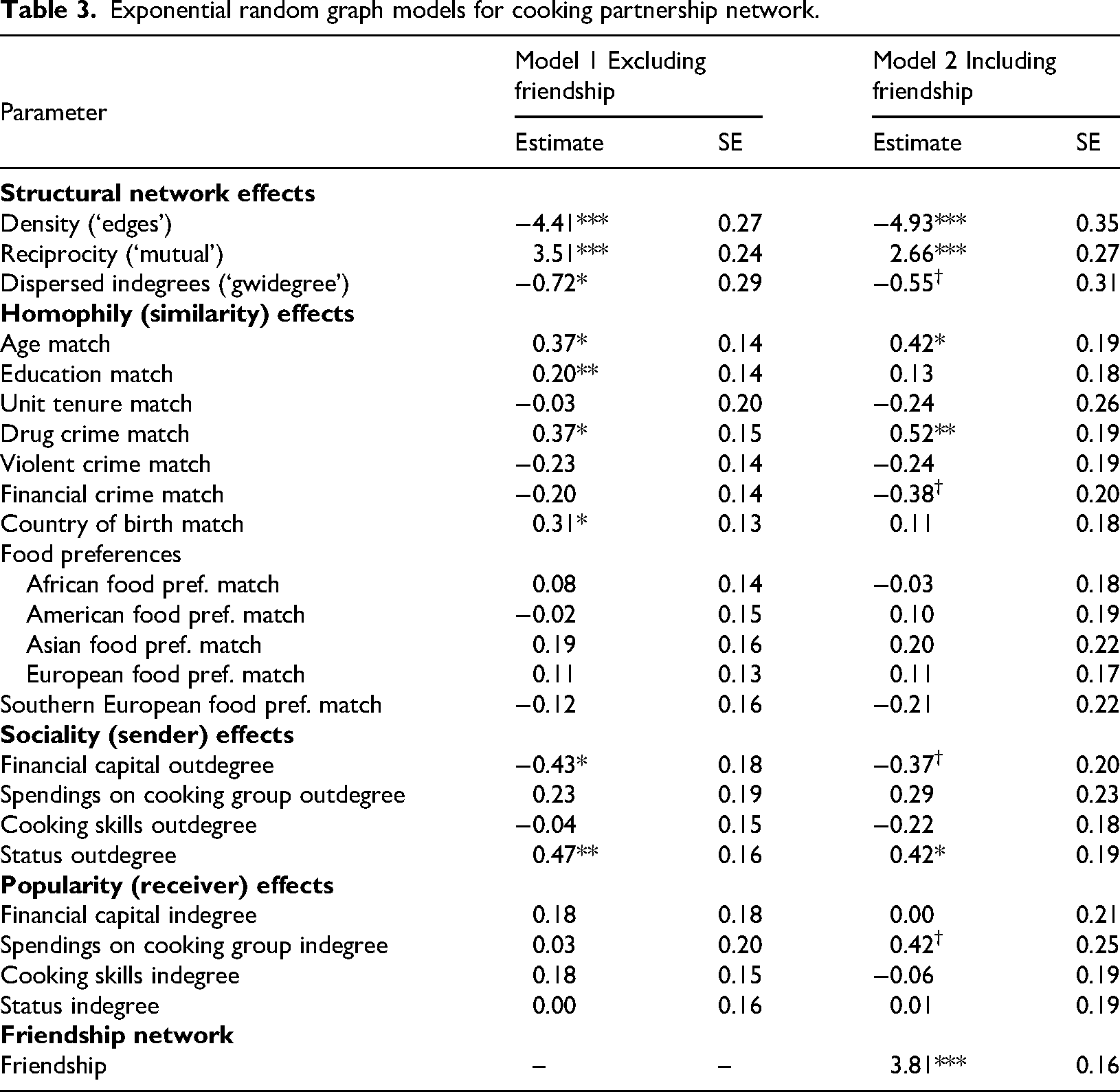
Exponential random graph models for cooking partnership network.
Taken together, these procedures provide confidence in the reliability and lack of bias of the estimated parameters. This conclusion is further supported by sensitivity analyses (results not shown), in which ERGMs were estimated (a) on the subset of respondents with complete data, and (b) using separate models for each of the three prison units - and next combining the results by a meta-analytic procedure (see Sentse et al., 2021). Both sensitivity analyses produced similar results and substantive conclusions, so we do not discuss these results here.
The estimated ERGM includes two classes of parameters. First, we incorporated ‘structural network effects’ to account for the underlying network structure (see Table 2). The ‘density (edges)’ term captures network density and models the baseline likelihood of observing a tie. The ‘reciprocity (mutual)’ term captures reciprocity by modelling the likelihood that an observed tie is returned or reciprocated. Finally, the ‘dispersed indegrees (gwidegree)’ term captures the indegree distribution and accounts for heterogeneity in the number of incoming nominations across incarcerated persons. Although a wider range of structural parameters is available, this set has been shown to adequately represent the basic structure of friendship networks in prisons (Haynie et al., 2018; Kreager et al., 2024; Sentse et al., 2021; Zwier and Geven, 2023).
Second, we included socio-demographic attribute effects that may be associated with the observed network structure. Four types of attribute effects were modelled (see also Table 3): (1) Homophily (similarity) effects, which model the likelihood of a tie between actors who share similar attribute values (here: age, educational level, unit tenure, committed the same type of offence, country of birth, and food preference). (2) Sociality (sender) effects, referred to as outdegree effects, which estimate the probability of sending a tie given an actor's attribute value, and (3) popularity (receiver) effects, commonly referred to as indegree/receiver effects, which estimate the probability of receiving a tie as a function of an actor's attribute value. Lastly, (4) the effect of friendship, which estimate the increase in the probability of cooking together when the sender or receiver is regarded as friend (i.e. when named on the question ‘With whom do you get along?’).
Results
Network descriptive statistics
The structure of the cooking networks in the three prison units is displayed in Figure 1, revealing three distinct social structures within each unit. The units differ in terms of clustering, showing a very tight network in the first two units and a more compartmentalised network on the third unit. Cooking groups are also visible, as men tend to nominate each other in smaller clustered groups. Interestingly none of these groups are entirely isolated, although some individual persons are.

Social networks regarding communal cooking in three Dutch prison units. The graph is directed; the arrow indicates which node nominated the other node as cooking together with. Black nodes are respondents whereas grey nodes are non-respondents. Note, left to right: unit 1, unit 2, unit 3.
Structural network effects
The results of the ERGM are presented in Table 3, specifically Model 1. The first parameter, density, shows a strong negative effect (exp(−4.41); p < 0.001), indicating that participants nominated fewer than half of their unit peers as cooking partners. The second parameter, reciprocity, is positive and significant, indicating that those who nominated someone as a cooking partner had a higher likelihood of being nominated in return (exp(3.51); p < 0.001). Finally, the parameter for dispersed indegrees is marginally significant and reveals that the distribution of incoming ties is almost evenly distributed, no one dominates as the main cooking partner within their unit (exp(−0.72); p < 0.1). Overall, these results suggest that men in prison do not cook with everyone, cook with the same persons as they nominated, and that cooking ties are broadly distributed rather than concentrated among a select few.
Homophily (similarity) effects
As is also shown in Table 3, Model 1, several demographic similarities matter when it comes to cooking together. Men were 1.4 times more likely to cook with others of the same age (exp(0.37); p < 0.05), 1.2 times more likely when they shared a similar educational level (exp(0.20); p < 0.01), and 1.4 times more likely to cook with others convicted for a drug-related offences (exp(0.37); p < 0.05). Lastly, men who were born in the same country were 1.4 times more likely to cook together (exp(0.31); p < 0.05). The other similarity factors, unit tenure and food preferences, were not significant.
Sociality (sender) and popularity (receiver) effects
Additionally, sociality and popularity effects were examined by including these in the ERGMs. Sociality effects indicate which attributes are associated with a higher probability of nominating another person as a cooking partner, whereas popularity effects indicate which attributes are associated with a higher probability of being nominated. As shown in Table 3, only two attributes were significant: financial capital and status. Persons with higher financial capital had a lower likelihood of sending out cooking partnership ties (exp(−0.43); p < 0.05), while those with higher status were more likely to do so (exp(0.47); p < 0.01). However, these effects were not mirrored in the receiver direction, indicating that financial capital and status were not significantly associated with receiving more or fewer cooking nominations. The other variables were not significant in any direction.
Friendship effects
Finally, an ERGM was estimated which included an edge covariate using the ‘getting along’ question, as a proxy for friendship (see Table 3, Model 2). This variable can be seen as a dyadic covariate in the communal cooking network. This network captures friendship like relations, indicating with whom one gets along. The covariate allowed us to assess the extent to which the cooking network diverges from the friendship network. The results show that these networks were very comparable, as men had 45 times higher odds of cooking together (exp(3.81; p < 0.001). Getting along with one's cooking partner is thus a highly important structuring variable for communal cooking partnerships. However, when friendship is included, density, reciprocity and dispersed indegrees lower in strength, and dispersed indegrees becomes marginally significant.
Regarding homophily effects, we observe in Model 2, two significant and one marginal significant effect, compared to four significant ones in Model 1. Sharing the same age (exp(0.42); p < 0.05) or being both convicted for a drugs-related offence (exp(0.52); p < 0.01) are in both models significant homophilic effects. However, when friendship is included, we observe that when two persons are both being convicted for a financial-related offence, the likelihood that they cook together is 0.7 times lower (exp(−0.38); p < 0.1). Nevertheless, this effect is only a marginally significant. Lastly, when we compare the homophilic effects of Models 1 and 2, we observe that educational level and country of birth, lose their significant effect.
As shown in Table 3, Model 2, only one attribute on sender and receiver effects was significant: status. Men with higher self-reported status were 1.5 times more likely to nominate others as cooking partners compared to those with lower status (exp(0.42); p < 0.05). This effect was not mirrored in the receiver direction, indicating that status was not significantly associated with receiving more or fewer cooking nominations. Two other variables were marginally significant. First, whereas financial capital was significant in Model 1, it was found to be marginal significant when friendship was included. Men with relatively higher financial capital nominated fewer cooking partners (exp(−0.37); p < 0.01). Second, men who spent relatively more money on their cooking group were 1.4 times more likely to be nominated as a cooking partner compared to those who spent less (exp(0.42); p < 0.1). This is the only popularity effect that was observed in both models, although marginally significant. For all three variables, it is noteworthy that effects were only one-directional and were not mirrored in the corresponding sociality or popularity effects.
Summary
The results of this study indicate that the communal cooking networks within these prison units are characterised by low density and centrality, but high levels of reciprocity. The data further suggest that the network is not randomly configured. Specific characteristics of incarcerated persons are associated with the structure of communal cooking relations. Incarcerated men are more likely to cook with others when they got along, were both convicted of a drug-related offence, and shared the same age. When friendship is excluded from the model, educational level and country of birth also show homophilous effects.
To aid interpretation, Figure 2 presents predicted probabilities of communal cooking between incarcerated persons with specific characteristics. We chose to only present the significant homophilous effects of the ERGM which includes friendship (Model 2). These predicted probabilities were calculated using the mean parameter estimates from Table 3, Model 2. The probabilities assume that all respondents share average values on all attributes, except for the three attributes that were statistically significant in the meta-analysis (see Table 3): (a) whether one respondent identifies the other as a friend, (b) whether the two respondents share the same age category, and (c) whether both respondents were convicted of a drug offence. The marginally significant homophilic attribute, of shared financial offence conviction, was held constant.
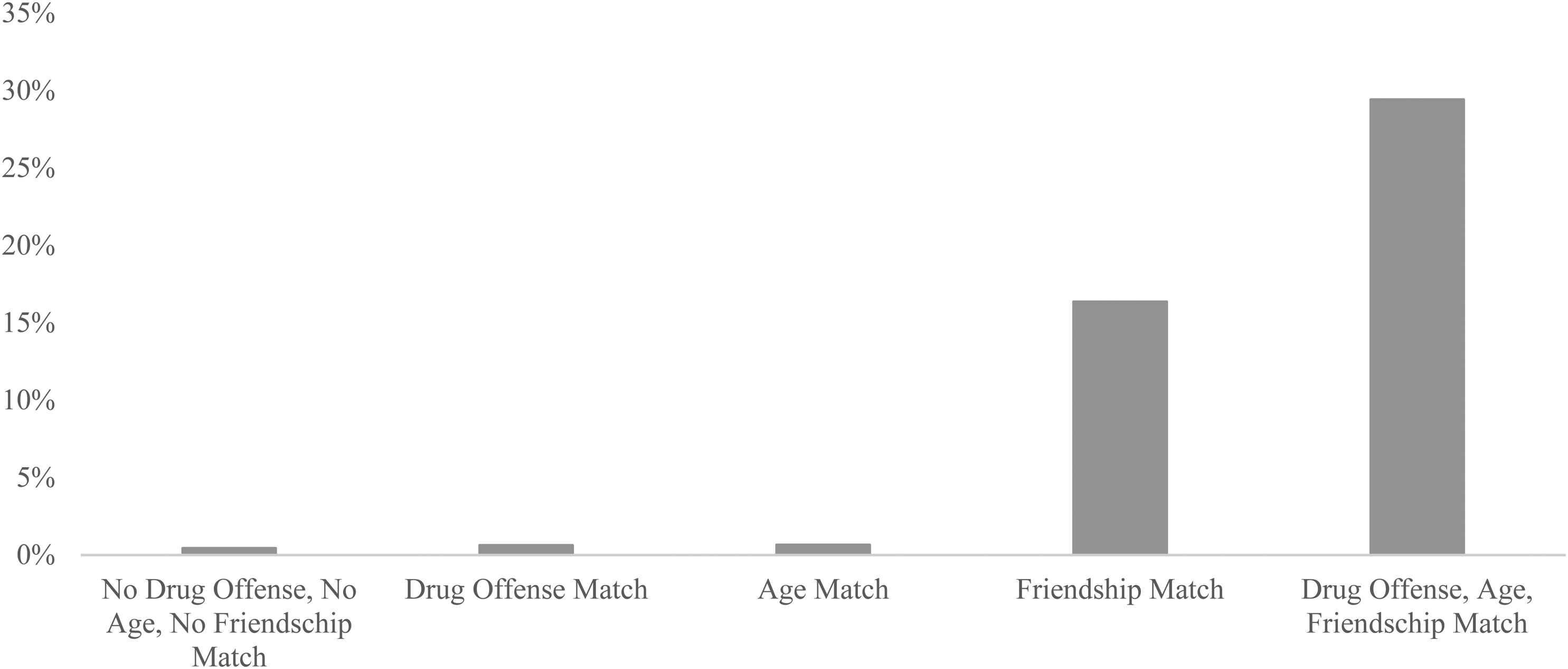
Predicted probabilities of communal cooking of Model 2 (in %).
Turning to Figure 2, when two respondents are not friends, do not share the same age, and were not convicted of a drug-related offence, the predicted probability of communal cooking is 0.43%. Holding all else constant, sharing a drug offence conviction increases this probability slightly to 0.62%, and matching on age yields a similar probability of 0.66%. In contrast, when one respondent identifies the other as a friend, the predicted probability of communal cooking increases to 16.36%, and increases further to 29.42% when friendship, age matching, and drug offence matching all coincide. These results demonstrate that shared attributes play a substantial role in structuring communal cooking relationships and that their combined effect considerably increases the likelihood of cooking together.
Discussion
Self-catering and communal cooking in prisons have increasingly been introduced as practices aimed at innovation, normalisation and addressing practical needs, for example in the Netherlands (Groeneveld et al., 2025; de Heide et al., 2026; Van der Vlist, 2022; Visser et al., 2026). However, little is known about with whom incarcerated persons choose to cook and which characteristics shape these choices. This study found that communal cooking is primarily organised around similarity and trust. Respondents were more likely to cook with peers of similar age, with those similarly convicted of a drug related offence, and with those they reported getting along with.
The strongest predictor of communal cooking is friendship. Incarcerated men who reported getting along with one another were considerably more likely to cook together. This finding is not surprising, as getting along requires trust and confidence which is also needed for cooking communally, for example trust in one's reliability and hygiene practices (e.g. Minke, 2014; Vanhouche, 2019; Weir, 2021; Young and Haynie, 2022). When friendship is excluded from the ERGM, homophilic effects become more prominent across a wider range of variables. Nevertheless, the direction of the association remains unclear. Friendships may serve as the basis for initiating cooking partnerships, but it is equally possible that repeated cooking together fosters friendship over time. Future research could explore the processes through which communal cooking partnerships emerge and are sustained.
Regarding relationship preferences, prior research has shown that age and offence type or offence severity were significant factors in structuring prison relations (e.g. Dillavou, 2024; Hashimi and Schaefer, 2024; Kreager et al., 2021; Sentse et al., 2021; Young and Haynie, 2022). The findings of this study align with this literature, demonstrating that age and offence type also structure communal cooking relations. Men within the same age category were more likely to cook together. This is interesting as prior research has found that younger incarcerated individuals were more likely to cook communally compared to older incarcerated individuals (Groeneveld et al., forthcoming). Additionally, men convicted for drug-related offences were more likely to cook communally with one another compared to others with a different type of conviction. One plausible explanation is that these individuals may have been active in the same (criminal) community, increasing the likelihood of pre-existing relations or shared norms that carry over into prison life. In contrast, being convicted for a financial offence was marginally negatively associated with homophilic communal cooking. Contrary to offences related to drugs, persons convicted for a financial crime might not have pre-existing ties before incarceration, as financial crimes might be more individual. Another possible explanation is that the low number of persons convicted for such an offence also lowers the chance for homophilic cooking nominations. Nevertheless, when generating a model without friendship, we observe that this effect disappears.
Prior research suggests that social organisation around cooking in prison is shaped by financial resources and cooking skills, which in turn translate into informal status and informal economic exchanges (Avieli et al., 2024; Earle et al., 2012; Minke, 2014). From this perspective, access to food, material resources, and practical expertise would be expected to drive the formation of cooking partnerships. However, our findings only partially align with these studies. Sending and receiving ties were at best marginally associated with commissary spending and spendings on cooking groups.
The absence of a significant economic capital structuring effect is also theoretically notable. Drawing on Bourdieu (2011) and McPherson et al. (2001), one would expect that individuals tend to cluster together based on shared characteristics. For example, individuals with greater financial means to cluster with others of similar resource levels. Furthermore, economic capital is embedded with social and cultural capital (Bourdieu, 1984). This suggests that economic positions should, in principle, shape patterns of engagement and associational life. Nevertheless, financial resources did not emerge as a significant variable of communal cooking partnerships in the present study.
This absence of this significant effect invites two reflections. First, these null findings may be related to the Dutch prison system. The introduction of standardised ingredient packages under the new Dutch prison food provision system (Nieuwbeerta et al., 2025) may have reduced the need for individual financial means and culinary skill, thereby potentially reshaping the informal economy around food as access to ingredients become more equalised. Improvements in the quality of convenience meals may have reduced the need for great cooking skills. Nevertheless, only one economic variable, specifically ‘financial capital’ which indicates one's spending on commissary, was marginal significant. Men who spent more on commissary cook alone or with less peers, which might reflect a higher spending on commissary products as less resources can be pooled (e.g. Earle et al., 2012).
Second, the absence of significant effects of financial capital and cooking skills in our study might be overshadowed as friendship is observed as the primary driver of cooking partnerships. This is consistent with broader literature that found friendship and trust as a structuring mechanism of social organisation and formation in prison settings (Crewe, 2009; Schaefer et al., 2017). When friendship was excluded from the models, sender effects for financial capital and status became stronger and more statistically significant, and additional homophilic patterns along educational level and country of birth emerged. In other words, people cook with their friends, and their friends tend to be similar to them; once friendship is accounted for, the independent contribution of sociodemographic similarity largely disappears.
Finally, status was found to be a significant sender effect, men with higher self-reported status nominated more cooking partners but were not differentially likely to receive nominations in return. This one-sided effect may indicate that higher-status individuals engage in outward social investment perhaps as an expression of their social position or as a strategic effort to extend their social network, while it does not generate equivalent reciprocal attention from others.
The present study is, to our knowledge, the first to examine cooperative behaviour within prison social networks through the lens of communal cooking. This study is unique for its reliance on self-reported data and provides unique insights into the cooking behaviour of incarcerated men. Nevertheless, several limitations and strengths should be acknowledged and addressed in future research.
First, the findings are based on data collected from only three male prison units within one penitentiary institution in the Netherlands. As a result, the generalisability of the findings remains uncertain. Future studies should therefore extend this line of research to a larger number of prison units, and penitentiary institutions, across different national contexts, and should extend to include women.
Second, a key strength of this study lies in its inclusion of factors specifically related to prison food practices, including financial resources, spending on cooking groups, cooking skills, and social status. These factors capture the diverse ways in which access to resources can shape one's position within the prison unit (e.g. Avieli et al., 2024; Earle et al., 2012; Minke, 2014). At the same time, future research would benefit from incorporating additional variables, particularly contextual factors that cannot be measured using solely administrative data. For example, the availability and quality of kitchen equipment, as well as the amount of time allocated for meal preparation, may play an important role in shaping communal cooking practices.
Third, unlike studies that rely on administrative records and thus have complete attribute data for respondents and non-respondents (e.g. Schaefer et al., 2017; Sentse et al., 2021), this study relied on self-reported data resulting in missing values for non-respondents. In total this study had a response rate of approximately 70% on both its social network and attribute surveys. This lower response rate is partly explained by the prison's low-trust environment and the sensitive nature of questions about peers (Whichard et al., 2022). This was partially mitigated by using neutral or positively framed network items and administering questions face-to-face to help build trust (Whichard et al., 2022). Further, because this study relied on self-reported data we have missing values. Imputation procedures were carefully considered but ultimately not applied given to the small network sizes, the absence of auxiliary information on which imputation could be based and lacking strong assumptions about the missingness mechanism in the prison context. Consequently, restricting attribute-based analyses to observed values was thus a conservative and transparent modelling choice. As a result, the attribute parameters reflect only known values which may introduce bias and limit generalisability. Future research should limit the missingness whenever possible and carefully consider the most appropriate strategies for handling missing data. As demonstrated above, non-administrative data may, in some cases, offer the best fit for a given research question. Therefore, the possibility of missing attribute data should not discourage researchers from using such sources.
Concluding, the results of this study offer insight into the factors that structure communal cooking and thereby contribute to our understanding of social organisation in prison. The study shows that communal cooking is primarily structured by trust, friendship, and social similarity rather than by financial resources or cooking skills as reported in other prison food studies. One possible explanation lies in the recently reformed prison food provision system in the Netherlands, which may have diminished the need for pooling resources and cooking skills. These findings suggest that the social organisation of prison cooking may not be fixed but may vary depending on institutional arrangements and food provision systems. Future research should therefore examine how changes in prison food provision reconfigure the functions of cooking, food and social interaction more broadly. Moreover, future research should examine under which institutional conditions food practices become less dependent on incarcerated persons’ inequalities in financial resources, culinary skills, and social status, and how such conditions might actively promote collaboration and constructive social interaction.
Footnotes
Acknowledgements
The authors wish to thank the prison staff for their support with the administration of the survey. Appreciation is also extended to the research assistants for their dedication as research team, to Elias Storme for technical support, and to the respondents for their valuable time and contributions.

Ethical approval and consent to participate
Approval for this study was obtained from Leiden University's Ethics and Data Committee, approval number 2025-04. All participants were verbally informed of the study's purpose, methods, use of data, and participant rights, and gave written consent to participate.
Funding
The authors disclosed receipt of the following financial support for the research, authorship and/or publication of this article: The Food in Custody study and The Life in Custody Study was funded by the Dutch Prison Service (DJI) and Leiden University. The opinions, findings, and conclusions expressed in this article are those of the authors and do not necessarily reflect those of the DJI.
Declaration of conflicting interests
The authors declared no potential conflicts of interest with respect to the research, authorship and/or publication of this article.
Data availability
Due to the sensitive nature of the data and participants, data cannot be shared.