







Abstract
This article examines the institutional legacy of coercive confinement at the former Good Shepherd Magdalene Laundry in Waterford, Ireland — now part of South East Technological University. Framed by the question of whether educational reuse reproduces, erases or transforms the site's carceral legacy, it draws on carceral geographies and gendered confinement to position the Magdalene Laundries as enduring systems of moral and spatial control whose afterlives demand ethical scrutiny. Focusing on the Waterford site as a single case study, the article traces its institutional transformation from a Catholic-run site of forced labour and confinement to a functioning technological university campus. It analyses survivor oral histories and spatial testimonies that disrupt institutional forgetting and examines how educational initiatives, particularly the Waterford Memories Project and When Silence Falls, activate the site as a space of memory, resistance and public pedagogy. In doing so, it interrogates the role of universities as inheritors of carceral spaces and asks what responsibilities such institutions hold in contemporary Ireland. By centring a survivor-informed, site-specific analysis, the article contributes to debates on spatial justice and institutional accountability. It argues that transforming a former carceral site into an educational space is not closure, but a critical threshold where memory, silence, justice and hope remain in active negotiation.
Keywords
Introduction
In Waterford city, the former site of a convent of the Congregation of Our Lady of Charity of the Good Shepherd of Angers (commonly known as the Good Shepherd Sisters), St Mary's Good Shepherd Laundry and St Dominick's Industrial School comprise the College Street Campus of what is now South East Technological University (SETU). The former laundry and industrial school form part of a network of institutions in Ireland, which existed for most of the 20th century, with the final Magdalene Laundry on Sean McDermott Street, Dublin, closing in 1996.
Between 1765 and 1914, at least forty refuges or asylums were established in Ireland for what was termed the ‘rescue’ of fallen women – women who, in the eyes of religious and social authorities, had transgressed dominant norms of sexual behaviour (Luddy, 2007). These institutions, many of which bore the name ‘Magdalene,’ framed their mission around rehabilitation through confinement, religious instruction and manual labour. Over time, however, they shifted significantly from their original voluntary or philanthropic pretensions to become deeply coercive spaces of prolonged incarceration.
By the time of Ireland's independence, these institutions were already well embedded within what James Smith (2008) describes as Ireland's ‘architecture of containment’ – a network of carceral institutions tasked with removing and silencing those deemed morally deviant or socially nonconforming (McGettrick et al., 2021). The purpose of such institutions aligned with the post-Civil War conservatism espoused by political leaders in the Free State, where ‘Irish people must by their discipline show themselves worthy of new freedom’ (Kiberd, 2002: 483). Ten Magdalene Laundries continued in operation in the Irish Free State between 1922 and 1996, evolving into closed regimes of silence, surveillance and unremunerated labour. Some survivors remained for decades, often without ever receiving a formal explanation for their detention (Office of the Ombudsman, 2017).
While originally conceived as a response to prostitution, the scope of the Magdalene system expanded rapidly in the early 20th century. With prostitution in decline – partly due to emigration and shifts in women's employment – the institutions began to accommodate a wider cohort, including unmarried mothers, girls transferred from industrial schools, sexual abuse victims and young women considered ‘sexually aware’ or ‘at risk of moral danger’ (Luddy, 2007: 206). These populations were often incarcerated without legal process, reflecting a broader cultural and political project to regulate and erase women's sexuality both within and beyond the patriarchal and ecclesiastical ideal of the family.
Referral to the laundries was often informal and opaque. Girls and women entered through a range of pathways: transferred from industrial or reformatory schools, referred by religious authorities, social workers or the Irish Society for the Prevention of Cruelty to Children or placed by family members under clerical pressure (McGettrick et al., 2021; O’Donnell et al., 2012; O’Mahoney, 2014b). Survivor testimony evidences that women were typically assigned new names, dressed in uniform, denied education, external communication, sufficient rest or recreation, as they worked, unpaid, washing laundry for hospitals, hotels and state agencies and subjected to a constant regime of surveillance and silence (O’Donnell et al., 2012; O’Mahoney, 2014b; O’Rourke, 2011). Survivors were unaware of why they had been sent, how long they would remain or whether they would be permitted to leave. For many, the laundries functioned as sites of permanent exclusion from society, reinforced by spiritualised rhetoric of penance and shame.
Although operated by Catholic religious orders – including the Sisters of Mercy, Sisters of Charity, Sisters of Our Lady of Charity and the Good Shepherd Sisters (the order who ran the Waterford Laundry) – the Irish State was deeply implicated. It used the laundries as places of confinement, contracted them for laundry services and failed to institute meaningful regulatory oversight (McGettrick et al., 2021). Survivor testimony has been routinely subordinated to clerical and state narratives, while access to institutional archives has typically been heavily restricted or selectively mediated. This is evident not only in what is withheld, but in the narrow and institutionally managed forms of access that are occasionally granted.
Currently, the Dublin Diocesan Archives holds only a small number of Magdalene-related items, largely within the Archbishop McQuaid subfonds. These comprise correspondence, reports and notes concerning female delinquency/‘immoral conduct’, probation returns and proposals for a female remand home/reformatory, as well as related communications (including references to High Park/Gloucester Street and Sean McDermott Street), rather than institutional registers, case files or internal operational records from the laundries themselves.
Where more direct access has been possible, it has been exceptional and non-replicable. A revealing example is Jacinta Prunty's (2017) The Monasteries, Magdalen Asylums and Reformatory Schools of Our Lady of Charity in Ireland, 1853–1973, which was produced through selective and privileged permission granted by the Sisters of Our Lady of Charity. To date, Prunty remains the only scholar to have been granted such direct access to a congregation's internal archives – access enabled in part by her position as a member of a religious order, the Holy Faith Sisters. As Crowe (2017) notes, these archives remain closed to independent researchers, making Prunty's access both rare and emblematic of the gatekeeping that sustains institutional opacity.
The Waterford Memories Project, among other initiatives such as Justice for Magdalenes Research, seeks to document oral histories that not only challenge the official silences surrounding these institutions, but also function as forms of advocacy and collective memory work. The Magdalene Laundries must be understood not as historical anomalies, but as integral components of the postcolonial Irish State's strategies of gendered social regulation. Their endurance, scale and brutality were made possible through the convergence of clerical authority, state complicity and a system that treated moral nonconformity as grounds for confinement.
Against this background, the transformation of the College Street site into a university campus raises questions that are central to this article: what does it mean for a former space of confinement to become a place of education? How do contemporary institutions engage, if at all, with the institutional violence embedded in the spaces they inherit? And what might such engagements reveal about the Irish State's relationship to its carceral past?
To address these questions, the article examines the former Magdalene Laundry and Industrial School on College Street, Waterford — now part of SETU. It traces the site's historical and architectural transformation within the wider institutional system that underpinned the Irish State's mechanisms for 20th-century social regulation. Drawing on the Waterford Memories Project and the Justice for Magdalenes Oral History Project, it then examines how survivors remember the site's segregation, surveillance and labour regimes, and how this testimony unsettles narratives of institutional ‘closure’ and informs educational events and resources produced at the site.
We conceptualise the College Street site as an unresolved terrain – a ‘site of conscience’ – where the institutional present remains shaped by the silences and absences of the carceral past, and where the politics of recognition and redress remain unfinished. As researchers working in and around this site, we approach this work with an awareness of our own positionality, within the academy and within the continued struggle for truth, justice and accountability for survivors of institutional abuse. The following section introduces the institutional site at the centre of this study and situates Waterford's Magdalene Laundry within Ireland's wider carceral landscape.
From laundry to lecture Hall: Introducing a contested site
Historical background: The Magdalene system as carceral architecture
Magdalene Laundries in Ireland originated in the late 18th century. Initially framed as philanthropic ‘rescue’ institutions for so-called ‘fallen women,’ these institutions evolved over the 19th century into powerful carceral regimes managed by Catholic religious orders (Coen et al., 2023; Luddy, 2007). Although such institutions were not unique to Ireland, the Irish Magdalene Laundries are remarkable for their longevity and severity. Unlike their European and North American counterparts, many of which closed in the early 20th century, Irish laundries remained operational until 1996. Following the foundation of the Irish Free State in 1922, the laundries transitioned from semi-voluntary refuges to punitive institutions of long-term confinement for women and girls. This shift was shaped by the intertwining of nationalist politics, Catholic social doctrine and institutionalised patriarchy (McGettrick et al., 2021; O’Mahoney et al., 2019).
By 1922, ten Magdalene Laundries were active in the Irish Free State. Though ostensibly charitable homes for ‘fallen’ or ‘penitent’ women, the laundries functioned as carceral spaces of indefinite confinement, unpaid labour and moral regulation. The women confined included unmarried mothers, victims of sexual abuse, girls transferred from industrial schools and those considered promiscuous or socially deviant or mentally ill. For many, there was no clear pathway to release. Women and girls entered the laundries through a range of referral routes, which included informal placements by family members, clergy or social workers, as well as formal judicial pathways such as transfer from industrial or reformatory schools under court direction or as wards of court (McGettrick et al., 2021). In many cases, women and girls were placed without their knowledge, consent or any indication of how long they would be held. One survivor noted: ‘You were put in there and you didn't know when you were going to get out’ while others reported being transferred from one institution to another without explanation (O’Donnell et al., 2012: 3). This lack of agency and information is evident in the following accounts.
At age 11, Martha was brought by her mother to an office in a Garda
2
station after being told that the school inspector wanted to see her about her non-attendance at school. Martha recalled that the man she met was not, in fact, the school inspector but was “something to do with the guards” (O’Donnell et al., 2013b: 9). After questioning her about school attendance, he told her he would drop her home; instead, he locked the car doors and drove her directly to the Good Shepherd Magdalene Laundry in Waterford: … he said, ‘come on and I’ll drop you home’ and he locked all the doors [and said], ‘come on you’re going to Waterford’. [Good Shepherd Magdalene Laundry] And I cried the whole way there … (O’Donnell et al., 2013b: 9)
A survivor of multiple Good Shepherd Magdalene Laundries (Sunday's Well, Cork; Limerick; and Waterford), Kathleen R. (O’Donnell et al., 2013a: 2) described a pattern of transfers between institutions where she was never informed of her rights or duration of stay: I was put into the Good Shepherd in Waterford in the orphanage [St Dominick's Industrial School for Girls] and I was there until I was seventeen. And the nuns put me out to work in Dungarvan in a hospital with nuns and it was very restricted, it was like I wasn’t out of the school at all, I wasn’t allowed to do anything and I rebelled and they put me back in with the nuns again and they put me up to the Magdalenes up in Sunday’s Well in Cork and I was up there a couple of years and I just said to myself, I didn’t want to spend the rest of my life there, so I rebelled again, I went up the stairs, sat on the stairs, I wouldn’t do no work, I wouldn’t eat nor nothing … I was transferred from there then down to Limerick and there again after another year or two I rebelled again, I didn’t want to be there either, so I done the same thing, sat on the stairs, I wouldn’t do nothing, then they pushed me down to Waterford, back to Waterford into the Magdalenes again. And I was rebelling all the time, I wouldn’t do nothing, nothing … nothing for them, I done nothing, wouldn’t do no work nor nothing for them, I wanted to be out in a job.
Inside the laundries, residents were assigned new names, given institutional clothing and placed under strict regimes of unpaid labour, routine and silence (McGettrick et al., 2021; O’Mahoney, 2014b). The architecture itself materially enforced these disciplinary practices. Dormitories were locked at night, windows were barred and communal areas such as chapels were physically divided according to status and/or institutional grouping (Hamill, 2023; O’Mahoney et al., 2019).
The operational logic of these institutions can be situated within broader carceral theory. Moran, Turner and Schliehe (2018) define carceral spaces as those that systematically isolate and discipline individuals through spatial mechanisms and ideological control. The Magdalene system isolated and disciplined women whose behaviour violated Catholic moral codes – particularly around sexuality, reproduction and class – codes which were essential in maintaining an idealised version of Ireland. Through religious doctrine, forced labour and institutional confinement, the laundries thus constituted carceral spaces, as defined by Moran et al. (2018). O'Sullivan and O’Donnell (2012) document the exceptional scale of coercive confinement in Ireland, noting that in 1951 more than 1% of the population was confined in such institutions. They maintain that: while many of these institutions may have had an ostensibly welfarist – as opposed to penal – rationale, both their orientation and the experiences of those confined in cells and dormitories or on wards suggest that, in the main, they were felt as punitive (O'Sullivan and O’Donnell, 2012: 2).
The term ‘coercive confinement’ thus refers to the involuntary or quasi-voluntary detention of individuals – including children and adults – in institutions whose stated purpose may have been care, rehabilitation or moral reform, but whose operations entailed significant restrictions on liberty, autonomy and legal recourse. The authors contend that the exceptional scale of confinement cannot be explained solely by poverty or deviance but reflects a historically specific system of social control (O'Sullivan and O’Donnell, 2012).
The following section traces the institutional transformation of the Waterford site from Magdalene Laundry to technological university campus and reveals the institutional legacy of the site. It then presents a detailed analysis of how spatial and disciplinary dynamics – identified in the broader system of containment – were materially expressed at the Waterford Laundry. Drawing on spatial data and testimonial material from the Waterford Memories Project, as well as publicly accessible records curated by Justice for Magdalenes Research, this analysis illustrates how carceral effects were operationalised through architecture and daily routine, which combined to ‘achieve’ carceral effects in practice (Moran et al., 2018: 34).
St Mary's Magdalene Laundry, Waterford
The evolution of the Waterford Laundry – from philanthropic institution to university – spans 184 years and brings us to the present day. The Waterford Magdalene Laundry, now SETU's College Street campus, offers a particularly compelling case study of institutional continuity and transformation. This section reconstructs the historical development of the site, situating it within the intersecting logics of religious control, state collusion and gendered carcerality. The following account draws on state reports, survivor-led research and limited available ecclesiastical documentation, including material from the McAleese Report (2013), which identifies Waterford as one of the ten laundries operating between 1922 and 1996.
The Magdalene Asylum in Waterford was established on 12 June 1842 by two Catholic priests, Rev. Timothy Dowley and Rev. John Crotty, who opened an ‘asylum for penitent women’ in the city, initially supervised by two lay matrons under the direction of the founding clergy. Its creation occurred during a time when Catholic charitable initiatives increasingly focused on the rehabilitation of women deemed morally errant, a pattern reflected in similar institutions across Ireland (Finnegan, 2004: 44–46).
Although Waterford has received less sustained scholarly attention than larger Dublin-based institutions such as Donnybrook and Sean McDermott Street, whose location, scale and public visibility have contributed to greater scholarly and commemorative attention, the site is documented in state enquiries and survivor-led research as part of the national Magdalene system (Department of Justice, 2013; McGettrick et al., 2021). The early development of the Waterford asylum (later, laundry) was shaped by its ecclesiastical context. Power describes the founding priests as acting ‘inspired by the Divine Pastor’ and working within a wider religious culture that sought to offer both spiritual and physical refuge to ‘fallen and abandoned women’ (Power, 1937: 327). The asylum initially operated in a house on Barrack Street and was modest in scale, with 32 penitents in residence.
In 1849, Rev. John Crotty assumed sole direction of the asylum following Dowley's reassignment and, in 1858, invited the Good Shepherd Sisters, who specialised in the care and ‘reformation’ of women, to Waterford. The Sisters were already operating multiple Magdalene Laundries across Ireland, including in Limerick, New Ross and Cork and their arrival in April 1858 marked a transition in the management and structure of the Waterford site, situating it within a wider institutional system of gendered confinement (Department of Justice, 2013: 31). The Sisters found the Barrack Street house to be ‘entirely unfit for conventual purposes’ (Power, 1937: 327). With the help of Rev. Crotty, they moved the community to a more suitable building on Hennessy's Road, formerly used by the Presentation Sisters, then to a site on Convent Hill Road and, finally, to the College Street location (Department of Justice, 2013: 31; Power, 1937).
Between 1892 and 1894, a significant phase of construction took place. New buildings were erected, including a convent, laundry, chapel and expanded school facilities, enabling the institution to meet the growing demands of both its penitential and educational functions (Department of Justice, 2013: 31; Power, 1937). By the close of the 19th century, the Waterford Magdalen Asylum, under the direction of the Good Shepherd Sisters, had evolved into a multi-functional religious institution comprising residential, educational and labour facilities with occupancy of between 100 and 120 women (Department of Justice, 2013: 31; O’Mahoney et al., 2019). This multi-institutional character would become more pronounced as the College Street complex expanded to include additional forms of gendered confinement and ‘care’.
Alongside the convent and the laundry, the College Street complex also incorporated St Dominick's Industrial School for Girls, creating a shared institutional complex within Ireland's wider system of coercive confinement (O’Donnell and O'Sullivan, 2020). While the Laundry remains the primary focus of this article, St Dominick's is essential for understanding the site's layered institutional afterlife, particularly given that later phases of residential ‘care’ developed on, or in relation to, the former Industrial School grounds. However, publicly accessible documentation on St Dominick's is limited: major state investigations, including the Ryan Report, produced detailed findings for only a subset of institutions and St Dominick's did not feature in any such major institution-specific investigation (Commission to Inquire into Child Abuse, 2009).
Reduced occupancy from approximately sixty women in the 1960s to approximately forty in the 1980s anticipates the closure of the Waterford Magdalene Laundry in 1982; however, the site remained under the control of the Good Shepherd Sisters and continued to operate in an institutional capacity as Gracepark Training Centre (Department of Justice, 2013: 32). This residential facility catered to girls aged 12–16 who were deemed ‘at risk,’ and was ‘located on the grounds of St Mary's, Waterford and developed from St Mary's’ (Office of the Ombudsman, 2017: 26). The Sisters stated that the centre was originally funded through the profits of the laundry before receiving financial support from the South-Eastern Health Board. In 1971, Gracepark Training Centre was moved to a separate building within the same complex. Some of the girls continued to work in the laundry for, at least, part of each day, which was confirmed in a letter from the Good Shepherd Sisters to the Chief Inspector, Department of Education, dated November 1971: ‘between 1.00 and 3.45 each weekday, the girls are engaged in manual work, mainly in the laundry’ (Office of the Ombudsman, 2017: 26). Some of the girls left the site to attend local schools but continued to work in the laundry after school and during school holidays. During this period, the overall layout of the complex was adapted to accommodate three distinct population groups: ‘the elderly, the not-so-young and the teenagers’ (Office of the Ombudsman, 2017: 41–42).
Parliamentary debates from 1980 provide further insight into Gracepark's role within the national care network. Then-Minister for Education, John Boland, described Gracepark as one of 23 residential centres providing accommodation and industrial training for girls who were ‘not offenders but … in need of care or protection,’ funded via the Department of Health (Dáil Éireann, 1980). Notably, Boland's statement omits enrolment figures for Gracepark, an omission that raises questions about the transparency and oversight of its operations at the time (Figure 1).
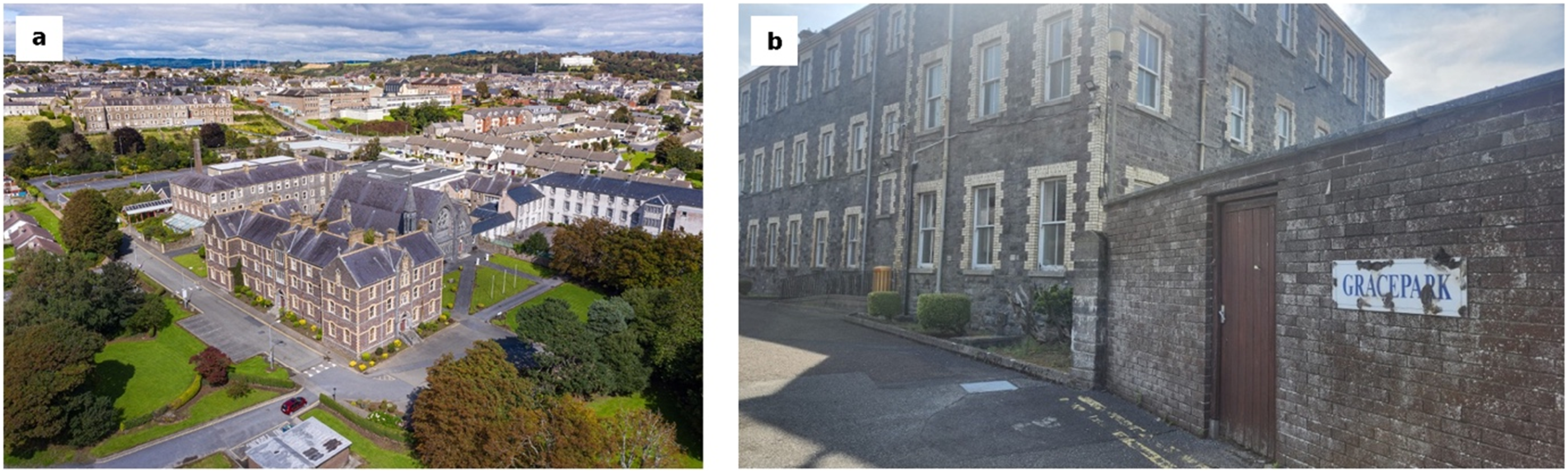
(a) Aerial photograph of the College Street campus. Source: SETU (2021). Photo: DigiCol. (b) Former laundry building on the College Street campus with ‘Gracepark’ sign still in place. Source: Waterford Memories Project (2025). Photo: Jennifer O’Mahoney.
Although the Laundry formally ceased operations in 1982, long-term survivors continued to reside within the broader institutional complex for several years thereafter. In August 1985, Suzanne Walsh – then in her early 20s and, later, a lecturer in Social Care at SETU – was appointed to Mayfield Children's Home, located on the former site of St Dominick's Industrial School. She joined as a lay administrator, a role that marked a significant shift in the institution's governance. In her public address at the Waterford Memories Project When Silence Falls event, Walsh recounted how, during this period, she was granted physical access across most of the site: ‘I was given a passkey and as far as I know, I was the only person who had a passkey who was on the lay staff team’ (When Silence Falls, 2016). Her reflections document the presence of older women living in the building adjacent to the chapel – part of what had been St Mary's – who continued to use a sewing room on the bottom floor. Walsh also observed that several Good Shepherd nuns still resided on-site into the mid- to late-1980s.
Around 1990, Walsh began working in Gracepark Training Centre. There, she undertook direct care responsibilities with fourteen teenage girls, describing a daily routine shaped by long hours, overnight shifts and intimate forms of institutional care: ‘We did all sorts of hours … cooking, giving people money, budgeting, minding people, working with them when they had crises, sitting with them at night’ (When Silence Falls, 2016). Despite the institution's transformation, Walsh affirmed that Gracepark remained physically and symbolically continuous with the Magdalene infrastructure: ‘It was still in this building … it was just a new name’ (When Silence Falls, 2016). These observations underscore how carceral architectures and institutional logics endured beyond the formal closure of the Laundry, sustained through the reconfiguration rather than dismantling of post-Magdalene space.
Following the formal closure of the laundry operations, the institutional legacy of the site continued through Gracepark's reconstitution under state regulation. A significant shift occurred with the enactment of the Child Care Act, 1991 and through the 1992 Child Care (Placement of Children in Residential Care) Regulations, which brought facilities like Gracepark under formal state oversight. While the nature of regulation changed in the 1990s, the Irish State had long borne formal responsibility for oversight of such institutions, even as it repeatedly failed to fulfil that duty.
Notably, Gracepark Training Centre, Waterford, was listed by name in the 1992 regulations as one of the registered residential centres authorised to receive children placed in care by the Irish Health Boards. This recognition meant that Gracepark had been fully absorbed into the statutory child welfare system, with obligations regarding care planning, case reviews, monitoring and reporting. The statutory listing also confirms its status as an institution publicly accountable under national child protection policy (Office of the Attorney General, n.d.). This transition marked a pivotal moment in the afterlife of Magdalene institutional infrastructure: the same physical space, now subject to state regulation, continued to house vulnerable girls and women in a context of surveillance and conditional care. Its formal recognition by the State in 1992 marked a shift toward public regulation, but the earlier lack of disclosure regarding admissions or resident numbers signals the persistence of opacity characteristic of post-Magdalene institutions.
In a Dáil Éireann debate in 1997, Michael Noonan (then Minister for Health) confirmed that the centre was still operating for girls aged 12–18, managed by the Good Shepherd Sisters and funded by the South-Eastern Health Board. The centre's regulation under the 1995 statutory framework reflects its continued integration into the child welfare system. The institutional function of the former Magdalene site persisted well into the late 1990s, now reshaped under the legal architecture of the post-1991 care regime. The site's architectural and institutional transformation from a laundry to a legally regulated facility thus illustrates structural continuity in Ireland's systems of gendered confinement and social control.
This institutional legacy overlaps with government policy to support education in the south-east region, particularly Waterford. In 1995, C.J. Falconer and Associates, with architects Peter and Mary Doyle, developed ‘the Campus Masterplan’, which converted the convent, grounds, former laundry and industrial school site into what was then Waterford Institute of Technology (WIT). In transforming the site into a third-level educational facility, C.J. Falconer and Associates (2025) decided to ‘pare away unnecessary buildings’ and introduce ‘circulation malls and linkages to join fragmented building structures in a unified form’. This reconfiguration, for which Tom O’Brien Construction (2025) was partially responsible, also included a ‘redesign of the original laundry buildings, the conversion of same into a magnificent restaurant facility’ (CJFA Architects, 2025).
SETU was established on 1st of May 2022, comprising campuses in Waterford, Carlow (formerly Institute of Technology Carlow), Wexford, Wicklow and Kilkenny. SETU's website notes that the College Street site was ‘acquired in 1994 from the Good Shepherd Order of Nuns’ and acknowledges the site's ‘remarkable’, listed architecture ‘including a beautifully designed classical chapel’ (SETU, 2025). There was no formal acknowledgement of the site's carceral and institutional legacy until October 2025, when SETU awarded an honorary doctorate to Elizabeth Riordan-Coppin, Waterford Laundry survivor, for her human rights advocacy and social justice work. In February 2026, SETU erected two plaques commemorating St Mary's Magdalene Laundry 1884–1982 and St Dominick's Industrial School 1884–1982, which commit the university to learning from this history.
The built environment of the Waterford Laundry bears material witness to institutional continuity and transformation. From its founding in 1842 as a Catholic-run refuge for ‘penitent women’ to its current incarnation as an educational campus, the site's history reveals how carceral functions were not simply abolished but recalibrated. The next section turns to the built environment, examining how architecture, layout and atmosphere embody systems of coercive confinement and raise critical questions of spatial justice.
Framing Carceral Atmosphere and Residual Architecture
The Magdalene Laundries must be understood not simply as discrete institutions of confinement, but as part of a broader architecture of gendered control that functioned through a form of spatialised morality where high walls, locked gates and regimented spaces formed part of a moral landscape designed to contain, erase and remake the ‘fallen’ woman (O’Mahoney, 2025; O’Mahoney et al., 2019). These residual carceral architectures did not vanish with the formal closure of these institutions. They persist materially, symbolically and institutionally in the repurposed structures now used for higher education and music education for people of all ages. As Turner, Moran and Jewkes (2022) observe, the ‘atmosphere’ of incarceration – while inherently elusive and resistant to fixed definition – persists long after the physical structures are repurposed.
Residual carceral architecture
The transformation of former carceral institutions into educational spaces invites critical inquiry into how certain spatial and affective traces of coercive confinement may persist. As Hamill (2023: 129) argues: ‘buildings are rarely static objects and evolve and are changed throughout their (sometimes lengthy) lifespans’. In the case of the Magdalene Laundries – particularly those in Waterford and New Ross, Wexford – both the built environment and its associated atmospheres offer potent frameworks for examining this continuity. These sites feature visually distinct architectural hierarchies: ornate convent structures contrast starkly with the utilitarian severity of laundries and dormitories, materially encoding systems of moral and institutional control. Survivor testimonies recall high walls, locked gates, locked doors and the physical isolation of confined spaces. As recalled by Kathleen R., survivor memories are shaped by the space where that violence was perpetrated: I was called and the nun called me and she packed a small little heart case … small little heart cases, with a couple of rags in it as I call it and she stood in the hall door in the Good Shepherd in Waterford and there was about two or three inches of snow on the avenue and the snow was still falling. She said, ‘off! Off out now! Away! Off out now!’ she said, ‘and try and get a job for yourself, we can’t put up with you here anymore’ (O’Donnell et al., 2013a: 2).
These features of spatiality, while historically specific, may continue to shape affective responses in the present through atmospheres of discomfort, unease or dissonance. Drawing on survivor testimony of the former laundry site and our embodied experiences as researchers working within that site, this section explores how material and spatial features coalesce to generate atmospheres and analyses how the ambient affect of atmospheres together with the residual architecture operate as spatial markers of past coercion. By examining the interplay between built form and lived experience, this section explores how practices of silencing and minimising institutional violence may endure in repurposed spaces, raising critical questions about SETU's ethical and interpretative responsibilities and how present-day institutions reckon with their inherited legacies.
Atmospheres are increasingly understood as relational and embodied phenomena, shaped through both material environments and the sensorial, affective experiences of those who encounter them (Stewart, 2011). Further, individuals are not only affected by atmospheres, but also participate in their creation as sensory perception, memory and spatial design intersect and coalesce in atmospheric experience (Edensor and Sumartojo, 2015; Turner and Peters, 2015b). As such, atmospheres are affective formations that emerge from the interplay between bodies, memory and environment, especially where feelings ‘seep from and are co-constituted around material and visual components’ of space (Turner and Peters, 2015a: 315).
This theoretical framing has particular resonance in the context of Ireland's Magdalene Laundries, where survivors recall sensory and spatial details that continue to shape their memory of incarceration. Martha was 11 years of age when she arrived at the Good Shepherd Waterford Laundry, and she stayed there for three-and-a-half years. In her testimony, Martha states that she was locked into her dormitory at night and the windows were barred: ‘there was bars on the doors too, there was … doors were locked, you couldn’t get out, I mean you would want to go through about Fort Knox to get out of there you couldn’t, you just couldn’t’ (O’Donnell et al., 2013a: 38). Jolene recalls a powerful sense of the building's material presence, intertwining the material and the symbolic, where religious iconography and spatial density serve as affective technologies of power; ‘The walls are so incredibly thick here … even going upstairs … just the big thick walls and the colour of the place and of course those massive religious statues’ (O’Mahoney, 2014a: 12).
This visual evidence offers more than spatial orientation – it reveals how disciplinary regimes were operationalised through built form. The tightly integrated layout demarcates segregated zones for religious life, penitential labour and confinement. The spatial organisation – laundry buildings, enclosed dormitories, shared chapels and walled perimeters – underscores the institution's operational logics of moral discipline and enforced seclusion. Located on Waterford's Cork Road, a major urban artery, the site existed within public view. Nevertheless, architectural features such as barred windows and restricted circulation paths rendered the women inside invisible. The chapel, although shared by the adjoining institutions of St Mary's and St Dominick's, was internally structured to maintain separation between communities. As Hamill (2023: 141) notes, the internal seating plan materially expressed the regime of internalised surveillance and enforced segregation.
As evident in Figure 2(a), three separate ‘sections’ exist within the chapel. A series of corridors connect these sections with different parts of the site: one corridor leads from the laundry to the seating for Magdalene women; one runs along the length of the building at the back for nuns and lay members of the community (such as workers) to enter and exit the chapel without meeting any other community; and another leads to the industrial school. Hamill (2023) observes structural similarities of this nature in the laundries that existed at Donnybrook (Dublin), Sean McDermott Street (Dublin), Waterford, Limerick and New Ross. The testimony from Kathleen R., who was confined for approximately 7 years in Magdalene Laundries in Cork, Limerick and Waterford (and who spent approximately twelve years in St Dominick's Industrial School in Waterford), confirms the pattern: ‘the church was a big church and in the middle … in the pews were the nuns and on the right were the children from the orphanage and on the left were the … Magdalenes’ (O’Donnell et al., 2013a: 5). These circulation routes enacted a regime of physical separation and surveillance, reinforcing broader systems of discipline and containment through architectural means.
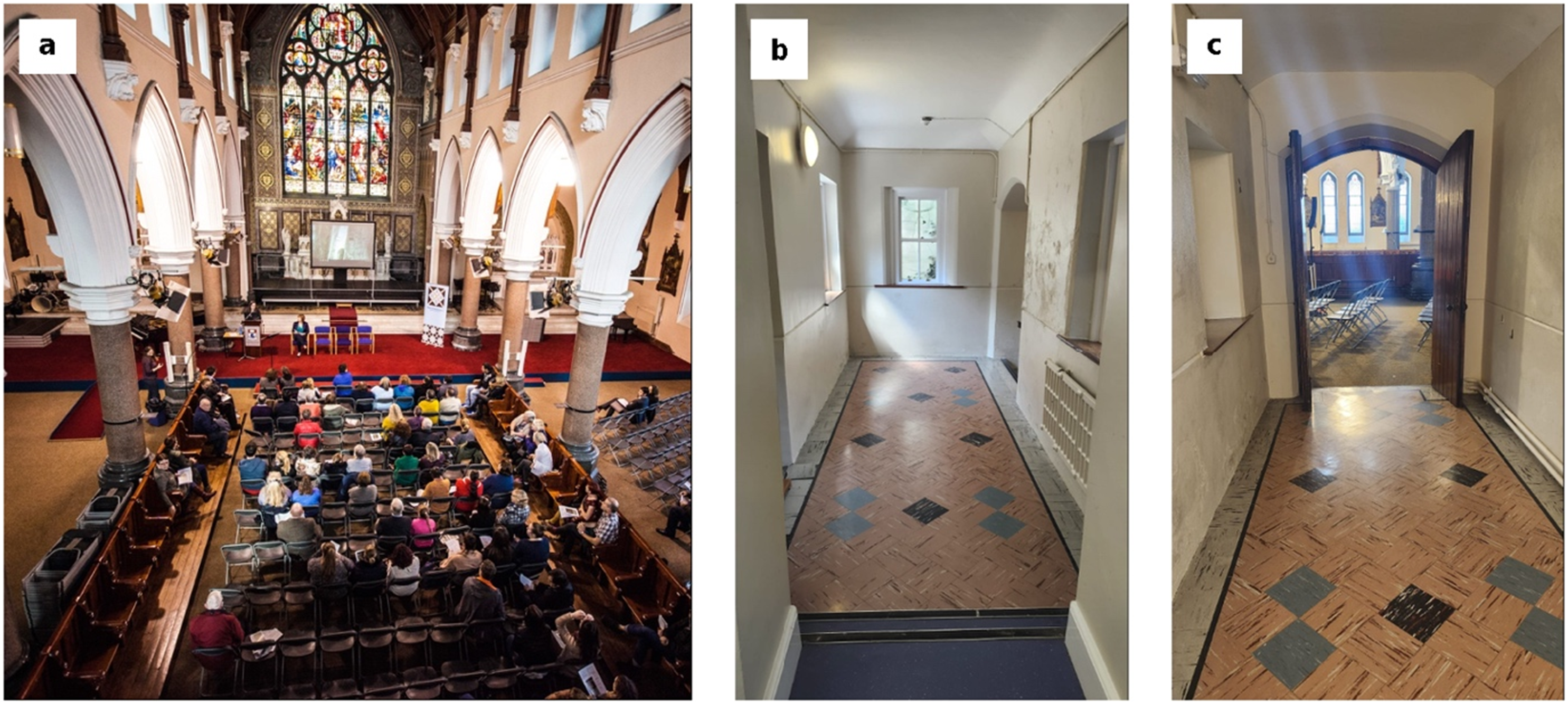
(a) St Mary's Chapel, part of South East Technological University (SETU)'s College Street campus. Source: Waterford Memories Project (2016). Photo: John Loftus. (b, c) Internal corridor leading to chapel, College Street campus. Source: Waterford Memories Project (2025). Photo: Jennifer O’Mahoney.
Both the Donnybrook and Waterford Magdalene Laundries exemplify the use of architectural design to enforce spatial segregation and institutional hierarchy, particularly within the chapel – a space ostensibly shared by religious and lay occupants, on occasion. At Donnybrook, the final built layout incorporated physically separate access routes: one corridor connected the convent to the nuns’ choir, while a distinct enclosed ‘covered bridge’ led directly from the Magdalene seating area to the laundry (Hamill, 2023). This ensured that the women returned to unpaid labour immediately after Mass, while the religious sisters exited via a separate route to the convent. A directly comparable spatial logic governed movement at the Good Shepherd Laundry in Waterford, as O’Mahoney, Bowman-Grieve and Torn (2019) document. There, a locked internal corridor connected the Magdalene dormitories to a segregated side entrance of the chapel. Survivor testimony and photographic evidence confirm that the women entered through the ‘penitent's entrance’ and were seated separately from the industrial school girls, who entered via a different side corridor and sat on the far right of the chapel (O’Donnell et al., 2013a).
Both Hamill and O’Mahoney et al. highlight how specific architectural features enforced and concealed regimes of confinement and forced labour in, what Hamill (2023: 14) terms, ‘umbilical corridor[s]’ as depicted in Figure 2 (b) and (c). These ‘umbilical corridors’ connected carceral spaces and funnelled girls and women directly from religious or residential spaces to labour settings without exposure to the outside world where access to the chapel, dormitories and work areas was possible without entering the main convent area. These spatial strategies of concealment resonate with what Brangan (2024) describes as ‘carceral erasures’ – architectural and administrative designs that render confinement invisible and deny recognition to those contained within. Notably, Hamill emphasises that this architectural strategy of enforced invisibility and control was unique to Magdalene settings and not found, for example, in other institutional buildings run by the same religious orders as Donnybrook (namely, the Religious Sisters of Charity), such as schools or homes for the blind. In Waterford, the corridor location functions to provide the Magdalene girls and women access to the chapel, while restricting access to the convent building.
As carceral spaces, the Magdalene Laundries were not passive spaces of confinement, but active ‘containers’ of atmosphere (Turner and Peters, 2015b: 326). Very little analysis on the architecture and atmosphere of Ireland's Magdalene Laundries exists, with the exception of Hamill (2023) and O’Mahoney, Bowman-Grieve and Torn (2019), which consider the Laundries in Donnybrook and Waterford – respectively. Hamill's account of Donnybrook details the spatial organisation – segregated wings, limited circulation and high perimeter walls – which ensured the women were rendered both physically and socially invisible. This aligns with the observation that architectures of coercive confinement – such as prison design – often involve the avoidance of ‘sensory and semiotic ambiguity’ (Edensor and Sumartojo, 2015: 254; O’Donnell and O'Sullivan, 2020), constructing environments that assert moral clarity and behavioural expectations. In the Waterford case, a regime of constant surveillance behind high walls and locked doors produced an affective state of internalised control. Jacobs (2006: 136) maintained that architecture cultivates specific affective responses through spatial arrangement, materials and even micro-conditions such as ‘mould, damp, dust, rust and fading’. The Waterford Laundry, in its aesthetic and functional arrangement, reproduced a panoptic mode of discipline, not merely physically but atmospherically, embedding fear, shame and conformity in its occupants. This reading also aligns with Reuber's (1996, 1999) analysis of Irish asylum design, where architecture was developed to support ‘moral management’ through classification, controlled circulation and surveillance logics associated with panoptic planning. While the Waterford case is a different institutional and gendered context, Reuber's account is useful here as an Irish precedent for reading built form as an active technology of institutional management.
While some atmospheric elements are deliberately engineered – for example, through the positioning of windows, the manipulation of sound and materials or the use of specific architectural styles – others are more diffuse, arising from emotional associations, historical legacies and individual subjectivities (Edensor and Sumartojo, 2015). In carceral contexts, such atmospheric design is not neutral; it is often intentional and deeply political, where architectural atmospheres are frequently curated to meet ideological or institutional aims, especially those related to discipline, control and containment (Borch, 2014; Turner et al., 2022).
A further dimension of carceral atmosphere is the semiotic use of religious imagery. The presence and role of Catholic iconography in constituting a ‘psychological architecture of surveillance’ finds strong empirical and affective corroboration in Jolene's testimony, which referenced the ‘massive religious statues’ (O’Mahoney, 2014a). Her observation is not simply a comment on architectural features, but a reflection on the lived atmospheric intensity of the institutional environment. The religious imagery does not merely operate as decoration but as a carceral semiotics. Statues of the Virgin Mary, the Sacred Heart and crucifixion scenes act as reminders of guilt, repentance and obedience (O’Mahoney et al., 2019), thereby embedding ecclesiastical discipline into the physical and perceptual landscape of the institution. The iconography fused with the oppressive architecture to anchor a theology of sin, shame and moral surveillance into the fabric of daily life.
These experiences are not limited to the immediate physical setting, but are shaped by prior associations, attachments and broader social conditions. In the context of carceral environments, Turner and Peters (2015b: 315) stress the importance of attending to the intangible, yet powerfully felt, dimensions of space, which emerge from and are sustained by material and visual components. Such residual architectures, and the atmospheres they produce, demand critical attention in the context of educational reuse and institutional accountability. As survivor testimonies recount, high walls, barred windows and restricted thresholds were not merely functional but instruments of discipline that continue to generate atmospheres of discomfort and unease long after formal closure. This raises pressing questions about how such sites are engaged, interpreted and taught. The following section examines one such intervention: the Waterford Memories Project and the event When Silence Falls, which sought to activate the site as a space of public witnessing and pedagogical engagement.
Case study: Memory, resistance and the university
The Waterford Memories Project, established in 2014, constitutes a survivor-centred, collaborative digital humanities project, which documents and examines the oral histories of those who lived and worked within the systems of coercive confinement in the south-east of Ireland (Waterford Memories Project, 2025). Survivors were consulted in the project design and throughout resource development. Providing open access resources for both informal and formal educational purposes is one way the project responds to survivors’ wishes about how their histories should be remembered (O’Donnell and McGettrick, 2020). Resources, such as the educational resource pack (O’Mahoney and McCarthy, 2019), challenge ‘state sanctioned narratives of the past’ and enable researchers, faculty, students, teachers and members of the public to ethically engage with, negotiate and navigate carceral legacies through art, performance, testimony and digital media across various educational sites (Paulson et al., 2020: 436).
Educational sites include policy, curricula and textbooks and incorporate the teaching and learning environment, student and educator interactions and the memories and narratives people bring into, onto and away from the site (Paulson et al., 2020). As site-specific theatremaker Mike Pearson (2010: 15–16) also observes: ‘every place holds within it memories of previous arrivals and departures, as well as expectations of how one may reach it or reach other places from it’. Educational sites have agency to ‘shape memory’ (Paulson et al., 2020: 430) and, we argue, also have the potential to rupture exclusionary narratives. Positioning education as a site of memory production foregrounds lived, embodied experience. It asks how feelings, senses and bodily practices connect memory to place within specific socio-historical and cultural contexts (Clughen, 2024; Paulson et al., 2020). The following section examines When Silence Falls: Exploring Bodily and Literary Memory in the Waterford Laundry to explore how educational sites can be harnessed as a site of resistance.
Education as a site of resistance
Taking place on 22 October 2016, When Silence Falls constituted a multi-disciplinary event that explored and remembered the former Waterford Magdalene Laundry and Industrial School through an immersive, site-specific event incorporating pre-recorded audio survivor testimonies, live art durational performances, audio-visual installations, film screenings and academic talks (O’Mahoney et al., 2021).
Alongside international artistic events and two conferences at the University of Galway (then the National University of Ireland, Galway) and University College Dublin, When Silence Falls (which was funded by a New Foundations, Irish Research Council Award) was programmed as part of the 1916:Home:2016 project. This project constructed a counter-narrative to the Decade of Centenaries 2012–2023 official state programme, which commemorated the anniversaries of historical events, thus contributing to Irish society's selective remembering.
When Silence Falls incorporated 13, simultaneous live art performances from SETU Theatre Studies and Visual Art students and faculty, facilitated by artist Dr Áine Phillips. Live art constitutes a radical, collaborative and disruptive practice that prioritises ‘corporeal action’ in a particular space (site), over a specific timeframe (thus making it durational), for an audience who ‘becomes an integral part of the work's meaning’ (Coogan, 2015: 4, 6). Informed by testimonies, archival documents and census records, performers engaged in embodied explorations, observing and responding to the built environment of the site: residual architecture, fittings, access points, hidden ramps, bricked-up windows, outside spaces, as well as the shifts in atmosphere, temperature and texture. Performers selected various locations spanning the ground floor of the former laundry and industrial school footprint, which intersected with the corridor that runs parallel to the chapel and one outdoor site in front of the public entrance to the chapel. Through time-bound, physical actions – informed by and located on – the site of incarceration, each performance aimed to make ‘the history of the women [and children] within materially real’ (Pine, 2008: 5) rather than re-present survivor experience through characterisation in a dramatic narrative.
Hamill (2023) and O’Mahoney et al. (2021) evidence that Magdalene Laundries functioned through a system of affective engineering. Their material and symbolic architectures were constructed to generate atmospheres of shame, silence and submission. These atmospheres were meticulously curated through layout, iconography, sensory deprivation and enforced labour. Given the dominance of the residual architecture of the College Street site and the persistence of carceral atmospheres, events such as When Silence Falls ‘build[s] an affective experience of past carceral space’ (Turner and Peters, 2015a: 72). Turner et al. (2022) stress that atmospheres linger – felt by both inmates and staff – during incarceration and after departure. These sites become what Turner and Peters (2015b: 326) term ‘containers’ of atmosphere – mutable but enduring, etched into spatial memory. Survivors’ testimony demonstrates how the women hold internalised atmospheric cues long after release, with Charlotte (quoted in this article's title) noting she is ‘still there’ decades later (O’Donnell and McGettrick, 2020: 2). Performers worked physically within these containers, focusing on concepts of silence, stillness, repetition, time, atmosphere and juxtaposition to create time-based rituals that ‘invite the audience to bear witness to historical trauma’ (O’Mahoney et al., 2021: 46). As the audience moved through the spaces and atmospheres during the event, they were enrolled as witnesses, watching and experiencing reframed testimony (Duggan and Wallis, 2011). Testimony and ritual co-existed, thus creating a ‘palimpsestic’ space, which ‘accumulate[d] different layers of function, meaning and aesthetic presentation’, where performers and the public dialogued with the past and the present across a temporal divide (Lavender, 2016: 67; Turner and Peters, 2015a). Atmospheres and carceral layers ‘accumulate in time and space’ and in bodies, impacting those who experience carceral spaces on a daily basis as well as those who survived them (Chakraborty and Repo, 2024: 4).
Approximately four hundred members of the public attended When Silence Falls, which opened the site to the wider community. Whilst such an event may be seen to offer a temporary ‘tourist’ experience of a laundry, which seems to authentically encapsulate what it might have felt like to be incarcerated in these buildings, it is more accurate to describe the experience as a co-creation of assumption, between performer and audience, about what life was like. The mediated presence of survivor testimonies in the space, echoing through corridors and rooms to which the incarcerated women were, historically, denied access, offered the audience an authentic insight into the lived experience in the very spaces and site where the violations of their human rights occurred. Thus, the built environment becomes a ‘potent mnemonic trigger’, a way to bring the past functions of the site into sharp relief in the present for members of the SETU community and the public (Harvie, 2005: 42). Anticipating the potential impact of this ‘temporary boundary crossing’ (Turner and Peters, 2015a: 88) and the residual atmospheres and carceral layers which may be encountered, counselling support and helpline information were made available to support those who experienced the event.
Performance is ephemeral, but the When Silence Falls documentation in tandem with survivor testimony, archived and publicly available on the Waterford Memories Project website, continues to make visible the systemic ways women and children were coercively confined in this former site of incarceration. Thus, the website becomes another space and performance site where we can disrupt institutional silences (Auslander, 2006). The Waterford Memories Project is part of the necessary memory work required if we want to ethically study, teach, research, work and socialise in a former site of carceral confinement. One of the core values underpinning SETU's vision and identity is a commitment to ‘act sustainably, responsibly and ethically’ (SETU, 2023: 9). We argue that to achieve such a vision, educational institutions such as SETU must formally and publicly acknowledge the legacies of sites on which they are built. Projects such as the Waterford Memories Project evidence the work of ‘social and societally conscious staff’ (SETU, 2023: 62), but this consciousness does not yet manifest in educational discourses such as university strategies and policy. As Maeve O’Rourke (2020: 2–4) notes, the Irish State has failed to implement comprehensive public education or memorialisation in response to its own history of institutional abuse, despite repeated recommendations by human rights bodies and survivor groups. When Silence Falls can thus be understood not only as artistic intervention but as a necessary pedagogical act in the absence of state-led truth-telling.
As bell hooks (2003: 12) argues, education can become ‘the practice of freedom’ when it interrupts systems of domination and constructs spaces where critical consciousness and collective healing may emerge. In the immersive, site-specific performances of When Silence Falls, we see an enactment of this pedagogy: a deliberately embodied method of engaging trauma and institutional violence through layered affective encounters that acknowledges the impacts of residual atmospheres and architecture and carceral layers, no matter how hidden, on the bodies who continue to use the space. These performances mirror what hooks describes as the ‘insurrection of subjugated knowledge’ whereby survivors’ mediated voices re-entered the built spaces, thus denying the erasure of memory (hooks, 2003: 5).
When Silence Falls thus staged an epistemological rupture within and against the State's selective commemorative frame, creating a temporary classroom of public witnessing where students, faculty and local communities co-produced historical accountability. We echo hooks’ (2003: 157–158) insistence on ‘radical openness’ and the courage to ‘call the spirit’ of the oppressed through acts of collective remembrance by enacting her idea of education as a tool for change – one that not only challenges the physical and symbolic legacies of past harm but also questions the institutions that still limit full justice for survivors.
The Waterford Memories Project, critically and creatively, reflects on the role of educational sites (whether through policy, strategy, curricula, classroom interaction or physical spaces) in maintaining or challenging silences. The project ruptures institutional narratives that silence and omit the lived survivor experiences of historical traumas and brings those legacies into the present. In this light, the site of the former Magdalene Laundry and Industrial School becomes not just a place of incarceration remembered but a locus of resistance performed – a space of pedagogical intervention and, ultimately, transformation. hooks reminds us that such work is not about finality, but about keeping open the possibility for what she calls a ‘pedagogy of hope’ – one grounded in truth-telling, co-resistance and the refusal of institutional amnesia. The transformation of the site into a space of education does not, in itself, constitute justice. Recognition remains incomplete, archives remain controlled and redress remains uneven. In this sense, the endurance of carceral architectures parallels the unfinished and contested character of justice for survivors.
Returning to the question that frames this article – whether educational reuse reproduces, erases or transforms a carceral legacy – the Waterford case suggests that all three occur simultaneously. The site's architectural residue reproduces elements of confinement, an institutional narrative of progress risks erasing it, and survivor-led memory work opens the possibility of transformation. Reuse alone does not constitute justice. For SETU and comparable institutions, occupying a former site of incarceration entails an ongoing ethical obligation: to name that history, to support survivor-led remembrance, and to treat recognition and redress as unfinished and ongoing work.
Footnotes
Acknowledgements
The authors acknowledge with deep respect the survivors who shared their testimonies and lived experiences. Their accounts form the foundation of this work and contribute to the ongoing process of truth-telling, learning and public recognition of institutional harm.

Funding
The authors disclosed receipt of the following financial support for the research, authorship, and/or publication of this article: This research was supported by the Irish Research Council New Foundations scheme 2019 and Creative Ireland Programme 2017–2022.
Declaration of conflicting interests
The authors declared no potential conflicts of interest with respect to the research, authorship, and/or publication of this article.