







Abstract
The Warsaw Ghetto Uprising is emblematic of armed Jewish resistance to the Holocaust; it should also be emblematic of rebel organization formation and capacity building in the most extreme power asymmetry. The Warsaw Ghetto Uprising happened because civilians who were directly experiencing a genocide formed rebel organizations that gained the capacity to hold territory. Drawing from video testimonies and memoirs of survivors, diaries of witnesses, and the work of historians, this study analyzes the formation and evolution of the Jewish Fighting Organization (ŻOB) to create and begin to validate a generalizable theory on how rebel organizations form in genocide, and how they create the capacity to hold territory from the genocidal opponent. The ŻOB evolved from a violent resistance organization to a rebel organization with a military infrastructure that could hold territory against the Nazis; further, it was this capacity to hold territory that allowed the ŻOB to win the survival of many Jews. These findings offer important insights on the possibility of rebel group mobilization against genocidal persecution, and can be used to understand contemporary genocide resisters.
Introduction
The memory of the Warsaw Ghetto Uprising crystallizes into canon: fewer than a thousand Jews, most of them barely adults, mostly armed only with revolvers and Molotov cocktails, stood against over three thousand Nazis armed with tanks and machine guns. Resigned to death’s inevitability, the Jewish fighters fought to assert that they could.
This understanding is true, but it is also incomplete. The battle lasted 28 days. Few urban areas battled longer—only four Nazi-occupied areas outlasted the Warsaw Ghetto (MacLean, 2001: 3). Afterward, many fighters escaped to fight the Nazis elsewhere, and still others hid in the remains. If they were a group of armed resisters determined to die fighting, why did they create a consolidated military organization and chain of command? How did they manage to defend the ghetto for days, giving some Jews, including many of the fighters, time to flee the ghetto through escape routes they had spent months creating?
These questions can be answered when we treat the Warsaw Ghetto Uprising not only as a heroic act of resistance but also as a battle between a rebel organization and a state. Conceptualizing the Warsaw Ghetto Uprising as violent resistance is useful, and previous studies that used this frame made essential contributions to understanding why the ghetto fighters resisted, why they chose violence, and how they fought. However, to understand the full scope of violent resistance to genocide, we need to disaggregate the concept of violent resistance. To achieve what they achieved, ghetto fighters not only decided to resist, and not only coordinated to use violence, but created a specific form of violent resistance group—a rebel organization.
In this paper, I temporally trace the formation and capacity-building of one rebel organization that fought in the Warsaw Ghetto Uprising, the Jewish Fighting Organization (Żydowska Organizacja Bojowa, henceforth referred to as the ŻOB). In doing so, I offer a first brush at a generalizable theory of how civilians can form rebel organizations in genocide, and how they can gain the capacity to hold territory from a genocidal state. When skilled civilian resisters networked in pre-existing underground organizations decide that no other organization can effectively resist the genocide, they will form a rebel organization. This rebel organization will develop the capacity to hold territory when its aim of holding territory is actively supported by the civilian population.
This sheds new light on how the context of genocide affects the evolution of violent resistance against it (Finkel and Straus, 2012; Shaw, 2007; Verdeja, 2012) because the Warsaw Ghetto Uprising demonstrates that it is possible for people trapped and targeted by genocide to create a rebel organization capable of holding territory from the state. There are cases of rebel groups forming in the overall context of genocide, such as the Sudan Revolutionary Front or the Sudanese Awakening Revolutionary Council; however, these kinds of organizations are not formed primarily by people directly experiencing genocide, and may even be formed by perpetrators. There are also many cases of previously established rebel groups fighting genocide, such as Rwandan Patriotic Front or the Guerilla Army of the Poor in Guatemala; although these organizations may be comprised mostly of members of the group targeted by the genocide, they were formed before the persecution escalated to genocide. This paper shows that it is possible for people directly targeted by a genocide to form a rebel organization while they are experiencing genocidal persecution. This has important implications for contemporary instances of rebel organization formation and evolution during genocide, including the formation of the Êzîdxan Protection Force (Paraszczuk, 2015) and Sinjar Resistance Units (Tomasevic and Coles, 2016) in Iraq, or the Northern Alliance in Myanmar (Human Rights Watch, 2019).
This paper proceeds in five parts. First, I review the disparate literatures on armed resistance in the Holocaust and rebel organization formation and structure. Second, I offer a theory of how a rebel organization can form and hold territory in genocide. Third, I explain my analytical approach, justify my case selection, and offer caveats about sourcing. Fourth, I temporally trace the foundation and development of the ŻOB, beginning with the forced internment of Jews in the Warsaw Ghetto and ending with the Warsaw Ghetto Uprising. Finally, I conclude with a few suggestions for further research.
Literature review
This article is indebted to the history and sociology dominated literature on armed Jewish resistance during the Holocaust and the political science dominated literature on rebel organization formation. The historiography of Jewish resistance to the Holocaust was initially situated within a nebulous definition of resistance as opposition to perpetrators (Hilberg, 1961: 663), as well as influential early assertations that Jews barely resisted (Arendt, 1964; Hilberg, 1961).
In his definitive assessment of the next 30 years of the historiography of Jewish resistance, Morrus details how much of the subsequent discourse was dedicated to fleshing out more specified definitions of resistance that could provide more analytical backbone for research (1995). Foundational to all these definitions was the intention of the resisters to resist, and their own understanding of their actions as resistance (ibid: 90–91). Perhaps correspondingly, much of the early sources on armed Jewish resistance seems to focus largely on individual people and individual actions; indeed, the very concept of intent to resist is grounded in the unit of analysis of the individual resisters.
The literature evolved to focus more on collective, networked resistance (Moore, 2010). Dreifuss and Druck credit Yisrael Gutman with this turn from individual accounts toward studies of how Jewish communities experienced the Holocaust, including how communities resisted (2017). Studies of ghetto fighters seem to follow this turn from the focus on the heroism of individuals to the dynamics of groups. Dreifuss’ recent reassessment of the ŻOB’s leadership is an excellent example of this (2017).
Sociologists contributed to understandings of Holocaust resistance as networked and collective and tend to offer three explanations for armed resistance: Jewish identity, perception of the Nazi threat, and resisters’ skills. The Jews self-identified as a people of honor (Einwohner, 2003). The ŻOB’s strategic use of Jewish identity and honor in its framing helped establish its credibility within the ghetto (Einwohner, 2008), and galvanize resistance (Suedfeld and de Best, 2008). Further, the Jews used the warped Nazi conception of racial identity as a tactical tool; Jews who could appear “Aryan” smuggled resources into ghettos to help the resistance (Einwohner, 2006). Then, correct perception of threat was a key catalyst of armed resistance (Einwohner and Maher, 2011; Soyer, 2014). Finally, experience of selective oppression prompted ghetto resisters to cultivate the skills necessary for effective resistance (Finkel, 2015). Midlarsky argues that the Warsaw Ghetto saw the most armed resistance because the Nazis’ mode of punishing Jews in Warsaw differed from other ghettos in Poland (2005).
This study attempts to build on this literature by focusing explicitly on the organizational aspect of armed resistance. This goes beyond a focus on networks and collectives of individuals to explore how the strategies and formal structures of organizations condition the extent and efficacy of their resistance. This focus on organizational structure is grounded in the political science literature on rebel organizations, which has flourished in the last decade (Parkinson and Zaks, 2018). Scholars of rebel organizations have identified how state strength (Buterbaugh et al., 2017) and the manner of state repression (Lindemann and Wimmer, 2018) influence not only the occurrence of armed resistance, but the structures of rebel organizations (Buesa and Baumert, 2018; Ghatak, 2018; Marsden, 2016).
The extent of state repression influences the formation of rebel organizations, as experiences of repression make people more likely to form and join rebel organizations (Brathwaite, 2014; Piazza, 2017; Wood, 2003). Yet, there is very little research on rebel organization formation and capacity-building that explicitly accounts for genocide. Given how scholars of rebel organization formation and evolution recognize that context and repression are key factors conditioning why rebel groups form and how much capacity they gain, this is a significant gap.
Theory
This paper begins to build a generalizable theory of how civilians directly experiencing a genocide 1 can create a rebel organization capable of holding territory from the genocidal state. I conceptualize a rebel organization as an organization that engages in armed conflict against a state for political purposes (Parkinson and Zaks, 2018), has an organizational structure that includes a specified chain of command, and has procedures for operations, training, and weapons procurement. 2 I borrow De la Calle and Sánchez-Cuenca’s conceptualization of holding territory as “break[ing] the state’s sovereignty over its own territory” (2012: 53). Many rebel organizations fight for decades and can never hold territory (De la Calle and Sánchez-Cuenca, 2012).
Genocide limits potential rebels’ wherewithal to organize and fight in infinite ways, and drastically constrains rebels’ aims. Most rebel organizations form and develop military capacity to hold territory from a state so that they can either secede from that state or change its government. Rebel organizations formed during genocide by genocide victims are fundamentally different in that they fight to hold territory simply for the sake of the survival of members of their group. The point of holding territory is to create an opportunity for members of the targeted group to physically escape the perpetrators, which contributes to physical group survival by preserving the lives of some of its members. Rebel organizations that form in genocide might also see temporarily holding territory as a means of asserting the continued existence and agency of the group, which contributes to ideational group survival. Rebel organizations outside of genocide might use rhetoric about the physical survival of the group they profess to represent, claiming that if they do not secede from the state or change its government, group survival is at stake. For rebel organizations formed by victims of ongoing genocide, the need for physical survival is not used as a justification for other aims. Due to the intense persecution and power asymmetry inherent to genocide, rebel organizations that form in genocide cannot afford to fight for aims beyond survival, and this distinguishes them from rebel organizations that form outside of genocide, which can afford to have the more ambitious aims of secession or overthrow.
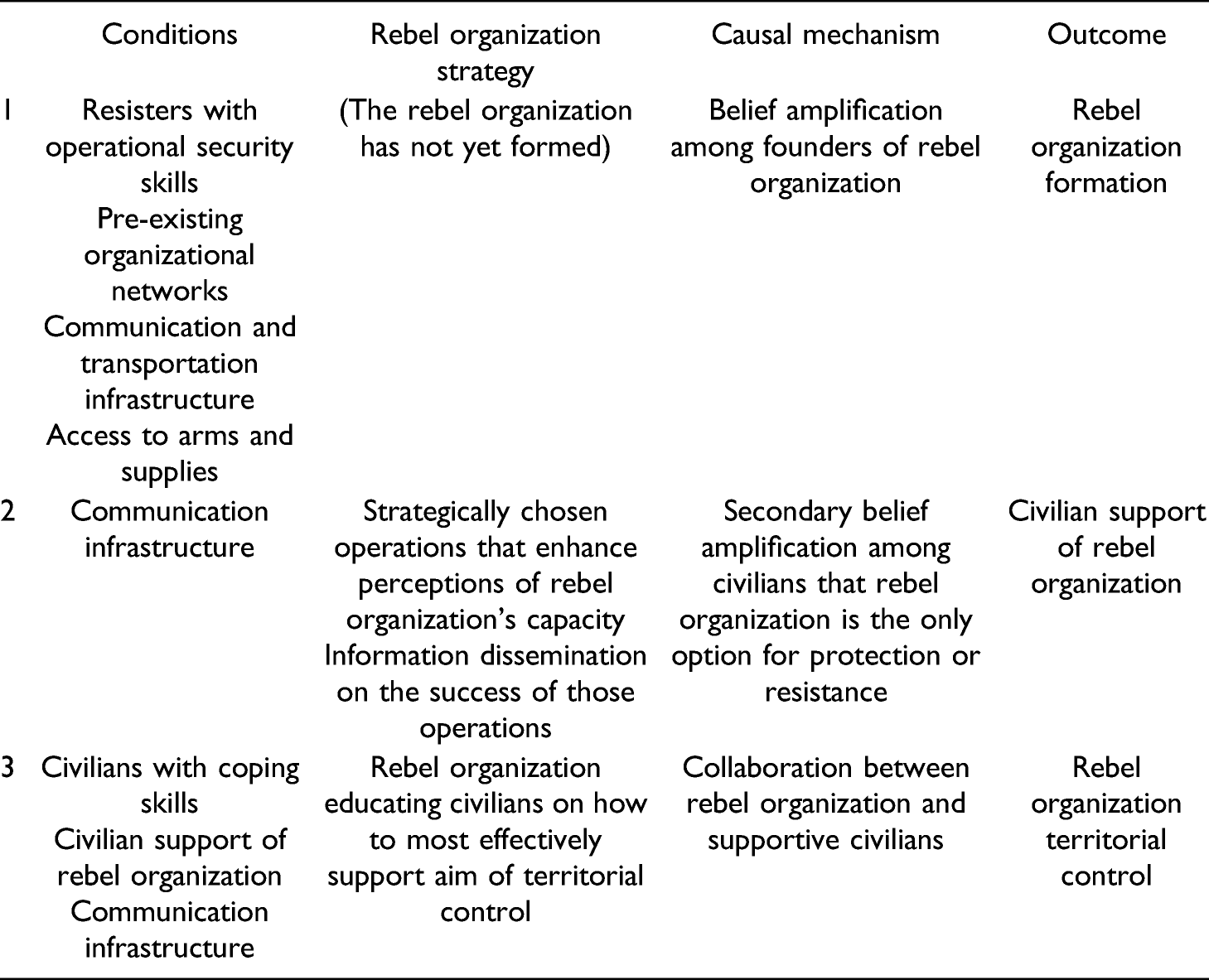
A rebel organization will form in the context of an ongoing genocide when there are resisters with operational security skills who are networked in pre-existing organizations, and who have access to a communication and transportation infrastructure. When those resisters decide that no other organization will effectively resist the genocide, they will form a rebel organization. Then, this rebel organization will develop the capacity to hold territory from a genocidal state when its aim of holding territory is supported by the civilian population.
Phase 1
For genocide victims to form a rebel organization, the following conditions are necessary: a group of resisters who have operational security skills, 3 pre-existing organizational networks of political or resistance organizations, a communication, and transportation infrastructure that spans disparate locations within the site of genocide and beyond it, and access to weapons and supplies. These preconditions are interlinked and mutually reinforcing: operational security skills, pre-existing organizational networks, and communication and transportation infrastructure all reinforce each other (Finkel, 2017: 161–164), and all of them condition access to arms and supplies.
Once these conditions are in place, the key causal mechanism that impels civilian resisters to transform themselves into rebel fighters is a particular kind of belief amplification (Snow et al., 1986: 471), or the conviction that if they do not take up the cause, the cause will be lost. Civilians can create rebel organizations to stop genocide when they have the skills, infrastructure, and hope of obtaining the resources necessary to do so, but they will decide to do so when they believe that no other kind of organization can effectively resist the genocide.
Phase 2
Many of the same conditions that are necessary for a rebel organization to form in the context of ongoing genocide are also necessary pre-conditions for its development of the capacity to hold territory from a genocidal state, but they are not sufficient conditions. An additional necessary condition is support from the civilian population surviving on the territory that the rebel organization seeks to hold. The same communication infrastructure that facilitated the formation of the rebel organization is necessary for the rebel organization to cultivate this support.
The rebel organization must make strategic decisions to spread information that enhances perceptions of its capacity. This involves a secondary belief amplification. If civilians 4 believe, as rebels do, that using military means to hold territory from the genocidal state is the best chance of mounting a meaningful resistance to the genocide, and if civilians also believe that the rebel organization has the capacity to effectively deploy such military means, then civilians will support the rebel organization.
The perception that a militarized fight for territory is the last best option for protection is largely due to factors outside the rebel organization’s control. However, civilians’ perceptions of the rebel organization’s efficacy are partially a function of the rebel organization’s strategy in winning the right fights and using their victories to enhance perceptions of their capacity. Thus, this secondary belief amplification is not so much about ideological agreement with the rebel organization’s aims as it is about perceptions of its material capacity: as civilians become increasingly convinced that the rebel organization has enough material capacity to have a chance of meaningfully holding territory from the genocidal state, they will become more supportive.
Phase 3
The coping skills of the civilian population 5 is outside of the rebel organization’s control, but it can pursue initiatives to educate the civilian population on how to deploy those skills in the ways that would be most helpful in holding territory against the genocidal state. The communication infrastructure is a necessary condition for marshalling that skilled civilian support to further the goal of territorial control.
The relationship between rebel combatants and civilian supporters is essential in the context of an ongoing genocide because of the extreme power asymmetry between the perpetrators and victims of genocide. There is already generalizable evidence that civilian support for rebel organizations enhances their likelihood of achieving territorial control (Rubin, 2020). The power asymmetry that precipitates and is heightened by genocide is so extreme that no rebel organization formed in the context of an ongoing genocide can hope to amass or project enough capacity to unilaterally break a genocidal state’s sovereignty over the territory where it is committing the genocide. However, a rebel organization can galvanize civilians to participate in unarmed means of reclaiming territorial control that support its armed efforts. This does not necessitate the projection or accumulation of capacity that would be impossible under conditions of ongoing genocide, but rather a coordination of the capacity that already exists among the victims of genocide, rebel, and civilian alike.
Case selection, analytical approach, and sourcing
This paper uses a case study of a single rebel organization, the ŻOB, to begin to validate this generalizable theoretical framework. The analytical approach is the genetic approach to causal investigation (Ermakoff, 2019: 591–596). The objective is to offer an abstracted, generalizable theory about how rebel organization formation and capacity-building happens in genocide, and then to begin to validate that theory through temporal tracing of the trajectory of the ŻOB.
As the unit of analysis of the theory is the organization, this case study does not tell the full story of the Warsaw Ghetto Uprising. The ŻOB was not singularly responsible for the military achievements of the Uprising. Many fought with no organizational affiliation or under another major rebel organization, the Żydowski Związek Wojskowy (Jewish Military Union, henceforth referred to as the ŻZW).
This study focuses on the ŻOB partially because there are significantly more data available on the ŻOB fighters than on ŻZW fighters. The ŻOB smuggled copious, detailed reports of its actions to the “Aryan” side of Warsaw, which lends itself to increased data available on the ŻOB (Arens, 2009: 9–11; Zuckerman, 1993: 370–372). Further, while the ŻZW chose to fight the Nazis continuously during the Uprising, the ŻOB chose to mount discrete attacks and retreat quickly back to their bunkers (Arens, 2005: 218). This meant that there were significantly more ŻOB than ŻZW fighters who survived to tell the story of their organization; further, the ŻOB survivors were better connected to people who could help disseminate their story, while the few ŻZW survivors were largely unknown to the relevant political communities (Arens, 2009: 9–10).
This study also focuses on the ŻOB over the ŻZW because the ŻOB better fits this paper’s high theoretical threshold of rebel organization formation. Almost all ŻOB members had been civilians during peacetime who became militarized during the Holocaust, while the ŻZW was formed from the ranks of the National Military Organization, a pre-war militant wing of Betar, and many of its leaders had served in the Polish army (Arens, 2005: 201). It is possible to argue that the ŻZW represents a re-constituting of a non-state military organization that pre-dated the genocide. It is not possible to argue this of the ŻOB.
This case study draws from an array of sources, detailed in the appendix. Prominently featured are the memoirs of ŻOB commanders, as well as video testimonies of ŻOB and ŻZW fighters and civilian collaborators, and written accounts of ghetto residents. The reliance on ŻOB accounts inevitably introduces bias, as some ŻOB members carefully calibrated their portrayal. The political factions among the Jewish community that predated the Nazi invasion of Warsaw persisted well beyond the Uprising through to Israeli politics. In some cases, ghetto fighters’ accounts of the Uprising were influenced by these persistent factional dynamics (Arens, 2009; Libionka and Weinbaum, 2006). Due to my reliance on ŻOB accounts, I may overemphasize its centrality to the Uprising. To counteract this, wherever possible, I corroborate ŻOB fighters claims with ŻZW fighters and collaborators, ghetto residents, and Nazi commanders recollections, and with the work of historians of the Warsaw Ghetto, Yisrael Gutman foremost among them.
Case study
The creation of the Warsaw Ghetto
When the Nazi-Germans invaded, about 30% of Warsaw’s population was Jewish (Gutman, 1989: xvi). Jewish Warsaw had a plethora of community organizations dedicated to every social issue imaginable, including politics (Ury, 2012). These community organizations were central to Jewish lives in Warsaw, including young people’s lives. Joseph Greenblatt (1996), a member of the ZZW, recalled, “Every Jewish kid belonged to some kind of a Jewish youth organization […] left or right or center, but they belonged” (video testimony). These organizations became more important to Jewish life in Warsaw as antisemitism in Poland increased (Gutman, 1989: xviii).
Nazi troops reached Warsaw on September 8, 1939. The Nazis established an information infrastructure to control the movements of every Jew, and Judenrat (Jewish councils) to govern Jewish communities (Gutman, 1989: 14). Jewish community organizations in Warsaw began to transform themselves into aid organizations operating underground.
In November 1939, the Nazis began to create a Jewish ghetto in Warsaw (Gutman, 1989: 48). On November, 16, 1940, with every known Jew in the city inside, the Warsaw Ghetto was sealed (Gutman, 1989: 61). When the Warsaw Ghetto was established, “the top echelon of Jewish public and political leaders left Warsaw and German-occupied Poland altogether” (Gutman, 1989: 146). This included the heads of youth movements, who escaped Poland altogether and sent back functionaries to ensure their movements did not abandon Poland’s Jews (ibid.). These functionaries would become the leaders of the ŻOB.
The ghetto covered 2.4% of Warsaw’s land and contained 30% of its population. 380,000 people lived together in 1.3 square miles (Gutman, 1989: 61). The penalty for escape was death (Mazor, 1993: 14). Officially supplied rations hovered around 177 calories a day (Ringelblum, 2015: 228). People depended on smuggled food, with up to 80% of calories consumed in the ghetto introduced in by networks of food smugglers (Cesarini, 1994: 153), many of whom where children (Schiff, 1998). In less than 2 years, 100,000 ghetto residents died (Roland, 1992: 223–225).
Phase 1: The formation of the ŻOB (Spring 1942–October 1942)
Beginning in the spring of 1942, rumors of an impending deportation circulated (Czerniakow, 1979: 382–383). The underground presses run by an array of youth movements 6 issued calls to arms, such as this one: “The Warsaw ghetto lives in the shadow of constant danger. Indeed, it must live like a besieged fortress. All means to defend it, for its final battle […]. The spirit of our daily actions must be that of Masada” (Gutman, 1989: 142). This hearkened back to the story of Masada—an ancient fortress that a Jewish rebel group died defending during the First Jewish-Roman War. It also made no impact, as many in the ghetto thought that the best chances of survival lay in living quietly and negotiating with the Nazis through the Judenrat.
At this point, calls to arms from youth movements were only calls, but many members of youth movements had the skills and connections to put them in action. As membership in youth movements became illegal upon the Nazi invasion of Poland, taking their involvement underground helped members cultivate operational security skills. Further, forced internment in the ghetto prompted youth organizations to network in new ways. Many of them were connected to Self-Help, a network of aid organizations, and they held their meetings after hours in Self-Help’s soup kitchens (Gutman, 1989: 123–125). Youth political groups within the ghetto and “Aryan” Warsaw came together to create the Anti-Fascist Bloc, which attempted to create formalized infrastructure to coordinate armed resistance to the Nazis (Dreifuss, 2017: 26). The Bloc was short-lived and did not manage to gather arms (Gutman, 1994: 114–115). Still, it created an organizational infrastructure that helped its constituent political movements coordinate (Dreifuss, 2017: 26).
Each movement had its own communication infrastructure, and each saw its most important mission as continuing the publication of clandestine newspapers (Gutman, 1989: 125). These newspapers, and the printing apparatuses that supported them, would be key to creating the civilian support that enabled the soon-to-be fighters to hold territory from the Nazis. Perhaps more importantly, since the political underground rarely coordinated in writing because of concerns about operational security (Frankel, 1996), each already had a sophisticated infrastructure of whisper networks for coordinating activities and spreading information within and beyond the ghetto.
Further, civilians in the ghetto had created a vast transportation infrastructure of smuggling networks, which were crucial for survival (Gutman, 1989: 41). There were four main means of smuggling. People who could pass as Polish could disguise themselves as Poles and move around the “Aryan” side of Warsaw (Meed, 1996). Some work units exited the ghetto daily, and Polish-passing members of those work units would sneak away after they entered the Aryan side in the morning (Rawicki, 2001). Some smugglers used routes in the sewers to enter and exit the ghetto (Frankel, 1996), while others, especially children, snuck through small spaces in walls (Schiff, 1998). Finally, there was a work unit of Jews tasked with gathering dead bodies in the ghetto and transporting them to the cemetery that bordered the ghetto and “Aryan” Warsaw, and smugglers in that work unit would smuggle objects in the wagons carrying the bodies (Landau, 1995). This route could also be used to smuggle people, faking dead, out of the ghetto (Landau, 1995) All of these routes pre-dated the establishment of any armed group in the ghetto and were later adapted by the ŻOB.
In late June, the German authorities ordered the Judenrat to organize the ghetto for a mass deportation (Czerniakow, 1979: 384). They claimed that deportations were simply for resettlement (Rosenberg, 1996). Warnings were given at underground meetings (Heilman, 1996) and in the underground press, that the deportation trains disembarked at extermination camps, but evidence of extermination camps did not spread much beyond the political underground (Zuckerman, 1993: 116–117). This evidence of extermination camps—and the Judenrat’s failure to warn Jews—led some youth leaders to advocate for armed resistance. As Yitzhak Zuckerman, a future commander of the ŻOB, said in an Anti-Fascist Bloc meeting, “For who would defend us, if we didn’t?!” (1993: 182).
On July 23, 1942, the day after the deportations began, the head of the Judenrat completed suicide (Gutman, 1994: 136), and the remaining Jewish leaders in Warsaw met to discuss resistance (Gutman, 1989: 229). The leaders decided against armed resistance, as they thought that the “core” of the Jewish people could still be saved, and violence would jeopardize the possibility of saving anyone (Zuckerman, 1993: 150).
Five days later, after three failed attempts to continue to meet with the Jewish leaders (Zuckerman, 1993: 196) representatives from three youth movements met (Gutman, 1989: 236). They resolved to start the ŻOB. They had no arms and no military training. As Hela Schipper Rufeisen, a ŻOB courier in attendance, recalls, “We had a pistol that didn’t work. One of the fighters tried stabbing a pillow with a knife, to see if he could stab a person” (interview, 2003).
At that point, there were no aspirations to hold territory. Zuckerman recalls, “our goal was, in fact, to bring Treblinka to Warsaw. If that had happened, the Jews would have done their best to run away and hide, since they wouldn’t have believed the Germans…” (Zuckerman, 1993: 209). By forcing the Nazis to kill them in open view, they believed they would demonstrate that the Nazi agenda was genocide, and that the Jewish people could and should resist.
The ŻOB becomes a rebel organization (August–October 1942)
The ŻOB’s very first task was to use its members’ existing operational security skills, access to whisper networks and contacts outside the ghetto, and knowledge of smuggling networks to begin to gather arms (Zuckerman, 1993: 210). Before the formation of the ŻOB, many of its constituent youth organizations had attempted to gather arms, anticipating armed resistance, but their efforts were unsuccessful because their communication and transportation infrastructure, and contacts beyond the ghetto, were too limited (Gutman, 1989: 165). The formation of the ŻOB solved this problem, as the founders could network their networks. The ŻOB relied heavily on food smuggling networks to obtain weapons (Ringelblum, 2015: 274).
Setbacks in acquiring arms, combined with unabating deportations, inspired the ŻOB to develop its military capacity. On September 3, 1942, the Nazis intercepted a precious arms shipment and killed two commanders (Gutman, 1989: 245). A few days later, some members of one of the constituent youth political organizations could not escape a deportation (Zuckerman, 1993: 213).
The summer deportations ended on September 12 (Gutman, 1989: 62). By then, 265,000 Jews had been murdered in Treblinka, leaving only about 10% of the ghetto population behind (Gutman, 1989: 62). Each week, the Nazi searches for Jews became more extensive and extreme, and avoiding deportation required increasing information, effort, and ingenuity (Gutman, 1994: 138–139).
The ŻOB met to decide whether to continue. Zuckerman recalls a deeply fatalistic mood, with most leaders backing a proposal of “public collective suicide” to try to convince the ghetto residents of the gravity of the situation (1993: 215). Zivia Lubetkin, another leader of the ŻOB, recalls, “It seemed to all of us to be the best and only way out” (Lubetkin, 1981: 123). Zuckerman dissented, saying, “It is our duty to remain alive […]. We now know how to obtain arms […]. Our task is to continue to develop the resistance movement […] to be able to act to save both the honor and the lives of those Jews who have survived the slaughter” (Lubetkin, 1981: 122–123).
The ŻOB resolved to develop the military capacity to use battle to save Jewish lives and assert Jewish political identity. As a result, they increased their outreach to other youth movements (Zuckerman, 1993: 218–221). Soon after, in October 1942, youth groups who had declined to join the ŻOB in July 1942 agreed to join (Gutman, 1994: 166). This was driven by the realization that armed resistance was the only available means of meaningful resistance (Gutman, 1989: 285–286). The Bund, the most active underground party in the ghetto, and the best connected beyond the ghetto (Gutman, 1994: 121), which had previously been against armed resistance (ibid: 108) joined (ibid.: 166). Vladka Meed, a ŻOB member, recalls, “Really, I would say, in October 1942, the organization came to life” (video testimony).
The ŻOB created a leadership and command structure designed to balance the diverse youth movement affiliations—and their attendant priorities and concerns—now comprised within it (Dreifuss, 2017). A Coordination Committee was created to act as a civilian ancillary to the rebel group, to raise money, build shelters for Jews to hide in during the next deportation, and disseminate ideas of resistance (Kotkowsky, 2000: 47). The ZOB structured combat units using previous movement affiliations, out of a conviction that people who had previously worked together would fight more effectively (Gutman, 1989: 324). In addition, restricting membership on this basis allowed the ŻOB to limit their ranks to those they deemed trustworthy (Arens, 2011: 118). The ŻOB’s deep grounding in pre-existing youth movements also enabled its founders to recruit youth of many political persuasions (Dreifuss, 2017: 29, Frankel 1996), while still maintaining operational security by only recruiting those known personally.
The creation and military structuring of the ŻOB was precipitated by two waves of belief amplification: one when the deportations began in July 1942, and another in September 1942, when they saw the devastation of the deportations. The belief amplification among this critical mass of young activists from a diverse array of political movements led the ŻOB to establish a clear chain of command, create operational procedures, and implement a training regimen (Gutman, 1989: 298). By the end of 1942, the ŻOB had military structure and operational procedures designed to meet the Nazis in armed combat.
Phase 2: The ŻOB gains a critical mass of civilian support (October 1942–January 1943)
The ŻOB’s early armed operations
The ŻOB’s early offensive actions were strategically chosen and amplified by its underground press apparatus. The first took place on August 20, 1942: they attempted to kill Józef Szeryński, the widely hated chief of Jewish Police, who was instrumental in the ongoing deportation (Gutman, 1989: 239). Although Szeryński survived the attack, the widespread reaction—including among his own police force—was glee that he had been targeted (Gutman, 1989: 239). A few days later, the underground press distributed leaflets pronouncing a death sentence on the whole police force, and the ŻOB mounted a poster saying the same (Gutman, 1989: 239).
This became a central strategy. As Boren (1996), a courier for the ŻOB, recalls, “They would announce that Jewish collaborators were sentenced by a court martial of the organization to death, the execution would be fulfilled within a week, and then sure enough then a sign came in, he was shot” (video testimony). The next high profile, and widely celebrated, attack came on October 29, against Jakub Lejkin, a policeman who epitomized Jewish collaboration with the Nazis to Warsaw’s Jews (Gutman, 1989: 302). The ŻOB killed Lejkin, and the next day, posters appeared throughout the ghetto saying that the ŻOB had sentenced him to die and carried out the sentence (Gutman, 1989: 302).
The ŻOB planned its highest profile attack yet for January 22, 1943, and it used the prospect of the attack to prime the public for armed resistance to the Nazis. On that date, the ŻOB planned to kill the Jewish police in retaliation for collaborating with the Nazis (Gutman, 1989: 304). They announced their intentions on a poster that also read: Jewish masses, the hour is drawing near. You must be prepared to resist, not give yourselves up to slaughter like sheep. Not a single Jew should go to the railroad cars. Those who are unable to put up active resistance should resist passively, meaning go into hiding. We have just received information from Lvov that the Jewish police there forcefully executed the deportation of 3,000 Jews. This will not be allowed to happen again in Warsaw. The assassination of Lejkin demonstrates that. Our slogan must be: All are ready to die as human beings. (Gutman, 1989: 305)
Again, the ŻOB paired a display of force with public messaging. While they showed the civilians of the ghetto that they could use militarized violence to exact retribution on people who harmed Jews, the ŻOB exhorted Jews to actively resist. This continued focus on the police also increased civilians’ wherewithal to resist deportation. Ringelblum recorded that the Jewish police were essential to the summer 1942 deportation, and that “in 90 per cent of cases it was the Jewish police who discovered the hideouts” that civilians had used to evade capture (1974: 340). The ŻOB’s clear message was that resistance is not only possible, but that it would be backed by an armed organization capable of defending Jewish civilians.
The first battle: January 18–22, 1943
The ŻOB’s planned January 22 action never took place because on January 18, 1943, the second deportation of Warsaw Jews to Treblinka began. Thus, the ŻOB’s first battle was a surprise; they had no intelligence of the deportation, and had no real battle plan (Gutman, 1989: 312). Still, due to civilians’ coping efforts at constructing hiding places throughout the ghetto, along with the fact that word spread quickly throughout the ghetto, the Nazis were only able to round up 3000 Jews on the first day, almost all of whom were caught before they had a chance to hide (Gutman, 1989: 310).
Meanwhile, the ŻOB fought the Nazis on the street. In one engagement, the ŻOB had 40 fighters assuming pre-planned positions to prevent the Nazis from accessing one street in the ghetto (Meed, 1979: 152). On the evening of January 19, the ŻOB had a military strategy meeting during which they decided against any more offensive attacks and decided to move to indoor defense of civilians, as their greatest tactical advantage came in fighting Nazis in dark, unfamiliar spaces (Tushnet, 1965: 55). Due largely to the rebel fighters’ skillful defense of indoor areas, the Nazis only managed to deport 5000 Jews, and temporarily gave up on deporting 3000 more (Gutman, 1989: 311). The troops did not complete their full deportation order because they stopped searching indoor spaces for fear of encountering the ŻOB (Zuckerman, 1993: 289).
The January Uprising showed the ghetto how the efforts of rebel fighters and civilian resisters could go hand-in hand. Civilian resisters had constructed hiding places, mostly in the form of secret compartments in pre-existing cellars. However, these hideouts would have been easily discovered in Nazi searches, which did not happen because they were defended by rebel fighters (Gutman, 1989: 311).
The ŻOB fighters were astonished at the Nazis’ fear of engaging them indoors, and this realization of their own capabilities reoriented them. Zuckerman recalls, “After that, we no longer felt like people going to death […]” (Zuckerman, 1993: 288). The ŻOB realized that they could fight a battle for some Jews to survive.
The key would be to hold terrain. The ŻOB resolved that the next time the Nazis attempted a deportation, they would attack from fortified bases to allow Jews to escape the ghetto, mostly through a network of tunnels and sewers used by smugglers (Tushnet, 1965: 64). Then, the ŻOB would regroup to their underground bunkers, from which they would mount continued, small-scale attacks to distract the Nazis while the Jewish civilians continued to evacuate (Tushnet, 1965: 64). Finally, the remainder of the ŻOB would withdraw through tunnels and sewers to join Polish fighters in their fight against Nazi occupation (Edelman, 2013: 64). Thus, the object of the next battle would be to prevent the Nazis from accessing escape routes from the ghetto, to hold terrain to enable the escape of the Jews.
The widespread opinion in the ghetto was that the Jews had won a victory in thwarting some of the January deportation (Gutman 1989; 317). In particular, the comparison with the summer 1942 deportation was galvanizing: then, the Jews had not mounted any armed resistance, and the ghetto was decimated, and now, when armed resistance was mounted, the Nazis gave up the deportation in under a week (Gutman, 1989: 318). Indeed, support for the notion of armed resistance was widespread in the ghetto as early as September 1942; the ghetto archivist Emmanuel Ringelblum wrote in his diary: “Most of the populace is set on resistance [...]. Whomever you talk to, you hear the same cry: The resettlement should never have been permitted” (1974: 326). The obstacle was a perceived lack of capacity. In his memoirs, Dr. Lensky recalled the ghetto after the summer 1942 deportation: Everyone felt in his heart that the actions could start anew any day, and the question kept cropping up as to what was to be done to defend ourselves effectively […]. But to our sorrow, we could not obtain weapons. The underground itself was lacking people, and its equipment was poor. It is, therefore, impossible for the underground to propose the idea of armed opposition, although from a psychological standpoint, the Jewish community was ready to carry out this mission. (Gutman, 1989: 164–165)
Civilians supported armed resistance in principle, but not in practice, because they believed there were prohibitive material limitations. The rebel fighters’ response to the January 1943 deportations showed that these material limitations were no longer prohibitive.
There was now widespread consciousness that the armed resistance was mounted by a coordinated organization that would continue to defend the Jews. As Dr. Lensky wrote in his diary at the time: They sensed that the ghetto has an organized force other than the […] Judenrat; a moral force that is fed up with the old methods which brought down a holocaust upon the Jews. The organization has chosen a new way of dealing with the Nazis. Hope was revived in the hearts of the doomed. Perhaps the Germans would not really expose their soldiers to danger and will stop sending them to execute operations because the Jews were prepared to resist […]. (Gutman, 1989: 319)
This is secondary belief amplification—the conviction among a critical mass of civilians that no other organization besides a rebel organization can defend them from an ongoing genocide. As Gutman wrote, “those who resisted were no longer seen as adventurous fighters who endangered the rest of the public but as faithful pathfinders whose bravery was the only possible response to an insoluble and utterly lost situation” (1989: 187). This secondary belief amplification among a critical mass of civilians made it possible for the rebel fighters to hold territory from the Nazis.
Phase 3: The ŻOB holds territory (January–April 1943)
The Interim: February–April 1943
The capacity to hold territory from the Nazis was definitively built in the 3 months leading from the January Uprising to the April Uprising. The civilians helping to build this capacity had extraordinary coping skills; the population of the ghetto in 1943 significantly differed from previous populations, due to the 1942 deportation. There was practically no one under 10 or over 60 (Gutman, 1989: 270). The population was somewhat better fed: food rations did not decrease at the rate that the population had (Gutman, 1989: 274), and smuggling networks sold the property left behind by murdered Jews, in exchange for food for the ghetto’s remaining people (Rawicki, 2001).
Most who survived the ghetto until 1943 managed to do so for one of two reasons, both of which speak to their coping skills: they had access to the information necessary to escape deportations (Schiff, 1998) or they were skilled laborers. The Nazis were often torn between murdering Jews and economically exploiting them (Gutman, 1989: 75). To survive, some Jews created or entered “shops” of skilled workers that produced goods the Nazis wanted (Gutman, 1989: 179–180). Many of these “shop” workers were exempted from the 1942 deportations precisely because they had skills the Nazis deemed useful (Gutman, 1989: 199–200). Warsaw’s Judenrat used a selective system of conscription for labor camps, which meant that the least skilled and capable were sent to camps earliest (Gutman, 1989: 83). While this made the Judenrat an object of deep loathing, it also made it so that the decimated 1943 ghetto population was disproportionately skilled.
During this time, almost every Jew participated in the construction of the elaborate network of underground bunkers, in what Gutman calls a “bunker mania” (1989: 351). In this, rebel and civilian incentives aligned; as Anna Heilman, a member of the ŻOB, recalls:
The young people didn’t have the responsibility of their families, they could afford to be heroic, they didn’t have to worry about anybody. The older people, they had families, they couldn’t afford to be heroic, they believed that maybe by building bunkers and all kinds of hiding places they can survive rather than fight. (video testimony)
Civilian resisters applied their individual skills to constructing and outfitting this elaborate survival infrastructure (Gutman, 1994: 196). Ringelblum recorded, “Skilled workers, engineers, etc., are making a living out of it” (1974: 338). Sophisticated hideouts had running water and electricity (Ringelblum, 2015: 342). Bakers baked bread that could last months in hiding (Gutman, 1989: 351). Civilians coordinated to try to ensure that every bunker had a doctor (Gutman 1989; 352).
The ŻOB used its combination of targeted offensive attacks buttressed by public messaging to spur these efforts on and encourage the civilians to prepare themselves for resistance. The Nazis were deporting workers from the “shops,” under the guise of transferring them to a new working location (Gutman, 1989: 334). In response, the ŻOB set fire to all the shops whose owners had agreed to “transfer” their workers first, and following these fires, the ŻOB put up posters saying “voluntary relocation’ means nothing more than complete annihilation of the ghetto” (ibid.). Most of the shop workers then refused voluntary transfer (ibid.). The underground press also published more generalized exhortations to spur civilians on. Boren recalls, The rumor started going that there will be no more actions [after January 1943]. That’s it, we’re stopping, you can work, you can stay here. But the underground did not believe that. We have signs on the street by the organization, for instance, stating hide yourself, don’t go voluntarily, don’t give in, stay away, prepare some food, prepare some medicine, hide yourself.” (video testimony)
In some cases, ŻOB cells were able to connect with civilian efforts. For instance, for weeks leading up to the uprising, the ŻOB collected some of the bread baked specially to last in the bunkers (Rosenberg, 1996). Some civilians built elaborate bunkers especially for rebel use, and intentionally connected those bunkers with the sewage system so that they could be used as escape routes (Schiff, 1998).
By the time of the final battle, almost every ghetto resident had secured a place in a bunker in the event of Nazi invasion (Gutman, 1994: 196). There is no evidence that any rebel organization centrally commanded or coordinated the construction of this bunker system; it was a civilian self-help effort that supported rebel aims of territorial control.
At the same time, the ŻOB set up bases which would be defended by a unit of 15 to 30 fighters, headed by a unit commander (Lubetkin, 1981: 176). Each unit would defend a territory surrounding its base so that civilians could escape. Training and command structure were re-organized so that each unit would know how to proceed if fighters were prevented from communicating during the battle (Zuckerman, 1993: 291).
The ŻOB increased its efforts to gather arms, mostly by fundraising. Many of their fundraising efforts were armed extortion of well-off Jews, including every remaining member of the Judenrat (Gutman, 1989: 342–347). They forced Jews to pay taxes and set up prisons for those who could not pay (Rotem, 1994: 25). These initiatives had the ancillary benefit of establishing the ŻOB as an authority in the ghetto (Gutman, 1989: 347).
During the winter and spring of 1943, the ŻOB also enjoyed increased respect from their Nazi enemies, who altered their tactics and no longer enforced repression measures like evening curfews (Gutman, 1989: 415). Zuckerman recalled: [...] we knew that a member of the Jewish Fighting Organization could walk around the ghetto safely. From January to April the Nazis were forced to walk in numbers. While the fighters of the organization could walk alone, the Nazis who had to pass through the ghetto would go in groups or units. (Gutman, 1989: 415)
When the Nazis approached the Judenrat to ask them to deal with the underground, its leader said he could not act because “the real power rested in other hands” (Gutman, 1994: 200). The Nazis no longer had territorial sovereignty over the ghetto.
The final battle: April 18–May 16, 1943
On April 18, 1943, the Polish underground notified the ŻOB that the Nazis had amassed troops to raze the ghetto (Gutman, 1989: 367). Word was spread, civilians moved to the bunkers, and fighters assumed their planned positions (Gutman, 1994: 201–202).
The battle began the next morning. The Nazis entered the ghetto with an SS Panzer-Grenadier Battalion of 444 men, a cavalry battalion of 386 men, 709 police officers, 103 soldiers on foot, and 337 local Polish collaborators (Tushnet, 1965: 73). SS Leader Heinrich Himmler personally ordered reinforcements to Warsaw to ensure that the Nazi forces would prevail (Gutman, 1994: 203). An average of 2054 Nazi soldiers, including 36 officers, fought every day in the campaign (Gutman, 1994: 204). The Nazis entered the ghetto with tanks and light cannons; each of about 750 Jewish rebel fighters was armed with revolvers, 10–15 rounds of ammunition, and handmade grenades (Gutman, 1994: 204).
The Jews fought the Nazis for almost a month. In the first days, the Jews decisively repulsed the Nazis (Gutman, 1994: 207). A ŻOB fighter recalls the troops’ unpreparedness for Jewish rebel fighters: “[…] we heard the astonished outcry of one of the Nazis: Juden haben Waffen! Juden haben Waffen! [The Jews have arms] […] The battle lasted about half an hour. The Nazis withdrew and there were many corpses and wounded in the street” (Gutman, 1994: 207).
On April 23, 1943, in an appeal for Polish aid, the ŻOB wrote, “every threshold of the ghetto has been and continues to be a fortress” (Schwarzbart, 1953: 11). The reports of Jürgen Stroop, SS Major General commanding the offensive, corroborated this confidence. After the war, he recalled: The second thing that struck me […] was our inability to capture Jews and Poles who had fled the sewers beneath the Ghetto. Those ‘catacombs’ made excellent secret passages and ambush sites, and the Jews thwarted all our effort to flood them. The few SS men who went underground were met with pistol fire […]. We never did gain control of those sewers. (Moczarski and Stroop, 1981: 135)
The ŻOB maintained control of the territory. Sam Goodchild, a ŻOB fighter, recalled: When the Germans came in, we watched them from the attics […]. And then naturally, they got a hail of Molotov cocktails. They [the ŻOB] used to rip off the stairs from the ground floor sometimes to the first floor and the second floor, rip off the stairs so that if someone wanted to come up high he had to sort of crawl up the concrete instead of walk on the stairs. The Germans never did risk this because we could kill them with a brick. (Sharp, 2003)
On April 19, 1943, ŻZW fighters managed to fly a Jewish flag and a Polish flag from the rooftops of the ghetto (Arens, 2011: 200). These flags were clearly visible from the Aryan quarter of the city and were of massive importance, which the Nazis immediately understood. Stroop recalled, “[…] they incited them [the Poles] and united the population of the Generalegouvernement—Jews and Poles. Flags and national colors are an instrument of combat just as weapons are” (Moczarski and Stroop, 1981: 181). Himmler telegraphed Stroop and ordered him to “bring down those two flags at all costs” (Moczarski and Stroop, 1981: 201). While control of subterranean territory proved crucial for the objective of helping Jews escape from the ghetto, controlling the attics and rooftops of the ghetto achieved a resounding ideational victory. The Warsaw Ghetto Uprising roiled Nazi leadership. Stroop recalls his superiors’ reaction: I spoke to Kruger three times and once to Heinrich Himmler. They were enraged. The Reichsführer [Himmler], who had always been polite, used the most vulgar language again and again. They demanded that all the units should be taken out of the ghetto and that within two hours the action should begin again under my command. I did not have to give the order to retreat for von Sammern’s soldiers had simply run away […], Kruger […] cursed and shouted over the phone, saying that it is a “shame,” a political and military “defeat,” a stain on the SS’ good name […]. (Moczarski and Stroop, 1981: 248)
The Nazis were forced to acknowledge that not only had the Jews used military means to hold territory in the ghetto, but they had also broken Nazi sovereignty over the territory where they subjected Jews to genocide. The Poles started calling the ghetto “Ghettograd,” after the Soviet city of Stalingrad, where the German armies and their allies encountered a crippling defeat (Gutman, 1994: 268). Goebbels wrote in a letter at the time, “The Jews have actually succeeded in making a defensive position of the Ghetto” (Tushnet, 1965: 100–101).
The Nazis never gained total territorial control. When Stroop realized that his troops would never infiltrate the Jews’ network of bunkers, he changed tactics. Lubetkin recalls, “Instead of sending in soldiers they set the ghetto on fire to burn us out. Their demonic design succeeded. In a matter of hours, the entire ghetto was enveloped in flames” (1981: 198). The Nazis decided not to fight to claim territory from the Jews, but to simply destroy it. Countless Jews died in the flames.
The Nazis originally allocated 3 days to reclaim the Warsaw Ghetto (Gutman, 1989: 386). Stroop declared the fighting over on May 16, 28 days after it began. Open-air battles for control of the ghetto only lasted about three to 5 days; the reason the Warsaw Ghetto endured was the network of bunkers, and the rebel fighters and civilian resisters who defended them (Gutman, 1989: 389). Survivors continued to live in the bunkers below the ruins of the ghetto until as late as January 1944 (Gutman 1989, 399). Some fighters escaped, and many of them went on to participate in the Warsaw Uprising of 1944 (Gutman, 1989: 425).
Conclusion
Understanding the extent of the ŻOB’s achievement is important beyond the context of the Warsaw Ghetto, or the Holocaust—it shows that it is possible for civilians who are immediately undergoing genocide to form a rebel organization and hold territory from a genocidal state. This paper offers a first brush at a generalizable theory, but only begins to validate it using a single case study that has specific scope conditions that may not be generalizable to all cases of genocide. Future research should examine more cases of rebel organization formation and territorial control within genocide to improve this theory, and should be particularly attentive to the scope conditions surrounding the genocidal context. In particular, the Warsaw Ghetto was an instrument of genocide constructed during a military occupation, and the dynamics of military occupation might have led to scope conditions essential for this theory to hold. Future research should explore victims’ formation of rebel organizations to resist genocide in other contexts of genocide, such as civil conflicts and colonization.
One scope condition that may make the Warsaw Ghetto Uprising seem to be a unique case is the intense territorial concentration of victims. There are two reasons that territorial concentration of victims enabled the creation of rebel organizations in the Warsaw Ghetto: territorial concentration facilitated secret communication and coordination, and territorial concentration enabled the creation of a secret, interconnected bunker system, which became the essential territory that the fighters held to enable the survival of some Jews. The availability of communication mechanisms and physical territory that are inaccessible to the perpetrator does not necessitate the same high territorial concentration of victims observed in the Warsaw Ghetto. Territorial proximity mattered much more for immediacy of communication in 1943 than it does today, and as rebels’ access to mobile technology increases, their military coordination improves (Macías-Medellín and Atuesta, 2021). Further, while their brutally tight physical proximity enabled the people of the Warsaw Ghetto to secretly create the territory that the rebels would defend to fight for survival, this theory should apply in any situation where there is territory accessible to the victims but inaccessible to the perpetrators. Therefore, this theory should be generalizable to cases beyond those with an intense territorial concentration of victims, but to cases where victims have means of secret communication, and hope of reaching—or creating—territory inaccessible to the perpetrators.
Understanding how rebel organizations form and hold territory from genocidal states expands our understandings of what kind of resistance to genocide is possible, which has important implications for research on rebel groups, repression, and conflict more generally. This paper explores how rebel organizations can form under the most extreme state repression—genocide—and shows that in a genocidal regime, rebel organizations can not only form, but they can use militarized means to hold territory. Repression scholars have suggested disaggregating autocracies by regime type is key to understanding political violence and resistance within autocratic states, but they do not disaggregate genocidal autocracies (Gaibulloev et al., 2017; Gandhi and Przeworski, 2006; Piazza, 2017; Wilson and Piazza, 2013). Future research should compare rebel organization formation within genocidal autocracies to rebel organization formation within other kinds of autocracies to gain better analytical leverage on how the context of genocide affects how rebel organizations form and hold territory.
Many have suggested that we need to better integrate our understandings of the Holocaust (King, 2012) and genocide (Finkel and Straus, 2012; Verdeja, 2012) with our understandings of political violence more broadly. This paper represents one attempt to do so, but we need many more. Future studies should also examine how rebel organization that resist genocide affect the wider landscape of conflict and genocide. For instance, the ŻOB was inspired by other fighters outside of the ghetto, and those ŻOB fighters that survived the Warsaw Ghetto Uprising continued to mount and inspire military resistance to the Nazis. More modern investigations could focus on how Yezidi armed groups affect the situation in Iraq, Syria, and Turkey, or on how ethnic minority armed groups affect the situation in Myanmar.
Finally, there is much light to be shed on how the memory of organizations like the ŻOB shape the healing of the communities they helped to save. Luisa Haberfeld, a survivor of the Warsaw Ghetto, recalls seeing the ŻOB fighters off before a battle during April 1943: [...] they said, “We are killing lots of Germans. The Germans are actually scared of us.” And we were sovery, very proud of them. If I may say so, I personally think that Israel, our country, Israel, has taken roots, has been created, and had a beginning in the Warsaw Ghetto Uprising. (Sharp, 2003)
A great deal of important work has been done in understanding how the experience of genocide impacts communities and nations of survivors. We should also understand the impacts of not only surviving a genocidal regime, but of rebelling against it.
Footnotes
Acknowledgments
The author wishes to thank the two anonymous reviewers and editors for their resoundingly constructive comments during the review process. She is also deeply grateful to Courtney Hillebrecht, Gerald Steinacher, and the participants in the University of Nebraska-Lincoln’s IR/Comparative Brownbag for their feedback on earlier drafts and support throughout the research process.
Declaration of conflicting interests
The authors declared no potential conflicts of interest with respect to the research, authorship, and/or publication of this article.
Funding
The authors received no financial support for the research, authorship, and/or publication of this article.
