






Abstract
Recent episodes of severe police repression and violence against protesters around the world have brought new urgency to longstanding calls for police reform and in some cases more fundamental structural changes including abolition of existing police institutions. However, the police are not monolithic and there is considerable subnational variation in the extent to which individual police officers and units use excessive force against civilians, and this variation has important implications for police legitimacy in the eyes of the public. In Iraq, where federal police violently repressed anti-government demonstrations in 2019—killing more than 600 protesters—but local police refrained from violence and in some cases intervened to protect civilians, public opinion became significantly more negative toward federal police but not toward local police. These results suggest that civilians distinguish between the conduct of different actors in a decentralized, fragmented security apparatus and attribute blame individually rather than collectively blaming the state security apparatus as a whole. I suggest that two mechanisms—decentralization and fragmentation of state security institutions—interact to shape the pattern of subnational police violence in Iraq and discuss broader implications for police reform in Iraq and beyond.
Introduction
Since Iraq’s transition to democracy began in 2003 after the 2003 U.S. invasion and overthrow of Saddam Hussein’s former dictatorship, remains fragile and illegitimate as a result of endemic corruption, sectarian competition, and recurring cycles of conflict and violence that have claimed the lives of at least 185,000 Iraqi civilians in the years since. 1 Persistent violence since 2003 has been perpetrated by a range of local actors including state, non-state, and parastatal security forces as well as international actors, particularly the United States, Turkey, and Iran, and some of the most deadly violence has been used to repress anti-government protests (Hamourtziadou and Gokay, 2020).
Over a 3-month period in 2019, Iraq saw a powerful wave of overwhelmingly peaceful protests demanding political reforms to address pervasive corruption, economic inequality, and the poor quality of public services, among other grievances—the most recent in a cycle of demonstrations that have recurred periodically since the Arab Spring in 2011. Although the 2019 protests were driven by the same grievances as earlier waves of demonstrations, the Iraqi government’s response was by far the most repressive in recent history. Federal riot police and SWAT forces, sometimes joined by non-state militias, used deadly force against protesters, killing more than 600 people—15 times the death toll of the similarly sized 2011 protests. However, not all Iraqi security forces participated in the repression. In contrast with the violent conduct of federal-level police, local community police officers visited the demonstrations to provide water and pamphlets affirming the right to peaceful protest, telling protesters that they were there to protect them and sometimes even marching alongside them.
The divergent responses of these two different components of Iraq’s state security apparatus despite their oversight by the same interior ministry may have had differential effects on public opinion toward local and federal police. The unexpected occurrence of the protests in between two waves of cross-sectional surveys conducted in July 2019 and December 2019 in the southern Iraqi city of Basra, one of the centers of the protest movement, was a kind of natural experiment that provided a rare opportunity to descriptively compare perceptions of police immediately before and after a major episode of state repression, following other studies that have used an “unexpected event during surveys” design (Muñoz et al., 2020; Curtice 2021). I found a significant increase in respondents’ concerns about violence against civilians (14 percentage points) and arbitrary arrests (21 percentage points) by federal-level security forces between the two surveys, but perceptions of local police did not become significantly more negative. Although the observational nature of the research design does not enable causal identification of the effects of state repression on perceptions of police, the descriptive results nonetheless suggest that violence against civilians negatively affected attitudes toward security forces—but only the specific security forces that perpetrated the violence. These results suggest that civilians distinguish between the conduct of different branches of state security forces and attribute blame individually rather than collectively blaming the state security apparatus as a whole, with important implications for efforts to reform state security institutions and hold them accountable for abuses of power in Iraq and beyond.
Evidence of subnational variation in police violence in Iraq—and corresponding variation in citizens’ perceptions of different security actors—raises a larger question: Why do some police engage in repression while others show restraint or even support for protesters? This question has important policy implications for human rights and national security not only in Iraq but in all states that rely on police to maintain order and manage social unrest. Media coverage of recent episodes of police repression in the very different contexts of the United States and Hong Kong has focused overwhelmingly on the most egregious acts of violence and misconduct, but in both cases, there was considerable variation in the behavior of individual police officers. In Hong Kong, where many police officers used violent tactics to suppress protests in 2019 including tear gas, rubber bullets, water cannons, and occasional live rounds, some police officers spoke out publicly against what they perceived to be excessive use of force and abuse of power. As one officer told the press under his real name, “When we were in the academy, we were taught to use only the minimum amount of force. It’s not for us to deliver punishment. But now, the majority of the police think the ‘rioters’ need to be punished […], they attack people indiscriminately, even non-protesters […]. If I wasn’t a policeman I’d be out on the streets like them” (Yu, 2019). In the United States, police responded differentially to Black Lives Matters protests in 2020. As was the case in Iraq, some police officers linked arms with protesters in solidarity and joined them in prayer (Silverman, 2020), but others engaged in more than 950 incidents of police brutality using rubber bullets, tear gas, and violent tactics (Thomas et al., 2020).
These recent episodes of severe police repression have brought new urgency to longstanding calls for police reform and in some cases more fundamental structural changes including abolition of existing police institutions (McLeod, 2018). But they have also revealed significant heterogeneity in police behavior that is in need of further study. In times of social unrest, police—as “the most visible daily manifestation of the state” (Mani, 2000: 22)—are also often the most visible instrument of state repression. However, the police, and state security institutions in general, are not monolithic and there is considerable subnational variation in the extent to which individual police officers and units use excessive force against civilian protesters. Some individuals and units are more abusive than others, while some may try to diffuse violence or intervene to protect civilians. What explains subnational variation in patterns of police violence? Sociologists, historians, and scholars of American politics and law have made important contributions to the study of police violence in the United States (Sierra-Arévalo, 2016; Soss and Weaver, 2017; Butler, 2018; Prowse et al., 2020), but there is a need for more research on the determinants of excessive force as well as restraint in other contexts. I argue that in the case of Iraq, two mechanisms interacted to shape the observed pattern of police violence during the 2019 protests, in which local police exercised restraint and intervened to protect protesters while federal security forces engaged in violent repression: (1) decentralization and (2) fragmentation of state security institutions. I conclude with a discussion of the broader implications of this research for understanding patterns of police violence in other comparative contexts.
Police fragmentation and decentralization
Patterns of police violence, like patterns of violence in armed conflict (Gutiérrez Sanín and Wood, 2017), vary across several dimensions that have been well-documented by researchers and human rights organizations including the nature of targeting (e.g., indiscriminate, selective, or targeting particular social groups—e.g., black Americans) and access to different technologies of repression (e.g., predictive algorithms, facial recognition, and advanced surveillance tools including drones). Another factor is police decentralization, or the extent to which police are controlled by local authorities and departments rather than by the central government. Research on authoritarian regimes suggests that highly centralized state security institutions with strong intelligence capabilities tend to use violence more sparingly and selectively than more decentralized systems because they are able to preemptively identify and eliminate threats (Greitens, 2016: 47-50).
In contrast, decentralized police systems like that of the U.S.—which has more than 18,000 2 different local police agencies that operate with little federal oversight—are characterized by a high degree of localization and absence of central regulation, which creates a culture of impunity in which misconduct by individual officers as well as “rogue units” 3 often goes unpunished. Even officers who are disciplined and fired can easily find new employment with police departments in other jurisdictions (Grunwald and Rappaport, 2019). Proponents of police decentralization in the United States, and of federalism more generally, have argued that devolving authority to a large number of local departments increases their responsiveness to local needs (Faguet, 2004), but more recent critiques have identified decentralization as a significant barrier to police reform, accountability, and transparency (Bell, 2016: 2138).
In addition to these factors, a fourth dimension of subnational variation has received somewhat less attention from scholars: security sector fragmentation, or the extent to which state security institutions compete and sometimes conflict with one another as well as with non-state actors that engage in law enforcement, security provision, and dispute resolution. Research suggests that security sector fragmentation tends to increase the likelihood of violence and instability. A cross-national study of more than 100 developing states found that police fragmentation is associated with an increased risk of civil conflict recurrence and suggested that this relationship might be driven by decreased information-sharing and coordination that tend to occur when fragmentation makes it easier for individual officers and units to pursue their own interests, which often diverge from the interests of the state and the public (Arriola et al., 2021: 3). In Tunisia, fragmentation of the state security apparatus hindered intelligence collection in ways that made the regime’s repressive strategy more violent and indiscriminate (Nugent, 2020: 73).
In Iraq, security sector reform has been particularly difficult because the police are both decentralized (controlled by local authorities) and fragmented (internally divided and challenged by strong militias and other non-state actors that operate largely outside of the central government’s control), in addition to being hindered by the enduring historical legacy of authoritarianism (Dodge, 2017; Blaydes, 2018).
Policing in Iraq
After the U.S. invasion and overthrow of Saddam Hussein’s authoritarian regime in 2003, the task of reconstructing state security institutions that were originally designed for repression to serve a new function as protectors of public safety and rights in an emerging democracy was a daunting one. The Iraqi police was the only one of the former regime’s security institutions that was not completely disbanded during the “de-Ba‘athification” 4 process—unlike the Army, Ministry of Defense, and other state security and intelligence services—because the police, in comparison with these more repressive institutions, were perceived by the U.S. as relatively more professional and capable of reform (Perito, 2011). However, the police were still described as “incompetent and brutal” (Byman, 2008: 626) despite being the least abusive of the former regime’s security agencies. Out of an estimated prewar police force of 20,000, around 7,000 police officers were fired for their affiliation with Saddam Hussein’s Baʿath Party, but most officers (around 65%) were allowed to keep their positions (Bensahel et al., 2008). In general, the post-2003 de-Baʿathification process has been criticized for collectively punishing Sunni Iraqis and gutting state institutions of competent technocrats whose expertise would have been valuable for reconstruction and democratization. However, the removal and exclusion of the former regime’s security, intelligence, and military personnel (sometimes described as “lustration”) is considered an important condition for transitional justice because of their complicity in state-perpetrated abuses (Roman David, 2011). The decision to leave the police mostly intact led to the continuation of “corrupt practices left over from the previous regime,” undermining post-2003 police reform efforts, which were widely recognized as a failure by 2008 (Pfaff, 2008: iii, 9).
Police militarization after 2003
In the years after 2003, the Iraqi police became increasingly militarized as a result of significant assistance and training from the U.S. Department of Defense (Perito, 2011) in the context of a broader global trend toward police militarization that poses threats to human rights and democracy (De Bruin, 2021). The U.S. train-and-equip program was originally supervised by the State Department, but as the al-Qaeda insurgency intensified and Iraqi police were increasingly deployed in counter-insurgency operations, the program was transferred to the Department of Defense (Perito, 2011). In the years since, Iraqi police have continued to perform quasi-military and overtly military functions, including during the recent conflict against the Islamic State. Several divisions of federal police officers armed with assault rifles and improvised rocket-assisted munitions (IRAMs) participated in the battles to recapture Mosul and other cities controlled by the Islamic State. 5 An estimated 19,000 civilians were killed in Islamic State-related violence between 2014 and 2017. 6 Although much of this violence was perpetrated by the Islamic State, individual members of Iraqi security forces and aligned militias were accused of committing numerous human rights abuses against civilians in Sunni-majority areas who have been widely stigmatized for their perceived collaboration with the Islamic State, including extra-judicial executions, sexual violence, and torture (Human Rights Watch 2017; Revkin 2018; Amnesty International 2018).
Separation between military and police has been identified as one of the most important features of healthy democracies (Hall, 1998). The heavy involvement of Iraqi police in military operations against the Islamic State and the use of military-grade tear gas against protesters have prompted calls for demilitarization of the police. Iraq’s own Ministry of Interior has acknowledged the need to “transition from ‘green’ to more ‘blue’ policing” (Ministry of Interior, 2018: 8)—a reference to the traditional colors of military and police uniforms, respectively. Toward this end, the Ministry of Interior has been working with international organizations to train local police officers in principles of community-oriented policing. 7 However, this and other reform efforts have been hindered by continued violence against civilians by Iraqi state security forces.
Different regions and social groups share common grievances with police
Grievances with state security forces are not limited to Sunni-majority areas. In recent years, Shia-majority areas of southern Iraq have seen significant protest movements calling for reforms to address state corruption, economic inequality, the poor quality of public services, and most recently, human rights abuses by security forces. Qualitative evidence from our surveys on perceptions of the Iraqi police in three communities with very different demographic compositions—the Sunni-majority city of Fallujah in the western province of Anbar, the Christian-majority town of Hamdaniyah in the northern province of Ninewa, and the Shia-majority city of Basra in the southern province of Basra—illustrates some common themes and concerns. In response to a free association, open-ended question that we asked our survey participants (“What are the first few words that come to mind when you think about the police in your community?”), responses were mixed—some positive and some negative. Among the negative responses, the following stood out as examples of recurring themes. One respondent improvised some poetic idioms to express frustration with the insufficient presence and inefficacy of the police (Basra): 8
The absent guard الحارس المغيب
The ineffective savior المنقذ الغير مفعل
Coat rack for evil deeds شماعة المساوئ
Other responses included “oppressing the youth and arrests” (Fallujah), 9 “fear, distrust, and tension” (Ninewa), 10 “military cars and weapons” (Fallujah), 11 “fighters and soldiers” (Basra), 12 “corruption, sectarianism, and discrimination” (Fallujah), 13 “unfair, biased, and disrespectful” (Ninewa), 14 “protecting thieves without any morals” (Basra), 15 “wasting resources and nepotism” (Fallujah), 16 and “inequality, bribery, and injustice” (Fallujah). 17 Although sectarianism and particularly the political marginalization of Sunnis after 2003 is a factor in negative public opinion toward the police in Sunni-majority communities, grievances about police corruption, inefficacy, and misconduct as well as perceptions of the police as an extension of the military are consistently expressed across different regions and ethnoreligious groups.
Police decentralization
After 2003, the Iraqi police were largely decentralized from the federal to the provincial government level, which has had the effect of giving local police commanders significant authority over hiring, discipline, and training with minimal oversight by the Interior Ministry (Pfaff, 2008: 9-10). The Iraqi police are organized into two main branches: federal and local. The federal police are the highly militarized police force that participated in the battle for Mosul and other counter-insurgency operations. The federal police, who wear military-style camouflage uniforms, respond to security incidents that exceed the capabilities of the police but are not severe enough for army intervention including riots and protests. The local police are responsible for enforcing domestic laws and maintaining order. The local police include sub-divisions of traffic police as well as “community police officers” who receive special training in community-oriented policing methods from Iraq’s Ministry of Interior with support from the International Organization for Migration. Community police officers are unarmed and wear vests that clearly identify them as community police.
Another important difference between the two major branches is that local police are usually recruited from and deployed in their home communities and are therefore relatively representative of the demography of the areas in which they work, but federal police go through a centralized training process in Baghdad and are deployed to areas where they are needed regardless of where they are from. As a result, local police tend to have stronger social ties to and empathy with civilians.
Police fragmentation
In addition to being decentralized, Iraqi state security institutions are also fragmented in two ways. First, under Iraq’s informal sectarian power-sharing agreement, the Ministry of Defense has traditionally been headed by a Sunni and the Ministry of Interior has been headed by a Shia, contributing to sectarian tensions and competition between different state security institutions. A second factor contributing to fragmentation is the presence of powerful non-state actors—tribes and militias—that coexist uneasily with state institutions and often challenge their authority (Gaston and Derzsi-Horváth, 2018). In Iraq, many Iraqis prefer to resolve interpersonal disputes and criminal accusations through tribal justice mechanisms and only resort to police and the court system as a last resort. In some areas, tribal and state authorities coordinate to resolve disputes, but the relationship between these parallel justice systems is not always cooperative and sometimes antagonistic. In some cases, tribal authorities resist and retaliate against efforts by police to intervene in what they consider to be internal tribal affairs, which has had a chilling effect on law enforcement. As one police officer in Baghdad explained in 2017, “Whenever we try to arrest anyone caught in the act or on suspicion, the tribe can always find us. If I see anyone breaking the law, I don’t intervene.” 18
In addition to tribes, police coexist with strong militias—some of which receive funding and training from Iran—that operate largely outside of the state’s control. At times, these militias have interfered with the work of the Iraqi police by blocking roads and taking over 19 or even sabotaging police stations. 20 The formerly independent Popular Mobilization Forces (PMF), a predominantly Shia militias supported by Iran, was formally integrated into Iraq’s state security apparatus and placed under the oversight of the Office of the Prime Minister in 2016, but in practice, the PMF continue to operate with significant autonomy, contributing to fragmentation by further blurring the lines between state and non-state security actors.
Methods and results
Between October and December 2019, Iraq saw a powerful wave of protests over corruption, economic inequality, and bad governance among other grievances. Federal riot police, SWAT forces, and militias aligned with Iran used excessive and lethal force to disperse the protests, killing at least 600 people with live bullets and heavy tear gas cannisters that caused fatal head injuries. 21 Importantly, local police officers—including unarmed community police officers—did not participate in the repression of protests. Instead, many community police officers visited the public squares and streets where demonstrations were occurring to provide protesters with water 22 and pamphlets affirming their right to peaceful protest and free speech, 23 telling protesters that they were there to protect them. In some cases, community police marched alongside protesters in solidarity and posed for photographs with them. Arguably, the demonstrations revealed a divide between local community police, who appeared to sympathize with protesters and at times explicitly supported their demands, and federal police who violently repressed them on behalf of the state. This pattern suggests that police decentralization may have helped to mitigate repression, since the violence was perpetrated by federal-level riot and SWAT officers while local police either stayed on the sidelines or expressed support for protesters. However, police fragmentation probably exacerbated repression. Iran-backed militias, whose presence the Iraqi government tolerates, fueled the violence by assassinating prominent activists, firing live bullets at protesters, and burning down their tents. Not only did federal-level state security forces decline to intervene to stop these militias, but many joined them in committing human rights abuses against protesters as the violence escalated.
Data from two waves of door-to-door household surveys that I conducted with the International Organization for Migration in the southern city of Basra, one of the centers of the protest movement, provides some insight into perceptions of the police at these two points in time: before and after a period of severe repression in July and December 2019.
24
Iraqi enumerators conducted the surveys with tablets following a random-walk procedure to select households followed by random selection of an eligible adult within each household to yield a representative sample.
25
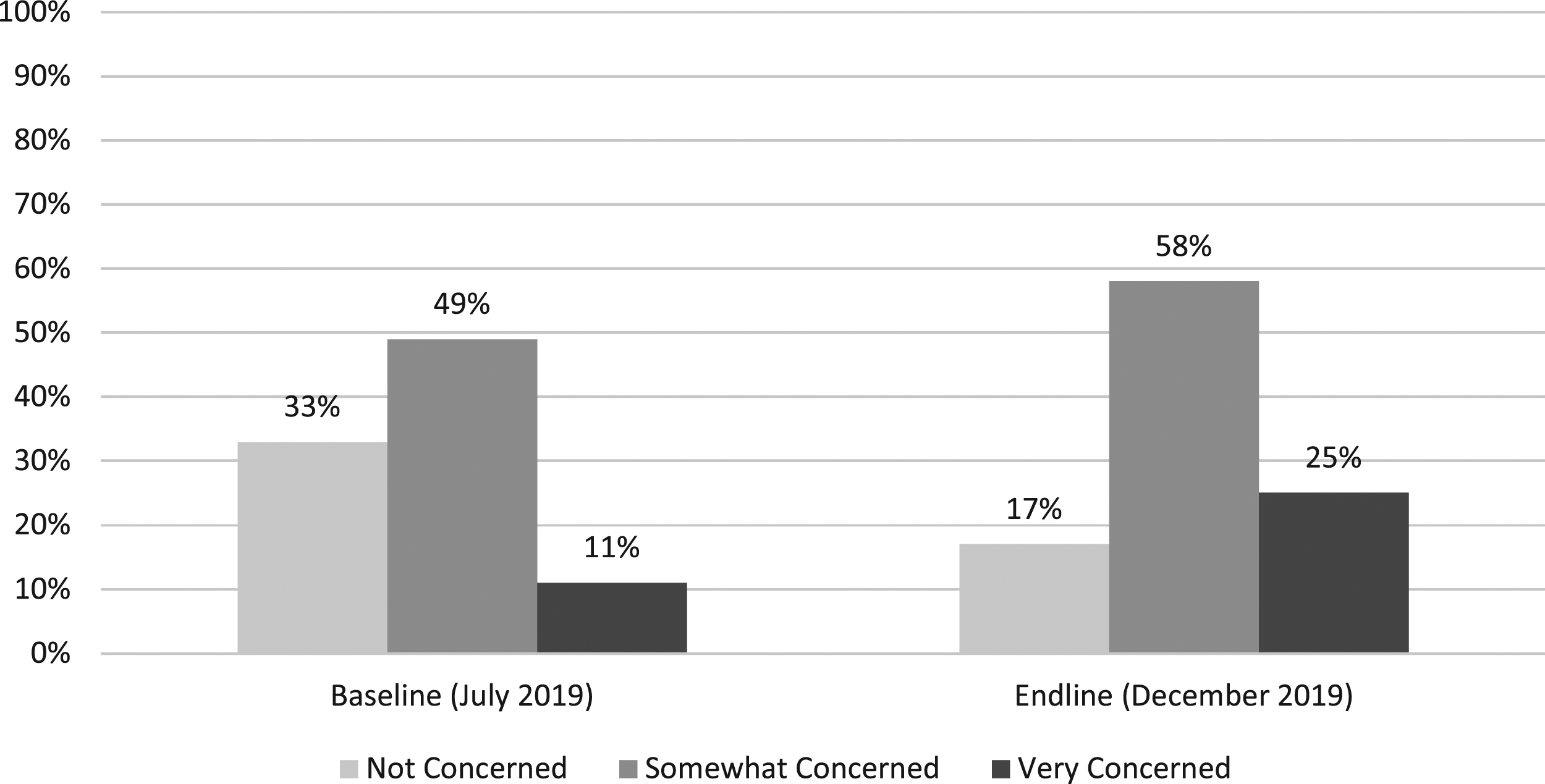
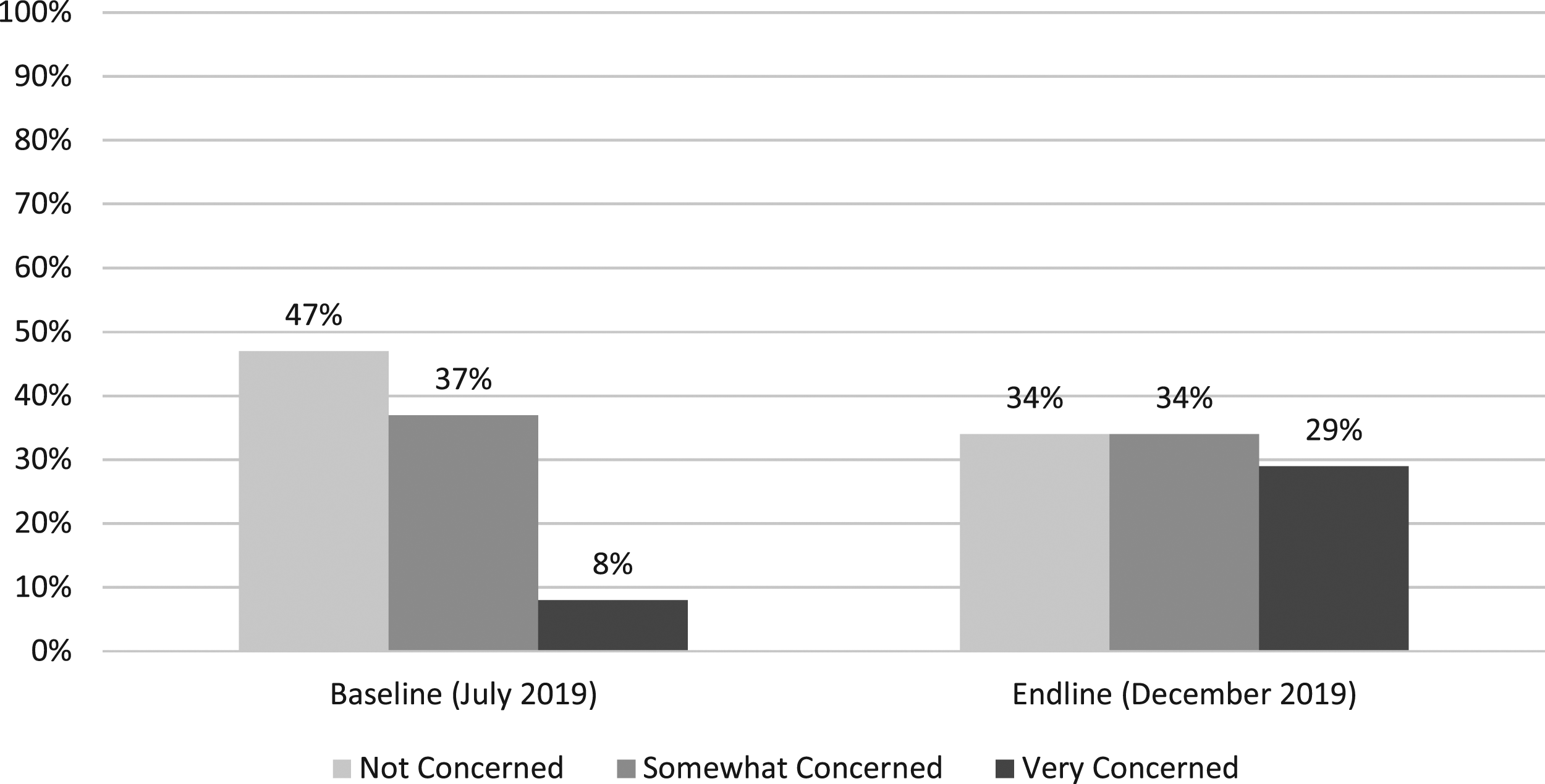
Importantly, these were cross-sectional random-sample surveys (N = 300 × 2 rounds) rather than panel surveys of the same respondents, so any changes between the two waves may be explained by sampling error rather than external events. Still, there were some striking changes between the baseline and endline surveys that are unlikely to be the result of sampling error alone. We found significant increases in respondents’ concerns about violence against civilians by “state security forces”
26
(a 14 percentage point increase in the number of respondents who were “very concerned”) and arbitrary arrests (a 21 percentage point increase) in Basra (Figures 1 and 2). Concern about violence against civilians by state security forces (July 2019 vs. December 2019).
27
Concern about arbitrary arrests by security forces (July 2019 vs. December 2019).
28
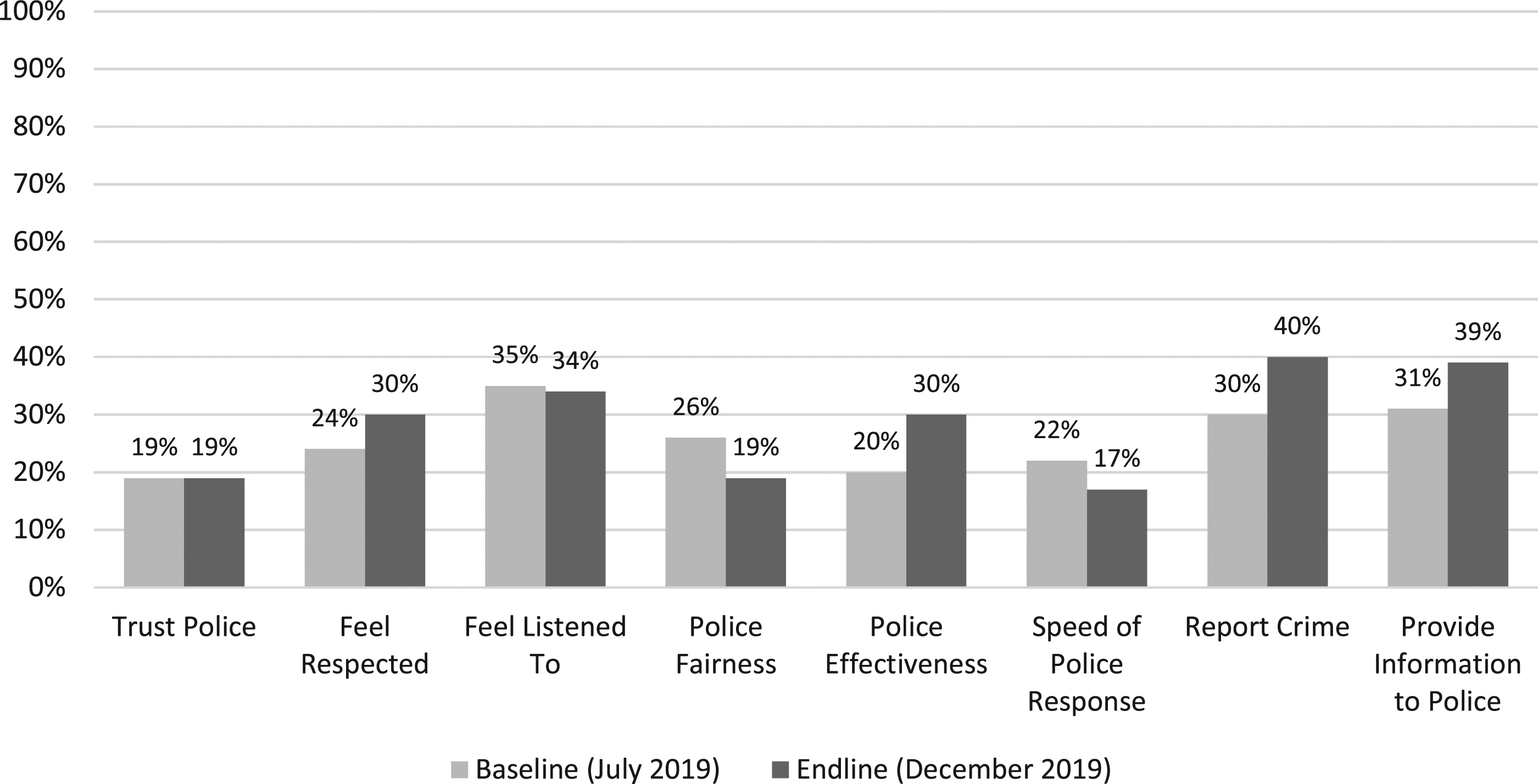
Despite these sharp increases in concern about violence and arbitrary arrests by “state security forces” in general, perceptions of local police based on an eight-point scale of legitimacy did not become significantly more negative and if anything, improved slightly for some indicators including feeling respected by police and willingness to report crime to the police (Figure 3). Changes in perceptions of local police: July 2019 vs. December 2019.
29
Conclusion
Given the observational nature of the survey data, the small sample sizes, and potentially confounding events including the Prime Minister’s resignation a few weeks before the endline survey, it is not possible to make causal claims about the effects of police repression on public opinion. Nonetheless, we can descriptively compare these two snapshots of public opinion at different points in time: before and after the onset of protests and repression. The findings—an increase in fear of violence and arbitrary arrests by federal-level security forces but no significant change in perceptions of local police—may have been driven by the fact that federal-level riot police and SWAT forces were heavily involved in repression of the recent protests, but local police were not (and some local community police officers positioned themselves as protectors of the protesters). The findings suggest that civilians distinguish between the conduct of different actors in a decentralized, fragmented security apparatus and attribute blame individually rather than collectively blaming the state security apparatus as a whole, consistent with research in Uganda finding that police repression negatively affects public opinion toward police but not the government as a whole (Curtice, 2021).
This evidence from Iraq provides insight into the difficulty of reforming a decentralized and fragmented state security apparatus where different security actors—local and federal, state, and non-state—vary significantly in their incentives, training, chains of command, and social ties to the communities where they work. Future research should further examine how these two dimensions of subnational variation, decentralization and fragmentation, interact to shape patterns of police violence and misconduct in other contexts.
Studying the social and institutional determinants of variation in police violence is important for efforts to reform state security institutions and hold them accountable. Previous research suggests that “peer intervention” can be an effective mechanism for preventing misconduct and deescalating volatile situations (Aronie and Lopez, 2017). However, police misconduct can also be socially contagious, spreading through peer effects as officers learn from and imitate the bad behavior of others (Quispe-Torreblanca et al., 2019; Ouellet et al., 2019). Understanding why some police engage in repression while others exercise restraint is an important step toward designing evidence-based programs to prevent misconduct.
Footnotes
Acknowledgements
This study was approved by Yale University’s Institutional Review Board on July 9, 2019 (Protocol #2000025209). I thank the editors of Violence and the two anonymous reviewers for their constructive comments on the article. The surveys cited in this article were funded and conducted by the International Organization for Migration (IOM) in partnership with Yale Law School’s Center for Global Legal Challenges (YLS-GLC) and are part of a larger IOM-Iraq project on Strengthening Community Policing funded by the Government of Germany. I am most grateful to Olga Aymerich at IOM and Professor Oona Hathaway at YLS-GLC for enabling this research partnership. The opinions expressed in this article are those of the author alone and do not necessarily reflect the views of IOM or YLS-GLC. For more information, see Revkin MR and Aymerich O (2020).
Declaration of conflicting interests
The author(s) declared no potential conflicts of interest with respect to the research, authorship, and/or publication of this article.
Funding
The author(s) received no financial support for the research, authorship, and/or publication of this article.
