






Abstract
Anger constitutes an undeniable driving force to comprehend many of the collective actions that have traversed the Argentine reality since the return of democracy. As an expression of a constellation of social emotions that materialize in individuals' experiences, the anger underpinning protests not only questions the disputes over the “correct ways of feeling” in society but also communicates about what it is willing to acknowledge in terms of violence management. Emotion and violence emerge as two privileged lenses to unravel a genealogy of anger that materializes in collective actions. This study aims to approach the aforementioned relationship through a series of concrete postcards of Argentine collective action (since 1983). Without striving for exhaustiveness, a series of postcards are reconstructed from paradigmatic collective actions, enabling the identification of “rhythms” in the connections between anger and violence through the interactions of repertoires and action meanings. The following are analyzed: “escraches” (political actions against individuals accused of crimes against humanity), roadblocks, looting, lynchings and “digital cancellation” actions. Records from virtual ethnographies and in-person interviews engage in dialogue with media records and existing academic literature on the selected paradigmatic cases, all aimed at initially characterizing a genealogy of anger in Argentina.
Introduction
Emotions such as anger emerge as an inseparable component of collective manifestations, where society seems to question, among other things, the violent nature of social relations. If we listen closely to some recent “outbursts,” we can hear the “anger” behind the “shout” (Holloway, 2010) that accompanied the Zapatista uprising; the “indignation” behind the “let them all go” during Argentina’s “2001 crisis,” the “rage” of the crowds that shaped “Occupy Wall Street,” or the “enough is enough” behind the riots that spurred the “Black Lives Matter” movement. In short, any of the collective actions that have erupted onto the public scene and captured our attention by questioning the place of violence in our society have also had an important part of their development rooted in a series of emotions that we can synthesize around anger.
Undoubtedly, collective phenomena are not the only contexts where the issue of violence in society is examined. However, if we revisit Melucci’s expression about the prophetic (1994) capacity of collective actions, we can see that in these phenomena, violence is expressed in a particular way, namely by “showing something that was already there but we did not see.” This, in a way, constitutes an opportunity to investigate one of the most problematic features of violence, which has sometimes been defined based on the tension between objective and subjective dimensions (Žižek, 2009). The ambiguity with which violence is usually defined implies a framework that must simultaneously understand the structural situations that constitute “unnoticed” violence and the multiple subjectivities that “perceive” violence differently.
Thus, the capacity of collective action to provoke reflection on violence offers an opportunity to interpret the structuration processes underlying our life in society. This approach considers the continuity between what existed before, what becomes manifest (new?) in the action, and what the action itself “prophesies” in terms of the mechanisms for managing differences that were surpassed in the very emergence of collective action. Therefore, our aim in this paper is to reconstruct a genealogy that (to paraphrase Foucault 1 ) recovers the singular configuration of events (collective actions), delving into the anger that has often gone unnoticed because it has been so overwhelmingly present, in order to link the scenes in which anger “has played different roles.” We will confine ourselves to Argentina, from 1983 to the present day, analyzing a repertoire of collective expressions of anger (the escraches, the puebladas and roadblocks, the lynchings, the lootings, and the digital cancellations) based on primary and secondary data sources. However, before advancing this analysis, it will be necessary to establish some theoretical starting points that recover components of a sociology of bodies and emotions, to define the aforementioned relationship between collective action, violence, and processes of social structuring.
Collective action and violence: contributions from a perspective of bodies/emotions
In his essays on violence, 2 Žižek (2009) explores the complexity of this phenomenon and emphasizes the importance of “objective violence,” which is divided into “symbolic violence” and “systemic violence.” Symbolic violence, according to Žižek, is the most basic form, related to the imposition of meaning through language. Systemic violence, on the other hand, is seen as the catastrophic consequence of the functioning of our economic and political systems. Both forms of violence are distinguished from “subjective violence”, which is perceived as a disturbance of the normal, peaceful state of affairs and is experienced against a background of zero violence (2009: 9). Žižek argues that objective violence is invisible because it underpins the normality of the zero level of violence that we subjectively experience. To understand what appears in our subjectivities as irrational explosions of violence, we must focus on the objective and systemic characteristics of a violence that, although pornographically present, is invisible, similar to the “famous dark matter of physics” (Žižek, 2009: 10).
The aforementioned complexity has a specific correlate in the field of collective action studies, among other dimensions, precisely because what is at stake here is the tension between the individual and the collective. This can be expressed in the question of how “perceptions of violence” (and their definitions, tolerances, etc.) are collectively constructed beyond the subjectivities involved—in this case—in a collective action. In other words, circumscribing the question to the interpretative framework of a theory of collective action, one might ask what relationship exists between each individual’s sensations of violence and the collective meaning that is constructed around it.
It is useful here to return to some of the ways in which collective action studies have understood its relationship with violence: In the realm of Žižek’s discourse on the invisible violence, Gargarella (2007) introduces the concept of popular violence, whose daily manifestation is expressed in the form of localized outbursts. In his observation of the Argentine reality, he points out how a certain “[...] acceptability in the face of a long series of manifest outrages’ could be related to the aforementioned outbursts, specifying the following line of connections: [...] one could say that poverty legitimises violence, inequality lights its fuse, and circumstantial grievances (i.e., salaries that are not paid on time), make it explode” (6). This is interesting for our work because it allows us to cross-reference structuration processes and everyday experiences of violence.
From a different angle, within the context of his exploration of contentious politics, Tilly’s insights (2003) into the concept of “collective violence” provide initial definitions that offer a foundation for understanding this multifaceted phenomenon. He identifies certain shared characteristics across various instances of violence, spanning from individual shootings to mass atrocities worldwide. These actions entail causing physical harm to individuals and/or property, involve the participation of two or more individuals, and are, to some extent, coordinated among those perpetrating the harmful acts (Tilly, 2003: 3). It’s crucial to underscore that beyond mere numerical analysis, there exists a common thread—prompting inquiries into collective rationale—often coupled with some degree of impact on the “body” or property.
Both discussions on collective violence share a common thread in the body as a locus of violence, emotions as mechanisms influencing these conflicts by affecting the bodies involved, and collective action emerging as a by-product of the social structuration of violence. It is precisely at this juncture that we can draw upon elements of a sociology of bodies and emotions 3 to articulate the specific perspective we aim to adopt here, namely, to render anger observable through: a- a hermeneutic lens of collective action, and b- an examination of the affected “bodies” to construct an interpretative framework rooted in an emotional ecology of anger (Scribano, 2020).
a- In previous discussions, we extensively delved into the foundations of a hermeneutics of collective actions, drawing upon the contributions of Melucci (1994) and Giddens (2003) to conceptualize everyday conflictual practices as tools for interpreting societal restructuration processes (Lisdero, 2012; Scribano, 2005). In essence, from this standpoint, it’s crucial to underscore that the networks of conflict preceding and guiding protest actions or mobilizations can serve as interpretative frameworks for these specific practices. Consequently, the insights gleaned from explicating a particular antagonism can illuminate broader social processes encompassing a wider array of relationships. This perspective enables us to grasp how episodes of social conflict emergence can be perceived as “messages” (Melucci, 1996) through which society signals its own processes of reproduction and change. The concept of protest repertoire (Tilly, 2010), which emphasizes the form of action, is reappropriated here, understanding that the collective forms assumed by the action also constitute a fundamental aspect of the “message” conveyed by said action, expressing the bodily emotional realm that is of interest in this context.
b- For us, bodies serve as the conduit through which social agents perceive the world. Perceptions represent a naturalized method of organizing the array of impressions that arise from an agent’s interaction with their surroundings. This intricate web of impressions shapes the sensations that “construct” what can be termed as the internal and external worlds: social, subjective, and “natural” realms. Sensations, both as a consequence and precursor of perceptions, position emotions as outcomes of the processes of alignment and correspondence between perceptions and sensations. Emotions can be viewed as both a puzzle and a product of experiencing something or feeling oneself. They are grounded in the “feeling state” of the world, which facilitates the maintenance of perceptions. It is at this juncture that a “politics of sensibilities” unfolds, weaving together cognitive-affective practices that delineate regimes governing how society “manages” productive energies (“politics of bodies”) and the acceptable modes of experiencing emotions (“politics of emotions”) (Scribano, 2019).
At this stage of the discussion, we can encapsulate the preceding points by proposing that collective action possesses the ability to “unveil” the specific nuances in which society acknowledges and shapes the potential for affecting and being affected, elucidating the “politics of bodies” grounded in the unique dynamics of violence (an interplay of proximities and distances, both objective and subjective, influenced by the specialization of conflictual domains), and solidifying an authentic emotional ecology as a pivotal element for reconfiguring the grammars implicit in the aforementioned dynamics.
Postcards of collective action in Argentina: anger since the return to democracy
In this second section, we focus on exploring “forms” of collective action in order to examine the aforementioned connection between emotions and violence in Argentina. To accomplish this, we have curated a selection of collective expressions of anger: namely, the escraches, looting, lynchings, and digital cancellations and escraches. While we acknowledge that anger manifests in various other ways, our selection of these “forms” is based on the following considerations:
Firstly, although each of these “forms” is situated within a specific temporal and spatial context in recent history, collectively, they are all associated with the period from 1983 to the present. In other words, they partly delineate the rhythm of the collective temporality under examination here. Moreover, the expressive strategy inherent in each of these ‘forms’ of action undeniably engages with elements we have identified in the definitions of collective violence, namely: bodies, the impact within collective frameworks where the threshold of tolerance is contested, and the mechanisms of action coordination are either redefined or revealed. Lastly, the selection of these “forms” is influenced by the availability of information and research background. Therefore, in this section, we will integrate a bibliographical analysis of studies that have explored each of these repertoires, alongside primary data gathered from various research contexts.
Regarding these two sources, it’s important to clarify: concerning the bibliographical survey, a selection of research studies was made based on their documentary and theoretical value in addressing the aspects relevant to our interests. The primary data we present (interview excerpts and ethnographic and media records) were gathered through a series of individual and collective research endeavors, all of which are part of the Programme of Studies on Collective Action and Social Conflict (CIECS - CONICET and UNC). While these various investigations have pursued different objectives and methodologies, they all share a common theoretical-epistemic framework linking collective action with bodies/emotions, a consistent focus on generating a qualitative corpus informed by “the feelings of the actors,” and the utilization of specific fieldwork methods (observations, virtual ethnography, and interviews) conducted in the city of Cordoba, 4 Argentina.
As a presentation strategy, we opted to showcase various “postcards” of anger, with each contributing uniquely to the diverse modulations of the emotional ecology. The concept of “postcard” (Scribano and Cabral, 2009), which challenges our linear perception of temporality, aims to elucidate the coexistence of different temporalities and the heterogeneous connections between bodies and their surroundings. We could adopt Benjamin’s (2005) words as our own when he states that “[…] in the fields we are concerned with, knowledge only flashes up in lightning. The text is the long roll of thunder that follows afterwards […]” (2005: 459). Therefore, we assert that within each postcard, we strive to reclaim anger as an element of the past that “[…] threatens to vanish with every present that fails to recognize itself in it” (Benjamin, 2005: 180).
Escraches: transition and organized anger
For our first “postcard,” we turn our attention to the escraches. H.I.J.O.S. (Hijos y Hijas por la Identidad y la Justicia, contra el Olvido y el Silencio 5 ), a human rights organization founded in the mid-1990s, initially comprising a group of children of disappeared and murdered individuals, exiles, and/or former detainees of state terrorism (1976–1983), plays a particularly significant role in shaping this “repertoire.” It is evident that the temporalities involved here are intertwined with discussions on the modes of action inherent to the democratic transition. Therefore, as a response to the culture of impunity perpetuated by the laws of Punto Final (1986) and Obediencia Debida (1987), along with the subsequent presidential pardons of 1989 and 1990, 6 H.I.J.O.S. organized actions aimed at socially condemning those responsible for directing genocidal state violence (Pérez Balbi, 2016).
Within this context, the escraches emerged as a significant tool that was extensively utilized between 1996 and 2005 in several major cities across the country (Benegas Loyo, 2013). These actions are organized around memory practices (Benegas Loyo, 2013) aimed at asserting rights, with the emotional focal point lying between anger over impunity and the hope for “truth and justice.” Consequently, these forms of action arise in opposition to the complicity of the judiciary (Bravo, 2010), seeking to challenge the appropriation, uses, and meanings attributed to urban spaces (Antonelli, 2003). They also aim to interrogate the cultural values associated with official memory and the perceived “need to restore social order” (Espeche, 2005), while contributing to the enhancement of citizenship. Faced with the attempt to apply the 2x1 system to the calculation of sentences for genocides, and the search to grant the benefit of house prisons on a massive scale, the escraches are back, to point out that a genocide on the loose is a threat to everyone [...] We “escrachamos” so that the neighbours of the neighbourhoods and towns where there are genocides know that a murderer, a rapist or a torturer convicted of crimes against humanity is living there [...]. (Communiqué by Members of the H.I.J.O.S. group. In La Voz del Interior, 22 March 2018)
Although the escrache does not position itself as a repertoire that supplants or disregards the role of formal democratic justice institutions, it proposes an alternative path towards transforming and engaging communities in the social condemnation of repressors. Therefore, the escraches cannot be reduced solely to their legal demands for prosecution; they exemplify the collective energies that not only demand justice but also reappropriate the social mechanisms for producing the “certainties” that this entails: “what is really central is the popular capacity to produce truths [...]” (Espeche, 2005, para. 23).
The “anger” against impunity paves the way for a redefinition of violence, reappropriating the meaning of action and challenging the legitimacy of “affecting” (buildings and people) in terms of “justice” as a contested good. The central feature of this emotional ecology is its foundation in “organized anger”: this is channeled not only into a disputed “legality” but also into the pathways that the social fabric had been structuring as “justice” from the marks that terrorism had left on the collective body. What this anger brings into play is the “distance” or “difference” with respect to the accepted ways of “affecting” bodies, which the mechanisms of terrorism and its consequences in everyday life had implied (Figure 1). H.I.J.O.S. Córdoba Foundation. Source: Publication of H.I.J.O.S. Córdoba. On Instagram [@hijoscordoba], 14 April 2023 (*14 April 1995—Foundation of H.I.J.O.S., 28 years of struggle. With the disappeared in our hearts, the struggle in our hands and the hope of the people).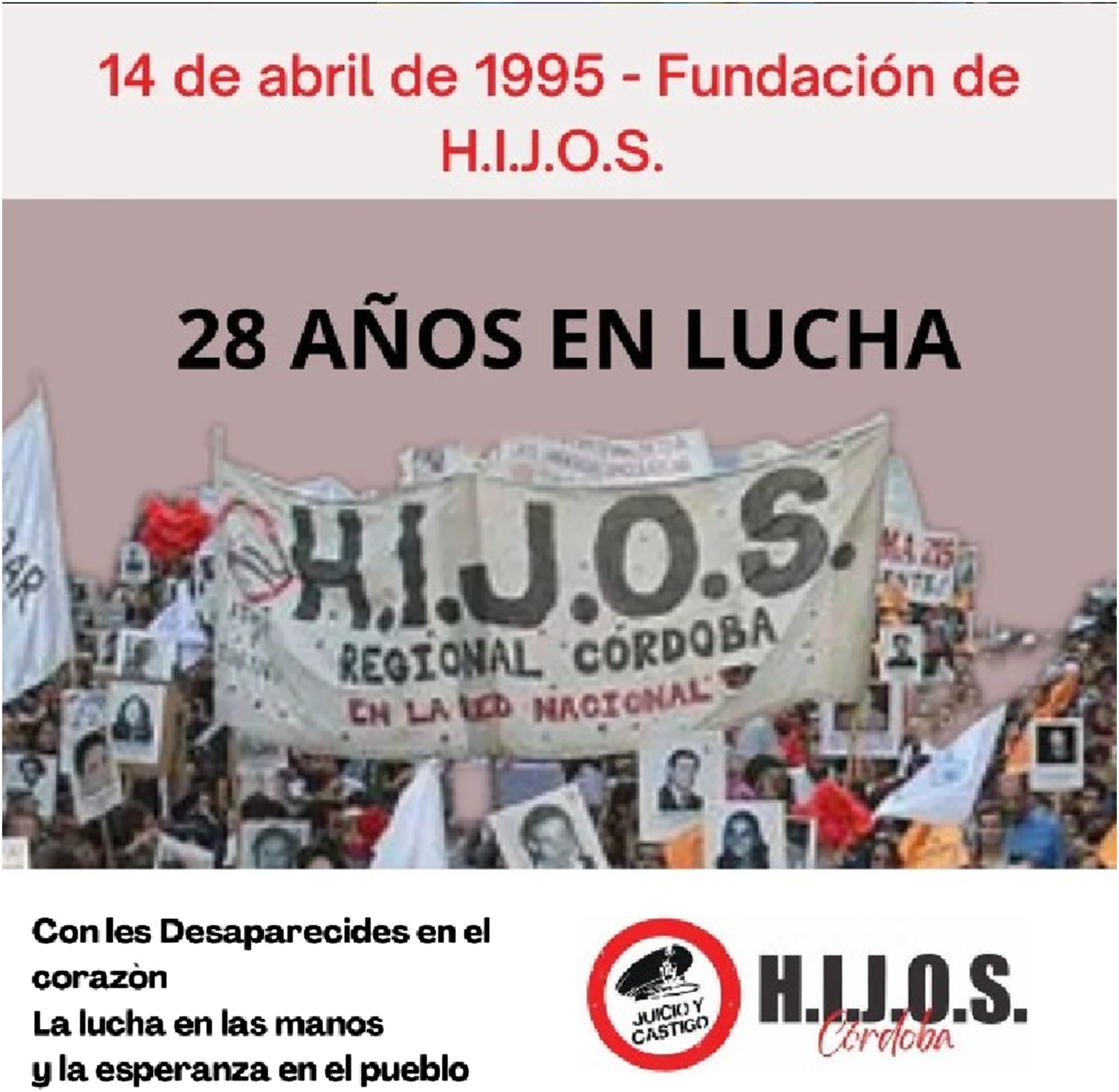
The heart, the mark on the collective body, highlights the wounds of a society that “endured” forced disappearances and torture as body politics, but from a place that transmutes anger into hope. The key mediation in this transmutation is the collective: H.I.J.O.S., the human rights organizations, the neighborhood, and the multiple emerging organizations that supported the escraches form the collective identity embodying this heart. This heart expresses the “organizational” time of anger and constitutes the materiality of “hope.”
The organization of anger and the re-signification of violence have, in this modulation, their counterpart in the restructuring processes of proximity and distance that unfolded with the implementation of the neoliberal policy package. It is not unthinkable that in the face of such a significant disruption in structuration processes (it is the time of the accelerated de-structuring of the wage society in Argentina), the accepted and acceptable ways of affecting and being affected would undergo transformations in the mechanisms of coordinating action.
It is interesting to note, then, that the growth of this collective action surpassed the limits of the H.I.J.O.S. organization and spread as a “valid” means of protest in Argentina (Manso, 2021). What the expansion of the “escrache” shows, along with the processes of bureaucratization and institutionalization of the organizations that emerged from it, is that these “new forms” of protest find emotional “effectiveness” in other fields of mobilization. In this expansion, organization remained the horizon of their conditions, representing a collective “novelty” (in comparison to the other protest identities up to that point). However, the bureaucratization involved in this expansion began to reveal certain limitations (evidenced in new problematizations or breaks in consensus). Specifically, the “forms” of collective violence that we explore below begin to show the “limits” of the organization in channeling the anger.
Roadblocks and “pueblada:” the breakdown and anger at the limit
The second postcard we would like to present focuses on the roadblocks and puebladas 7 that emerged in the 1990s as a consequence of the adjustments implemented by the neoliberal socio-economic model and its program of state reform (Carrera and Cotarelo, 2004). The blockades carried out by piqueteros around 1996 in the Neuquén towns of Cutral Có and Plaza Huincul can be recognized as the initial stage of this type of protest (Auyero, 2003). This episode, in particular, combined a roadblock with a pueblada as an expression of feelings that connect anger and indignation with unmet demands (of democracy in general, but specifically of the then-recent political cycles). The evolution of the piquete form, like the escraches, follows a path of bureaucratization and institutionalization in its expansion as a protest repertoire. However, we are interested in returning to the moment of the puebladas 8 of the mid-1990s to explore a particular twist in the modulation of the anger-violence relationship.
As a form of expressing anger, the puebladas and roadblocks that initiated a significant protest cycle in Argentina are articulated as a “cry” in the face of the “risk” of social exclusion, reinvented from the distance of classic identities, such as workers, citizens, etc. (Scribano, 1998). In this regard, Auyero (2003) links these collective manifestations with three interrelated processes: a) deproletarianization as a result of deindustrialization and the dislocation between macroeconomic policies and employment levels, b) the withdrawal of the welfare-populist state from public systems of health, education, and housing policies, accompanied by the privatization of companies and its correlate in increased unemployment, and c) the impact of the decentralization of health and education services as they were transferred to local management spheres, deepening the resource crisis in the public administrations of the provinces.
It is not difficult to observe that social representativeness and corporeal reproductivity constitute two central aspects in the logic of the configuration of anger expressed in these repertoires. Regarding the first particularity (the crisis of representativeness), the “novelty” is that this emotional ecology is combined here with a strong process of institutional delegitimization. Nobody planned an alternative to the 3,000 layoffs at the oil company and the thousands more layoffs in private companies that worked for YPF. Nobody planned, either, that we indigenous people would take to the streets. Without political banners, just the men. Now we do not want assistance, we want work (Cutral Có, Neuquén - Revista Viva, July 21, 1996, quoted in Scribano, 1998).
Neither the organizations traditionally leading the protests nor the identities emerging from the cycles of democratic transition manage to become a channel of containment for an anger that is characterized by existing on the margins of any planning, at the limits of the representativeness built up until that moment. In this sense, this modulation of anger reflects the collective limits of society’s capacity to express itself. While the escraches begin to reveal new identities born from the inability of classic protest organizations to express anger, the puebladas accentuate this tendency. However, this feature is also combined with the limits associated with social reproducibility. We can’t do anything else because the people are starving. Otherwise nobody gives us importance and that way we attract the attention of those in charge (Cruz del Eje, Córdoba - La Unión, June 18, 1997, quoted in Scribano, 1998).
The notion of the bearable as a critique of the effects of social restructuration is expressed in the anger as a critique of the material conditions of life. Thus, while the escraches implied connections of the social body with the consequences of the marking left by the dictatorship (including its legal consequences), the roadblocks and puebladas constitute another form, another temporality, and other relations between anger, violence, and the body. Here, the dimension of the social body affected is linked to previously unseen transformations in the operative capacities of social energies. Although escraches and puebladas may—from an analytical point of view—echo the same movement by sharing certain connections with the de-structuring of the wage society and the accepted and acceptable ways of affecting and being affected, what the puebladas and the pickets bring as a novelty are the limits of the reproductive in the effects of hunger, exclusion, and unemployment.
It is interesting to highlight the strong symbolic content expressed in the action of “blocking” as a “message” about “a limit point.” The restructuration of bearability regarding the perception of new criteria of exclusion becomes evident: the very form of the action, as the obstruction of strategic transit routes supplying different regions of the country, expressed what one was not “willing to bear.” The “piqueteros,” as an emerging identity, are the actors who organize and carry out protest measures against the formal political system by blocking streets and access to cities, burning tires, using pyrotechnics, and chanting expressions of the conflictual plot of adjustment and state violence (Scribano, 1998). The pueblada activates a mobilization that transcends and redefines traditional forms of action: the population aims to make itself felt, seen, and heard in the struggle for the recovery of living and working conditions. In other words, the puebladas reveal a collective identity—latent in everyday life—that enables and anticipates a new space for participation, belonging, and the construction of solidarities that emerge from the perception of a limit to the reproduction of the body.
This perception, transformed into a bodily mark, configures a new sediment in the emotional ecology of the anger expressed in this protest. In the words of Scribano (1998), the roadblock and the pueblada are thus presented “as forms of a fabric that seeks to represent a bridge between promise and anger […]. They are expressive forms of claims produced in disconnection with the State that refuses to recognize, that is, to acknowledge again the situation that generated its action of withdrawal, of absenting itself from civil society” (35; 39). The mentioned “withdrawal of the state” must be associated here with the “crumbling” (Castel, 2002) of the wage society as objective violence, and with the anger that shapes the puebladas as the materialization of the expression of the acceptable limits of these violences.
Analytically speaking, we can consider the puebladas as a transition to other “forms” of collective expression of anger, where the critique of the “organic” is further accentuated: such is the case of looting and lynchings. Although all these forms coexist in time, the nuances observed in terms of “organizational forms” become more significant as the first decades of the new century unfold in Argentina, as we shall see below.
Lootings and lynchings: the implosion and the outbursts of anger
As our third postcard, we delve into the occurrences of looting and lynching. In focusing on looting, these actions have been examined from a contentious political perspective, placing analytical emphasis on the structures shaping mobilization opportunities, clientelistic networks, and the political significance associated with the action (Auyero, 2007). They have also been characterized as “spontaneous insurrections,” linked to cycles of popular rebellion (Carrera and Cotarelo, 1997), or as reactions of impoverished masses to the new living conditions imposed by capitalist development. In this latter context, “hunger” (Arias and Rodríguez, 1999) emerges as a primal motivator, prompting not only sporadic reactions but also cultural and political ones, underpinned by the idea of legitimacy. Protagonists justify their actions in defense of rights, such as the right to food, bolstered by community consensus.
Regarding lynchings, they have been characterized as collective acts of punitive violence, reshaping notions of justice and challenging the legitimacy and authority of the State (González et al., 2011). These “attacks” are often seen as expressions of social dissent and a rejection of impunity (Gamallo, 2017). Alternatively, attention has been drawn to the role of political discourse in mass media regarding lynchings, emphasizing the “mechanisms of legitimization” of these punitive collective actions and the consecration of processes of exclusion (Baquero, 2015), which are also intertwined with the “absence of the state” (Hernández, 2014). These dynamics contribute to the reconfiguration and consolidation of certain social perceptions regarding violence (Focás and Fernández, 2014).
Beyond the specifics of each of these phenomena, our aim here is to highlight the collective logic of anger. 9 From our perspective, looting and lynchings demonstrate their connection to a rhythm of anger associated with the restructuring of flexibility: as everyday certainties implode and become ingrained in the body as a condition of feeling, emotions emerge as a “out reason” framework for action. It is no longer the “organizations” that guarantee the emotional framework of mobilization, but from another place in the processes of individuation, anger is the common substratum from which fragments of complex realities (produced by the aforementioned implosion of the state, security mechanisms, health systems, etc.) are linked. Angers illustrates how the “political management” of bodies fails to influence the definition of the situation, suggesting that the structuration processes of body proximities and distances have inertias in the aftermath of political times.
In this context, we can see that when institutionalized conflict resolution mechanisms fail or prove inadequate, looting emerges as an untimely action that sparks anger, rage, and a sense of powerlessness. [...] they were customers, they were neighbors. And you have that feeling of anger; I had that feeling of anger with the people, with the neighbors, for about a year. That’s why I didn’t open it (the store) anymore. (Interview with a looted trader, 50 years old, Córdoba) When they entered, a lot of impotence, a lot of rage, a lot of anger because they took everything [...]. (Interview with a worker of looted premises, 43 years old, Córdoba); I feel sad for the people who lost things. They lost material things and, at the same time, they lost a lot emotionally. And also anger because I think that in a society we should be organized: it shows you every day that any imbalance makes everything fall down and everything is “left to the good of each one.” (Interview with a merchant who defended commercial premises, 40 years old, Córdoba).
Anger, rage, and impotence are shared descriptors among the actors, implying the development of cognitive-affective practices built upon the bodily imprints of the “implosion,” and therefore, enduring over time: not only is emotional engagement disembodied in the diffuse forms of looting action, but looting itself becomes a collective emblem of the societal body that “becomes conscious” of the state of coexistence. The other, the neighbor, the people, relinquishes the fluid identities that previously provided some certainty regarding social proximities (the citizen, the worker), and now transforms into a potential adversary. Looting serves as both testament and catalyst for an impending alterity. This, coupled with the sensation of “disorganization” permeating society, conveys a disordered reorganization as an action logic: it is not a matter of pure contingency, but the chaos that pervades everyday life finds—in part—its logic of coordination of action in and through this unstructured-structuring anger.
In the same direction, from the episodes of lynching we can observe how anger is “accumulated” and explodes in the pores of the organization of the daily structure. When lynching erupts, the action becomes a moment of discharge and revenge, which condenses in physical punishment an emotional charge that drags with it the discomforts—anger, hatred, impotence—of everyday life. At the same time, it not only dis-borders the social “organization” but becomes a state of feeling that exceeds the “close” protagonists of the action. [...] if I have the opportunity, I slap him [...] I combine the anger I have, which I have been dragging for a long time, and when I slap him, all the anger of everything goes into it, you understand me. I mean, I see it also as an emotional discharge. I go out to hit him hard (Interview with a person who participated in lynching episodes, Córdoba, 2012; 2023, 38 years old) It bothers me a lot. To me, everything I earned costs me. Everything. Time. Time more than everything. Time is the most valuable thing you have. I value my work very much, it gives me food, comfort and everything... And to have a “rat” that you see come and take everything from you... (Interview with a person who took part in a lynching, Córdoba, 2023, 33 years old)
The sensibilities that are woven between anger-violence-emotion find in collective action a “message” that communicates the thresholds of tolerance and punishment of society as a whole. However, these notions, which turn around a political economy of morality that is structured in everyday life, have a central axis in the potential of defining the relationship with a diffuse but “dangerous” “other.” In this sense, the lynchings are an opportunity to observe more clearly what we began to describe from the looting: the subjects elaborate classificatory schemes according to corporealities that convey rejection and on which an emotionality that enables the re-configuration of violence is deployed. And I kept the “shitty nigger…” and then with the years and everything else, I was doing a kind of “razzia,” you understand me... although I have friends who are dark-skinned, let’s say that what I call “shitty niggers” is actually a bad word, because it is “shitty people.” They have a certain likeness, a way of speaking, a way of walking, moving, expressing themselves [...]. In other words, I generated even more hatred. (Interview with a person who participated in lynching episodes, Córdoba, 2012; 2023, 38 years old)
Lynching not only makes explicit the violence on which the geometry of bodies in society is structured, but centrally informs about the material with which this map is constructed: naturalized perceptions are the tool and expression of naturalized violence, as much as of the dispositions to violence that the agents carry. The “naturalized” forms of “classifying” have to do with being able to see, feel and smell a socially constructed bodily difference. As a social mark, lynching configures this “politics of the senses” as the objective component of the diffuse and inorganic identity implied by these collective actions. There are no “organizations” that “coordinate” the lynchings, claiming the sense of the repertoire: however, there is a series of bodily marks, which naturally “see” the world in a “common way,” recognizing a set of racialized “others,” on which they “unload” the anger as a way of “consecrating” the identity and performativity of an action. There are no “individual” actions of lynching, nor “lynching” as a marginal morality, but what appears here is a moldering of collectives different from the organizational forms consecrated until then. Today, beyond what has happened, I continue with my position and I am still the same. As long as my body gives me, and as long as I can do it, whoever hurts me, I will go out and look for him. Because there are no situations to go and denounce and let someone else take care of it, because it is not going to happen. I directly try to make my shield. I try to, at least, show myself that if they steal from me I will go out and look for them, if they harm me I will go out and look for them. So, I try to take care of myself. But society is still out in the open... because there is nothing. There is nothing to contain them. (Interview with a person who took part in a lynching, Córdoba, 2023, 40 years old)
Both the looting and the lynchings show conclusively that the emotional conditions of action are associated with temporalities that overflow institutional times, in which solid bodily marks of the effects of social trends are configured: such as the deterioration of living conditions, the verification of the inefficiencies of the state to guarantee minimum conditions of re-productivity (health, education, security, etc.), the consecration of the consumer subjectivity, etc. The “nomadic” identities (Melluci, 1994) seem to open spaces towards organizational overflows that imply, at least in these latitudes, the implosion of the extended logics of action coordination. The digitalization of the world, and its key place in the coordination of action—as will be seen below—seem to be the link that completes this trend.
Digital cancellations and escraches: uberization and digital anger
The final postcard pertains to social media escraches and digital cancellations: practices of denouncing gender violence (Manso, 2021), workplace violence, among other, which signify a new turn in the relationship between anger and violence. Far removed from any metaphysical conception of emotions as a substrate for the aforementioned transformations, it is crucial to note—as we have been doing—that the regimes of sensibilities dictating the correct ways of embodying and expressing emotions in each modulation described thus far also leave their mark on the body. One might conceive of an epigenetics wherein the body and collective action coexist with various overlapping sociabilities shaped by collective logics, each form of repertoire serving as an indicator. Consequently, the social media escraches carry, as a sediment in the experiences of the agents, the conditions and consequences of the forms presented thus far. Serving as the final link, they encompass more “recent” temporalities acknowledging a certain affiliation with structural processes such as the digital transformation of life (Lisdero, 2021).
To show one of the possible plots of this logic of sedimentation, we can observe how the protagonism of feminist collectives, since the return to democracy, drove a series of organizational processes that had their correlate in the public agendas in Argentina. The creation of Encuentro Nacional de Mujeres in 1986, the emergence of Ni Una Menos collective in 2015, the International Women’s Strike developed in March 2017 and the demand for the Law on Voluntary Interruption of Pregnancy; are some of the events that begin to consolidate the visibilization and denunciation of gender violence with social networks (Manso, 2021). Each of these episodes can be reconstructed from their tensions and temporal proximities with the forms we have described so far (although not exclusively). But it is from the “escrache” in blogs or social networks, where a place of vindictive “justice” is again staged, as it happened with the escraches, but where it is also emphasized: “an instance of individual reparation and/or a means of punishment, as a form of protection against new injustices, as a necessity against the ineffectiveness of institutional justice and; as a way to encourage other victims/survivors to denounce acts of injustice” (Manso, 2020: 42 - our translation).
The online/offline relationship enables here other possibilities of thinking about the “affections” linked to the performative feature of violent action, an issue that also speaks of how these actions refer to a regime of sensibilities where platforms not only exist as a technical possibility but are centrally incorporated as logics of interaction. The implementation of new information and communication technologies—ICTs—update novel forms of intermediation of social relations that are structured around the dialectic between links/unlinks (Cingolani, 2016), which connects and distributes the ways of feeling oneself and participating in life. This is the basis for the idea of “uberization,” taken up here as a performative condition that tensions the asymmetries that organize the digital, where expressions of anger acquire other modulations to communicate the bearable/unbearable. The action only superficially seen emerges as individual and innocuous: an attentive look at the digital escraches allows us to realize that the action of “reacting” to the material that is observed, canceling or weighting the visibility, constitutes an effect of reality that demarcates new twists of the “affected” bodies (Figure 2). “Escrache”—Facebook. Source: On Facebook, 24 October 2017 (*Thanks to the publication I made this morning I have the data of all the aggressors, thanks to a neighbor who lives in Malagueño, who sent me everything!!!! Here is the photo of the driver of the vehicle and main aggressor. The shorter gentleman on the right, in a blue and red jacket. His name is X, plus other relatives of X who were at the scene, whose details I also have. Please, share this is the number 1 scourge. The others will fall little by little. Thanks to the people who collaborated and shared).
What we have called elsewhere “platform sensibilities” (Scribano, 2022), as a particular configuration of possibility proper to the productive forms of being-being in/by the networks, marks the differences and continuities with the “original” escraches. Far from the idea of the de-materialization of bodies, what digitized relations highlight are the potentialities of networks to weave renewed coordinates of the material. Thus, for example, social networks draw maps to “locate” and “mark” bodies in social space, providing a central component for the re-configuration and affectation of the “other.” (Figure 3). “Escrache”—Instagram. Source: Publication of BCL Librería. On Instagram [@bcllibreria], 24 de julio 2023 (*This is not the kind of content we would like to share in our profile but today we have to do it. On Saturday we lived this event and we want to publish it to warn our local neighbors about this person, who repeatedly came to the bookshop and behaved in this way. The impunity and tranquility with which this man is taking over the bookshop we work for every day is very worrying and disempowering. We can only ask you to spread the word about this person in order to prevent other merchants from going through this situation).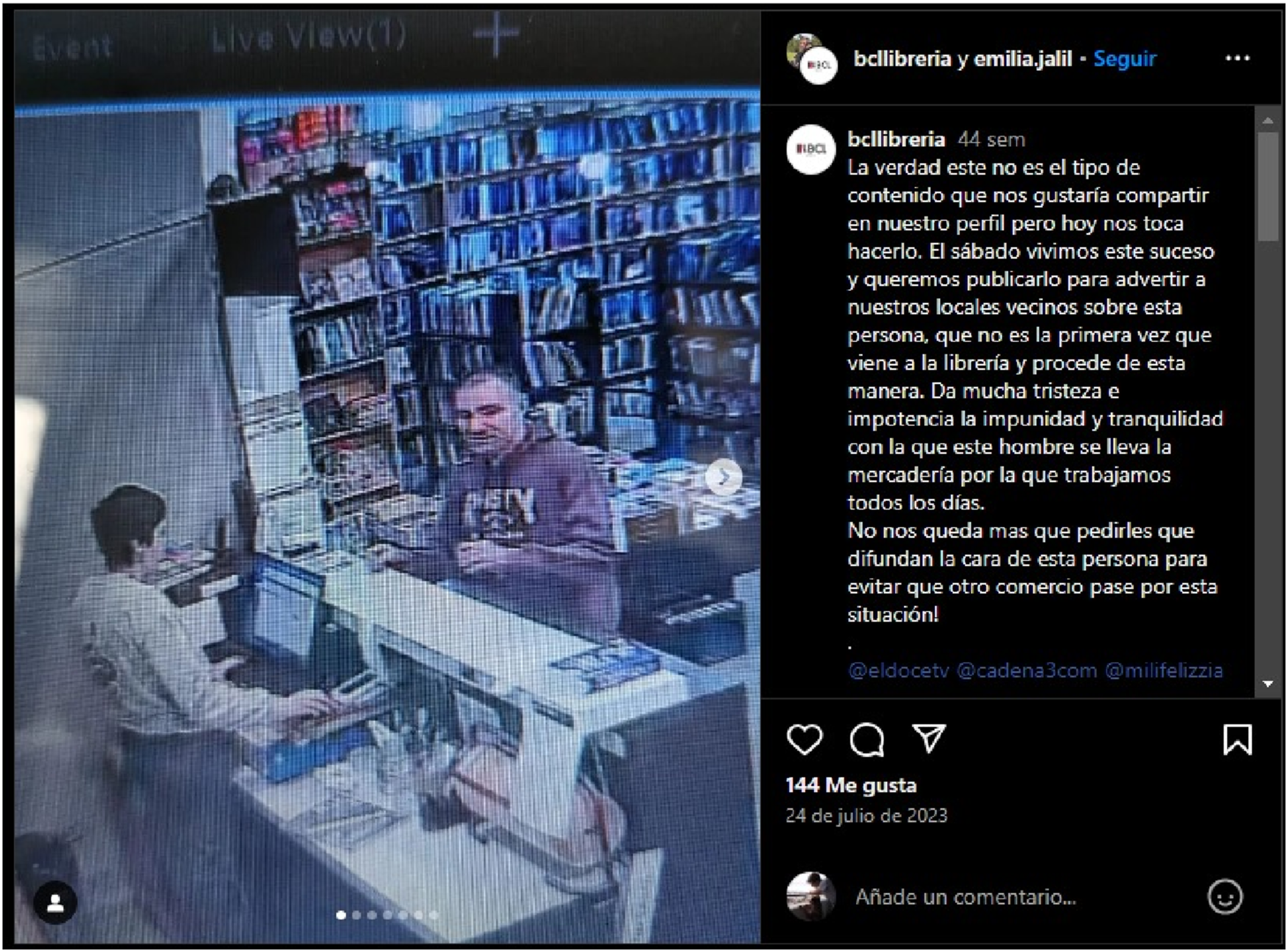
On the other hand, the escraches have also echoed into other social spheres, consolidating themselves as a tool to be used to express discontent and anger against those actors who have not only committed crimes, but against all types of actions that are evaluated as reproachable and, therefore, need to be canceled. These practices pursue “the collectivization of social and moral condemnation, promoting a shameful emotional experience for the targeted subject: his defamation on a massive level. In this way, his consequent social categorization as unworthy of the respect and consideration deserved by virtuous members of the community is achieved” (Bastus, 2020: 114). From digital “escrache” to this “culture of cancellation” (Brovelli, 2020) a shift stands out that not only emphasizes the “restitutive,” but also the punitive, giving a singular twist to the logic of punitive violence observed around lynchings: the canceled is sought to remove/reject/isolate its entity, and this is linked to political correctness, all within the framework of some platform sensibilities as a privileged—and not neutral—place in the configuration of the moral political economy of an “epoch.”
Conclusions
Jasper (2014) clearly frames the problematization that we wanted to address in this paper: “Anger and indignation, the morally grounded form of anger, are crucial to many aspects of protest […]. But we need to know far more about the many forms that anger can take, the many ways it can be displayed” (Jasper, 2014: 208-212).
Precisely in the quest to broaden the knowledge on the “forms of anger,” we have proposed to reconstruct this genealogy by analyzing some repertoires of collective action in Argentina since 1983. From a specific perspective within the social studies of bodies/emotions, we analyze a series of postcard drawn from two types of sources: available studies and expressions from actors (interviews, ethnographic records, etc.) constructed in different investigations. Viewing this genealogy through the emotional ecology of anger allows us to connect everyday experiences with the processes of social structuration, emphasizing the mediations that stress the objective/subjective conditions of violence. What these actions collectively express as “no reason” is understood here as links in states of feeling that permeate the daily ways of managing hunger, insecurity, and injustice, and therefore to configure the deep-seated bases of violence in society.
Although it is subject to political capture and exchange, anger exceeds calculation and provides a space of expression for something “more” than the cement with which institutional politics is built. The links between the different repertoires described above show certain temporal overlaps, associated not only with the impossibility of anchoring in the demand to understand the collective actions that express anger but also with the limitations of institutionalized management.
The temptation to concentrate on “the demand” could constitute another myopia in the task of re-tracing this genealogy of anger. In this sense, what we have mentioned about the destructuring of the wage society (Castel, 2002) and its consequent re-structuring of the neo-liberal society, marks a structural rhythm that gives shape to the anger, and that has its correlate with the de-institutionalization and re-institutionalization of a set of collective practices that configure the daily dimension with which violence emerges as a problem in each postcard presented. Thus, the anger channeled in the escraches, give way to the limits of the very organization in the puebladas and roadblocks. For their part, looting and lynching express not only the impossibility of containing anger, but also how this emotional ecology is constituted in an extended framework of the experiences of de-institutionalization, reconfiguring a formless interactivity of practices of feeling that re-institutionalize the certainty of uncertainty in the framework of the social “implosion” of the structures that configure the material conditions of existence. In the same direction, digital escraches inform about the re-configuration of digital materiality: platform sensibilities are the structure of possibility to express an internalized anger, equally collective (although without “organizations”), and with an unprecedented capacity to “affect” the most intimate/material of bodies. The uberization as a collective logic that frames the emergence of digital anger contains in its present the sediments of previous forms (Figure 4). Genealogy of anger.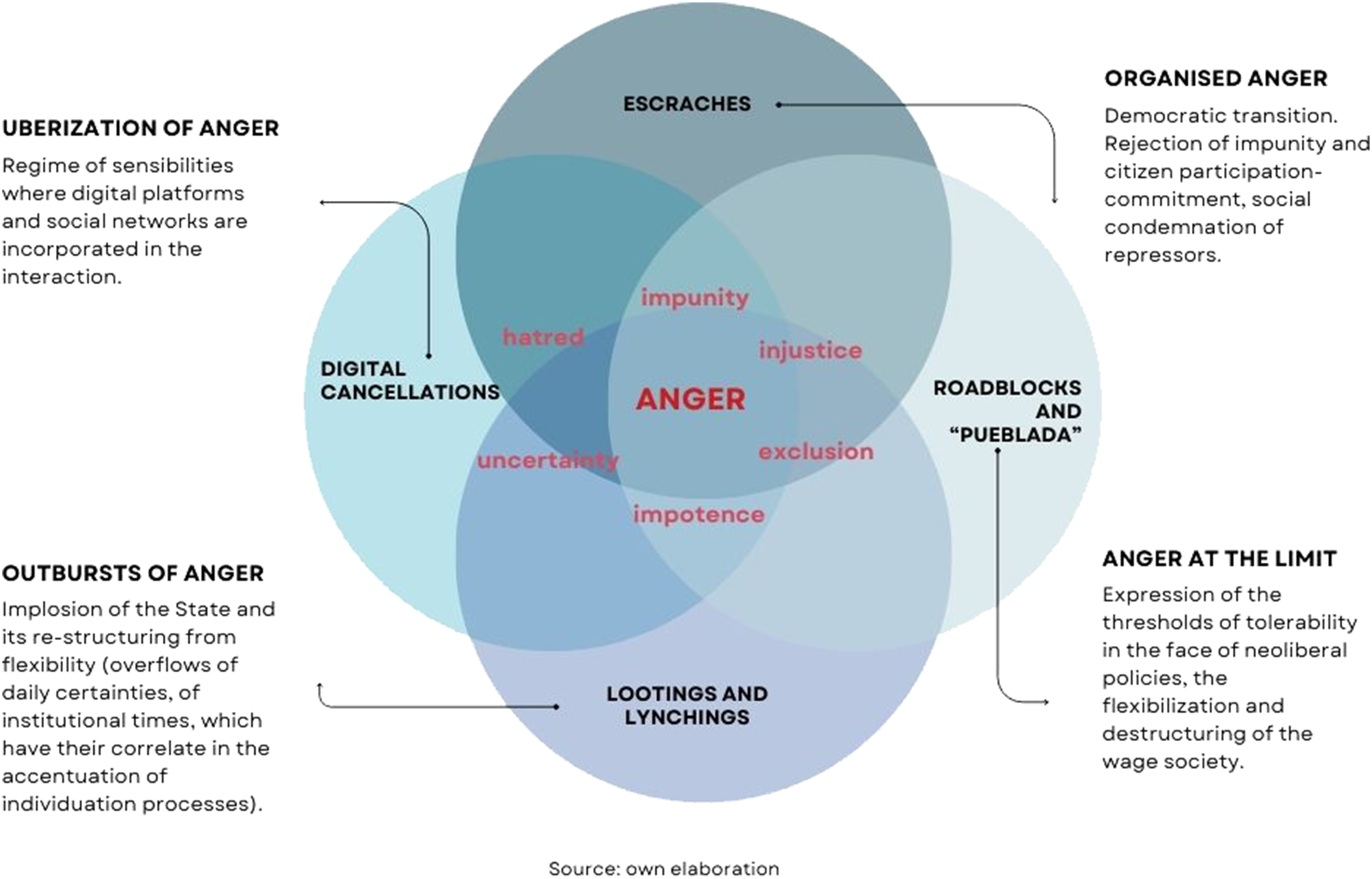
We can conclude by highlighting the potential of a hermeneutic reading of the different rhythms and modulations through which collective actions unfold, based on an approach to the emotions deployed—anger being a privileged lens—to observe the plots and re-configurations of violence in our societies: its expressive forms, its modes of affectation and effects as objective/subjective marks.
Footnotes
Declaration of conflicting interests
The author(s) declared no potential conflicts of interest with respect to the research, authorship, and/or publication of this article.
Funding
The author(s) received no financial support for the research, authorship, and/or publication of this article.
