






Abstract


Institutional racism, or systemic racism, is defined as the pattern of social and political systems discriminating against a group of people based on race.
Institutional racism, or systemic racism, is defined as the pattern of social and political systems discriminating against a group of people based on race.
America has a long-standing history of systemic racism. It has crippled the lives of African Americans for centuries. Its impact is far reaching and widespread and affects every aspect of their lives. Racist practices occur in housing, education, employment, wages, access to wealth, criminal justice, political power, and health care. 1 Racism hurts African Americans and the entire country in a multitude of ways. Racism also affects their health and health outcomes in a negative way to a marked degree. Black women are nearly 4 times as likely to die of pregnancy-related causes than white women. Black men are more than twice as likely to be killed by police as white men. Black people are more likely than white people to experience high blood pressure, diabetes, and stroke. And they are more likely to die at early ages of all causes. 2
African Americans experience higher levels of diabetes. In the most recent diabetes estimates by the Centers for Disease Control and Prevention (CDC), among people 20 years of age or older in the United States, 13.2% of non-Hispanic blacks have been diagnosed with diabetes, compared to 7.6% of non-Hispanic whites. 2 Minority populations have been shown to suffer a greater burden of disease, exhibit poorer self-management abilities, and experience more diabetes-related complications compared to non-Hispanic whites,2-4 resulting in worse diabetes outcomes and higher rates of mortality. 4
Thirty states have declared racism as a health crisis and emergency. The American Medical Association (AMA) has recognized racism as a public threat and has detailed a plan to diminish its effects. The AMA recognizes that racism negatively impacts and exacerbates health inequities among historically marginalized communities. According to AMA Board Member Willarda V. Edwards, MD, MBA, “Without systemic and structural-level change, health inequities will continue to exist, and the overall health of the nation will suffer. As physicians and leaders in medicine, we are committed to optimal health for all, and are working to ensure all people and communities reach their full health potential. Declaring racism as an urgent public health threat is a step in the right direction toward advancing equity in medicine and public health, while creating pathways for truth, healing, and reconciliation.”5,6 The Diabetes Care and Education Specialist (DCES) must be committed to this effort.
In the early 2000s the World Health Organization (WHO) laid the foundation that provided a deeper understanding of health disparities on a global perspective. That work ultimately resulted in the development of the social determinants of health (SDH). SDH are the economic and social conditions that influence individual and group differences in health status. The WHO recognizes that “this unequal distribution of health-damaging experiences is not in any sense a ‘natural’ phenomenon but is the result of a toxic combination of poor social policies, unfair economic arrangements and bad politics, where the already well-off and healthy become even richer and the poor who are already more likely to be ill, become even poorer.” 7
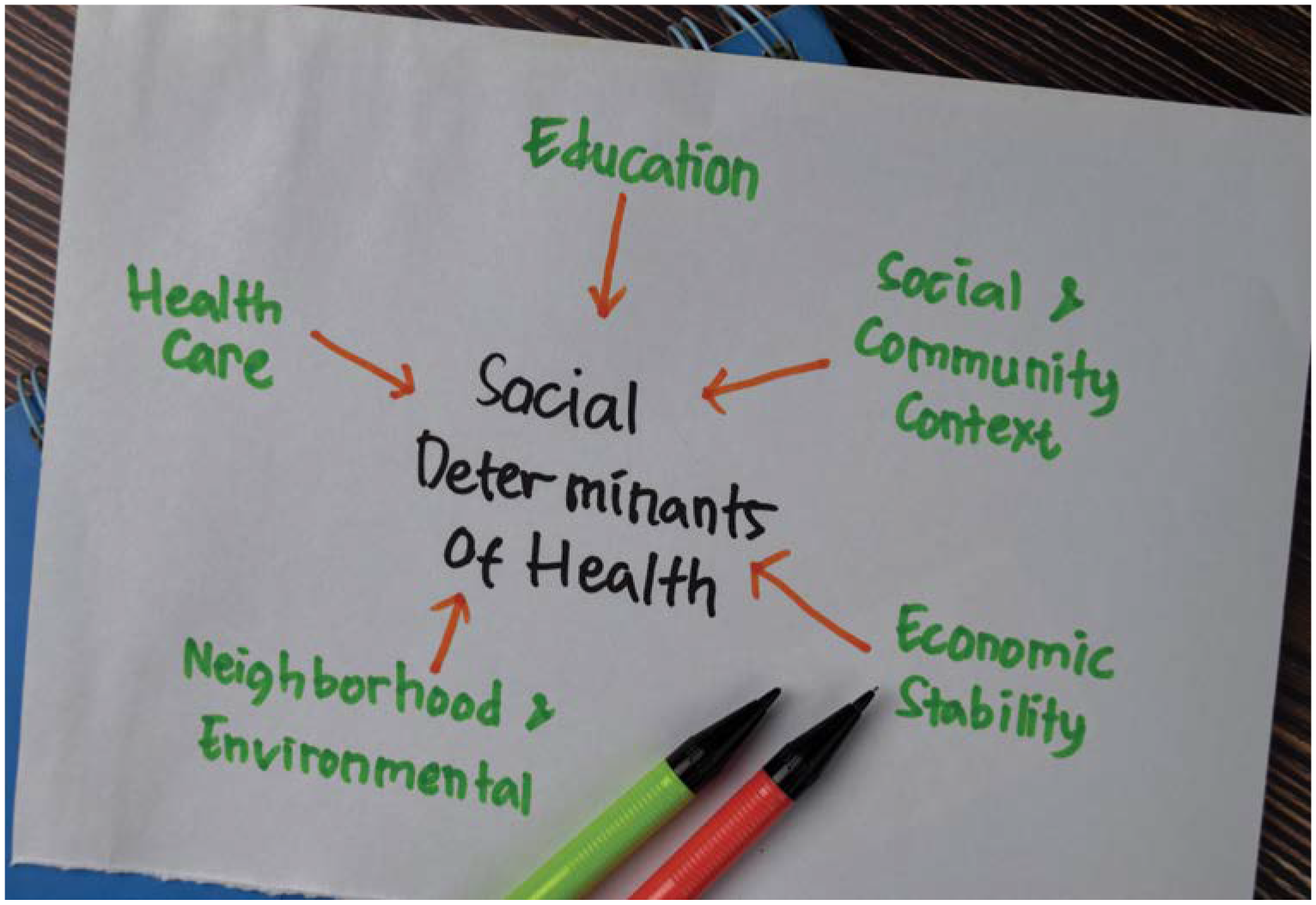
In 2008, the WHO Commission on Social Determinants of Health published a report titled Closing the Gap in a Generation. Their goal was to bring an understanding, from a social justice perspective, of how health inequalities impact the health care system, what are the remedies, and what factors exasperate injustices. The work of the Commission was based on development goals and, thus, connected SDH to economic growth and bridging gaps in the health care system. 8
The 2010 Affordable Care Act (ACA) established by the Obama administration agreed with the ideology of SDH, and ultimately, US policy would come out of those findings. The CDC defines social determinants of health as “life-enhancing resources, such as food supply, housing, economic and social relationships, transportation, education and health care, whose distribution across populations effectively determines length and quality of life.” 9
The CDC has outlined their current initiative to address SDH through Healthy People 2030 as follows:
Health care access and quality
Education access and quality
Social and community context
Economic stability
Neighborhood and built environment.
The goal of this initiative is to identify, reduce, and ultimately eliminate inequities in health care and to promote the highest level of care among all population groups across America. 10 It is believed that poor health outcomes are often made worse by the interaction between individuals and their social and physical environments; therefore, social determinants of health are in part responsible for the unequal and avoidable differences in health status within and between communities.
Provide DSMES and health education through multiple modalities because people learn in a multitude of ways.
There is no onesize-fits-all solution in education. Have a variety of tools at the ready to meet the individual’s learning needs and styles.
We know that the bigger picture of tackling systemic racism has to include addressing public policy and dismantling long-standing practices and beliefs. What can we, as DCESs, do to have a positive impact on the health outcomes of African Americans and address racism in health care? How can we use SDH to close the gap on health disparities? We can start by implementing several Healthy People 2030 initiatives.
Health care access and quality has a component addressing health communications, with 3 essential goals:
Client understanding: Ensure that your clients understand what is happening to them, their health and their bodies, the disease process and all its ramifications, the plan of care, and all of their options and potential outcomes. Client engagement: Ensure patient-centered care; involve clients as active participants in their health care decisions. Client-practitioner communication: Ensure clients feel heard and understood. It takes time to build rapport and establish connections, but it is worth the effort.
In the context of economic stability, there is a component to address nutrition and healthy eating with a goal to reduce hunger and food insecurities. Practitioners should have resources on local food pantries and food banks. If you do not have the information, reach out to a registered dietitian or social worker for that information. Be willing to have the conversation about access to fruits and vegetables. Take the time to familiarize yourself with the communities in which your clients live. Know what services are or are not available. Know if they live in food deserts. Be insightful. Be prepared to have conversations about food insecurities but also have resources and some answers.
One way a DCES can be impactful is through social and community context, an area that is being addressed in health communications as it relates to health literacy. It is important to provide DSMES and health education through multiple modalities because people learn in a multitude of ways. There is no one-size-fits-all solution in education. Have a variety of tools at the ready to meet the individual’s learning needs and styles.11,12
The Association of Diabetes Care and Education Specialists (ADCES) is in a unique position to make a real difference in the current culture and climate in our country. The call for members to increase their consciousness and responsiveness was encouraged when our organization extended an invitation to Dr Uche’ Blackstock to offer the keynote address at ADCES 2020 Annual Conference to raise our awareness on systemic and structural racism in America and its effects on health equality. In the keynote given by Dr Blackstock, we were introduced to the Structural Vulnerability Assessment tool. 13 She challenged us to recognize the influence of structures, including policies, economic systems, and social hierarchies, on patient health and the practice of health care in and out of our clinics. She encouraged each of us to practice structural humility and develop structural competency, which she defined as a framework for exploring the effects of social structures on health outcomes.
Although we have worked hard to become culturally competent, stereotypes may be unintentionally reinforced, and global techniques may not be the best way to approach the individual we serve in the compassionate and person-centered way that we know profoundly changes behavior. The Structural Vulnerability Assessment tool provides probes that can help us unmask the barriers to self-care people face in our health care system. These barriers can be broken into 8 domains:
Financial security
Residence
Risk environments
Food access
Social network
Legal status
Education
Discrimination.
To improve our encounters with marginalized people, we must identify how and to what extent each of the domains impacts the individual. And we must provide support and advocacy to overcome the identified roadblocks. We attest to providing ethically responsible diabetes services when we sit for the certification exam, where we agree that the DCES “shall be guided at all times by concern for the physical, emotional, social, and economic welfare of the person. The needs, goals, and life experiences of the person shall be taken into account.” 14 The vulnerability tool can be used to ensure that we are providing diabetes services that meet this ethical standard.
The Structural Vulnerability Assessment tool provides probes that can help us unmask the barriers to selfcare people face in our health care system.
The competencies for ADCES promote person-centered care that “is respectful of and responsive to an individual’s ‘preferences, needs, and values’” and, more specifically, addresses the important competency of assessing a “person’s skills and knowledge level, education, health literacy/numeracy, culture, readiness to learn, preferred learning style and language, barriers to learning, financial barriers, confidence and skills with technology use, and support needs.” The ADCES Practice Paper, Cultural and Health Literacy Considerations With Diabetes, 15 lays a foundation, but skills must be developed to be the responsive and sensitive DCES we aspire to be.
Dr Blackstock took it beyond how an individual might internalize racism to how racism is built into the practices and composition of the community, the businesses, and other settings the individual navigates. She admonished us to examine access to care and to our programs, the quality of care provided, and the policies and barriers that keep individuals from positive health outcomes. She discussed the four I’s of oppression—ideological, institutional, interpersonal, and internalized. If change is going to occur, then it must be addressed at all levels, including individual, interpersonal, institutional, community, and policy.
We must intentionally and judiciously act to address, as individual providers and as an organization, the structural racism that we encounter. We must consider how our protocols, procedures, and encounters may impact African American lives and be accountable for our role in recognizing and addressing SDH in the direct services we provide and as advocates for those living with the complex condition called diabetes.
The ADCES Practice Paper, Cultural and Health Literacy Considerations With Diabetes, lays a foundation, but skills must be developed to be the responsive and sensitive DCES we aspire to be.
DCESs have worked for years on the language we use in addressing people with diabetes. It is important that we be as reflective of our words and thoughts when working with marginalized people. The DCES should be mindful of how language can reinforce bias and stereotypes.

DCESs have the opportunity to effect real change in the fight to end systemic and structural racism in health care, and specifically diabetes care, by understanding and acknowledging that racist practices and beliefs are harmful and foster health inequities. These inequities can be seen in access to preventive care, diagnosis, treatment, research opportunities, and education. Now is the time to act on what is within your control to advocate for and affect respectful, fair, and equitable diabetes services.
We can improve our diabetes services by:
Advocating for access to health care and health insurance for all people.
Expanding assessments to include questions that address structural vulnerabilities of people and populations.
Stepping out of our comfort zones to engage in dialogue on the barriers people encounter in self-care, be it living in food deserts, lacking a safe place to exercise, or concerns regarding health service delivery.
Developing our personal competence in health equity by participating in continuing education programs, the cultural competency community of interest, and self-study that assists in addressing SDH.
Appreciating those disquieting, uncomfortable moments with someone who differs from ourselves as opportunities for personal and professional growth. We need not be afraid to lend our voices for change and can instead advocate for change.
Bringing an end to structural racism in our country isn’t a “quick fix” or even likely to be fully realized in our lifetime. It will happen only through a great deal of thoughtful effort by all people, including the marginalized and those who have benefited from that marginalization. Although many in the latter group might wish that the call to end racism would “just go away,” it can’t. DCESs have a distinctive role to affect real change in the fight to end structural racism in health care, and specifically diabetes care, beginning with ourselves, our peers, our organizations, and our professional associations. By acknowledging that racist beliefs are harmful and foster health inequities (access to preventive care, diagnosis, treatment, research opportunities, education, etc), we are taking a first (small) step in the right direction. Many steps will have to follow to ensure that equal care is offered and encouraged to ALL people with diabetes.
DCESs have a distinctive role to affect real change in the fight to end structural racism in health care, and specifically
diabetes care, beginning with ourselves, our peers, our organizations, and our professional associations.
As with all goals, we must continually reassess our efforts and ability to change behaviors. How can we measure our endeavors to address health inequities? The Robert Wood Johnson Pathways to Health Equity report identifies that equity is achieved when “everyone has the opportunity to attain full health potential, and no one is disadvantaged from achieving this potential because of social position or any other socially defined circumstance.” 16
Footnotes
Valari Taylor, MS, RDN, LD, is in private practice in Rio Rancho, NM. Lisa Golden, MA.Ed.HD, CRC, CDCES, is with the Texas Workforce Commission in Crowley, TX. Leigh Bak, MSN, APRN, ACNS-BC, CDCES, is with Yale New Haven Hospital in New Haven, CT.