






Abstract


Automated insulin delivery (AID) systems are transforming diabetes care and are now recommended as the preferred insulin delivery method in people with type 1 diabetes, adults with type 2 diabetes, children and adolescents with type 2 diabetes, and those with other forms of insulin-deficient diabetes. Consistent with the 2026 ADA Standards of Care, 1 selecting an AID system should be individualized based on the person’s needs, preferences, and circumstances.
“Will This Work for Me in My Everyday Life?”
For clinicians, this shifts the conversation from selecting the most advanced technology to identifying the system that best fits how a person wants to live and will realistically use.
Start With What Matters Most to the Individual
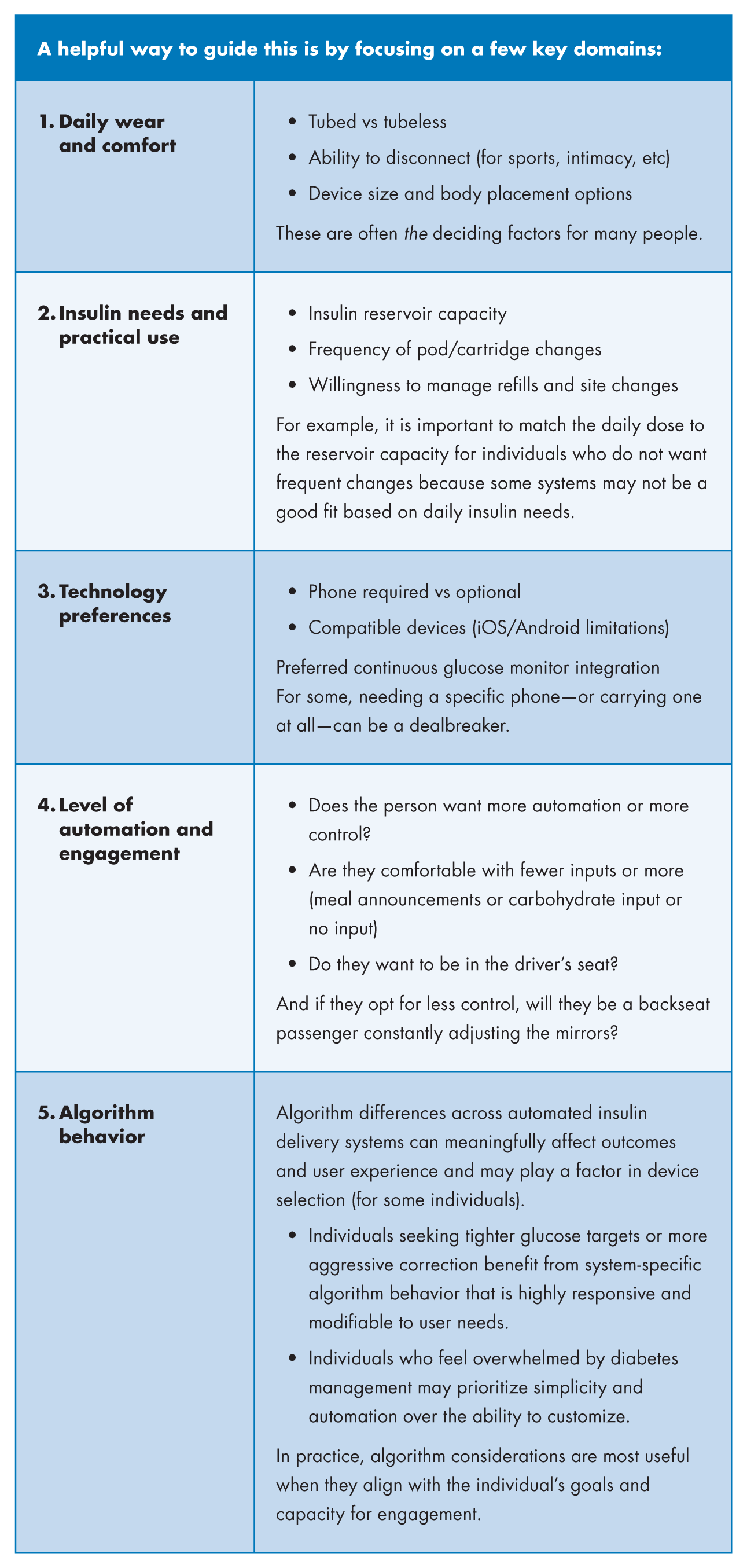
Across clinical experience and expert input, the most important factors are often practical—not technical:
How the device is worn
Whether it has tubing or is tubeless
If it can be removed temporarily
What is the size and visibility of the device
Is it compatible with their current continuous glucose monitor
Is a smartphone a requirement for use
In fact, many individuals and families make decisions based on physical design (e.g., choosing tubeless simply because it is tubeless or something that looks cool or a certain way), with less focus on algorithm differences.
Clinical Takeaway
Start with lifestyle and lived experience to guide technology selection—and then layer in clinical and technical considerations.
Keep It Simple: A 3-Question Framework
When helping someone choose an AID system, start with:
“How do you want to wear it?” (tubed, tubeless, removable, visible vs discreet)
“How do you want to interact with it?” (phone-based, pump-based, more hands-on vs less and more automated)
“What would make this easy—or frustrating—in your daily life?”
This approach quickly narrows options and centers the decision on the person—not the product.
Focus on “Fit,” Not “Features”
Instead of asking, “Which system is best?,” shift to: “Which system fits how you want to live your daily life?”
Bottom Line
The goal is to translate needs and preferences into decisions. Once preferences are clear, practical system specific considerations become clearer:
Preference for no tubing → tubeless systems
Higher daily insulin needs → larger reservoir capacity and/or increased change frequency
Desire to avoid smartphone dependence → systems with on-device control
Preference for minimal interaction → systems with greater automation
This practice helps move from general discussion to practical decision-making. Because as we know, the best AID system for an individual is the one a person will consistently wear, trust, and use.
Visit danatech for More Information About AID Systems
Footnotes
Acknowledgements
This article was artificial intelligence augmented.
Author Contributions
All authors listed contributed to the writing of the article.
Declaration of Conflicting Interests
LaurieAnn Scher is a consultant who works for ADCES, danatech. Dana Moreau is an employee of ADCES, danatech.
