





Abstract
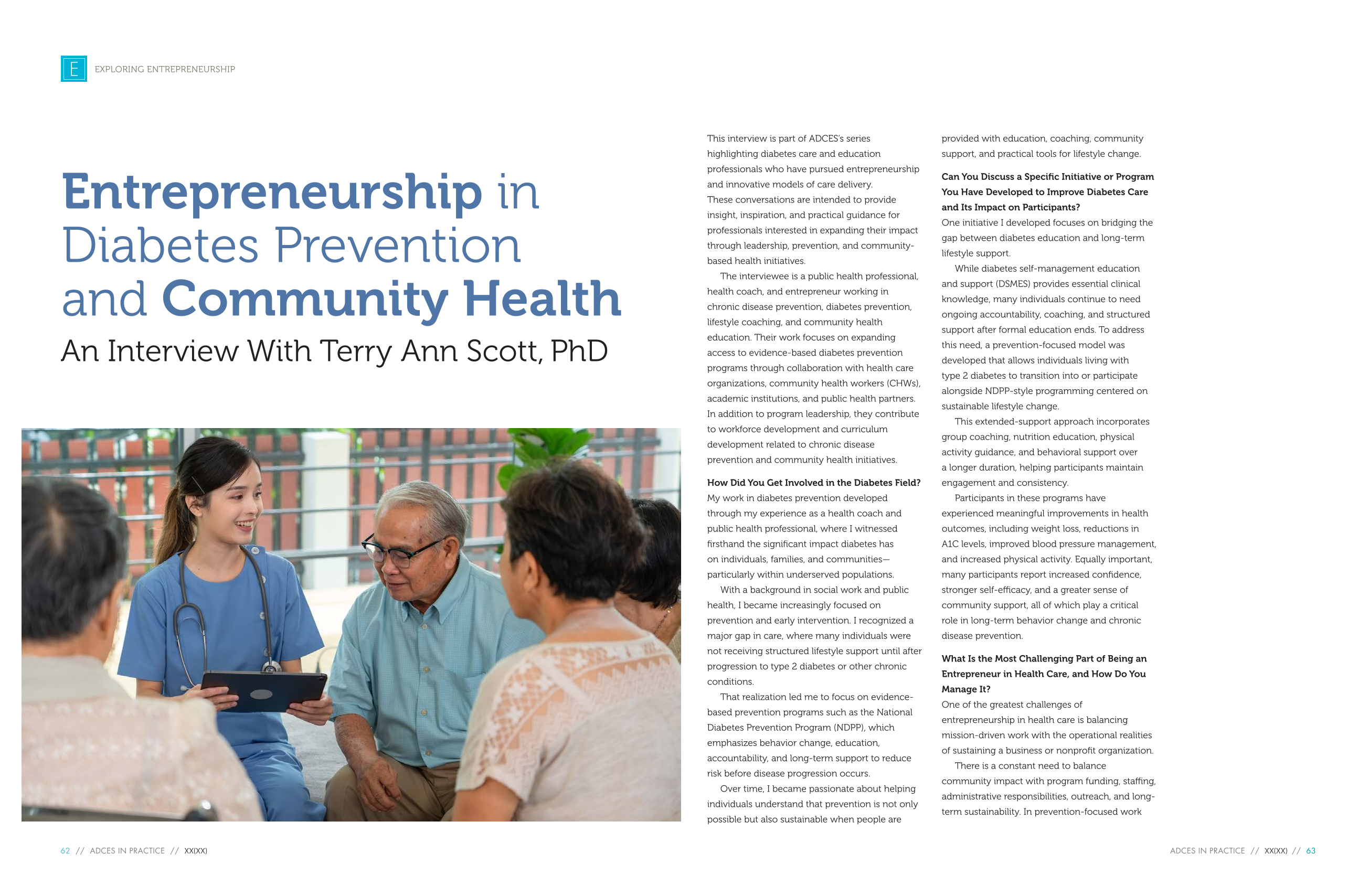
An Interview With Terry Ann Scott, PhD

This interview is part of ADCES’s series highlighting diabetes care and education professionals who have pursued entrepreneurship and innovative models of care delivery. These conversations are intended to provide insight, inspiration, and practical guidance for professionals interested in expanding their impact through leadership, prevention, and community-based health initiatives.
The interviewee is a public health professional, health coach, and entrepreneur working in chronic disease prevention, diabetes prevention, lifestyle coaching, and community health education. Their work focuses on expanding access to evidence-based diabetes prevention programs through collaboration with health care organizations, community health workers (CHWs), academic institutions, and public health partners. In addition to program leadership, they contribute to workforce development and curriculum development related to chronic disease prevention and community health initiatives.
How Did You Get Involved in the Diabetes Field?
My work in diabetes prevention developed through my experience as a health coach and public health professional, where I witnessed firsthand the significant impact diabetes has on individuals, families, and communities—particularly within underserved populations.
With a background in social work and public health, I became increasingly focused on prevention and early intervention. I recognized a major gap in care, where many individuals were not receiving structured lifestyle support until after progression to type 2 diabetes or other chronic conditions.
That realization led me to focus on evidence-based prevention programs such as the National Diabetes Prevention Program (NDPP), which emphasizes behavior change, education, accountability, and long-term support to reduce risk before disease progression occurs.
Over time, I became passionate about helping individuals understand that prevention is not only possible but also sustainable when people are provided with education, coaching, community support, and practical tools for lifestyle change.
Can You Discuss a Specific Initiative or Program You Have Developed to Improve Diabetes Care and Its Impact on Participants?
One initiative I developed focuses on bridging the gap between diabetes education and long-term lifestyle support.
While diabetes self-management education and support (DSMES) provides essential clinical knowledge, many individuals continue to need ongoing accountability, coaching, and structured support after formal education ends. To address this need, a prevention-focused model was developed that allows individuals living with type 2 diabetes to transition into or participate alongside NDPP-style programming centered on sustainable lifestyle change.
This extended-support approach incorporates group coaching, nutrition education, physical activity guidance, and behavioral support over a longer duration, helping participants maintain engagement and consistency.
Participants in these programs have experienced meaningful improvements in health outcomes, including weight loss, reductions in A1C levels, improved blood pressure management, and increased physical activity. Equally important, many participants report increased confidence, stronger self-efficacy, and a greater sense of community support, all of which play a critical role in long-term behavior change and chronic disease prevention.
What Is the Most Challenging Part of Being an Entrepreneur in Health Care, and How Do You Manage It?
One of the greatest challenges of entrepreneurship in health care is balancing mission-driven work with the operational realities of sustaining a business or nonprofit organization.
There is a constant need to balance community impact with program funding, staffing, administrative responsibilities, outreach, and long-term sustainability. In prevention-focused work especially, securing resources and maintaining program growth can be challenging despite the significant public health need.
To manage this, I prioritize structure and intentional time management. I dedicate specific time blocks to administration, program development, partnerships, curriculum planning, and participant engagement. Maintaining that balance allows me to stay connected to the purpose behind the work while continuing to build sustainable systems and community partnerships.
What Advice Would You Give Someone Who Is Considering Starting Their Own Health-Focused Business or Program?
Start with a clear focus and build intentionally.
Many professionals enter entrepreneurship wanting to solve multiple problems at once, but it is often more effective to begin with 1 strong, evidence-based service or program and build from there.
I encourage professionals to focus on:
Identifying a clear target population
Developing 1 sustainable and measurable program
Establishing systems for participant engagement and outcome tracking
Building strategic partnerships within health care and community settings.
It is also important to remain adaptable. Public health and health care needs continue to evolve, and successful programs are those that can respond to community needs while maintaining quality and consistency.
How Do You Stay Motivated Personally and Professionally?
I stay grounded by maintaining routines that support both physical and mental wellness, including regular exercise, reflection, continued learning, and staying connected to my purpose.
Professionally, I remain motivated by the impact of prevention work. Seeing participants improve their health outcomes, reduce risk factors, and gain confidence in managing their health reinforces the importance of this work and continues to inspire me.
I also find motivation in helping expand access to prevention services in communities that have historically experienced barriers to health care, education, and chronic disease support.
How Do You Maintain Your Professional Competencies?
I maintain my competencies through ongoing professional development, continuing education, and active engagement in the diabetes prevention and public health fields.
This includes participating in ADCES trainings, Centers for Disease Control and Prevention (CDC) related NDPP updates, webinars, conferences, and workforce development initiatives. My work in program delivery, curriculum development, and CHW training also requires me to stay current with research, clinical guidelines, and best practices in chronic disease prevention.
In addition to formal education, I believe there is significant value in learning directly from participants and communities. Their lived experiences provide important insight that strengthens program development and delivery.
What Certifications or Credentials Are Especially Valuable for Professionals Working in Private Practice or Prevention Programs?
For professionals involved in diabetes prevention and chronic disease management, CDC-recognized Lifestyle Coach training is foundational for delivering NDPP programs effectively.
For clinicians specializing in diabetes care and education, the certified diabetes education and care specialist credential provides advanced expertise and credibility within the field.
Additional training in motivational interviewing, health coaching, behavior change strategies, cultural competency, and community health can also be highly beneficial, particularly for professionals serving diverse populations.
Because chronic disease prevention is multidisciplinary, ongoing education across nutrition, physical activity, behavioral health, and public health is essential.
How Do You Collaborate With Other Health Care and Diabetes Care Professionals?
Collaboration is central to effective diabetes prevention and chronic disease management.
I work closely with health care providers, registered dietitians, fitness professionals, public health organizations, and CHWs to ensure participants receive comprehensive and coordinated support.
This collaboration includes referral partnerships, shared educational initiatives, participant support strategies, and communication regarding program progress when appropriate. I also work with academic institutions and workforce development programs to help strengthen the pipeline of trained prevention professionals and CHWs entering the field.
How Do You Obtain Referrals for Your Programs?
Referrals are generated through a combination of health care partnerships, community outreach, digital engagement, and word-of-mouth referrals from participants.
Health care providers often refer individuals with prediabetes, obesity, hypertension, or elevated chronic disease risk factors. Community organizations, health departments, and CHWs also play an important role in connecting individuals to prevention resources and support services.
CHWs are especially valuable because they often have trusted relationships within the communities they serve and can help bridge gaps between health care systems and community-based prevention efforts.
How Do You Approach Cultural Competency and Addressing Implicit Bias in Health Care?
Cultural competency is essential in chronic disease prevention because health behaviors are influenced by culture, environment, lived experiences, and access to resources.
I approach this work through ongoing education, self-reflection, active listening, and community engagement. It is important to understand the social and cultural context in which individuals are making health decisions rather than relying on assumptions or one-size-fits-all approaches.
I also believe health care professionals must continuously examine implicit bias and work to build trust, respect, and culturally responsive programming. Improving health outcomes requires not only education but also meaningful relationships, understanding, and equitable access to prevention resources. ■
Footnotes
Acknowledgements
The author would like to acknowledge the participants, health care professionals, and community partners who continue to support chronic disease prevention and diabetes prevention efforts.
Author Contributions
Declaration of Conflicting Interests
The author declares no conflicts of interest.
Funding
This manuscript received no external funding.