






Abstract
Live supervision has long been a hallmark of couple and family therapy training and practice. Previous research has highlighted the importance and benefits of live supervision in family therapy training, though some reports have noted negative effects. This study explores family therapy students’ experiences and descriptions of live supervision and its significance for their development as family therapists. Data was collected from four focus groups with a total of nineteen informants, and systematic text condensation was used in the analysis. Themes that were constructed are presented within three dimensions: (1) Frames for practice provide space to train and experiment; (2) Live supervision both elevates and restricts; and (3) The relationship promotes connection and collaboration. The themes are discussed in relation to previous research and theories, and implications for the training of family therapy students and future research are presented.
Keywords
Introduction
Live supervision has been a hallmark of couple and family therapy (CFT) training and practice, distinguishing it from other forms of psychotherapy (Castronova et al., 2020; Maaß et al., 2022). In this context, live supervision means that the supervisor is present in the room or behind a mirror, allowing direct communication with therapists during client sessions. This live supervision is a unique alternative to retrospective supervision based on therapists’ narratives or video analyses, and the immediate feedback opportunity is considered live supervision’s greatest strength (Bartle-Haring et al., 2009; Bernard and Goodyear, 2019). The research literature also highlights how live supervision is both significant and sometimes a prerequisite for acquiring therapeutic skills (Wilson et al., 2016). For example, McGoldrick (1982) argues that supervision in the early stages of training is most effectively oriented toward live supervision, as this format allows for immediate pedagogical intervention and situated skill development. At the same time, she cautions that live supervision carries the risk of inviting overly active supervisory involvement, potentially limiting trainees’ opportunities to develop sufficient autonomy if interventions occur too early or too frequently.
In family therapy training, students learn various theories and methods, practice different techniques, and acquire therapeutic competencies. They also reflect on their own experiences, values, and attitudes with supervision playing a crucial role (Cuccurullo and Visone, 2021; Vetere and Sheehan, 2017). Live supervision can be seen as a process in which a qualified therapist guides the trainee’s professional development and socialization into becoming a professional family therapist (Todd and Storm, 2014). This also is reflected in the aspect of the supervisor having the ultimate responsibility for ensuring an ethical and professional practice that meets the clients’ needs (Maaß et al., 2022) and suggests an asymmetrical relationship between trainee and supervisor. However, in systemic family therapy training inspired by postmodern perspectives, this notion might be challenged by a collaborative, non-hierarchical approach to both therapy and training (Nanouri et al., 2022). By sharing the same therapy sessions, the supervisor and therapists become personally involved, reflecting on similarities and differences in thoughts, sensations, and intuitions, forming a “therapeutic we” (Cuccurullo and Visone, 2021). There is evidence that live supervision impacts students’ perceptions of therapy progress but less is known about trainee growth and the effectiveness of the therapy (Castronova et al., 2020). Maaß et al. (2022) found in a systematic review of 138 qualitative and quantitative studies of live supervision in psychotherapy training that 87% reported positive effects. Highlighted factors include the development of therapeutic skills, increased competence, satisfaction with the therapy process, and integration of learning through the supervision process. Furthermore, in a meta-synthesis of 15 qualitative studies (3 within couple and family therapy) by Wilson et al. (2016) on students’ experiences with live supervision during training, the authors conclude that live supervision provides many valuable learning opportunities and appears to be a resource for students’ development. A distinct finding is how students experience increased competence and how the supervisor adds a quality that benefits both students and clients. At the same time, the learning outcome is clearly linked to the relationship between the student and the supervisor. However, the authors also highlight how aspects related to power dynamics and fear of negative feedback can cause students to lose confidence and trust in their own development. Furthermore, in the systematic review of Maaß et al. (2022), negative effects were found in 43% of the studies. The findings describe how those being supervised sometimes felt a lack of competence in the conversations, experienced performance anxiety, or felt overwhelmed in the situation. The asymmetrical nature of the trainee – supervisor relationship mentioned above might negatively affect the relationship between the supervisor and the supervisees. This aligns with research indicating that supervision can also have harmful effects (Ellis, 2017; Todd and Storm, 2014; Wilson et al., 2016). Harmful supervision can be understood as an experience where psychological or emotional difficulties arise for the supervisee during the supervision. While characteristics and behaviours of both parties can contribute to relationship problems, it is ultimately the supervisor’s responsibility to address and repair ruptures in the supervision relationship (Todd and Storm, 2014). Ammirati and Kaslow (2017) emphasize that the first crucial step in preventing negative effects is increasing awareness of potential harm in all forms of supervision and addressing this issue in both research and practice.
An important step in this regard, when it comes to live supervision during family therapy training, is to gain deeper insights into students’ experiences. Much has been described about supervision from the perspectives of theory, practice, and research. However, as Wong (1997) point out, it is primarily supervisor perspectives that are highlighted. Although there is more current research on the perspectives of supervised students, more knowledge is needed about student experiences of live supervision in family therapy training. In the meta-synthesis by Wilson et al. (2016) only three of the studies came from the field of family therapy. Furthermore, Maaß et al. (2022) point out that in recent years, studies of live supervision in family therapy (including family therapy training) are fewer and increasingly encompass other therapeutic approaches, such as cognitive therapy. Thus, the overarching aim of this study is to explore how students in family therapy experience live supervision in their training and the significance it might have for their development as family therapists.
Method
This study is a qualitative focus group study. The use of focus groups for gathering data appeared to be a natural choice and in accordance with informants’ experiences with reflection-oriented practice in teams (Acocella and Cataldi, 2021). The epistemological location of the study is within a social constructionist framework that assumes that social reality is negotiated through language, relations and culture (Gergen, 2015a). This accords with a qualitative research tradition supported by social constructionist theories about knowledge development as co-creation between informants and researchers (Malterud, 2017). These ideas also accord with our sociocultural view of learning by providing scientific accounts of how people think and learn (McNamee and Moscheta, 2015). In this lies also a wish to understand how meaning constructions around significant learning are presented and promoted through language.
Context of the study
The study was conducted at the Conversation Centre at VID Specialized University, established in 2018 as a free, student-driven conversation service under the live supervision of University College staff. One goal of providing our own conversation service has been to develop and strengthen the quality of the Master education of family therapy students through being a systemic practice in accordance with its theoretical foundation. This is drawn mainly from critical realism, social constructionism and post-structural perspectives. This is in accordance with the field internationally and the study program has been developed following the standards of the European Family Therapy Association (EFTA) for systemic family therapy education programs in Europe (EFTA – TIC, 2011). Following EFTA standards, the program and practice is a 4-year specialization in family therapy, part of a 7-year education process to become a family therapist. Students can apply for a practice place from their second year of study, whereafter two students and one teacher form a team determined by where in the program the students are and the nature and extent of their experience. The team collaborates to plan and conduct conversations in which live supervision has a defined role before, during and after the conversations.
Recruitment and data collection
The sample of informants was composed strategically (Acocella and Cataldi, 2021), which here meant inclusion of informants who were students attending the program and who had practice at the Conversation Centre. Criteria for participation were that students had completed at least one conversation course, alternatively a minimum of 10 hours’ practice with clients under live supervision. Information letters containing an invitation to participate were sent in four waves to all students who had had a practice place. Informed consent was collected from those who accepted before the interviews were conducted. The study is approved by the Service Provider of the Knowledge Sector (SIKT), application number 592500.
Data collection
The empirical material for the study is collected from four focus group interviews within total 19 informants. The interviews were conducted in two rounds: 2019–2020 and 2022–2023. The break is caused by several episodes of closing of the Conversation Centre from the spring of 2020 because of the COVID-19 pandemic. After the start of study further time was required before the students had had enough practice to fulfil the criteria for participation. • Focus group 1 was conducted in June 2019 with five informants, one man and four women. Two of the students had completed their second year of study, one was attending a third year, and two students completed their Master study the same spring. • Focus group 2 was conducted in January 2020 with five students, one man and four women. One informant was a second-year student, two were attending their third year and two were completing their fourth year of study. • Focus group 3 was conducted in June 2022. The informants were four women who were all attending their fourth and last year of study. • Focus group 4 was conducted in May 2023 with five students, one man and four women. Three of the informants had completed their second year and two had completed their master’s degrees that same spring.
The sample contained informants with fundamental clinical competence in process of specializing as family therapists at the master’s level. The skewed gender distribution reflects that of the program generally. Wilson et al. (2016) describes a similar imbalance in their meta-study and explains this with the general gender imbalance among family therapists in general.
The interviews were conducted with the help of a semi-structured thematic guide, and informants were asked to reflect on topics relevant to conversational practice. Topic headings were experience with live supervision, the connection between theory and practice, and the experience of professional development. The informants reflected around points of view, ideas and experiences, and the interaction between them became the data for the study. The moderator’s experience was that the interviews proceeded in a cooperative atmosphere in which themes were treated openly and broadly. Narratives of good and less positive experiences were reflected over in accordance with our goal of organizing an exchange of experiences that could contribute to awareness about own learning but also about possibilities for change regarding future work (Calvert et al., 2016). The interview can thus promote the knowledge the study is seeking while students receive knowledge they can take with them further. The interviews were audio-recorded.
Ethical implications
Empirical data is not only created between informants but also between informants, moderator and researchers (Acocella and Cataldi, 2021). The study authors are also supervisors at the Conversation Centre as well as course lecturers, and this created a double role when we began research on the study course and students with whom we had a relation. This mixture has made it necessary for us to have a keen awareness of the need to practice self-reflexivity in all phases of the research process. Preconceptions about the theme and closeness to the issue, data and informants have thus demanded extra attention from us as researchers. We have chosen to be transparent about the context of the study. In a hermeneutical sense, research should contribute to a circular movement toward new knowledge development while remaining fundamentally critical (Malterud, 2017). In this context, it was understood that our co-construction of themes reflected critical questions about the course and our own practice could arise. We have therefore also had to balance freedom in the research role against institutional loyalty. At the same time, doing research within one’s own field can also have advantages through the immediate understanding of the phenomenon being researched. In the study, we have tried to develop pedagogical knowledge that can be further generalized to other institutions educating family therapists.
In the same way, we considered it necessary to assign the role of moderator during the research interviews to an external but experienced family therapist with knowledge of the research topic. Further, the recordings of the interviews were transcribed by an external transcriber, and we received the text back without any attributions of names to statements. We performed the analysis ourselves but have tried to remain sensitive to interpretations as well as regarding communication of the results of our analysis.
Analysis
The interviews were analysed in four steps using a form of systematic text condensation inspired by (Malterud, 2012): (1) Total Impression: In the initial step, we read through the entire dataset to get an overall sense of the data. From this reading we formed a general impression and found preliminary themes. (2) Identifying and Sorting Meaning Units: In the next step, we sorted and described meaning units, that is segments of text that we considered were related to the same theme. This process involved breaking down the data into smaller units and organizing these into codes. (3) Condensation: In the third step, we condensed the meaning units into shorter, more concise representations, trying to preserve our construction of their core meanings. This step involved transforming the codes into more abstract labels. (4) Synthesizing: In the final step we synthesized the condensed meaning units into a coherent description and conceptual framework to create descriptions and concepts that could capture the essence of our understanding of the data.
We performed the four steps in the analysis process in order and alone before we compared and discussed our work together. We were then able to challenge and supplement one another’s interpretations and practice extra attentiveness toward having conducted selective understandings of the material. Further, this gave us the foundation for critical reflections along the way. The process was repeated several times and through discussions we developed new understandings that lead to being able to re-read the text with a fresh gaze.
Results
Themes and sub-themes.
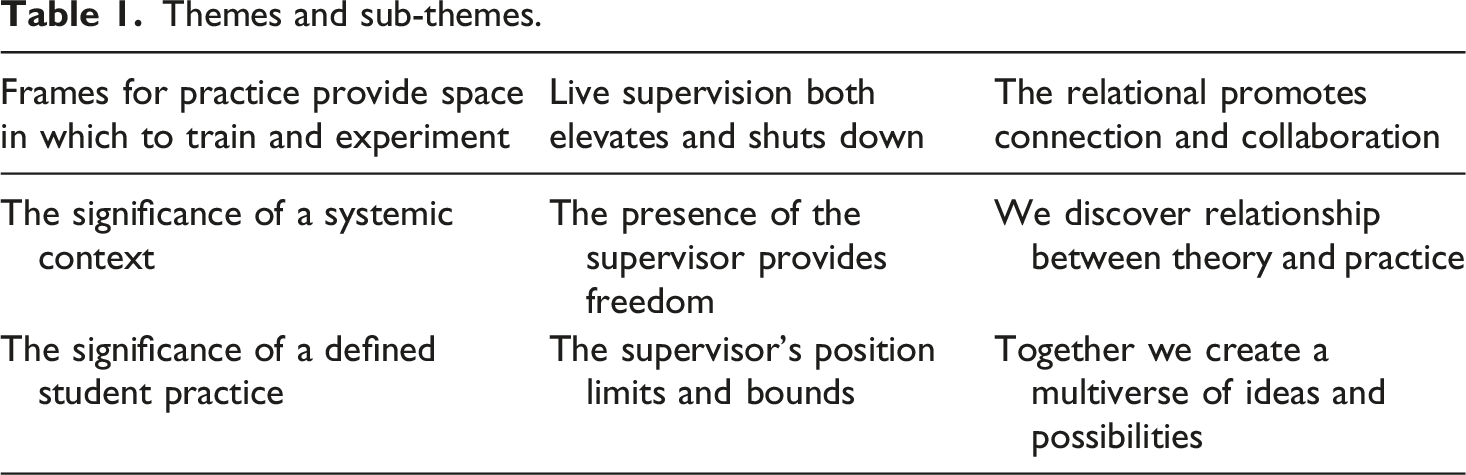
Frames for practice provide space in which to train and experiment
This theme concerns the significance of the systemic context of practice and its definition as student practice. The students found that this form of practice gave them space to train and try out being family therapists without feeling that they were putting their own needs ahead of those of others.
The significance of a systemic conversational practice
All the informants emphasized the significance of a practice in which the context was systemic, and the expectations of students and supervisors aligned with the learning goals of the course. They could do as they learned. “Everything happens at once. We get the practice, we get the conversations, there is someone observing us, and we get the supervision directly afterwards” (II/78). They found that practice gave them great space for learning and disciplinary development. When the disciplinary ideas of how to practice were defined, students could maintain a dedicated focus within family therapy as a discipline, and within the therapist role. “It’s as though you enter a bubble and can just play inside the field” (II/156). The frame gave them opportunities to develop intimacy with the systemic landscape. Practice was a “total package” in which they could use the language, concepts and approaches that belonged to it. “Sitting almost in a laboratory, open to one another from the perspectives of the different roles: co-student and supervisor. That’s very educational, yes, the context does something” (IV/870).
The informants highlighted how the practice also embraced the ethical values and foundational principles of the discipline. The supervisors’ attitudes to clients and therapeutic practice appeared to be integrated and were in this way inspirational. “Not that kind of hierarchical thinking, right? But more an in-the-same-boat thinking” (I/762). “One very good attitude that our supervisor reminded us about … we’re all people and we have these train tracks we’re driving on. Sometimes we go off the rails. This doesn’t mean that you’re derailed for good” (I/753). Some highlighted the significance of having responsibility for an entire conversational therapy course involving facilitating work in a holistic and multivoiced manner. “Bringing the whole system in instead, that just opens up a whole other world” (II/88). They described experiencing education within a professional field that was both important and unique.
The significance of a defined student practice
The informants also highlighted the significance of a defined student practice. This clarified the context for the clients as well and provided a neat framework within which students could train. “Those who come here know what this is, and those of us who are here, we know what it’s about” (III/355). “Trying out new things is allowed, and it’s ok not to be completely trained” (IV/40). They did not believe that clients were particularly concerned about their being students, because the supervisor was part of the team and had responsibility for maintaining the quality of the conversation. The conversation approach therefore appeared to be a caring practice for both clients and students.
The informants showed a high level of ethical awareness about meeting clients’ needs. Beginning to train in systemic conversation practice could feel like a balancing act in which one’s own needs end up first. One student explained it this way: “I didn’t like that feeling that my interests in a sense should come before the quality of the conversation” (l/152). Even though the informants strove to gain increased competence in the therapist role, they appeared to be equally concerned with providing what their clients needed. Clients’ issues were primary, and the students wanted to contribute to creating change for them in the conversations. Even though we’re here to increase our competence, even though we’re here to practice and this is a course of education, I’m still here to help those who turn up, or do something for them, help can also be a loaded word. But … to do something that can create change (II/1045).
Some informants emphasized the intrinsically ethical nature of the service itself as low-threshold and open for applications from anyone with a need, independent of what they were struggling with. “Here we’re just searching for whatever is useful for the people we talk with. That really appeals to me” (I/201). Despite being in training, students felt they were doing something important for others. This meant that all students experienced the practice as meaningful and caring.
Live supervision both elevates and shuts down
This theme refers to how the students experienced live supervision as chiefly educational, but also with a shadow side. On the one hand, the presence of the supervisor provided security to try things out and the inspiration to learn. At the same time, there was a hierarchy in which the supervisor’s voice was implicitly present and over ordinate. This asymmetry was strengthened by the supervisor’s dual role as a teacher on the programme.
The presence of the supervisor is freeing
One experience that all the informants described was being able to work specifically and thoroughly with the therapist role to the extent afforded by collaboration with the supervisor. They described acquiring therapist skills within frames experienced as free, but safe. “This having an outsider’s gaze on oneself, that’s very educational” (III/74). “Being observed, I’m not very fond of that, but I’ve only benefitted from it” (IV/534). The presence of the supervisor allowed the informants to give themselves space to practice. They tried out ideas because they had peace of mind in the belief that less useful interventions could be improved through the suggestions of the supervisor. “I feel that we dare to be creative and, what can I say, that we get the help we need to fill our shoes and then stand firmly in them” (I/436).
The informants emphasized the generosity shown by the supervisors in demonstrating how to work therapeutically. “Here you must just throw yourself into it. This is a unique opportunity with the most liberated framework imaginable for the learning process within a discipline” (II/319). “I can try out questions from the narrative approach, from the strategic, from the structural. I’m not locked in or made to define myself. Defining the project and what we’re going to work with happens together with the client” (I/443). The presence of the supervisor took on special significance when the therapy conversations moved in demanding directions, or arguments between clients escalated to levels with which students felt they could not manage. The supervisor then took a more active and responsible role in the conversation and informants could rest in their greater levels of experience. If one gets to that point and gets stuck, or if something goes in the wrong direction, or if there is something that happens, then we have great disciplinary weight and a wealth of experience behind us that can take over (IV/478).
The informants emphasized that engaging with the supervisor as a conversational partner fostered a profound sense of inspiration and professional growth. They regarded the experience as rewarding and intellectually enriching. It enabled them to critically observe and reflect upon how a family therapist, drawing on extensive experience, deep theoretical knowledge and competence applies the discipline in complex dialogical contexts. This exposure not only enhanced their understanding of therapeutic practice but also stimulated reflective learning, encouraging them to integrate observed approaches into their own evolving professional identity. “I managed to sort of get a foot in the door by having an experienced therapist along. It was real turbo-learning” (IV/569). The cooperation with the supervisor made a difference. “With such close follow-up by the teacher, with supervision beforehand and afterwards, and with this practice that provides professional development” (I/464).
The supervisor’s own perspective limits and bounds
Some of the informants chose nevertheless to emphasize how they felt about demonstrating for the supervisor what they had attained of knowledge from the course. “I have the theories and ways of doing things that we’ve learned along with me. Now, we’re in a way going to present this. This sets a frame that’s a little limiting” (II/621). Despite most of the informants describing collaboration with the supervisor as open and trustworthy, some felt it had limited them in their therapeutic exploration. While the supervisor challenged them to try out new ideas and find their own style, they sometimes entered the conversations in a closed-off position because they had a prior understanding of the supervisor’s disciplinary perspectives and therapeutic work approach. The supervisors encourage us, in a way, to take our place and do whatever we want, more or less directly stated. At the same time of course, you know from knowing the teachers on the course, what it is that they already favour (II/535).
The supervisor’s position could also influence what the students took with them from supervision before and after the therapy conversations. For several of the informants, supervisors’ suggestions became a general framework that limited their own contributions and ideas. “It irritated me then. I felt that, actually I know better, but then I notice that I’m just being limited” (III/446). They found therefore that the competence the supervisor brought to the practice could also narrow their view of the available alternatives for action. In the therapy, students dismissed what they thought would be most useful. They felt stuck in having to select the planned over the intuitive and put their own ideas aside to show that they understood the suggestions of the supervisor. “I needed to be more supported in that, yes, you can have a plan, you can lay out a structure, but if you get a different insight, then you go for that” (II/559).
The relational creates connection and collaboration
This theme concerns how students experienced discovering the relation between theory and practice and the significance of the relationship they had with the supervisor. Teamwork and collaboration expanded their understanding of the discipline of therapy and the therapist role.
We discover the relation between theory and practice
A general reflection from all the informants was how they used practice to understand the professional literature. “Doing it” was different from reading about it in a book. “There are many approaches, many concepts. What’s helped me is reading about it, having a conversation and reflecting over it, but also getting to experience it in therapy” (III/434). When theory was brought into the therapy room, informants were helped to grasp it. Theoretical concepts became visible in terms of how they took their place in the conversations and were reflected on in the supervision. “With only theory, there isn’t as clear a connection to practice, but we have practice at the same time as we’re acquiring theory” (IV/704). “We’re really building bridges, that’s what we’re doing. For me, it’s the best way to learn” (III/615). The informants experienced what they were reading about and thus understood more about what they were doing. Several informants described how theory could also be bodily experienced, for example, in the resonance they felt in encountering their own blind spots, or the effect of being transparent with ideas and hypotheses.
They also developed better understanding of the more academic meta-perspectives and scientific-philosophical ideas. “I really think a lot about social constructionism, and we try to take it along with us into the therapy room” (I/640). “I speak a lot about discourses and how we can understand, or encounter different understandings, for example about what it means to be good parents, and how we can connect this to discourses. In this way we can try to provide a larger space for parents to occupy. I see this and have something to connect it to” (IV/ 298).
Family theory gained proximity with practice, and theoretical concepts appeared more understandable and applicable when theory and practice went hand in hand.
Further, many informants described the significance of being able to perform as therapists on real clients. In a dedicated practice, they could use professional language and concepts, try out methods and direct. “The listening, the leaning-back… yes, but at one point I realized that here I just have to get going and take over direction, and that has been so educational for me” (III/75). Family therapy as a discipline was experienced as “playful and creative,” and “fun to practice.” “There are so many tools in the discipline that we can more easily make use of in this form of practice and get to try out” (IV/403). Several students highlighted experiences of the potential residing in concrete techniques and in systemic interventions: “That we can go all the way down to the detail level, the way the chair is angled - really exciting! Because those sorts of tiny things, they have an influence” (I/710). “I mean, it was totally crazy how freely they spoke when we were doing the genogram. Without asking loads of questions, so much information came out. That was such a valuable experience” (III/382). These experiences gave them the self-confidence to acquire a professional repertoire, and to become more certain about the role of therapist.
Together we create a multiverse of ideas and possibilities
All the informants highlighted how they got a “boost” from doing therapy as a collaboration. Practice was no longer about their own ideas and structures, rather on co-creation and dialogue. “Putting words to being part of a fellowship … it’s been the good practice” (III/62). The significance of being one of several appeared at many levels. Some highlighted how it felt safe to have others to lean on when the conversation became challenging to manage. Together, the team could explore possibilities and directional choices. Some highlighted how teamwork provides multiple voices and understandings, and thereby a multiverse of ideas that expand both the therapeutic and the teaching spaces. Several informants described learning from one another’s differences: “We have filled each other out, we have slightly different ways of being, but overall, we’ve absolutely helped one another develop, and that’s been very nice” (IV/617). Reflections made as a team remained in the mind for self-reflexive work later and brought attention to one’s own professional development.
Several informants emphasized how being conversation partners provided space for inner dialogues and thereby awareness of the importance of being able to think before one speaks: “It’s very comfortable to be able to withdraw a little bit now and then, listen and reflect and have the inner dialogue. I discover things in a different way when we can take turns” (IV/587). When someone had co-responsibility, they could take turns being active: “Just being able to give a nod. OK, now you jump in because I’m stuck here. It’s very good to know that we can help each other” (IV/597).
As students, all informants expressed how they felt responsibility for delivering a high level of therapy. Being one of several therapists enabled informants to give more attention to meaningful statements made by clients: “Because it’s totally impossible when you’re sitting there and are concentrating, to capture everything, this about being two more who can be attentive” (I/548). Many informants highlighted how being several provided them the opportunity to practice systemic interventions such as different listening and conversation positions. They could use various approaches such as open reflections to enable the involvement of co-students, the supervisor and clients: “We can try out reflecting in a team. We’ve tried out being a therapist and co-therapist, and I think that’s really been educational. And afterwards I have someone to reflect with” (I/594).
Discussion
In this study, we have explored how master students in Family Therapy experience live supervision in a practice and supervisory arena connected to the training program. Generally, the study suggests that this is an organization that provides students with a good space for learning about family therapy therapeutic work and development of the therapist role. Different factors contribute as parts of a whole, but we feel the study clarifies the significance of live supervision constructed as a cooperative model in which all team members are active in encounters with clients.
One theme that was generated in the analysis is how frames for practice provide space in which to train and experiment. For the students, clear frameworks are important, in which the limited experience of therapists is highlighted, and the systemic approach is implicit. A defined systemic context provides students with both proximity to the discipline and an arena in which to try it out. At the same time, the students show a distinct ethical awareness about prioritizing what clients require ahead of their own needs. Clients can be in great crisis, or disputes between parties can escalate to a level which inexperienced students cannot manage, and a dilemma arises when they do not feel they can deliver what is needed. The supervisor can then reduce this dilemma through offering both action and their knowledge and support the students by structuring an intervention in the moment. This reflects other studies (see Charlés et al., 2005; Falke et al., 2015), that show how the supervisor can play a dynamic role in the conversations. One of the strengths of live supervision is that it contributes to ensuring clients are served by and derive benefit from the therapeutic process (Bartle-Haring et al., 2009). Ethical questions around therapeutic factors are also an important element in themselves, among which those related to how the supervisor appears as a professional role model for the students. How the supervisor approaches ethical dilemmas, acknowledges contributions and perspectives, collaborates with students and behaves toward clients can influence students more than what the supervisor says (Falender, 2018; Wilson et al., 2016).
As described in our introduction, one of the most distinct aspects of educational supervision is that the supervisor is responsible for the student’s professional development. The theme the presence of the supervisor provides freedom, depicts how multivoiced teamwork contributes to this professional development, both in terms of therapeutic skills and the role of family therapist. A prerequisite is that the supervisory alliance is experienced as a secure relation in which the supervisor supports students in finding their own answers and inspires them in exploring their own roles as therapists (Moon, 2021). Systemic supervision must begin with students’ understandings and action repertoires, must create meaning, and must move them on from what they already know to that which they can come to know.
While the students emphasize the great generosity of the supervisor and the freedom to try things out themselves, it is important to highlight how the supervisors position also limits and bounds. Students’ knowledge of the supervisor as teacher and professional can also limit their use of ideas and interventions in the conversations. Castronova et al. (2020) describes how the supervisor’s position within an educational clinic can appear unclear and characterized by ambiguous relationships. The supervisory context becomes unclear, and students can feel the stress and pressure of having to succeed on several levels simultaneously to satisfy the different roles of the supervisor. The challenges our findings describe though not dominant in the data, can nevertheless be understood as significant and indicative of how institutional power is always present as part of how educational courses and student practices are constructed and regulated (Gergen, 2015a). Hierarchical positions in educational supervision can be challenging to manage, but it is still the supervisor’s professional responsibility to create a supervisory context that takes best possible care of all participants. When the students are challenged by an asymmetric relation the supervisor in accordance with a cooperation-oriented supervision model can attempt to be more participatory in the therapeutic process. The students can thus move from a position of feeling judged to being part of cooperation toward a goal of being as providing the best possible help to clients. In accordance with social constructionist ideas there is also much power in words and language. Conscious use by the supervisor of descriptive rather than judgemental feedback can help students to do the same about their own performance, about the clients and about the situation (Guiffrida, 2015). We also believe that the asymmetry of the power relationship can be reduced through constant reminders as well as open and dialogical meta-reflections. If the students experience becoming critically engaged we have what Moody et al. (2014) describe in how hierarchical disruption can be processed into enthusiasm for learning and mastery of skills. Similar to Ammirati and Kaslow (2017), we see it as necessary to constantly elevate and problematize the power of the supervisor and strive for self-reflexivity about how the supervisory role is performed. Supervisors also form convictions about professional discourses that can exclude alternative ways of acting. Several actions can be taken to equalize this relational imbalance. The supervisor should be transparent about their preferred therapy style and encourage active reflections around this (Wilson et al., 2016). The supervisor should also provide opportunities for evaluation where different aspects such as roles, coping strategies and preferred ways of giving and receiving supervision can be reflected.
We want to emphasize that power in this context in itself must not be misunderstood as negative or positive, but as a force that contributes to and influences supervision in a direction (Grøver, 2017). Reflection over this finding is also important to understanding the studies we have described in the introduction which present how a relational asymmetric in supervision can appear damaging and influence students’ ideas about themselves as professionals and therapists (Ellis, 2017; Maaß et al., 2022). The finding in this way suggests the significance of raising and holding closely to a systemic ideal of both being and educating multivoiced, reflecting practitioners who relate to a complex reality (Bertrando and Lini, 2019; Maturana and Varela, 1988). By striving toward a pluralistic attitude to professional discourses we can attempt to elevate ourselves over the level of debates about theories, models and methods and toward inclusion and dialogue (McNamee, 2021).
An unsurprising, but nevertheless meaningful theme that was constructed is how students find relationship between theory and practice, when they try out ideas and new skills in conversations with clients. When they experience how theory can be applied in practical situations theory “parts” begin to form a coherent whole and the larger significance of how to practice becomes clearer. I accordance with Falke et al. (2015) we wish to highlight immediate and continuous feedback that can occur when a supervisor is active in the therapy and can demonstrate interventions and tailor reflections. In the shared space, students can draw on the supervisor’s knowledge and integrate this with their own experiences (Bernard and Goodyear, 2019). This cooperation helps students to ground the base of values, theoretical knowledge and experience on which systemic work rests. A frequently active and continuous reflection in which new and generative questions can be posed can thus be understood as an active learning versus a more traditional educational model (Butler et al., 2021; McNamee and Moscheta, 2015). Group dynamics is itself a pedagogical learning element in which interaction between individual constructions and co-creation offer a new dimension. For new therapists in a learning process, factors such as social support, someone to lean on and someone to share responsibility with are important for mastery (Castronova et al., 2020). Teamwork promotes a multiverse of ideas and perspectives on how to intervene, develop, and bring conversations with clients forward.
In this perspective, words and actions derive their meaning in relation to others who already practice the same activity (McNamee, 2021), and as professionals we stand on each other’s shoulders. Gergen (2015b, p. 49) argues that “knowledge lies somewhere within the complex context between descriptions, explanations, logic, principles, laws, formulas and related forms of representation.” It involves students understanding traditions, history and the concrete contexts that make up the discipline of family therapy. At the same time, they need to experience the narrative process by being able to reflect experience, critically assess it and not least, find the words and language to express it (Guiffrida, 2015). Only then is new knowledge created. The possibilities that lie in cooperation-oriented live supervision appear to be those of a constructive learning space in which new clinicians can develop skills and work towards gaining theoretical understanding as well as values and norms related to disciplinary culture (Butler et al., 2021).
Conclusion
This study illuminates that live supervision can have significance for students’ development and understanding of the family therapist role. Cooperation in a team with a supervisor and co-student offers a multiverse of ideas and makes possible reflective interventions during conversations that are experiences as significant for student learning. A cooperative supervisory model is described both as an opportunity to build bridges between theory and practice, but also to protect ethical and disciplinary standards towards clients during therapy conversations. At the same time, it is important that the supervisor is sensitive toward how the relation in the supervisory context is influenced by an asymmetrical power relation that can be difficult for students to manage. When the study and practice place is connected, it is therefore important for the supervisor to reflect over and distinguish the different roles and acknowledge which hat should be worn for each. Further, the supervisor can put this into words and make it possible to reflect and discuss the different roles with students.
Implications for education
The study suggests that movements often arise in the interplay and possible tension between different forms of knowledge, such as theory and practice, or between everyday understandings and scientific concepts.
A cooperation-oriented live supervision contributes greatly to students’ experience of competence development. Learning activity that promote a high level of reflection combined with skill development are already a requirement of educational programs in family therapy and systemic practice, also from the practice field itself. Following conclusion of studies, and in work as a family therapist, a continuous capacity for further professional development through reflection, discussion and assessment is required (Grasaasen and Michalsen, 2019). Pedagogical perspectives that concern how to facilitate reflection in themselves become a goal. Live supervision can thus appear to give an attitude toward learning in which competence has no endpoint, rather is a fluid foundation for a professional development that will continue throughout the career (Falender, 2018).
Implications for further research
We have been particularly concerned with how study participants pose questions about power in relation to the supervisory role. Good intentions are not enough; rather, an elevated awareness of how power has a place in professional relations is required. An important issue is that of when live supervision is experienced by students as constructive and when it becomes destructive. More, and more nuanced knowledge is required about how supervisors experience, manage and reflect over their own role. We find it interesting, therefore, to produce research that can provide a more nuanced understanding of live supervision, both from the perspectives of students and those of their supervisors.
Further, we see it as important to research how clients experience live supervision during the conversations. This is an important consideration to take in educational clinics in which the goal to educate competent therapists must be balanced against that of providing the best possible help for clients. In this regard, an interesting question is that of how clients experience the balance between their own problem as the centring point and the students learning process. This is an issue about which there is little research and in which the experiences and voices of clients are largely absent (Bartle-Haring et al., 2009; Locke and McCollum, 2001; Wilson et al., 2016).
Strengths and limitations
The biggest limitation of this study, as we have previously expressed, is that we, the researchers, are teachers teaching in the program where the participants were students. This naturally affects what we have noticed and how we have made sense of what the students shared. It also influences students’ descriptions, and this is reflected in the results. At the same time, our knowledge of the program and its structure may have contributed to a deeper understanding of the students’ perspectives. Balancing these dual roles of educator and researcher is challenging, but it also enriches the study by integrating practical and theoretical knowledge.
Another limitation could be that due to the pandemic, data collection had to be performed in two waves over several years, and supervision and education have changed during this time. However, when we analysed the interviews, it appeared that the themes we generated continued to be valid across the entire time span; no one wave of the pandemic stands out in our analysis.
Footnotes

Funding
The authors received no financial support for the research, authorship, and/or publication of this article.
Declaration of Conflicting Interests
The authors declared no potential conflicts of interest with respect to the research, authorship, and/or publication of this article.