






Abstract
Biologic systems are rarely dichotomous. The Lyon Consensus proposed considering an Acid Exposure Time (AET) between 4% and 6% indeterminate. The DeMeester scoring (DeMS) lacks an indeterminate range, bifurcating at 14.72. We compared single-day AET and DeMS to determine a comparable indeterminate range for the DeMs. Number days abnormal not evaluated.
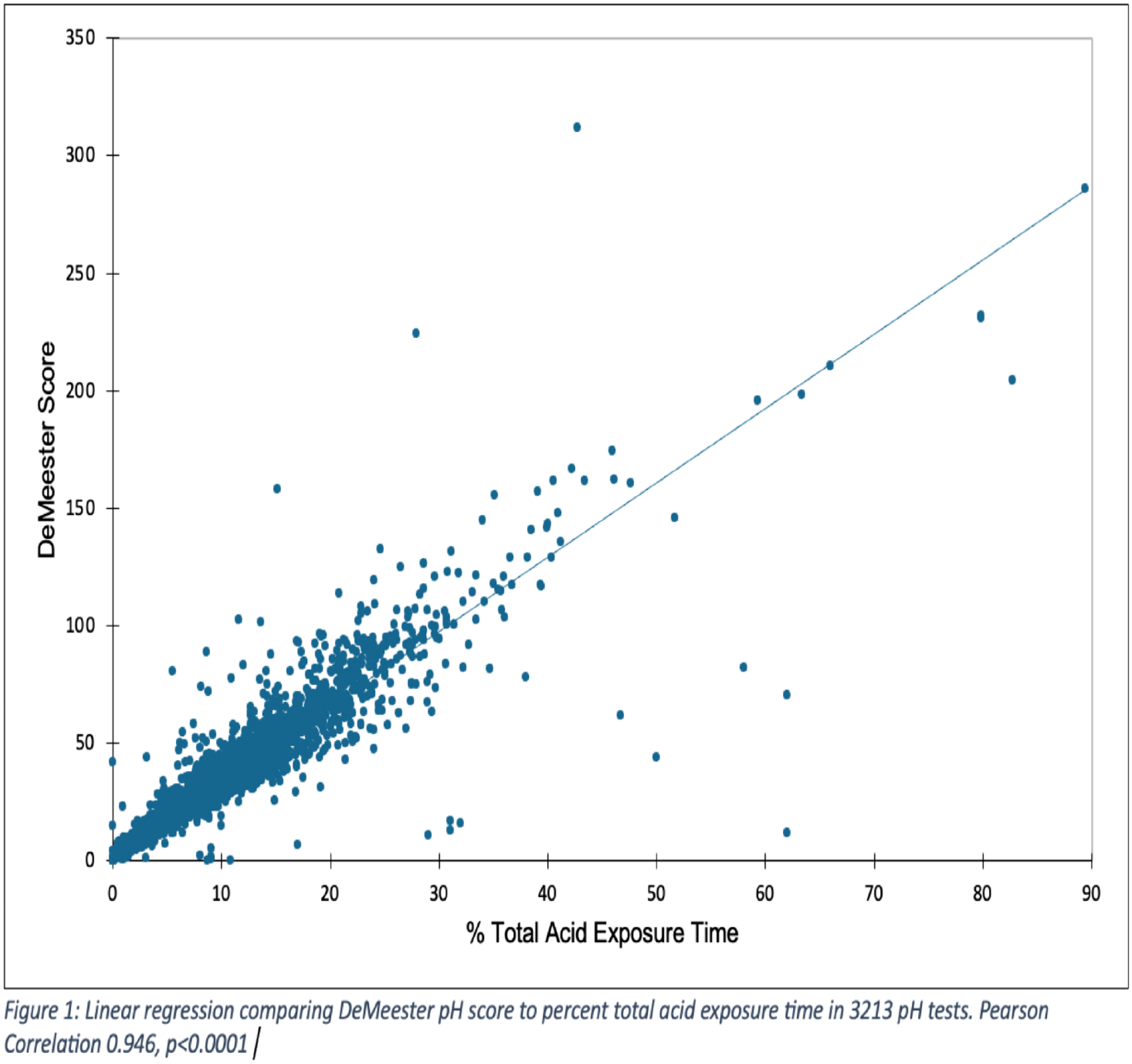
Our single-site database provided 3213 pH studies done off acid-suppressive medications reporting total, upright, and supine AET and DeMs.
Linear regression comparing all values demonstrated a strong correlation (Pearson r of .930) between DeMs and % (Figure 1).
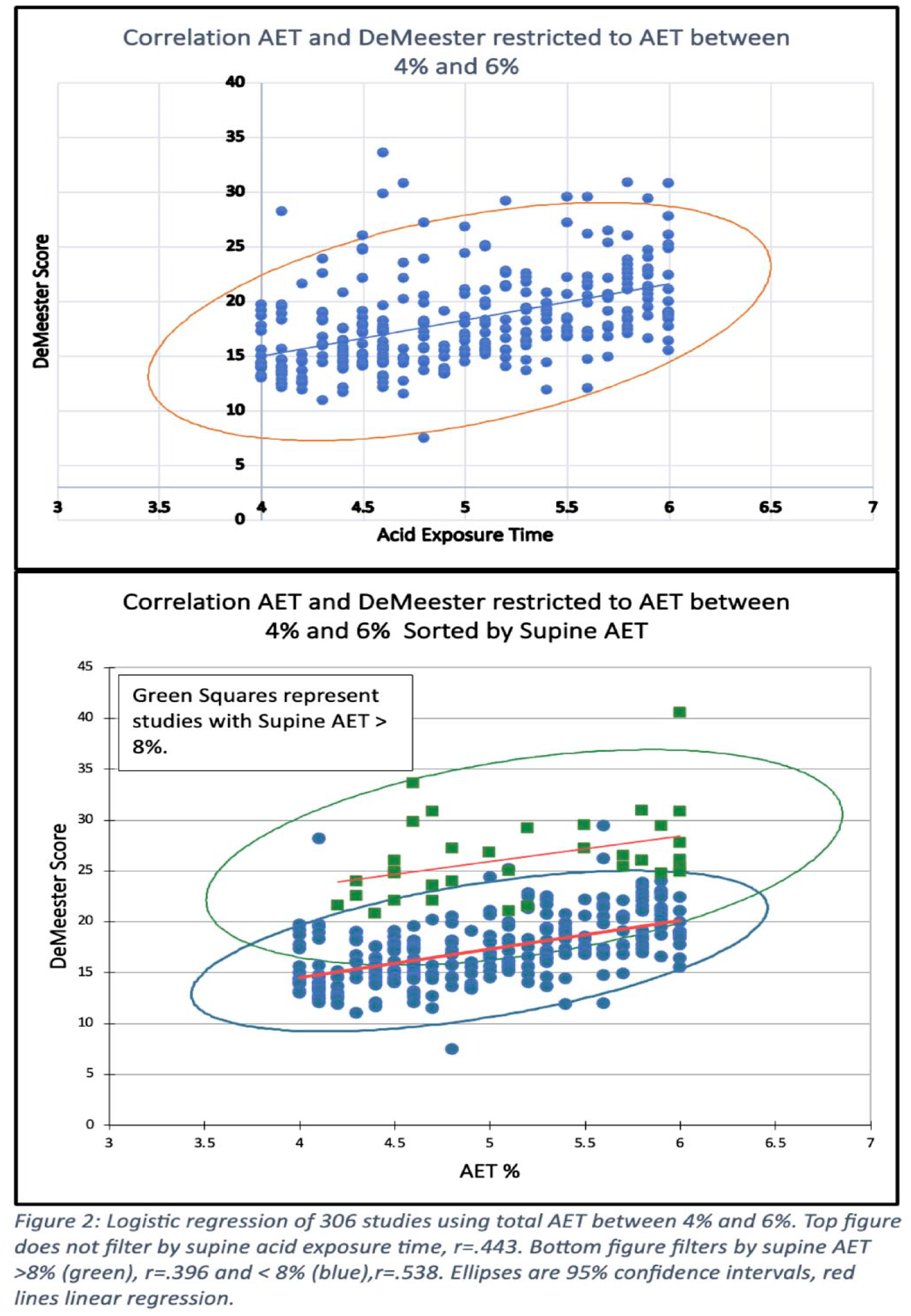
Analysis for AET between 4% and 6% initially correlated with a DeMeester was 9.4 to 27 (95% CI). However DeMs weighs supine AET more than upright AET and supine AET >8% found 2 fairly distinct subsets. When supine AET ≤8%, indeterminate AET 4% to 6% correlated to a DeMs was 10.8 to 23.4 (95% CI) (Figure 2). Flipped around, for a DeMeester ≥14.72, 2% (41/2052) of studies using total AET would be falsely normal (ie, AET <4%) and 6.8% indeterminate. Using DeMeester <14.72 as normal then, by AET, 2.3% would be indeterminate (4-6) and none would be abnormal (>6%).
Biologic systems are rarely dichotomous. The Lyons Consensus proposed an indeterminate range of AET (as well as # days abnormal) to account for the continuum of esophageal reflux. Based on that range, we propose the following regarding the DeMeester Score:
As no DeMeester scores below 14.72 were normal by AET (>6%), a DeMeester of <14.72 should be considered normal in 97.7% and indeterminate in 2.3%. The indeterminate range for the DeMeester score should be from 14.72 to 23.4 (95% confidence interval). Current use of total AET overlooks the discordant “normal” values for supine and upright reflux. Therefore an indeterminate AET score may be superseded and the study considered abnormal with DeMeester score of >23.4.