







Abstract
The information contained in light from our surroundings is often taken for granted because of its ubiquity, and the subliminal nature of the way we normally use it. Revealing the richness and depth of our common human experience through the unexpected qualities of light is seen as an artistic opportunity. An architectural training enables the integration of a subjective and qualitative experience, with the ‘objective’ structures that we are surrounded by. The built space can act as a ‘neutral’ reference onto which the complexity of daylight is superimposed. The author, trained as an architect, has been involved for more than 30 years in the design and construction of non-gallery artworks that engage the experience of natural light in public and semi-public spaces. This practitioner reflection discusses the relation of the position of the observer and sources of light, and how the movement of the viewer acts as a catalyst for revealing their situation through six works of various scales that the author worked on in New York; Boston; Abu Dhabi; London; and Berlin.
Introduction
If the doors of perception were cleansed every thing would appear to man as it is, Infinite. For man has closed himself up, till he sees all things thro’ narrow chinks of his cavern. (Blake, 1790–1793).
To avoid being overwhelmed by William Blake’s ‘Infinite’ of sensory input, the process of guiding our physical progress through space requires that we learn from infancy to constantly filter and edit received data at a subconscious level, so that we can predict efficiently what will happen next in each instant, and act on these micro-predictions. Therefore, most of the time, efficiency favours predictability to avoid a potentially unmanageable cacophony of input and we therefore ‘see all things thro’ narrow chinks’.
But as a complement to this essential editing, at times we also crave subtlety, complexity and change, perhaps for no other reason than to ensure we are not missing something important, and we experience this as a deeply satisfying moment of opening to a richer experience of our immediate environment. The American artist Robert Irwin thought of this opening up of the sense of sight as ‘forgetting the name of the thing one sees’ (Weschler, 1982: title).
This practitioner reflection discusses the relation of the position of the observer and sources of light, and how the movement of the viewer acts as a catalyst for revealing their situation. There is a conscious attempt in most of these works to avoid explicit constructed meaning, and to connect the senses directly to ambient information in the form of contextual light as far as possible, (though unintended associations may emerge from, or attach to, the work). The construction of ‘sensitive surfaces’ in various forms that re-present daylight is common to all the projects. This is most overt in the Chapel, the Dichroic Light Field and Folded Light, where the form-making is derived almost entirely from the way light is moved within the piece. Sana Al-Nour is similarly derived from the reflection of light from above to below, but this was altered a little in the process of the piece becoming integral to the air-handling systems during the 10-year design and construction process. The Light Portal uses car headlights as a kind of substitute for the variability of the ‘natural world’, so presents a unique case within the group of projects. The Lichthof is another unique project, in which attention is drawn to the double meaning of the word ‘transparency’, and how it can be confused with ideas of openness and honesty.
To make manifest the sometimes subliminal experience of the changes of daylight over time, in as direct and unmediated way as possible, outside the typical gallery space is a challenging task, especially in a public realm which tends towards endless distraction of a more practical kind: signage; shop windows; etc. the very things one is trying to see ‘past’. Expectations of public artworks as representational of (usually conventional historical) narratives, makes a more abstract ambition still more challenging. Integrating work into building and infrastructure projects has enabled control of the context somewhat, so this work has come to occupy a liminal territory between what are currently seen as the separate worlds of art and architecture; not as an addition to an architectural space but as an integral part of it.
All design studios have different methods, reflective of the personalities and specific skills of the primary members, which can be difficult to explain to those who work outside this collective creative process. The work is often a collaborative process of exploration by a relatively small group of people, building on earlier thoughts and ideas from a variety of sources, and in that setting even passing observations or comments, can be highly significant to the development of a concept into a finished work. Therefore, the origin of designs from a studio can be impossible to attribute perfectly precisely. The work shown was all done in this context but, given this caveat, the author was the primary designer in all cases shown, and in the later projects was also the studio principal, so the word ‘we’ in the text refers to the design team and the collective effort, and the words ‘I’ and ‘me’ refer to the author who generated the original concepts which guided the team’s efforts.
Architecture and daylight
Architecture is a strange ‘art’, in that it hovers between delight and efficiency; between crafting the subjective human experience, and optimising instructions to form built enclosure; between the individual and the collective. The disciplines and rigours of communication, fabrication and construction require simplification and abstraction in instructions (the familiar plan and section drawings at the very least), structural logic, and economic use of resources, which tends towards simplification of form and reduction of the decorative impulse and the mark of the hand to a minimum.
Despite periodic attempts, architecture rarely achieves anything remotely like the subtlety and complexity of the natural world, which is incremental in its processes and patterns, and infinitely more complex, varied in scale and subtle than building. The density of ‘information’ in the natural world is vastly greater and more variable than that contained in the architecture of cities. I have taken the position that the very abstraction and geometric orderliness of any given architectural context can be used as a foil to the subtlety and variation in daylight. Architecture becomes the ‘blank canvas’ which can be made to reveal the complexity of natural light.
Dichroic Light Field, New York City, completed 1995 (Figure 1): The information in the sky is mediated by a textured and semi-reflective glass plane and the simple device of a grid of fins of coated glass projecting at right-angles. The surface is 8 m above street level at its lowest and therefore always reflecting the sky or surrounding building silhouettes as seen from the street. The dichroic coating on the fins splits the daylight into two components: ‘white’ light is divided into yellow and indigo; and the angle of the fin to the wall juxtaposes the light from behind the viewer (mediated by both the fin and background surface), with the light from in front of the viewer (simply reflected off the background surface). The colour of the light affected by the fin changes as the viewer’s angle relative to the surface changes, and depends on the quality and intensity of the light in the sky. The reflected colour is generally seen from the south and the transmitted colour from the north. There is no artificial light other than ambient urban light. So, the contrast that is contained within the skydome is presented as a field of colour which changes as the viewer walks past, and over the seasons and interacts with shadows and incidental reflections from the surrounding towers. The intent is that the viewer would have their experience of the daylight deepened as they interact with the piece repeatedly over time and from different viewpoints. It does not have a single, ideal viewing angle, but acts as a sensitive surface, to gently tug the viewer out of habitual assumptions about the surroundings.
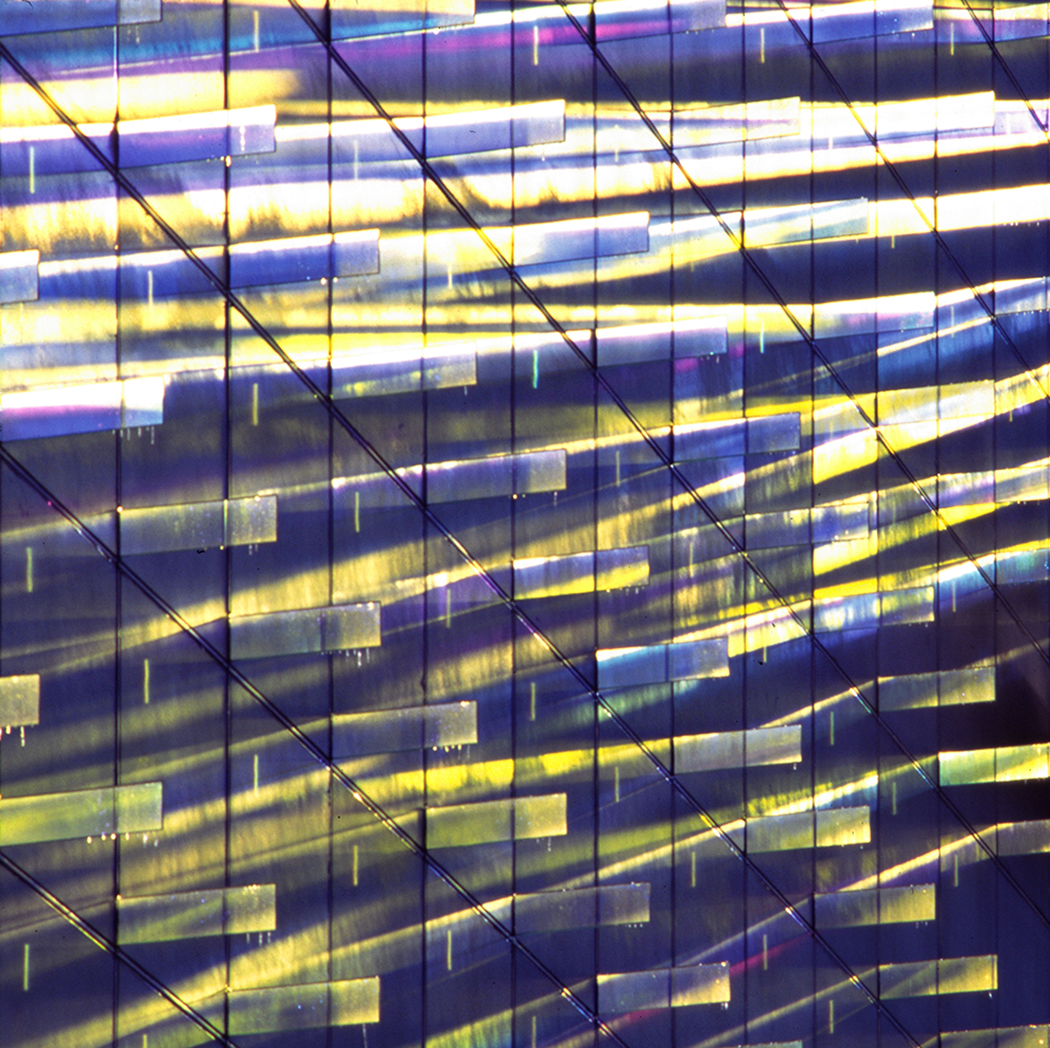
Dichroic Light Field (1995) (photo: ©David Sundberg, courtesy of JCDA): A view from the south during the moment that reflected gold light and transmitted indigo light overlap, in winter at around noon.
Salvation Army Chapel, London, completed 2004 (Figure 2): The sky overhead is re-presented on the outer wall of a small private chapel, which also serves to mark the entrance to the building, over which it is suspended. The moving clouds and changing light illuminate and inform the interior, connecting the users in their inner world to the larger context of the sky over London. Translucent semi-reflective tilted louvres are set at slightly different angles to present a continuous image to a viewer at the threshold of the space. The image of the moving sky can be read as a real-time high-definition backlit projection. The glowing translucent amber/gold of the walls was selected initially to contrast with the blueish light of day and further lift the view of the sky and clouds out of its familiar context. When we presented the project the client almost immediately saw the view of the sky as representing the ideal that the ‘Army’ was ‘on the march’ and meeting under the sky; and saw the fiery walls as representative of the passion of their convictions. The placement of the sky where traditionally there might be an image of Christ in a chapel, places the natural world at the centre of the contemplative experience. This was an important motive for me in the work and was happily accepted by the client.
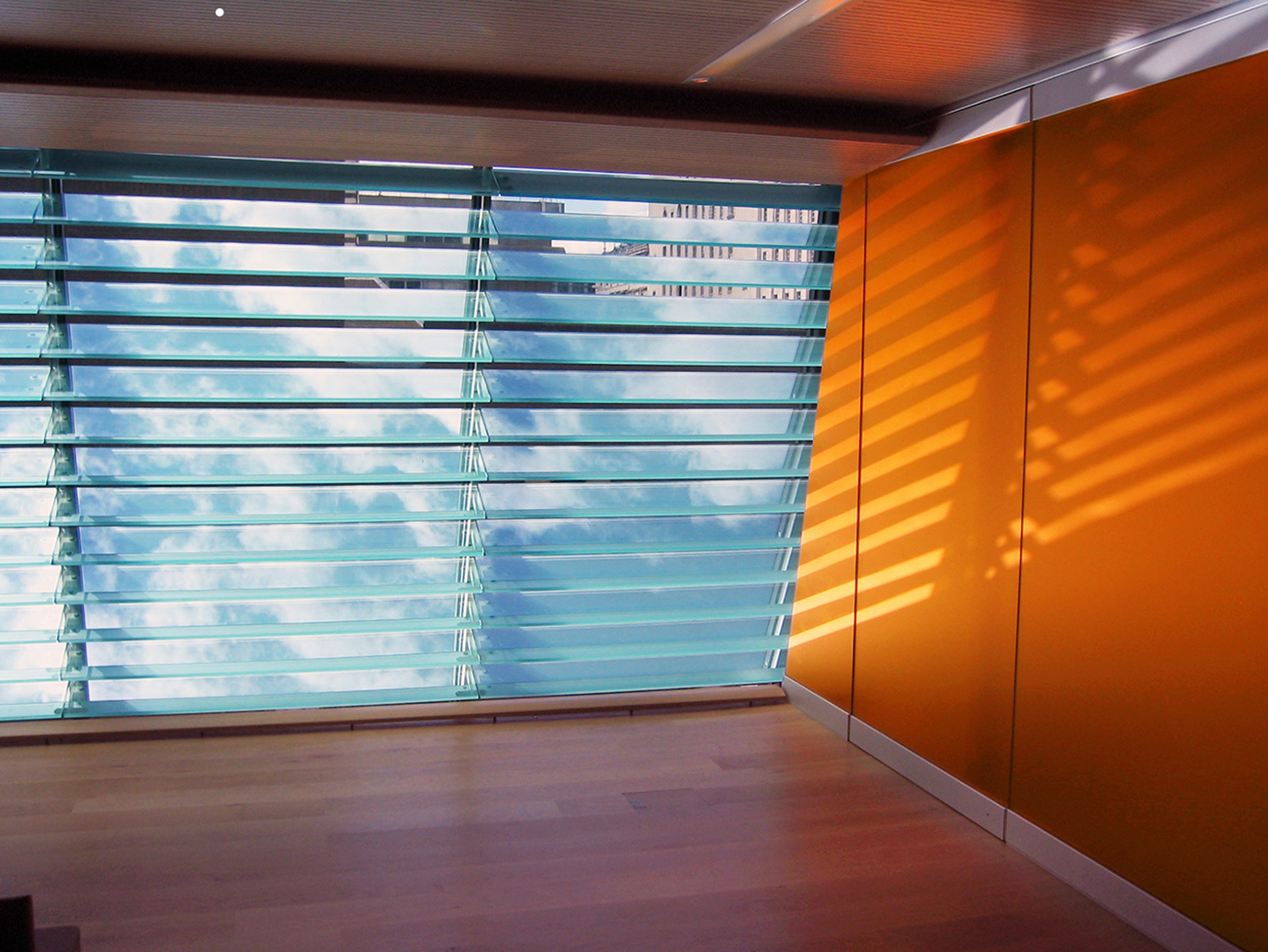
Salvation Army Chapel (2004) (photo: ©Luke Lowings): Clouds presented on the tilted translucent and semi-reflective fins. Sunlight is also projected onto the gold internal surface of the walls.
At night the space is illuminated with ceiling strips and the chapel as a whole is lit from light sources in the void between the gold walls and the translucent glass outer walls. The sky in London at night is never totally dark because of light from the streets reflected off the clouds, so in this piece the light of the city performs the role of daylight: changing with the cloud density and the activity of the city.
Artificial light
The sun, as a light source, is outside our constructed world, and is a potent symbol of energy, power and mystery. The sun appears to move constantly, in long cycles of day and night, summer and winter. These cycles are part of our evolution, our daily sleep and weather patterns, holidays, harvests and cultural references: all are fixed around solstices and seasons, everywhere in the world. This gives sunlight and its absence a privileged position relative to the relative newcomer of electric light, which is still developing its own language. I believe that the complexity and contrast within the natural rhythms of daylight resonate more deeply with the viewer, than a constructed ‘theatrical’ narrative.
In addition, daylight is from a single source and has parallel rays, whereas artificial light sources are multiple and from sources that are relatively close to the illuminated surface, so making replication of daylight in colour, angle, intensity and variation, difficult to achieve using artificial light. Public artworks are frequently experienced after dark, or indoors, and therefore artificial lighting is an essential component of the work but it is not prioritised over the daylight in these projects. We have addressed the challenge in a number of ways.
Light Portal, Boston, completed 2006 (Figure 3): In this project artificial lighting is provided by one of the ‘observers’ of the artwork which also becomes one of the participants: at night, car headlights and, at any time, flash photography illuminate the work through retroreflection within micro-prisms in plastic film – a common material of road signs which we have here re-purposed.
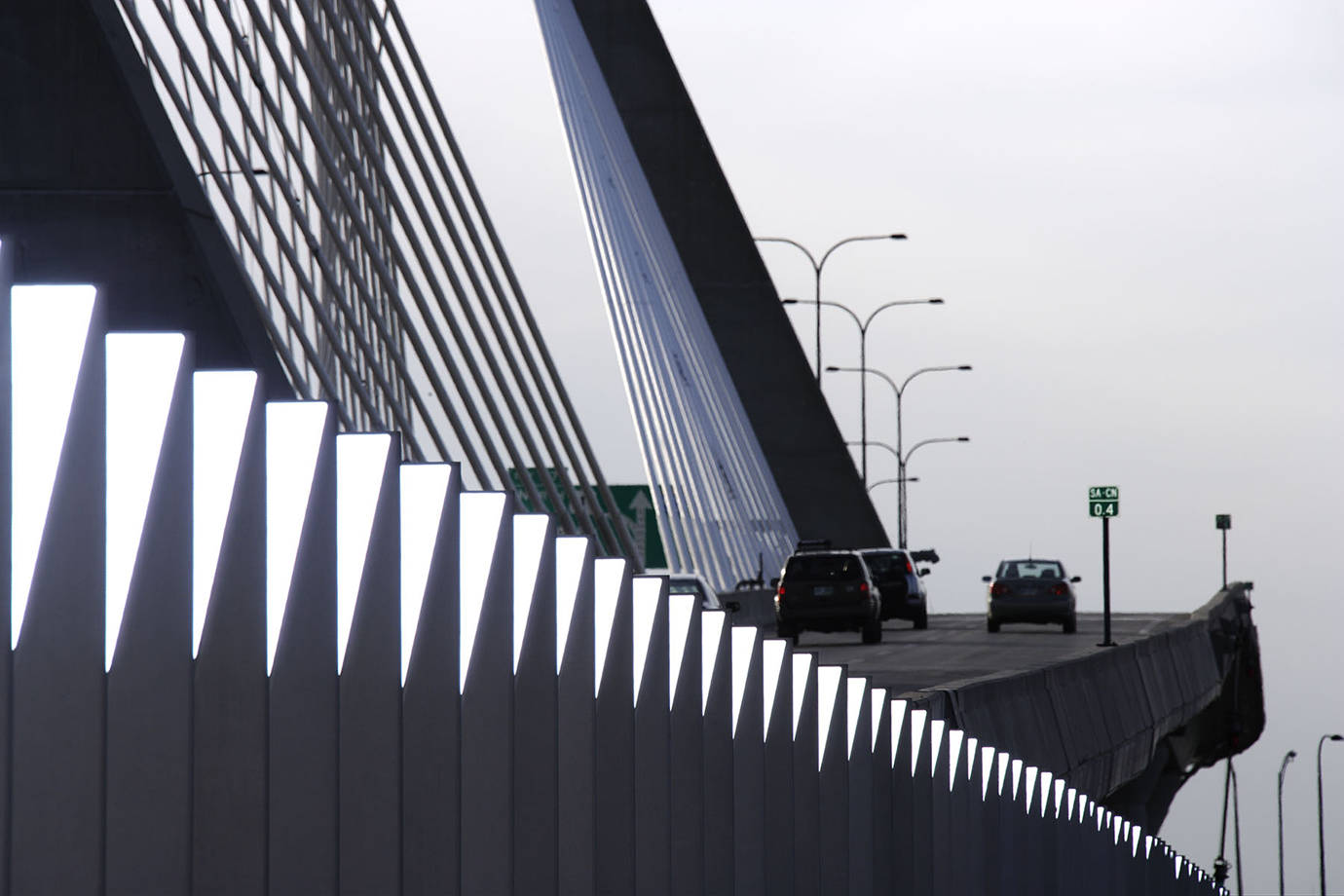
Light Portal (2006) (photo: ©Andreas Keller, courtesy of JCDA): A view of one side of the Light Portal illuminated at dusk with flash photography, with the road rising from the tunnel to the bridge.
A notional horizontal plane between a huge interstate road-bridge and the tunnel into which the road descends forms a rectangle: the ‘Portal’. This rectangle manifests as a concrete acoustic and flood barrier which separates the pedestrians navigating the public spaces around the tunnel mouth and under the bridge from the road. The fins on top of the wall are visible to both cars and pedestrians, connecting both experiences of the Portal. They present a near-solid visual barrier to car drivers (approaching obliquely), but a more permeable view to pedestrians. The fins are effectively self-illuminating at night, particularly from the cars’ perspective – the light of the headlights is bounced back to its source and the whole portal lights up as one drives into the tunnel. The retro-reflectivity of the fins uses ambient day and artificial light from street lights around the bridge undercroft to make the fins more apparent to pedestrians, providing a continuous horizontal datum as a reference of height and scale.
Folded Light, London, completed 2016 (Figure 4): The light of the sky entering a narrow 10-storey lightwell from above is organised to dramatically contrast with the shadow of the lower levels, by the simple means of a folded surface of polished and textured stainless-steel sheet. So, the characteristics of the light striking any particular spot on the surface are divided along the fold-lines of the steel. The folds get progressively smaller, and therefore steeper, towards the bottom of the lightwell, apparently compressing under the implied weight of the surface above. A central vertical blade of dichroic-coated glass combines the information arriving horizontally from the surroundings with that on the vertical axis (see Figure 4). Artificial lighting in the daylight range from below reverses the daytime situation at night, and a potential second ‘event’, with programmable coloured lighting is also available.
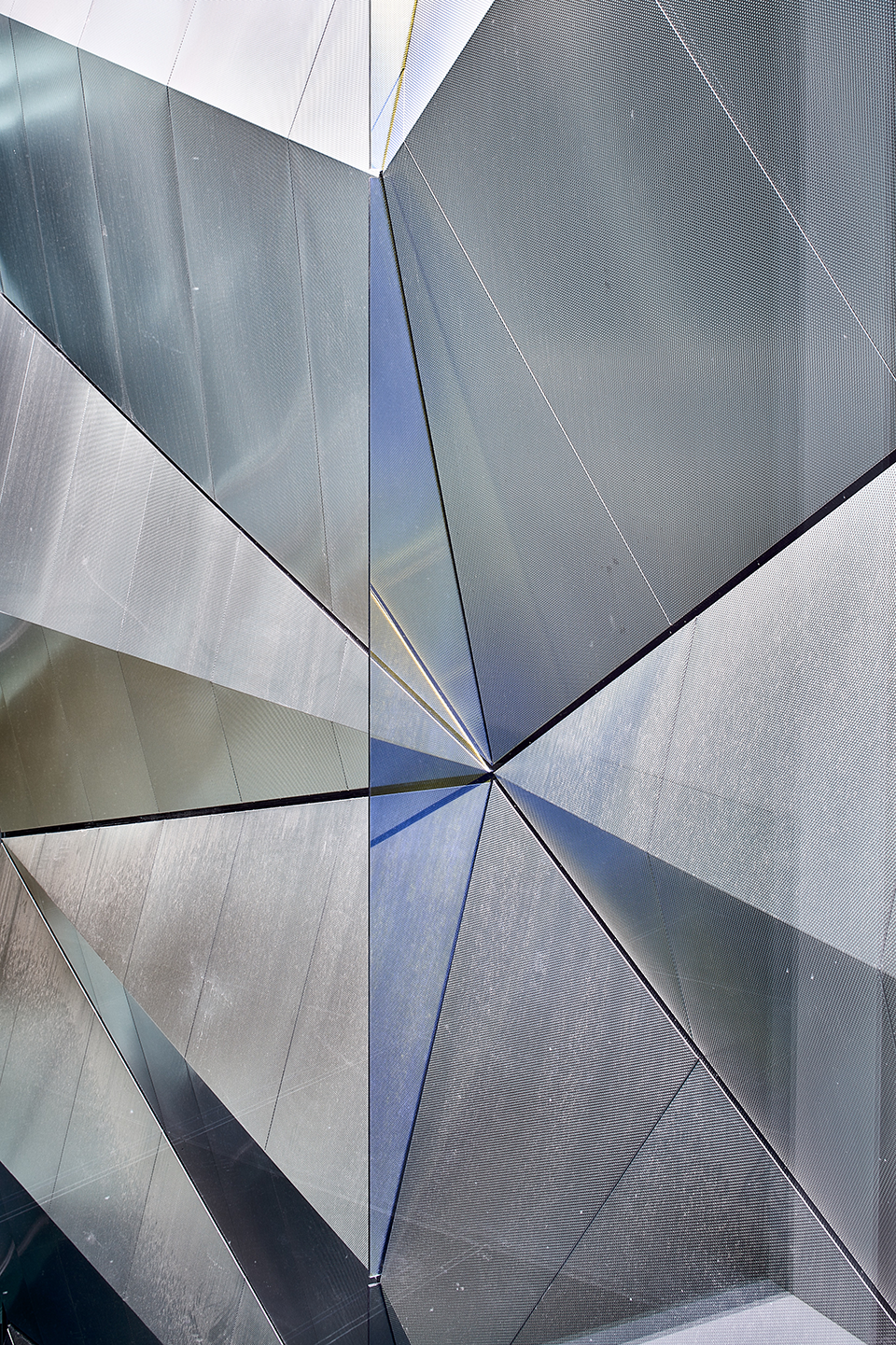
Folded Light (2016) (photo: ©Tim Soar, courtesy of CL): A partial view of the folded surface bisected by a vertical fin of coated glass. The folds contrast the daylight above with the shadow below to dramatise the changes in light conditions across the surface.
Sana Al-Nour, Abu Dhabi, completed 2019 (building in process) (Figure 5): This building-integrated sculptural form is seen from the upper daylit departures level and the lower artificially lit arrivals level. It describes the partial surface of a torus (a curve revolved around a vertical axis) to reflect a glimpse of daylight from the upper level into the lower, via the pearly reflective outer surface. The interior surface is predominantly a turquoise blue in reference to the water of the Arabian Gulf. The lower ring covers a 30-metre diameter area of the arrivals level. Each leaf-shaped glass panel is curved to further evoke the water and caustic reflections. Neither arrival nor departure levels completely reveal the form, so both are required to see the piece fully.
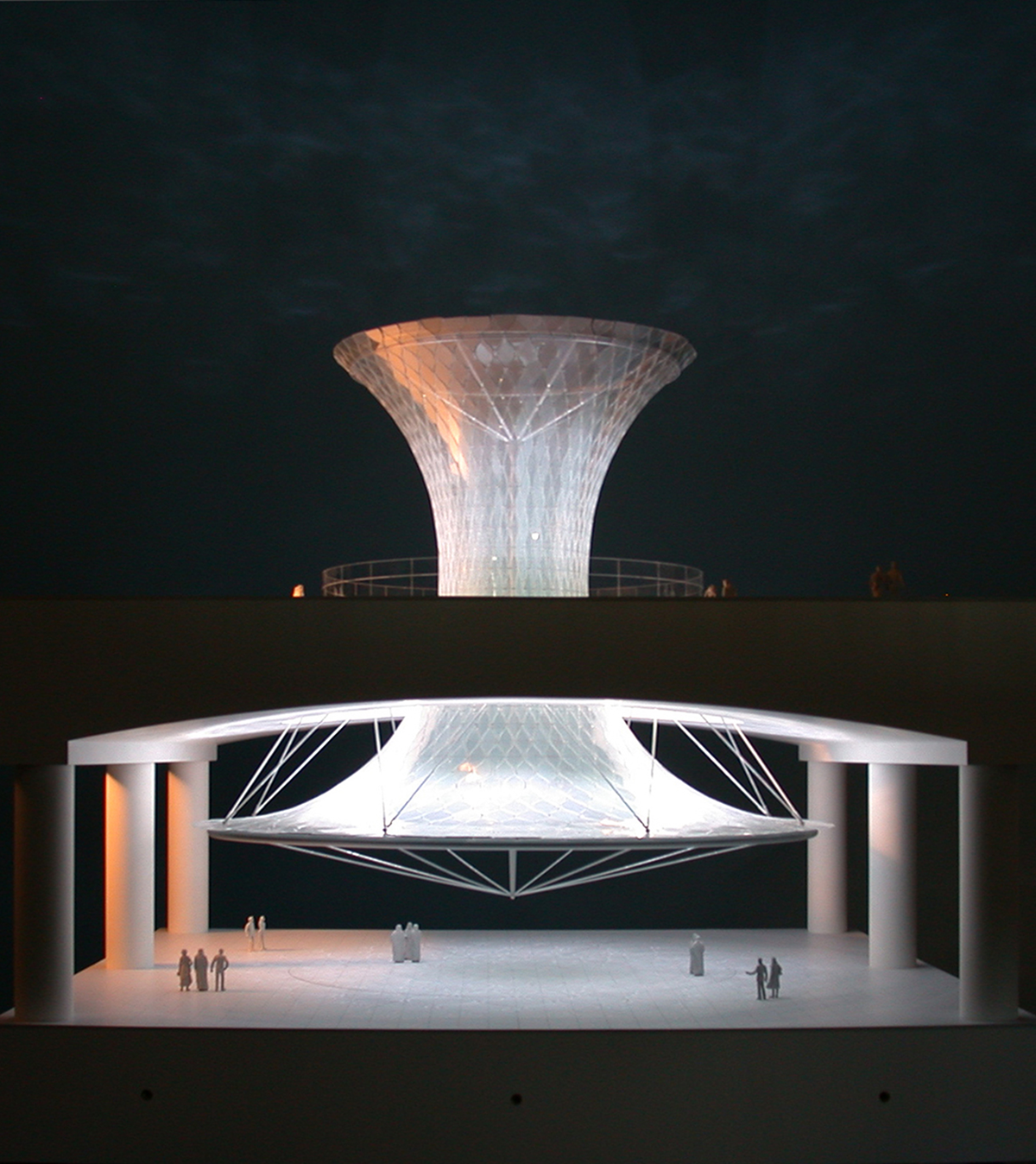
Sana Al-Nour (2019): Photo of 1:50 scale model (photo: ©Alice Colverd, courtesy CL). This view is not possible in reality: the piece is visible either from the upper arrivals level or from underneath and both arrival and departure must be completed to see the whole piece.
It is artificially lit from the ring of the floor within which the piece is suspended, 96 fittings each with multiple LED sources shining up and down. Light is reflected off the outer surface of the form – the condition that prevails during the day – but in this case both up and down. The object becomes a huge lantern in the space, as the sources combine to a single even ring of light which is visible in the model photograph. The lighting here is again programmable for overt communication (e.g. national colours for special days) at the insistence of the client.
The form changed somewhat during the design process to absorb input from simulations of air-movement, as the sculpture came to be integrated into the air-handling system of the building: an air deflector as well as a light deflector.
Lichthof, Foreign Ministry, Berlin, completed 1999 (Figure 6): The paradoxical nature of glass is here manifest within a building that deals with the concept of national boundaries. The proposition that a glass wall can be a metaphor for clarity and honesty is at least as old as modernism and perhaps well-meaning, but it can be deceptive: everyone can see in, but entry is carefully controlled.
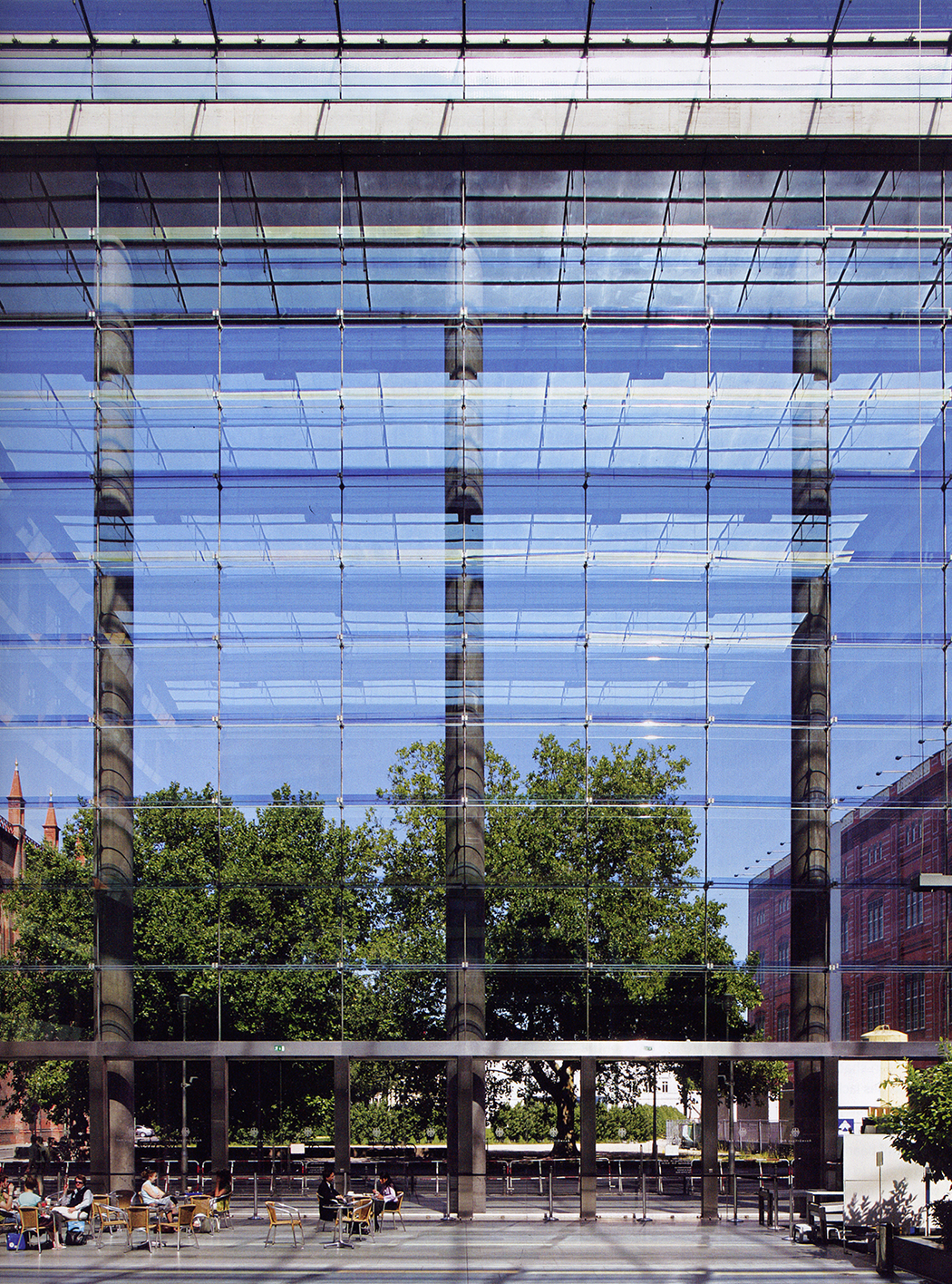
Lichthof (1999) (photo: ©Andreas Keller, courtesy JCDA). The view from inside the ‘public’ space, with the view of the roof of the courtyard reflected in the slightly enhanced reflective wall.
In this project a façade for a semi-public courtyard in the new German Foreign Ministry was designed to use the surrounding building to minimise support structure. Strips of dichroic glass were added, held away from the main glass wall to add a shimmer of spectral colour, and a colourless coating was added to the central rectangle of glass to enhance its reflectivity, leaving a border of uncoated glass panels. I hoped that this enhancement of the boundary plane, while still allowing light to interact between the surfaces, would speak of the physical (and political) fact that visual transparency is not the same as access. The lowest glass panels take the paradox to an extreme: they are as transparent as glass can ever be, but thick and resistant enough to resist impact from a vehicle.
Final thoughts
I seek to reveal the depth of lived experience by stepping away from, or manipulation of, representation. As these projects show, neutrality is not an option however, and even the simple act of re-presentation of natural light involves construction of a ‘stage’ on which to present it, or a framing device (the gold box of the chapel for example). In each project an attempt is made to move beyond preconceptions about what one is likely to see and feel. I try to understand that scale is a difficult thing to grasp, even in reality; and to strike a balance in the relationships of structure, glass, and light, between opacity, transparency and translucency; focus and blurring; glare and shade.
These projects often use glass because it can manifest the mutability of light without lapsing into a binary light/dark dichotomy. Glass has a beguiling, abstract quality which, coupled with its durability gives an aura of universality. Stained glass served as a medium for religious art in the cathedrals of the Middle Ages, and float glass as a façade for International Modernism in the 1950s and 1960s, and Globalisation in more recent times. As I have mentioned in the text, it can appear to be present and not present, but I try to be conscious at all times of its materiality, to maintain a clear functional (even if poetic) role within the architectural and social context, without glib effects.
Light is ultimately whatever information it brings, at any specific moment, to the eye, and that depends on what is in its way, what we let it fall through, onto, or into, and when. It reveals information from what it is reflected by, refracted in, passes through, as well as about its source. In as much as one never steps into the same river twice, we also never bathe in the same light twice, because it keeps changing. The familiarity of the light in a space at the same time each year, reveals to us the rhythms of our own lives and the length of our personal journey.
Footnotes
Acknowledgements
The Dichroic Light Field, Light Portal, and Lichthof were designed in the context of James Carpenter Design Associates (JCDA) in New York, with Luke Lowings as the primary designer, and James Carpenter as principal, initiated between 1990 and 2001. The Salvation Army Chapel, Folded Light and Sana Al-Nour were designed in the context of Carpenter | Lowings (C | L) in London, with Luke Lowings as the main designer and principal, between 2001 and 2019. James Carpenter is the driving force behind JCDA and ‘staked out the [design] territory’ within which the studio operates and from which C | L grew. Many other team members, especially Richard Kress and Marek Walczak at JCDA; Iljana Eggert and Valerie Spalding at Carpenter | Lowings, performed important roles in the work shown.
Declaration of conflicting interests
The author(s) declared no potential conflicts of interest with respect to the research, authorship, and/or publication of this article.
Funding
The author(s) received no financial support for the research, authorship, and/or publication of this article.