







Abstract
Apart from the history of the Chinese sea goddess Mazu, there are other religious themes that have also been derived from the maritime world that require more of our academic attention. This paper provides a historical overview of a sea-related theological conceptualisation that originated in the Bohai Sea: the maritime and transcultural history of Mount Penglai, a legendary immortal island of Chinese mythology. The history of Penglai is normally treated within a mere Daoist context and is not explored in its theological and philosophical implications in relation to the sea. I will suggest, by contrast, that the history of Penglai offers a unique perspective on Chinese maritime religiosity as it was conceptualised, practiced and imagined by various types of agents and individuals. In its own right, Mount Penglai represents a kind of maritime religiosity that was emanated from various approaches to it being constructed as a mythological space over the longue durée.
Prologue
Most of us have heard of the story of Mazu, one of the most celebrated sea deities in China, especially when it comes to her connection with Fujian, Guangdong, Taiwan and its coastal community. 1 There is no question that the worship of Mazu and her unitary symbolic character is of remarkable importance, but there are other religious themes, also derived from the China’s blue domain, that require our attention. This paper will focus on a sea-related theological conceptualization that originated in the Bohai Sea: the maritime and transcultural history of Mount Penglai, a legendary immortal island of Chinese mythology. The history of Penglai is normally treated within a mere Daoist context and has not been explored in its theological and philosophical implications in relation to the maritime world. I will suggest that the history of Penglai can also offer a unique perspective on Chinese maritime religiosity as it was conceptualised, practiced and imagined by various types of agents and individuals. Most of these people are from the maritime northeast and include emperors, scholar-officials, fishermen, coastal dwellers, intellectuals, travellers, ritual specialists, painters as well as consumers in the marketplace. In its own right, Mount Penglai functions as a semiotic feature, which is represented by a kind of maritime religiosity that is compelled by the conceptualization, canonization, transformation and circulations of ideas, thoughts and narratives.
The study of Mazu has generated a literature so vast it is difficult to summarise. Apart from this well-known sea goodness, however, it is probably not an exaggeration to argue that studies of Chinese religion have attempted to turn their attention away from the sea. Much has been written on cults and symbolism in relation to mountains, rivers, lakes and forests. 2 From time to time, we come across stories and papers that touch on sea dragons, as well as their paradisical underwater palaces (longgong). 3 Yet, most of our knowledge and understanding of Chinese religion, especially during the early modern era, is essentially continental-oriented and land-based. But such a tendency should not come as a surprise. China has long been regarded as an agrarian state and a land power. Understandably, its cultural and religious landscapes have been tightly bound to a continental identity. While it is not a false claim to argue that Chinese religion has a close bond with the country’s continentality, maritime scholars have reminded us that we should not take for granted that the history of China is all about agriculture and Confucianism. 4 The maritime-ness of late imperial China could be exposed from a variety of angles, ranging from its coastal governance and seaborn shipping to its offshore voyages and religious activities. Like many other non-landlocked countries, the “coastal, island and waterborne communities” of China “certainly adapted their activities and cultures to the patterns of the ocean”. 5 In other words, it is time to reconstruct her maritime identity as it has been equally diverse, variegated and substantial since the early modern era, if not from earlier times.
In this paper, I consider a framework of maritime religiosity as an appropriate perspective from which to approach China’s maritime-ness. I do this for two principal reasons. First, the subject itself has not yet been thoroughly examined in the field of Chinese imperial history over the longue durée. Compared to its ‘continental religiosity’, if such a term ever existed, we know relatively little about what happened to China’s opposite domain, except for the worshipping of several prominent deities from Southeast China such as Mazu and the king of the Southern Sea. Second, the study of religion, as a discipline, reaches across borders between history, anthropology, theology, cultural geography and literary studies and, above all, religion also matters in maritime studies, in which a fundamental concept is that of a maritime religiosity. A key to my understanding of religion and the maritime world – writing as a maritime historian – is the idea that religion is a particular kind of mental and material experience that is accessible through a range of psychological, conceptual and cultural behaviours recorded in historical sources. Religion is about the interrelations between familiarities and un-familiarities; land and sea; life and death; as well as certitude and imagination. It, therefore, demands a methodology that reaches beyond the narrow boundaries of political or economic histories. Hence, the opening up to other disciplines, such as the study of religion as what it could offer is exceptionally crucial. Furthermore, maritime religiosity resists arbitrary boundaries. While it could be bounded physically in a temple or on the deck of a vessel, where some sorts of religious ceremonies or rituals may take place, it can also be notional. For the first emperor of China, for instance, Mount Penglai and its religious connotation is a cultural concept featured in the Bohai Sea and it represents all sorts of mysterious supremacies, namely, immortality (changsheng) and perpetuality (bulao).
Maritime Religiosity
We are still waiting for a thorough and comprehensive account that theorises the concept of maritime religiosity in imperial China. Historians learn to privilege land over water and inland over coastal people. In the Eastern world, we are accustomed to imagining human history as beginning and ending on terra firma. Our understanding of our origins, both religious and scientific, are decidedly terrestrially. Traditionally, the blue domain has not been connected with our histories, religions and geographies. Yet fortunately, a band of maritime historians, anthropologists and underwater archaeologists have long challenged assumptions based only on terrestrial discourses and begun to demonstrate the extent to which China’s domain has also been aquatic, or semiaquatic, in various aspects of its culture including its religiosity. 6 Sustained by religious as well as secular traditions along the coast of China, we have benefited from all these representative research and are able to suggest that China’s terra-centricity is no longer everything in the history of this oriental culture. However, we still a need a more systematic and analytical framework with which to bring these fascinating studies together. This paper attempts to provide a theoretical overview of the idea of maritime religiosity in order to situate our Penglai discussion alongside other religious stories within a more structured and layered context.
Since there is no substantial study that features the connections between the sea and religion in imperial China, it might be best to derive some theoretical insights from studies that examine other maritime spaces. 7 In this case, we can draw meaningful parallels between the Bohai Sea and other maritime domains that have also been perceived as religious seascapes. Alain Corbin’s classic The Lure of the Sea: Discovery of the Seaside in the Western World 1750-1840, published in 1994, serves as an appropriate starting point. Corbin demonstrates that our natural world, including the sea, forests, and other facets of our so-called natural geography, are very much human constructs. 8 As such, it would not be an exaggeration to argue that environmental history is also cultural history. Following this line of thought, the primary concern of the history of the sea, or our sea, is the interaction between human needs and desires and the geographical world. In his book and some of his other writings, Corbin set up his discussions against a geographical area where land and water meet – the seashore – and sought to treat its interactions with humanity. While he wrote about “the desire for the shore that swelled and spread” among the majority of Europeans since ancient time, Corbin also elaborated on some individuals’ personal feelings of desire for the shore, a desire tinged by deep-rooted social anxieties. 9 By focussing on personal accounts, he hoped to determine why seashores are laden with meanings that simultaneously attract, relax and unsettle. These approaches are worth mentioning because the Penglai story is also about a wide-spread perception among Chinese, Korean, Japanese and other Asian communities, on the one hand, but it can also be conceived as personal cognition, on the other hand. In other words, the history centring on Penglai itself has been woven by both collective and individualistic experiences since the ancient period. This history has always been dialectical, always mixed with various acuities.
In The Lure of the Sea, Corbin saw the sea as an unstable zone of contacts between individuals’ imaginations and their social practices; to him, it is also a system of appreciation in which desire and place can become attuned to each other. Corbin traced the origins of two distinct philosophical trajectories regarding the sea to the Enlightenment in England, France and, to a lesser extent, Germany. He noted that prior to this era the sea was primarily a source of anxiety and that a classical epistemology shaped a “configuration of feelings” in which the sea was represented as a fearsome and abhorrent wilderness. Similar to a great abyss, there was no proper order on the sea; it was ungodly, chaotic and irregular. 10 Beginning during the Middle Ages, the sea was also considered a remnant of the Great Flood as recounted in the Book of the Genesis, the seashores were thereby envisioned as a rough interspace between “order and civilisation” represented by land and “demonic and chaos” by the sea. Carrying a symbol of frenzy, repulsiveness and disorder, the sea was seen as a mysterious space full of sea monsters and demonic creatures. This conception of the ocean continued until the Reformation. Even then, the sea remained conceptualised as a precarious pavilion and in most writings, it was commonly portrayed as a metaphor for the fragile and the perilous. It was not until the 17th century that philosophers in France began to conceive of the sea and the coast from a relatively different perspective. It became a remarkable place where one could directly experience the divine wonders of the natural world. This significant turn in revaluating the sea was made possible by the development of a new natural theology at the time. Theologians who practiced in churches, such as the St Gregory of Nyssa and St Ambrose of Milan, interpreted the Flood as a kind of necessary disaster that helped wash away the sins of humanity and rejuvenated the community of the faithful. The ocean was part of a holy nature created by the God, a perfect manifestation of the Creator’s infinite kindness: Its marine resources, such as sea salt, were considered essential nutrition; the shoreline was a barrier that protected human settlements from potential dangers. 11 The various marine species were no longer defined as monstrous or demonic but a promising sign of the magnificence of Creation.
At the turn of the 18th century, the sea was once again reframed from a sacred segment of nature to a restful destination for elites, especially in the Netherlands and Italy, in search for a harmonious shelter where they could clear their minds and recover from physical and mental illnesses. As Corbin saw it, these new practices and understandings of the sea were formulated as a result of another wave of discussions concerning new religious and intellectual ideas. To a substantial extent, these discourses are still ongoing. Although the sea is no longer perceived as a mythical uncertainty, it continues to carry some spiritual and therapeutic energy within itself, and these could have mental and emotional benefits. In a way, these benefits are also religious in nature. 12
Corbin established an effective theoretical framework that connects the sea and the human world through a European historical trajectory. His approach to decoding the mysteriousness and religiosity of the sea from a historical point of view is in many ways also applicable to the story of the Bohai Sea and Mount Penglai. According to the Chinese compilation of mythic geography and beasts entitled The Classic of Mountains and Seas (Shanhai jing), for instance, the Bohai Sea, as well as the watery space adjacent to China, has also been described as a mythical world full of unfamiliar, if not bizarre, marine creatures, such as the baize, or Hakutaku in Japanese. 13 One story concerning the existence of Mount Penglai is that this holy mountain was stabilised by three giant marine reptiles, called ao (similar to turtles), who lived beneath the island. These three ‘turtles’ were dispatched from Heaven and considered consecrated. They could survive without food for a very long time, and every 60,000 years they were replaced by three new turtles. Without these turtles, Mount Penglai would have become unsettled and the sea around would have become turbulent, stormy and tumultuous.
These fantasies are quite similar to the ancient picture of the sea detailed in Corbin’s study, but interestingly, there are also some asymmetries between the European and Chinese versions of these sea tales. For instance, the stability of Mount Penglai from religious narratives (that the mountain was supported by three turtles) could be seen as a distinct contrast to the repulsive and volatile image of the sea in European stories. As pointed out earlier, the lure of the sea was clouded in the horrifying symbolism surrounding it and this prevented the seaside from exercising its appeal in Europe before the Renaissance. 14 By contrast, as a representative totem symbolising the ocean, Mount Penglai was not seen as an unsettled mythical site from its early existence. Even though the Bohai Sea without the three turtles was supposed to be in turmoil, it was seen as being steadied and calmed by a divine power that ruled not only the sea but also the entire natural world. The Bohai Sea and Mount Penglai were built into natural landscapes and meteorological phenomena whose overall systems were seen as those of a stability and order that had been defined and formalised since the dawn of time. In other words, unlike the seashore portrayed in Corbin’s study, the Bohai and Penglai were not perceived as interspaces that demarcated order versus the demonic but a corridor that channelled both mortals and immortals.
In some other writings, the Penglai story is even portrayed as being more than a connector between the mythological and the real world. There was once a time when this mysterious island was the locus of a sense of longevity and peacefulness, a significant outpost of the supernatural world rather than a periphery. It was not demonised in the way that other European sea spaces were in stories from the classical period and the Middle Ages. Similar to some other Western or Pacific traditions, such as the Dutch and the Fijians, 15 the myth of Penglai enables coastal dwelling Chinese to consider the Bohai as a place full of power and energy shrouded in mystery. Although in the West, Penglai Island is not as symbolic as the Garden of Eden, the former in its many different guises is a central feature of Chinese culture, one of the popular seascape paradises found in stories in mainstream literary and religious writings from ancient times to the present. Arguably, the Penglai story seems to have a tenacious hold on the human imagination in Asia, covering the East and Southeast, but it is in the imagination of the Chinese where the island has taken its strongest hold. In other words, Penglai Island was not only an object of passive contemplation, like many other islands in world history, it also became an ‘incentive to action’ and ‘an agent of history’. By now, we might then question how Penglai Island came to constitute such an illuminating influence that it steered people to imagine, contemplate, venerate and even worship this space. It is well-known that China was slow to populate its own offshore islets. The relationship between China and its coastal islands, in various aspects, was also largely ambivalent, and Mount Penglai was even not a real island but a conception generated by its absence rather than its presence. To better comprehend the reasons behind the construction of the social history of Penglai, we need to understand the historical importance of islands, either real or imagined, within a Chinese context.
The Lure of Island
Along with mountains, rivers, lakes and seas (shanchuan haiyu), islands are one of the key features of a natural landscape that is indispensable to Chinese history. All of these geographical formations provide metaphors that allow the Chinese to give shape to a world, or emperors to their tianxia worldview, that would otherwise be shapeless and nondescript. The Chinese in general do not think of themselves as other Pacific islanders, similar to those Polynesians who belong to a sea of islands. 16 From the Penglai story, we discover that the Chinese did not attempt to create the concept of insularity by establishing boundaries and isolating islands from the mainland, thereby turning the sea into an empty space. In fact, there are thousands of islands along the China coast, and narratives featuring islands can be traced back over two millennia. The Chinese character for island is dao, which can be divided into two constituent characters, a bird and a mountain. According to the Chinese dictionary Explaining Graphs, published in the 2nd century BCE, the word dao was defined as “the mountain in the sea that could be stopped over at”. 17 This is why Penglai Island was customarily named both Penglai xiandao (heavenly island) and Penglai xianshan (heavenly mountain). In some way, Mount Penglai and Penglai Island are very much interchangeable.
The definition of island in Chinese is different from the way Europeans define island in their dictionaries. According to the study conducted by Bin Luo and Adam Grydehøj, the English, Germans and Scandinavians, for instance, maintain strong connections between islands and water in the etymological origin of the term ‘island’ in their respective languages. 18 As an example, take the root of river/stream in the Scandinavian vernacular: it has the same origin as the word for island. As argued by the Swedish etymologist Owe Ronström, the relationship between land and water tends to be central to the word for islands within European speaking and writing spheres. 19 In these cases, the Europeans and Chinese do not share a common formulation where water is the essence of an island. Instead, the Chinese apparently tend to bridge mountains and islands more closely. This does not imply that the islands viewed by the Chinese are particularly mountainous or rocky when compared to those located in European waters. We can only potentially suggest that mountains have been proven to be a more-significant natural metaphor and symbol in China than in its European counterparts. This notion also provides us pointers with which to recognise that islands and continents belong to one interconnected world within a Chinese setting. As island historian Ian Watson notes “most typical islands have a mainland from which one can look across at the island and think of it as “off” the mainland, subordinate to the mainland, an outpost of the mainland, and more remote and isolate than the mainland”. 20 In other words, while mainland is the essential force that shapes our understanding of islands, the process has also happened the other way round, in which islands have also affected the course of a continental past. As we shall see, a significant part of mainland history, especially that across the Bohai region, has been shaped offshore and, to be more precise, by the conceptualisation of Penglai. In essence, it has played a crucial role in the course of political, social, cultural and economic developments across areas that cover both land and sea.
Due to the intricate associations between islands, the sea and the mainland, the former has also represented a multitude of thoughts and ideas. As the Chinese throughout history saw this geographical space, islands on the sea not only symbolised fragmentation, loss and vulnerability but also safety, protection and recovery. They were also where the government quarantined the pestilential (such as those infected by leprosy) and exiled the subversive (like the Renaissance man Su Shi of the Song Dynasty) in imperial China. 21 At the same time, islands were considered hideouts of the formidable pirates while, in the case of Penglai, island stood for a paradise and fairyland, where the Chinese welcomed divine forces. As a result, islands signified both separation and continuity, isolation and connection, order and disarray, as well as reality and paranormality. Over time the perception of islands has been a key catalyst for visions of the past and future in Chinese history, while Penglai Island is one of the fanciful locations where the Chinese imagined the origins and extinctions that occurred within their religious world. In some cases, Penglai Island evoked an even greater range of emotions than any other natural land-based geographical features. Individuals, ranging from emperors to fishermen, projected onto this mythical island their most intense desires, but it was also the locus of their gravest doubts. These people, as we will examine in due course, had heavenly and paradisical notions about this place but they also felt its distant and untouchable nature. Associated with hope and pleasure, Penglai Island also served as a reminder of these people’s powerlessness. In a word, the Penglai imagination was among the few places the Chinese felt cosmically connected; it was also where their possessive instincts and generous impulses were explicitly demonstrated.
Islands serve as a crucial feature that provides more facets to the very connections between China and the sea. As such, they deserve a much larger place in our understanding of the history of China, whose civilization has long been labelled as an agricultural, land-based one. As a fanciful island situated somewhere in the Bohai Sea, the Penglai story also permits us to correct the imbalance between recent studies that mostly focus on the sea space off the coast of Southeast China and the space that is situated closer to the mainland. Based on the theoretical paradigms I outlined above, this paper is devoted to arguing that the relationship between Penglai, the Bohai Sea and continental China has long been dialectical and interconnected. The history of this relationship is full of intriguing twists and turns, recounted in religious and maritime studies, that have had profound consequences for a sizeable number of Chinese and, to a certain extent, part of the Asian community, living both onshore and inland. In the following sections, we will explore in greater detail the history of Penglai in transition since the time the Shanhai jing was produced.
The Penglai Island in History
The enduring history of Penglai Island must begin with Shanhai jing (see Figure 1), which was briefly mentioned in the previous section. An encyclopaedic account mostly compiled between the period of the Warring States and the Western Han dynasty, it has been repeatedly hand-copied (shouchao), reprinted (chongyin) and edited (xiuding) over the centuries and into the present time.
22
The Shanhai jing remains a unique and authoritative record of a wide range of beliefs the ancient Chinese held about their familiar universe, which encompassed geography, religion, mythology, minerals, fauna, flora, medicine and so forth. From Figure 1 attached below we can have a sense that Mount Penglai (represented by a grand palace on the cumulus) originated in the sea. However, apart from this pictorial record, there is very few traces in the Shanhai jing that touch upon the religious and historical significance of this spiritual site. It was only until Sima Qian (c.a 145–c.a 86 BC) completed his Shiji (Historical Records) when the geographical, spiritual and symbolic features of Penglai and other islands in the Bohai Sea, namely, Fangzhang and Yingzhou, were given more considerable attention, which in turn, became representative in Chinese mythology, “Ever since the time of Kings Wei (r. 356–320 b.c.e.) and Xuan (r. 319–301 b.c.e.) of Qi (modern Shandong) and King Zhao (r. 311–279 b.c.e.) of Yan (modern Hebei), expeditions were dispatched to the three divine islands of Penglai, Fangzhang, and Yingzhou. They were said to lie in the Gulf of Bohai not far beyond where men dwelled. Unfortunately, whenever anyone approached them, winds would arise and blow his boat o course. No doubt, some must have arrived there in the past. All the Transcendents and the Never-Dying Herb can be found there. Everything including birds and beasts are white, while the palaces are made of gold and silver. Before some reached these places, they appeared from afar like clouds, but as they arrived, the three divine islands submerged into the sea. As the people approached, winds suddenly arose and carried their boats farther away so that in the end, none of them were able to get there. Every ruler has yearned for these places.”
23
Shanhai jing tuhui quanxiang (Ming edition), Hainei beijing, juan 12, p. 9.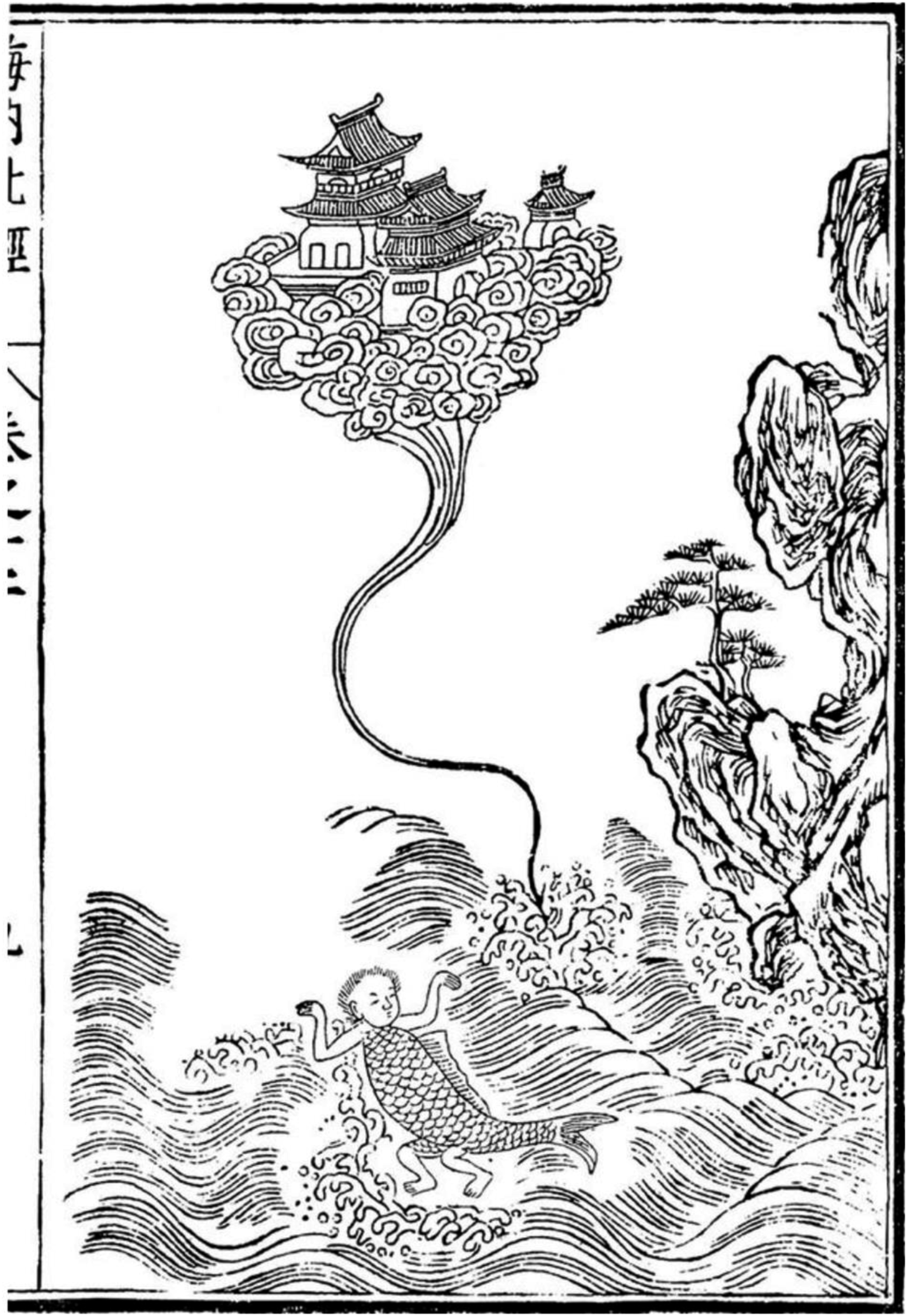
Although the Shanhai jing was the first historical account in which Penglai was recorded, we know fairly little about the author(s) of this Classic. We can however be reasonably sure that they did not distance themselves from the ocean. Yet, this anonymous author was not really a sailor or a person of the sea. Had they been more experienced in any one of those maritime activities, we might never have had this fanciful writing full of excitement and imagination. In addition, it should not be an overstatement to argue that the author’s contemporaries were just beginning to explore China’s coastal waters, namely the Bohai Sea, as it was the most immediate sea space adjacent to the North China Plain. During the time the Shanhai jing was produced, detailed knowledge of the Bohai Sea, including its coast and the islands scattered adjacent to it, was scarce and mostly inaccurate. Although the information recorded in the Classic is hardly reliable, this is where the Penglai story originated. In hindsight, ironically, we should be thankful for the innocence that provided us with such a mythical geography of Penglai Island and the Bohai Sea, a geography that still resonates throughout Chinese and other East Asian cultures.
We are now very certain that Penglai Island was uninhabitable simply because it only exists in the Chinese imagination. If we agree with Henri Lefebvre that spaces can be both mental or conceptual, then the construction of the Penglai island should be no different from the process of how devine spaces were built in the form of churchs or chapels in the West. In other words, although the Penglai mytholgoy seems to be abstract and disembodied, it still possesses real consequences. 24 However, it is perhaps problematic to apply Lefebvre's assessment or our current understanding of coastal geography and its history to decode what occurred dating back to imperial times. The Chinese had long believed that Penglai Island was habitable and that it was home to holy deities. Unfortunately, we have limited records of these thoughts prior to the Qin empire, the first dynasty of imperial China. We can only assume that their understanding of the physical geography of the Bohai Sea was full of confusion and that it was precisely this lack of knowledge that allowed them to construct a magnificent mythical seascape that featured Penglai Island. Even to this very day, Penglai’s legacy continues to offer more scope to the Chinese imagination than some of its land-oriented mythologies. Travelling back to ancient China, Penglai Island would have been one of the master metaphors that encouraged the Chinese to navigate a fairly maritime horizon that could bring them power, fortune and longevity. Compared to the Yellow River, which had caused countless and disastrous floods since the time when the Chinese had no choice but to live under these conditions, 25 the Bohai Sea was comparatively calm and peaceful. Although the Chinese, especially the country’s coastal community, were not unaware that the dragon king, who ruled the Bohai Sea, could also trigger storms and tsunamis, they felt that if they found a way to conduct the relevant rituals to worship this king, these water disasters would mostly be avoidable. To the Chinese, the Bohai Sea was less corrupting, unlike in Western culture, such as that of the Greeks, who believed their part of Earth was wholly surrounded by watery chaos from an encircling sea (or a great impassable river) and regarded land as familiar, comforting, and troublesome. 26 While in Greek geography, “the terrifying aperion of primal chaos was banished to the outmost edge of the globe, where flowed the stream of Ocean”, 27 the Bohai Sea was moderately more stable and fuller of inspiration, largely because Penglai Island was seen as being able to suppress most of the potential anarchy. After all, the island was home to the immortals; it was a fairyland. However, this does not mean that the Chinese conceptualised the Bohai Sea being free of risk. One still required the nerve, skills and audacity to sail across that ocean. It is said that if the mainlanders in early China had the courage to sail across the Bohai Sea, they would eventually reach Penglai Island and be rewarded. The renowned stories of Xu Fu setting sail for Penglai during the Qin dynasty and stories of the eight ‘immortals’ who successfully crossed the Bohai Sea are two remarkable examples. 28 Both stories are so well-known to almost everybody who brought up in China and the Sinophone community.
The notion of mythical islands is not unusual to many civilisations. However, Penglai Island has been quite foundational to the Chinese way of writing, thinking and conceptualising the wider sea. In 634 AD, during the Tang dynasty, a district in the Shandong peninsula was even named Penglai, 29 while in the Qing, Penglai had already been upgraded to a xian, an administrative subdivision of the Dengzhou prefecture. 30 While we are all familiar with the fact that the Chinese have long considered themselves being situated at the centre of universe and projected all that was strange, unfamiliar, and so-called uncivilised to the periphery, the Bohai and Penglai associations offer us an alternative picture, to a certain degree. Although the Chinese were not very familiar with this immediate sea space and its respective mythology, it was not considered a frontier, peripheral region that was totally distanced from the very core of the aforementioned centrism. These spaces somehow co-existed harmoniously and were not disconnected from each other within this cultural framework. In other words, in a cultural sense, the Penglai imagination, especially after it was heavily coloured by Daoism, was part of this Sino-centrism, which, in turn, motivated the Chinese to further explore and discover the Bohai Sea.
According to John Gillis, Mircea Eliade, and many others, there are places in which we live and places we live by. The former may be considered our physical geography, whereas the latter can be our mythical geography. 31 One enables us to live our lives by fulfilling our basic material needs; the other instils meaning into our minds and existence. As humans we require both physical and mythical geographies. In most cases, these two geographies are separate from each other, but sometimes they might overlap. Apparently, the Penglai imagination is not a physical geography but the one that meets the Chinese desire to search for meaningful aspirations in the world. Penglai Island was thought to be located somewhere remote in the Bohai Sea, of which the Chinese of the early imperial period had very little practical information. Despite the fact that this was a mythical geography, the Penglai ‘existed’ beyond the edge of everyday existence.
Why did the Bohai, or in general the sea, become a favoured location for some of these mythologies? It was very much because the Chinese were, generally speaking, late in mastering the ocean. But failing to master the ocean does not mean that the Chinese failed to interact with the sea. We all know that there were fishermen who plied these seas and that various types of maritime activities took place even before the first emperor united China. Mastering the ocean refers to the degree to which a civilization maps its coasts, navigates to unknown waters and undertakes long-distance voyages. Compared with those European seafaring countries, ancient China was less engaged with the sea in this regard. Had the Bohai Sea already been mapped and explored more thoroughly by their contemporaries, the authors of the Shanhai jing and other Qin-Han texts would have sailed to more distant waters. It was not until the Three Kingdom period that the Bohai and Yellow Seas were ‘mastered’ in a more comprehensive way. The Bohai Sea was then further explored and even utilised during the Sui-Tang period, as the Sui emperor dispatched his grand navy to sail across the Bohai Sea in the hope of annexing the Korean peninsula. 32 Meanwhile, as recorded in the Xin Tang shu (New Book of Tang), “the Balhae mohe raided Deng Prefecture (through the Bohai Sea), and Heunggwang (king of Silla) attacked and drove them off. The emperor gave Heunggwang the title Envoy of the Peacekeeping Navy and sent him to attack the Mohe.” 33 However, the Penglai imagination continued to serve as a mythical geography very much as it had always done, providing direction and meaning culturally and mythologically. Like the cardinal points of a compass, it reminded the Chinese not only where the immortals were but also who they were – earthlings as opposed to divine powers.
If we try to situate the Penglai mythology in a global context, the sea has always been a tempting mystery to land-based civilisations. In fact, it took time for humans, even most Europeans, to sail from inland waterways to the high seas. The sea has been seen not only as an alluring space of opportunity but also one of extreme danger. Not unlike the Chinese, other ancient cultures, such as the Phoenicians, also established a certain rapport with their sea gods, while the Egyptians preferred to worship water that came from the Nile and maintained an intense antipathy towards the sea. Even the Ancient Greeks, who were renowned for their dependency on the Aegean Sea, were not always comfortable navigating the Mediterranean. James Romm tells us that “they were more comfortable onshore than off, and did not sleep or take meals on board if they could help it”. 34 Among the Greeks, there was always a need to return to terra firma. Alain Corbin similarly summarises European attitudes towards the sea, as follows: “in ancient epics, shore keeps alive the dream of fixed abode prescribed by the gods or provides a focus for hope of return”. 35 In such cases, the Europeans did not voluntarily go in search of new worlds before the age of discovery. The story featuring Xu Fu and Penglai Island, by contrast, might serve as an exceptional example here when China is juxtaposed with Greece. As mentioned above, the Bohai Sea was not a non-place that was as worrying metaphysically as it was physically, compared to how the Greeks viewed the seas. While the Greeks believed that one could only locate monstrous disorder in the mythical ocean, Xu Fu viewed the Bohai Sea and Penglai Island as significant opportunities. These spaces did not represent disturbances or impassabilities but channels full of hopes and prospects. Xu’s venture into the Bohai Sea in search of Penglai Mountain even became a long-lived legacy in Chinese history.
Penglai and Daoism
For centuries after the Qin dynasty collapsed, Daoist geography gained even greater influence, first in China and then across the wider Asian sphere. In the ninth and tenth centuries, as Daoism grew more extensively across China, interest in mythical geography increased. Places like paradise or purgatory, which had hitherto been abstractions, began to take on specific geographical locations. Until then the faithful had been satisfied by their imaginations, but from the Tang period onwards these were replaced by other accounts that purported to be more authentic. Ranging from textual materials to scroll paintings, these accounts, whether wholly fictionalised, somehow assured the Chinese that the Penglai Island constructed within a Daoist setting was a real place. For example, in the two Penglai xianhui tu, one painted by Zhao Daheng in the Song dynasty and the other by Hu Tinghui the Yuan dynasty, the painters seemed certain that they had discovered Penglai and was enjoying their journeys exploring this mythical place. 36 Another example was the artwork compiled by a renowned painter in the Qing, Yuan Jiang. 37 Inspired by the Penglai legend found in Daoist writings, Yuan visualised this immortal island in a traditional way, through Chinese landscape and architecture paintings, using black, creamy white, sandy yellow and turquoise green as the four major colours. Specifically, the painter captured the misty atmosphere of Penglai, rendering the pavilions using meticulous lines and an asymmetrical setting, in what art historians refer to as ruled line style. Apparently, the island Yuan portrayed was situated in a dim, barely visible sea. Although he did not precisely highlight the location of this Penglai Island, the painting suggests that it was a real, grand paradise located somewhere on the sea. On a related note, the mystical communion with the natural world in Daoist China, as J. C. Cooper pointed out, was in fact usually expressed in landscape paintings, such as the above. 38 After all, Chinese landscape painting was practiced not merely as an artwork but primarily as a kind of spiritual exercise as a way to pursue the meaning of dao.
In addition to these artworks, Penglai has long been featured in much literature since the Tang dynasty, if not earlier. As suggested above, the conception of Penglai has often been associated with the two other holy mountains in the Bohai Sea, namely, Yingzhou and Fangzhang, since Sima Qian published his grand account. Together, the three islands in the sea were identified as the three holy mountains (san shan/san shenshan). In most cases, these holy sites were rendered as spaces to be admired and worshipped and, in some cases, they could even be seen and reached as recorded by Tang writers. In his poem Deng gaoqiu er wangyuan (Reaching the top of a hill to enjoy a distant view), for instance, the renowned Tang poet Li Bo wrote that “Climbing up the mountain, and looking at the sea…the three mountains are far away, sitting still.” 39 His contemporary Bai Juiyi also expressed that “there are three holy mountains in the sea. According to the legend, there is medicine out there with which you could attain immortality, as well as costumes that could help achieve divinity.” 40 Other writers such as Wei Yingwu and Li Jiao drew on the symbolism of Penglai and the three mountains in similar regard, suggesting that the holy site was located in the sea to the East. The long and extensive poem entitled “The sun shining on the three sacred mountains (Hairi zhao san shenshan fu)” composed by Ge Ganyu, another Tang writer, even describes Penglai Island together with Yingzhou and Fangzhang in vivid detail, as if the author had journeyed the place and saw it as representing the purest expressions of peacefulness, longevity and holiness. 41 Writers of the Song and Yuan dynasties followed Ge’s style of revealing the beauty of Penglai. For example, in his “Three holy mountains (san shenshan fu),” the Yuan poet Yang Weizhen also provides his readers with a comprehensive picture of the geography and flavour of Penglai and the Bohai Sea and also of the feelings they evoke.
Consistent with their appreciation of Penglai Island, the visions of Ming and Qing writers situate this righteous place in the past. Wu Tinghan, Zhang Fengyi, Tu Long, Wang Weizhen, Cai Xin, Bai Ling, Li Tuixi and many more continued to apply Penglai as a theme in their literary writings. Some, such as Wu and Zhang, suggested that Penglai Island lay remotely in the sea but was only accessible through the mind, while some inclined to believe that although Penglai was situated beyond the reach of ordinary people, it was assigned a geographical location in the Daoist cosmos, where deities and immortals enjoyed pleasant music and wine.
42
When the famous Qing novelist Li Ruzhen referred to a number of celestial islands in the East, in his Flowers in the Mirror, he was actually appealing to common cultural knowledge pertaining to the Penglai legend.
43
Here, we can recognise that there was a noticeable tendency to no longer think of Penglai as a vague and imprecise fantasy. In the Penglai xianzhi (the Penglai Gazetteer), published during the Kangxi era, there was even an illustration titled “The emergence of the holy mountains (shenshan xianshi)” (see Figure 2). The emergence of the holy mountains (shenshan xianshi) in Penglai Xianzhi. Source: Penglai Gazetteer.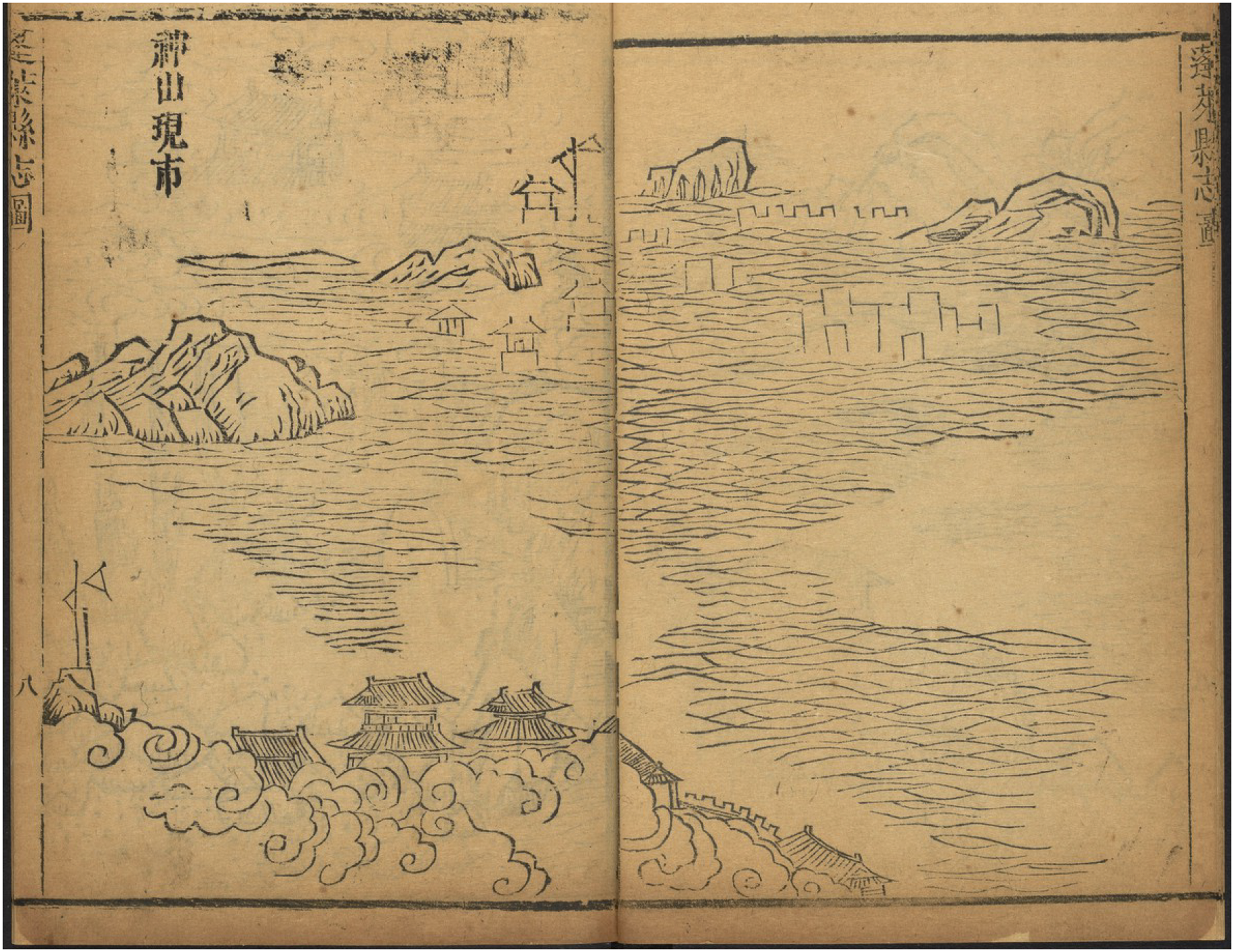
Occasionally, Penglai was identified as being situated along with mountains in the wild rather than as an island in the sea. When the Japanese monk Kuanfu, who visited China in 927 AD, claimed to have found Penglai, he was referring to Fuji Mountain in Japan. 44 The fact there were no detailed pictures or accounts featuring this mythical place made it possible for almost any mountain or island in China or Japan to be envisioned in that manner. The plausibility of Penglai was, in a way, ensured by the lack of precise geographical knowledge at the time. As a result, it had been located and relocated over space and time, and it seems as if there was always a new lead as to where Penglai could possibly be. One thing that did not change was that the idea of Penglai remaining closely attached to the Bohai Sea. This is where Xu Fu, the explorer in ancient China and a figure heavily coloured in a Daoist fashion, had sailed to. Moreover, it is worth noting that the conception of Penglai did not disappear during the Ming and Qing eras, despite the fact that the coastal waters off China had been thoroughly explored and charted by then. The admiration for Penglai never really expired in the mental geography of those who clung to the belief that the Penglai imagination could actually be realised. In fact, even until the present century, the search for a Penglai paradise never really ended; and it has somehow taken on new life for the benefit of modern tourism. Established in 2012, the Penglai Dengzhou Maritime Cultural and Tourist Company is still making use of the Penglai legend when promoting its large-scale recreation project, which will be completed in the Shandong peninsula within the next few years.
In addition to visualising and conceptualising the Penglai legend in Chinese landscape paintings, literary writings, and Daoist folklore, similar to those we discussed above, the holy Daoist Island/mountain was also being ‘brought or moved inland’ in some large-scale construction projects administrated or supervised by the central authority. In other words, it was being intentionally and deliberately constructed by the mortals in order for it to be visualised and actualised the way they understood the legend. Similar to the first emperor of China, Emperor Wu of the Western Han Dynasty was also obsessed with the idea of immortality and was keen to discover Penglai Island. After multiple attempts to send giant fleets off the coast, however, the emperor had no luck in locating this sacred island. He then decided to construct a small walled city in Dengzhou, which he called the Penglai water castle (shuicheng), which remained a symbolic site in the Qing era (see Figure 3) and underwent several reconstructions and renovations over time. In this case, the Penglai conceptualisation differed from the popular imagination of this place insofar as it was realised as a city made of bricks rather than an imagined island situated in a misty sea. Penglai shuicheng (water castle). Source: Penglai Gazetteer.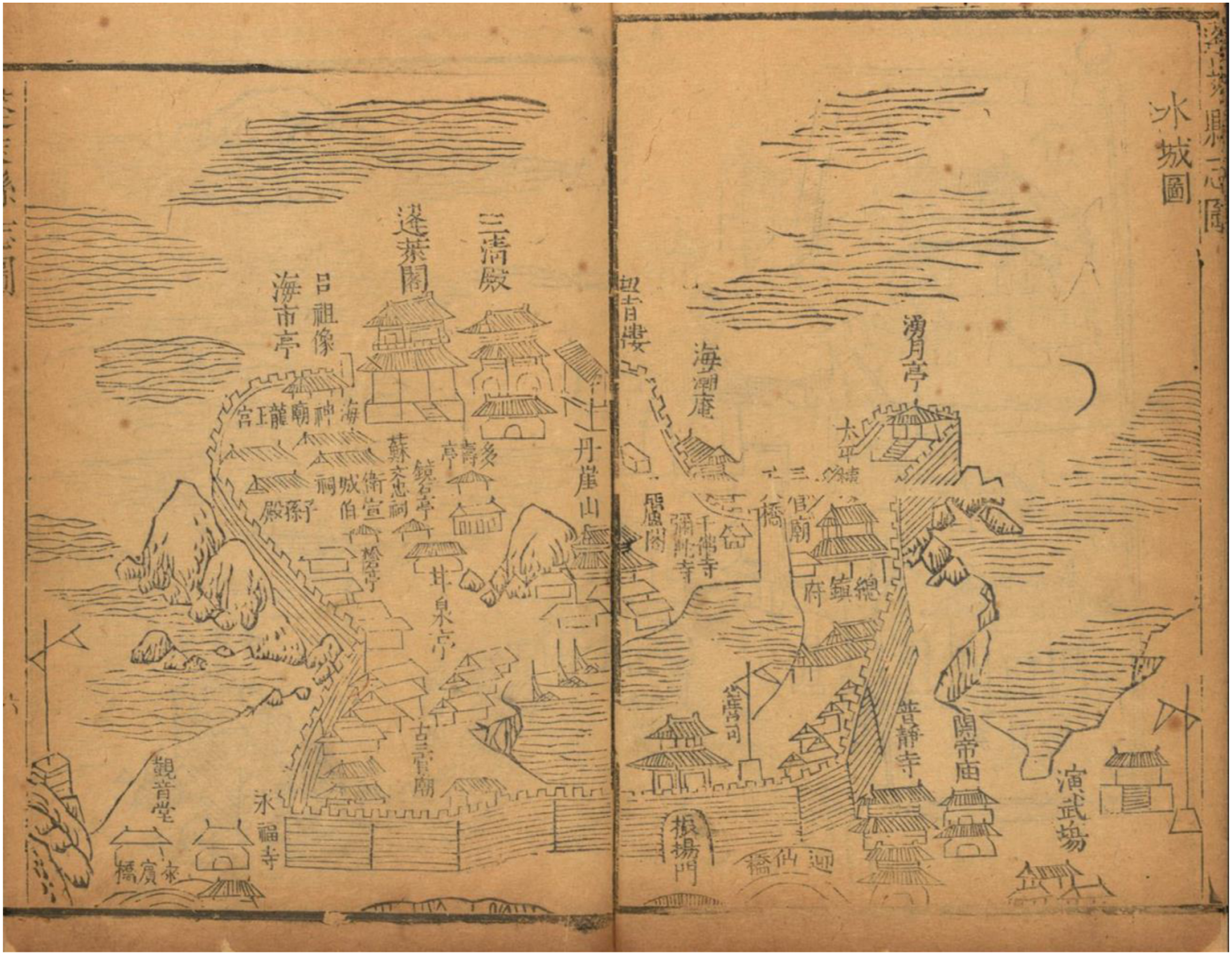
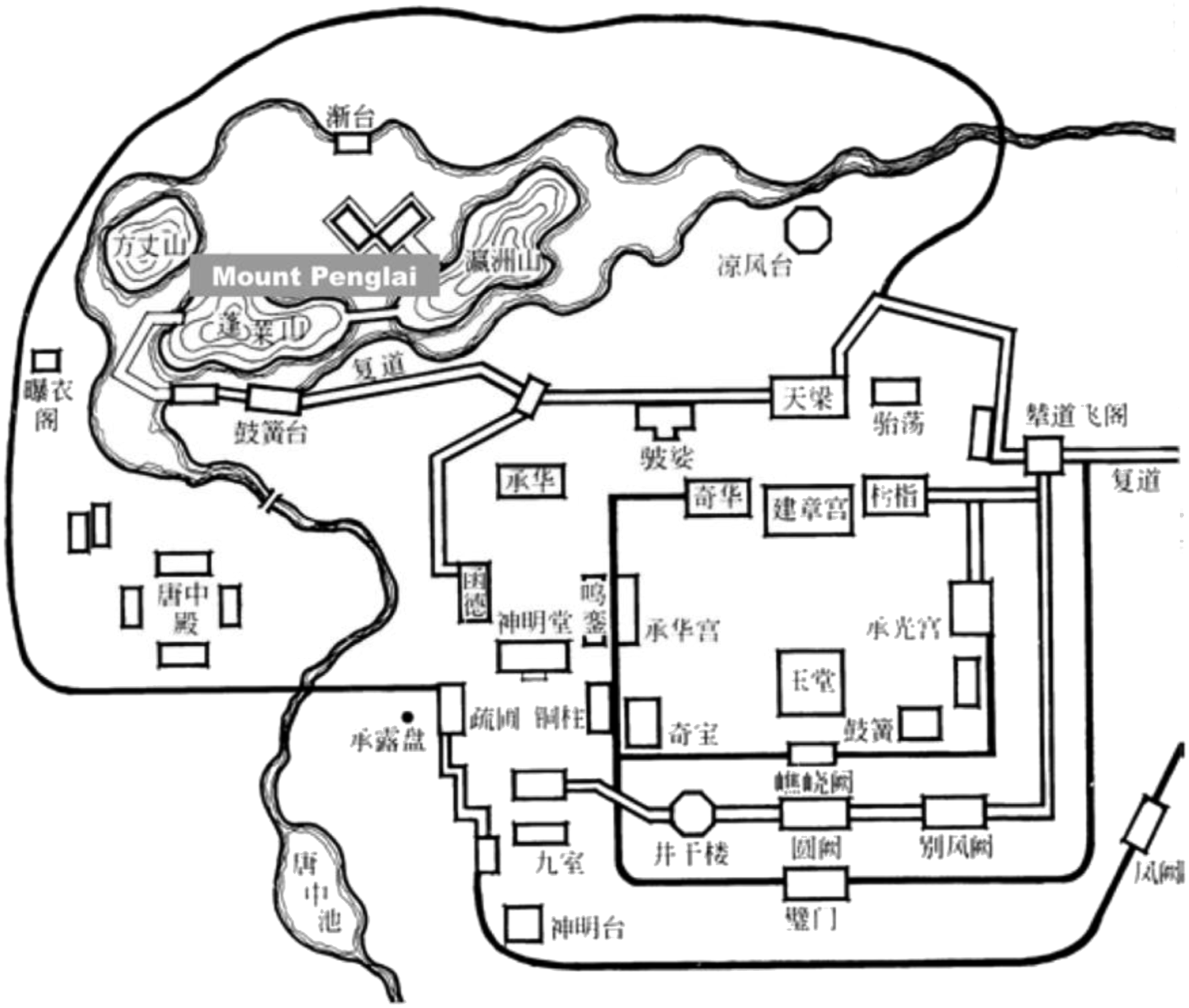
Besides the water castle, the Wu emperor also created his own Penglai in his Jianzhang Palace, which was one of his imperial residences in the city of Chang’an.
45
(Figure 4) The practice of visualising the Penglai legend in imperial gardens or habitations was not exclusive to the Hanwu emperor. The Qianlong emperor also referred to one of his imperial complexes, called Yingtai, as the Penglai paradise. In his “Narrating the Yingtai (Yingtai ji),” the emperor wrote, “[we see] the three sides of Yingtai were [being] surrounded by a great pond called Taiyi. If we looked at Yingtai from a bird’s-eye view, [we would see that] the palace and its architecture as a whole are no different from the Penglai in the sea.”
46
The Grand Pond inside the Jianzhang Palace.
47
The reason the Penglai legend was brought to these emperors’ gardens or residences is because these imperial places, as Clarke argued, “were thought to be a means whereby the imperial mandate could be enacted at a distance, as it were, and was also linked with the quest for immortality by virtue of its symbolic replication of the fabled islands of the Immortals in the Eastern Seas”. 48 In a way, the Penglai paradise, as such, was more likely to have been something that was created rather than found. Echoing what Clarke observed, I would like to add that although these constructions were associated with a Daoist origin along with the idea of longevity and endurance, they also became products of man rather than the supernatural or a divine creation. The idealisation of Penglai in these imperial premises has also somehow provided this supposedly unknown, unmapped island with the type of credibility that accounts for its appeal to commoners who found a nowhere to be as believable as a somewhere. By spatialising the Penglai legacy at the imperial level, the emperors and the ruling classes were in fact offering a lot of latitude to the Daoist thinking of this place. Despite the fact that most coastal islands off the China coast had been very much completely explored by the Qing dynasty, a kind of third space remained in the mental geography of the Chinese. As argued earlier, islands had long been perceived as thresholds and liminal places between land (known and familiar) and water (unknown and unfamiliar), such status made Penglai Island particularly attractive to both Daoist and non-Daoist thinkers, ranging from emperors and ruling elites, to writers, artisans, painters and the coastal residents.
Concluding Remarks
The idea of a sacred paradise (xianjing) belongs to those landscapes or seascapes that mankind conjured up as mythical worlds, where the confinements of ordinary existence do not apply and “the human soul tried and will always try to set its heart on the impossible”. According to Yi-fu Tuan, fundamentally, the root meaning of sacred, or sacer is separateness. 49 The perception of a sacred space is always thought of as being attached to the notion of far from the centre, or simply being out there, a place that occupies its own separate space and time, which is inaccessible and incorruptible. Notions of sacred places are found in virtually all cultures, and the Penglai mythology in the Bohai Sea is certainly one of the illustrative examples of a mythology in the East. Its history and legacy express a sense of longing focused on a place where plenitude, peace and immortality are imagined to exist. It is an imagined geography being ‘mandalised’. In the conception of those writers from the Song to the Qing, Penglai was a place presumed to be where immortals and deities resided. These inhabitants, including the Eight Immortals, lived in a kind of freedom without restrictions or limits and were nurtured by an environment, potentially a Daoist environment, that provided them with everything they needed. There was no toiling or trouble; no sickness or death. All of these writings echo with what Harry Partin reminds us of in his observation that “the nostalgia for paradise is among the most powerful nostalgias to haunt human beings….it may be the most powerful and persistent of all.” 50
Penglai Island is often portrayed by writers and painters in imperial China as a primordial stratum of a Chinese belief that was first recorded in the Shanhai jing and was associated with the Bohai Sea as its place of origin. Yet throughout the centuries during which Daoism began to spread widely across China, the island itself was frequently linked with regeneration, relocation, and even with a new beginning and outlook. Occasionally it was identified as a mountain in the wild; it could also be found in the garden of an imperial palace. It has been located in all kinds of times and places, integrating both the horizontal and vertical views of the cosmos. Meanwhile, the Penglai legend also links China with East Asia, particularly Japan, at least as far east as Mount Fuji. However, although it seems that Penglai Island could be found somewhere, at the same time it was portrayed as not at all accessible. In other words, some might consider Penglai as nothing but a conceptualization and place beyond real life, while for others, for example, faithful Daoists, writers or painters, there has always been a Penglai located in some distant place and time, beyond the reach of ordinary humankind. All this vagueness and mysteriousness originated from and is closely associated with the Bohai Sea, which in turn constitutes the shaping of a representative maritime religiosity.
Footnotes
Author’s Note
This article was first drafted for the AAS Annual Conference hosted in Honolulu, Hawai’i, in March 2022. It was presented in a panel, entitled “From the Bohai to the Yellow Seas: A Transboundary and Cross-cultural Story,” chaired by Prasenjit Duara.
Acknowledgements
The author wishes to thank Prasenjit Duara, Ian J. Miller, Xiaofei Gao, and Young Rae Choi for reading the earlier drafts of this essay and providing invaluable feedback and corrections. I am also indebted to the anonymous reviewers for their engaged response to the paper that had the depth allowing me to improve the final version.
Funding
The author(s) disclosed receipt of the following financial support for the research, authorship, and/or publication of this article: Research for the project on the Bohai Sea from which this article stems was supported by the Daiwa Anglo-Japanese Foundation and the Suntory and Toyota International Centres for Economics and Related Disciplines.