







Abstract
The differentiation of human and physical geography is a fundamental distinction in Geography. This commentary examines the past, present, and possible future places of physical geography within Geography, focusing on the situation in the United States. Physical geography played a major role in the establishment of Geography as an academic discipline, but became marginalized soon thereafter. For the past 80 years, Geography in the United States has largely been a social science that has uneasily accommodated a natural-science component within it. Although somewhat healthy during the latter part of the 20th century, physical geography appears to be on the decline. In part, this situation reflects the social-science identity of Geography, a lack of adequate training of physical geographers in basic science and mathematics, as well as growing emphasis on research in geomorphology, climatology, and biogeography, the major subfields of physical geography, by cognate disciplines. The future of physical geography is in doubt: it could keep struggling to compete with better-trained scientists in cognate disciplines, evolve into a geospatial methods branch of the earth and environmental sciences, or pursue integrated research with human geographers to address Anthropocene concerns. Any of these paths forward has important implications for trying to sustain the process approach to inquiry that has underpinned research in physical geography since the 1950s. Regardless of how physical geography evolves, it needs to seriously address issues of equity, diversity, and inclusion. Doing so will only enhance whatever it becomes.
Introduction
Geography is an eclectic discipline that since its emergence as a contemporary academic discipline in the early 1900s has always had somewhat of an identity crisis, especially in the United States. Succinctly defining Geography in a manner that nearly all geographers can agree upon is at best difficult and at worst futile. Throughout its modern history, a key dichotomy that has not only lent fundamental structure to contemporary Geography but also served as a source of divisiveness is the distinction between human and physical geography (Martin, 2005). According to this distinction, physical geography considers Earth’s biophysical environment, including landforms (geomorphology), climate (climatology), and living organisms (biogeography), whereas human geography focuses on people, including urban processes (urban geography), economic activity (economic geography), and cultural phenomena (cultural geography). The distinction is useful because it emphasizes the incredible breadth of geographic scholarship and the broad scope of Geography’s subject matter. However, divisiveness results from differences in subject matter and, more fundamentally, from contrasting philosophical and methodological viewpoints (Viles, 2010). Imbalance of emphasis on the human versus the physical has also been a concern (Marcus, 1979). Like in any human endeavor, gross imbalances in emphasis and representativeness can lead to marginalization of minority viewpoints, often unintentionally.
Throughout my career as a geographer (now spanning over four decades), I have been interested in and lived through changes in physical geography, especially in the United States. Nearly 20 years ago, as part of the centennial celebration of the American Association of Geographers (AAG; then called the Association of American Geographers), I speculated on the trajectory of physical geography (Rhoads, 2004). How healthy was this part of Geography? Where was it headed and how might it evolve? How would relationships with other parts of Geography develop?
Enough time has now elapsed to reexamine the status of physical geography. Here I briefly comment on the place of physical geography within Geography, identifying the spaces it has occupied, the ones it now occupies, and ones it might or might not occupy in the future. I also consider its relationship with cognate disciplines and how the identity of physical geography is related to these disciplines. My focus mainly is on physical geography in the United States with which I am most familiar. I leave it for other physical geographers elsewhere to consider how my assessment of physical geography in the United States relates to their situations (see Thomas, 2022).
Past places
Although looking backward sometimes is not constructive because what has happened has happened and nothing can be done about it, the past can provide insight on former commitments, how those commitments have changed, and how past and present commitments inform future commitments. The emergence of modern Geography in the United States as a university-level field of study in the early 20th century, with its own departments and faculties, was grounded heavily in physical geography (Martin, 2005). At its inception, American Geography was closely connected to the natural sciences, particularly geology. The herculean effort of William Morris Davis, geologist cum physical geographer, in championing geography as a distinct academic subject both nationally and internationally, in initiating the formation of American Geography’s main professional organization—the AAG—and in advancing geographic pedagogy at all educational levels, has been well documented (Chorley et al., 1973; Martin, 2005). Without Davis, Geography’s development in the United States probably would have been much delayed. Besides Davis, many other natural scientists contributed to the development of academic and professional Geography in the United States (James and Martin, 1978; Martin, 2005) so that in its earliest years, American Geography was heavily weighted toward the physical both in terms of the expertise of practitioners and in terms of research output (Rhoads, 2004). Geomorphology dominated physical geography between 1900 and 1950 and adopted explanatory description as embodied in the cycle of erosion as its primary conceptual framework. Exactly what constituted an explanatory description was not entirely clear from Davis’ writings, but in relation to landforms, this approach is captured most succinctly as the “description of factors of terrain, climate, or soils in qualitative, generalized expressions accompanied by explanations of the development of the forms through the action of natural processes and by classifications of the forms into groups determined by common origins” (Strahler, 1954: 4). Biogeographic studies in early American Geography included a mix of climate determinism, cyclic change related to successional theories, and human–environment impact (Cowell and Parker, 2004). The cyclic approach (Cowles, 1911) aligned closely with Davis’ advocacy of explanatory description as framework for geographic inquiry (Davis, 1915). Studies in climatology largely emphasized classification and regional description (Skaggs, 2004).
Davis recognized that human geography should be part of the American educational curriculum (Martin, 2005) and therefore championed environmental determinism as a conceptual framework for geographical explanation of human conditions. Building on the work of Semple (1901), Davis (1906) asserted that a statement of geographical quality is one that defines a relation between an inorganic control and an organic response, including human response. With a few notable exceptions (Davis, 1911, 1913), Davis’ published voluminous work focuses on topics in physical geography, especially geomorphology, rather than on issues related to environmental determinism. On the contrary, climate determinism espoused by Ellsworth Huntington, a student of Davis’, Griffith Taylor, and others became an explanatory theme in many geographic studies of human–environment relations (Randalls, 2017).
Despite the subsequent association of environmental determinism with the “physical” roots of Geography, much work in physical geography between 1900 and 1925 occurred independently of any connection with human concerns or processes (Cowell and Parker, 2004; Rhoads, 2004; Skaggs, 2004). Certainly, a scheme such as the cycle of erosion (Davis, 1899), which considers landscape evolution over millennial timescales, in and of itself has little relevance for the human condition, even when explanation is cast within an environmental deterministic perspective. What is clear is that early academic Geography in the United States had deep roots in what Pattison (1964) refers to as the Earth-science tradition and what I denote here as “pure” physical geography. By the term pure, I refer to studies of Earth’s biophysical environment without an explicit attempt to integrate consideration of human factors, other than possibly considering humans as change agents that can trigger disturbances of biophysical systems.
By the 1920s, physical geography began to fade as dissatisfaction with environmental determinism grew and Geography reoriented its focus toward the human. Two notable chorological perspectives on Geography, Sauer’s (1925) morphology of landscape and Hartshorne’s (1939) emphasis on regional geography, provided little accommodation for pure physical geography. Despite Sauer’s claim that “all geography is physical geography” (Sauer, 1931), his main focus was on culture and the imprint of culture on landscapes (Solot, 1986). His conception of the relation between the human and the biophysical essentially inverted the environmental determinist relation, identifying culture as the major factor influencing the morphology of landscape. Knowledge of the physical environmental is necessary, but only as the initial condition upon which the cultural imprint occurs—a perspective that did not lead to much integration of research being conducted at the time by human and physical geographers (see James and Jones, 1954). By acknowledging human–environment interaction as an important component of Geography (Williams et al., 2014), Sauer built on the legacy of George Perkins Marsh’s perspective (Bendix and Urban, 2021; Lowenthal, 2000; Marsh, 1864); however, he felt that inquiry without explicit consideration of humans was not Geography, which is inherently anthropocentric (Sauer, 1925: 29) and relegated geomorphology to geology (Sauer, 1925: 50).
To Hartshorne (1939), the physical environment also was largely viewed through its interrelation with human activities. Because full characterization of regions should involve exploration of human–environment interrelations, “physical geography is of fundamental importance in geography as a whole” (Hartshorne, 1939: 575). Similar to Sauer, Hartshorne also felt, in addressing geomorphology in particular, that the study of landforms as objects in and of themselves is “in contradiction to that of geography as a chorographic science” (Hartshorne, 1939: 600)—a theme he expands upon at considerable length in Hartshorne (1959: 84–96). He also points out that many geographers trained in geomorphology have difficulty maintaining a geographic point of view and have introduced confusion into methodological thought in Geography—perhaps a veiled criticism of Davis. Like Sauer, Hartshorne (1959) felt that the human element was essential to geographic inquiry: “the study of geography with man [sic] excluded even from consideration is a study of integration without its major integrating element” (p. 105).
The evolution of Geography from 1925 to the early 1950s shifted it toward finding its place among the social sciences, rather than the natural sciences, within the academic intellectual milieu. By 1950, the overwhelming majority of members of the Association of American Geographers were interested in human geography (Bryan, 1950). This development, along with growing dissatisfaction with the Davisian cycle of erosion (Strahler, 1952) and explanatory description (Strahler, 1954)—core concepts that provided the initial foundation for physical geography within Geography—meant that physical geography was in crisis—a situation that led to numerous commentaries on the sad state of affairs (Bryan, 1944; Leighly, 1955; Russell, 1949). These commentaries also provided guidance for change. On the one hand, Geography could abandon the specialty areas of physical geography to cognate disciplines, yet provide training in physical geography for human geographers so they can gain deep insight into interrelations of humans and their environment (Bryan, 1944, 1950). On the other hand, physical geographers could refocus their work on environmental processes to gain explanatory insight into biophysical phenomena, including the geographic structure and organization of these phenomena without necessarily explicitly considering human factors (Ahnert, 1962; Leighly, 1955). For the most part, physical geographers chose the latter course, with the key elements of the new approach involving grounding of inquiry in principles of basic science, including physics, chemistry, and biology as well as a concern with dynamics, systems thinking, and quantification using mathematics or statistics (Gregory, 2000). This change in focus reflected a concern about making physical geography more scientific by aligning it both conceptually and methodologically with other natural sciences. The new approach, which developed somewhat slowly through the 1950s and 1960s, gradually extended beyond a primary concern with geomorphology (Strahler, 1952) to include climatology (Court, 1957; Hare, 1955; Terjung, 1976) and biogeography (Fosberg, 1976; Gersmehl, 1976; Morgan and Moss, 1965). It also coincided with the quantitative revolution in human geography, leading to rapprochement between the two sides of the discipline, if not in terms of conceptual integration, at least on the basis of a shared methodological perspective (Johnston and Sidaway, 2016).
By the 1970s, physical geography in the United States was undergoing a resurgence, mainly through systematic studies of landforms, climate, and biological or ecological communities conducted within what has become known as the process approach (Rhoads, 2006). Helping to fuel this growth, at least in part, was recognition that geographical knowledge, including knowledge in physical geography, is relevant to emerging concerns about the effects of human activity on the environment. This renaissance continued throughout the 1980s and early 2000s, resulting both in evaluations of the status, accomplishments, and future directions of physical geography (Bauer, 1999; Bauer et al., 1999; Marcus, 1979; Rhoads, 1999, 2004) as well as detailed overviews of specific subfields (Graf et al., 1980; Mather et al., 1980; Vale and Parker, 1980).
During this same period, much research in human geography abandoned the scientific approach to inquiry initiated by the quantitative revolution of the 1950s and 1960s, often generically labelled as “positivist,” and adopted an array of viewpoints informed by theory in the social sciences and humanities. In fact, Geography in the United States had largely transformed itself into and had become recognized as a social science during the 1960s (Johnston and Sidaway, 2016). This transformation has only continued to solidify from that time to the present. A common annoyance among physical geographers is the manufacture by human geographers of perspectives on Geography, usually by title, that completely or almost wholly ignore physical geography. Over the past 20 years, the enormous growth in Geographic Information Science, a new technological constituent of Geography (Goodchild, 2004), as well as the recent self-promotion by geographers of their field as relevant to concerns of the Anthropocene (Derickson, 2018; Ellis, 2017; Gibson-Graham et al., 2019; Knitter et al., 2019; Lorimer, 2012), has shifted the social-science centering slightly, but not necessarily in favor of physical geography.
The present place
Since the turn of the century, my sense is that physical geography within the United States is in a state of decline, as least in a pure sense grounded in the process approach. Evidence to support this claim is not abundant, but between 1979 and 2020, the number of academic geographers in the United States who identified physical geography as their primary field of interest declined from 36% to 20% (Yeh, 2021). More concerning is that only 17% of students now identify physical geography as their primary field of interest. These data are supported by trends in specialty group affiliations in the AAG. Since 2010, affiliates associated with physical geography have declined from 10% to 6% of all affiliations (Figure 1). Meanwhile, human-geography affiliates have increased from 59% to 69%. Since 2015, the number of affiliates in each of the four largest physical-geography specialty groups—biogeography, climate, geomorphology, and coastal/marine—has decreased systematically (Figure 1). Not only is physical geography a minority component of American Geography, the evidence suggests that the number of physical geographers is dwindling. The question long ago asked by Leighly (1955), “What has happened to physical geography?” can also be asked today. So can the question I asked nearly 20 years ago: “Whither physical geography?” (Rhoads, 2004). Whether or not physical geography is in decline elsewhere in the world is uncertain, but it seems to be strong in at least some contexts, particularly in Europe. It may be that the situation is still as Ahnert (1962: 1) characterized it 60 years ago: “worry about the place of physical geography seems to be a specifically American problem rather than a world-wide one.”
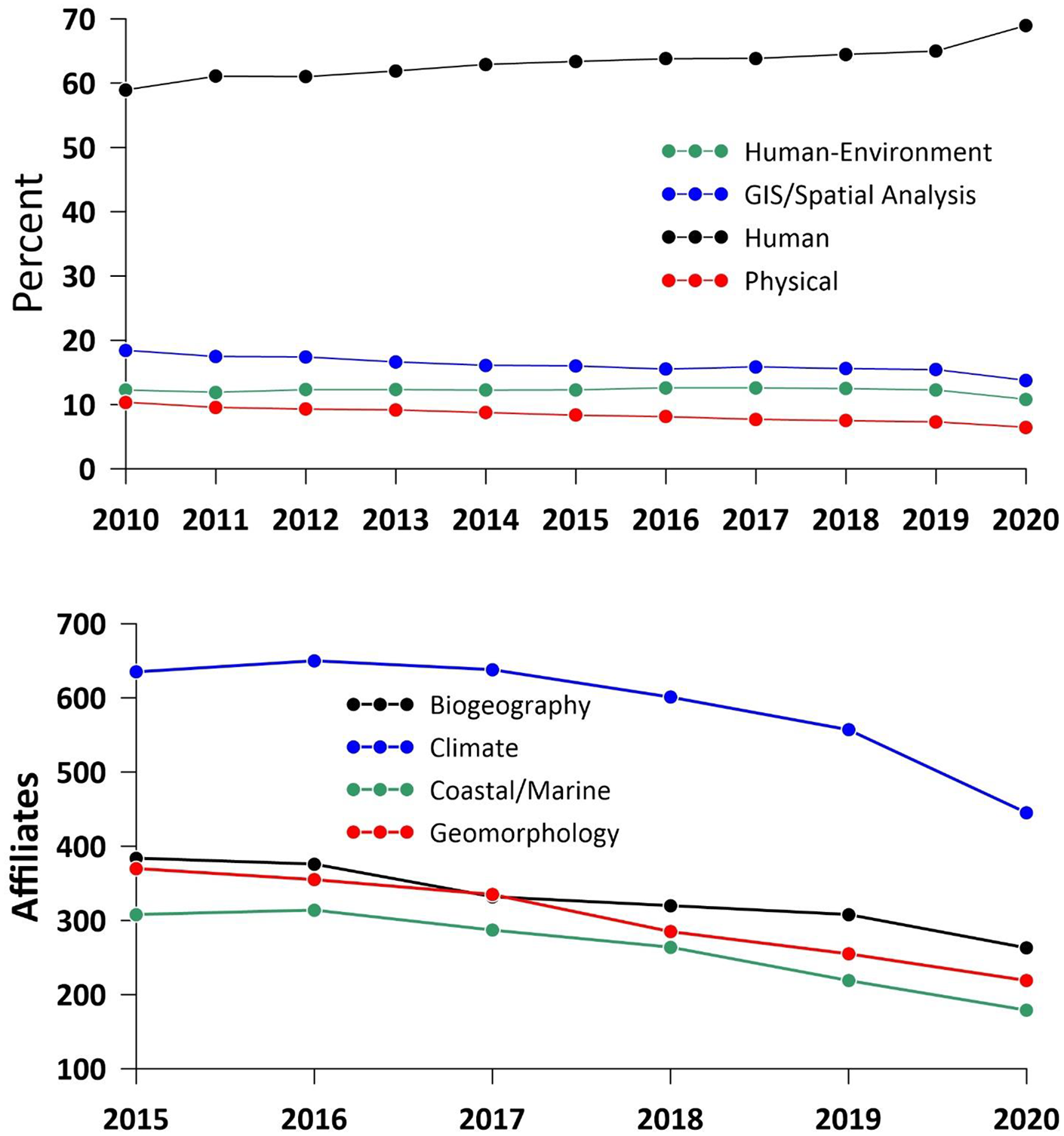
(Top) trends in percentages of total affiliations in four categories of AAG specialty groups since 2010. (Bottom) recent trends in affiliations in core physical-geography specialty groups.
The exact reasons behind the apparent waning of physical geography in the United States are not entirely clear, but several factors may be important. Geography is identified primarily as a social science both within the discipline and within the institutional structure of most universities. This situation is not new; it has existed since at least the 1940s, but it has become firmly embedded both in the identity of Geography as well as in its institutionalization since that time. It, combined with the rather muddled public perception of contemporary academic Geography, does not favor recognition of physical geography as a field of study for undergraduates. More concerning is that many vacated positions in physical geography are not being replaced by physical geographers (Yeh, 2021).
Even when Geography is housed within a more science-based setting, the situation does not necessarily improve. During my tenure as unit executive officer, I oversaw the transition of our department into a School of Earth, Society, and Environment that included Departments of Atmospheric Science and Geology. This move generated considerable concern among human geographers in our department. In the end, as I anticipated, the move actually benefited the human-geography program (in addition to our Geographic Information Science focus) because Geography was seen as the unit primarily serving the society part of the school’s mission. After joining the school, the department subsequently hired several additional human geographers. Also, the formation of an interdisciplinary school major focusing on environmental science, including physical aspects of environmental science, siphoned away many potential undergraduate majors who otherwise may have been interested in physical geography. The focus of the graduate-level physical-geography program also narrowed to a water-related focus (fluvial geomorphology and hydrology) because other aspects of Earth-surface processes and climate were covered by Geology and Atmospheric Sciences, whereas biogeography became the domain of the Department of Plant Biology.
Perhaps the most critical factor affecting the health of physical geography has been the lack of adequate training of students in relation to competing disciplines. The concern about rigor of training is not new. The need to fully equip physical geographers in methods of mathematics and physical science was recognized 50–60 years ago (Ahnert, 1962; Leighly, 1955; Thornthwaite, 1961). Sadly, the need for such training has not widely materialized. As a physical-geography major in the 1970s, I was one of the few who took college-level courses in basic physics and chemistry. Subsequently, I enrolled in a calculus course as a graduate student, when it did not count for credit in my graduate program. Since I joined the Geography department at the University of Illinois in 1986, only a handful of our undergraduate majors have concentrated in physical geography. Until recently, that concentration included calculus and physics or chemistry as required courses. The overwhelming majority of students drawn to the department pursue concentrations in human geography, general geography (a mix of human and physical geography), or in geographic information systems, all of which do not require courses in natural science or mathematics. Just this past year, we decided to eliminate the math and natural-science requirements from the physical-geography concentration because it seemed pointless to have a concentration without students. Our graduate program also required calculus and physics, but we decided to eliminate those requirements as well so that our own undergraduates would be eligible to join our graduate program. These changes work against adequate training, but reflect the reality of practical considerations within the discipline. Most students admitted to our graduate program in physical geography have backgrounds outside of Geography (e.g. geology or engineering) and thus have adequate training in basic science and math to pursue cutting-edge graduate-level research. To a substantial degree, the market for graduate students in our physical-geography program has become undergraduates or students with Master’s degrees who did not major in Geography. Concern about the extent to which Geography is providing adequate training to undertake cutting-edge research in physical geography is one shared by contemporary graduate students (King, 2017).
The lack of adequate training is critical because the pursuit of state-of-the-art research on topics traditionally studied by physical geographers requires, now more than ever, a solid understanding of theoretical principles derived from physics, chemistry, and biology, expressed mathematically. Whereas many human geographers have largely turned away from a quantitative, science-based focus, broadly characterized as positivist, in pursuit of relevant theoretical depth, such depth for physical geography conceived as a natural science working within the contemporary process approach is to be found in the underlying foundation of physical, chemical, and biological principles and in quantitative expressions of these principles. The lack of adequately trained physical geographers seems to be reflected in academic hiring. Of the few positions that have been available in physical geography in the United States, several at leading research institutions have been filled by Earth scientists who received their graduate and post-doctoral training outside of Geography. The inferred message seems to be that geographers trained in research areas relevant to these positions either are not available or are not viewed as the best candidates.
Over the past several decades, interest in biogeochemical, climate, earth-surface, and ecological processes has soared outside of Geography within the atmospheric, earth, environmental, and life sciences. This voluminous body of work has focused on many important research problems, both basic and applied, that are central to traditional subfields of physical geography like geomorphology, climatology, and biogeography. For example, the American Geophysical Union now has over 60,000 members and includes sections on Earth and Planetary Processes (EPP), Hydrology, Biogeoscience, and Atmospheric Sciences; over 8000 members designate EPP and Hydrology as primary affiliations. Physical geographers are competing within a research arena dominated by cognate disciplines in the Earth, atmospheric, and environmental sciences, all of which are much larger than Geography, explicitly embrace characterization as natural sciences, and thoroughly train their practitioners in basic scientific knowledge. Moreover, the identity of physical geography in relation to these cognate disciplines is rather indistinct. Obvious potential themes for a distinctive identity include an emphasis on spatial relations or on the connection between environmental processes and human activity. On the human side of geography, exploration of various theoretical viewpoints, such as humanist, Marxist, structurationist, critical realist, post-structuralist, post-modern, feminist, anti-racist, and post-colonial perspectives, has led to innovative conceptions of space and its role in human contexts (Johnston and Sidaway, 2016). By contrast, space within the process approach of physical geography is treated as the arena in which underlying environmental processes interact to structure systems of interest; space is the container for these processes, and it is these processes that are of primary interest. This view of the role of environmental processes acting in or over space is shared by cognate disciplines, whose practitioners often ask questions, engage in sophisticated spatial analyses, and use methods and tools (GIS, remote sensing, spatial analysis) similar to those of physical geographers. With regard to human–environment interactions, concern about human-induced environmental change in the Anthropocene has fueled explosive growth in research on such interactions across the natural sciences, largely undermining declarations within physical geography of a distinctive focus on these interactions (e.g. Ellis, 2017; Harden et al., 2020; Spencer and Lane, 2017). Physical geographers certainly have made and will continue to make important contribution to human–environment research; however, they face strong headwinds in trying to stake any sort of special claim to this type of research.
Future places
What does the future hold for US physical geography? Such a question is nearly impossible to address given myriad uncertainties regarding what may transpire over time. What seems evident is that physical geography currently is in trouble. This component of Geography, already in a marginalized position since the middle of the 20th century, seems to be in decline, at least in terms of its traditional topical foci of geomorphology, climatology, and biogeography, and the research conducted within these focal areas under the contemporary process approach. Whatever the future holds, the trajectory of physical geography depends largely on the collective initiative of institutionalized Geography in the United States. The apparent decline appears to have evolved organically through choices made by individual Geography departments across the country. In that sense, it represents an uncoordinated, yet general sentiment on what Geography should be both now and in the near future. Although decision making at the institutional level in many ways impersonalizes choices, in the end, this process represents choices made largely by fellow geographers.
To what extent does the majority, that is, human geographers, value physical geography? Is it simply a “scientistic” partner that has been tolerated, but is not truly valued as necessary, important, or in any way complementary? A key focus of much contemporary human geography is on diversity, inclusion, and championing of the disadvantaged. Do these concerns only arise in relation to the social, economic, political, or cultural contexts of society, or do they apply to intellectual contexts within Geography itself? I pose these questions not to coerce change within the discipline, but only to prompt contemplation of decisions and the consequences of these decisions. The issue that Geography is facing is whether it will seek to sustain physical geography or whether the continued decline of this part of Geography is acceptable, perhaps even to the point of loss of it entirely.
The need for adequate training, although ultimately the responsibility of physical geographers, is, in the final analysis, also a collective problem. Continued attempts can be made to increase the scientific and mathematical rigor of training for physical geographers, but such efforts cut against the grain of the institutionalized view of Geography as primarily a social science. Undergraduates often have a rather confused perception of Geography, given its absence in most high school curricula. As with the public at large, students interested in physical processes commonly confound it with geology or the earth sciences writ large, a mistake that does not favor physical geography. Those that do chose physical geography may do so for reasons other than the intellectual rigor, such as a general interest in the environment; the opportunity to simultaneously maintain connections with interests in human geography; or curiosity about GIS, remote sensing, and other spatial-analytical tools. The methodological training of many physical geographers now focuses on collection and analysis of geospatial data. Although contemporary research often relies on these methods, explanations of spatial patterns still requires adequate understanding of physical, chemical, and biological processes that produce these patterns. Moreover, training in geospatial methods is not exclusive to physical geography; it has become de rigueur throughout the earth, atmospheric, and ecological sciences.
Is it realistic to expect undergraduates in such institutional settings to pursue a rigorous natural-science curriculum and to hire the quantity and quality of faculty necessary to deliver such a curriculum? Despite nearly 60 years of trying, the answer thus far seems to be no. Restructuring of physical geography in the United States to compete at the highest levels with research in related areas of the earth, atmospheric, and biological sciences would first and foremost require a shift in Geography’s identity to fully embrace the earth-science tradition (Pattison, 1964). The identity of Geography is, in the end, a social construction, but attaining such a shift in identity will be difficult to achieve given current trends. Instead, the discipline seems to be heading in the opposite direction given that positions once held by physical geographers in some cases have been recast to focus on human–environment relations. While such positions do not necessarily exclude physical geographers, they also do not focus specifically on the traditional expertise of physical geographers.
Another development that now hinders or, at the very least, reshapes opportunities for research in physical geography is that what was the Geography and Spatial Sciences Program (GSSP) at the National Science Foundation (NSF), situated with the Behavioral and Cognitive Sciences Division, recently became the Human–Environment and Geographical Sciences (HEGS) program. Funding by this rechristened program now emphasizes research that explicitly focuses on human–environment interactions and, based on my own experience in trying to submit a proposal to the revised program, no longer funds “pure” physical-geography research—a major blow to this subfield of Geography. Although physical geographers have been told to seek funding from other programs at NSF, such as the Geomorphology and Land Use Dynamics Program in the case of geomorphological research, the reality is that such alternative programs already are underfunded and highly competitive, while catering to a well-established clientele of geoscientists. Lamentably, a key funding mechanism for research by physical geographers has been constrained.
The problem of adequate training for physical geographers and perhaps even the problem of funding diminishes if physical geography, or some variant of it, changes its dominant approach—a potential option. A quandary is that the process approach, although not unique to physical geography, has been and continues to be quite fruitful in solving problems of interest to physical geographers. Productive paradigms are not ones that are ripe for change (Kuhn, 1970). The success of the process approach is evident from the growth of research within domains of geomorphology, climatology, and biogeography within cognate disciplines.
Epistemologically, theoretical principles from physics, chemistry, and biology have provided a fertile foundation for advances in knowledge within physical geography. Application of these principles to characterize processes of interest to physical geographers has grounded understandings in the general knowledge framework of the fundamental sciences. This grounding has also served as the basis for realist as opposed to positivist perspectives on physical geographic knowledge (Rhoads and Thorn, 1994; Richards, 1990; Richards et al., 1997). From an ontological perspective, however, realism is elusive. The time and space scales of concern in physical geography are Newtonian, rather than relativistic or quantum mechanical, so that the implicit ontology is that of mechanistic materialism—a convenient fiction that does not accord with the processual nature of the world revealed by contemporary physics (Rhoads, 2006). A good example is that of gravity, a relevant concept in problems related to hillslopes, rivers, and glaciers. The ontology of gravity is unclear even in physics. The mechanistic conception of gravity as an attractive force acting over distance between two masses, which Newton himself could not accept (Rovelli, 2016), has been superseded by contemporary understandings. In general relativity, gravity refers to the warping of space–time through interaction with matter (Chown, 2017). It is not, in fact, “real,” at least in the sense of being an independent attractive force, but instead becomes an abstraction representing the effect of space–time curvature (Kaku, 2021; Prescod-Weinstein, 2021). In particle physics, gravity has been related to the action of a hypothetical particle known as the graviton, the existence of which has yet to be ascertained (Chown, 2017). Despite such ontological concerns, which are relevant to cognate sciences that also ground explanations in principles of the basic sciences, explanation based on mechanistic conceptions of physical processes has been epistemologically productive in physical geography (Rhoads, 2006).
One possibility for conceptual change has emerged recently through the inauguration of critical physical geography (CPG). This intellectual project aspires to “combine critical attention to relations of social power with deep knowledge of a particular field of biophysical science or technology in the service of social and environmental transformation” (Lave et al., 2014: 2–3). It is similar to the development of Critical GIS, which has connected critical-human geography with geographic information science (Kwan, 2002; Leszczynski, 2009; Pavlovskaya, 2006, 2019). The attempt to integrate critical-human geography with physical geography is admirable and the project is gaining adherents (Adamson, 2021; Blue and Brierley, 2016; Brierley et al., this volume; Lave et al., 2018). However, the extent to which CPG differs fundamentally from political ecology, which has made similar assertions for its role in Geography, remains unclear. Despite the claim that CPG intends not to privilege social processes/theories in explanations of environmental conditions, a critique it levels against political ecology, thus far, CPG studies have had a heavy critical-human slant, rather than achieving balanced treatment of human and physical issues within specific research projects (Lave et al., 2018). In other words, those engaged in the practice of critical physical geography seem to emphasize critical analysis of social, political, and cultural aspects of environmental issues, rather than integrating rigorous science-based analysis of biophysical aspects of these issues with critical analysis. Such integration will be difficult to achieve within critical perspectives, which have arisen in part as a critique of science-based understandings (Johnston and Sidaway, 2016). A hallmark of critical perspectives is that they typically challenge the epistemic privileging accorded to traditional science-informed perspectives. Explorations of the limits of scientific knowledge; the extent to which social, political, economic, and cultural processes influence this knowledge and are intertwined with it; as well as the ways in which specific forms of knowledge contribute to relations of power or can even be wielded as power are all useful endeavors, but are hard to accomplish while also embracing science as a realist, modernist project—the characteristic epistemological stance of most contemporary natural science. Should CPG ultimately supplant the process approach in physical geography, with which it currently is not well connected, it would be a very different kind of “physical” geography, one that is in essence an extension of human geography. In all fairness to proponents of CPG, they have not in any way explicitly claimed that they aim to replace or restructure extant physical geography; they seek mainly to occupy a niche connecting the physical and human sides of the discipline—a worthy goal (Rhoads, 2004). In the end, social processes within Geography will determine the place of CPG within the discipline.
Regardless of how physical geography evolves in the future, equity, diversity, and inclusion are important concerns. Physical geography, like many science, technology, engineering, and mathematics (STEM) fields, has not been a welcoming place for women, Black and Indigenous people of color, people with disabilities, and members of the LGBTQ (lesbian, gay, bisexual, transgender, and queer/questioning) community. The Earth sciences, including physical geography, remain disproportionately White with some of the least diverse racial and ethnic representation in academia (Basilio, 2021; Bernard and Cooperdock, 2018; Dowey et al., 2021). This situation has led to calls to increase diversity by removing barriers, enhancing visibility of career opportunities, providing mentoring, improving recruitment, ensuring accessibility, and targeting financial assistance (Dowey et al., 2021; Guhlincozzi and Cisneros, 2021; Lawrence and Dowey, 2021). While such efforts are necessary and valuable, it is incumbent upon physical geographers to heed the affirmations of marginalized people (DiAngelo, 2018). Acknowledgment of systemic racism is a critical first step. Without a doubt, the culture of physical geography, like that of the natural sciences, is dominated by a White patriarchy (Prescod-Weinstein, 2021). Repressive practices associated with this patriarchy are deeply engrained within universities (Prescod-Weinstein, 2021). As a White male, I acknowledge that I am part of this institutional structure that has disadvantaged others.
As noted by Prescod-Weinstein (2021), the path to diversity is not to assimilate underrepresented people into the extant structure, but to transform this structure. Through implicit bias that discounts the intellectual capabilities, social arrangements, cultural milieus, and life experiences of marginalized people, the structure perpetuates systemic racism. The result can be considerable discomfort and distress: “it is destructive and dehumanizing to work in a community that values diversity for the ‘sake of science’, but doesn’t value equal opportunity for the sake of respecting other people’s fundamental humanity” (Prescod-Weinstein, 2021: 160). The loss of one’s authenticity through assimilation, known as code-switching, can be a source of persistent trauma (Morales et al., 2021). Put simply, diversity cannot be achieved without genuine acceptance that leads to a true sense of belonging (Dutt, 2020).
The enhancement of diversity depends on authentic inclusion and equity, which in turn require change in the status quo. Such change must be informed by voices of the marginalized—voices that are now beginning to speak out. Bias training is important, but it takes more than formal instruction to change the existing patriarchy (Dutt, 2020). Instead, new academic ideals, models, and metrics must be established to authentically include those who currently are underrepresented, not for the sake of science, but because they are valued for who they are (Ali et al., 2021; Davies et al., 2021). Through such transformation, marginalization hopefully can be eliminated.
The social milieu of physical geography is as important as the process of knowledge generation, and in fact, the two are integrally intertwined. A welcoming, inclusive, and equitable physical geography will not only enhance diversity, it will also enhance our science. Every person in the community of physical geography should have the unfettered opportunity to pursue their love of inquiry joyfully and with freedom from repression or marginalization. Everyone stands to benefit from a social environment that accepts, values, and respects the authenticity of each member of this community.
Footnotes
Declaration of conflicting interests
The author declared no potential conflicts of interest with respect to the research, authorship, and/or publication of this article.
Funding
The author received no financial support for the research, authorship, and/or publication of this article.