







Abstract
The primacy of climate change as the leading global concern in society has been challenged since the COVID-19 pandemic, with uncertainty persisting due to the scarcity of longitudinal studies. This paper aims to assess how the COVID-19 experience has shaped travelers’ long-term concerns about anthropogenic climate change. To better understand climate concerns, three determining factors were considered: negative emotions, personality traits, and risk perceptions. The study uses self-reported information by a large sample of 6,354 European frequent travelers split into three fieldwork waves: (1) December 2020, during the pandemic, (2) March 2023, after travel restrictions, and (3) June 2024, in the “new normal”. Findings reveal that the explanatory weight of the three determinants has changed because of the pandemic. Negative emotions have a greater effect in explaining concerns after the health crisis, alongside varying effects of personality traits and perceived risks. Results confirm that COVID-19 has led to a greater dominance of climate emotions over personality traits and risk perception in shaping concerns. Findings are useful for policymakers and practitioners, as they can use the results to design more tailored communication and to maintain public engagement with climate change amid competing global crises for attention.
Keywords
Introduction
The COVID-19 health emergency of 2020 challenged climate change’s long-standing position as the world’s foremost global concern (Manzanedo and Manning, 2020). In response, assessing concerns for climate change in the post-pandemic has become crucial, as future pandemics may be exacerbated or triggered by a changing climate (Gössling et al., 2021).
Yet evidence on how the pandemic has affected public concerns about climate change remains mixed. Some authors argue that the health emergency partially displaced attention and concern over climate change (Evensen et al., 2021). Other researchers found no significant shift in climate change concerns between the pre-pandemic and mid-pandemic periods (Drews et al., 2022; Evensen et al., 2021). Meanwhile, a growing body of work indicates that concerns intensified in the pandemic’s aftermath (Duan et al., 2024; Sisco et al., 2020) as COVID-19 and climate change are interconnected challenges (Walby, 2022).
These studies have mainly focused on the cognitive appraisal of climate change, while rarely analyzing shifts in negative emotions toward it, despite emotions being regarded as major drivers of climate change concerns, judgment, and action (Brosch, 2021; Chalkiadaki and Vaida, 2023), even more than cognitive or personal factors (Smith and Leiserowitz, 2014). To address this gap, the present study examines how negative emotions toward climate change have evolved post-pandemic, alongside their role in shaping concerns for the climate. Previous evidence points to heightened anxiety and fear in society about the climate crisis following the COVID-19 pandemic (Stefkovics and Hortay, 2022; Stefkovics et al., 2024). However, these studies have not tracked changes over time (Stefkovics et al., 2024), nor have they delved deeper into their effects on concerns.
Beyond emotions, this study also analyses the role of personality traits and risk perceptions as explanatory factors of concerns during and after the pandemic. Prior research suggests that certain personality characteristics correlate with environmental beliefs (Brick and Lewis, 2016; Tucholska et al., 2024) and with resilience capacities in the face of crises (Amiri and Jahanitabesh, 2022). However, it remains unclear which personality traits have been more sensitive since the pandemic. Concerning perceived risks, there is some evidence of higher levels of risk aversion post-pandemic (Arlou, 2022), but no evidence on the recent evolution of risk perceptions across travelers and their influence on climate-related concerns.
The present study draws on the Risk as Feelings Theory (Lowenstein et al., 2001), widely applied in research about choice under risk or uncertainty. Most relevant to this study, the theory proposes that negative emotions arising from or strengthened by a situation or event can influence judgment and flood consciousness (Lowenstein et al., 2001). As COVID-19 has elicited more intense negative emotions toward climate change (Stefkovics et al., 2024), one might assume that these new emotional states could translate into greater concern about the climate crisis, its origins, and consequences. In other words, COVID-19 may have led to a more dominant role of negative emotions in explaining climate-change concern, surpassing personal factors or cognitive risk assessments.
By adopting a cross-sectional longitudinal approach, we surveyed European frequent travelers at three key points in time: (1) In 2020, 6 months after the start of the pandemic, (2) in 2023, following the lifting of COVID-19 travel restrictions, and (3) in June 2024, in the “new normal.” Although we did not survey the same individuals, the three fieldwork waves followed the same specifications and sampling strategy. This allowed us to assess how climate change concerns have evolved from the height of the COVID-19 pandemic to today, along with the varying role of negative emotions, personality traits, and travel risk perceptions as predictors of concern.
Beyond existing post-pandemic climate concern studies, this paper shows how the emotional and cognitive domains operate through distinct yet interconnected processes. While the average level of concern within the analyzed traveler population remained the same across the study periods, there was a significant emotional shift among travelers regarding climate change due to the pandemic. The study is therefore relevant for identifying factors that became more salient in explaining why some travelers developed heightened concern about climate change after the pandemic. This evidence could not be captured with a single cognitive-consequentialist study. The research offers timely insights into maintaining climate change concern among travelers amid competing global crises for attention.
Background
Approaches to the Impact of COVID-19 on Climate Change Concerns
Among the most prominent drivers of social concerns about climate change are experiences lived firsthand, e.g., exposure to extreme events (Bang et al., 2000; Gifford and Nilsson, 2014). However, there is still little certainty about how and to what extent the exposure to the COVID-19 pandemic has transformed societies’ views and mindsets toward the current climate crisis (Stefkovics et al., 2024).
To date, studies on the relationships between COVID-19 and climate change concerns have focused on cognitive appraisals with varying conclusions. Some research indicates that individuals have limited cognitive capacity for concern. In turn, the emergence of COVID-19 has led to a lower level of concern about future threats from climate change (Botzen et al., 2021; Gregersen et al., 2022). Conversely, other authors emphasize that the pandemic has increased environmental awareness, as seen in a rise in rural living, driven by a desire to move away from polluted urban centers (Soga et al., 2021), or a stronger preference for green hotels (Centre for Climate Change and Social Transformations, 2020). According to Bostrom et al. (2020) and Stefkovics et al. (2024), this heightened concern about climate has also led to a greater demand for more ambitious policies.
In contrast to the above, evidence suggests that awareness of climate change has not been affected by COVID-19 (Gong et al., 2022). Given that climate change is the most important problem for developed societies (Masud et al., 2015), these studies found that awareness of climate change has remained relatively unchanged since 2000 (Bang et al., 2000; Bergquist and Warshaw, 2019). They conclude that the health crisis did not appear to modify climate-related worries (Bergquist and Warshaw, 2019; Sisco et al., 2020), as climate change has become the status quo of social concerns over the past 40 years (Evensen et al., 2021).
The authors have also analyzed factors at the sociodemographic, political ideology and environmental value levels that explain heterogeneity of concerns; that is, why some individuals are more risk-averse or conscious about climate risks after COVID-19 (Evensen et al., 2021). However, little evidence exists regarding climate emotions (Stefkovics et al., 2024). This is relevant because in the face of complex threats such as climate change, affect and anticipated emotions are major drivers of concern and action (Van der Linden, 2014, 2017). Given the mixed evidence, this research examines how the experience of COVID-19 has influenced viewpoints on climate change across the cognitive and affective domains in the context of other personal and cognitive aspects that also intervene.
Emotions and Concerns About Climate Change
Emotions are understood as a complex and conscious response to an event, with subsequent effects on judgment, opinion, and behavior (Lazarus and Smith, 1988; Lowenstein et al., 2001). An event such as COVID-19 generated higher levels of anxiety, insecurity, and fear in society (Agyeiwaah et al., 2021; Neuburger and Egger, 2021; Perić et al., 2021; Roman et al., 2022; Wang et al., 2020), especially at the beginning when the causes and the possibility of controlling the pandemic were unknown (Stefkovics and Hortay, 2022). These emotional outcomes resulted in changes in society’s behavior and preferences (Nazneen et al., 2022; Rahman et al., 2021). For example, fear of COVID-19 was correlated with greater concerns and support for policies such as mask mandates and stay-at-home orders. Evidence also suggested a possible attenuation of negative emotions toward the pandemic once it was under control (Stefkovics et al., 2024).
Regarding climate change, emotions (especially negative ones such as anger, fear, sadness, annoyance, or anxiety) play an important role across a wide range of climate-related judgments and behavioral responses (Brosch, 2021; Chan et al., 2024), often more than knowledge, information, or personal factors (Smith and Leiserowitz, 2014; Xie et al., 2019). Furthermore, experiencing environmental events firsthand (e.g., hurricanes, heat waves) can strengthen negative emotions in a way that overwhelms and modifies awareness and concern about the changing climate (Chalkiadaki and Vaida, 2023; Lowenstein et al., 2001). These negative feelings toward worsened climatic conditions also lead to a greater willingness to engage in mitigation behaviors (Brosch, 2021).
More recently, Stefkovics and Hortay (2022) and Stefkovics et al. (2024) concluded that the experience of COVID-19 increased individuals’ fear and anxiety about the climate crisis and suggested exploring the evolution of a wider range of negative emotions and their effects on concerns more deeply post-pandemic (Stefkovics et al., 2024). The present research addresses this gap by analyzing a broader set of negative emotions in a cross-sectional longitudinal study. Therefore, we assess the impact of COVID-19 through a comparative analysis of a range of negative emotions provoked by both crises and the explanatory power of these emotions for travelers’ climate-change concerns.
Risk-as-Feeling Applications in Climate Change Research
The risk-as-feelings hypothesis appeared to clarify phenomena that traditional cognitive appraisal theories could not explain (Lowenstein et al., 2001). It postulates that negative feelings aroused by risky situations exert a direct impact on attitudes, guide information processing, and flood cognitive evaluations. It also argues that emotions are conscious sentiments but do not necessarily correlate with the level of knowledge or information about a problem (Lazarus and Smith, 1988). For instance, a person can feel fear or anxiety about outcomes that she/he objectively knows are highly unlikely—e.g., aeroplane crashes, or not objectively terrible—e.g., public speaking.
The theory also holds that certain situations activate emotions, and people often use tactics to override their emotional response, which marks the behavioral change. For instance, higher levels of fear of an X-ray can lead to a decrease in smoking as a form of risk mitigation. Also, negative sentiments arising during a heatwave can flood cognitive judgments when evaluating other hazards or lead to hesitation in booking future summer travels (Petrova et al., 2023).
Empirical work on climate-related emotions indicates that fear and anxiety anchor people’s mental representations of climate hazards and lead them to perceive a changing climate as more imminent or unavoidable (Smith and Leiserowitz, 2014). Applications of the risk-as-feelings perspective consistently affirm that negative emotions shape judgments more powerfully than cognitive assessments (Dézma et al., 2025).
An important condition that fulfils the risk-as-feelings hypothesis is that negative emotions arise from a situation that differs from those that drive the cognitive evaluations. This study fulfils this condition because it relies on recent evidence that a health crisis has elicited negative emotions over time toward the current climate crisis (Brosch, 2021). Our aim is to understand to what extent these more intense negative emotions toward climate change persist over time, on the one hand, and lead to greater concern about the climate crisis, on the other hand, thus becoming increasingly dominant as predictors of concern.
Personality Traits
Personality can be described as habitual patterns of behavior, thought, and emotion (Rammstedt et al., 2022). Personality traits are core variables that underpin concerns about and beliefs in anthropogenic climate change (Clayton, 2020; Gifford and Nilsson, 2014) that explain pro-environmental engagement (Hopwood et al., 2021; Milfont et al., 2015).
The Big Five of personality (Extraverted, Opened, Sympathetic, Disorganized, Anxious) is the most widely used model in tourism literature (Goldberg, 1990). From this group, openness seems to be the personality trait that predominantly explains concern for the environment and positive attitudes toward emissions reduction (Soutter et al., 2020). Regarding other personality traits, results are mixed (Boncu et al., 2022). For instance, while some authors found that extraversion is reliably linked with strong beliefs in climate change and its causes (e.g., Gibbon and Douglas, 2021), others did not find a significant relationship (e.g., Rothermich et al., 2021).
Personality can also enhance coping attitudes, behavior, and emotions during crises and lockdowns (Rammstedt et al., 2022). For instance, research on the COVID-19 outbreak showed that people who were more conscientious and open were more likely to follow guidelines and recommendations, while those considered extraverted showed a negative relationship with behavioral adaptation – e.g., wearing face masks.
We focus on assessing the role of personality traits on travelers’ concerns about climate change during and after COVID-19. This evidence may help identify which personalities are more vulnerable to the effects of health crises, thereby providing useful information for designing personality-specific communications post-pandemic.
Travel Risk Perceptions During and After COVID-19
Any crisis has systemic impacts on society, with risk being among the most overlapping terms in the literature of crises (Walby, 2022). Risk perception can be conditioned by individual characteristics, including personality traits, gender, culture, and experience (Godovykh et al., 2021). Individuals’ opinion and behavior are in part influenced by their perception of risk—i.e., their assessment of the likelihood of suffering accidents, environmental disasters, crime, etc. (Bratić et al., 2021). Hence, risk perception affects daily activities, work, and travel behavior (Aydin et al., 2021).
Since risk perception was considered a limiting factor for traveling (Roehl and Fesenmaier, 1992), a wealth of studies has explained how perceived risks affect tourism demand (Abraham et al., 2020; Osland et al., 2017). Terrorism, political conflicts, climate-induced disasters (e.g., wildfires, floods, or heat waves), natural mega-events (e.g., tsunamis), and health-related risks are recognized as key in influencing travel decisions (Aydin et al., 2021; Bratić et al., 2021; Golets et al., 2023).
During COVID-19, the perception of risk for traveling led to a large increase in individuals’ readiness to change or cancel travel plans (Bratić et al., 2021; Golets et al., 2023; Perić et al., 2021), especially to those destinations experiencing a high number of reported infections (Jiricka-Pürrer et al., 2020; Neuburger and Egger, 2021). Travel restrictions were thus accompanied by higher perceptions of travel risk due to the COVID-19 health scare (Nazneen et al., 2022; Rahman et al., 2021).
More recent studies have concluded that the desire to travel has not changed due to the pandemic (Pratt and Tolkach, 2023), but some travelers have become more risk-averse (Arlou, 2022; Corbisiero and Monaco, 2021). Some of them have adopted more “low-carbon lifestyles” (Manzanedo and Manning, 2020) to avoid threats becoming more common in the future (Sigala, 2020). An unanswered question is to what extent the control over the pandemic has led to changes in the perceptions of travel risks more recently. Due to scant research, this study is exploratory in assessing the post-pandemic evolution of perceived travel risk and its possible impact on tourists’ concerns for climate change.
Data and Methods
Research Design
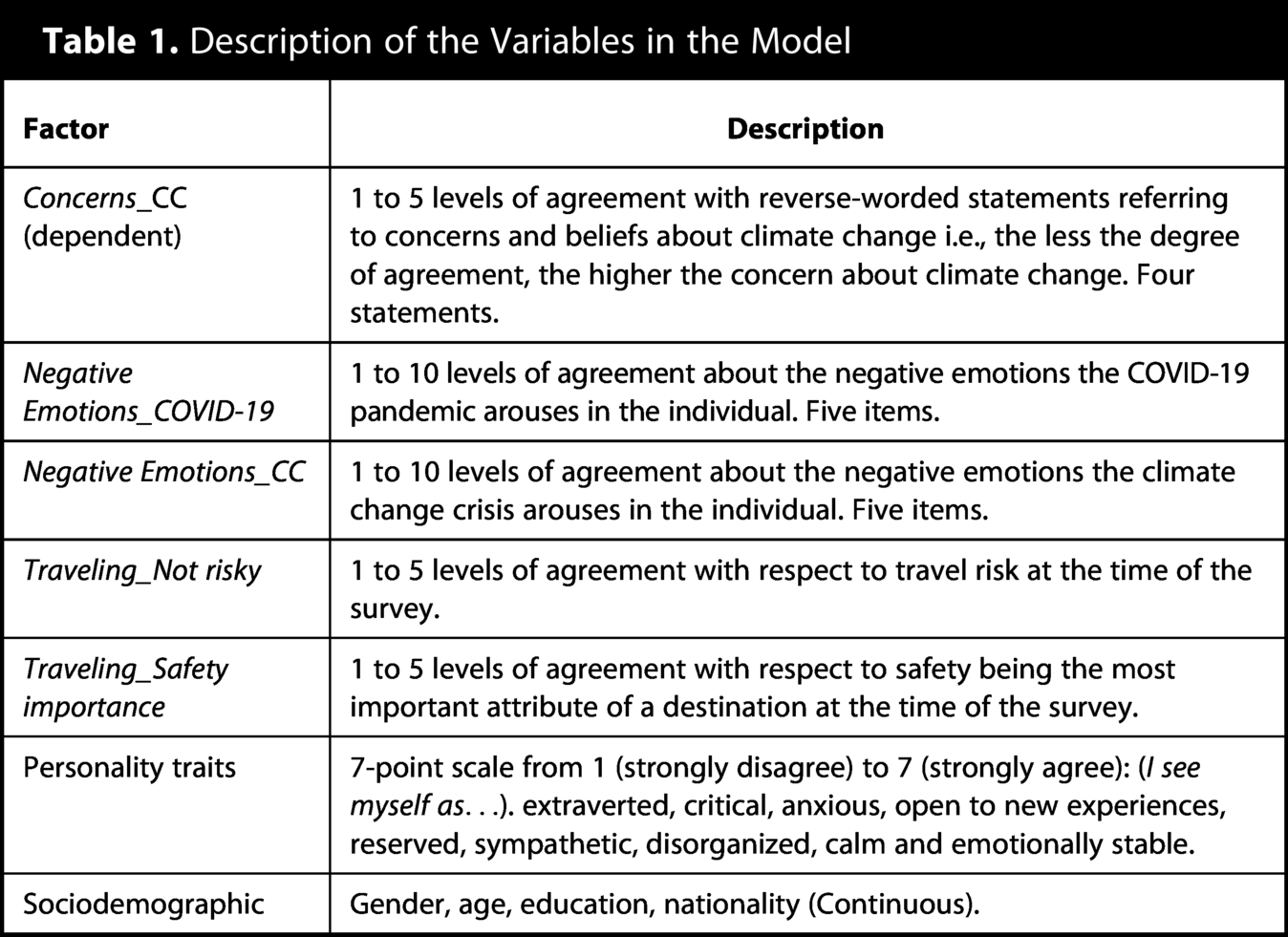
The research instrument consisted of a four-section questionnaire. The first section inquired about respondents’ socioeconomic characteristics and their self-assessed personality traits. Personality was measured by adapting Gosling’s et al. (2003) scale for the Big-Five model (Goldberg, 1990), with 8-item measures rated on a 7-point scale: extraverted, critical, anxious, open to new experiences, reserved, sympathetic, disorganized, calm, and emotionally stable. The second section assessed individuals’ travel risk perception. We used the scale developed by Floyd and Pennington-Gray (2004) with the following modification: health security, i.e., “free of COVID-19”, is the most important attribute a destination can offer. In addition, individuals were asked to assess the negative emotions—sadness, anxiety, anger, helplessness, and distress—aroused by the pandemic and regarding climate change, utilizing a scale of 1 to 10 (level of agreement) (Searle and Gow, 2010). The final section assessed individuals’ climate change concerns. We adapted four statements from the skepticism scale (Whitmarsh, 2011)-e.g., it is too early to say that climate change is a problem.
All scales were scored so that high scores indicate strong endorsement or agreement with the statement, except for items on the skepticism scale, where a low degree of agreement with the items indicates stronger endorsement or greater awareness of climate change. The use of reverse-worded items helps reduce respondents’ tendency to agree with a given item regardless of its content—acquiescence bias (Zhang et al., 2016). Table 1 describes the variables in the model. Note that the same scales and questions were utilized for the three waves.
Description of the Variables in the Model
Data Collection
The fieldwork was conducted by a specialized market research company using online consumer panels. Compared to other methods (e.g., mail or phone surveys), panels allow (1) obtaining lower item non-response rates, (2) collecting data across multiple countries faster, and (3) easily controlling for demographic sampling characteristics (Kwak and Radler, 2002). The survey was distributed to a demographically representative sample of citizens aged 18 or older from the United Kingdom, France, Sweden, and Germany, which represent the main outbound tourism markets in Europe. Individuals were screened to determine whether they had made an overseas trip and/or would plan to make one.
The first fieldwork was conducted in December 2020, 6 months into the pandemic, when travel restrictions were in place across Europe. The second was in March 2023, after the travel restrictions had been lifted. The last one, in June 2024, within the new normal. The sampling frame remained identical across waves; that is, the “post-pandemic” surveys (2023 and 2024) and sampling plan followed the same design specifications as the fieldwork conducted during the outbreak (2020). Before launching the first fieldwork, an online pre-test with 100 individuals was conducted to validate the questionnaire.
Despite different individuals being surveyed at each wave, the sample was stratified into three homogeneous groups: 2,432 individuals in the first period (38.3% of the total sample), 1982 and 1940 individuals interviewed in the second and third periods, representing 31.2 percent and 30.5 percent of the total sample, respectively. In each wave of surveys, the sample was also evenly distributed among countries (around 25 percent of completed questionnaires per country).
The survey was initially disseminated to a larger pool of potential respondents. 102 responses (40, 32, 30, respectively) were excluded from each study wave based on predefined quality and eligibility criteria: they resided outside the target markets or did not categorize as frequent travelers (reporting zero overnight trips per year).
Data collection did not require a full ethical review. Nevertheless, it adhered to the research standards of the EU General Data Protection Regulation and complied with the ISO 20252 standards for market, opinion, and social research, including data analysis. All participants voluntarily consented to participate in the survey and were informed about the purpose of the study. The data collected were anonymized and treated confidentially.
Data Analysis
The data was analyzed with Stata software. Frequency analysis and the chi-square test were used to describe the socioeconomic profile of respondents and determine whether there were significant differences in sample characteristics across waves.
The Likert-scale items measuring negative emotions, climate change concerns, and travel risk perceptions were reduced using principal component analysis (PCA) with Varimax rotation. This allowed us to extract important information from the data and express it as a reduced set of new orthogonal variables (Abdi and Williams, 2010). PCA was selected over Factor Analysis because it is more appropriate for reducing the dimensionality of items while preserving as much information as possible for use in the regression model (Schreiber, 2021). Additionally, it does not involve theory testing (Bryant and Yarnold, 1995). The PCA results are shown in the appendix (Table A1). Communalities above 0.50 and cut-off points were used to determine the variables of each factor (Deng & Li, 2019).
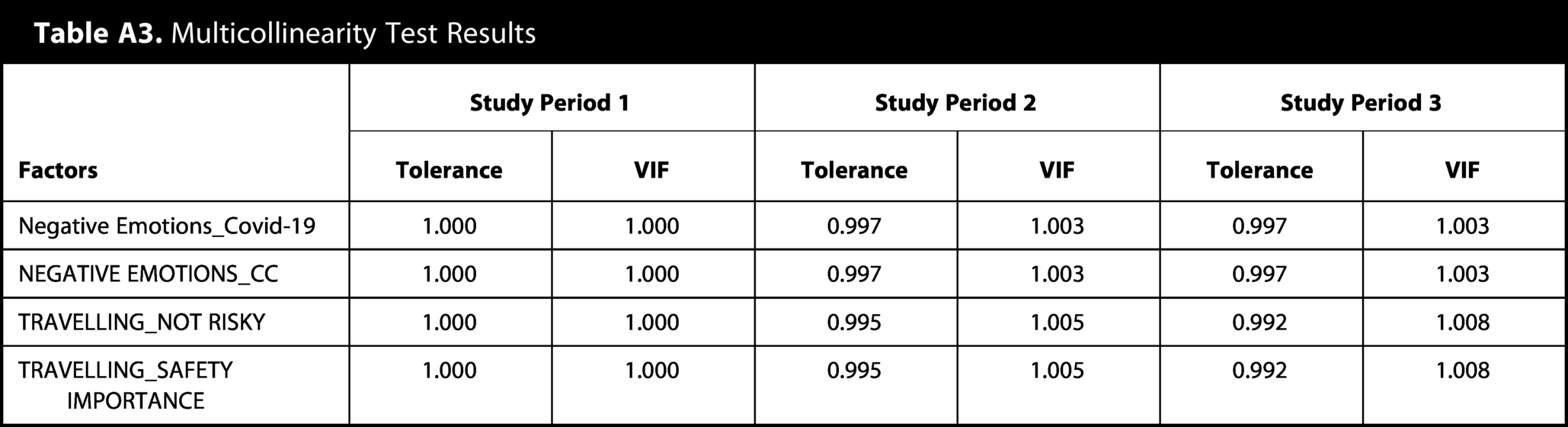
The ANOVA test enabled us to analyze the evolution of negative emotions, climate change concerns, and travel risk perceptions across the different study periods and to determine whether there were significant differences between the subsamples (Table A2). A linear regression model was run to empirically analyze the determinants of concerns across the subsamples. Sociodemographic characteristics were also included as explanatory variables in the model. Multicollinearity among the explanatory variables was assessed for each subsample using tolerance and variance inflation factor (VIF) statistics. All VIFs were below 2, indicating no multicollinearity problems (see Table A3 in the Appendix). The robustness check was done by replicating the estimates with subsamples (British, French nationalities), obtaining very similar results.
Results
Socioeconomic Profile and Personality
Table 2 shows the socio-demographics and personal characteristics of the three study samples. Only the most frequent categories are shown. No significant differences were found in the general profile of individuals across the three waves of individuals surveyed from Germany, France, the United Kingdom, and Sweden (F or χ2 p > 0.05). On average, respondents were middle-aged, university graduates and employees with a monthly income between 1,200€ and 2,800€, with a high end of more than 3,500€. With no significant differences between groups, individuals see themselves as self-disciplined, sympathetic, and open to new experiences, extroverted and enthusiastic, but also relatively reserved and quiet.
Main Socio-Demographic and Personal Characteristics of the Three Study Samples
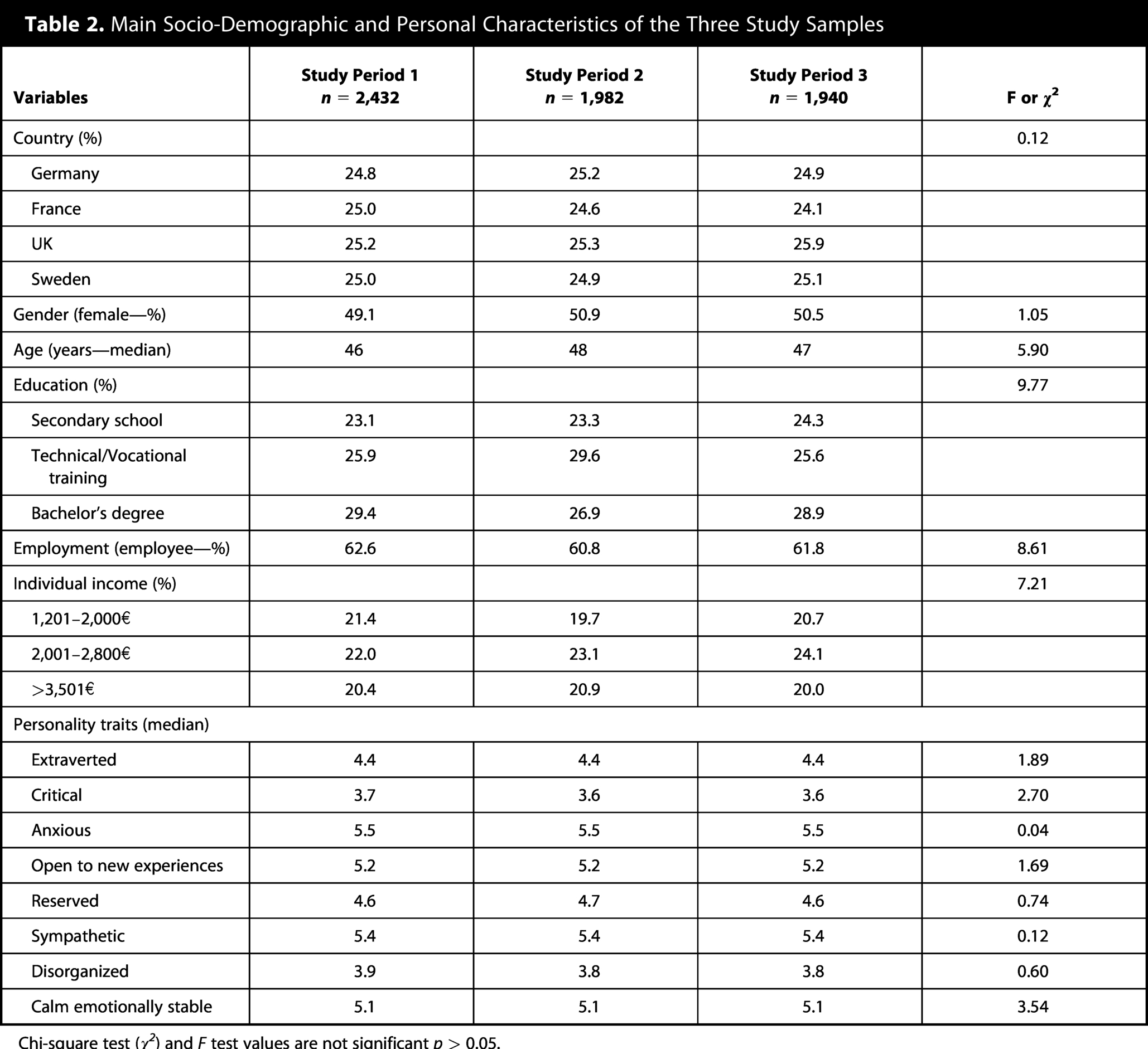
Chi-square test (χ²) and F test values are not significant p > 0.05.
Emotions, Risk Perceptions, and Climate Change Concerns Over Time
Five constructs were extracted from the PCA analysis (as shown in Appendix Table A1): two factors grouping ‘negative emotions’ (Negative Emotions_COVID-19; Negative Emotions_CC); two factors comprising the ‘travel risk’ items (Traveling _Not risky; Traveling_Safety importance); and one related to ‘climate change concerns’ (Concerns_CC). According to Cronbach’s alpha coefficients, the constructs have appropriate scale reliability. The Kaiser–Meyer–Olkin (KMO) test for sampling adequacy showed that the samples were factorable (KMO-1 = 0.909; KMO-2 = 0.957; KMO-3 = 0.927), and the significance of Bartlett’s test of sphericity confirmed the adequacy of the analyses (p < 0.001). Factors are practically stable and robust across waves, explaining 70.77 percent, 69.37 percent, and 71.30 percent of the total variance in each wave.
Negative Emotions_COVID-19 and Negative Emotions_CC explain distress, anxiety, anger, helplessness, and sadness aroused by both crises. Although eigenvalues and the percentage of explained variance indicate a strong, important pattern in the data across the three study waves, the second study period shows higher values, suggesting that the factor retains more information in this period. The opposite occurs for emotions toward climate change: the eigenvalue and percentage of variance are lower in this period, indicating a weaker pattern in the data, although it remains important.
The factor Concerns_CC measures the level of consciousness/skepticism about the origins and consequences of climate change. The eigenvalues and the percentage of explained variance remain practically the same across the waves. The factor Traveling_Not risky explains the perceived risk for traveling abroad, while Traveling_Safety importance shows the average level of importance individuals attach to traveling under health security conditions, i.e., free of COVID-19. While the last factor is stable across the study waves, Traveling_Not risky has a stronger effect in the second study period.
Table 3 shows the ANOVA results, which confirm significant differences between the subsamples for three factors: Negative Emotions_COVID-19, Negative Emotions_CC, and Traveling_Not risky. On average, individuals from the second and third periods reported feeling less sad, helpless, anxious, and distressed about the health crisis, while showing stronger negative sentiments toward climate change (Emotions_CC). Traveling was perceived as significantly less risky (Traveling_Not risky) as the pandemic situation was under better control. On the other hand, travelers’ level of concern on the climate crisis (Concerns_CC) and the importance attached to traveling safety (Traveling_Safety importance) did not significantly change across groups.
ANOVA Results
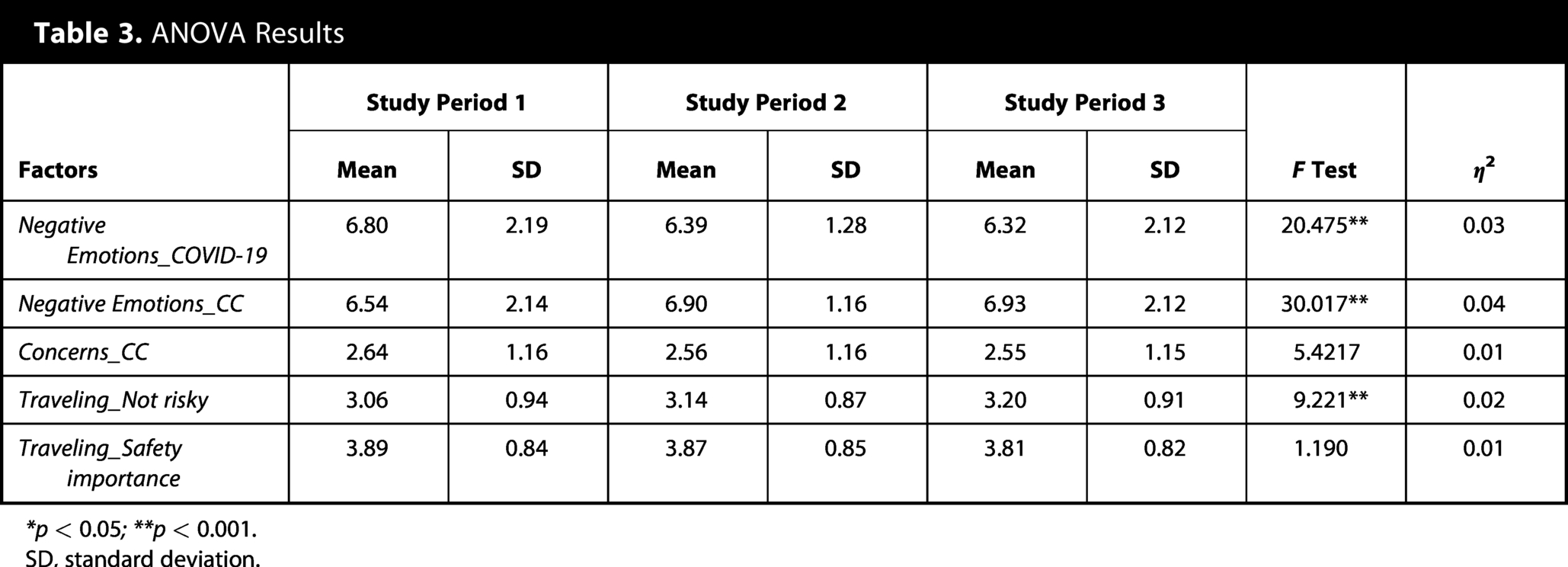
*p < 0.05; **p < 0.001.
SD, standard deviation.
The effect size for a between-groups design was calculated using η2 (Eta squared). All the values indicate small and medium effects between 0.01 and 0.06 (Abdi and Williams, 2010). Although the ANOVA analysis showed statistically significant differences for the abovementioned aspects, the η2 values indicate that the magnitudes of these differences are very small. In practical terms, this indicates that the changes are small and should be interpreted with caution.
Model Results
Table 4 presents the results of the multi-group linear regressions. The model’s explanatory weight is overall consistent across waves (R2-1 = 0.313; R2-2 = 0.261; R2-3 = 0.311), although the predictive strength for the outcome is lower in the second wave. This suggests a temporary decrease in the explained variance, which may indicate a shift in travelers’ experiences, emotions, and perceptions of travel risk.
Regression Results
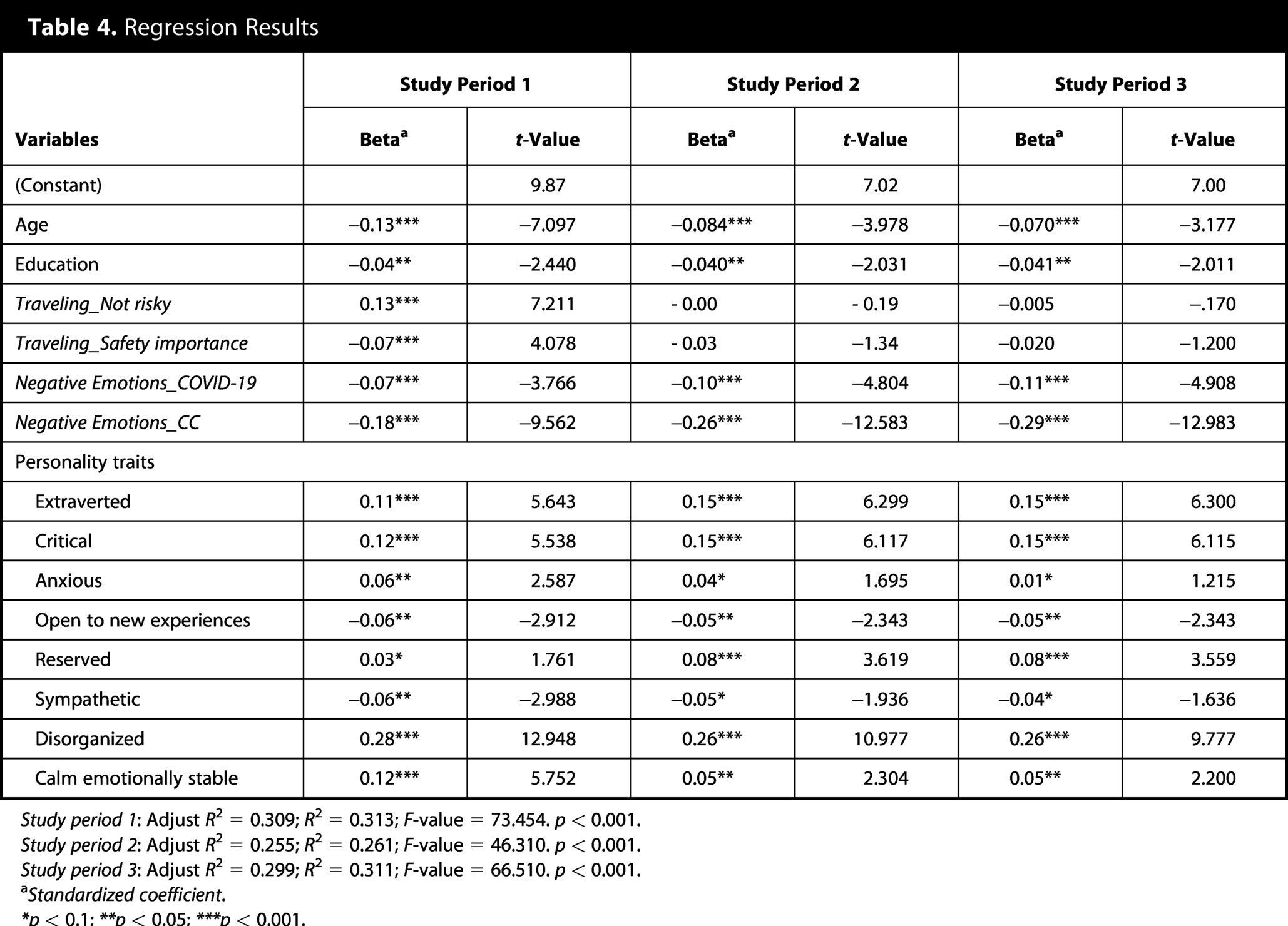
Study period 1: Adjust R2 = 0.309; R2 = 0.313; F-value = 73.454. p < 0.001.
Study period 2: Adjust R2 = 0.255; R2 = 0.261; F-value = 46.310. p < 0.001.
Study period 3: Adjust R2 = 0.299; R2 = 0.311; F-value = 66.510. p < 0.001.
aStandardized coefficient.
*p < 0.1; **p < 0.05; ***p < 0.001.
As the dependent variable (Concerns_CC) is a reverse-word factor, the interpretation of results is opposite. That is, negative signs imply that climate change concerns rise when the exogenous variable increases, while positive signs imply the opposite: climate change concerns diminish.
Age and education were significantly and negatively associated with Concerns_CC across the three study groups. This means that the older the person and the higher their level of education, the greater their awareness of the climate crisis. However, beta values for the variable age decrease in the second and third periods, suggesting that generational differences in opinion on the risks of the climate crisis are narrowing after the pandemic.
The two emotion-related factors (Negative Emotions_COVID-19; Negative Emotions_CC) have significant beta values with a negative sign in all periods. This means that the higher the anger, anxiety, and sadness because of both crises, the greater the level of concern. Negative Emotions_CC have stronger effects on concerns than Negative Emotions_COVID-19, as expected. Across periods, the values of beta coefficients of negative emotions increase, indicating that negative emotions toward both crises have more explanatory weight of concerns over time. This means that those travelers revealing the strongest negative emotions toward the climate crisis in the second and third periods were more worried about climate change than those with the same feelings in the first period.
Personality traits also significantly influence Concerns_CC. Climate concerns were greater among those individuals who defined themselves as more open to new experiences and sympathetic if compared with those who consider themselves as highly extraverted, critical, anxious, reserved, disorganized and calm. Across the three study periods, results show that concerns among the most conscious personalities—e.g., open and sympathetic travelers—are lower and less significant after the pandemic, while other personalities are more skeptical in nature—e.g., extroverts—reinforce their position.
Climate change concerns are significantly affected by travel risk perceptions only in the first period. That is, during the COVID-19 lockdown, travelers who attached greater importance to travel safety were more concerned about climate change (negative sign for Traveling_Safety importance). Meanwhile, those who perceived that traveling was not so risky during the pandemic (Traveling_Not risky) were less worried about climate change. Once travel restrictions were lifted, i.e., after the first study wave, perceptions of travel as risky or unsafe also lost significance, becoming a factor with no influence on concern.
Overall, results show that the factors impacting concerns differ in significance and effect across the periods. While travel risk perceptions no longer determine climate change concerns after the lockdown, negative emotions have a greater effect on concerns in the “new normal” than in the pandemic, with an explanatory weight higher than that of the other factors and variables in the model.
Discussion
Concern is a motivator for climate action and a precursor for decision-making (Davidson and Kecinski, 2022). However, concern for climate change can be affected by other problems and crises at any time, which may undermine the efforts needed for climate adaptation and mitigation (Duan et al., 2024). This research examines the role of COVID-19 as a long-term disruption of travelers’ emotional states and concerns for the climate.
According to our data, the COVID-19 crisis did not alter the average level of climate-related concerns across travelers, in line with Bergquist and Warshaw (2019), Evensen et al. (2021), and Sisco et al. (2020). However, since climate action and support depend on high levels of concern (Choon et al., 2019), there remains a challenge in raising awareness of climate change among travelers after the health crisis.
This study advances understanding of post-crisis climate-related concern by assessing the varying roles of personal, affective, and cognitive factors in shaping concerns over time. First, we found that age and education played a less important role in shaping individuals’ attitudes after the pandemic (Zafar and Ammara, 2024). Second, we found that some personality traits (openness to new experiences and sympathy) are less effective at predicting awareness of climate change after the pandemic. On the contrary, other traits emerge (extroverted, critical), as with greater predictability of skepticism in the post-pandemic.
Third, safety and travel risks perceptions are non-significant in explaining climate change concerns after COVID-19, suggesting that travelers’ concerns for climate change are no longer dependent on perceptions of risk in the absence of travel restrictions (Pratt and Tolkach, 2023). Fourth, we found that negative emotions have gained dominance as a primary driver of climate change concern because of the pandemic, surpassing the influence of individual characteristics, such as personality traits, and the other factors analyzed.
In this vein, this study gives empirical support to the Risk as Feeling hypothesis (Lowenstein et al., 2001), proving that a context situation such as the recent pandemic has had long term spillover effects on negative emotions toward the climate crisis, to the point that it has flooded the consciousness of some travelers that think that a changing climate is more imminent, anthropogenic and dangerous as a result of the experience lived during COVD-19. This finding addresses the lack of knowledge noted by previous authors (Stefkovics et al., 2024) regarding the implications of emotional despair among travelers after the pandemic (Droit-Volet et al., 2023; Stefkovics and Hortay, 2022).
Applications of the risk-as-feelings perspective consistently affirm that negative emotions shape judgments more powerfully than cognitive assessments (Dézma et al., 2025), and this study provides empirical data that extends this hypothesis in the context of climate change concerns and the emotional outcomes of a health crisis such as COVID-19.
Conclusions and Implications
The conclusion of the study is clear: cognitive judgments and negative emotions toward climate change operate through distinct behavioral processes but are highly interconnected. COVID-19 has had an impact on negative feelings and on their role in anchoring climate change consciousness. This helps us understand why some travelers are more worried about climate change in the “new normal”.
The fact that more conscious travelers might have become more visceral in the aftermath of the pandemic has policy implications, mainly regarding climate change communication. The greater dominance of negative emotions can be exploited as fuel to accelerate policy support (Smith and Leiserowitz, 2014). Even though the average level of concern has not increased after the pandemic, it is now relatively easier to engage in climate action for those travelers whose negative emotions have been reinforced. On the other hand, the lesser significance of socioeconomic factors post-pandemic suggests that tourism campaigns do not necessarily need to target, for instance, a specific age group of travelers (Van der Linden, 2014).
There are also shadows, as this study defends the exploitation of negative emotions to seek greater support for climate policies—e.g., hopelessness and anger are highly correlated with the sense of worry regarding climate change (Clayton, 2020), or anxiety as desirable for its capacity to induce significant behavior (Marx and Weber, 2012). But the constancy of negative emotions or the predominance of anxious mental states is an increasing trend in our society unrelated to COVID-19 (Gregersen et al., 2022). In turn, climate change communication and persuasion must be cautious to avoid undesirable consequences for mental health.
Finally, since perceived travel risks have become less impactful on post-pandemic concerns, there is scope for supporting communication detached from risk and safety issues. That is, communication efforts at destinations may be more successfully raised by working through the interplay of emotions and personality traits rather than by focusing on alerting about potential travel risks and lack of safety in the face of new climate change-induced events.
Limitations and Future Research Directions
Although the analysis in this study is limited to four European outbound tourism markets, the results can provide insights into the broader context of European travelers. This is possible as there are shared characteristics in travel behavior and cultural patterns across European countries (Blešić et al., 2022; Roman et al., 2022). In other contexts, this study cannot translate into generalizable recommendations—e.g., Australian or Chinese tourism markets—but represents a step forward in designing a methodological guide that can be utilized to replicate the same study relatively easily.
Since the results are based on self-reported concerns and emotions, there is also the possibility of response bias toward negative emotions and climate change beliefs after COVID-19. This can be addressed by comparing the current results with those observed when worsened climate change scenarios materialize over the following decades.
The results cover three periods in the evolution of the pandemic and a large sample of European citizens. Besides, the variable measurement, survey questions, and structure, sampling frame, and mode of administration were identical across waves. However, there are limitations inherent to a repeated cross-sectional design, especially related to future causal inference, if compared to a panel design. The fact that different participants are surveyed at each wave makes within-person trajectories unobservable, which may have introduced cohort effects that could not be distinguished—e.g., differences by generation or age effects.
There are also limitations inherent to the implementation of future targeted campaigns based on climate emotions, especially related to their measurement. Destinations cannot directly observe emotions unless they adopt digital monitoring systems to track emotional states of travelers based on observation and revealed preferences—e.g. face coding- which require technology and smart management of data.
This points to future research directions involving alternative source countries, and the analysis of potential transferability of results as well as delimiting causal inference boundaries. Cross-cultural validation and field experiments testing communication messages would all strengthen external validity before the adoption of wide strategies in Europe and beyond.
Footnotes
Authors’ Contributions
Conceptualization, Y.E.L.-G., J.D.L.; methodology and data curation, C.S.-R.; writing—original draft preparation, Y.E.L.-G.; writing—review and editing, J.D.L. and C.J.L.; visualization, Y.E.L.-G.; supervision, C.J.L.; funding acquisition, all. All authors have read and agreed to the published version of the manuscript.
Author Disclosure Statement
No competing financial interests exist.
Funding Information
This work has been partially supported by the Project PID2023-152064OB-I00 (VALECONCLIMATUR) funded by the
Appendix
Multicollinearity Test Results
| Factors | Study Period 1 | Study Period 2 | Study Period 3 | |||
|---|---|---|---|---|---|---|
| Tolerance | VIF | Tolerance | VIF | Tolerance | VIF | |
| Negative Emotions_Covid-19 | 1.000 | 1.000 | 0.997 | 1.003 | 0.997 | 1.003 |
| NEGATIVE EMOTIONS_CC | 1.000 | 1.000 | 0.997 | 1.003 | 0.997 | 1.003 |
| TRAVELLING_NOT RISKY | 1.000 | 1.000 | 0.995 | 1.005 | 0.992 | 1.008 |
| TRAVELLING_SAFETY IMPORTANCE | 1.000 | 1.000 | 0.995 | 1.005 | 0.992 | 1.008 |