







Abstract

Introduction
The escalating climate crisis demands an urgent and decisive transition toward low-carbon energy systems capable of delivering deep, near-term greenhouse gas (GHG) reductions. Methane, with a global warming potential 28 times that of carbon dioxide over a 100-year horizon, has emerged as a critical lever for slowing the rate of warming in the immediate decades (IPCC, 2022; Shindell et al., 2021). Biogas technology, operating through the anaerobic digestion of organic materials, presents a compelling solution at the intersection of methane abatement, renewable energy generation, and circular resource management (Kabeyi and Olanrewaju, 2022). Its climate mitigation value is twofold: it captures methane that would otherwise be released from decomposing organic waste while displacing fossil fuel consumption across power, heat, and transport sectors. Recent assessments indicate the global technical potential for biogas could supplant approximately 20 percent of current natural gas consumption, representing a substantial contribution to decarbonization strategies (Scarlat et al., 2018).
The climate rationale for biogas is further strengthened by its ability to generate co-benefits that enhance overall system sustainability. The digestate produced serves as an organic fertilizer that can improve soil carbon sequestration, while the decentralized nature of many biogas systems enhances energy access and reduces reliance on traditional biomass (Divya et al., 2015; Paustian et al., 2016). These attributes position biogas as a uniquely integrated climate solution capable of addressing both emission sources and sinks.
However, the net climate benefit of biogas systems is neither automatic nor guaranteed. Significant risks and trade-offs persist that can substantially undermine or even negate its climate value. Fugitive methane emissions from poorly maintained systems, reported to range from 2 percent to 10 percent, can erase the climate gains from fossil fuel displacement (Liebetrau et al., 2010; Jackson et al., 2020). More fundamentally, the cultivation of dedicated energy crops can trigger indirect land-use change (iLUC), release soil carbon stocks, and create a carbon debt that may require decades to repay (Searchinger et al., 2018). These complexities underscore the need for a systematic assessment framework capable of distinguishing between climate-beneficial and climate-detrimental biogas pathways.
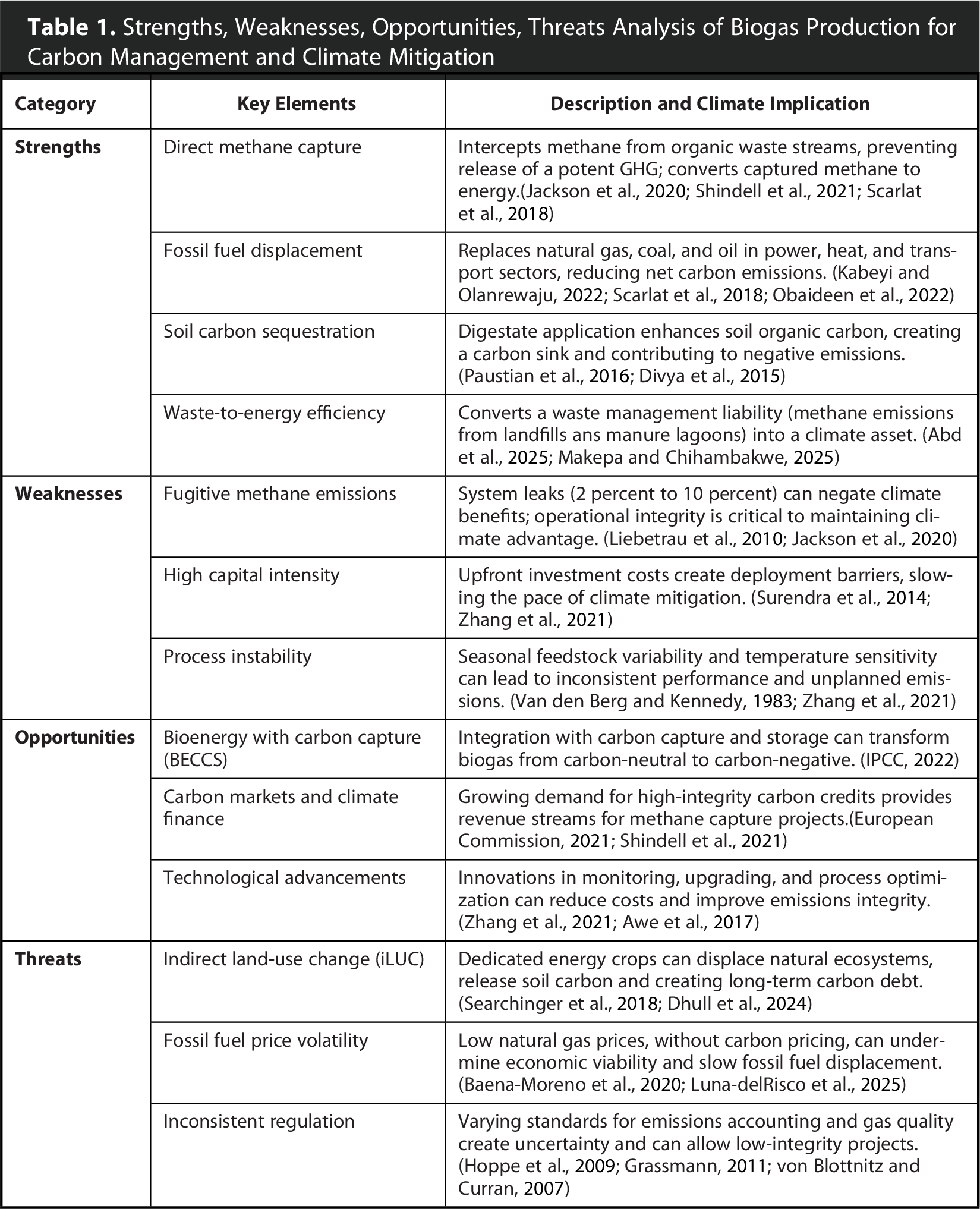
This perspective employs a descriptive review methodology structured around a Strengths, Weaknesses, Opportunities, Threats (SWOT) analysis framework to systematically investigate the role of biogas technology in climate change mitigation. The SWOT framework serves as a strategic planning tool that categorizes factors into internal elements (Strengths and Weaknesses) and external elements (Opportunities and Threats) (Weihrich, 1982). Within the specific context of climate change and carbon management, these categories are defined as follows. Strengths represent internal attributes that enhance biogas technology’s capacity to mitigate GHG emissions, effectively manage carbon, and contribute to long-term climate stability. Conversely, weaknesses constitute internal attributes that undermine its carbon mitigation potential, create unintended carbon liabilities, or compromise its overall climate integrity. Turning to external factors, opportunities encompass elements within the policy, market, or technological environment that could be leveraged to amplify the carbon benefits of biogas and accelerate its deployment as a climate solution. Finally, threats are defined as external factors that could jeopardize the carbon neutrality of biogas systems, compromise their overall climate mitigation value, or create negative climate trade-offs. The foundation of the discussion, provided in Table 1, is assembled from a comprehensive review of peer-reviewed literature, technical reports, and case studies obtained from academic journals, with particular emphasis on integrating recent findings (post-2020) concerning carbon accounting, methane emissions, and climate policy. The discussion of the specific parameters of SWOT follows.
Strengths, Weaknesses, Opportunities, Threats Analysis of Biogas Production for Carbon Management and Climate Mitigation
Strengths: Biogas as a Methane Abatement and Carbon Removal Tool
Biogas technology demonstrates exceptional strength as an integrated carbon management solution. Its primary climate function is the capture and utilization of methane that would otherwise escape to the atmosphere from decomposing organic waste. With methane accounting for approximately 30 percent of the observed rise in global temperatures since the preindustrial era, this abatement function is strategically critical for near-term climate mitigation (Shindell et al., 2021).
Beyond methane capture, biogas displaces fossil fuels across multiple sectors. When used for power generation, it reduces coal and natural gas consumption; as a vehicle fuel, it offers a lower-carbon alternative to diesel and gasoline; and for heating, it can substitute for natural gas. Research indicates that decentralized biogas systems can achieve substantial net emission reductions when properly designed and operated (Scarlat et al., 2018; Obaideen et al., 2022).
A further climate strength lies in the digestate byproduct. When applied to agricultural lands, digestate improves soil organic carbon content, contributing to carbon sequestration in terrestrial ecosystems (Paustian et al., 2016). This creates a dual climate benefit: Reducing emissions from waste while enhancing carbon sinks in agricultural soils.
Weaknesses: Internal Barriers to Climate Integrity
The climate mitigation potential of biogas faces significant internal weaknesses that can compromise its net GHG performance. Methane leakage throughout the production chain remains a critical vulnerability. Studies indicate that fugitive emissions of just 3 percent to 5 percent can eliminate the climate benefits of natural gas substitution, while higher leakage rates can render biogas systems net contributors to warming (Jackson et al., 2020; Liebetrau et al., 2010). A significant internal weakness remains the high capital intensity of biogas infrastructure. Unlike modular solar or wind technologies, biogas requires sophisticated civil engineering, gas-tight storage, and often expensive upgrading equipment for grid injection (Surendra et al., 2014; Zhang et al., 2021). These upfront costs create a structural deployment lag that slows the pace of methane abatement. Furthermore, this financial hurdle is scale-dependent: While industrial-scale plants in the Global North struggle with long-term return on investment in fluctuating energy markets (Baena-Moreno et al., 2020; Liu et al., 2014), smallholder digesters in the Global South face a complete lack of accessible credit (Surendra et al., 2014; Luna-delRisco et al., 2025). This creates a geography of climate inequity where the regions with the highest potential for waste-to-energy methane capture are often the least financially equipped to implement it (Obaideen et al., 2022; Lapiso and Roubík, 2025)
Technical limitations further constrain climate performance. Many systems, particularly in developing regions, exhibit sensitivity to low temperatures and seasonal feedstock variability, leading to process instability and inconsistent biogas yields (Van den Berg and Kennedy, 1983; Zhang et al., 2021). This instability can result in unplanned methane releases or the need for fossil-fuel backup, undermining overall emission reductions.
The high capital costs associated with digester construction, gas storage, and upgrading equipment represent a structural barrier to rapid deployment (Surendra et al., 2014). This financial hurdle slows the pace of climate mitigation and limits the scalability of the technology in the critical near-term window.
Opportunities: Leveraging External Drivers for Enhanced Climate Impact
A convergence of policy drivers, market mechanisms, and technological innovation presents significant opportunities to amplify biogas’s climate mitigation contribution. The most transformative external opportunity is the integration of bioenergy with carbon capture and storage (BECCS). Biogas systems are uniquely suited for this because the anaerobic digestion process naturally produces a high-purity stream of biogenic CO2 during the biomethane upgrading phase. Unlike the diluted postcombustion flue gases of coal or gas plants, this concentrated CO2 stream significantly lowers the energetic and financial costs of carbon capture. By geologically sequestering this biogenic carbon, biogas transitions from a carbon-neutral energy source to a carbon-negative removal technology. This allows biogas to serve a dual role: Providing dispatchable renewable energy while actively lowering the atmospheric concentration of GHGs, a critical requirement for nearly all IPCC 1.5°C pathways (IPCC, 2022).
The rapid evolution of carbon markets represents another significant opportunity. The Global Methane Pledge has elevated awareness of methane abatement as a high-impact climate strategy, creating demand for high-integrity carbon credits from biogas and other methane capture projects. These market mechanisms can provide direct revenue streams that improve project economics and incentivize deployment at scale.
Continuous technological advancements in digester design, process monitoring, and gas upgrading are steadily improving system efficiency, reducing costs, and enhancing the reliability of emissions reductions (Zhang et al., 2021). Innovations in low-cost methane sensors and remote monitoring are particularly promising for ensuring the climate integrity of distributed biogas systems.
Threats: External Risks to Climate Performance
The expansion of biogas production carries significant threats that could undermine its climate benefits. iLUC represents the most severe climate risk. When biogas production relies on dedicated energy crops rather than waste feedstocks, the cultivation of these crops can displace natural ecosystems, releasing soil carbon stocks and damaging carbon sinks (Searchinger et al., 2018). This can create a carbon debt that requires decades to repay through fossil fuel displacement, potentially rendering the system a net climate negative over a policy-relevant time horizon.
Economic competition from fossil fuels remains a persistent threat. Without robust carbon pricing mechanisms, low natural gas prices can undermine the economic viability of biogas projects, slowing deployment and perpetuating reliance on fossil energy (Baena-Moreno et al., 2020; Luna-delRisco et al., 2025). This market dynamic directly counteracts the climate objective of fossil fuel displacement.
Regulatory fragmentation poses an additional threat. Inconsistent standards for emissions accounting, gas quality, and grid access create market barriers and can allow low-integrity projects to claim climate benefits without delivering verifiable reductions (Hoppe et al., 2009; Grassmann, 2011). This undermines confidence in biogas as a climate solution and can divert investment away from high-impact applications.
Integrated Approach to Climate-Optimized Deployment
In this perspective, the SWOT analysis reveals that the climate effectiveness of biogas technology is determined by two critical pillars of deployment: Operational integrity supported by rigorous monitoring and the alignment of policy frameworks with empirical climate outcomes. As synthesized in Table 2, these pillars address the inherent vulnerabilities of the biogas lifecycle, moving the sector from production-based incentives toward a high-integrity, performance-based mitigation model.
Strategic Pillars for High-Integrity Biogas Deployment and Methane Abatement
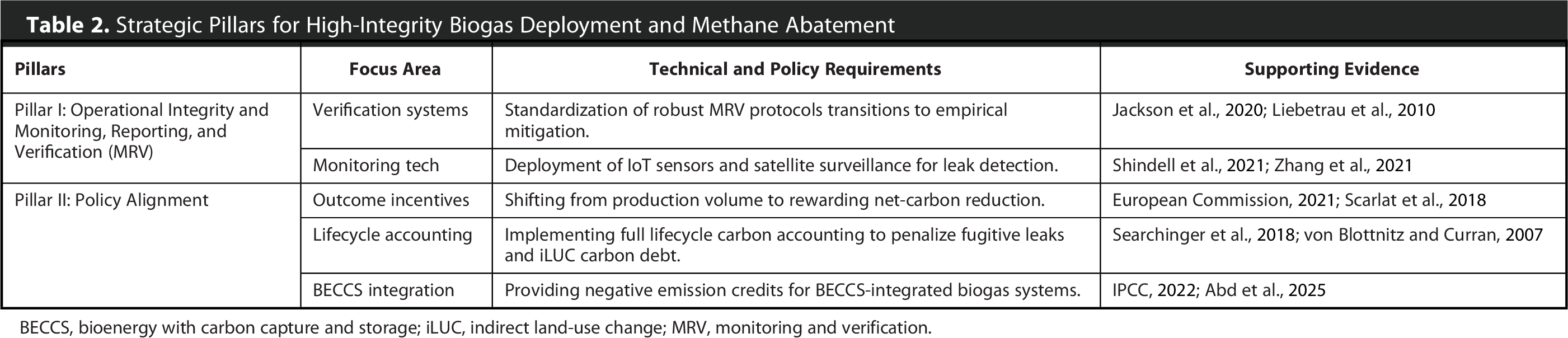
BECCS, bioenergy with carbon capture and storage; iLUC, indirect land-use change; MRV, monitoring and verification.
Pathways Forward: Quantifying and Mitigating the “Methane Gap”
To bridge the gap between theoretical climate benefits and verified performance, the biogas sector must transition from static emission factors to real-time, site-specific measurement. The reported 2 percent to 10 percent leakage rate remains a critical technical “blind spot” that can be resolved through a multitiered monitoring framework (Jackson et al., 2020; Liebetrau et al., 2010).
Advanced Monitoring Technologies
The evolution of sensor technology now enables a synergistic monitoring framework that integrates both “bottom-up” and “top-down” approaches to leak detection. At the facility level, the deployment of Internet of Things (IoT) -enabled sensor networks provides critical “bottom-up” granularity. By installing low-cost, continuous metal-oxide or laser-based point sensors across digester domes, valves, and piping, operators can achieve real-time detection of localized fugitive emissions. When these sensor arrays are integrated with Supervisory Control and Data Acquisition systems, they facilitate automated pressure-relief management and set-point optimization. This technical integration is essential for preventing the intentional venting events that frequently account for significant, yet avoidable, methane loss (Awe et al., 2017; Zhang et al., 2021).
Complementing these ground-level efforts, remote sensing and satellite monitoring offer a “top-down” perspective necessary for regional and industrial-scale oversight. High-resolution satellite constellations, such as Greenhouse Gas Satellits (GHGSat) or Methane Satellite (MethaneSAT), alongside aerial drone surveys utilizing optical gas imaging, are increasingly capable of identifying large-scale “super-emitter” events that may bypass localized detection systems. These technologies provide the transparency required to verify the climate integrity of large-scale industrial biogas hubs and regional clusters. By providing independent, verifiable data, these top-down platforms serve as a cornerstone for high-integrity carbon accounting and the validation of biogas as a reliable climate mitigation instrument (Shindell et al., 2021).
Digital Twins and Predictive Maintenance
The integration of machine learning with real-time process data offers a transformative pathway for proactive emission management. By developing “Digital Twins”—virtual replicas of physical anaerobic digesters—operators can simulate process stability under fluctuating feedstock loads and environmental temperatures (Abd et al., 2025). These computational models provide the predictive capacity to identify biological instabilities, such as those induced by seasonal variability or nutrient imbalances, before they escalate into “foaming” or over-pressurization events. Since these instabilities are the primary triggers for unplanned methane releases and intentional venting, the ability to preemptively adjust organic loading rates or thermal set points is critical for maintaining climate integrity (Van den Berg and Kennedy, 1983; Zhang et al., 2021). Ultimately, the transition toward AI-driven predictive maintenance shifts the operational paradigm from reactive troubleshooting to a preemptive mitigation strategy, ensuring that biogas facilities function as stable, low-leakage components of the global energy system.
Standardizing “Methane-Intensity” Metrics
To institutionalize climate accountability, the biogas sector must adopt a standardized “Methane-Intensity” (MI) metric, harmonizing its reporting with the rigorous performance benchmarks currently utilized in the natural gas industry. This metric quantifies fugitive emissions as a percentage of total methane throughput, providing a transparent, empirical basis for cross-sector comparison. The establishment of a “Climate-Certified Biogas” designation, contingently anchored to a verified MI threshold of less than 1.5 percent, generates a potent market signal that distinguishes high-integrity projects from those characterized by substandard operational oversight (Shindell et al., 2021; Scarlat et al., 2018). By integrating verified MI data directly into carbon credit valuation, policy frameworks can effectively internalize the cost of methane leakage. This transition shifts methane abatement from a mere regulatory compliance burden to a decisive competitive advantage, incentivizing the deployment of the advanced monitoring and predictive maintenance technologies previously discussed (European Commission, 2021; Makepa and Chihambakwe, 2025).
Conclusion and Research Priorities
This perspective presents a systematic SWOT analysis that identifies biogas as a sophisticated carbon management strategy capable of delivering immediate methane abatement and long-term carbon sequestration. At the same time, the analysis demonstrates that its climate benefits are contingent rather than inherent; fugitive methane emissions and iLUC remain critical vulnerabilities that can negate or even reverse net mitigation gains (Jackson et al., 2020; Searchinger et al., 2018). Consequently, the transition of biogas from a localized waste-management solution to a high-integrity climate asset requires a fundamental paradigm shift, moving away from production-centric models toward a performance-based “climate-optimized” framework.
The realization of this framework depends on the convergence of high-resolution monitoring and outcome-oriented policy. By bridging the “methane gap” through multi-tiered sensor integration and recalibrating economic incentives toward standardized MI metrics, the industry can establish a verifiable pathway toward net-zero contributions (Zhang et al., 2021; European Commission, 2021). In this perspective, such an evolution ensures that biogas scaling is strategically restricted to high-integrity pathways, such as waste-first feedstocks and BECCS-integrated systems, which provide definitive and quantifiable atmospheric benefits (Makepa and Chihambakwe, 2025).
Moving forward, this perspective identifies several research priorities to solidify the role of biogas in global decarbonization. Future research should prioritize empirical, longitudinal studies to quantify leakage across diverse operational scales and geographic climates, providing the data necessary to refine global emission factors (Liebetrau et al., 2010). Additionally, the technical validation and life-cycle assessment of Biogas-BECCS are required to confirm its scalability as a carbon dioxide removal pathway (IPCC, 2022). Finally, the integration of digital twins and artificial intelligence offers a promising frontier for enhancing process stability, optimizing methane yields, and preventing unplanned venting events (Abd et al., 2025). By systematically resolving these technical and regulatory vulnerabilities, the biogas sector can move beyond its historical scope as a waste-management auxiliary to function as a high-integrity, verifiable pillar of global climate mitigation.
Authors’ Contributions
S.N.F.S.A.: Study conception and design, methodology, software and analysis, validation, formal analysis, investigation, resources, data curation, writing—original draft preparation, writing—review and editing, visualization, supervision, and project administration. E.K.L.S.: Study conception and design and writing—original draft preparation. T.F.N.: Validation, investigation, and writing—review and editing
Footnotes
Acknowledgment
This work was supported by the facilities and resources of Universiti Sains Malaysia. The authors also extend their sincere gratitude to the editors and anonymous reviewers for their insightful comments and valuable suggestions, which have significantly enhanced the rigor and clarity of this article.
Author Disclosure Statement
The authors have no conflict of interest to declare.
Funding Information
No funding is involved in this study.