






Abstract
Technology is increasingly recognized as a key driver of the transition toward a circular economy, prompting growing interest in the factors that influence consumers’ intention to use mobile waste management applications. Considering recent social, economic, and technological transformations, understanding both external and internal drivers of such intentions remains essential for environmentally concerned companies and governments. This study examines the effects of financial incentives and eco-anxiety on consumers’ intention to use mobile waste management applications. A quantitative analysis was conducted using survey data from 1,503 Spanish consumers. The results show that financial incentives are positively associated with intention to use these applications, with perceived benefits mediating this relationship. In addition, financial incentives moderate the relationship between eco-anxiety and intention to use, strengthening its positive effect. These findings provide actionable insights into the design of incentive schemes and communication strategies aimed at fostering sustainable behavior.
Keywords
Introduction
The transition toward a circular economy and a sustainable development model requires innovative solutions that transform how resources and waste are managed. In this context, technology emerges as a key enabler, offering tools for both companies (eco-design, process software) and consumers (mobile applications, second-hand platforms) (Czekała et al., 2023). Smart waste management systems, such as mobile applications, are therefore gaining relevance as mechanisms to promote reuse and recycling, reduce waste generation, and decrease the extraction of natural resources.
While scientific literature has traditionally focused on the proenvironmental behavior of companies—as they are responsible for placing products on the market—recent research has emphasized the growing importance of consumer behavior in achieving sustainability goals (Hidalgo-Crespo & Amaya-Rivas, 2024; Hornik et al., 1995). Consequently, understanding the determinants of consumers’ intention to use mobile applications for waste management has become a key research priority. Previous studies grounded in behavioral theories have identified economic and emotional factors as central to proenvironmental decision-making (Ajzen, 1991; Stern, 2000).
Financial incentives such as pay-as-you-throw (PAYT) and save-as-you-throw (SAYT) systems have been widely implemented to encourage waste reduction behaviors. These mechanisms are based on the principle that consumers who generate less waste or sort it properly are financially rewarded, while those who produce more pay higher fees. Empirical evidence suggests that PAYT and similar systems can effectively reduce municipal waste and promote recycling (Romano & Masserini, 2023; Ukkonen & Sahimaa, 2021). However, their success largely depends on citizens’ acceptance and engagement, as financial incentives may not always translate into sustained behavioral change.
Beyond economic considerations, psychological dimensions are increasingly recognized as influential in shaping sustainable behaviors. Among these, eco-anxiety—the chronic fear or emotional distress related to environmental degradation—has emerged as a relevant construct in understanding proenvironmental actions (Clayton & Karazsia, 2020; Pihkala, 2020). While moderate levels of eco-anxiety can motivate individuals to adopt environmentally responsible behaviors, excessive anxiety may lead to emotional exhaustion or avoidance (Mathers-Jones & Todd, 2023). Thus, mobile applications for waste management may not only facilitate environmentally friendly behaviors but also serve as coping tools, allowing users to transform anxiety into constructive engagement.
From a consumer behavior perspective, examining economic and emotional factors in isolation provides an inherently partial understanding of the processes underlying the adoption of sustainable technologies. Whereas financial incentives capture rational and utilitarian dimensions of decision-making, emotional factors reflect internal motivations that can activate, reinforce, or inhibit action (Stern, 2000). Research on environmental behavior has highlighted that approaches focusing exclusively on one type of motivator tend to oversimplify the complexity of sociotechnical systems and the behavioral outcomes that emerge from them (Vlek & Steg, 2007). Accordingly, the joint examination of financial incentives and eco-anxiety enables a more integrated understanding of consumers’ intention to use mobile waste management applications, acknowledging that such intentions arise from the interaction between external regulatory mechanisms and internal psychological responses.
Despite the growing attention to economic and emotional factors, much of the existing research has treated these influences as analytically separate, thereby offering a fragmented view of proenvironmental decision-making. This study adopts an integrative perspective by examining how financial incentives and eco-anxiety—conceptualized as external regulatory signals and internal affective responses—interact in shaping consumers’ intention to use mobile waste management technologies. The article offers an empirical extension of established intention-based models, particularly Theory of Planned Behavior (TPB) and Technology Acceptance Model (TAM), by incorporating eco-anxiety into their explanatory structure. By jointly analyzing economic and emotional factors, the study provides additional empirical evidence on how rational evaluations and affective responses coexist within sustainability-oriented sociotechnical systems. In doing so, it contributes to a more context-sensitive application of technology adoption theories in environmental decision-making settings.
Literature Review and Hypotheses
While the scientific literature has traditionally focused on the proenvironmental behavior of companies (Alcalá et al., 2025)—since they are the ones placing products on the market—more recent academic work increasingly emphasizes the role of consumers (Hidalgo-Crespo & Amaya-Rivas, 2024; Hornik et al., 1995), as they decide what to do with a product at the end of its life cycle, which has a significant impact on sustainability.
One of the actions consumers can take to manage their waste is to use mobile applications. However, very few studies analyze people’s intention to use these technologies (Vorobeva et al., 2022), as most focus on their intention to separate waste (e.g., Kim & Nguyen, 2023).
Czekała et al. (2023) provided a review of the various existing technologies for waste management. Among them, they highlight smart garbage containers, artificial intelligence and robotics, automated vacuum collection systems, electronic waste, and e-waste management solutions. The latter includes the most popular mobile and internet applications available for waste management, such as educational platforms, food waste reduction tools, or bottle refill location services. Sinduja and Kumar (2024) integrated urban solid waste, human elements, and technology into an intelligent system based on a mobile application.
According to some authors, digitalization has a positive effect on waste separation behavior. For example, Zhang et al. (2025) analyzed the impact of digitalization on mass waste separation behavior and found a positive and significant relationship. Zhou et al. (2021) explained how an incentive-based smart recycling system increased recycling rates. Despite the topic’s relevance, there is still much to explore in the field of new technologies and artificial intelligence to improve waste management (Andeobu et al., 2022).
Understanding the determinants of consumers’ intention to use mobile applications for waste management has become a key research priority. Behavioral intention has traditionally been explained through intention-based theories such as the Theory of Reasoned Action (Fishbein & Ajzen, 1975) and the Theory of Planned Behavior (Ajzen, 1991). These frameworks conceptualize behavior as the outcome of a deliberate and reasoned process in which intention represents the immediate antecedent of action. Intentions are shaped by individuals’ evaluative beliefs about expected outcomes, perceived social influences, and their assessment of their ability to perform the behavior. Applied to digital waste management, this perspective suggests that consumers’ beliefs about the consequences, social expectations, and feasibility of using an application jointly determine their willingness to adopt such applications. Building on these frameworks, Jampala and Shivnani (2024) identified behavioral issues in waste separation in India, while Emmanouil et al. (2024) aim to improve citizen participation to comply with EU legislation. Verma et al. (2025) explored the challenges of adopting mobile recycling apps in emerging countries like India, analyzing psychological (e.g., social influence, cultural fit) and functional (e.g., ease of use, perceived value, trust, and security) facilitators within these frameworks.
Technology adoption research builds on similar assumptions. Models such as the Technology Acceptance Model (Davis, 1989) emphasize perceived usefulness as a central driver of intention, reflecting the extent to which individuals believe that using a system will enhance their performance or help them achieve valued outcomes. Together, these frameworks provide a coherent foundation for analyzing the cognitive mechanisms underlying the adoption of mobile waste management applications.
In this context, Heeremans et al. (2025) analyzed the intention to use systems for improving the sustainability of single-use packaging. Their research examined four systems. Through an online survey, they identified performance expectancy, effort expectancy, social influence, and an affective component as significant predictors of consumers’ intentions to use these systems for nonfood products. The “refill at home” system was found to be the most favored. Similarly, Wang et al. (2023) reported that affect, attitude, and social factors positively influence citizens’ intention to separate waste. The study also found that perceived benefits exert an indirect effect on intention through attitude, while facilitating conditions shape both intentions and actual waste-separation behaviors.
External factors—financial incentives
Within this intention-based perspective, financial incentives can be understood as contextual mechanisms that shape individuals’ evaluations of expected outcomes. By altering the perceived costs and benefits associated with waste-related behaviors, incentive schemes such as PAYT and SAYT may influence consumers’ attitudes toward using mobile waste management applications and strengthen the perceived usefulness of these applications.
The use of financial incentives as a strategy to improve waste management is driven by several motivations that have been empirically supported in the literature. Research has shown that financial incentives can positively influence household recycling behavior (Xu et al., 2023; Yang et al., 2022), increase the frequency of recycling activities (Hornik et al., 1995), promote waste reduction and proper waste sorting (Messina & Tomasi, 2020), and encourage both the adoption of and intention to use new technologies aimed at improving recycling separation and reducing waste generation (Vorobeva et al., 2022).
To date, the repercussions of financial incentives on environmental behavior, as well as on the intention to use waste management technology, remain unclear. Previous research has yielded highly variable conclusions (Ling & Xu, 2021; Xu et al., 2023), and it is uncertain which factors determine the effect of financial incentives. For example, Ling et al. (2021) reported a reduction in proenvironmental motivation in both the short and long term caused by financial incentives. Walid Daoud et al. (2025), on the other hand, noted an influence, but it was weaker than that of internal factors (such as awareness or responsibility). However, Xu et al. (2018), Messina & Tomasi (2020), and Yang et al. (2022) showed that financial incentives improved waste separation behavior.
Given their role as external regulatory mechanisms within intention-based models of behavior and technology adoption, financial incentives can be expected to exert an influence on consumers’ willingness to engage with digital waste management solutions. By directly linking waste-related behaviors to economic consequences, incentive schemes such as PAYT and SAYT affect consumers’ evaluative beliefs regarding the benefits of using mobile waste management applications.
Although financial incentives are widely implemented in environmental policy, empirical evidence regarding their effect on technology adoption in waste management remains fragmented. Prior research has largely examined their impact on recycling or waste reduction behaviors, rather than on the intention to adopt digital tools that support these behaviors. Moreover, the cognitive mechanisms through which incentives operate—particularly their relationship with perceived usefulness—have received limited empirical attention in this context.
Accordingly, financial incentives are expected to positively influence consumers’ intention to use mobile waste management applications, both directly and indirectly through perceived usefulness. We propose the following hypotheses. Financial incentives based on PAYT schemes have a positive effect on consumers’ intention to use mobile waste management applications. Financial incentives based on SAYT schemes have a positive effect on consumers’ intention to use mobile waste management applications. Perceived usefulness mediates the relationship between financial incentives and consumers’ intention to use mobile waste management applications.
Internal factors—eco-anxiety
Eco-anxiety, defined as the concerns and emotional distress caused by the climate crisis, exerts a complex and nonlinear influence on proenvironmental behaviors, potentially both catalyzing and inhibiting action (Mathers-Jones & Todd, 2023; Stanley et al., 2021).
Moderate levels of cognitive eco-anxiety can motivate the adoption of sustainable habits such as recycling or responsible consumption (Coates et al., 2024; López-García et al., 2025; Lutz et al., 2023; Mathers-Jones & Todd, 2023; Ogunbode et al., 2022; Sharma et al., 2024), sometimes serving as an active coping mechanism (Innocenti et al., 2023; Kühner et al., 2024), and generally increasing the likelihood of acting in line with one’s concerns (Innocenti et al., 2023; Kühner et al., 2024).
The manifestation of this relationship also depends on the type of action, distinguishing between sustainable consumption (private) and active participation (public) (Innocenti et al., 2023; López-García et al., 2025). In fact, eco-anxiety was a crucial mediator for the active participation of young people who perceived themselves as agents of change (López-García et al., 2025).
On the other hand, when eco-anxiety reaches high or chronic levels, it can lead to paralysis or avoidance (Ayassamy et al., 2024), generate hopelessness (Innocenti et al., 2023; Kühner et al., 2024), reduce self-efficacy—the belief in one’s ability to effect change (Innocenti et al., 2023; Kühner et al., 2024)—and result in “eco-paralysis,” a state of inaction (Boluda-Verdu et al., 2022; Clayton & Karazsia, 2020; Innocenti et al., 2023; Mathers-Jones & Todd, 2023). This complex relationship is moderated by interconnected factors, such as self-efficacy (Innocenti et al., 2023; Kühner et al., 2024), the perception of oneself as an agent of change (López-García et al., 2025), personal values (Kühner et al., 2024), emotional regulation (Clayton & Karazsia, 2020; Innocenti et al., 2023; Ogunbode et al., 2022), and contextual factors (Mathers-Jones & Todd, 2023; Ogunbode et al., 2022). Moreover, eco-anxiety can lead to cognitive impairment, affecting concentration, memory, and decision-making (Boluda-Verdu et al., 2022; Clayton & Karazsia, 2020; Innocenti et al., 2023), which may either drive action to regain control (Innocenti et al., 2023) or reduce self-efficacy and contribute to inaction (Boluda-Verdu et al., 2022; Clayton & Karazsia, 2020; Innocenti et al., 2023).
According to Leknoi et al. (2024), attitude is a critical and fundamental factor influencing intention to separate waste, highlighting the existence of internal factors. Other authors point to intrinsic motivation (Walid Daoud et al., 2025; Yang et al., 2022) or responsibility as behavior influencers. This implies that internal factors need to be considered in waste management behavior and intention. In our study, we focus on eco-anxiety, which has been less studied and presents variations in the results. Eco-anxiety could motivate a protective response (such as using apps that allow for the reduction of environmental impact).
Despite the growing body of research on financial incentives in environmental policy and the increasing attention to emotional drivers such as eco-anxiety, these streams of literature have largely evolved in parallel. Studies on incentive schemes have primarily focused on observable recycling or waste reduction behaviors, while research on eco-anxiety has examined its motivational or inhibiting effects on proenvironmental actions more broadly. However, limited attention has been paid to how economic and emotional factors jointly shape the intention to adopt digital tools that support sustainable practices. In particular, the combined role of financial incentives and eco-anxiety in the adoption of mobile waste management applications remains underexplored. Addressing this gap is important, as intention formation in sustainability-oriented sociotechnical systems is likely to emerge from the interaction between contextual economic signals and individual affective responses, rather than from isolated determinants.
Within this integrative perspective, eco-anxiety can be understood as an affective driver that shapes individuals’ motivation to engage in environmentally responsible behaviors. As an emotional response to environmental degradation, eco-anxiety reflects concern about ecological threats and a perceived urgency to act. In line with intention-based models, such affective states may influence behavioral intention insofar as they heighten the perceived relevance and moral salience of proenvironmental actions. In the context of mobile waste management applications, individuals experiencing higher levels of eco-anxiety may be more inclined to adopt digital tools that enable them to contribute to waste reduction and environmental improvement. Accordingly, eco-anxiety is expected to exert a positive influence on consumers’ intention to use these applications. Therefore, we propose the following hypothesis: Eco-anxiety has a positive effect on consumers’ intention to use mobile waste management applications.
However, the motivational impact of eco-anxiety may not operate independently of contextual conditions. As suggested earlier, financial incentives provide structured economic signals that can render environmentally responsible actions more tangible and instrumentally meaningful. When such incentives are present, they may channel emotional concern into more concrete behavioral intentions by reinforcing the perceived effectiveness and practical value of the action. Therefore, financial incentives are expected to strengthen the positive relationship between eco-anxiety and intention to use mobile waste management applications. On this basis, the following hypotheses are proposed: Financial incentives based on PAYT schemes positively moderate the relationship between eco-anxiety and consumers’ intention to use mobile waste management applications. Financial incentives based on SAYT schemes positively moderate the relationship between eco-anxiety and consumers’ intention to use mobile waste management applications.
Method
Data collection and sample characteristics
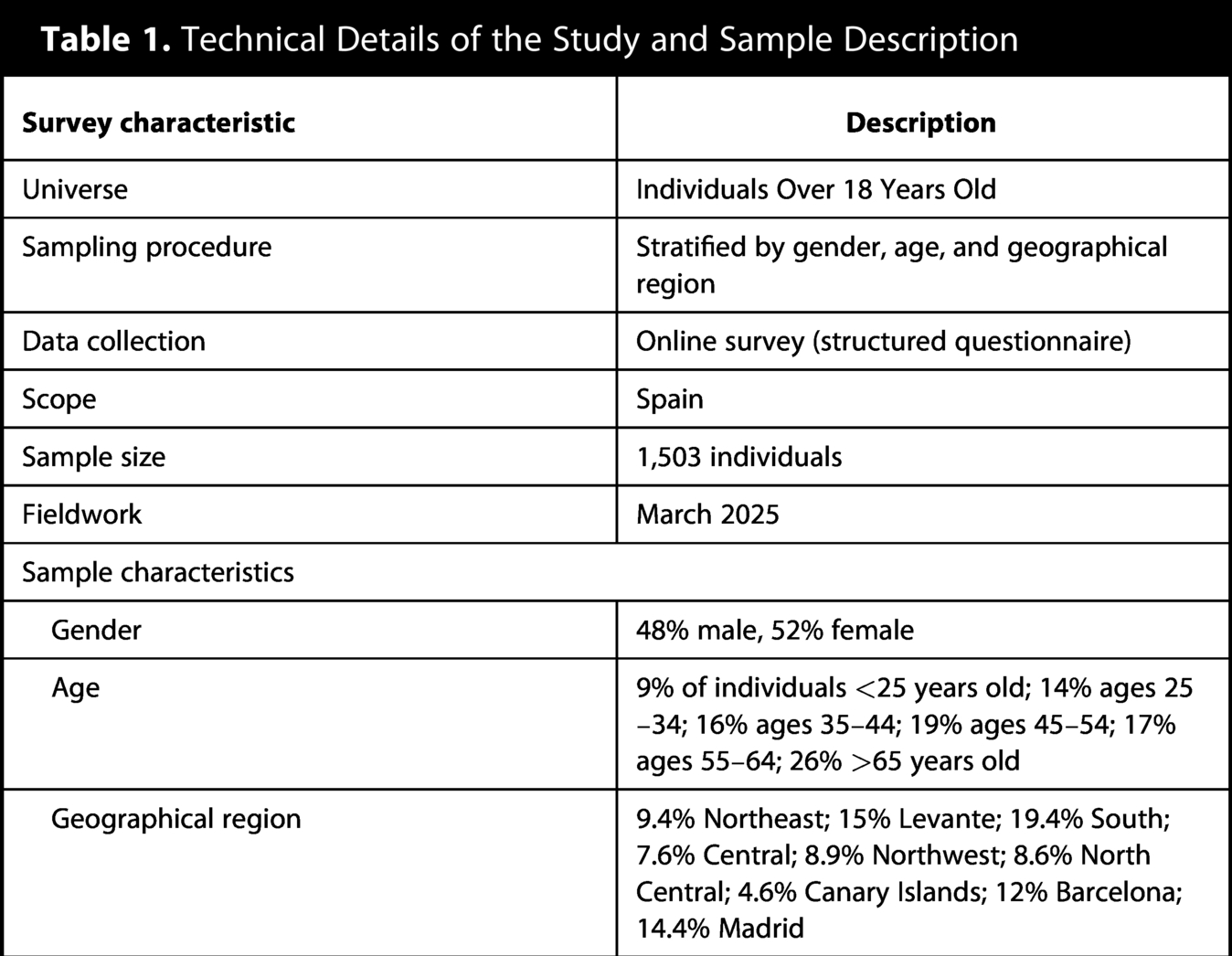
A self-administered, online survey was conducted among a randomly selected population sample of individuals over the age of 18 residing in Spain. To reach this population, invitations were distributed proportionally by gender (48% women, 52 percent men) and age quotas (9% of individuals <25 years old; 14% between the ages of 25 and 34; 16% between the ages of 35 and 44; 19% between the ages of 45 and 54; 17% between the ages of 55 and 64; and 25% >65 years old) and regional quotas (9.4% Northeast; 15% Levante; 19.4% South; 7.6% Central; 8.9% Northwest; 8.6% North Central; 4.6% Canary Islands; 12% Barcelona; and 14.4% Madrid) until the sample used in this study was obtained. In all, 1,967 invitations to participate in the study were sent. The final sample consisted of 1,503 respondents (see data description in Table 1).
Technical Details of the Study and Sample Description
Participants were assured of confidentiality in accordance with national regulations (Organic Law 3/2018, 2018) and EU Regulation 2016/679 (European Union, 2016), as well as the Helsinki Declaration (World Medical Association, 2024), regarding their rights to access, rectify, or cancel their data. Participation was voluntary and uncompensated.
Measurement instruments and statistical analysis
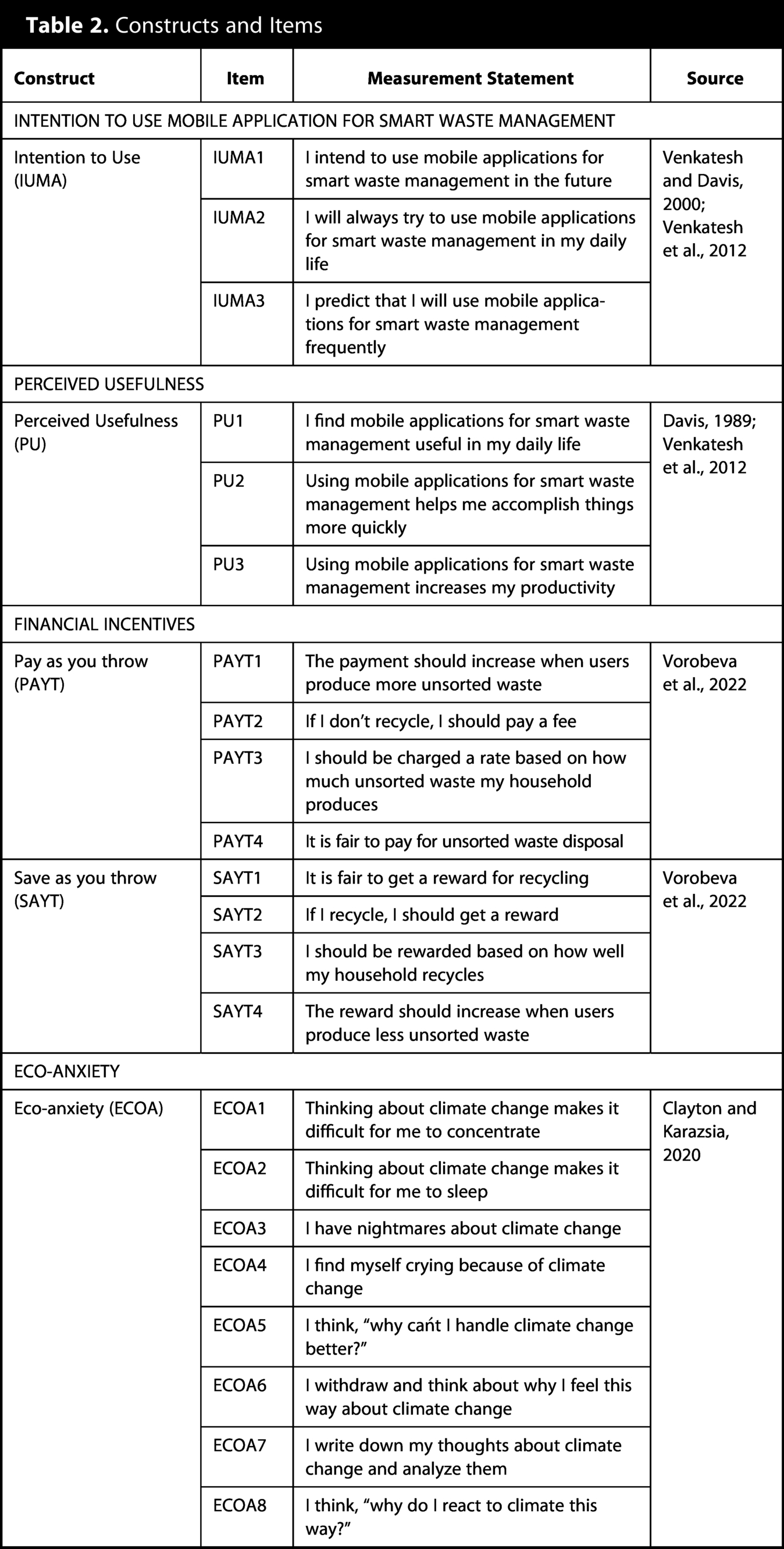
For the development of the questionnaire, questions used in previous studies were adapted (Table 2). Specifically, the measurement of each of the variables was operationalized through multi-item scales specifically developed to capture its conceptual attributes with precision. All scales used a seven-point Likert-type response format, ranging from 1 (Strongly Disagree) to 7 (Strongly Agree).
Constructs and Items
To ensure content validity and clarity of the questionnaire items, a pilot test was conducted with a convenience sample of 10 individuals. They provided qualitative feedback on the wording and structure of the questionnaire, which ensured the clarity of the instrument.
Dependent Variable
Intention to Use (IUMA), which reflects the intention to use mobile applications for smart waste management (adapted from Venkatesh & Davis, 2000). To measure it, a construct (three items) was adapted from the TAM2 scale (Venkatesh et al., 2012; Venkatesh & Davis, 2000).
Independent Variables
Perceived Usefulness (PU) is defined as “the degree to which a person believes that using mobile applications for smart waste management would enhance his or her performance” (adapted from Davis, 1989). It was measured by a scale (three items) adapted from the TAM scale (Davis, 1989).
Financial Incentives. Participants’ perceptions of the application of financial incentives for waste management behavior were evaluated using scales developed by Vorobeva et al. (2022): (1) PAYT, which focuses on payment policies (fines) for the generation of unsorted waste, and (2) SAYT, which focuses on the benefits and rewards associated with recycling. Each of these scales is composed of four items.
Eco-Anxiety. The psychological impact of climate change was measured using the Climate Change Anxiety Scale by Clayton and Karazsia (2020). Specifically, one construct was used: cognitive-emotional impairment, consisting of 8 items.
To test the research hypotheses, a sequential process was followed. First, the factors comprising the measurement scales were tested by means of exploratory factor analysis. Second, the measurement model was assessed by testing the reliability and validity of the measurement scales. Lastly, PLS-SEM was used to test whether a cause-and-effect relationship existed between the intention to use mobile applications for smart waste management and the predictor variables of the analysis model; in addition, gender, age, region, and number of people living in the household were analyzed as control variables. The partial least squares (PLS) method is based on ordinary least squares estimation and on principal components analysis and not on the calculation of the covariance. A regression analysis may be considered a special case of a PLS analysis, to which certain constraints have been applied. Statistical analysis was performed with SmartPLS 4.0 software (Ringle et al., 2024). The choice of PLS-SEM is based on its ability to handle complex models and its focus on prediction, being particularly suitable for this study (Hair et al., 2019). Moreover, it is less sensitive to violations of data normality assumptions (Chin, 1998; Ramayah et al., 2016).
Results
As shown in Figure 1, a high percentage of the individuals expressed their intention to use mobile applications for smart waste management, scoring values of 5 or higher in all three items, recognizing their intention to use these mobile applications in the future (49.23% of the total number of respondents), to always use them in their daily lives (49.43%), and to use them frequently (47.7%).
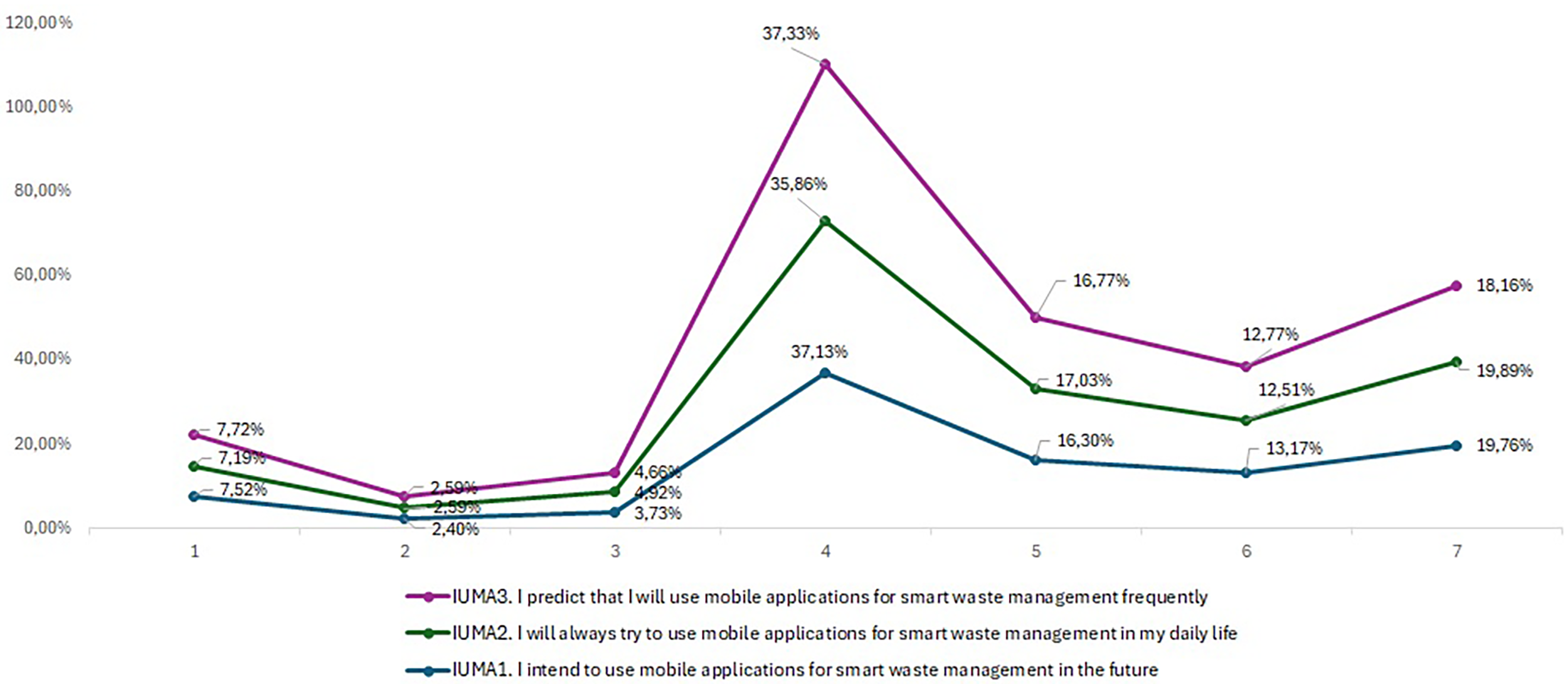
Intention to use mobile applications for smart waste management.
To examine whether significant differences existed in intention-to-use scores across gender, age, region, and number of people living in the household, Pearson’s chi-square tests were conducted. The results of the analyses showed heterogeneity in the use intentions by age, specifically in all three questions: IUMA1 (Pearson χ2 = 71.07, p = 0.000), IUMA2 (Pearson χ2 = 77.95, p = 0.000), and IUMA3 (Pearson χ2 = 79.03, p = 0.001). The results of the analyses also show statistically significant differences in the mean score of the variable IUMA2 by the number of people living in the household (Pearson χ2 = 63.53, p = 0.018).
To analyze the effect of eco-anxiety on individuals’ intention to use mobile waste management applications, as well as to measure the effects of the different types of financial incentive, and thus answer the research questions, the PLS analysis was conducted in two phases. First, the measurement model was analyzed, confirming the reliability and validity of the measurement scales of the variables: perceived usefulness (PU), financial incentives (PAYT; SAYT), eco-anxiety (ECOA), and intention to use mobile applications for smart waste management (IUMA). Second, relationships were analyzed between the dependent variable IUMA and the independent variables: PU, PAYT, SAYT, ECOA, and the interaction effects of the variables PAYTxECOA and SAYTxECOA.
Assessment of the measurement model
An exploratory factor analysis was carried out to verify the factors formed from the observable variables. The value of the Kaiser–Meyer–Olkin sample adequacy index and the Bartlett’s test of sphericity (significance level of less than 0.001) show, for all the measurement scales, the appropriateness of the analysis performed.
Table 3 summarizes the reliability and validity of the latent variables IUMA, PU, PAYT, SAYT, and ECOA. For all the observed variables, the standardized factor loadings reach significant and acceptable values, greater than 0.7, and, in many cases, close to or higher than 0.9. All constructs show very high values for the composite reliability index, above 0.7. The values achieved for the average variance extracted (AVE) are greater than 0.5 in all cases, thus verifying the convergent validity of the model.
Reliability and Validity of Constructs
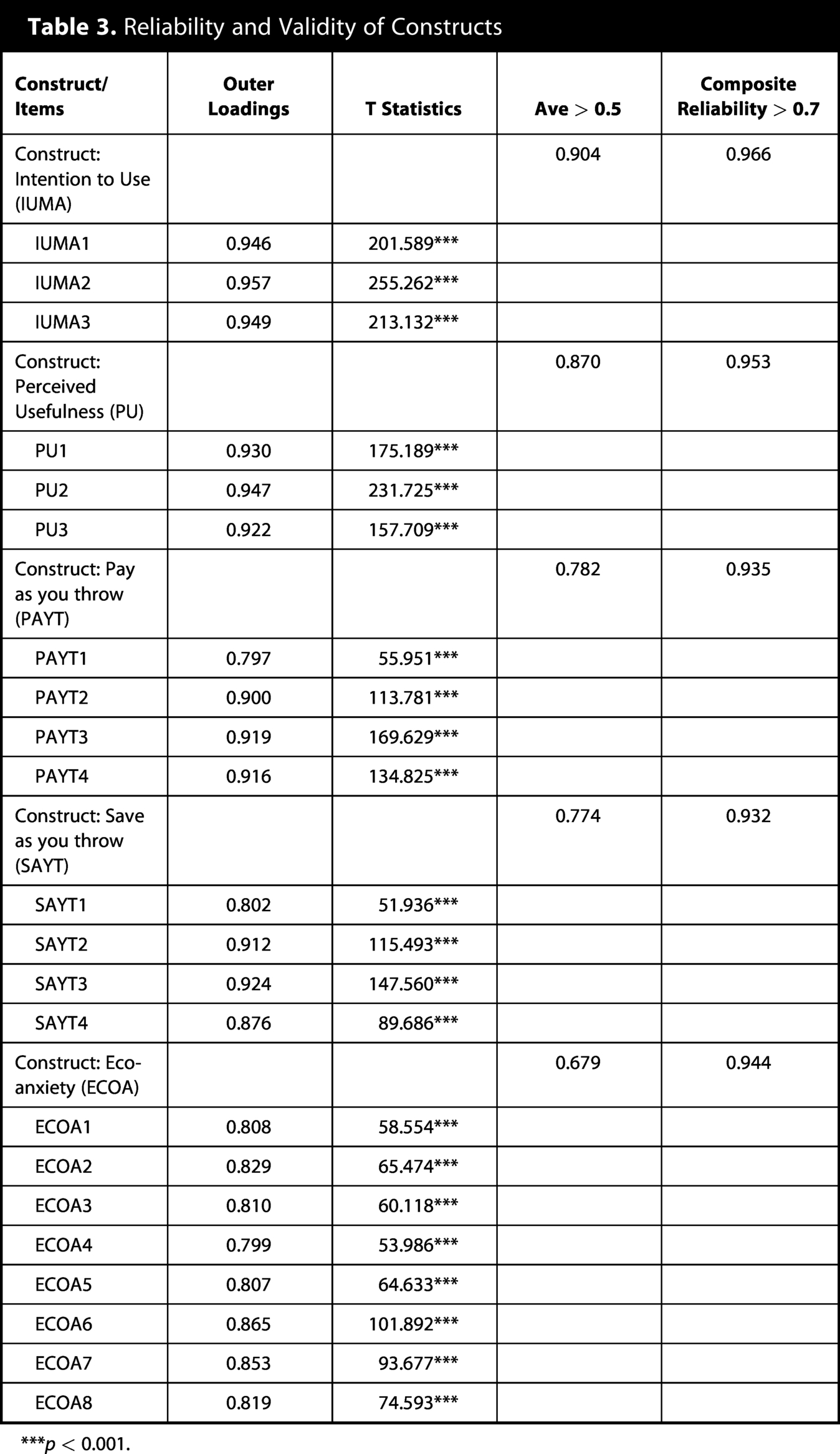
***p < 0.001.
Table 4 shows the results of the discriminant validity analysis. The square root of the AVE is greater than the correlations between the constructs for all cases. Moreover, the HTMT to measure discriminant validity shows satisfactory results with values in all cases <0.9. Table 5 shows that the model loadings were larger than the cross-loadings.
Discriminant Validity
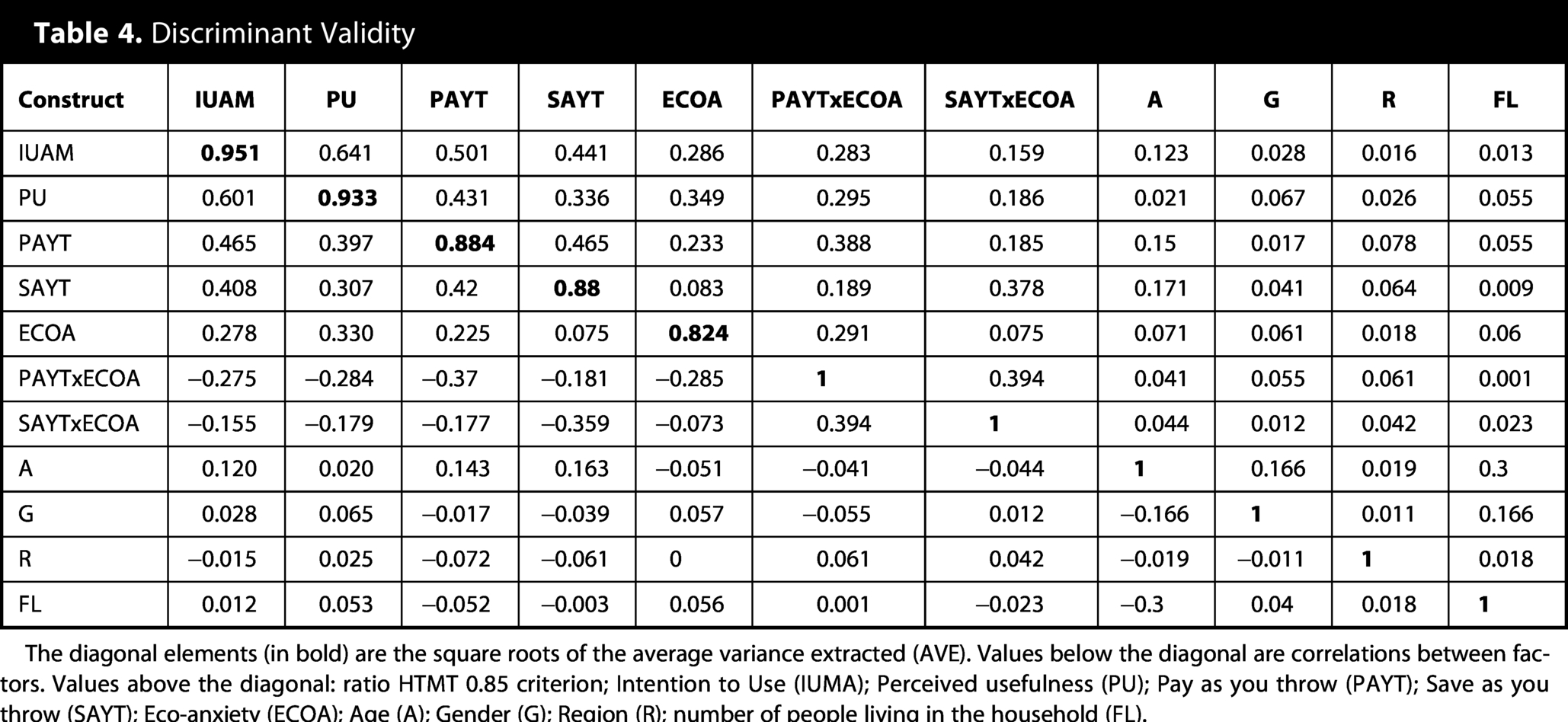
The diagonal elements (in bold) are the square roots of the average variance extracted (AVE). Values below the diagonal are correlations between factors. Values above the diagonal: ratio HTMT 0.85 criterion; Intention to Use (IUMA); Perceived usefulness (PU); Pay as you throw (PAYT); Save as you throw (SAYT); Eco-anxiety (ECOA); Age (A); Gender (G); Region (R); number of people living in the household (FL).
Cross Loadings
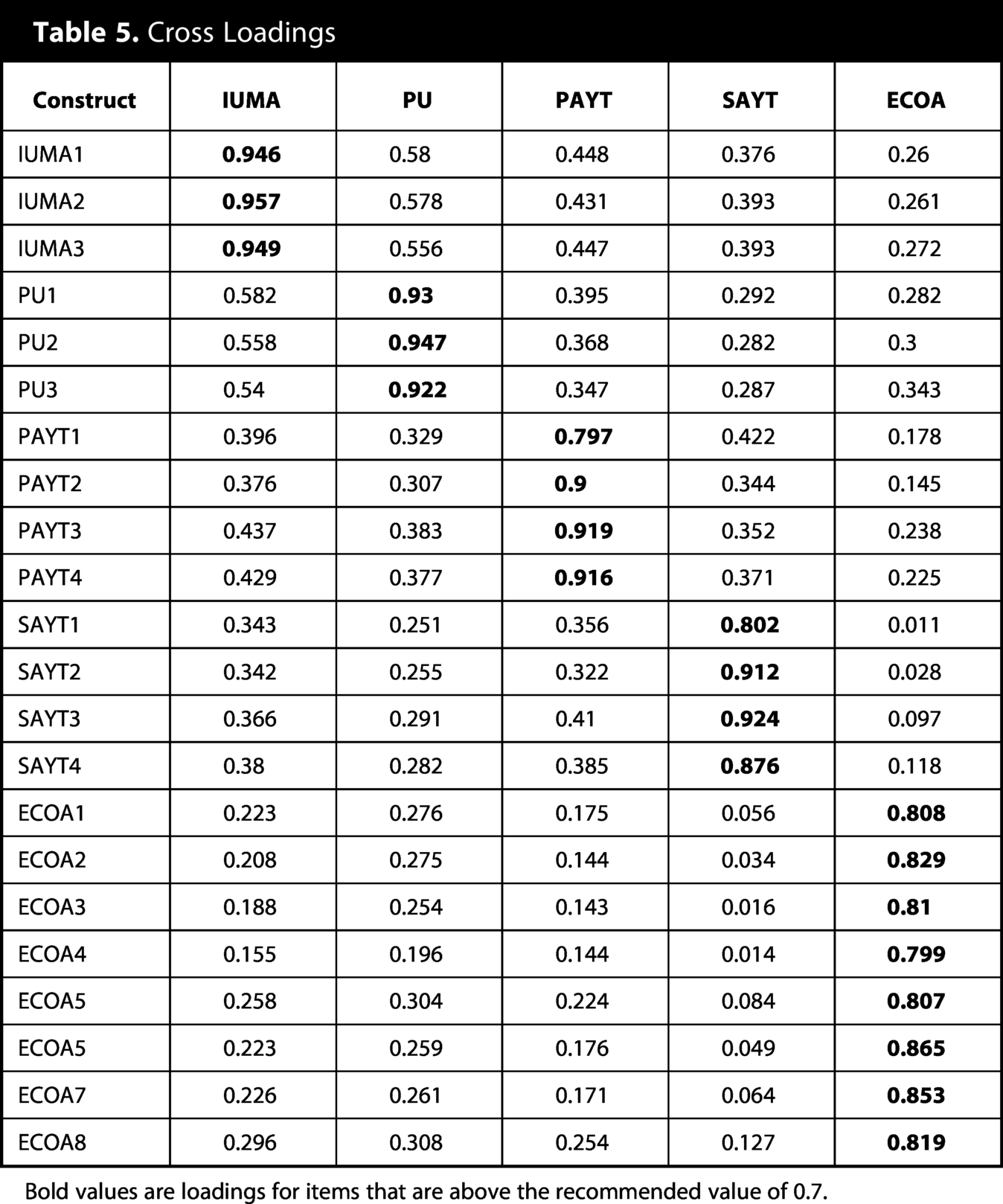
Bold values are loadings for items that are above the recommended value of 0.7.
Assessment of the structural model
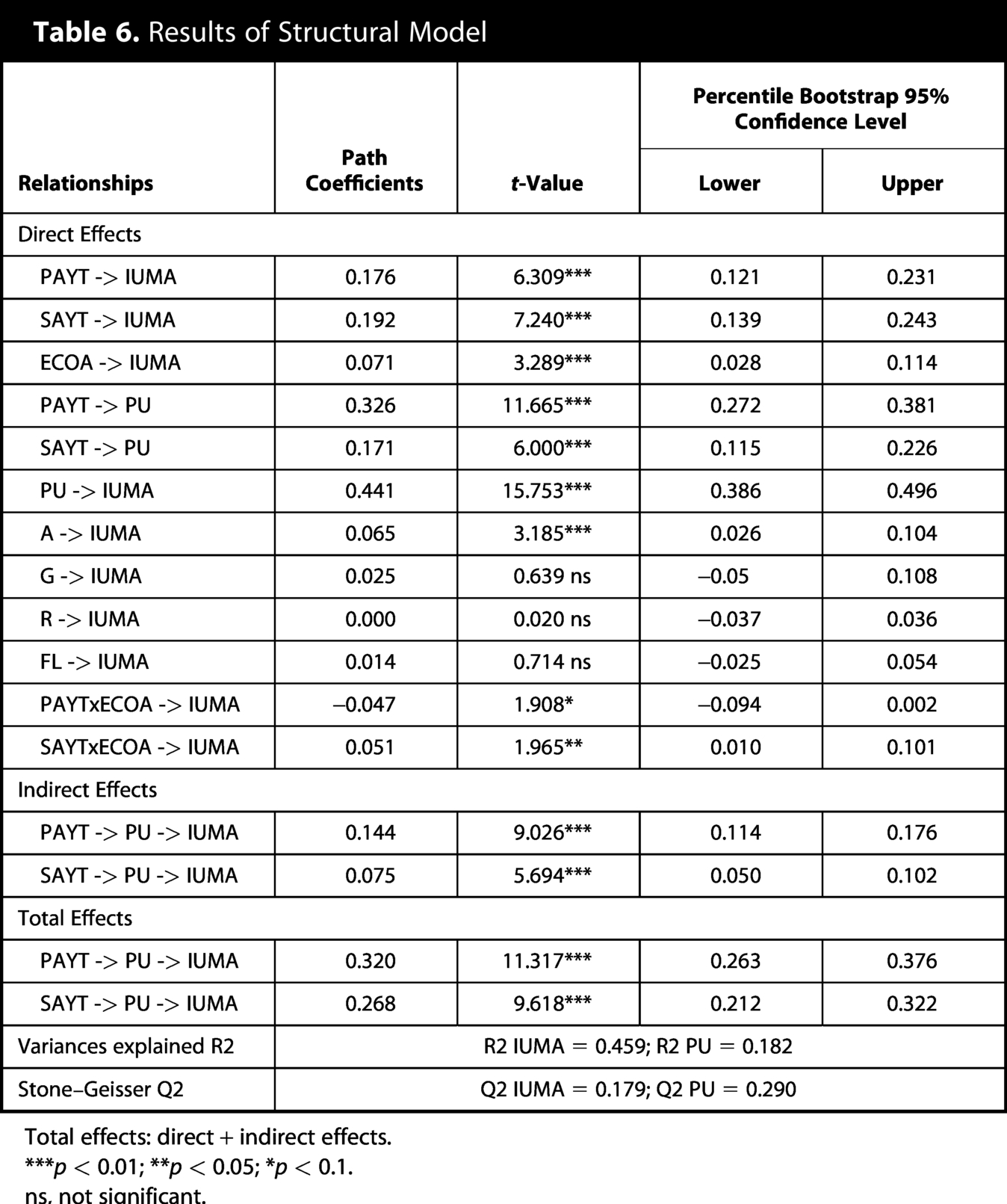
To assess the significance of the path coefficients, bootstrapping with 5,000 resamples was used (Hair et al., 2011). Table 6 shows the overall model results, namely, R2 in the dependent variable and the path coefficients.
Results of Structural Model
Total effects: direct + indirect effects.
***p < 0.01; **p < 0.05; *p < 0.1.
ns, not significant.
Data analysis confirmed our research hypotheses. The financial incentives variables, for both PAYT and SAYT variables, are positively related to the IUMA variable (path coefficients are positive and significant at a significance level of 0.01). There was also a positive relationship between financial incentives (for PAYT and SAYT, p < 0.01) and the perceived usefulness (PU variable), with this variable being the strongest predictor of the IUMA variable (path coefficient 0.441, p < 0.01). As shown in Table 6, the path coefficients measuring the indirect effects on IUMA of each of the two variables, PAYT (0.144, p < 0.01) and SAYT (0.075, p < 0.01), are statistically significant. Considering these indirect effects of financial incentives on IUMA, through the variable PU (p < 0.01), a strong total effect of the PAYT and SAYT incentives on the variable IUMA is observed (path coefficient 0.33 and 0.27, respectively, p < 0.01). These results provide empirical support for positive relationships between IUMA and the variables (PU, PAYT, and SAYT), confirming research hypotheses H1, H2, and H3. Financial incentives increase a positive attitude toward the use of mobile applications for waste management by generating tangible benefits.
On the other hand, for the Eco-anxiety variable (ECOA), it was verified that cognitive eco-anxiety is positively related to the IUMA variable (0.071, p < 0.01). Thus, confirming hypothesis H4.
In addition, analysis revealed some significant moderator effects. Specifically, the SAYT incentives system moderates the relationships between eco-anxiety and intention to use (IUMA). The link between SAYTxECOA and IUMA variables (0.051, p < 0.05) demonstrates that the presence of a reward-based incentive further amplifies the influence of eco-anxiety on intention to use mobile applications for smart waste management (IUMA variable). The PAYT system did not show a significant moderator effect on this relationship, at the significance level of 0.05 (p = 0.056). These results provide empirical support to confirm the hypotheses H6 and did not provide sufficient empirical support for H5.
The common method bias was assessed through Variance Inflation Factor (VIF) values of the inner model. In the current study, all the VIF values are lower than 3.33; the model can be considered free from common method bias (Kock, 2015).
The explanatory power of the research model was high because the variance explained (R2) was 46 percent (see Table 6). Stone–Geisser cross-validated redundancy (Q2 > 0) confirms the model’s predictive relevance. These results show that the model was highly predictive of the IUMA use intention level. In summary, the final model explains a substantial portion of the variance in IUMA use intention, highlighting the primacy of cognitive factors, perceived usefulness, and financial incentives and revealing a nuanced role for both eco-anxiety and financial incentives.
Discussion
The results of this study corroborate existing research on the adoption of proenvironmental technologies and provide additional empirical support for intention-based models in sustainability contexts. First, the positive influence of perceived usefulness (PU) on the intention to use mobile applications is consistent with established frameworks such as TPM and TAM, confirming their applicability in digitized waste management (Hidalgo-Crespo & Amaya-Rivas, 2024; Knickmeyer, 2020). Spanish consumers, when deciding whether to adopt mobile applications for smart waste management, primarily value the perceived usefulness of the technology for accomplishing the task.
The most novel finding is related to the mediation effects found. The positive mediation effect of the perceived usefulness on the relationship between financial incentives and intention to use is particularly relevant. These results suggest a widespread recognition by consumers that financial incentives can contribute significantly to increasing their positive attitude toward the use of mobile applications, by making them perceive them as more useful. The alignment of these perceptions with the perspective of sustainability in environmental matters is evident, since the incorporation of effective technologies can contribute to more efficient and, consequently, sustainable waste management (Zhang et al., 2025; Zhou et al., 2021).
The analysis also revealed a positive effect of eco-anxiety on intention to use. This result suggests that eco-anxiety acts as a motivator, consistent with the goals of proenvironmental behavior that aims to motivate the adoption of sustainable habits to reduce environmental impacts (Coates et al., 2024; López-García et al., 2025; Lutz et al., 2023). Other authors found that, in general, moderate anxiety levels tend to increase the likelihood of acting in line with one’s concerns (Hogg et al., 2024; Innocenti et al., 2023).
Financial incentives showed a positive total effect on intention to use, confirming their role as contextual mechanisms that shape expected outcomes. Notably, PAYT showed a slightly stronger total effect than SAYT (0.32 > 0.27, p < 0.01), a result that aligns with prospect theory (Tversky & Kahneman, 1981), according to which loss aversion—such as avoiding a financial penalty—can constitute a particularly powerful direct motivator.
However, a more nuanced pattern emerged when examining interaction effects. Only SAYT significantly moderates the relationship between eco-anxiety and intention to use (0.051, p < 0.05), whereas PAYT did not. This asymmetry suggests that although penalty-based schemes may directly stimulate behavioral intention, reward-based mechanisms are more effective in amplifying the motivational impact of environmental concern. While PAYT operates through an avoidance-oriented logic centered on preventing financial loss, SAYT reflects a gain-framed, approach-oriented structure that reinforces positive engagement. For individuals experiencing eco-anxiety, the presence of a reward-based incentive may provide a constructive channel through which emotional concern is translated into intentional technological adoption. This interpretation is consistent with prior findings indicating that PAYT can discourage engagement among individuals with lower perceived proenvironmental behavior, while SAYT tends to promote system use (Vorobeva et al., 2022).
Taken together, these findings indicate that financial incentives influence proenvironmental technology adoption through distinct psychological pathways. Their effectiveness depends not only on their economic impact but also on their motivational framing and interaction with affective states. In sustainability-oriented sociotechnical systems, economic and emotional drivers do not operate in isolation; rather, their interplay shapes the formation of behavioral intentions in distinct ways.
Conclusions
This study provides both theoretical and practical insights. From a theoretical perspective, it offers empirical evidence on the joint role of financial incentives and eco-anxiety in shaping consumers’ acceptance of mobile waste management applications within established intention-based frameworks. The results suggest that these factors do not operate only as direct predictors, but through more nuanced relationships. In particular, the findings indicate that the effectiveness of financial incentives is not uniform but depends on the incentive structure (loss-based PAYT versus gain-based SAYT) as well as on users’ prior perceptions.
In practical terms, the findings offer guidance for the design of public policy and business strategies. To encourage the adoption of mobile waste management applications, communication campaigns should emphasize the usefulness of this technology.
The implementation of PAYT incentives can be more effective than SAYT, especially if they target segments of the population that are already aware of the benefits of recycling. Therefore, the organizations that design the applications should consider incorporating incentive mechanisms into app design.
Communication about the climate crisis should be balanced, encouraging action without generating paralyzing anxiety. This implies avoiding alarmist messaging, focusing instead on solutions and improvements.
As limitations, first, the cross-sectional design of this study restricts causal inference. Longitudinal studies would allow for stronger validation of the causal pathways identified. Second, the study relies on self-reported intention rather than observed behavior, which may introduce biases associated with subjective reporting. Future research should incorporate behavioral data—such as actual usage records of mobile applications—to enhance external validity. Third, the sample is limited to Spanish consumers, which restricts the generalizability of the findings. Replication in other cultural and socioeconomic contexts is needed to assess whether the relative influence of incentives or eco-anxiety varies across populations.
Future research could investigate whether incentives are merely an initial motivation to start using the application and decrease over time, or if they determine continued usage in the long term. Furthermore, it would be worthwhile to explore whether the intention to use proenvironmental applications is driven by environmental interest or if it is purely utilitarian, stemming from the expectation of rewards. Future studies could also differentiate findings based on age groups or geographical areas, as these factors may affect how rewards are valued. Rewards might not only serve as an incentive to use the application but could also help improve environmental awareness. A drawback of reward systems is the potential that they replace intrinsic motivation, leading users to only perform actions that carry a reward and even stop actions they were previously performing because they do not offer one.
In sum, the digitization of waste management represents a promising avenue, but its success will depend on a deep and nuanced understanding of consumer behavior.
Authors’ Contributions
Conceptualization: L.M.M.-V. and D.Q. Methodology: L.M.M.-V. and D.Q. Software: L.M.M.-V. and D.Q. Validation: L.M.M.-V. and D.Q. Formal analysis: L.M.M.-V. and D.Q. Investigation: L.M.M.-V. and D.Q. Resources: L.M.M.-V. and D.Q. Data curation: L.M.M.-V. and D.Q. Writing—original draft preparation: L.M.M.-V. and D.Q. Writing—review and editing: L.M.M.-V. and D.Q. Visualization: L.M.M.-V. and D.Q. Supervision: L.M.M.-V. and D.Q. Project administration: L.M.M.-V. and D.Q. Funding acquisition: L.M.M.-V. and D.Q. Both authors have read and agreed to the published version of the article.
Footnotes
Acknowledgment
The authors are grateful for the valuable contribution of the TheCircularLab team at Ecoembes in the execution of this study.
Author Disclosure Statement
The author(s) declared no potential conflicts of interest with respect to the research, authorship, and/or publication of this article.
Funding Information
No funding was received for this article.