







Abstract
Introduction:
There is consensus that telehealth may be an effective and scalable solution to the nation’s ongoing obesity crisis. However, there are concerns about the quality and safety of obesity care accessed via telehealth and particularly direct-to-consumer (DTC) telehealth. The current study sought to understand the perceptions of the efficacy, quality, and safety of care accessed via telehealth among individuals who accessed weight loss treatment via a national DTC telehealth platform.
Methods:
An online survey, originally intended for the purposes of quality improvement, was sent to individuals who had accessed weight loss treatment via a national telehealth platform. The survey, made available between June 30, 2025, and July 3, 2025, consisted of 22 questions that queried individuals about various aspects of their experience with the platform. Data were de-identified and retrospectively analyzed, with descriptive statistics used to report on the number and percentage of participants who indicated agreement with survey items.
Results:
1381 participants who accessed weight loss treatment via the platform completed the survey. Overall, participants (>70%) reported a positive experience pertaining to the quality and safety of care accessed via the platform. The majority (>80%) of participants reported a positive experience with the online clinical intake and with providers on the platform. Participants consistently (>90%) rated their overall experience with the platform as equal to or better than prior in-person health care experiences. There was variability with regard to participants’ awareness of specific safety practices implemented by the platform.
Discussion:
Our findings indicate that factors such as structured intake processes, ongoing communication with providers, and accessible educational resources may play important roles in fostering individuals’ confidence and trust in telehealth-delivered obesity care.
Introduction
Telehealth has become an increasingly popular means of accessing health care since the days of the COVID-19 pandemic, with studies showing that 20–50% of patients have sought treatment for a wide variety of conditions and across a wide variety of medical specialties via telehealth since 2021.1,2 Though precise data on the number of Americans who have sought obesity treatment specifically via telehealth are difficult to find, a compilation of evidence suggests that millions of Americans have likely used telehealth for this purpose. A recent KFF survey reported that 18% of American adults have taken a glucagon-like peptide-1 (GLP-1) medication to lose weight and/or treat a chronic condition, and 17% of these adults received their medication from an online provider or website. 3 And according to one industry report, there are now at least 100 telehealth companies that offer access to GLP-1s and other medications for the treatment of obesity. 4
Previous research has found that individuals who receive antiobesity medications (AOMs) through telehealth-delivered weight loss programs can achieve clinically meaningful weight loss on par with that seen in clinical trials and in-person health care settings.5,6 Such findings are noteworthy. Over 40% of American adults are considered to have obesity, 7 and studies show that most are unable to access treatment due to issues such as access, cost, and limited provider availability. 8 Telehealth has shown itself capable of overcoming such barriers, 8 and there appears to be consensus that telehealth can be an effective and scalable solution for the ongoing obesity crisis.9,10
However, there are also concerns with the use of telehealth, particularly direct-to-consumer (DTC) telehealth, for obesity treatment. As the authors of a 2024 New England Journal of Medicine perspective wrote, “the arguments supporting the potential benefits of DTC delivery of [AOMs] are persuasive” with the potential to reduce cost, inconvenience, and stigma while improving dependability, efficiency, engagement, and retention. 11 At the same time, they note that the quality and safety of DTC delivery of AOMs have been understudied. 11
To fill the aforementioned gaps in research, we conducted a retrospective analysis of customers who accessed obesity treatment through a national DTC telehealth platform and completed a survey exploring their attitudes, beliefs, and opinions about the quality and safety of the care they received. Specifically, we examined their overall perceptions of quality and safety, their experience with the online intake process, their sentiments toward patient-provider relationships, their opinions about the care they accessed on the platform compared to prior in-person health care experiences, and their awareness of specific safety practices employed by the platform.
Methods
Telehealth platform
Hims & Hers is a DTC telehealth platform that aims to increase access to treatment for adults aged 18 years and older with traditionally stigmatized conditions. These conditions include overweight and obesity, as well as men’s sexual health concerns such as erectile dysfunction and premature ejaculation; dermatological concerns such as hair loss; and mental health disorders such as anxiety and depression. Prospective patients seeking treatment for one of these conditions come to the platform and complete a comprehensive clinical intake that inquires about their current symptoms; family, medical, and medication history; and treatment needs and preferences. Once the intake process is complete, a medical provider licensed in the state in which the patient is seeking care reviews the information gathered during the intake and has the opportunity to follow up with the patient, if needed, to ask any remaining questions to gather additional information deemed necessary to provide care. The provider then makes an independent clinical determination as to whether treatment is appropriate, and, if appropriate, shares a diagnosis and treatment plan. All licensed medical providers furnishing care through the platform are employed or contracted by You Health, a professional corporation owned and managed by licensed health care providers. Those who provide treatment for overweight and obesity receive specialized training from You Health on obesity medicine and the treatments available through the platform and may have existing board certification in obesity medicine. Patients sign up for a subscription to receive their medication dispensed by a licensed pharmacy at regular intervals. With this subscription, patients also have access to a mobile application with multimedia content intended to educate and support patients about their specific conditions and treatment as well as unlimited access to a care team via messaging. The care team comprises physicians, nurse practitioners, and registered nurses who collaborate on patients’ care, triaging patients’ questions and concerns as appropriate.
Patients seeking weight loss treatment via the platform may be prescribed oral or injectable AOMs, depending on a number of factors including their initial weight, weight loss goals, medical and medication history, treatment preferences, and the prescribing provider’s clinical judgment. At the time of this analysis, available oral AOMs included clinically supported combinations of bupropion, naltrexone, topiramate, and metformin; available injectable AOMs included semaglutide. Following their initial prescription, patients receive ongoing medication management and can message their care team online or through the mobile app at any time with questions, concerns, or progress updates. Patients also have access to behavioral, lifestyle, and mental health content through the app. This content includes articles, blogs, and videos that provide patients with dietary advice, sample recipes, exercise programs, and mood and stress management tips.
Participants
We conducted a retrospective analysis of individuals aged 18 years and older who had accessed weight loss treatment via the Hims & Hers platform and responded to an online survey, originally administered for the purposes of quality improvement, regarding their attitudes toward the quality and safety of care provided via the platform. To be eligible to participate in the quality improvement survey, individuals had to have an active subscription to the Hims & Hers platform at the time of survey completion and review and electronically sign an online consent form describing the content and purpose of the survey. The consent form informed individuals that participation in the survey was entirely voluntary, that their participation would not affect their access to treatment via Hims & Hers, that their responses would remain confidential unless Hims & Hers received explicit permission for identifiable use, and that survey data would be used for the purposes of improving Hims & Hers’ products, services, and user experience. Individuals who completed the survey were entered into a raffle to win one of three $100 Visa gift cards.
The current study—the retrospective analysis of data from the quality improvement survey—was approved by the WCG Institutional Review Board (Protocol 001, approval #1-1913411-1) on October 30, 2025. All survey data were de-identified prior to inclusion in the study, and additional participant consent for the study was not required.
Survey
The online survey was hosted on Qualtrics, a HIPAA-compliant survey platform. The survey was developed by the Hims & Hers Customer Insights and User Experience Research team, in consultation with clinical, product, and quality experts across the organization. Prior to writing the survey, the team gathered items and themes of interest from the experts. Based upon this input, the team developed specific questions that were reviewed by the experts to assess content validity and ensure that the questions as written accurately reflected the desired themes. Following their approval, the survey items were reviewed by two senior researchers (L.G. and J.Y.) for clarity, readability, and ease of completion. The survey was then programmed into Qualtrics and underwent quality assurance prior to being made available to participants. The team conducted a logical flow test to ensure that any skip logic and branching within the survey performed as planned and tested the survey on different devices and internet browsers to ensure that the survey could be completed on desktop or mobile devices as well as on different web browsers. The team then sent a test survey to a small group of internal respondents to confirm that survey completion and data collection would go as expected.
The survey was designed to assess individuals’ attitudes toward the quality and safety of care accessed via the Hims & Hers telehealth platform. It consisted of 22 questions that queried individuals about their overall perceptions of the quality and safety of care they accessed through the platform, their experience with the online intake process, their attitudes towards the providers and care teams they interacted with through the platform, how they viewed their telehealth experience compared to prior in-person health care experiences, and their awareness of specific quality and safety measures in place on the platform. Some questions, including those asking individuals to compare their telehealth experience to prior in-person care experiences, were optional; this was to consider that some individuals may not have had recent in-person health care experiences. Individuals were able to complete the survey on their personal computer, tablet, or smartphone, with an estimated time to completion of 15 min.
Sample questions included:
“To what extent do you agree with the following statement about your experience with Hims & Hers: I fully understood the risks and benefits of the medication I was prescribed.” Participants were asked to respond using a 5-point Likert scale ranging from “strongly disagree” to “strongly agree.”
“When you first became a customer you filled out an intake form as part of that process. Thinking back to that initial experience, how would you rate the intake experience with Hims & Hers?” Participants were asked to respond using a 5-point Likert scale ranging from “strongly disagree” to “strongly agree.”
“Compared to traditional in-person healthcare you have used, how would you rate your experience with Hims & Hers in the following area: overall sense of safety and medical quality.” Participants were asked to respond using a 5-point Likert scale ranging from ‘Much worse” to “much better.”
“How aware are you of the following safety practices used by Hims & Hers: Medications sourced from FDA-regulated facilities.” Participants were asked to respond using a 5-point Likert scale ranging from “not at all aware” to “very aware.”
A link to the online survey was sent via e-mail to a random sample of 280,733 customers with an active subscription to the Hims & Hers platform between June 30, 2025, and July 3, 2025. This recruitment sample size was determined based upon the following: (1) the desire to have a total of 2000 customers receiving various types of treatment through the platform complete the survey—a sample size considered robust in consumer and user experience research12,13 and one that was meant to increase reliability and enable subgroup analyses and (2) an anticipated 1% survey completion rate based upon historical quality improvement and user experience work within the company.
Statistical analysis
We performed descriptive statistics in Microsoft Excel (Version 16.107.2) to report on available baseline demographic data for participants, as well as to indicate the number and percentage of participants who responded to survey items.
Results
Of the 280,733 individuals who received the e-mail to complete the online survey, 2399 (0.9%) individuals who accessed any type of treatment via the platform completed it. In total, 1381 (0.5%) individuals who accessed obesity treatment specifically via the platform completed it and are the subject of this analysis. Here, 335 (24%) of the 1381 participants were male and 1046 (76%) were female. Briefly, 581 (42%) participants had been engaged in treatment for <1 month at the time of survey completion, 493 (36%) participants had been engaged for 1–6 months, and 307 (22%) had been engaged for >6 months.
Participants’ overall experience related to the quality and safety of care accessed via the telehealth platform
Table 1 summarizes participants’ survey responses. Overall, participants reported a positive experience pertaining to the quality of care accessed via the telehealth platform. Participants indicated feeling well educated about their prescribed medication, with 85% (1173/1381) reporting that they fully understood the risks and benefits of their treatment and 83% (1146/1381) indicating that they received clear treatment instructions and follow-up communication about it. Participants also indicated appreciation for and confidence in the providers they interacted with via the platform and their treatment recommendations, with 83% (1056/1273) stating that they felt supported during the intake process and 82% (1132/1381) indicating that they were confident that their prescribed treatment was safe and appropriate. Participants also indicated good communication and follow-up throughout their treatment journey, with 75% (1035/1381) reporting that they felt supported over the course of time in their treatment journey, specifically when receiving educational content (992/1273; 78%), during follow-up and monitoring (942/1273; 74%), and when asking questions or requesting changes from their care team (929/1273; 73%).
Summary of Participants’ Most Common Survey Responses (N = 1381)
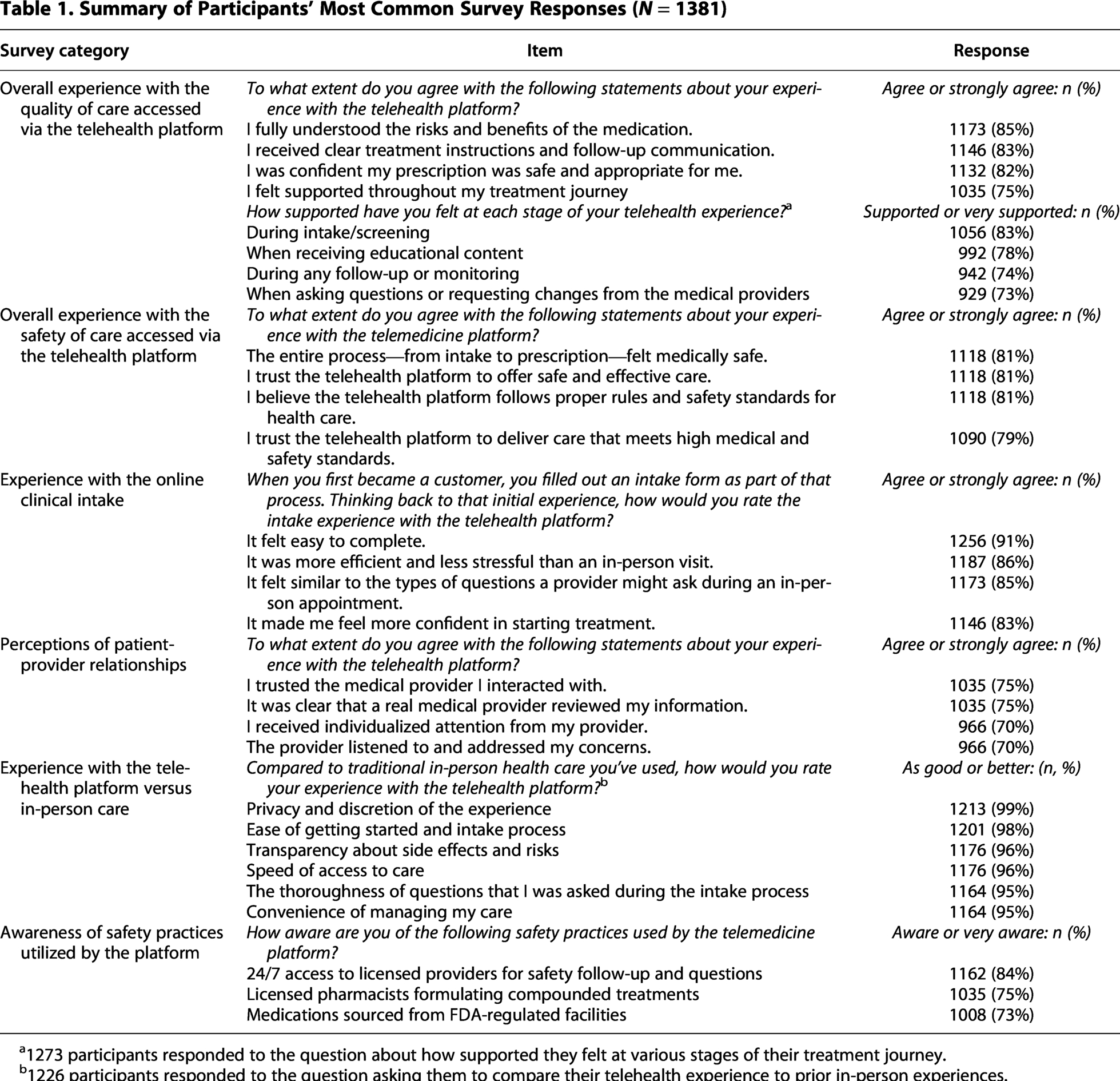
1273 participants responded to the question about how supported they felt at various stages of their treatment journey.
1226 participants responded to the question asking them to compare their telehealth experience to prior in-person experiences.
Overall, participants also reported a positive experience pertaining to the safety of care accessed via the telehealth platform. Briefly, 81% (1118/1381) stated that the process of intake and prescription on the platform felt medically safe, that they trusted the telehealth platform to offer safe and effective care, and that they believed the platform followed proper rules and safety standards for health care. Seventy-nine percent (1090/1381) reported that they trusted the platform to deliver care that met high medical and safety standards.
Participants’ experiences with the online clinical intake
The majority of participants reported having a positive experience with the online clinical intake. Ninety-one percent (1256/1381) reported that it was easy to complete. Eighty-six percent (1187/1381) reported that it was more efficient and less stressful compared to a traditional, in-person visit and that it helped them understand possible side effects of treatment. Eighty-five percent (1173/1381) reported that the questions included in the online clinical intake felt similar to the types of questions asked during a traditional, in-person visit. Eighty-three percent (1146/1381) reported that the online clinical intake process made them feel more confident in starting treatment.
Participants’ perception of patient–provider relationships
Participants reported positive experiences with providers on the telemedicine platform. Seventy-five percent (1035/1381) expressed trusting the medical provider they interacted with and said it was clear that a real medical provider had reviewed their information during the online intake process. Seventy percent (966/1381) reported that they had received individualized attention from their provider and care team. Seventy percent (966/1381) reported that the medical provider and care team members they interacted with listened to and addressed their concerns. Briefly, 72% (944/1381) reported that communication with providers via the telemedicine platform was easier than communication in traditional health care settings.
Participants’ experience with the telehealth platform versus in-person care
Briefly, 1226 participants responded to questions comparing their experience with the telehealth platform to prior in-person care. Ninety-four percent (1152/1226) reported that their overall quality of care they experienced with the platform was the same as or better than prior experience with in-person care. When asked about specific aspects of the experience, participants reported several being the same or better than previous in-person experiences. Ninety-nine percent (1213/1226) reported that the privacy and discretion afforded by the telehealth experience were the same or better than previous in-person experiences. Ninety-eight percent (1201/1226) reported that the ease of getting started and the intake process were the same or better than previous experiences. Ninety-six percent (1176/1226) reported that transparency about side effects and risks of treatment was the same or better than previous in-person experiences and that the speed of access to care was the same or better than previous in-person experiences. Ninety-five percent (1164/1226) reported that the thoroughness of questions asked during the online intake and the convenience of managing their care were the same or better than previous in-person experiences. Ninety-four percent (1152/1226) reported that the clarity of treatment options and information and the ease of communication with their care team were the same or better than previous in-person experiences. Ninety-three percent (1140/1226) reported that the follow-up support and ongoing care they received after initiating treatment on the platform and the overall sense of safety and medical quality were the same or better than previous in-person experiences. Ninety-two percent (1127/1226) reported that how well the provider listened and responded to their concerns, the personalization of their treatment plan, and their trust in the care model and medical providers were the same or better than previous in-person experiences.
Participants’ awareness of safety practices utilized by the telehealth platform
Participants’ awareness of safety practices utilized by the telehealth platform appeared to vary. Eighty-four percent (1162/1381) were aware that they had 24/7 access to a care team via messaging for safety-related questions and concerns. Seventy-five percent (1035/1381) were aware that licensed pharmacists were formulating compounded medications available through the platform. Seventy-three percent (1008/1381) were aware that the medications available through the platform were sourced from FDA-regulated facilities. Sixty-two percent (856/1381) were aware of clinical quality procedures, such as ongoing provider training and chart reviews. Fifty-nine percent (814/1381) were aware of pharmacy quality procedures, such as maintaining clean rooms and performing sterility checks.
Discussion
DTC telehealth models are frequently characterized as offering a lower standard of care than traditional health care, particularly for complex and chronic conditions such as obesity.11,14 However, findings from the present study suggest that this characterization may not align with patients’ actual experiences. Among nearly 1400 individuals who accessed obesity treatment through a national DTC telemedicine platform, the majority reported strong confidence in the quality and safety of the care they received, indicated that they were well informed about the risks and benefits of treatment, and felt supported by their medical providers and care teams throughout the treatment process.
Importantly, participants overwhelmingly rated their telehealth experience as equivalent to or better than prior in-person health care across a wide range of domains, including overall quality of care, transparency about treatment risks, ease of communication, and continuity of follow-up. Taken together, these findings suggest that DTC telehealth-delivered obesity care, when thoughtfully designed and clinically supported, may not only meet patient expectations for safe, high-quality care but may also address longstanding gaps in accessibility, engagement, and patient-centeredness that have challenged traditional care models.
Indeed, our findings extend previous work that has shown how telehealth-enabled obesity care can overcome barriers, most notably limited provider availability, access issues, and stigma, that have historically interfered with individuals’ ability to access and engage with care. As previously stated, over 40% of American adults—>100 million men and women—are considered obese. However, there are only ∼11,500 Board-certified obesity medicine physicians. 15 Wait times to see such specialists are often several months. 16 However, even if individuals are able to access care, they may refrain from doing so due to stigma. Previous research has shown that approximately one-half to two-thirds of adults with obesity have felt stigmatized by a health care provider, 17 and that such stigma is associated with lower patient trust in providers, less perceived provider empathy, and the avoidance or delay of care. 18
In our study, we found that 86% of participants believed the speed of access to care was the same or better than in-person health care experiences. Here, 86% felt that the online intake was more efficient and less stressful than in-person health care experiences. In addition, 75% trusted the medical provider they interacted with. Moreover, 70% believed that the care team members they interacted with listened to and addressed their concerns. Altogether, these findings indicate that DTC telehealth cannot only make it easier for individuals to access obesity treatment; it can also deliver care that is empathic and supportive.
Participants’ responses to other items point to several features of the telehealth model that may further explain their favorable perceptions of the quality and safety of care they accessed. Over 80% of respondents reported feeling well educated about their prescribed medications, including a clear understanding of potential risks, benefits, and side effects, suggesting that the platform’s intake and educational processes effectively supported informed decision-making. Seventy-five percent reported feeling supported not only at treatment initiation but throughout ongoing care, including during follow-up monitoring and when communicating questions or concerns to their care team. Taken together, these findings suggest that structured intake processes, ongoing asynchronous communication, and accessible educational resources may play important roles in fostering patient confidence and trust in telehealth-delivered obesity care. Rather than perceiving these elements as substitutes for traditional care, participants appeared to experience them as meaningful contributors to the quality, continuity, and safety of their treatment.
The above notwithstanding, our findings also indicate an opportunity to better educate individuals about important quality and safety practices that are or should be utilized by telehealth platforms. Briefly, <70% of participants reported being aware of specific clinical and pharmacy quality procedures employed by the platform. These included ongoing provider training, chart reviews, and maintenance of pharmacy clean rooms. It is possible that participants were unaware of such procedures because they occur behind the scenes; however, they are integral in ensuring high-quality care.
There were some limitations to our analysis. One was sampling bias. Individuals were invited, but not required, to complete the survey. Those who volunteered their time to complete the survey may have had more positive perceptions of telehealth than the general public or those who had declined to complete the survey. In addition, individuals who were dissatisfied with treatment or were concerned with the efficacy, quality, or safety of care available through the platform may have terminated their subscription and, therefore, not received an invitation to complete the survey. Another was our reliance on retrospective data pertaining to one telehealth platform. The survey was originally intended as a means of improving the experience of individuals accessing care via the Hims & Hers platform specifically. Responses may not reflect individuals’ sentiments toward telehealth as a whole. That being said, just as in-person health care settings can vary in quality, so can telehealth platforms. Findings indicate that participants found the quality and safety of care accessed via this particular platform to be good. A third limitation was our use of a survey that was developed internally and not a validated instrument. The use of a survey that was not tested for construct validity or internal consistency may limit reliability of results. A fourth limitation is that we did not collect robust demographic data, as this was outside the scope of the quality improvement project from which this survey originated. The lack of such data may limit generalizability of results. Strengths of the current study include the large sample size and diversity of survey questions.
In conclusion, with the prevalence of obesity in the United States above 40% and an increasing number of individuals looking to telehealth platforms for help losing weight, it is high time to understand how patients perceive the quality and safety of care they access through such platforms. Findings from our analysis indicate that the majority of individuals who engaged with a platform for obesity treatment had positive perceptions of the quality and safety of care they received. Future work should focus on opportunities to more systematically assess the quality and safety of care available via telehealth platforms and educate individuals on important quality and safety practices to look for when seeking care via such platforms.
Ethical Considerations
This study received ethical approval from the WCG IRB on October 30, 2025.
Consent to Participate
This study received ethical approval from the WCG IRB (approval #1-1913411-1) on October 30, 2025. This is an IRB-approved retrospective study of survey data originally collected for quality improvement. All participant information was de-identified, and participant consent for the study was not required. Participant data was not and will not be shared with third parties.
Transparency Statement
The study was conducted objectively, independent of the authors’ employment statuses. Hims & Hers Health, Inc. and You Health Medical Groups did not restrict data analysis, interpretation, or publication. The conclusions made by the authors reflect data independently of corporate oversight. No individuals, outside the authors, had access to the data, results, or article.
Declaration of Generative AI
No generative AI or AI-assisted technologies were utilized in conducting the study or preparing the article.
Data Availability
The datasets generated during and/or analyzed during the current study are not publicly available due to commercial restrictions but may be available from the corresponding author upon reasonable request.
Authors’ Contributions
J.S.Y.: Conceptualization, investigation, and writing—original draft. L.G.: Investigation, methodology, and data curation. S.M., C.P., and K.B.: Data curation and writing—review and editing. P.C.: Supervision and writing—review and editing.
Footnotes
Author Disclosure Statement
Jessica Yu, Lauren Governale, Sachie Mochia, Craig Primack, and Patrick Carroll are full-time employees of Hims & Hers Health, Inc. Knox Beasley is a full-time employee of You Health Medical Groups.
Funding Statement
This research was supported by