






Abstract
Extraversion is a fundamental personality trait that explains individual differences in behavior, cognition, and attitudes. Changes in extraversion suggest shifts in various related constructs, including self-esteem, and the number of friendships. While previous studies have reported an increasing trend in extraversion in countries such as the United States and China, temporal changes in extraversion in Japan remain unexplored. Therefore, this study examines temporal changes in extraversion in Japan using a cross-temporal meta-analysis. We collected a total of 75 data points (48 studies, n = 48,905) conducted between 2010 and 2021 that reported average extraversion scores using the Japanese version of the Ten Item Personality Inventory (TIPI-J). To assess the influence of survey year on extraversion, hierarchical multiple regression analyses were conducted, controlling for the average age and gender composition. Findings revealed a significant decline in extraversion scores over time and a significant decline in both men and women. These findings enhance our understanding of personality shifts in Japan.
Instruction
Extraversion has been widely used as a psychological concept in self-assessment personality tests. American Psychological Association (APA, 2018) defines extraversion as “an orientation of one’s interests and energies toward the outer world of people and things rather than the inner world of subjective experience.” Individuals with high extraversion are known to be active, sociable, talkative, and assertive (McCabe & Fleeson, 2012).
To measure extraversion, various scales have been developed. In recent years, researchers have often assessed extraversion as one of the five factors in the Big Five personality theory (e.g., McCabe & Fleeson, 2012). The Big Five theory is currently the most well-established framework for understanding personality in Japan (Hashimoto & Oshio, 2024). The five factors are extraversion, agreeableness, conscientiousness, neuroticism, and openness. Although developed in Western countries, studies have confirmed that these five factors also apply to Japanese populations (Yamagata et al., 2006). Among the five factors, extraversion consistently demonstrates the strongest cultural universality, with its content and meaning being essentially the same across many cultures (McCrae & Costa, 1997).
Temporal Changes in Extraversion
Previous research has indicated that extraversion increased over time in some countries. For example, in the United States, Twenge (2001) used a cross-temporal meta-analysis and has shown an increase in extraversion between 1966 and 1993. Meta-analysis is a statistical method used to combine and analyze the results of multiple studies conducted on the same theme (Shelby and Vaske, 2008). Cross-temporal meta-analysis, in particular, allows us to examine statistical data such as mean scores collected over different years, helping to understand year-by-year changes in psychological constructs (Twenge, 2001).
Similarly, in China, a cross-temporal meta-analysis has demonstrated that extraversion increased between 2001 and 2016 (Peng & Luo, 2021). Additionally, studies have shown that extraversion has been rising over time in other countries, including the Netherlands (Smits et al., 2011) and Sweden (Billstedt et al., 2013). A common trend across all countries examined is the increase in extraversion over time. 1 Across all these countries, this temporal increase was observed for both men and women, with no significant gender differences reported.
Though changes in extraversion have been examined in some countries, research on changes in extraversion in Japan has remained scarce 2 . Oshio et al., 2014 conducted a cross-temporal meta-analysis using YG Personality Test, which includes an indicator labeled as extraversion. YG test is a Japanese personality scale developed by Yatabe (1954) based on Guilford’s personality theory. However, the validity and reliability of Guilford’s personality theory have long been questioned, particularly in relation to its factor structure, which many researchers doubt for its validity and independence (Eysenck, 1972, 1977). A similar issue has been pointed out to apply to the Japanese YG test (Shimizu & Yamamoto, 2017; Wada, 1966). This criticism is thought to stem from the fact that the test’s structure, consisting of 120 items, has not been verified through factor analysis during its development (Eysenck, 1972, 1977; Shimizu & Yamamoto, 2017; Tsuzuki et al., 1970, 1971).
Contrary to YG test that has questionable validity and reliability, in recent years, personality research has widely accepted scales based on the Big Five theory as standard tools both in Japan and worldwide, with both their validity and reliability being well established (Gosling et al., 2003; Hashimoto & Oshio, 2024). Therefore, this study attempts a cross-temporal meta-analysis of extraversion using a scale based on the Big Five theory.
Investigating the temporal changes in extraversion carries broader significance. Below, three key points illustrate its importance.
Significance
First primary contribution of this study is that it provides empirical evidence regarding the inward-looking tendency (introverted: low in extraversion) among the Japanese population—a phenomenon that has long been suggested but not empirically verified. Numerous studies have argued that Japanese people, especially the younger generation, are becoming increasingly inward-looking (Burgess, 2015; Fujita, 2015; Kikuchi et al., 2015; Kobayashi, 2017; Yonezawa, 2014). For instance, Yonezawa (2014) pointed to the decrease in the number of Japanese studying abroad and the decline in new employees willing to accept overseas assignments, attributing these changes to a growing inward-looking orientation. He further explains that this trend evolved into a “national concern” for industrial, academic, and policy leaders, as they considered it a challenge to fostering the “globally competitive human resources” needed to sustain Japan’s economy (Yonezawa, 2014). While this inward-looking orientation is often cited as the cause of Japan’s declining international engagement, the extent to which it reflects an actual psychological shift in personality traits among the Japanese population has not been adequately examined (Burgess, 2015; Kikuchi et al., 2015). By empirically analyzing longitudinal changes in extraversion, this study aims to offer new insights into the validity of the increase in inward-looking tendency in Japan.
Second, changes in extraversion may also suggest changes in various related psychological constructs. Extraversion is a comprehensive trait that explains individual differences in attitudes and behaviors (Back et al., 2009; Paunonen and Ashton, 2001). Because of this, its relationship with various psychological factors—such as cognition, behavior, and attitudes—has been widely studied. For instance, extraversion has been found to have a positive relationship with concepts like self-esteem (Gebauer et al., 2015; Nushi, 2005; Schmitt & Allik, 2005) and subjective well-being (Diener & Seligman, 2002; Lynn & Steel, 2006; Tan et al., 2018). Moreover, it is positively associated with the breadth of social networks (Feiler & Kleinbaum, 2015). Given the broad psychological implications of extraversion, understanding its temporal change can provide critical insights into the cognitive, behavioral, and attitudinal changes.
A final key implication is that conducting research on temporal changes in psychological constructs itself holds significant value, particularly in Japan, where such studies remain scarce. Understanding the temporal shifts in psychological constructs provides crucial insights into societal and cultural trends. For example, in the United States, where research on changes in psychological constructs is more prevalent than in Japan, constructive discussions based on past findings have contributed to an accumulation of knowledge regarding regional changes in personality traits and social behavior (Twenge, 2013). Twenge (2013) identified an increase in self-centeredness and a growing emphasis on extrinsic values as key factors contributing to the strengthening of self-assertion and the emergence of more extraverted tendencies among young people. Based on these observations, she labeled American youth as “Generation Me.” This framework has successfully provided a clearer and more systematic explanation of cultural changes in the United States. Furthermore, by examining the economic activities and social values characteristic of Generation Me, the study has expanded insights into the broader societal impact. In contrast, Japan has relatively few such studies, making it challenging to systematically analyze cultural changes (Ogihara, 2017). This study aims to contribute to the accumulation of research in this field by examining temporal changes in extraversion in Japan.
Purpose of This Study
Based on the above, the purpose of this study is to conduct a cross-temporal meta-analysis of extraversion and examine the changes in extraversion in Japan. Furthermore, as previous research in other countries found consistent trends for both men and women, this study also examines changes in extraversion by gender to see if a similar pattern holds in the Japanese context.
Hypotheses
Below are the hypotheses of this study. First, we hypothesized that extraversion among Japanese people would decline. This prediction was based on the fact that self-esteem positively correlated with extraversion (Gebauer et al., 2015; Nushi, 2005; Schmitt & Allik, 2005), and self-esteem in Japan have been reported to decline (Ogihara, 2016; Ogihara et al., 2016; Oshio et al., 2014). 3
Regarding gender, we hypothesized that extraversion in both men and women would follow a similar trajectory. This prediction was based on findings from previous studies on temporal changes in extraversion in other countries, which have consistently shown similar trends for both men and women (Billstedt et al., 2013; Smits et al., 2011; Twenge, 2001).
Preliminary Survey
To examine the extraversion scales targeted for data collection in this study, we conducted a preliminary study. The definition and conceptual framework of extraversion can vary slightly among researchers, even within scales based on the same Big Five theory. Differences in phrasing and conceptual structure can lead to variations in extraversion scores across different scales (Gosling et al., 2003; Rentfrow et al., 2013). Therefore, in this paper, we focused on collecting data from the most commonly used scales in studies conducted in Japan.
To examine the usage of extraversion scales based on the Big Five theory in Japan, a full-text search on J-STAGE (Japan Science and Technology Information Aggregator, Electronic; https://www.jstage.jst.go.jp) was conducted. J-STAGE is an online platform operated by the Japan Science and Technology Agency (JST) that allows users to electronically access and search for academic papers and research findings in Japan. The search terms used were “extraversion,” “外向性” (“extraversion” in Japanese), “Big Five,” and “ビッグ・ファイブ” (“Big Five” in Japanese) with an OR search applied. By using an OR search, any paper containing at least one of these four terms was included in the search results. The search was limited to journal articles, and only peer-reviewed articles were considered. The publication years were restricted to the three-year period from 2020 to 2022. Studies that did not involve Japanese participants were excluded from the collection. The searches were conducted in August 2023.
Usage Frequency of Big Five Based Scales, 2020-2022
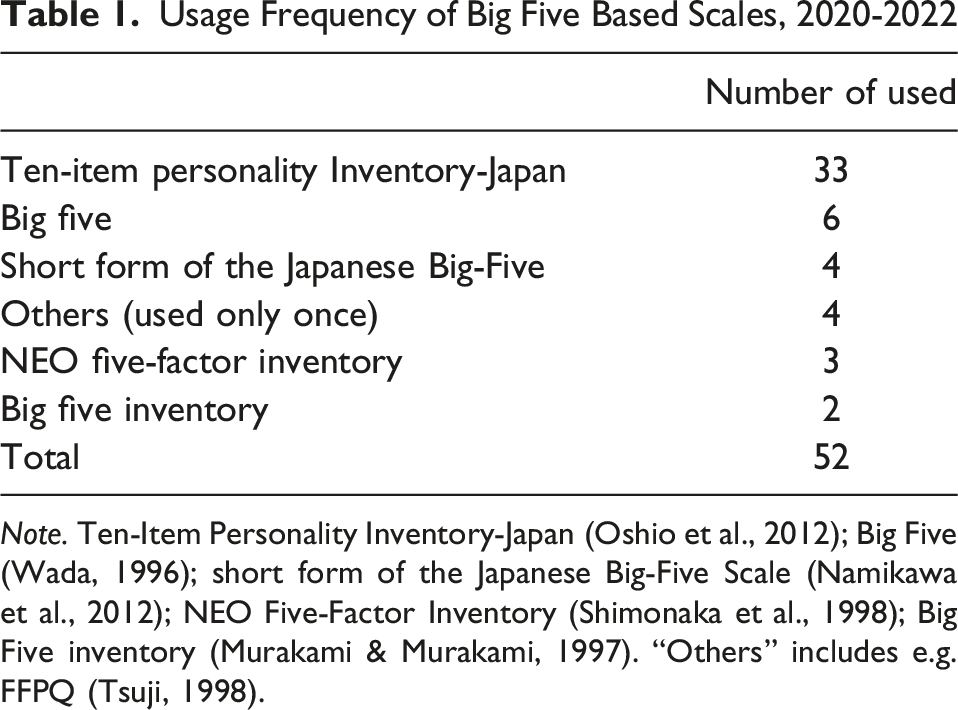
Note. Ten-Item Personality Inventory-Japan (Oshio et al., 2012); Big Five (Wada, 1996); short form of the Japanese Big-Five Scale (Namikawa et al., 2012); NEO Five-Factor Inventory (Shimonaka et al., 1998); Big Five inventory (Murakami & Murakami, 1997). “Others” includes e.g. FFPQ (Tsuji, 1998).
TIPI-J
The TIPI-J is based on the TIPI developed by Gosling et al. (2003) and was adapted for studies of Japanese participants (Oshio et al., 2012). The TIPI-J consists of 10 items, measuring the Big Five factors with two items per factor. With only 10 items, it reduces the burden on respondents while maintaining high validity and reliability in both paper-based methods and internet-based recruitment methods (Oshio et al., 2012; Takawaki & Yamada, 2019), making it widely used in recent academic research (Hashimoto & Oshio, 2024). Extraversion is measured by two items: “活発で,外向的だと思う” (I see myself as someone who is active and extravert) and “ひかえめで,おとなしいと思う” (I see myself as someone who is reserved and quiet.)
Responses were made on a 7-point scale, ranging from 1 “全く違うと思う” (strongly disagree) to 7 “強くそう思う” (strongly agree).
TIPI-J’s validity and reliability are often considered inferior to scales that utilize relatively more items (e.g., 10 items). However, the Extraversion scale of TIPI-J has been confirmed to demonstrate sufficient levels of internal consistency, concurrent validity, discriminant validity, and test-retest reliability (Oshio et al., 2012). Specifically, the correlation between its two positively and negatively keyed items, which serves as an index of internal consistency, was found to be adequate (r = −.59). Its concurrent validity with other Big Five scales was the highest among the five factors (rs = .67–.85), and its discriminant validity was also confirmed (correlations with non-corresponding scales did not exceed |.41|). Furthermore, its test-retest reliability was the highest of the five factors (r = .86) (Oshio et al., 2012). Based on these findings, the TIPI-J extraversion scale can be deemed valid for assessing longitudinal changes. 4
Method
Collection Method
To gather studies that utilized the TIPI-J scale, a full-text search was conducted using the J-STAGE academic database and CiNii Research (Citation Information by NII; https://cir.nii.ac.jp). Both are comprehensive databases for Japanese academic literatures. The search terms “TIPI-J” and “日本語版 Ten Item Personality Inventory (Japanese version of the Ten Item Personality Inventory)” were used with OR search. The search was limited to journal articles, bulletins, and conference papers. Care was taken to avoid collecting duplicates by ensuring that the same study was not later published in another journal or other format. The publication period was set from 2012 to 2022, because the TIPI-J was introduced by Oshio et al. (2012) in 2012, and studies published afterward were not yet widely available when we began our examination in August 2023.
Collected Scale
The focus was on collecting studies using the Japanese version of the Ten Item Personality Inventory (TIPI-J; Oshio et al., 2012). As we explained, preliminary survey indicated that, from 2020 to 2022, the TIPI-J was the most frequently used scale compared to other Big Five-related scales. Extraversion is measured using two items: “活発 で,外向的だと思う” (I see myself as someone who is active and extravert) and “ひかえめで,おとなしいと思う” (I see myself as someone who is reserved and quiet) on a 7-point scale, ranging from 1 “全く違うと思う” (strongly disagree) to 7 “強くそう思う” (strongly agree).
Analysis of Overall Japanese Population
This study examined the effect size of the survey year on the average scores of the extraversion scale in TIPI-J. A hierarchical multiple regression analysis was conducted in the R (version 4.4.1), with the TIPI-J extraversion scale as the dependent variable, and the following independent variables: survey year, quadratic and cubic terms of the survey year, mean age, quadratic and cubic terms of mean age, and the proportion of women in the sample. The quadratic and cubic terms for the survey year was entered in Step 2 of the analysis, after examining the linear trend in Step 1. Because extraversion has been reported to be higher in women (Kawamoto et al., 2015; Oshio et al., 2012; Terracciano et al., 2005), the proportion of women participants were included as independent variables to control for other potential influences while analyzing the temporal changes in extraversion scores. The influence of age on extraversion varies across studies. Although some Western research has reported that extraversion decreases with age, it is known that the trend differs across its facets. For instance, meta-analysis by Roberts et al. (2006) of longitudinal studies reported a complex pattern: when extraversion is divided into Social Dominance and Social Vitality, Social Dominance increases through young adulthood, whereas Social Vitality decreases toward old age. Furthermore, a large cross-sectional study by Soto et al. (2011) showed that the Activity facet of extraversion significantly decreases from late childhood to adolescence, while the Assertiveness facet tends to remain relatively flat. In contrast, studies in China have found that extraversion increases with age (Fung & Ng, 2006), suggesting that cultural factors may shape the developmental trajectory of extraversion. Additionally, cross-sectional studies conducted on Japanese samples (Kawamoto, 2016; Kawamoto et al., 2015) using the TIPI-J and HEXACO models found no significant relationship between extraversion and age. HEXACO model is a six-factor framework of personality that extends the Big Five by adding the dimension of Honesty–Humility (Ashton et al., 2004). Furthermore, research has shown that the relationship between age and extraversion differs depending on the measurement scale used (Lehmann et al., 2013). Considering these findings, the present study accounts for the potential influence of age on extraversion by including mean age and quandratic and cubic terms of mean age as a control factor. Quadratic and cubic terms of the survey year were included as independent variables to examine any curvilinear effects. The analyses were weighted based on the sample size of each study.
For papers that included the survey year (37 studies), the average difference between the survey year and the publication year was 2.31 years (SD = 1.30). Therefore, for papers that did not specify the survey year, it was estimated by subtracting two years from the publication year.
For studies that reported participants’ school grades instead of mean age (2 studies), the mean age was estimated based on the standard age for the respective grade level within the Japanese educational system. 5 For studies that reported only age brackets (e.g., 20s) (2 studies), the mean age was estimated using the midpoint of the overall range (e.g., 24.5 for the range of 20s).
Analysis of Gender-specific
After examining changes in extraversion among the Japanese population as a whole, we also analyzed changes by men and women. Even if extraversion is changing overall in Japan, it does not necessarily mean that the same trend is observed both in men and women. Changes in extraversion might not be uniform across genders. We could collect papers presenting average extraversion scores by gender, with 17 data points (11 studies) for men (n = 3,609) and 20 data points (14 studies) for women (n = 5,172), determining that the number of studies was too small to conduct a multiple regression analysis. Instead, we divided the data into two groups based on the survey year and conducted a two-way ANOVA with gender and survey year as between-subjects factors. Analyses were weighted by the sample size. Specifically, the data were split into studies conducted between 2010 and 2015 (Men: 13 data points, 7 studies, n = 3,042; Women: 7 data points, 7 studies, n = 3,710) and studies conducted between 2016 and 2021 (Men: 4 data points, 4 studies, n = 567; Women: 7 data points, 7 studies, n = 1,462). 6
Eligibility Criteria
The five eligibility criteria were established for data collection. (1) Papers that did not report the mean values or sample sizes were excluded.
This criterion was necessary because mean values and sample sizes are essential for data analysis. (2) Studies that included data from non-Japanese participants were excluded.
This criterion was set because the study aims to investigate the temporal changes in extraversion among Japanese people. (3) Studies that focused exclusively on individuals who were hospitalized, suffering from illness, or unable to live independently without support were excluded.
This criterion was included because studies have reported a strong association between specific illnesses and personality traits (Chapman et al., 2007). (4) Studies where respondents used the questionnaire to assess another person’s personality rather than their own were excluded.
This criterion was set because the focus of this study is on self-reported measures, so other-reported measures were not included. (5) In studies that conducted two surveys before and after an experiment on the same individuals, only the pre-experiment data was used.
This criterion was established because collecting data twice from the same individuals could introduce bias, and the post-experiment data might reflect the impact of the experiment on personality.
Some studies reported separate mean scores for men and women but also included participants whose gender was not specified. In such cases, we estimated the gender of these unspecified participants based on the reported gender ratio and proportionally assigned them to the men’s and women’s groups. Additionally, while some studies reported the total score for the two items of TIPI-J, others reported the mean score. This study used the mean score for analyses.
As a result of the above procedures, we were able to collect 75 data points for the final analysis, derived from the 48 studies. 7 The total sample size was 48,905 participants (24,033 men and 24,872 women). The breakdown by age group was as follows: 1 data point targeting junior high school students, 1 data point targeting high school students, 30 data points (21 studies) targeting university students, 34 data points (20 studies) targeting adults, and 9 data points (5 studies) targeting older adults aged 60 and above. The survey years within the study ranged from 2010 to 2021.
Results
Overall Japanese Population
Hierarchical Multiple Regression Analysis Predicting Extraversion (2010-2021)
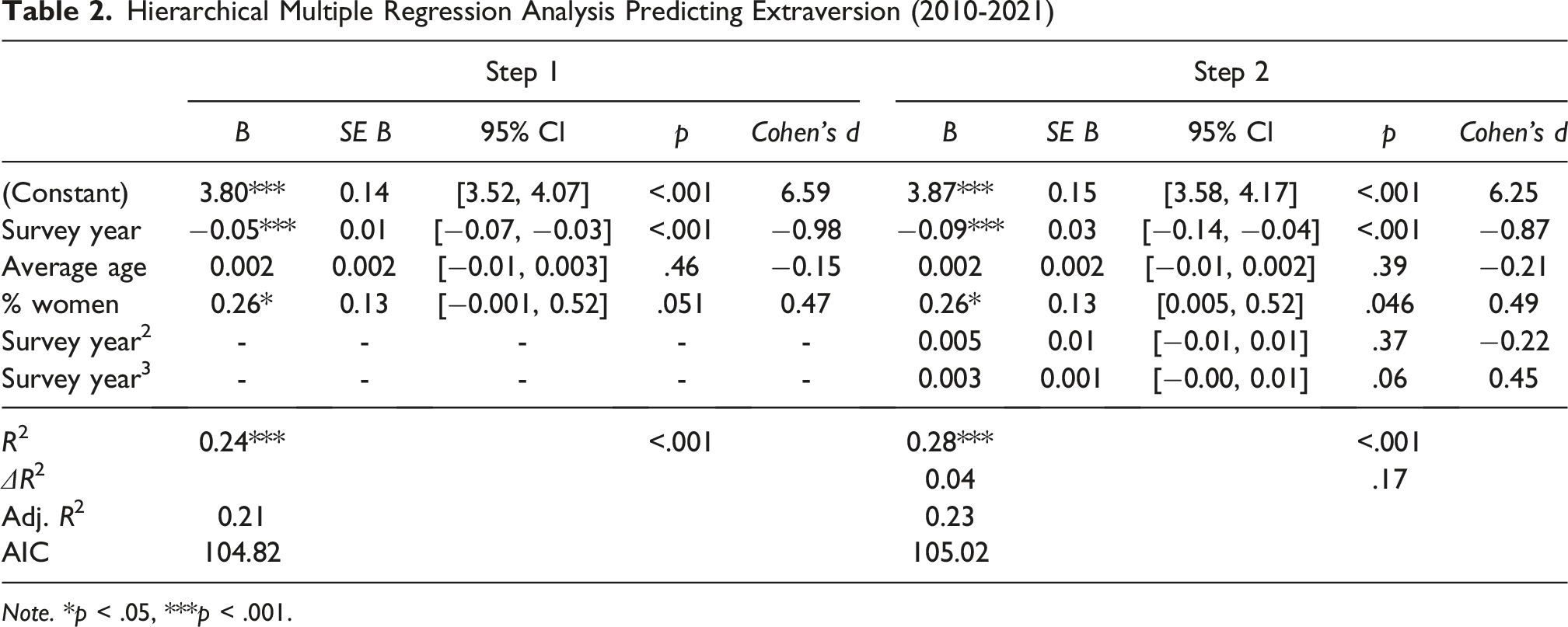
Note. *p < .05, ***p < .001.
The survey year had a significantly negative impact in both Step 1 and Step 2.
9
The quadratic and cubic terms of the survey year were not significant. These results indicate that the extraversion score linearly decreased between 2010 and 2021 (Figure 1). The solid line represents the predicted annual changes, calculated based on the unstandardized regression coefficient of the survey year and intercept, which was found to be significant in the hierarchical multiple regression analysis. Changes in the score of Extraversion in Japan between 2010 and 2021.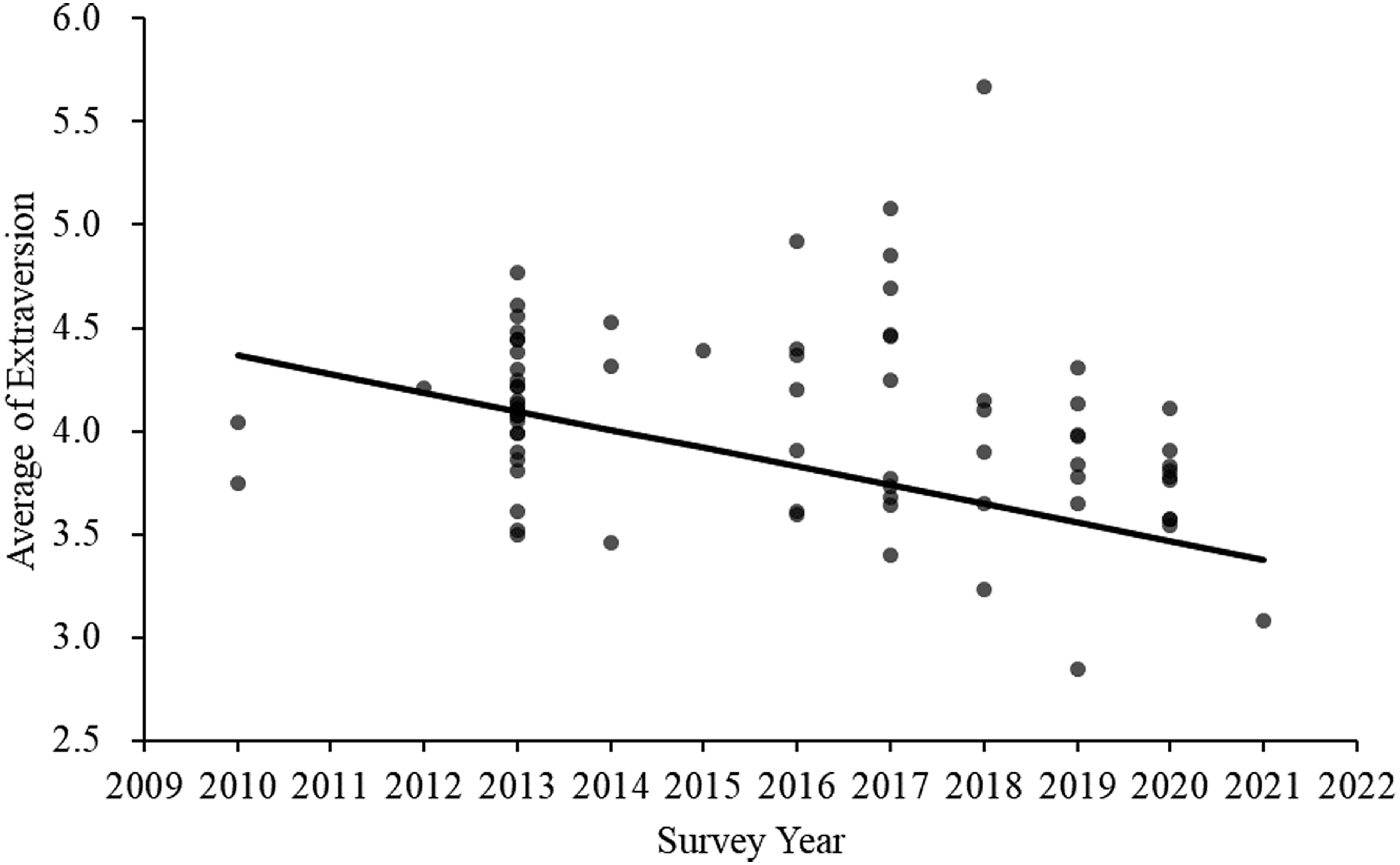
The proportion of women had a significant positive effect on average extraversion. This result is consistent with previous findings reporting that women tend to score higher on extraversion compared to men when using the TIPI-J (Kawamoto et al., 2015; Oshio et al., 2012). Regarding the analysis of age, the mean age was included as a continuous variable in the regression model. The analysis revealed that the influence of age on extraversion was not statistically significant. This finding is consistent with previous cross-sectional research in Japan, which also reported no significant association between extraversion and age (Kawamoto, 2016; Kawamoto et al., 2015). However, because this study is cross-sectional, the potential influence of cohort effects must also be considered.
Hierarchical Multiple Regression Analysis Predicting Extraversion (2010-2019)

Note. *p < .05, ***p < .001. Year3 was excluded from step 2 because it was not statistically significant (p = .56) and did not improve the model’s AIC.
Figure 2 presents a plot of the predicted values for each year. During this period, a trend of an initial slight increase followed by a decrease was observed. Although the exact reasons for this temporary slight increase remain unclear, it should be noted that shorter survey periods generally make time-series changes more susceptible to random short-term fluctuations. Despite these minor fluctuations, the fact that the survey year demonstrated a significant negative effect throughout this entire period suggests that the extraversion of the overall Japanese population has been on a declining trend since at least around 2012 or 2013. Changes in the Score of Extraversion (2010-2019).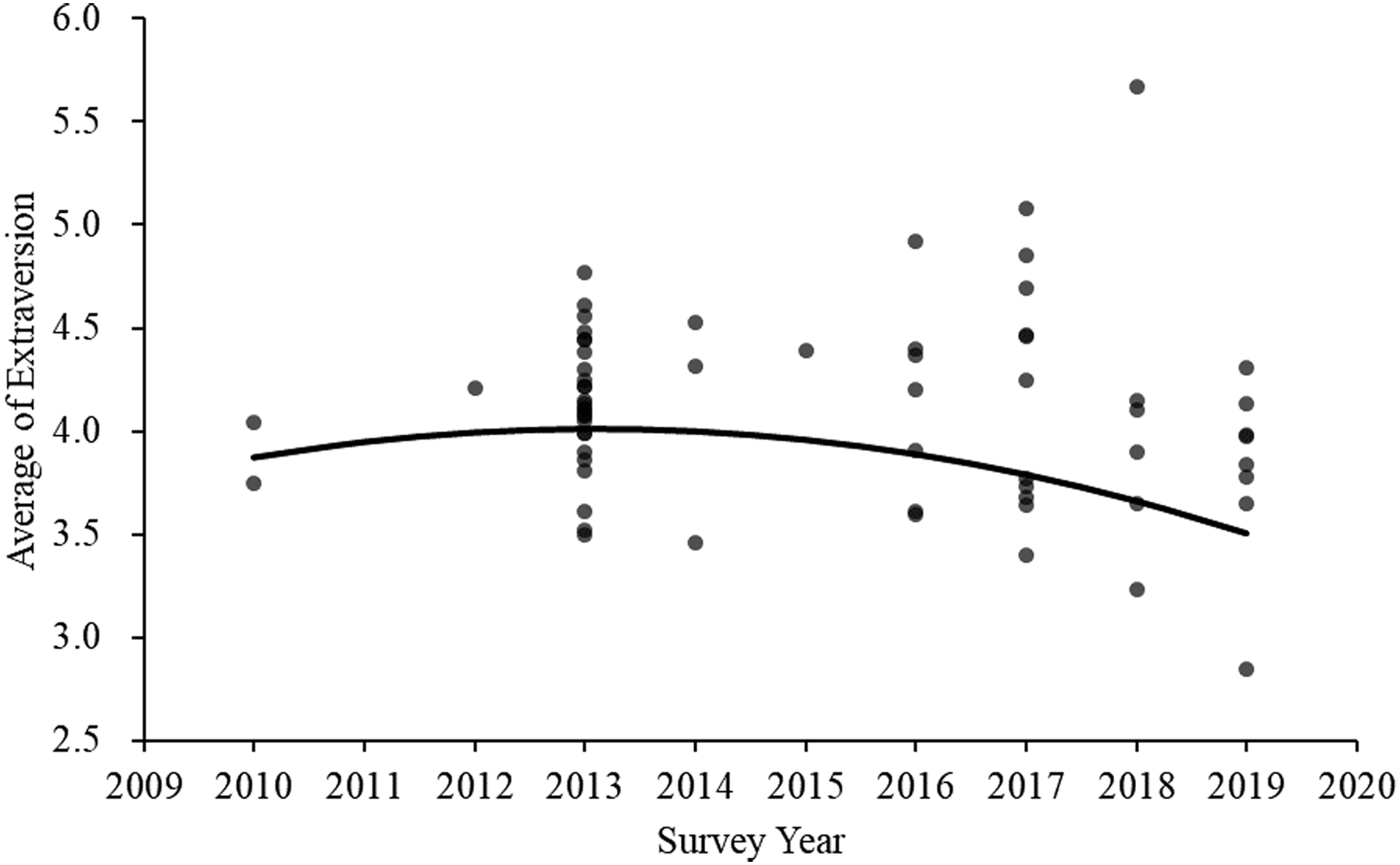
Changes by Gender
The average extraversion scores for men and women were reported in several studies: 17 data points (11 studies) for men and 20 data points (14 studies) for women. These studies were categorized by survey year into two groups: the 2010-2015 group (Men: 13 data points, 7 studies, n = 3,042, M = 3.90, SD = 0.22; Women: 13 data points, 7 studies, n = 3,710, M = 4.19, SD = 0.12) and the 2016-2021 group (Men: 4 data points, 4 studies, n = 567, M = 3.69, SD = 0.11; Women: 7 data points, 7 studies, n = 1,462, M = 3.95, SD = 0.40). To examine whether the decline in extraversion occurred similarly across men and women, a two-way ANOVA was conducted, with men and women and survey period (2010-2015 or 2016-2021) as between-subjects factors. Each study was weighted by its sample size.
The main effect of survey year was significant, F (1,33) = 4.93, p = .03, Cohen’s d = −0.77, indicating that extraversion scores were lower in the 2016-2021 group than in the 2010-2015 group. Specifically, based on the estimated marginal means (EMMs), scores were found to have decreased from 4.05 (95% CI [3.95, 4.14]) in the 2010–2015 group to 3.82 (95% CI [3.64, 4.01]) in the 2016–2021 group. The interaction between survey year and gender was not significant, F (1, 33) = 0.28, p = .86, suggesting that the decline in extraversion occurred similarly in both men and women. In terms of the EMMs, scores decreased from 3.90 (95% CI [3.77, 4.04]) in the 2010–2015 to 3.69 (95% CI [3.38, 4.01]) in the 2016–2021 for men, and from 4.19 (2010–2015: 95% CI [4.07, 4.31]) in the 2010–2015 to 3.95 (95% CI [3.76, 4.14]) in the 2016–2021 for women (Figure 3). Changes in the Score of Extraversion by Gender.
A significant main effect of gender was also found, F (1, 33) = 7.32, p = .01, Cohen’s d = −0.72, with women scoring higher in extraversion than men. According to the EMMs, women showed a higher mean score (4.07, 95% CI [3.96, 4.18]) compared to men (3.80, 95% CI [3.63, 3.97]; Figure 4). The current finding aligns with previous reports of higher extraversion scores among women than men in Japanese TIPI-J studies (Kawamoto et al., 2015; Oshio et al., 2012). Gender Differences in Extraversion. Note. Error bars mean 95% CI.
Discussion
Decline in Extraversion in Japan
This study employed a cross-temporal meta-analysis to investigate changes in extraversion scores on the TIPI-J scale among the Japanese population between 2010 and 2021. The results showed that extraversion in Japan declined during this period, and the decline in extraversion was significant in both men and women. Furthermore, in an analysis restricted to the period up to 2019 to account for the potential impact of the COVID-19 pandemic, both the survey year and the square of the survey year were found to significantly affect the mean extraversion scores. Although this suggests a non-linear trend, the estimated marginal means (EMMs) confirm that extraversion among the Japanese population has been in decline since at least 2012 or 2013.
The findings of this study provide empirical support for the long-standing claim that Japanese people are becoming more inward-looking (Burgess, 2015; Fujita, 2015; Kikuchi et al., 2015; Kobayashi, 2017; Yonezawa, 2014). Although this claim has frequently appeared in media reports and policy discussions, there was a lack of direct evidence based on personality traits (Burgess, 2015; Kikuchi et al., 2015). By demonstrating a temporal decline in extraversion, this study helps fill that gap and offers empirical insights into personality-level changes in Japan.
These results are particularly striking when placed in a global context. Previous research has consistently documented an increase in extraversion over time in a variety of other countries. For instance, studies have reported this upward trend in diverse nations, including the United States (Twenge, 2001), China (Peng & Luo, 2021), the Netherlands (Smits et al., 2011), and Sweden (Billstedt et al., 2013). The decline observed in Japan, therefore, highlight a unique trajectory of personality change over time.
This decline in extraversion is consistent with the previous research showing that extraversion has been shown to have a moderate positive correlation with self-esteem (Gebauer et al., 2015; Nushi, 2005; Schmitt & Allik, 2005), and self-esteem in Japan has also been reported to have declined in recent years (Ogihara, 2016; Ogihara et al., 2016; Oshio et al., 2014).
The temporal change in extraversion in Japan warrants attention. Extraversion is one of the five major dimensions in the Big Five personality model, which is widely used to describe individual differences in psychology and behavior. The structure of the Big Five model has been observed across various cultures, including Japan (Yamagata et al., 2006). Research has consistently shown that extraversion is associated with various psychological constructs, including the number of friendships (Feiler & Kleinbaum, 2015), subjective well-being (Diener & Seligman, 2002; Lynn & Steel, 2006; Tan et al., 2018), and self-esteem (Gebauer et al., 2015; Nushi, 2005; Schmitt & Allik, 2005). Given these extensive associations, a decline in extraversion has broad implications for shifts in national psychological characteristics and their potential societal implications. However, research on temporal changes in psychological constructs among Japanese individuals remains limited (Ogihara, 2017), making it difficult to systematically understand how personality traits are changing in this cultural context. In contrast, in the United States, where research on psychological changes is relatively abundant, Twenge (2013) has conceptualized the increasing self-centeredness and growing emphasis on extrinsic values (e.g., fame and wealth) among young people as “Generation Me,” providing a clearer framework for explaining cultural shifts in society. Investigating the decline in extraversion can contribute to the accumulation of research aimed at achieving a more comprehensive understanding of personality in Japan.
Limitations and Future Directions
A key limitation of this study is its 12-year timeframe (2010-2021). Data collection was restricted to this period as the TIPI-J scale was first introduced in 2010. While acknowledging that a longer timeframe is always desirable, fully utilizing the currently available data is crucial; otherwise, we risk overlooking significant contemporary societal shifts. Although this span may be subject to measurement errors or temporary period effects, the observed data consistently show a downward trajectory, suggesting a substantive shift rather than random short-term fluctuations. Future research could overcome this limitation by analyzing archival data from governmental and research bodies, as well as other behavioral data. Such an approach would enable a more longitudinal assessment of trends in extraversion.
A second limitation concerns the “Age-Period-Cohort (APC) identification problem.” Because these three factors are linearly dependent (Age = Period – Cohort), it is mathematically impossible to strictly separate their unique effects without relying on strong assumptions (Fosse & Winship, 2019; Roemer et al., 2026; Rohrer, 2025; Rudolph et al., 2020; Trzesniewski & Donnellan, 2010). While this implies that we cannot definitively distinguish whether the observed decline is driven specifically by period effects or cohort differences, it does not invalidate the descriptive evidence of the downward trend presented here. This study successfully documents the aggregate decline in extraversion as a “social fact,” moving the discussion from anecdotal possibility to empirical findings.
Finally, exploring the causes of declining extraversion in Japan represents a crucial future direction. This study did not identify specific socioeconomic factors, although such variables are likely involved, as suggested by findings in China (Peng & Luo, 2021). The potential influence of these societal changes is consistent with the theoretical framework of Rentfrow et al. (2008), which identifies societal influences as a key factor contributing to differences in personality traits. Notably, Japan’s decline in extraversion contrasts with trends in other countries showing the increase in extraversion (Billstedt et al., 2013; Peng & Luo, 2021; Smits et al., 2011; Twenge, 2001). Investigating why extraversion is decreasing in Japan would deepen understanding of both personality traits and Japanese culture.
Supplemental Material
Supplemental Material - Decline of Extraversion in Japan: A Cross-Temporal Meta-Analysis
Supplemental Material for Decline of Extraversion in Japan: A Cross-Temporal Meta-Analysis by Ryonosuke Akimoto, Yuji Ogihara in Personality Science.
Footnotes
Author note
At the time the research was conducted, Ryonosuke Akimoto was affiliated with Aoyama Gakuin University. He is now at The University of Tokyo.

Author Contributions
Ryonosuke Akimoto: Conceptualization; Data curation; Formal analysis; Methodology; Visualization; Writing – original draft. Yuji Ogihara: Conceptualization, Supervision, Writing – review & editing.
Funding
The authors received no financial support for the research, authorship, and/or publication of this article.
Declaration of conflicting interests
The authors declared no potential conflicts of interest with respect to the research, authorship, and/or publication of this article.
Data Accessibility Statement
The data are currently unavailable due to a forthcoming publication. However, the complete dataset is scheduled to be released as a dedicated data paper in the near future.
Supplemental Material
Supplemental material for this article is available online.
Notes
References
Supplementary Material
Please find the following supplemental material available below.
For Open Access articles published under a Creative Commons License, all supplemental material carries the same license as the article it is associated with.
For non-Open Access articles published, all supplemental material carries a non-exclusive license, and permission requests for re-use of supplemental material or any part of supplemental material shall be sent directly to the copyright owner as specified in the copyright notice associated with the article.
