






Abstract
Research indicates that individuals high in the antagonistic personality trait of Machiavellianism tend to endorse deceptive, self-serving behaviors. Compelling evidence exists, however, indicating that situational affordances influence Machiavellian tendencies. Furthermore, past studies predominantly focused on overall Machiavellianism, but the construct is arguably multidimensional. Two studies (Ns = 1,416 and 723) examined the roles of Machiavellian approach (reflecting the willingness to employ aversive means for personal gain) and Machiavellian avoidance (reflecting distrust and sensitivity to threat) for the proposal of offers in the dictator and ultimatum games. In Study 1, Machiavellian approach was related to less egotism and more strategic giving when rejection of the proposed offer was possible (i.e., the ultimatum game) compared to the setting in which rejection of the proposed offer was not possible (i.e., the dictator game). Study 2 confirmed stronger negative associations of Machiavellian approach with charitability and a social value orientation, compared to respective links of Machiavellian avoidance. These findings emphasize that different facets of Machiavellianism manifest differently in terms of exploitative tendencies and thus underscore the necessity to treat Machiavellianism as a multidimensional construct.
Introduction
In everyday contexts, human beings exhibit a wide range of altruistic or cooperative behaviors when they engage in interpersonal help, donate to charitable projects, or share their property with others. Despite the seeming omnipresence of rather antisocial behaviors—such as deception, lying, and exploitation—the Truth Default Theory posits that most individuals are honest, and the majority of dishonest acts are carried out by a small share of people (Levine, 2014). One important personality trait in this regard is Machiavellianism because it stands out for the belief in the utility of deception and exploitation (Christie & Geis, 1970). Machiavellianism is characterized by strategic egotism for the sake of self-enrichment at the expense of others, low moral commitment, striving for status and control, and negative views of humanity (e.g., Blötner & Bergold, 2022; Christie & Geis, 1970). Consistent with this, various self-report studies found Machiavellianism to be associated with the willingness to engage in deception (Blötner & Bergold, 2023; Daiku et al., 2021; Muris et al., 2017; Turi et al., 2022). However, scholars pointed out the importance of situational specifics in research on Machiavellianism, given the strategic, flexible, situationally adept nature of this construct (Bereczkei et al., 2010; Christie & Geis, 1970; Jones & Mueller, 2021). Furthermore, the majority of studies linking Machiavellianism to cheating or exploitation used overall scores (Muris et al., 2017; Turi et al., 2022), while the construct is arguably composed of different facets (e.g., Grosz et al., 2025). Thus, to contribute to research on Machiavellian exploitation, the two present studies examined exploitative tendencies as a function of situational specifics and two specific facets of Machiavellianism.
Theoretical Background
Relations Between Machiavellianism and Deception
A frequently discussed feature of Machiavellianism regards the strategic nature of the trait. That is, individuals high in Machiavellianism are expected to enact low-key deception and possess high self-control (e.g., Muris et al., 2017). Consistent with this, five behavioral studies with different settings conducted by Jones and Paulhus (2017) revealed that overall Machiavellianism was related to low-risk exploitation but not high-risk exploitation. Overall, subclinical psychopathy (a trait that is similarly aversive but unlike Machiavellianism, is expected to be characterized by low self-control), in turn, was positively related to any kind of exploitation. Similarly, overall Machiavellianism predicted higher attained control in a competitive resource control game (Curtis et al., 2021).
The strategic notion assigned to Machiavellianism suggests that features of the situation within which a highly Machiavellian individual is embedded affect whether and how this individual would engage in exploitative tendencies. In this vein, several studies illustrate the importance of situational affordances, such as the risk for being detected and the presence of others, that elicit concrete advantages or disadvantages (Bereczkei et al., 2010; Christie & Geis, 1970; Jones & Mueller, 2021; Jones & Paulhus, 2017). However, the majority of pertinent research rests on self-reported engagement in exploitation or deception. Self-report measures, however, reflect aggregates across different situations that each engender unique (and thus, hardly comparable) affordances. To provide a more indirect assessment of exploitation that also incorporates a stronger emphasis on situational specifics, the present research rests on economic game paradigms. That is, Machiavellianism was viewed in light of redistribution scenarios in which participants imagined receiving an opportunity to act either selfishly, altruistically, or equitably. Compared to self-report, such game paradigms reflect a better way of testing the effects of situational affordances because the latter are controlled systematically by the examiner. Notably, outcomes recorded in imaginary exploitation tasks do not necessarily mirror the outcomes in real-world situations in which real exploitation imposed on real people is possible. It stands to reason, however, that the adopted, more indirect approach reflects a logical, ethically appropriate step forward in research on Machiavellian exploitation while providing the opportunity to economically recruit comparatively large samples. As such, this research outlines pathways for future research.
Structure of Machiavellianism
Machiavellianism is not a uniform, unidimensional construct. Instead, a plethora of theoretical frameworks has been postulated (see Grosz et al., 2025), leaving open the question of which facet of Machiavellianism accounts for recent findings on engagement in exploitation, deception, and the like. Blötner and Bergold (2022) developed a motivationally oriented framework of the contents of Machiavellianism. Therein, Machiavellian approach reflects the search for advantages even at the expense of others. Machiavellian avoidance encompasses the tendency to attribute selfish motives to others and the corresponding drive to protect oneself from exploitation as (ostensibly) carried out by others. Thus, in this framework, Machiavellian approach should account for the acquisition of not yet available (in)tangible resources, while Machiavellian avoidance should account for the defense of (in)tangible resources a person already possesses and seeks to keep (Blötner & Bergold, 2022).
Consistent with these characterizations, Machiavellian approach was found to be linked to the tendency to use goal-oriented, inflated speech intended to obtain individual advantages, such as status, whereas Machiavellian avoidance was found to be associated with the tendency to use vague, evasive speech intended to prevent harm and loss of resources (Blötner & Bergold, 2023). The latter characterizations underscore that Machiavellian approach reflects the exploitative notion typically assigned to Machiavellianism, while Machiavellian avoidance reflects hypervigilance to threat. This structure proved appropriate across samples from Germany, Serbia, the United Kingdom, and Canada (Blötner et al., 2025, Study 2). These previous findings underscore the utility of the framework in terms of construct validity (Grosz et al., 2025) and cross-cultural applicability.
Current Research and Hypotheses
To further test the approach-avoidance distinction concerning prototypically Machiavellian outcomes, namely opportunistic exploitation of situations (Christie & Geis, 1970), two studies were conducted in which the roles of the above facets of Machiavellianism were tested in imaginary exploitation paradigms. In both studies, the ultimatum game (UG) and the dictator game (DG) were employed. In the UG as administered in the present research, the participants were asked to imagine making an offer as to how to divide a fixed amount of a desired good to a virtual recipient who can accept or reject the offer. If the recipient rejected the offer, neither of the players would receive a share, posing a comparatively high risk when players behave too egotistically (i.e., make a very unfair offer). In the DG as administered in this research, in contrast, the virtual recipient can neither accept nor reject the offer; instead, the decision made by the allocator about the distribution would be realized immediately (cf. Camerer & Thaler, 1995), rendering the paradigm a low-risk game. Both games are frequently played as one-shot paradigms, and regardless of the game played and the outcome achieved, renegotiation of the allocation is not allowed. Both games reflect zero-sum games, that is, the profit of one person is concomitant with the loss of another person.
Another well-established measure that taps engagement in low-risk exploitation is the Social Value Orientation Slider (SVO; Murphy et al., 2011). Unlike the latter two games, assessment of an SVO does not imply a zero-sum situation, as it is possible that both parties profit. It is also possible, however, to enrich oneself while spitefully preventing the profit of another person. The measure entails six imaginary scenarios in which participants must decide which of nine options about sharing a virtual currency with another virtual person they prefer. That is, the player decides about the relative profit they obtain, relative to the profit a virtual recipient can receive. The higher the response anchor of the selected option, the higher the charitable tendency. This setup is interesting for studies on Machiavellianism as some scenarios enable individuals to increase their status while keeping their “opponents’” status low, which alludes to the Machiavellian philosophy (Christie & Geis, 1970). This measure was used in Study 2. In all scenarios, participants were in the role of the proposer, providing them with an opportunity to engage in exploitation. Differences in the risk potentials of these games (i.e., high-risk versus low-risk exploitation in the UG and DG, respectively) were expected to trigger the situational sensitivity of Machiavellianism (Bereczkei et al., 2010; Jones & Mueller, 2021).
It stands to reason that within the approach-avoidance distinction, Machiavellian avoidance is more strongly related to the stabilization of the resources a person already possesses, as reflected through skeptical views about humanity, mistrust, and the tendency to see threats everywhere. In contrast, Machiavellian approach pinpoints the preference to use any means necessary to obtain desired goods (Blötner & Bergold, 2022, 2023). Therefore, Machiavellian approach should be more important to explain the acquisition of desired resources than Machiavellian avoidance, which, in turn, should be more important to explain the defense of a person’s status. Given that both the UG and the DG provide opportunities for egotistical self-enrichment, it was hypothesized that Machiavellian approach would be negatively correlated with offers made in the UG (H1) and the DG (H2) alike.
Since the virtual recipient in the UG can reject the offer made, however, exploitation in the UG is associated with a higher risk than exploitation in the DG, with individuals high in Machiavellianism displaying exploitation preferably in low-risk situations (Jones & Paulhus, 2017). That said, Machiavellianism is frequently described by means of a strategic orientation (Christie & Geis, 1970), suggesting that the effects proposed in H1 and H2 differ in magnitude. Therefore, it was hypothesized that proposers scoring high in Machiavellian approach playing the UG would make higher offers to another (virtual) person than would proposers high in Machiavellian approach who play the DG (H3), as the corresponding concession in the UG is necessary in order not to come away empty-handed. Accordingly, the game played was expected to moderate the relationship between Machiavellian approach and the offers made. Unlike in Study 1, in which each participant was randomly assigned to play only one of the two games, participants in Study 2 played both games in random order. Given the exploitative affordances in the DG (compared to the UG in which attempted exploitation can be punished) and the respective propensity of Machiavellian approach (Blötner & Bergold, 2022, 2023), Machiavellian approach was expected to be more strongly negatively correlated with offers in the DG than in the UG (H4).
Of note, the situational affordances administered in the three economic game scenarios arguably do not involve the loss of already existing (in)tangible resources but the likelihood of not acquiring specific resources. Thus, the scenarios likely do not trigger Machiavellian avoidance (Blötner & Bergold, 2022). In line with the above characterizations of Machiavellian approach and avoidance concerning resource acquisition and defense, respectively, Machiavellian approach was expected to be more strongly negatively correlated than Machiavellian avoidance with offers in the UG, the DG, and with an SVO (H5). Hypotheses 1, 2, and the first two predictions of H5 were tested in both studies; Hypothesis 3 was uniquely tested in Study 1; Hypothesis 4, as well as the prediction concomitant with the SVO in H5, were uniquely tested in Study 2.
This research was not preregistered. The Open Science Framework directory provides all datasets and R scripts (https://osf.io/j7dk4/overview). Both studies received approval from the Institutional Review Board of the FernUniversität in Hagen. Informed consent was obtained from all participants in the online surveys conducted. The manuscript reports all studies, measures, manipulations, and data exclusions.
Study 1
Method
Sample
I expected to detect only small effect sizes, given different data sources used to assess Machiavellianism (i.e., self-report) and exploitative tendencies in economic games (Dang et al., 2020). Thereby, I sought to detect the link with a high statistical power. Thus, I conducted an a-priori power analysis with the R package pwr (version 1.3–0; Champely et al., 2020) to derive the minimum sample size required to detect an effect as small as Cohen’s f2 = 0.02 (which corresponds to a small effect; Cohen, 1988) in a regression analysis with five predictors (i.e., main effects of Machiavellian approach, Machiavellian avoidance, and the game played; corresponding interaction effects of Machiavellian approach and avoidance with the game played), given an α-level of 5% and a target power of 99%. This power analysis revealed a required minimum sample size of 1342 participants. Based on recruitment efforts for an undergraduate psychology student project, 1416 participants were recruited via social media groups and university groups to participate in an online study.
Students of psychology could earn partial course credit. The only inclusion criterion was an age of at least 18 years, which all participants fulfilled. Given the conciseness of the study, I did not include attention or seriousness checks. From the total sample, 1,087 participants self-identified as female, 308 as male, and 21 indicated nonbinary gender or did not respond. The average age was 30.3 (SD = 10.2, ranging from 18 to 72). The UG and DG were administered to 723 and 693 participants, respectively.
Measures
The Machiavellian Approach and Avoidance Questionnaire assesses both facets of Machiavellianism with four items each, responded to on a five-point scale, 1 = strongly disagree, 2 = disagree, 3 = neither agree nor disagree, 4 = agree, 5 = strongly agree (Blötner & Bergold, 2022). Estimates of reliability for Machiavellian approach and avoidance, derived from the two-factor model proposed by the original authors, were McDonald’s ωs = .79 and .75, respectively. Exemplary items for Machiavellian approach and avoidance are “I tend to manipulate others to get my way.” and “If I show any weakness, other people will take advantage of it.”, respectively.
Procedure
After providing demographic information, participants were randomly assigned to play imaginary versions of either the UG or the DG. Participants in both conditions were instructed to imagine that they were provided with a sum of 10€, which they had to share with another person. That is, participants were always assigned the role of the proposer who makes an offer as to how they would share the money. Participants playing the UG were informed that the (virtual) recipient could reject the offer, leading both players not to receive anything. In turn, participants playing the DG were informed that the (virtual) recipient could not reject the offer, leading to an immediate payout of the allocated sums to the players. In both games, offering 0€ meant keeping the whole sum, whereas offering 10€ meant surrendering the whole sum to the recipient. The online platform informed the participants that there would be no opportunity for renegotiation. Of note, no actual incentivization occurred. After playing either game, participants responded to the Machiavellian Approach and Avoidance Questionnaire. Afterward, they could add comments before receiving final information about the purpose of the study.
Analysis Plan
To test Hypotheses 1 and 2 and to explore the relations among the study variables in general, bivariate correlations were calculated. To test Hypothesis 3, a hierarchical multiple regression analysis was utilized. In the first model, offers made were regressed onto Machiavellian approach, Machiavellian avoidance, and a dummy variable reflecting the game played (i.e., main effects). In the second model, the Machiavellian approach × game and Machiavellian avoidance × game interactions were added, and it was tested whether the interactions explained additional variance above and beyond the three main effects. To account for potential nonnormality of the distributions of offers in the two games, rank correlations were computed, and in the regression analyses, bootstrapping was applied (k = 5,000). Of note, Machiavellian avoidance was added in an exploratory manner and to gauge potential suppression effects (i.e., strong correlation with Machiavellian approach but negligible correlation with the outcome under scrutiny). To test for differences in the strengths of associations in the context of testing Hypothesis 5, correlation difference tests for dependent correlations were carried out with the R package diffcor (version 0.8.4; Blötner, 2024).
Results
Differences Between Subsamples
Before conducting the above analyses, demographic differences between the subsamples playing different games were tested. No significant gender (χ2 [3] = 0.84) or age differences (t [1407.30] = −0.46) occurred in the assignment to random conditions, ps ≥ .65. On average, participants playing the UG (M = 5.10, SD = 1.22) offered more money to the virtual recipient than those playing the DG, M = 4.96, SD = 1.32, t (1393.19) = 2.18, p = .03, d = 0.12, 95% CI [0.01, 0.22].
Bivariate Correlation Analyses and Correlation Differences
Rank Correlations and Descriptive Statistics for Central Variables (Study 1)

Note. Reported correlation coefficients refer to the offers in the dictator game (n = 693)/ultimatum game (n = 723). Bolded parameters were significant at p < .05.
aCorrelations of facets of Machiavellianism with offers in the games differed significantly at p < .05.
bCorrelations of facets of Machiavellianism with offers in the games did not differ significantly at p < .05.
Table 1 also informs about whether Machiavellian approach and Machiavellian avoidance were differentially related to offers made in the two economic games, α = .05. Compared to Machiavellian avoidance, Machiavellian approach was more strongly correlated with offers in the DG (p = .03) but not with offers in the UG (p = .16). These findings partly support Hypothesis 5.
Regression Analyses
Regression of Offers Onto Machiavellianism Facets and the Game Played (Study 1)
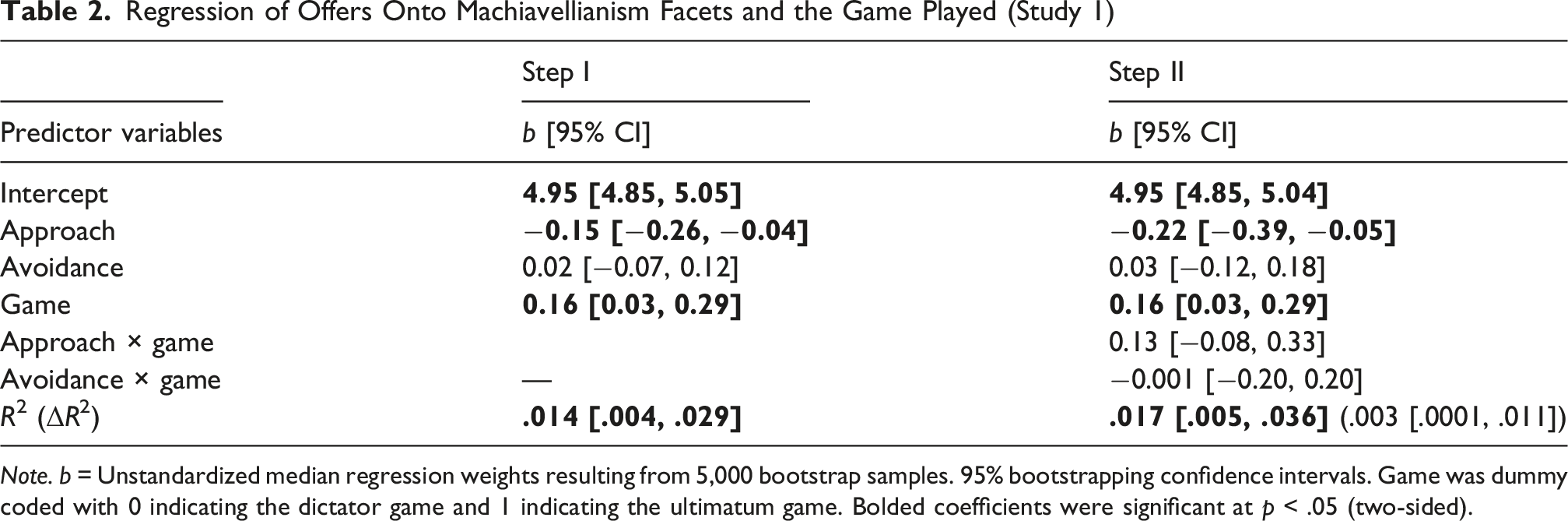
Note. b = Unstandardized median regression weights resulting from 5,000 bootstrap samples. 95% bootstrapping confidence intervals. Game was dummy coded with 0 indicating the dictator game and 1 indicating the ultimatum game. Bolded coefficients were significant at p < .05 (two-sided).
Discussion
The findings from the first study provided mixed support for the exploitative notion assigned to Machiavellian approach (Blötner & Bergold, 2022, 2023) because bivariate and multivariate analyses engendered different conclusions. More specifically, correlation analyses suggested that individuals high in Machiavellian approach resort to exploitation if they witness a low-risk opportunity to do so (as provided by the DG, where the recipient cannot prevent or punish selfishness), but not if they witness a high-risk opportunity (as in the UG, where the recipient can punish selfishness). These findings support Hypothesis 2 but not Hypothesis 1. This pattern of differential relations resonates well with considerations according to which individuals high in Machiavellianism would resort to aversive behaviors only if the chances for disadvantages are low (Bereczkei et al., 2010; Christie & Geis, 1970; Jones & Mueller, 2021; Jones & Paulhus, 2017).
In turn, offers made in the two games were not substantially correlated with Machiavellian avoidance. Correspondingly, Machiavellian approach was more strongly related to exploitative tendencies than Machiavellian avoidance in the DG but not in the UG, lending partial support to Hypothesis 5 and the above notion that the approach facet accounts for exploitative tendencies.
However, in multiple regression analyses where the statistical relationship between Machiavellian approach and Machiavellian avoidance was controlled, the moderation Hypothesis 3 could not be supported. At the statistical level, Machiavellian avoidance was strongly correlated with Machiavellian approach but virtually uncorrelated with offers in the two imaginary economic games (see Table 1). Thus, Machiavellian avoidance was arguably a suppressor in the regression analyses employed to test Hypothesis 3. That said, some scholars raised doubts about statistical control of conceptually and empirically strongly related constructs (Hoyle et al., 2023). Applying their considerations to the present study, it is unclear what scores of Machiavellian approach and Machiavellian avoidance reflect once being adjusted for shared contents such as disagreeableness, dishonesty, and cynicism (Blötner & Bergold, 2022; Hoyle et al., 2023).
Of note, each participant in Study 1 played only one of the games, rendering intraindividual comparisons impossible. For instance, the tendency to make high or low offers in general, that is, regardless of the game played, might reflect an interindividual difference variable that is worth examining in more detail. Furthermore, the frame of reference targeting money as a resource that is to be reallocated may interfere with a person’s financial status outside the study setting. That is, wealthier individuals may have been more charitable in the games because, in their daily lives, they can afford to do so. The participants’ socioeconomic status, however, was not recorded, limiting direct tests of this assumption.
To address some of these points, Study 2 involved two adaptations: First, all participants played both games, with the order being randomized. Second, deviating from the kind of resource that was reallocated in Study 1, the participants in Study 2 were instructed to reallocate a sum of 100 points, which reflects a currency with which the participants had no cognitive association in real life. Of note, the two games played in Study 1 reflected zero-sum games where the gain of one person comes at the expense of another person. Thus, low offers made by highly Machiavellian individuals can either reflect egotism (i.e., profiting at the expense of others) or spitefulness (i.e., preventing another person’s profit, although collective profit would not require individual sacrifices). To address this uncertainty, Study 2 further involved a measure for SVO as it partially rules out the zero-sum nature concomitant to the DG and UG, and it helps answer the question of whether Machiavellian exploitation is due to egotism or spitefulness.
Study 2
Method
Sample
The hypotheses tested in Study 2 (i.e., H1, H2, H4, and H5) put more emphasis on Machiavellian approach than on Machiavellian avoidance. Thus, in planning the necessary sample size, I prioritized parameter estimates for Machiavellian approach over parameter estimates for Machiavellian avoidance. Based on the correlations observed in Study 1, I expected to observe only small to moderate correlations between Machiavellian approach on the one hand and offers in the two games on the other. According to the convention by Gignac and Szodorai (2016), correlations as high as |r| = .10 and .20 reflect small and moderate effect sizes in personality research, respectively. Thus, I conducted an a priori power analysis to compute the sample size required to ensure sufficient power to detect a correlation of r = −.15 with a power of at least 1–β ≥ .99, given a Type I level of α = .05 and one-sided testing (R package pwr version 1.3–0 [Champely et al., 2020]). The analysis revealed a minimum sample size of n = 692. Unlike in Study 1, an attention check and an integrity check were implemented in the survey for Study 2. A sample of 773 German participants was recruited by means of the same procedures utilized in Study 1 to take part in an online survey. From this sample, 725 passed the attention and integrity checks. Another two participants were excluded as they indicated an age of 200 years or above. From the final sample (n = 723), 579, 130, and 10 participants self-identified as female, male, and nonbinary, respectively. Four participants preferred not to disclose their gender. The average age was 29.43 years, SD = 9.95. Most participants (n = 679, 94%) were university students.
Measures
Participants responded to the following measures in the following order.
Machiavellianism
The Machiavellian Approach and Avoidance Questionnaire was administered (Blötner & Bergold, 2022; see Study 1 for details; ωApproach = .84, ωAvoidance = .79). The same response format was used as in Study 1.
Economic Games
The participants played the UG and the DG, employing the same instructions as in Study 1. Unlike in Study 1, each participant played both games (with the presentation order being randomized), and they were asked to reallocate a sum of 100 points instead of 10€. Thereby, offering 0 points meant keeping all points, whereas offering 100 points meant surrendering all points to the recipient.
The Social Value Orientation Slider (Murphy et al., 2011), in turn, provides the participants with six scenarios about reallocations of resources. In each scenario, participants indicate which of nine possible options about sharing a virtual currency with another person they prefer. That is, in each option, the player and a virtual recipient can profit, but the player decides about the relative profit. The higher the response anchor of the selected option, the higher the charitable tendency. In line with the original authors, a Social Value Orientation Angle was computed using the formula
Analysis Plan
Rank correlations were computed. To test for differences in the strengths of associations, correlation difference tests for dependent correlations were carried out with the R package diffcor (version 0.8.4; Blötner, 2024).
Results
A paired t-test revealed that, on average, participants made higher offers when they played the UG (M = 49.43, SD = 9.83), compared to the DG (M = 47.68, SD = 13.19), t (712) = 4.36, p < .001, d = 0.15, 95% CI [0.08, 0.29]. The order of administration of the DG and UG was not associated with significant group differences in the offers in the two games, MUGs = 49.51 and 49.18, SDUGs = 10.61 and 9.01, MDGs = 47.35 and 47.99, SDDGs = 12.31 and 14.00, ts (696.46–705.06) = −0.44 and 0.64, ps ≥ .52.
Rank Correlations and Descriptive Statistics for Central Variables (Study 2)
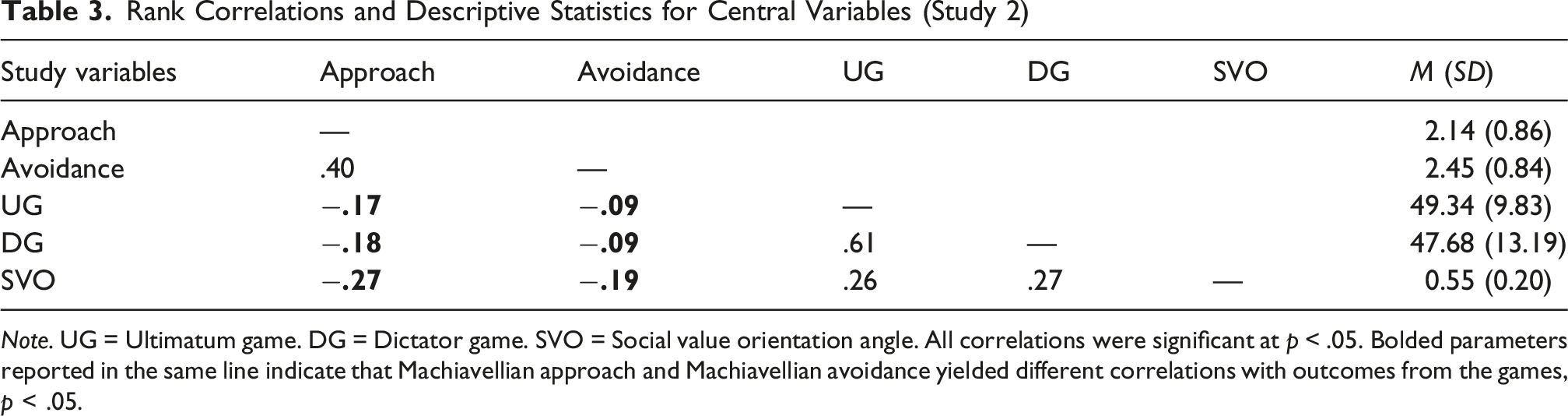
Note. UG = Ultimatum game. DG = Dictator game. SVO = Social value orientation angle. All correlations were significant at p < .05. Bolded parameters reported in the same line indicate that Machiavellian approach and Machiavellian avoidance yielded different correlations with outcomes from the games, p < .05.
Differential correlation patterns of facets of Machiavellianism with proposals in the games played could also address the question what motivates Machiavellian exploitation: The results suggest that spitefulness is more important than egotism since both facets were more strongly related to SVO (where individual profit can be achieved even if the other person profits) than to offers in the UG or the DG (where individual profit depends on the other person’s loss and vice versa), ρs = −.27 versus −.18 and −.17 (Machiavellian approach); −.19 versus −.09 and −.09 (Machiavellian avoidance), zs ≥ 2.15, ps ≤ .016.
Discussion
Findings from the second study suggested that Machiavellian approach was related to exploitative tendencies in different economic games, and even more so than Machiavellian avoidance. These findings support Hypotheses 1, 2, and 5 as tested in Study 2. On the contrary, the strengths of association of Machiavellian approach with offers in the UG and DG did not differ significantly. That said, the average intraindividual difference between the offers in the DG and the UG was significantly different yet small. Thus, participants made almost the same offers in both games. These findings contradict the abovementioned consideration that individuals high in Machiavellian approach were more sensitive to situational stimuli, which should have led them to adapt their offers to the affordances of the game played. Thus, Hypothesis 4 could not be supported. Of note, the instructions for the economic games in the concomitant online survey played did not mention whether participants encountered the same or a different (imaginary) interaction partner in the DG and the UG. Thus, the participants may have perceived a need to show consistency, which could explain the small difference between the average offers in the DG and the UG and why no significant differences could be established in how individuals high in either facet of Machiavellianism behaved in the games (see also the strong correlation between the offers made in the UG and the DG).
This being said, it could not be ensured that participants in fact understood the instructions of the economic games played. For instance, Koppel et al. (2025) evaluated the degree of comprehension of different economic games. They found that—across sample types, education levels, game types, and other features—substantial percentages of participants did not understand the instructions, suggesting the necessity to employ test rounds or comprehension tests in studies utilizing economic games. In doing so, researchers can identify and exclude participants who would otherwise bias the findings of the study.
Compared to Study 1, in Study 2, the “currency” of the resource that was to be reallocated was changed. Whereas the sum proposed in Study 1 reflected money, participants in Study 2 were asked to share points. This difference was implemented to acknowledge differences in the socioeconomic status of the participants, such that outside the study, wealthier individuals could afford to share a small amount of money with another person. As evidenced from individual comments at the end of the survey, several participants reported difficulties in imagining the practical meaning or value of the points. Therefore, features of the design (i.e., imaginary, non-incentivized setting without comprehension checks) could have made it difficult to observe differential effects of Machiavellian approach in the two games. Thus, future research should use monetary resources as a reference point, control for socioeconomic status, and thoroughly check whether the participants actually understood the instructions.
General Discussion
This research involved two studies on the roles of two facets of Machiavellianism in exploitation tasks. More specifically, it was tested how Machiavellian approach and Machiavellian avoidance (Blötner & Bergold, 2022) relate to offers in the ultimatum and dictator games (both studies) as well as to a social value orientation. While Study 1 involved a between-subjects design in which participants played either the UG or the DG, Study 2 built on a within-subjects design, enabling intraindividual comparisons between offers in the UG and the DG. Throughout both studies, striking evidence occurred in favor of the exploitative notion of Machiavellian approach (Blötner & Bergold, 2022, 2023).
Support of Earlier Findings With Methodological Advancements
Generally speaking, these findings align with earlier studies according to which Machiavellianism was related to self-reported cheating, exploitation, and deception (e.g., Blötner & Bergold, 2023; Daiku et al., 2021; Jones & Paulhus, 2017; Turi et al., 2022). However, the findings expand on recent findings because, unlike many earlier studies, the present research relied on exploitation tasks that engender specific situational affordances, and different Machiavellianism facets were measured. Accordingly, the goal-oriented facet of the construct, characterized by the endorsement of malevolent behaviors (i.e., Machiavellian approach), outperforms the misanthropic, distrustful, harm-avoiding facet (i.e., Machiavellian avoidance) in terms of relations with exploitative tendencies. These differences in associations with crucial outcomes underscore that Machiavellianism should not be treated as a unidimensional construct (see Grosz et al., 2025, for comparisons between different conceptualizations). As can be seen in the RMarkdown files in the Supplement, the distributions of the Machiavellianism scores were slightly right-skewed at best, suggesting that the two facets of Machiavellianism were approximately normally distributed. Offers in the economic games played, however, were leptokurtic in both studies.
The Trait × Situation Interaction for Machiavellianism
Recent findings raised doubts about the strategic characterization of Machiavellian approach, given its extreme overlaps with subclinical psychopathy (e.g., Blötner et al., 2025, Study 1), but these findings did not consider situational specifics that would trigger or inhibit strategic action. The DG and UG provide different yet relatively specific situational affordances that inform about whether or not engagement in exploitation pays off. As such, the present Study 1 underscores the notion of a trait × situation interaction for Machiavellianism as postulated by Bereczkei et al. (2010) and Jones and Mueller (2021), among others. Since individuals high in Machiavellian approach behaved differently in the two games, the findings also underscore the situational adeptness discussed in the context of Machiavellianism (Bereczkei et al., 2010; Jones & Mueller, 2021). Evidence from Study 2 was at odds with such reasoning, however, because individuals high in Machiavellian approach did not adapt their offers to the situational affordances provided by the game. That said, it cannot be ruled out that the participants in fact understood the instructions such that they would be able to exploit their (virtual) partners in the DG (cf. Koppel et al., 2025). Moreover, unlike imaginary distribution settings with a virtual partner, games with actual incentives for real exploitation may have triggered the readiness to engage in exploitation (see also the Limitations below).
Mixed Motives Concomitant With the Ultimatum Game
One important issue related to decisions in the UG and DG refers to the motives at play. It stands to reason that the DG is a single-motive game because decisions about offers are solely driven by weighing one’s own welfare against the welfare of the recipient. In case of the UG, the proposer’s behavior is driven by a more complex motivational pattern, rendering the UG a mixed-motives game: The proposer’s decision to make a fair offer can be motivated by an interest in the responder’s welfare, strategic considerations (i.e., fear that the offer would be rejected), or as a means to secure one’s own outcome (regardless of the outcome for the recipient). In the current two studies employing the UG, the concrete motive that accounted for a proposer’s offer was not clear, but it would be interesting from a theoretical perspective to assess the reasons that drove a specific offer.
Egotism Versus Spitefulness
To delve more deeply into charitable tendencies as a function of Machiavellianism, SVO was measured beyond offers in the DG and UG. Unlike the latter two games, sums proposed in the assessment context of an SVO do not reflect zero-sum games, such that the proposer’s and the recipient’s profits are mostly independent. Thus, choosing a self-profitable option does not necessarily suggest egotism but spitefulness. This aligns with the prototypical Machiavellian motivation to increase one’s status while making efforts to corrupt the status of a (potential) opponent (Christie & Geis, 1970).
Limitations and Future Directions
Beyond the specific limitations reported in the discussions for each study, both studies shared a set of other limitations. In both studies, no real exploitation occurred, such that there was no actual recipient who suffered from the player’s selfishness in the three paradigms employed. Relatedly, the games were not incentivized. It stands to reason that tangible consequences, such as financial incentivization of the interaction, increase the competitiveness of the games because then, engagement in exploitation in fact pays off. In line with this, Zhao et al. (2017) found that participants made smaller offers in an incentivized DG than in a non-incentivized DG. Thus, the absence of real incentivization may have limited the validity of the game paradigms as played in this research, which may be an explanation for the small effect sizes observed. Another aspect regards the magnitude of the (imaginary) incentive. That is, even though the present economic games were not actually incentivized, it could make a difference whether participants should reallocate a sum of 10€ or whether they should reallocate 100€ or even 1,000€. It stands to reason that exploitative tendencies concomitant with Machiavellian approach become more salient if the games are played for notable amounts of money (i.e., in a high-stakes situation), where selfishness outweighs the impact of social norms. In line with this, Study 1 dealt with such a small amount of money to be reallocated, whereas Study 2 built on an abstract currency of points, and the effect sizes in Study 1 were larger than those obtained in Study 2. Building on recent research linking Machiavellianism to white-collar crime (i.e., large-scale rather than small-scale exploitation), effect sizes for the association between Machiavellianism and exploitative tendencies should differ as a function of the sum that should be reallocated (cf. Paulhus, 2014).
Regardless of incentivization, however, in both studies, the virtual receiver in the games was unknown because they were fictitious. In this regard, some participants commented at the end of the survey that their willingness to be charitable may be contingent on whether they like the other person and on the degree to which the other person appeared needy. Thus, the design in both studies posed high psychological distance (Trope & Liberman, 2010). That is, it is easier to resort to antisocial behavior if the potential victim is not cognitively represented as a human being. Moreover, Machiavellianism is characterized by interpersonal callousness (Christie & Geis, 1970) as well as selfishness in actual bargaining and poker settings, that is, settings that elicit gain of resources at others’ expense (Gunnthorsdottir et al., 2002; Palomäki et al., 2016). In the two presented studies, the interpersonal component was missing. Thus, future research should rely more strongly on real interactions between participants or the appearance thereof. For instance, manipulated, interactive videos of the ostensible receiver could be used such that unbeknownst to the proposers, they are provided with a pre-recorded video of the receiver.
Another general limitation regards the recruitment of university students of psychology, who are typically predominantly young, female, highly educated, and prosocial (Vedel, 2016; Vedel & Thomsen, 2017). As such, selection biases may have been at play. Thereby, women tend to score lower on both facets of Machiavellianism than men (Blötner & Bergold, 2022). These characteristics suggest limited generalizability and restricted variance in aversive tendencies, such as exploitation, necessitating higher sampling variance in future studies.
In this regard, the cultural background of the sample is worth noting because German culture is rated quite high in individualism (i.e., the tendency to prioritize one’s own goals and self-actualization over in-group-related duties and responsibilities) and motivation towards achievement and success (i.e., focus on status and prestige; Hofstede Insights et al., 2025). The reported findings could be different in more collectivistic cultures that put more emphasis on equality and less emphasis on showcasing individual achievements, both of which regard outcomes of economic games (Ehmke et al., 2010) and Machiavellianism (Blötner et al., 2025) alike. In this vein, direct cross-cultural comparisons of actual exploitation (rather than mere imaginary or self-reported propensity) as a function of Machiavellianism reflect an outlook for future research. Similarly, the present studies focused on the proposer but neglected the emotions, behaviors, and cognitions of the recipient. From the above findings, it could be argued that highly Machiavellian recipients could behave very spitefully and tend to reject an offer in the UG if it went along with even slight disadvantages. That is, highly Machiavellian recipients might resort to defection in negotiations to inhibit an opponent’s pursuit of status.
In general, one could argue that all games played in the present study involved quite artificial scenarios, given that offers could be made only with fixed steps and that higher profits in one resource in favor of one person could not be compensated with higher profits in another resource in favor of the other person. To increase ecological validity, it would be advantageous to provide players with a multidimensional set of target resources. For instance, Sondern and Hertel (2023) had participants negotiate about a set of different resources that possessed distinct value for the two negotiators. Therein, a negotiator could make an offer in which they profited less in category A but more so in category B.
To decide whether one engages in exploitation, it might be important whether one would ever meet the other person again. In line with the strategic or long-term orientation assigned to Machiavellianism (Muris et al., 2017), individuals high in Machiavellianism should be more likely to resort to exploitation if they can be sure that they will never have to interact with the exploited person again, compared to when they must expect to be somehow dependent on this person in the future. Thus, the presence or absence of a future time perspective of the interpersonal interaction is arguably a potential determinant of the likelihood to engage in aversive interpersonal behaviors. Future research, while employing more naturalistic settings, should consider the degree of future contact as a moderator for the relation between Machiavellianism (facets) and exploitation.
Last, given recent debates about the quality of online survey data (Jaffe et al., 2026), the findings from Study 1 in particular can be affected by inattentive or even fraudulent response behaviors because no attention checks were implemented. Accordingly, the degree to which dishonest responses affected the findings cannot be determined. I strongly encourage future (online) research to adopt suitable means to warrant data quality.
Conclusion
Economic games pose a hallmark for research on collaborative, prosocial, charitable, but also defective, antisocial, and exploitative action. In the past decades, numerous paradigms and specific adaptations thereof have been developed and probed. The present research was among the first to apply prominent economic games to the deceptive, exploitative, and aversive personality trait Machiavellianism. Thereby, the goal-oriented facet of Machiavellianism, Machiavellian approach (Blötner & Bergold, 2022), appeared to be the main driver of the endorsement of exploitation.
Supplemental Material
Supplemental material - Machiavelli Entered the Game: Distinct Relations of Machiavellianism Facets With Exploitation in Economic Game Paradigms
Supplemental material for Machiavelli Entered the Game: Distinct Relations of Machiavellianism Facets With Exploitation in Economic Game Paradigms by Christian Blötner in Personality Science
Footnotes
Author Note
Atsushi Oshio was the handling editor of this manuscript. This research was approved by the Institutional Review Board of the University of Hagen, approval codes KA_ChristianBlötner_0624_01 and KA_ChristianBlötner_122024_01.
Acknowledgements
Not applicable.

Author Contributions
Christian Blötner: Conceptualization; Data curation; Formal analysis; Funding acquisition; Investigation; Methodology; Project administration; Resources; Software; Supervision; Validation; Visualization; Writing – original draft; Writing – review & editing.
Funding
The author received no financial support for the research, authorship, and/or publication of this article.
Declaration of Conflicting Interests
The author declared no potential conflicts of interest with respect to the research, authorship, and/or publication of this article.
Supplemental Material
Note
Not applicable.
References
Supplementary Material
Please find the following supplemental material available below.
For Open Access articles published under a Creative Commons License, all supplemental material carries the same license as the article it is associated with.
For non-Open Access articles published, all supplemental material carries a non-exclusive license, and permission requests for re-use of supplemental material or any part of supplemental material shall be sent directly to the copyright owner as specified in the copyright notice associated with the article.
