







Abstract
Participation in competitive, integrated employment contexts is chronically low for adults with extensive support needs (ESN). Prior research indicates that adults with ESN face pervasive hardships in accessing employment opportunities that promote meaning, well-being, and dignity in their career trajectories. Experiencing dignity is a fundamental part of feeling included and valued in the workplace. This article provides recommendations for vocational practitioners and educators for how to advance dignity for people with ESN when working in or preparing to work in inclusive employment settings. These recommendations are aligned with the Elements of Dignity and voiced by people with intellectual and developmental disabilities who have lived experiences in competitive, integrated employment.
“Thus, it is important for educators, service providers, and other practitioners who support people with ESN to incorporate practices that promote dignity and well-being to elevate work as a meaningful thread in one’s life. Employers, special educators, vocational rehabilitation specialists, and other service providers can engage in a collaborative effort that focuses on elevating expectations, ensuring a sense of belonging, and recognizing the unique contributions of people with ESN.” ‘‘We assert that it is critical for people with ESN to experience dignity at work in order to thrive personally and professionally in the workplace.”
Working in a competitive, integrated employment setting is a highly meaningful experience that can facilitate an individual’s professional and personal agency. Since 2012, Employment First, a national systems-change framework in the United States, has emphasized the premise that all individuals, including those with the most significant disabilities, are capable of full participation in competitive, integrated employment and community life (Office of Disability Employment Policy, n.d.). Employment First policies have been instrumental in expanding inclusive employment opportunities and equitable practices, such as the elimination of subminimum wages, increased benefits, and broadened access to job preparation and on-the-job support. The benefits of the Employment First policy extend to communities, businesses, families, taxpayers, and people with disabilities. Most importantly, for people with disabilities, inclusive employment opportunities contribute to fair wages, health benefits, and the dignity associated with having gainful employment (Association of People Supporting Employment First [APSE], n.d.).
However, even with policies like Employment First in place, adults with disabilities experience unemployment at a rate twice as high as their peers without disabilities (7.9% vs 3.8%; Bureau of Labor Statistics, & U.S. Department of Labor, 2019; Gasper et al., 2019). Often, barriers to employment are perpetuated by myths and misunderstandings of what support is available to employers and potential employees with disabilities in the workplace. Moreover, systemic barriers and discrimination further exclude adults with extensive support needs (ESN) from accessing opportunities to engage in competitive, integrated employment. Although adults with ESN are broad and diverse in their needs and disability identities, available data provides a proxy to understand workforce participation for this population. For example, data from the American Community Survey (2021) report any type of employment (i.e., full or part time) for only 33.9% of adults aged 18 to 64 years with a cognitive disability (i.e., defined by having difficulty concentrating, remembering, or making decisions; Erickson et al., 2022). In addition, adults aged 18 to 64 with an independent living disability (i.e., defined by having difficulty doing errands alone such as visiting a doctor’s office or shopping) were employed at a rate of 20.3% (Erickson et al., 2022). Collectively, these low rates of participation in competitive, integrated employment suggest a pervasive opportunity gap exists that prevents adults with ESN from accessing inclusive workplaces.
Even when looking beyond the basic binary metrics of employment (i.e., employed vs. unemployed status), adults with ESN face pervasive hardships in accessing employment opportunities that promote meaning, well-being, and dignity in their career trajectories (Gilson et al., 2022; Sinclair et al., 2023). Thus, it is important for educators, service providers, and other practitioners who support people with ESN to incorporate practices that promote dignity and well-being to elevate work as a meaningful thread in one’s life. Employers, special educators, vocational rehabilitation specialists, and other service providers can engage in a collaborative effort that focuses on elevating expectations, ensuring a sense of belonging, and recognizing the unique contributions of people with ESN. The purpose of this paper is to emphasize the importance of fostering dignity in the workplace and in employment-based preparation settings for individuals with ESN. In the remainder of this article, we will provide a brief overview of dignity and share strategies for practitioners that are informed by the voices of working adults with intellectual and developmental disabilities (IDD; Gilson et al., 2022; Sinclair et al., 2023).
An Introduction to Dignity
Dignity is defined as “the feelings of being recognized, acknowledged, included, and respected for who we are or what we know” (Prilleltensky & Prilleltensky, 2021, p. 32). Dignity is often discussed alongside equity and inclusion for people with ESN. To experience dignity, there must be inclusion and equity in access to opportunities in daily life, including human rights (Ward & Stewart, 2008); choice and participation in day programs (e.g., Frounfelker & Bartone, 2021); dignity of risk in inclusive higher education (e.g., Bumble et al., 2022); and planning for retirement and palliative care (e.g., Strnadová, 2019). However, the equity-driven approach of “dignity of work” is less studied for people with ESN. We assert that it is critical for people with ESN to experience dignity at work in order to thrive personally and professionally in the workplace (Gilson et al., 2024).
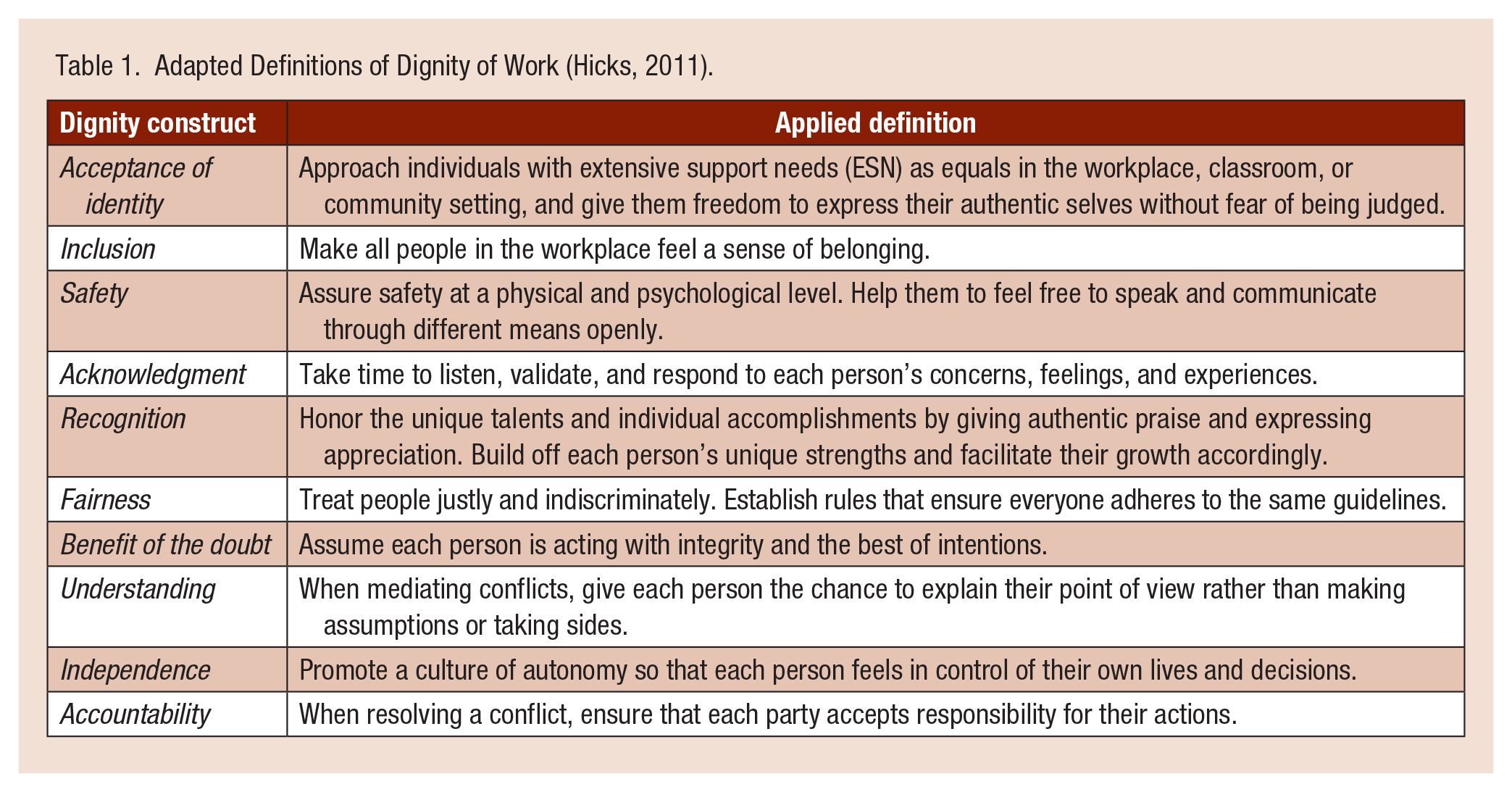
Approaching employment for individuals with disabilities through a dignity of work lens exemplifies how people with disabilities are “citizens and rights holders, rather than as objects of social welfare or charity” (International Labour Organisation, 2015, p. vii). This mindset shift provides the opportunity for individuals, employers, and other vocational practitioners to change how they think about inclusive employment as a wise business decision rather than an act of charity. Table 1 provides definitions of dignity of work constructs (see Hicks, 2011; Gilson et al., 2024) that we modified to be more inclusive of individuals with ESN. The revised model allows for a more holistic, expansive understanding of dignity of work, which can be applied to individuals with and without disabilities.
Adapted Definitions of Dignity of Work (Hicks, 2011).
Fostering Dignity in the Workplace
In the following section, we present practical strategies and recommendations to promote dignity in the workplace for people with ESN. Our strategies are informed by the experiences, perspectives, and voices of 18 adults aged 19 to 39 years (M = 27), with IDD who accessed employment through a wide range of support needs (e.g., job coaches, communication devices, job carving, vocational rehabilitation; Gilson et al., 2022; Sinclair et al., 2023). Although not all adults in the sample had ESN, they all self-identified as disabled and accessed a wide array of support needs in employment contexts. To honor the lived experiences of people with disabilities, quotes from adults with IDD who consented to participate in a research study are included below to exemplify how they experience dignity at work. They share experiences of times when their dignity was honored and other times when their dignity was dismissed.
To guide practitioners on how to best support individuals with ESN in employment contexts, we adapted the Elements of Dignity model introduced by Hicks (2011) to be more inclusive of individuals with ESN. Specifically, we present eight strategies that vocational practitioners can use to foster dignity for adults with ESN in the workplace and other employment preparation settings. These strategies are relevant for all individuals who support people with ESN to prepare for and access employment. We will use the term “vocational practitioners” to apply to anyone who supports children, adolescents, and adults with ESN to expand employment opportunities or teach job-related skills, including employers who hire or intend to hire individuals with ESN, educators who equip transition-age students with ESN, vocational rehabilitation providers or job coaches who assist adults with ESN in job preparation and placement, and other practitioners and community members at large who support adults with ESN.
Strategy 1: Accept and Celebrate Each Person’s Unique Identity
In some cases, disability may be a core component of one’s identity, alongside other characteristics, such as culture, gender, race, ethnicity, religion, or sexual orientation. However, none of these traits—individually or collectively—define an individual. Rather, each individual embodies a unique composition of identifying characteristics that comprise who they are. Erika, who worked as a janitor at a bank and lived in a group home, emphasized the importance of not making assumptions based on someone’s disability, “And I have a disability, and then people get upset, and I just get a little irritated, because people are just, it’s like, ‘Oh, you have a disability, you can’t work,’ or, you can’t work here.’”
As Erika shared, she understands how she has had prejudicial views placed on her abilities due to having a disability, thus highlighting the importance of presuming competence and setting high expectations for people with disabilities. To achieve this, vocational practitioners could ask their employees, students, or clients questions about their interests and strengths. They could also conduct observations of students or clients in a classroom or workplace context to evaluate areas of support needs and accommodations needed to promote success in the workplace. In addition, before assuming that someone will need help based on the presumed characteristics of their disability, ask if they would like assistance and how they would prefer to be supported on the job.
Strategy 2: Promote a Culture of Inclusion in the Workplace
The next way to promote dignity at work is by cultivating a culture of inclusion. For example, Stanley, who worked at a cleaning facility on a college campus and lived independently, said, “I love my job a lot . . . I am proud of my team . . . My friends support me, lots of years.” The notion of being part of a “team” and having “friends” conveys a sense of belonging, which is likely a byproduct of an inclusive culture.
There are several ways to build an inclusive vocational setting through the physical environment, employee responsibilities and interactions, and opportunities for advancement. First, arranging the physical environment in which all people can access spaces and interact establishes a foundation of physical inclusion. Vocational practitioners can consider the following questions: Where are the individuals with ESN working during their shifts? Are they often completing tasks during off-peak hours or on the periphery of where the hub of activity is in the space? Second, vocational practitioners can ensure that jobs for people with ESN are integrated into the larger purpose and mission of the company, rather than relegated to exclusionary positions that are often deprioritized. They can audit the responsibilities of the position by asking: Are there ample opportunities to interact with others? Are employees with ESN working alongside co-workers and peers who could provide natural support? Job coaches could then be tasked with identifying and training natural supports who could serve as a sustaining source of connection and support for the employees. Finally, all people should have the opportunity for career advancement and greater responsibility within the work setting based on their performance and merit of their current position. Vocational practitioners can ask themselves: What are future tasks that an employee can take on, and what does the growth trajectory look like?
Strategy 3: Assure Safety Physically and Mentally
Another important indicator of dignity is establishing a feeling of safety in the workplace where all people are comfortable physically and psychologically to speak openly and be themselves. For example, Beth, who worked at a grocery store and lived with her family, explained how her job coach helped her to feel safe and calm at work, even during challenging situations. She said, “[The job coach] calms me down—stuff like that . . . And helps me stay on task.” In Beth’s experience, having a job coach ultimately allowed for a greater sense of self-regulation and control in stressful times.
It is also important to ensure people with ESN feel mentally safe at work. Russ, who worked in an office and lived with his family, did not feel like he could be himself work because “myself is usually funny and giggling and laughing,” although he feels the need to be serious at work. Teresa felt like she could not be herself at work because, “I talk loud, and I feel like I can’t do that there because they’re like a call center and we can’t have a lot of high-pitched voices.” Troy, who had experience with maintenance and janitorial positions, summarized succinctly, “If at a job place you can’t be yourself, it’s probably pretty hard to work there.”
Vocational practitioners can foster a sense of safety through their words and actions. Words of affirmation (e.g., “You are doing great work! You make a positive impact here!”) can remind someone that they are valued and safe. Actions like taking an interest in one’s background, hobbies, and culture may also facilitate an open dialogue where one feels like they can express themselves and show their true personality. Furthermore, informing individuals about where and how they can ask for help without fear of consequence can reduce concerns about navigating any challenges that may arise.
Strategy 4: Acknowledge Needs and Listen Fully
Alongside establishing a safe environment, it is essential to follow through on the invitation for others to speak openly by actually acknowledging their experiences and listening to their viewpoints when they choose to do so. This includes taking time to listen, validate, and respond to each individual’s concerns, feelings, and experiences. Jeff, who worked full-time at a warehouse for a cosmetics company, shared his frustration when people do not understand what he is saying. He said, “Sometimes it’s hard for people to get to know me.” In his present employment, Jeff felt connected to his co-workers and boss because they often took time to listen and check in throughout the day. For example, his supervisor checked in with him consistently, as he explained, “She just says, ‘How am I doing? Hey, Jeff. How’s it going? And we just talk for a bit . . .’. I feel trusted and safe around [my co-workers and boss].”
Similarly, Shelley, who worked in a grocery store and lived with roommates, explained that her workplace follows an “open door policy,” where “you can just go in there and talk to [the supervisor] if you need to.” Jason, who worked in an office setting and lived with his family, shared the positive impact of feeling acknowledged and supported at work: [My supervisor] helps me out when it comes to, like, if it seem like I’m not really, like, that social at the moment. She’ll know when I’m upset and I want to talk and then whatever I need to bounce ideas off. I’m really proud that I have coworkers that’ll listen and include me. I’m really proud to be there. Like I said, it’s welcoming.
Acknowledging one’s needs and listening fully with intention are important steps for practitioners in any space, including the classroom or workplace. Promoting an “open door policy” as Shelley described gives assurance that the person can feel comfortable approaching someone in an authoritative position when they are having an issue. This step may also involve explicit instruction of how to communicate needs and concerns prior to an incident occurring so that people feel equipped to navigate problematic scenarios.
Strategy 5: Recognize the Achievements and Contributions of Each Person
Every person can make a valuable contribution to a task or workplace, whether that be in the form of their productivity, personality, or work ethic. It is important for vocational practitioners to recognize that achievement might take a different form for someone with ESN than it would for another person and that each person’s growth trajectory is individualized. Even in a fast-paced environment, it is critical to celebrate the process and effort rather than just the end product. For example, Teresa shared, “At first when I had my tasks it took a minute for me to understand them, but I got better at it and [now] I’m doing it fast.” Troy also shared how his ideas for more efficient workflow were often valued by his supervisor: I’m a fast learner. I definitely don’t like to push corners or cut corners but if I see a way to make things more efficient, I’ll talk to my superior or whomever I’m working with and say, ‘hey why don’t we do it this way?’ It’s more streamlined and it gets it done correctly faster and better . . . I like things to be as effective and smarter, so [my supervisors] like that.
Similar to the ideas presented for assuring safety, recognizing achievements and contributions can be done routinely by celebrating efforts of people that applaud the process, rather than just the product or performance. For example, praise can extend beyond a simple “good job!” to behavior-specific praise linked to someone’s effort: “I really appreciate how carefully you are organizing the file folders to make sure everything is in the right place.” By attending to specifics of skill development, vocational practitioners can support the growth trajectory of people with ESN and determine where mastery of skill has occurred and where future growth opportunities may be directed.
Strategy 6: Treat all People Fairly and Justly
Given the discrepancy in employment rates between people with and without disabilities, and discrepancy within disability categorizations, these data suggest that people with disabilities are treated differently in the hiring, onboarding, retention, and advancement processes. For example, Erika expressed frustration from examples when people have assumed incompetence on the basis of her disability, “I’m a person that, I have a disability, and it will take me a little bit longer. But you shouldn’t have them work it out, and let’s see how they do, but you don’t need to judge them.”
Deficit-based assumptions often originate at the application stage when employers make decisions based on disability disclosure or accommodations listed. Troy shared that when he disclosed his disability on a job application, it caused red flags for many potential employers: You’ll get asked questions like, “What kind of medicines do you take?” or “What kind of problems do you have? Do they affect where you go to work? Can you drive?” Things like that which, I think, have, whether you like it or not, silent results. You just get eliminated instantly.
Beth summarized these unfair and ableist practices, “People don’t think we are capable to be hired like everybody else can be. I still believe that everybody can be hired, one way or another.” Furthermore, when people with ESN are hired, it can be viewed as a charitable act rather than a sound business decision, despite the numerous data to support increased productivity and higher revenue for employers who hire people with disabilities (e.g., Opportunities for Ohioans with Disabilities, n.d.).
Although most people we interviewed felt supported and recognized by the supervisors in their workplace, some reflected on the importance of navigating conflict and persisting amid low expectations and biased assumptions. When asked to give advice to people with disabilities seeking employment, Michael, who worked as a substitute paraprofessional and lived with roommates, said, “Just keep fighting and don’t let the boss say, ‘no, you can’t do it.’ Just tell them you can and let them give you a chance to show them that you can.”
Even after hiring, the onboarding and retention process often looks different for people with disabilities than their counterparts without disabilities. Teresa explained how she quit her job at the grocery store because of discrimination she experienced on the basis of her disability:
I was supposed to be working in the deli part of [the grocery store] because then they haven’t moved me up. I was disappointed that they [did not] move me up, so I was asking why they haven’t moved me up. My manager had said that I can work in a deli, and one day in the morning when I talked to my co-worker, [they] told me a person in the deli called me retarded.
In Teresa’s situation, the manager could have approached her advancement with greater dignity by seeking to understand her viewpoint and speaking with her directly rather than other people. Moving forward, vocational practitioners can reflect on how their practices embody fair and just treatment of all people indiscriminately, to ultimately move toward an asset-based mindset rather than deficit-based assumptions. This means establishing rules and procedures that ensure everyone adheres to the same guidelines, seeking to understand all sides during a conflict or disagreement, and being transparent when explaining why decisions are made.
Strategy 7: Hold People Accountable for Their Actions
Another critical component of dignity is being held accountable for one’s actions. For example, John, who worked as a custodian and lived with a roommate, shared, “I am reliable at my job, and I show up on time. They can rely on me to be there and basically do my job.” Michael felt he had a strong relationship with his supervisors because he is responsive to feedback and “they know that I’m a hard worker and they know if they need to talk to me, they can call me in their office and say, ‘oh, look, you did a good job on this’.”
Although often not directly stated, it seemed evident that some people with ESN had internalized a high quality of work ethic because someone had once reminded them of their value and held them to high expectations. Oftentimes, people with ESN are given multiple chances beyond the typical amount allocated to attempt the same task as a peer or are not issued the same consequences as their nondisabled peers for truancy, tardiness, or inappropriate behaviors, which can be misinterpreted as having lower expectations or standards. Similar to the previous component of fostering dignity, accountability is best implemented when everyone is held to the same standards. However, even when setting high expectations, it is important for vocational practitioners to recognize each person’s support needs and provide reasonable accommodations to help them thrive along their own trajectory at their own pace.
Strategy 8: Encourage Independence and Self-Determination
The final component of dignity combines several previously described elements to emphasize the importance of fostering independence and self-determination in an individualized way that allows for each person to feel autonomous and in control of their own decisions. Troy explained how he exhibits independence in his job: I’ll get there early. I’ll set myself up for success by getting things done and in order before they need to be so that it’s as proficient and effective as I can be that I can figure out to make it. I’ll tell someone what I’ve done to make it, so it’s understood that that’s already been handled.
For example, Erika said, “If I didn’t have a job, I would be a couch potato. I would be sleeping all day, playing video games all day, being bored easily, all that. So it’s very good for me to have a job.” However, others also commonly discussed the importance of interdependence in the workplace and how valuable it is when employees can help one another. As Russ said, “I have [a community] to do the completion of the work, not just me.”
Although prior research affirms that the inclusive workplace provides a venue to promote independence (e.g., Sinclair et al., 2023), it is important that employers and educators nurture that innate sense of self-determination to help each person thrive. This includes facilitating opportunities to practice simple choice-making as well as complex decision-making skills, such as providing a choice of the order in which a task is completed. Encouraging problem-solving is especially important in fostering self-determination, which may mean that support providers need to intentionally step back and allow room for risk and failure rather than intervening the moment someone indicates a need for help (Ingles et al., 2022).
Conclusion
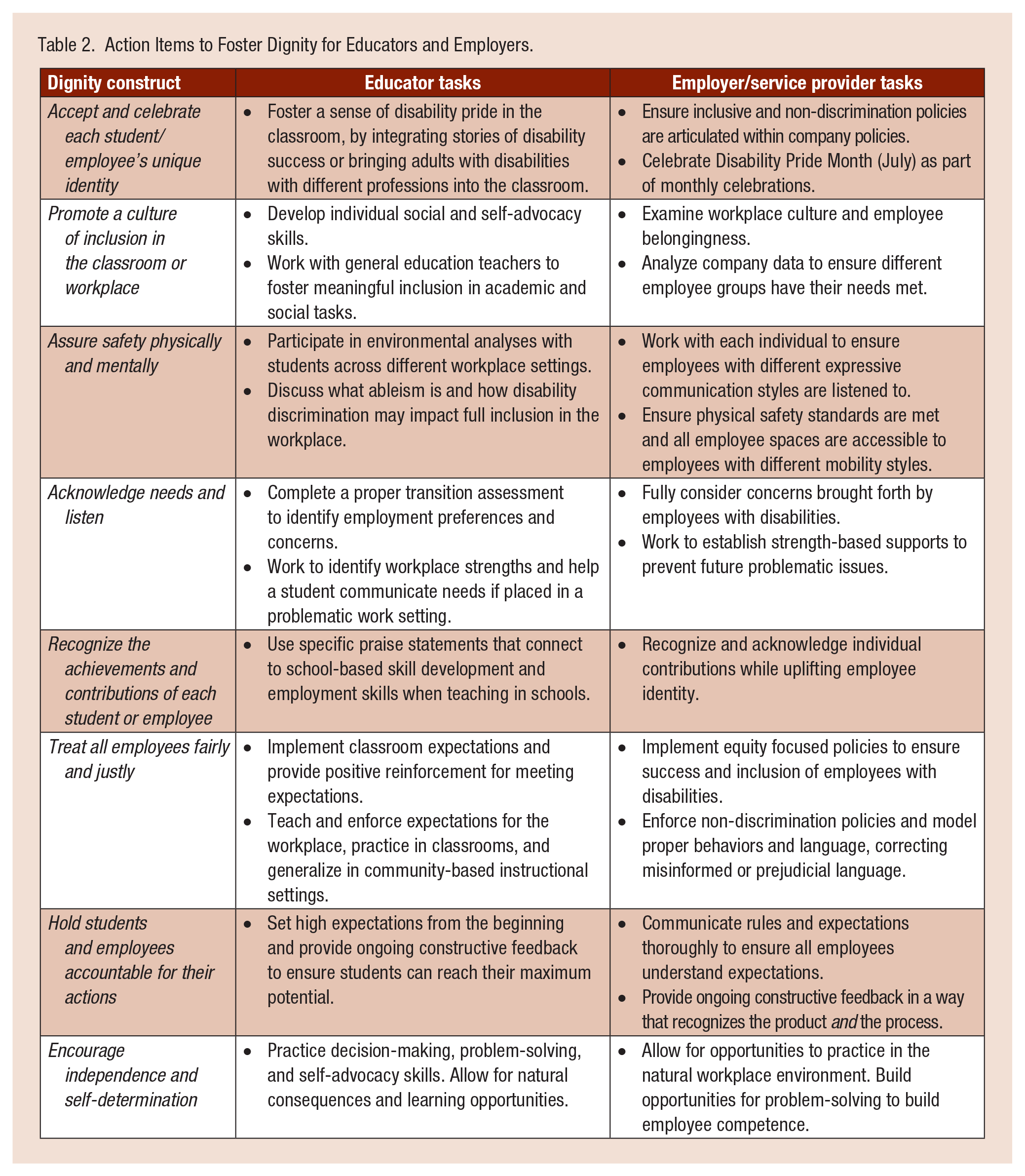
Promoting dignity at work for adults with ESN is an essential step in ensuring that employment continues to provide a deep source of meaning, psychological empowerment, and a high quality of life. We expanded an existing framework for fostering dignity in the workplace to make the employment landscape more inclusive to the unique needs and experiences of people with ESN (see Hicks, 2011). In Table 2, we summarize these recommendations by delineating ways that educators, service providers, and employers can foster dignity in their respective settings and spheres when supporting transition-age students and adults with ESN. These recommendations were informed by the perspectives of adults with IDD with lived experiences in competitive, integrated employment settings. These voices are critical to the continued progression of inclusion in the workplace. As we navigate progress, we must ensure these perspectives and experiences are heard, acknowledged, and amplified.
Action Items to Foster Dignity for Educators and Employers.
Footnotes
Authors’ Note
James Sinclair is now affiliated to University of Arkansas.
Conflict of Interest
The author(s) declared no potential conflicts of interest with respect to the research, authorship, and/or publication of this article.
Funding
The author(s) received no financial support for the research, authorship, and/or publication of this article.

Author Biographies
Carly Gilson is an Associate Professor of Special Education in the Department of Educational Studies at The Ohio State University. Her research focuses on strengthening pathways to inclusive higher education and integrated, competitive employment for young adults with intellectual and developmental disabilities by equipping students, educators, and families for the transition process.
James Sinclair is an Assistant Professor of Special Education in the Department of Curriculum and Instruction at the University of Arkansas. His research interests focus on the implementation of school-based mental health services for high school students with disabilities and the implementation of in-school practices that support positive postschool outcomes including employment, postsecondary education, and community engagement.