







Abstract
Background
Text messages are useful for health promotion and can be modified during public health emergencies.
Purpose
Describe how we developed and implemented a physical activity (PA) text messaging component within a faith-based intervention, modified the text message content in response to the COVID-19 pandemic and evaluated participants’ perceptions of the modified text messages.
Research Design and Study Sample
PA promotion text messages were delivered to predominately Spanish-speaking, churchgoing Latino adults (n = 284) in Los Angeles, California. In 2020, we modified the messages to disseminate COVID-19-related information and support and share virtual PA resources.
Data Collection and Analysis
We analyzed quantitative and qualitative survey data to gauge participants’ experiences with the text messages.
Results
COVID-19 related text messages were a feasible, acceptable addition to a PA intervention for a sample of Latinos.
Conclusions
Throughout the pandemic, the messages enabled continued communication and support for PA and protection from COVID-19 in a population at high-risk of health inequities.
Background
Text message interventions are a widely-used approach for disseminating health promotion information.1–4 They can be used to address health behaviors,5–8 such as physical activity (PA),3,4,9–12 and often involve health promotion messages and reminders that serve as “cues to action” for a health behavior. 13 Text messages can be delivered as a solo intervention14,15 or integrated into multi-component programs.13,16 Health promotion text message components embedded within broader community-based interventions, such as faith-based programs, may have greater salience for participants than solo text interventions because the messages are connected to a trusted community institution.2,13,16 Text message interventions are acceptable for a variety of populations, even those who experience high technological barriers such as older adults 10 and non-English speaking populations (e.g., Spanish-only speaking Latinos).4,11,17,18 This study focuses on Latino adults, a group that is disproportionately affected by low PA rates19,20 and has high mobile phone use. 21
In addition to health behavior support, text messages can be used to share information about public health emergencies. Critical incidents like the COVID-19 pandemic can severely disrupt planned health promotion activities. This is especially so for programs working with populations disproportionately impacted by these incidents. Latinos, for instance, have experienced disproportionately high morbidity, 22 mortality, 23 and economic stress 24 due to COVID-19. Health promotion practitioners may feel responsible for not only continuing to deliver planned activities, but for integrating new activities and information to reduce the negative impact of a critical incident like COVID-19 and prevent further exacerbation of inequities. 25 However, when the critical incident limits in-person interactions, such modifications are challenging to implement for programs designed around in-person activities. 26 Further, programs serving bilingual Latino communities may need to find new ways to efficiently deliver programming and communicate with participants in both Spanish and English. Text messages may be an effective, convenient tool, with the capacity to deliver messages in multiple languages, that can be readily modified in the face of critical incidents.
Text messages are used by public systems to communicate time-sensitive information about critical incidents like severe weather,27,28 and more recently, COVID-19. 29 They have been used to help prevent COVID-19 misinformation 30 by disseminating links to reliable sources of information such as government websites. 31 Text message interventions have also been used to support mental health and provide a sense of social support during the COVID-19 pandemic.32,33 Bilingual text messages have been used in health promotion efforts 13 and may be a useful tool to support mental health for Latino adults. 34 For existing health promotion text message projects, including those serving Latinos, the pandemic presented an opportunity to take on a new role disseminating information and support about COVID-19. However, we are not aware of any prior studies examining how existing text message efforts have made this pivot.
We conducted a process evaluation of the text message component of the Parishes and Parks (P&P) intervention, an on-going cluster randomized controlled trial that involved partnerships among faith institutions, local parks departments, and academic and research institutions.35,36 The intervention aimed to increase PA among churchgoing Latino adults in Los Angeles, California (CA). In this paper, we address three questions: 1. How was the PA text message component of P&P developed and implemented? 2. How was the text message component modified in response to the COVID-19 pandemic? 3. How satisfied were study participants with the text message component, including the COVID-19 modifications?
Methods
Development and Implementation of the P&P Text Message Component
P&P is a collaboration among researchers at RAND, kinesiology faculty and students at California State University Los Angeles, and community leaders from the Archdiocese of Los Angeles, local Catholic churches, the Los Angeles Department of Recreation and Parks and local public parks, and local community-based organizations. The P&P intervention aimed to link Catholic churches with local parks to promote PA among churchgoing Latino adults in Los Angeles. Planned project activities included in-person, park-based exercise classes and peer-led walking groups, sermons to encourage PA, policy advocacy with local park advisory boards, and daily text messages to provide PA-related encouragement and reminders about intervention activities.35,36 P&P has a community advisory board that helped shaped the intervention activities and guided all phases of the research.
The text message content was developed by the diverse research team, incorporating content used in prior studies13,17,37 as well as original content. Roughly half of the messages were motivational and/or informative (e.g., “Set goals and track your progress! Plan your PA ahead of time and keep records. It’s a great way to meet your goals.”), while the other half were challenges that prompted the participant to do a specific set of exercises (“Wednesday Challenge. Do 5 squats right now!”). All texts were translated into Spanish by a native-Spanish speaking team member and reviewed by two other bilingual team members. Using a web-based platform, 38 we programmed texts to be sent every morning, Monday through Friday, for ten months. Holiday and birthday greetings as well as reminders about P&P PA exercise class programming/schedules and other events were also sent. Study participants could send texts with questions and comments to the research team, and study staff would typically respond within one day.
The overall P&P intervention is being evaluated through a clustered, randomized controlled trial, wherein churches are randomly assigned to intervention or control group. Details about the study design and intervention are available elsewhere. 36 The implementation of the P&P intervention and evaluation is staggered over two cohorts. This paper describes the text message component as it was implemented at three churches during the first cohort. The study has been approved by RAND's Human Subjects Protection Committee.
Baseline data collection took place between March 2019 through November 2019. Study staff conducted a consent process with potential participants; of the 288 individuals who agreed to participate in the overall P&P study, 284 agreed to receive text messages and provided a cell phone number. Study participants also provided their preferred language, Spanish or English, for the messages.
Parishes and Parks PA Text Message Content.
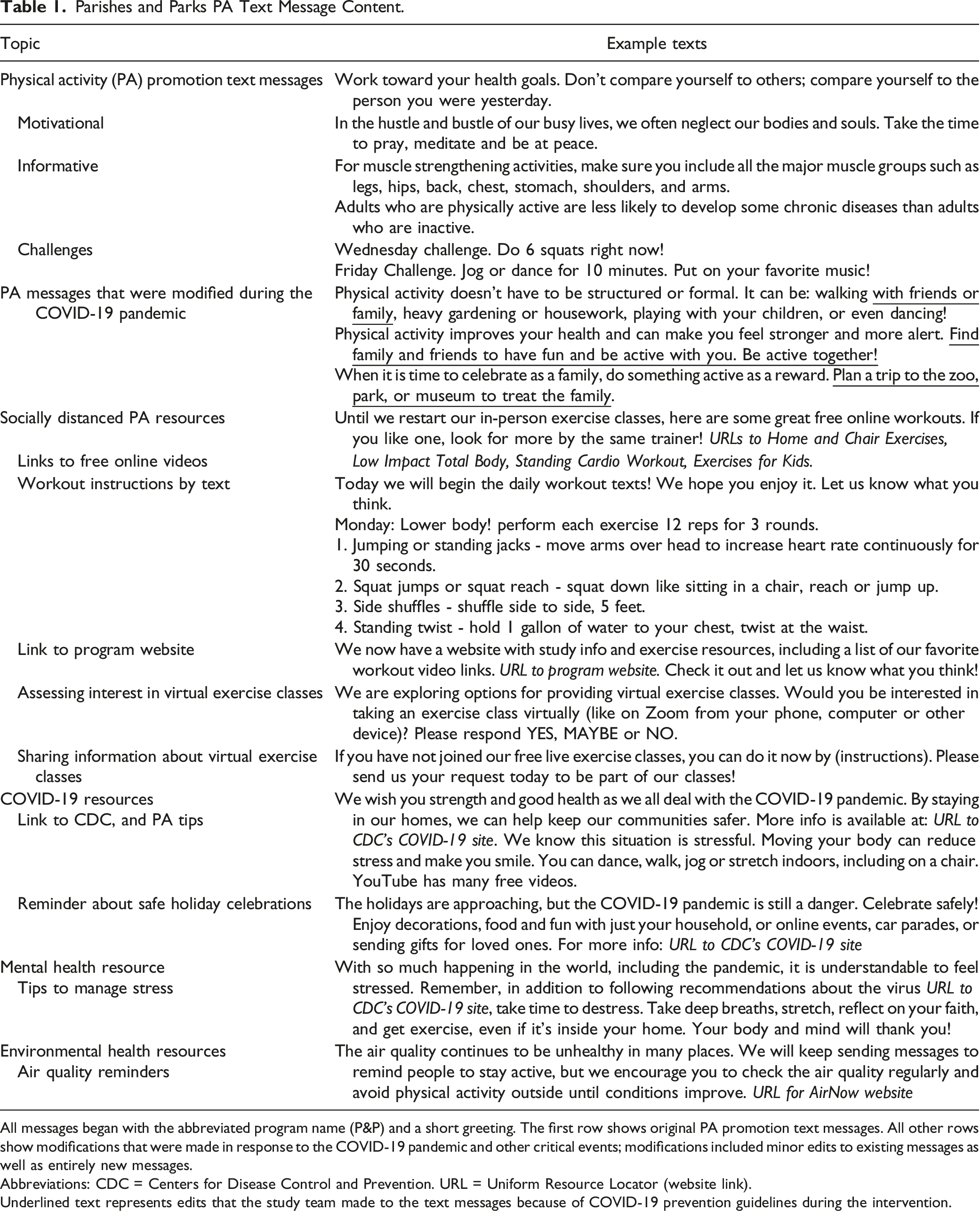
All messages began with the abbreviated program name (P&P) and a short greeting. The first row shows original PA promotion text messages. All other rows show modifications that were made in response to the COVID-19 pandemic and other critical events; modifications included minor edits to existing messages as well as entirely new messages.
Abbreviations: CDC = Centers for Disease Control and Prevention. URL = Uniform Resource Locator (website link).
Underlined text represents edits that the study team made to the text messages because of COVID-19 prevention guidelines during the intervention.
Modifications During the COVID-19 Pandemic
In response to the COVID-19 pandemic, on March 19, 2020 the governor of CA put in place a stay at home order. Because of the rapid spread of COVID-19 and the necessity of maintaining physical distance from other people, in-person P&P activities like exercise classes at the park and church services were suspended at that time. We changed some of the text message content to align with social distancing recommendations and provide additional support to our study participants (see Table 1).
To obtain information about the implementation and modification of the text message component, study staff reviewed memos that the study team maintained in real time throughout the implementation. They also reviewed message logs and other records stored on the messaging website. 38 The lead author identified and summarized key findings; two co-authors reviewed and revised them.
Participant Sociodemographic and Physical Activity Characteristics
During baseline data collection, bilingual research assistants administered the sociodemographic survey as well as the Global Physical Activity Questionnaire (GPAQ) using tablets; 39 surveys were provided in Spanish and English. The sociodemographic survey asked about participants’ age, sex, race and ethnicity, country of residence throughout lifetime (United States or other), educational attainment, and marital status. We calculated proportions for all categorical variables and the mean and standard deviation for the one continuous variable, age. We used GPAQ responses about the duration and frequency of PA to classify participants as meeting leisure-time moderate-to-vigorous PA recommendations (≥150 minutes per week) or not. 40
Participant Satisfaction
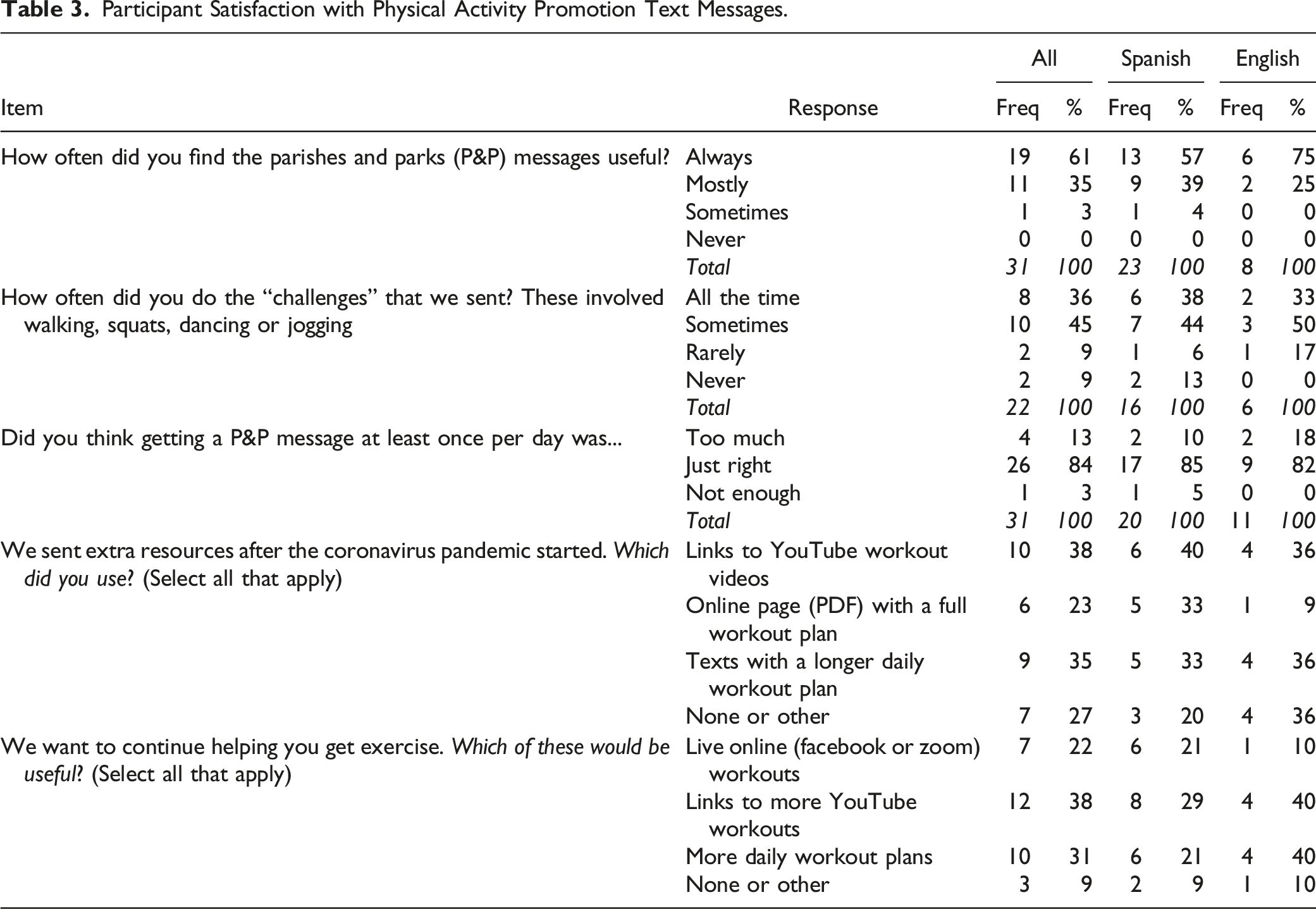
A survey about the text message component was conducted with study participants. This survey took place via text message between November 2020 through January 2021, after each church finished its initial 10-month cycle of texts. During one week, five multiple choice questions were sent, one per day. The questions asked about the perceived usefulness of text messages, appropriateness of the message frequency and how often respondents used or participated in specific activities associated with the text message component. Multiple-choice process evaluation items and open-ended follow-up questions were programmed to be sent, and responses captured, through the same web-based platform that we used for the text messages. 38 We present frequencies for each survey question.
After we sent each multiple-choice question, we followed up with those who responded and sent an open-ended question to elicit more information. For example, to the participants who answered the question about how useful they perceived the text messages to be, we then asked “Please tell us more. Why were they useful/not useful?” Thirty-two people received at least one of these open-ended questions. Also, after the last multiple-choice question, we told all participants that we welcomed any additional feedback. In addition to the evaluation, we collected unsolicited feedback that participants submitted via text message throughout the intervention period. All qualitative responses were reviewed and grouped by theme, with emphasis on responses that referenced the COVID-19 pandemic.
Results
Modifications During the COVID-19 Pandemic
After the stay at home order began in March 2020, 41 the text messages became, temporarily, the sole P&P intervention component. We continued the planned daily PA promotion text messages. We also developed new programming and content to provide virtual PA support: links to free online exercise classes in Spanish and English; exercise instructions developed by our team kinesiologist that were sent as texts or a downloadable PDF; a new program website with links to online resources, and eventually providing live exercise classes via social media.
In addition, we sent periodic messages with links to reliable COVID-19 information (e.g., to the Centers for Disease Control [CDC] and the local health department) and tips for stress management. We also sent messages about limiting outdoor activities during periods when wildfires caused poor air quality in Los Angeles and elsewhere, another contextual factor affecting participants in 2020.
The content of our pre-programmed PA promotion messages was modified in some cases to not contradict social distancing recommendations (Table 1). For instance, some messages originally encouraged group PA and/or park activities that were deemed no longer safe. However, many pre-programmed messages included content that remained relevant during the pandemic, like suggestions to dance or do squats at home, and messages with an uplifting tone (e.g, “be kind to yourself,” “embrace and love your body,” and “take time to pray, meditate and be at peace”).
Participant Sociodemographic and Physical Activity Characteristics
Sociodemographic Characteristics and Baseline Physical Activity of Study Participants.
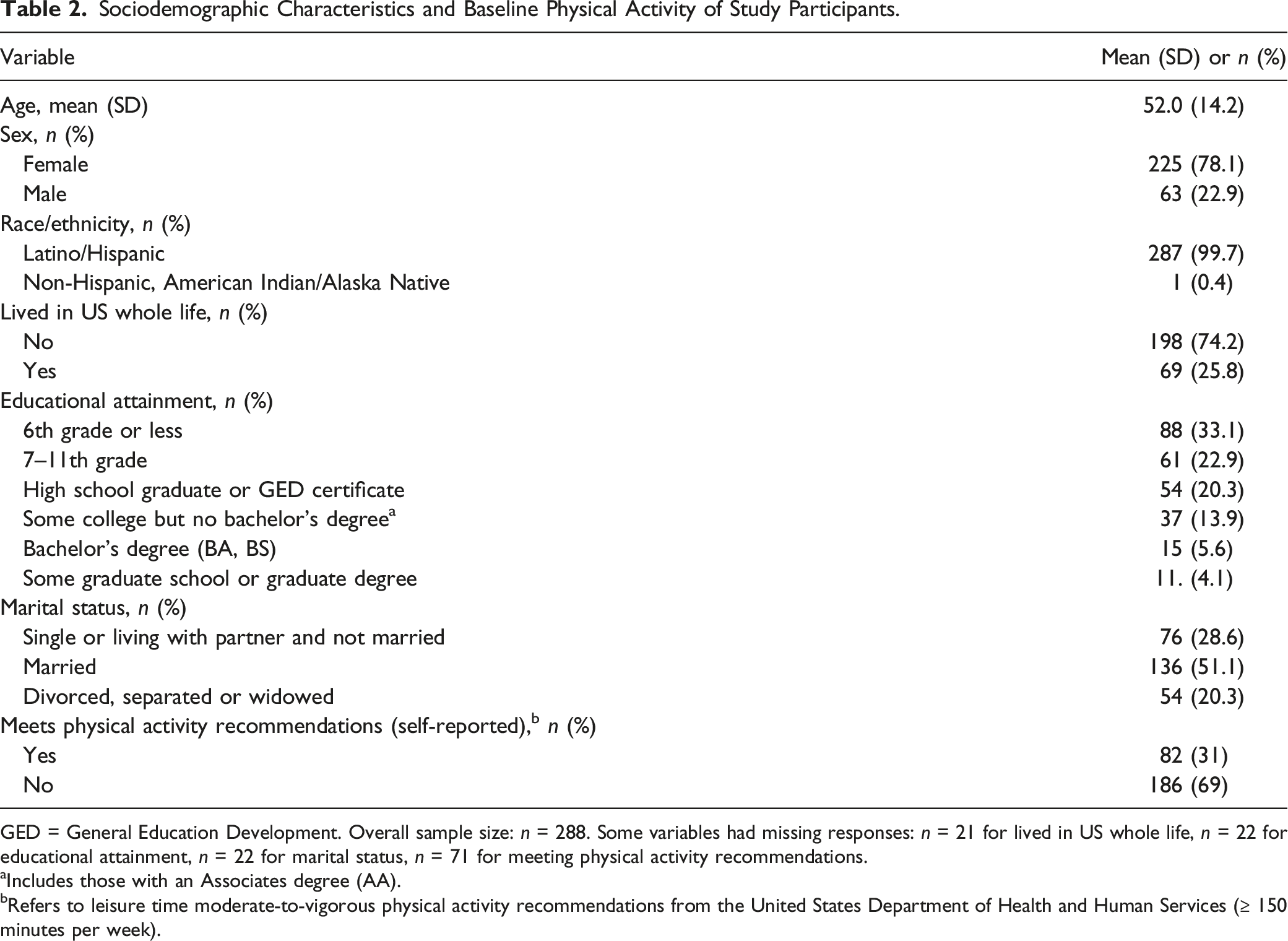
GED = General Education Development. Overall sample size: n = 288. Some variables had missing responses: n = 21 for lived in US whole life, n = 22 for educational attainment, n = 22 for marital status, n = 71 for meeting physical activity recommendations.
aIncludes those with an Associates degree (AA).
bRefers to leisure time moderate-to-vigorous physical activity recommendations from the United States Department of Health and Human Services (≥ 150 minutes per week).
Participant Satisfaction
Participant Satisfaction with Physical Activity Promotion Text Messages.
Role of the Parishes and Parks Text Message Component Specific to the COVID-19 Pandemic: Qualitative Responses From Participants.
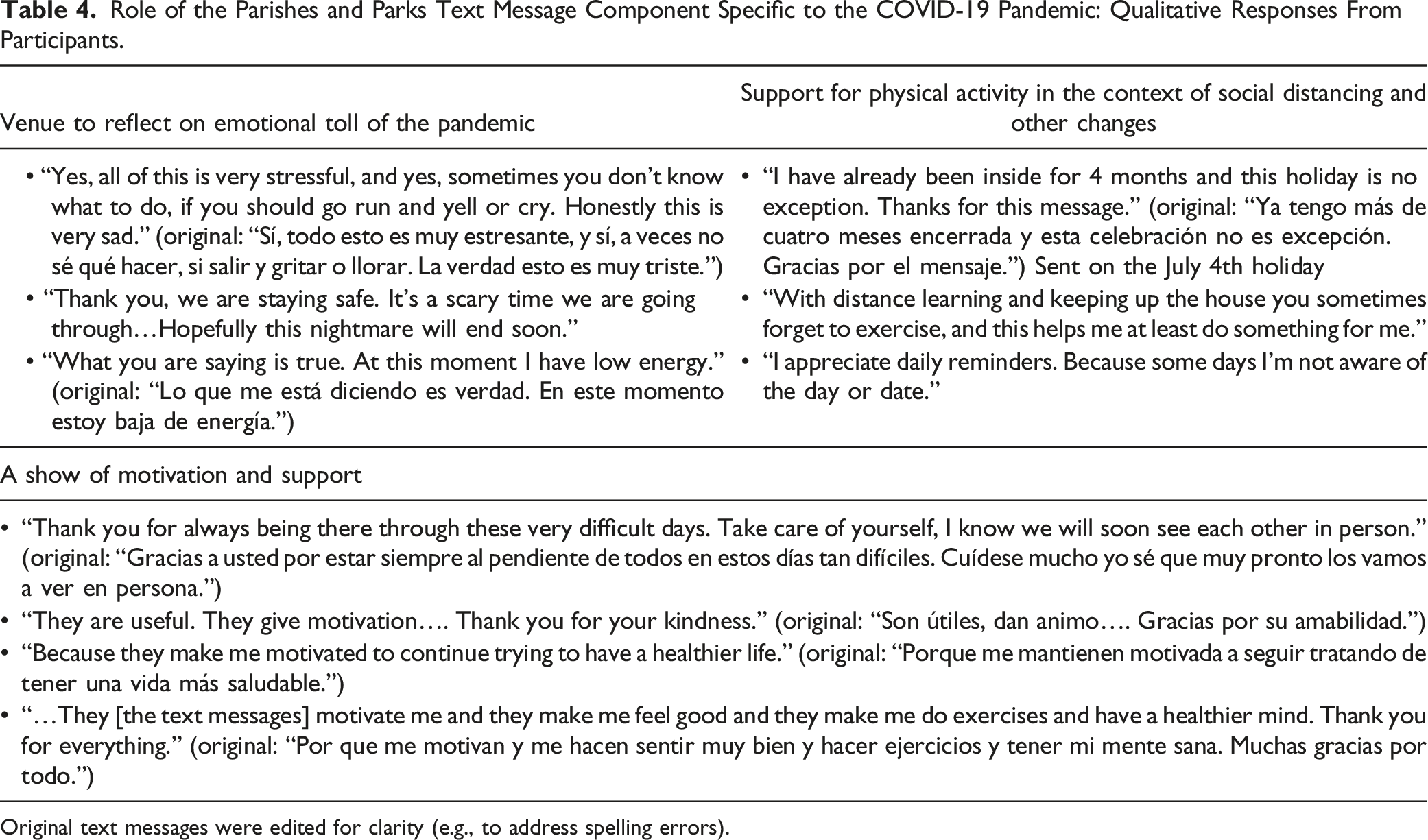
Original text messages were edited for clarity (e.g., to address spelling errors).
Discussion
We developed and implemented a PA-focused text message component serving a sample of Latino churchgoing adults in Los Angeles, CA. When the COVID-19 pandemic began, we modified the text messages to offer additional, at-home PA resources and pandemic-related information and support. The text messages were well-received by participants; the majority of respondents, both Spanish-speaking and English-speaking, reported that the text messages were useful, with some commenting that the messages were helpful during a very stressful, challenging time.
In the present study, text messages were sent in either Spanish or English based on each participant’s preferences. Nearly 80% of participants preferred to receive messages in Spanish. The text messages were feasible to implement and acceptable to both language groups. All of the daily text messages made reference to the larger faith-based program (Parishes and Parks, or P&P), and some of the content mentioned faith and/or church activities. The P&P text messages about COVID-19 are similar to the “personalized, repetitive” approach typical in health promotion text messages, rather than the “impersonal, bell ringer” approach commonly used in emergency communications. 30 (p. 34)
The overall P&P intervention was originally designed to be implemented in-person at churches and public parks. When non-essential workers had to stay at home in the early stages of the COVID-19 pandemic, 41 we modified our intervention to deliver PA support to participants in their homes. Across the three types of at-home PA support that we delivered via text, links to free online PA videos were the most often used. The fact that our project had an already established, easy-to-modify text message component in place at the start of the pandemic proved critical to our ability to quickly disseminate new, text-based PA resources.
We modified our text messages to not only continue providing PA support in a socially distanced manner but also to share accurate information about COVID-19. This aligns with the call to utilize more communication channels to promote accurate information and combat the “infodemic” during COVID-19. 42 Cervantes et al, found that, for unvaccinated Latinx patients in Colorado who were hospitalized with COVID-19, opportunities to have “conversations with trusted sources, such as faith-based leaders, or access websites that provided accurate and consistent information” could improve uptake of COVID-19 prevention strategies like vaccines. 43 (p. 9) The P&P text message component was well situated to serve as a trusted source of information and to offer links to accurate information.
We sent text messages to support mental wellbeing and foster a sense of social support. Some of these were part of the original intervention. Others were added during the pandemic, in line with other community based programs that augmented their social and mental health support activities in the wake of the COVID-19 pandemic. 26 Our participants stated that they appreciated the demonstration of support during a difficult time. A study from Canada indicated that mental health-focused text messages were associated with improved mental wellbeing during the COVID-19 pandemic. 33
In the present study, our sample size was small, and we did not have a comparison group for the process evaluation. Some respondents may not have received our messages because of technical problems (i.e., phone not working or new number) or if they blocked receipt of our messages. The number actually exposed to this intervention component is likely smaller than the 284 individuals to whom we sent messages. Lastly, our results add to the limited body of literature about interventions with Latino faith communities,44,45 but the results may not generalize to other communities.
Because we made modifications in reaction to an unexpected contextual change, as opposed to adaptations planned in advance, 46 we were not able to pilot test this modified study component beforehand. We sent our participants links to CDC and local public health department COVID-19 information websites as a source of reliable information, but we do not know to what extent participants trusted those sources. Trust in COVID-19 information from CDC varies in correlation with sociodemographic factors and political inclination, 47 and may have decreased overall during the course of the pandemic. 48
Conclusion
We found that text messages were feasible and acceptable for promoting PA among mostly Spanish-speaking, Latino churchgoing adults in Los Angeles, CA. The text messages were efficient to implement and provided a useful conduit to offer information about emerging, critical issues. We have described modifications that we made to the text message component during the disruption caused by the COVID-19 pandemic. We have shared results showing that most respondents found the text messages useful and that the messages provided meaningful support in the context of the pandemic. These findings suggest that text messages are a practical, well-received intervention or component that can be easily modified during disruptions from public health emergencies.
Footnotes
Declaration of Conflicting Interests
The author(s) declared no potential conflicts of interest with respect to the research, authorship, and/or publication of this article.
Funding
The author(s) disclosed receipt of the following financial support for the research, authorship, and/or publication of this article: This work was supported by the grant from the National Cancer Institute, R01CA218188. LGP was supported by a Diversity Supplement from the National Cancer Institute (3R01CA218188-03S2).
