






Abstract
The global educational landscape in 2026 finds itself at an unprecedented crossroads. We are no longer merely adapting to a post-pandemic recovery; we are actively wrestling with a hyper-accelerated socio-technological paradigm shift. As structural inequalities widen under the weight of global economic volatility, migration pressures, and regional shocks, the mandate of educational institutions as engines of social mobility is under severe threat. Globally, the fractures between marginalized student populations and rigid institutional frameworks are being exposed by uneven digital transformations, systemic racism, and legal vulnerabilities.
This issue of Equity in Education & Society brings together vital empirical and conceptual insights from Guyana, Guatemala, Jamaica, Sweden, and the United States. Each paper, in its unique contextual framing, exposes the critical intersections of technology, race, gender, geography, policy, and familial labour. Together, they offer a diagnostic look at how contemporary educational systems either replicate historical marginalization or offer radical pathways toward equity.
The digital frontier and institutional labour in higher education
In higher education, the friction between technological advancement and operational capacity creates a complex equity gap. Charmaine Bissessar offers a timely phenomenological critique of generative Artificial Intelligence (AI) within the Caribbean higher education context in her paper, ‘To use or not to use ChatGPT and assistive artificial intelligence tools in higher education institutions? The modern-day conundrum – students’ and faculty’s perspectives’. Utilizing the Unified Theory of Acceptance and Use of Technology (UTAUT2) framework, Bissessar captures the immediate tension between pedagogical innovation and academic surveillance.
The integration of Large Language Models (LLMs) has fundamentally disrupted traditional assessment architectures. Bissessar notes that this evolution is: ‘pushing the boundaries of human intelligence, making the future of higher education inextricably intertwined with AI’.
Through interviews with students and staff, the study uncovers a complex duality. On one hand, assistive tools offer substantial performance expectancies, acting as crucial augmentations for distance learning and streamlining research. On the other hand, serious concerns persist regarding plagiarism, the erasure of critical thinking, and the financial barriers to accessing premium, high-tier AI tools. Marginalized students face a dual penalty: they often lack the financial capital to access advanced AI tools and must navigate institutional environments devoid of clear, equitable policies. As Bissessar acutely warns, ‘Until policies are developed, then this is only an unresolved conflict’.
This technological strain cross-links directly with the operational realities outlined by Nola P. Hill-Berry and Nellian E. Hutton-Rose in ‘Students’ perceptions of the quality and utility of assessment feedback: Implications for educational leadership and quality assurance’. Grounded in a university setting in Jamaica, their study explores a fundamental component of pedagogical justice: how feedback is communicated, valued, and utilised. Feedback is the cornerstone of academic development, yet its execution is deeply entangled with institutional resource scarcity, heavy staff workloads, and massive class sizes. Hill-Berry and Hutton-Rose demonstrate that for students to value and use assessment feedback, it must be clear, specific, timely, and actionable.
The higher education operations gap
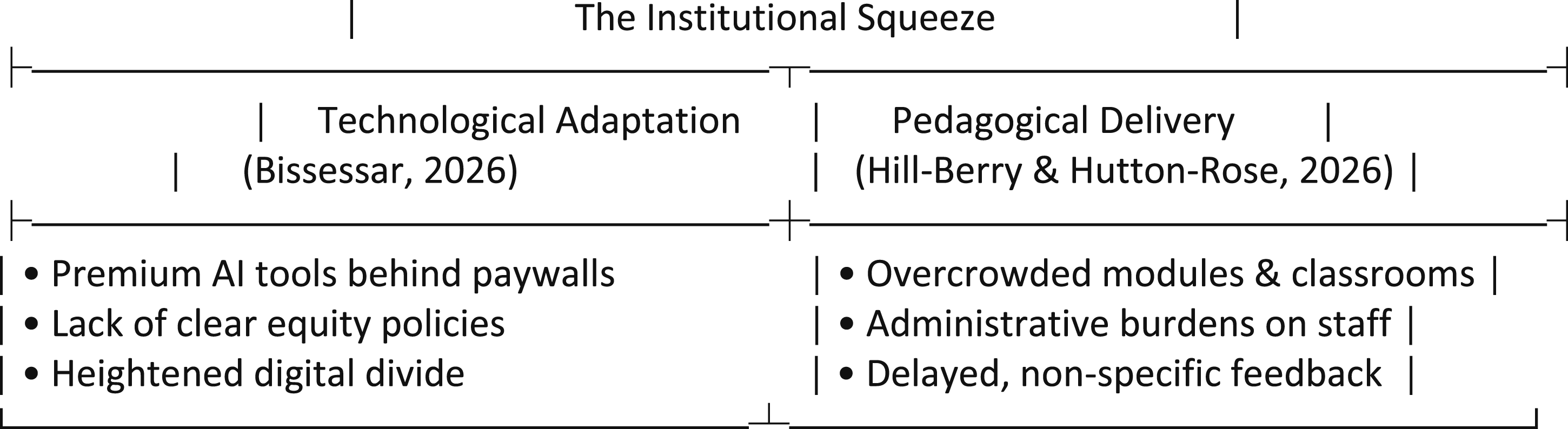
When higher education institutions treat quality assurance as a bureaucratic tick-box exercise while failing to invest in infrastructure and staff well-being, the feedback loop breaks. Students lacking external academic capital are left unable to self-correct, compounding the inequities highlighted by the digital divide.
Racialized crises and relational architectures for males of colour
While higher education grapples with technology and labour, the human cost of systemic exclusion falls heavily on minoritised student groups. Two papers in this issue examine the specific, racially gendered challenges faced by young men of colour navigating higher education ecosystems, offering vital institutional counter-strategies. In ‘Exploring the dual pandemic experiences of Black male engineering students’, Fatima Elmouden et al. investigate the compounding pressures of the COVID-19 health crisis and systemic racism. Black male students in highly competitive engineering disciplines do not experience institutional barriers in isolation; rather, the macro-systemic shocks of societal racial violence and economic disruption directly bleed into their academic environments. Elmouden et al. demonstrate that standard institutional mental health and academic counselling frameworks are frequently ill-equipped to address this ‘dual pandemic’ reality, leaving these students to carry a heavy psychological and academic burden alone.
Serving as an essential thematic bridge, Chivas L. Conner’s paper, ‘Natural mentoring for males of color transitioning to college’, explores a powerful relational buffer to these exact systemic pressures. Transitioning into higher education can be alienating for young men of colour, particularly when entering historically white institutions or hyper-competitive fields like those described by Elmouden et al. Conner’s work highlights the profound impact of natural mentoring – organic, non-institutional relationships formed with trusted adults within or outside the campus community.
Conner demonstrates that these informal mentorship ecologies provide crucial social capital, emotional validation, and navigational tools that formal, bureaucratic university programming fails to replicate. Natural mentoring acts as a protective architecture, shifting the focus from deficit-based institutional retention models to asset-based, community-driven empowerment.
Rhizomatic ecologies: Family, borderlands, and community support
A recurring theme across this issue is that a student’s educational trajectory cannot be isolated from their familial and community ecosystem. This connection is profoundly articulated by Marina Lambrinou in ‘Rhizomatic familias: Toward a new conceptual framework of mixed status youth and their families in the United States’.
Lambrinou introduces a ‘rhizomatic’ framework to understand how mixed-status families – here members hold differing legal and citizenship statuses – navigate the systemic surveillance and legal precarity of the state. Traditional educational frameworks view family involvement through a linear, institutionalised lens (e.g. PTA attendance, formal parent-teacher conferences). Lambrinou challenges this by showing that mixed-status families operate as non-linear, adaptive, and underground networks (‘rhizomes’) to protect their youth, pass down survival strategies, and maintain educational aspirations despite the constant threat of deportation and state-sanctioned exclusion.
This necessity of understanding student success through a broader communal and geographic ecology is echoed internationally by Kerri Evans et al. in ‘Relationships, parental involvement, and community support: Differences in school environment for boys and girls in rural Guatemala’. Examining a sample of 1590 sixth-grade students within the indigenous Totonicapán Province, this study investigates how child, family, and community networks interact to shape the school environment.
Totonicapán faces severe structural challenges, including a chronic child malnutrition rate of 82.2%, deep-seated poverty, and recent climate disasters. Evans et al. demonstrate that within a bilingual Spanish and K’iche’ curriculum, parental involvement serves as a direct, statistically significant catalyst for improving the school environment across all genders. However, their path analysis reveals a startling, gendered divergence: • For male students: Positive peer relationships paradoxically yielded a direct negative influence on a healthy school environment, tied to gendered classroom disruptions and popularity norms. • For female students: Negative school environments remain an acute barrier to retention, as parents are more likely to keep daughters home due to deep-seated community anxieties regarding travel-based violence and safety.
Intersecting ecologies of family and community
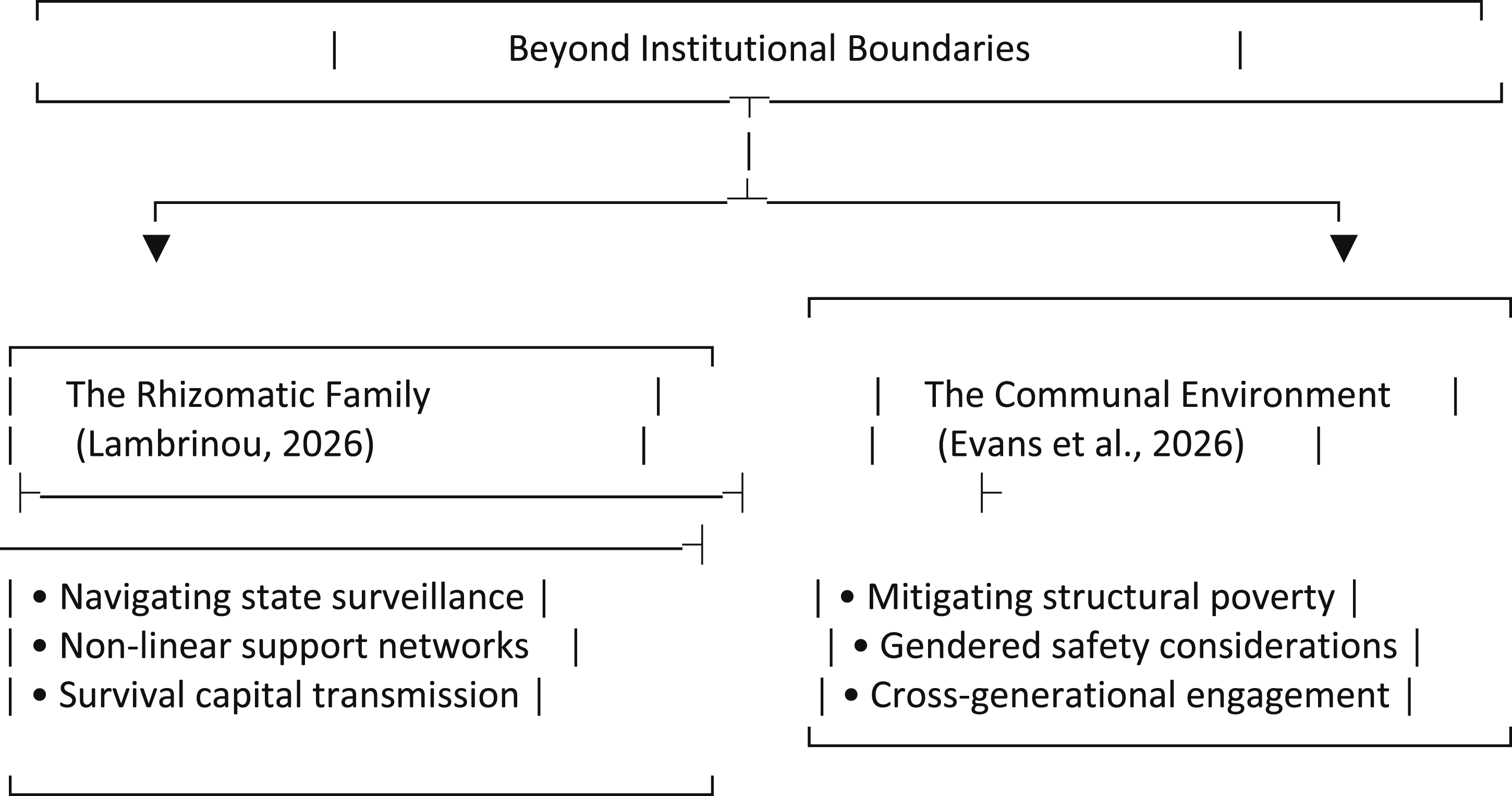
Both Lambrinou and Evans et al. challenge educational institutions to look past the physical school gates. Whether dealing with the legal borderlands of the United States or the geographical and economic challenges of rural Guatemala, educational equity cannot occur in a vacuum isolated from the material and political realities of the surrounding community.
Macro-governance and the power to enact equity
If the grassroots realities of equity are rooted in families, mentorship, and classrooms, the structural capacity to enforce fairness sits within governance and macro-policy. This top-down dimension is evaluated by Jabil Seven and Lene Foss in ‘Proposed measures to enhance equity: A study of Swedish superintendents’ emerging power’. While Sweden is historically celebrated for its social welfare model, the marketization and decentralisation of its educational system have introduced new equity challenges.
Seven and Foss investigate how superintendents – operating at the intersection of local municipal politics and national educational mandates – wield their emerging administrative power to implement equity measures. The study reveals that superintendents are no longer merely bureaucratic implementers; they are critical actors who must actively navigate competing political agendas to secure resource distribution for marginalised schools. Seven and Foss provide a crucial macro-perspective that connects back to every paper in this volume: for grassroots interventions – such as institutionalising AI equity policies (Bissessar), funding smaller class sizes for better feedback (Hill-Berry & Hutton-Rose), sustaining minority mentorship networks (Conner; Elmouden et al.), or supporting vulnerable migrant or indigenous communities (Lambrinou; Evans et al.) – to succeed, administrative leaders must have the clear political power and structural mandate to prioritise equity over market efficiency.
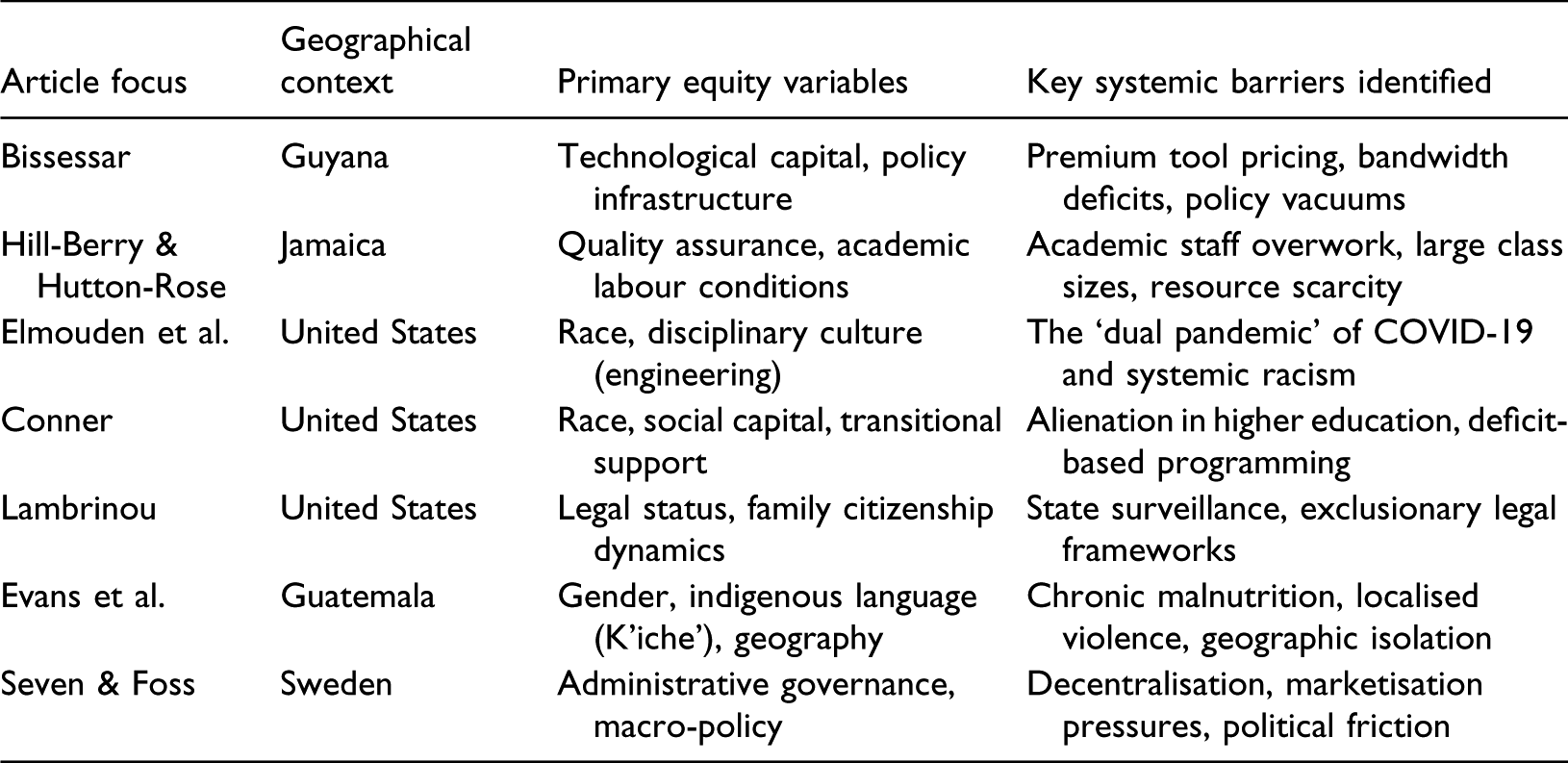
Comparative matrix of core equity dimensions
A manifesto for radical equity: A challenge to leaders
When read together, these seven papers present a clear, unified narrative. We cannot separate the digital tools we deploy (Bissessar) from the physical environments and cultural realities where our students live (Evans et al.), the legal structures that govern their families (Lambrinou), the relational spaces that protect them from systemic racism (Conner; Elmouden et al.), or the labour conditions of the educators and power structures of leaders tasked with guiding them (Hill-Berry & Hutton-Rose; Seven & Foss).
Therefore, this editorial of Equity in Education & Society issues a direct challenge to educational stakeholders worldwide: • To Policymakers: Move beyond market-driven and decentralised funding models that force schools and universities to compete at the expense of equity. Equity demands targeted resource distribution to bridge the digital divide, address geographical isolation, and safeguard vulnerable families from state surveillance. • To Institutional and University Leaders: Stop treating equity as a compliance exercise. Protect the labour conditions of your staff so they can provide meaningful, high-quality pedagogical support. Concurrently, move away from rigid, deficit-focused retention models for minoritised students; instead, invest in organic, asset-based mentoring networks and clear, inclusive technological frameworks. • To Communities and Researchers: Continue to dismantle the false boundaries between the classroom and the home. Honour the complex, non-linear survival strategies of marginalised and mixed-status communities and actively integrate these grassroots insights into institutional designs.
Fairness in education and in society requires a systemic dismantling of the barriers that convert a student’s identity – whether shaped by race, gender, legal status, geography, or class – into an educational disadvantage. The insights in this issue provide the empirical tools; global educational leaders must now provide the political courage.