







Abstract
Pediatric cancer affects the entire family, including siblings. Siblings experience strong negative emotions (e.g., loneliness and guilt), disruptions to their routines and responsibilities, and decreased parental attention (Alderfer et al., 2010; Long et al., 2015a; Van Schoors et al., 2019). While many siblings are resilient to these challenges, they remain at risk for psychosocial difficulties, including diminished quality of life, academic problems, and cancer-related posttraumatic stress (Alderfer et al., 2020; Long et al., 2018). Siblings commonly report unmet psychosocial needs (O’Shea et al., 2012; Patterson et al., 2017). Although supporting siblings is now a standard of care in pediatric oncology (Gerhardt et al., 2015), this standard is not being routinely met (Scialla et al., 2018) due to a multitude of healthcare delivery barriers such as billing/documentation challenges and staff shortages (Brosnan et al., 2021). Historically, sibling research has been challenged by limited awareness of siblings’ needs across families and healthcare systems, methodological concerns including small sample sizes, and few funding opportunities (Long et al., 2015b). Given the pervasiveness and complexity of these challenges, it is critical to build a team to create and advance a shared vision, partnership, and action for sibling psychosocial research and care.
The complementary expertise and skills within collaborative teams providing care and conducting research can improve the approach to tackling such important research questions and challenges, making team science ideal and increasingly necessary within pediatric hematology/oncology (e.g., Stegenga et al., 2020). Along with other members of collaborative teams, nurses play an important role in understanding and addressing the needs of siblings and families who are impacted by cancer. For instance, nurses often educate and prepare sibling bone marrow donors; provide support during treatment, survivorship, or bereavement; and conduct research on sibling interventions and outcomes. Therefore, nurses bring a valuable perspective regarding psychosocial support for siblings to collaborative teams.
The team science literature can provide insight into ways to enhance team functioning and processes to facilitate successful teamwork in a range of contexts (e.g., Guler et al., 2018; Hall et al., 2018; Salas et al., 2018). Although team science approaches, including transdisciplinary research initiatives, have been portrayed within oncology research (e.g., Gehlert et al., 2014; Vogel et al., 2013), these approaches have been infrequently described within pediatric hematology/oncology research despite the potential benefits. Team science refers to initiatives that “are designed to promote collaborative—and often cross-disciplinary—approaches to analyzing research questions about particular phenomena” (Stokols et al., 2008, p. S77). These cross-disciplinary teams may be multidisciplinary (i.e., each discipline provides an additive impact), interdisciplinary (i.e., the team is integrated but remains focused on discipline-specific approaches), or transdisciplinary (i.e., initiatives transcend individual disciplines to create novel, real-world solutions; Hall et al., 2012). In particular, transdisciplinary team-based research offers an innovative way of tackling complex and societal challenges. Here, we illustrate the utility of transdisciplinary team science in undertaking common challenges within hematology/oncology research, such as limitations with small samples and complexity in creating systems to adequately address the health and psychosocial needs of youth and families.
There are several aspects of transdisciplinary team-based research that are important to highlight. Although the specific composition of transdisciplinary teams is influenced by the research area, team members are diverse across multiple domains, including disciplines, work settings, and other demographic characteristics. For instance, the Iowa State University Translational Research Network consists of transdisciplinary teams of individuals from various disciplines (e.g., human development, prevention science, and education) and settings (e.g., schools, government, and community) and aims to address multiple issues related to youth health and wellness (e.g., physical activity and language development; Scudder et al., 2021). Community-based participatory research is also a good fit with transdisciplinary team-based research, such that community partners are involved at all stages of research to help successfully translate research findings into policy and practice (Hall et al., 2012; Woods-Jaeger et al., 2020). Transdisciplinary team science also holds the potential to produce novel and practical outcomes relevant to enhancing care (Hall et al., 2018; Stokols et al., 2008). For example, transdisciplinary training across nurse practitioners, dieticians, and pediatric psychologists to disseminate knowledge and skills may improve the care of adolescents with type 1 diabetes (Pierce et al., 2021).
Hall et al. (2012) proposed a refined four-phase model of transdisciplinary team-based research (i.e., development, conceptualization, implementation, and translation) and, building from the science of team science literature, highlighted several critical processes for working with transdisciplinary teams. In the current paper, we describe this four-phase transdisciplinary model and provide an example of its application to sibling research. This approach was used to overcome discipline-specific silos through the coordination, creation, and implementation of a shared vision for sibling research. Throughout this paper, key team processes are italicized within the text. These team processes as well as examples from our work are included in Table 1. Although some team processes are particularly relevant at certain phases of the model, these processes can be fluid and appear at various phases. For instance, establishing a safe environment for team members is crucial in the initial development phase. If the transdisciplinary team decides to begin new initiatives that require inviting new collaborators with additional expertise, it would be important to revisit the goal of fostering psychological safety given the incorporation of new team members.
Components of Transdisciplinary Team-Based Research and Examples From SPARCCC.
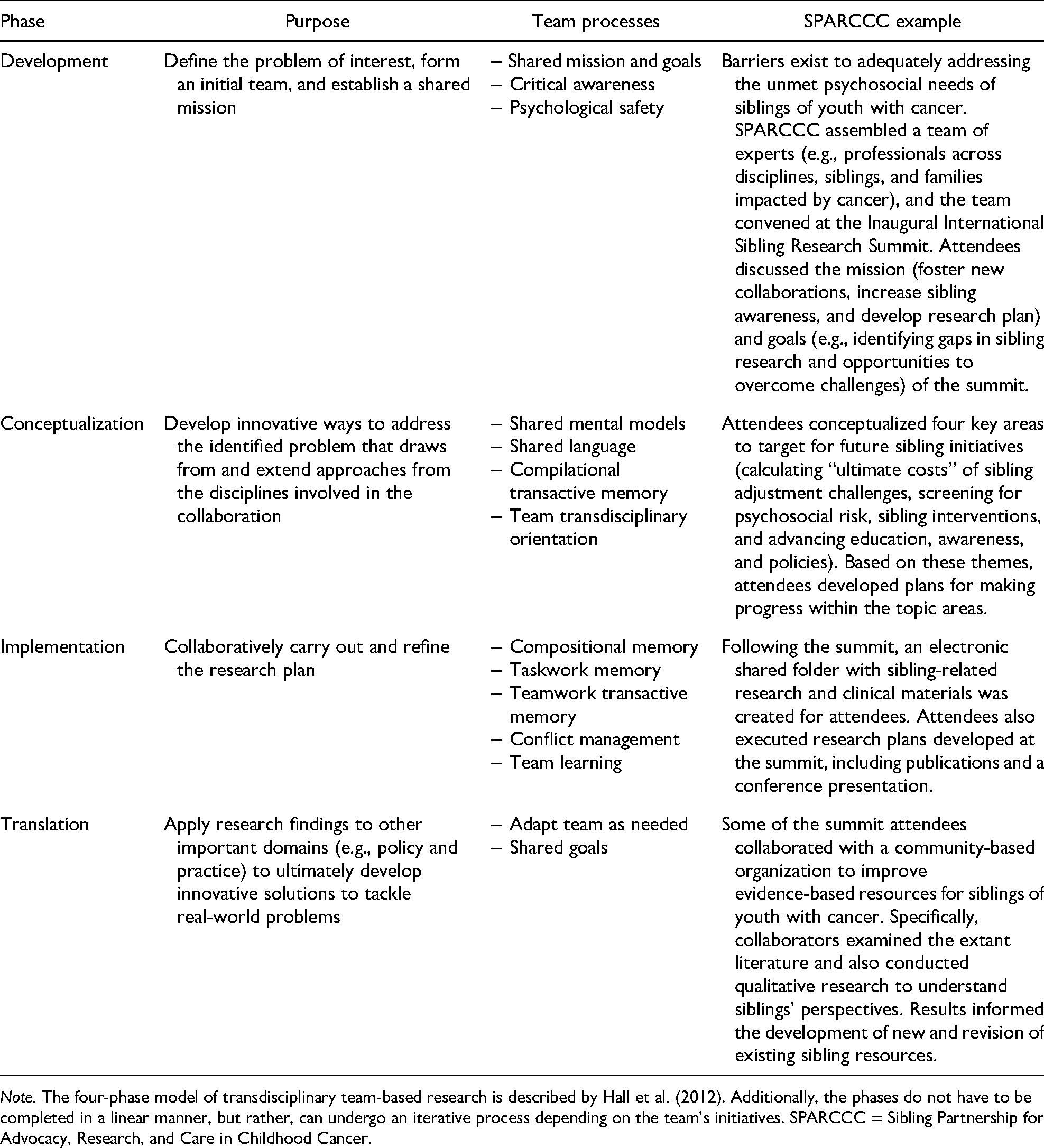
Note. The four-phase model of transdisciplinary team-based research is described by Hall et al. (2012). Additionally, the phases do not have to be completed in a linear manner, but rather, can undergo an iterative process depending on the team’s initiatives. SPARCCC = Sibling Partnership for Advocacy, Research, and Care in Childhood Cancer.
Application of the Four-Phase Model of Transdisciplinary Research to Sibling Research
To highlight the application of the four-phase model and key team processes, we provide examples from the Sibling Partnership for Advocacy, Research, and Care in Childhood Cancer (SPARCCC; formerly the Sibling Research Advisory Board), which is a community–academic partnership established in 2004 to identify and address the needs of siblings of youth with cancer (Long et al., 2015b). SPARCCC is comprised of family members of children who have had cancer and professionals across nursing, psychology, medicine, child life, social work, and public health who work in multiple settings, including academic medical centers, universities, and nonprofit organizations. Their mission is to facilitate sibling-focused research, disseminate findings, and advocate for screening and adequate care for siblings of children with cancer (https://sparcccpartnership.wixsite.com/sparccc).
Development Phase
The primary aim of the development phase is to define the societal problem of interest. A small group of individuals motivated to make changes in a particular research area gather to form an advisory or working group and define the problem. As a first step, the advisory group identifies disciplines that could be relevant to addressing this problem. During this process, it can also be useful to identify experts in other areas that are not directly tied to the research topic of interest, such as methodological or theoretical domains, but could apply their knowledge to the defined problem. Based on the disciplines identified, a larger team of experts is formed. During the development phase, the boundaries of the problem are defined, including key concepts and factors to be considered. In this work, the team is laying the foundation for their collaborative work together, including fostering group cohesion and encouraging information-sharing among team members. There are several important team processes relevant to this phase, including identifying a shared mission and goals, which can be revisited and revised throughout the team’s work together; developing critical awareness of the strengths and limitations of the approaches of each discipline represented by the team members; and fostering psychological safety, which is fundamental for promoting openness for sharing opinions, navigating conflict, and mitigating errors.
As an example, the core SPARCCC team identified that siblings of youth with cancer have unmet psychosocial needs and that there are barriers to adequately address these needs through research and clinical care (defining problem of interest). To begin to develop innovative solutions for overcoming these barriers, SPARCCC decided to assemble a transdisciplinary research team to create a shared vision and develop a plan for collaborative sibling research. To accomplish this goal, SPARCCC hosted an inaugural international summit in 2016 with financial support from Alex’s Lemonade Stand Foundation (ALSF), which is a community organization that supports youth with cancer and their families through direct contact and grant funding for pediatric cancer research. When planning for the inaugural summit, the core team discussed relevant disciplines to include—such as nursing, psychology, social work, public health, and medicine—and potential international experts in sibling or family research and/or pediatric oncology were identified from past collaborations with SPARCCC members and through relevant literature and web-based searches. In addition to the seven SPARCCC members, 13 internationally recognized experts were invited and agreed to attend the inaugural summit, and attendees consisted of researchers, clinicians, trainees, and policymakers. To ensure that the sibling’s voice was also present, six adolescent and young adult siblings also participated in the inaugural summit.
The purpose of the inaugural summit was to foster new collaborations and partnerships, increase awareness of siblings’ needs, and encourage research focusing on evidence-based strategies that could ultimately be disseminated to families and meet the needs of siblings (shared mission). With this mission in mind, SPARCCC members developed specific objectives for the inaugural summit (shared goals), including identifying gaps in the current sibling research; identifying barriers to effective sibling research and opportunities to overcome these challenges; introducing the voice of siblings in the research conversation; and creating a collaborative community of committed sibling researchers. Attendees were provided with the shared mission and summit goals before their meeting together and reminded of these objectives throughout the summit.
The 1.5-day Inaugural International Sibling Research Summit in Philadelphia, Pennsylvania, began with formal introductions such that each attendee gave a three-slide presentation, which highlighted their discipline, current institution, and their past, current, and planned work related to siblings and/or families. At the end of day 1 of the inaugural summit, attendees gathered for a reception to build connections and foster ease of future connection and collaboration (fostering psychological safety). Throughout the summit, intentional conversations were facilitated to create a culture of collaboration that elicited ideas, sparking excitement for creating change and increasing engagement among attendees
Conceptualization Phase
The primary goal of the conceptualization phase is to develop innovative ways to address the identified problem through perspectives and approaches from each discipline. After defining the problem, as well as all components that would be relevant to addressing this issue, the team examines gaps in the literature and then develops specific research plans for their work together, including identifying novel research questions, positing hypotheses, and generating a conceptual framework to guide research, practice, and advocacy efforts. Depending on the initiatives generated, the team may form smaller workgroups to tackle components of the research plan. Important team processes during the conceptualization phase include the development of shared mental models, including visual models of key elements of the research that can also serve as visual representations for the team. The team develops a shared vocabulary, or shared language, rather than discipline-specific jargon so that all team members can communicate effectively and understand the ideas being shared. Another important team process is being able to identify the expertise areas of each team member (compilational transactive memory), which can be facilitated through profiles and regular interactions among team members. Finally, the team builds a team transdisciplinary orientation, which is a team characteristic suggesting that the group values the integration of multiple disciplines, and approaches tasks with an eagerness to learn from other disciplines.
During the inaugural sibling summit, attendees first met as a large group to listen to several presentations, including an introduction to SPARCCC and its previous work, a review of the inaugural summit mission and objectives, and a panel of siblings who shared their experiences and provided a context for developing sibling research initiatives. Invited presentations provided an overview of the current literature regarding siblings of children with cancer and gaps in the field (promotion of shared mental models and shared language). Attendees were also provided with biographies of all of the participants and interacted with others throughout the inaugural summit to learn about each other’s areas of expertise (compilational transactive memory).
After the initial presentations, attendees met as a group to begin conceptualizing novel next steps for the field of sibling research. Specifically, they were invited to consider the “Future Perfect,” or the ideal future regarding supporting siblings of youth with cancer. Four main priorities emerged from these group conversations (shared mental models): (a) calculating the “ultimate costs” of sibling adjustment difficulties, (b) screening siblings for psychosocial risk, (c) developing and evaluating interventions for siblings, and (d) advancing education, awareness, and policy related to siblings. Tackling two topics at a time (first screening and evaluating interventions, then ultimate cost and advancing awareness), attendees broke into subgroups for more in-depth conversations about these topics. Each group was charged with formulating a plan for making progress within their chosen topic area, and each group took notes on their conversations (shared mental models). Then, the larger group came together to debrief and further discuss each topic.
The format of the inaugural summit also invited organic conversations about the future of sibling research. For instance, breakout groups sparked further conversation about possible avenues for research funding, as this history has been a challenge in the field of sibling research. Attendees identified past and possible future funding resources. Attendees also discussed the importance of educating funding agencies about the need for sibling research. Based on all of the ideas shared at the inaugural summit, attendees gathered at the end of the 1.5-day meeting to identify proximal tasks and longer-term aspects of the research plan to address siblings’ unmet needs. For instance, attendees discussed creating an internet-based repository for sibling resources and the sibling literature, disseminating content from the inaugural summit, designing multisite research projects, and developing avenues for continuing these productive conversations and extending potential collaborations.
Implementation Phase
The primary goals of the implementation phase are to collaboratively carry out and refine the research plan defined in the conceptualization phase. The group may begin to look like a more traditional team, with each member more formally involved with specific tasks and engaging in more routine team activities, such as regular communication or meetings. Additional experts may be identified to join the transdisciplinary research team to assist with conducting the research plan; it is crucial for new members to become integrated, and the team processes described previously (e.g., developing a shared language and goals) are critical for supporting new team members. Key processes for the implementation phase are primarily related to the logistics of conducting research. Drawing from the conceptualization phase, some concepts are repeated in this stage, such as understanding each member’s area of expertise (compilational transactive memory) and the roles and tasks to be done (compositional transactive memory), to ensure tasks are streamlined and each member’s skills are used effectively. Additionally, defining how tasks are being completed (taskwork transactive memory) and how interactions will occur (teamwork transactive memory) can also help facilitate team processes. Due to differences in approaches and terminology across disciplines, conflict can arise as team members are implementing the research plan. Although a healthy debate is important in the transdisciplinary research team process, as it can lead to new approaches and perspectives, negative effects should be minimized through conflict management. Finally, the transdisciplinary research team engages in team learning, “a team-level property that captures the collective knowledge pool, potential synergies among team members, and unique contributions” (Kozlowski & Ilgen, 2006, p. 86). Specifically, the team engages in an evolving process of reflection and action during the implementation phase, including sharing information, asking questions, and discussing feedback.
Immediately following the inaugural sibling summit, a shared folder was created for all summit attendees to access sibling-related research and clinical materials. Some attendees also began to implement research plans from short-term goals identified in the conceptualization phase. Specifically, subgroups were formed to conduct several research projects, and a team leader was established for each research project. Each subgroup decided on how tasks should be completed (e.g., dividing up writing sections of a manuscript; taskwork transactive memory) as well as each member’s role in the group (e.g., conducting literature searches and writing manuscript sections; compositional transactive memory). Subgroups also made decisions about the frequency and form of communication, including check-ins via email and scheduling virtual meetings as needed (teamwork transactive memory). Any disagreements about research approaches were handled through open conversation. Furthermore, subgroups engaged in team learning throughout the implementation process. Several research projects were completed during this phase. Specifically, some of the attendees of the inaugural summit completed a systematic review of the sibling literature (Long et al., 2018); published a study of medical residents’ awareness, training, and perspectives regarding the impact of cancer on siblings (Buchbinder et al., 2020); and presented sibling content at the 49th Conference of the International Society of Paediatric Cancer in October 2017.
Translation Phase
The purpose of the translation phase “is to apply research findings to advance progress along the discovery-development-delivery pathway to ultimately provide innovative solutions to real-world problems” (Hall et al., 2012, p. 424). Transdisciplinary teams may anticipate translational applications earlier on in the research project, such as during the development and/or conceptualization phase, which may influence team member composition earlier on in the process (e.g., inclusion of policymakers or clinicians for policy and clinical applications). Activities in the translational phase vary depending on the team’s focus and type of research (e.g., basic, applied, and implementation). For instance, a team may focus on additional research questions, engage in program development, or enhance existing policies. Also, there may be changes to goals based on the translational efforts (develop shared goals for the translational endeavor) and the team composition to include new partners with expertise in disciplines not currently represented (evolution of the team).
As part of the translational phase, SPARCCC partnered with a community organization to improve evidence-based sibling resources (shared goals for translational efforts). Specifically, SuperSibs is an ALSF program that provides “comfort and care” mailings to siblings across the United States (more information about SuperSibs can be found at: https://www.alexslemonade.org/childhood-cancer/for-families/supersibs). The SPARCCC team includes ALSF representatives and frequently collaborates with the organization. SPARCCC researchers and ALSF staff reviewed the existing literature on supporting siblings and conducted qualitative research to understand siblings’ perspectives of helpful resources, evaluate current SuperSibs resources, and identify potential new resources (Oberoi et al., 2019). Based on the findings, SuperSibs implemented changes including bolstering their school-based resources and revising their materials to incorporate new coping skills such as relaxation strategies.
Iterative Pathways
Transdisciplinary teams revisit the components of the four-phase model as needed. For instance, findings from the implementation phase may lead the team back to the conceptualization or development phase. After the translation phase, SPARCCC initiated a Second International Sibling Summit, which was held in Chicago, Illinois, in March 2018 with funding from ALSF (development phase). Building on the inaugural summit, the second summit aimed to identify strategies to improve psychosocial screening for siblings, which was one of the research priorities identified during the conceptualization phase. Additional professionals from various disciplines, including those with research and clinical expertise in psychosocial screening, as well as local siblings and families were invited to the summit. The second summit had several objectives, including reviewing the current research on screening siblings for psychosocial risk and unmet needs, identifying current clinical efforts and tools for screening, discussing screening logistics, identifying barriers to screening, and developing future research goals related to sibling psychosocial screening. During the first evening of the second summit, the emerging team continued to cultivate a safe environment for new and returning attendees to foster professional relationships and participation in this group setting.
As part of the conceptualization phase, attendees were again prompted to envision a “Future Perfect” but this time specifically for psychosocial screening. Attendees discussed this topic in subgroups first and then ideas were shared among the larger group for further conversation. Several themes emerged from discussions, including the importance of timing, instruments utilized, a multirespondent approach, logistics around protocols for positive screens, and integration of screening into the standard of care in pediatric oncology. During the second summit, several priorities emerged, and attendees formed workgroups to tackle the following areas: (a) implementation of the sibling psychosocial standard of care in pediatric oncology, (b) identification of feasible sibling screen measures, and (c) promoting awareness of the sibling message. As the second summit wrapped up, each participant was encouraged to identify proximal tasks that they were going to focus on following the summit. Furthermore, each workgroup established an initial plan for the implementation phase (e.g., leader[s] for the initiative and form of communication).
Following the second summit, attendees completed several objectives (implementation phase), including engaging in a social media campaign to spread sibling awareness on Sibling Day (April 10), submitting a grant proposal to examine the implementation of the sibling psychosocial standard of care, publishing a manuscript outlining a framework for psychosocial screening (Long et al., 2021), and initiating quarterly newsletters for community partners and professionals. As a result of their participation in the second summit, attendees were equipped to increase sibling awareness and disseminate efforts more broadly in their communities.
The second summit also sparked additional activities to ensure longer-term collaborations, including conversations about the development of a 501c3 nonprofit (Sibling Partnership for Advocacy, Research, and Care [SPARC]) to serve as a hub for sibling efforts, and nonprofit status was recently obtained https://siblingpartnership.squarespace.com/. This new direction will help to provide infrastructure and assist with the sustainability of our collaborative goals, as additional iterative pathways are explored. For instance, SPARC plans to host future summit meetings to continue transdisciplinary collaboration on the key research areas identified in the inaugural summit. In future summits and collaborations, it will also be critical to examine the effectiveness of team science efforts within sibling initiatives and possible benefits to siblings and their families.
Discussion
Team science broadly and transdisciplinary-based research teams specifically hold promise within hematology/oncology nursing. This paper illustrates the application of the transdisciplinary four-phase model (Hall et al., 2012) and key team processes to the challenge of meeting the needs of siblings of children with cancer. This novel approach of assembling and collaborating with an international, transdisciplinary team of professionals, community partners, and sibling and family collaborators has allowed us to magnify our efforts to improve sibling research, care, and advocacy. This transdisciplinary team approach has applications to many other domains within pediatric hematology/oncology nursing, particularly areas requiring transcending discipline silos and generating creative solutions to target complex issues.
Despite the benefits of transdisciplinary research, there are notable challenges at various levels (e.g., individual and group levels), including substantial time and effort required for project management, difficulties with sustainability, and limited institutional incentives related to promotion review for engagement in transdisciplinary work (e.g., Borner et al., 2010; Scudder et al., 2021; Vogel et al., 2014). To tackle some of these challenges within our transdisciplinary team, we have utilized the summits as opportunities for collaborators to gather and formulate innovative next steps to advance psychosocial care, research, and advocacy for siblings of youth with cancer. Attendees have been actively engaged during and following the summits, achieving postsummit goals such as promoting sibling awareness and conducting sibling-focused research. Although communication among members has declined after the completion of specific projects, the members remain connected through this network. Furthermore, the core SPARC team regularly meets to foster ongoing sibling projects including planning future summits and other initiatives to maintain the connectedness and vibrancy of the larger group.
In addition to incorporating team science frameworks in assembling teams, it may also be beneficial to evaluate team functioning in a variety of domains (e.g., cross-disciplinary research teams) and settings (e.g., healthcare settings and international collaborations). Although outside the scope of the current paper, other relevant team models could be applied to the work conducted in hematology/oncology nursing. One widely used framework is the input-process-output model to examine factors related to team performance (McGrath, 1984). Future work could include the application and evaluation of team science frameworks to better understand factors related to effectiveness across different types of teams (e.g., research and clinical) and ways to enhance team functioning in a variety of settings. Together, team science approaches can be utilized to tackle challenges, increase team effectiveness, and enhance the provision of care within hematology/oncology nursing.
Implications for Pediatric Hematology/Oncology Nursing
Nurses are in a prime position to engage in transdisciplinary research teams and identify collaborators for these team processes. Furthermore, because family needs span a vast array of issues, it is necessary for nurse scientists to collaborate with other professionals, families, and community members in research and intervention to create more holistic and comprehensive solutions for families affected by pediatric cancer and hematological disorders. We provide an example of transdisciplinary research where we were able to identify gaps in care, come to a shared mental model, and prioritize research that can better meet the needs of siblings of youth with cancer. Our collaboration of families, researchers, and community partners continues to grow and has been productive and meaningful in understanding the challenges facing siblings in order to improve our team science and ultimately evidence-based practice.
Footnotes
Acknowledgments
The authors would like to thank the following team members who contributed their ideas and expertise during the 2016 and/or 2018 Sibling Summits: Michael Amylon (Stanford University), Elvia Barboa (PADRES Contra El Cáncer), Maru Barrera (The Hospital for Sick Children), Deborah Berk (Dana Farber Cancer Institute), David Buchbinder (Hospital of Orange County & University of California, Irvine), Linda Ewing (University of Pittsburgh), Stephanie Fooks-Parker (Children’s Hospital of Philadelphia), Martha Grootenhuis (Princess Máxima Center for Pediatric Oncology, & Emma Children's Hospital AMC), Katie (Kerr) Holcomb (Ryan’s Case for Smiles), Kiyoko Kamibeppu (The University of Tokyo), Ulrika Kreicbergs (Ersta Sköndal University College & Karolinka Institutet), Grace Lerro (Alex’s Lemonade Stand Foundation), E. Anne Lown (University of California, San Francisco), Avi Madan-Swain (University of Alabama, Birmingham), Anna Marsland (University of Pittsburgh), Susan McHale (Pennsylvania State University), Valerie Nguyen (University of North Carolina), Anjali Oberoi (Boston University), Emily Pariseau (Boston University), Pandora Patterson (Canteen Australia), Linda Paul (American Academy of Pediatrics), Wendy Plante (Brown University), Alice Prchal (University Children’s Hospital Zurich), Emma Robertson, Skye Robertson, Lisa Towry (Alex’s Lemonade Stand Foundation), Lauren Quast (University of Georgia), Kristi Rico (Okizu), Sandi Ring (Chicago, Illinois), Liz Scott (Alex’s Lemonade Stand Foundation), Patrick Scott (Alex’s Lemonade Stand Foundation), Christina Sharkey (Oklahoma State University), Megan Tudor (Yale Child Study Center), Lori Wiener (National Institutes of Health), and Tammi Young-Saleme (Nationwide Children’s Hospital & The Ohio State University). We would also like to thank Nicole Cardona, Jenna Eilenberg, and Monica Gordillo (Boston University) for their feedback on an earlier draft of this manuscript.
Declaration of Conflicting Interests
The author(s) declared no potential conflicts of interest with respect to the research, authorship, and/or publication of this article.
Funding
The author(s) disclosed receipt of the following financial support for the research, authorship, and/or publication of this article: Funding for the 2016 and 2018 International Sibling Summits was provided by Alex’s Lemonade Stand Foundation (Conference Planning Grants; PI: Alderfer). Ms. Wawrzynski’s contributions were supported by the National Institute of Nursing Research of the National Institutes of Health under Award Number F31NR018987.
