







Abstract
Background
This one-group pretest–posttest experimental research was conducted to determine the effect of storytelling on the anxiety levels of children diagnosed with cancer.
Method
Children aged 4–10 years and their parents in the pediatric hematology-oncology service of a university hospital were included in the study (N = 39). A 2-day storytelling intervention with the A Hopeful Cloud Story book to help children express their anxieties and cope with the changes caused by hospitalization for cancer treatment was applied to children. The Child Fear Scale (CFS) was used to evaluate the anxiety levels of children before and after the intervention.
Results
The average age of the children was M (SD) = 6.54 (2.11) years, and most were male (56.4%). According to the children's reports, the CFS pretest mean score was M (SD) = 3.54 (0.55), and the posttest mean score was M (SD) = 1.33 (0.48). In the posttest, it was determined that the children's CFS scores decreased (p < .001). According to parent and researcher reports, a significant decrease was observed in the children's CFS scores after the intervention.
Discussion
As a result, the storytelling intervention is effective in reducing children's anxiety levels. It would be helpful to use a storytelling intervention in the treatment and care processes of children with cancer.
Background
While significant improvements have been seen in survival rates with current treatments and care for childhood cancer, the number of newly diagnosed children continues to increase each year (Kutluk & Yeşilipek, 2024). Because of the long treatment process, the disease negatively impacts children and their families (Şengül & Bayram, 2022). Due to treatment-related symptoms (nausea and vomiting, fatigue, pain, etc.), prolonged hospitalization, and interventional procedures (catheter placement, etc.), children may experience psychosocial symptoms such as anxiety, fear, restlessness, and withdrawal (Hasnani, 2023; Lazor et al., 2019; Torres et al., 2019). Anxiety is a common symptom in children with cancer. A meta-analysis reported the anxiety rate as 13.92% in children and adolescents with cancer (Al-Saadi et al., 2022). One of the significant causes of anxiety is the disruption of familiar routines and being away from social circles and family. Therapeutic approaches that consider the child's developmental characteristics will facilitate adaptation and enhance psychosocial well-being (Altay et al., 2020; Hüzmeli et al., 2024). Using therapeutic approaches in child care as part of atraumatic care helps children cope with the complex treatment process and meet their emotional needs (Aguilar, 2017; Raybin et al., 2024).
Therapeutic methods for children with cancer can provide opportunities for them to express their feelings (e.g., anxiety, fear, hope) related to their experiences (Erdoğan & Altay, 2022; Mullan & Kothe, 2010). Therapeutic approaches used in children with cancer include therapeutic play (Hüzmeli et al., 2024), technology-supported interventions (e.g., mobile apps, virtual reality, biofeedback; Ozturk & Toruner, 2022; Savaş et al., 2024), storytelling (Akard et al., 2015), picture drawing (Altay et al., 2017), art therapies (Aguilar, 2017), and psychosocial-cognitive therapies (Arpaci et al., 2023). Therapeutic approaches are reported to be effective in reducing anxiety (Hüzmeli et al., 2024; Ozturk & Toruner, 2023), fear (Hüzmeli et al., 2024), and depressive symptoms (Ozturk & Toruner, 2022) in children. Nurses working in pediatric oncology services should be able to identify and implement therapeutic approaches appropriate for the child's age group. Storytelling is one approach that can be used for this purpose. Stories share emotions and experiences through fictional characters. Connecting with lived events and creating meaning through stories is possible (Harper, 2010). With the help of appropriate stories, feelings such as fear, anxiety, and insecurity can be made tangible for children. As children listen to therapeutic stories related to the topic discussed in the story, the problem becomes concrete, and they develop the ability to look at it from an outside perspective (Liberman, 2017; Yılmaz, 2023). In this respect, stories based on events and people similar to the child's situation can help children make sense of their experiences.
The literature has shown that storytelling can be successfully implemented in hospitalized children with chronic illnesses (Altay et al., 2017; Dewi et al., 2021; Ezegbe et al., 2019; Haristiani et al., 2022). Storytelling has been used in this patient group for anxiety management, hospital fear management, and health-illness education (Akard et al., 2015; Cho et al., 2023; Haristiani et al., 2022; Wilson et al., 2015; Zarifsaniey et al., 2022). Anggraini (2022) reported that storytelling through digital stories effectively reduced the anxiety levels of children aged 2–12 receiving chemotherapy (Anggraini, 2022). In a study conducted with adolescents with cancer, they were asked to create their own stories using digital storytelling. Adolescents stated that this method was beneficial for understanding and expressing their own experiences, as well as understanding the experiences of others (Laing et al., 2017). Storytelling can help children identify their experiences and emotions and understand their surroundings. There are limited studies investigating the effectiveness of storytelling in Turkey. Therefore, this study contributes to the literature. This study aimed to investigate the effect of storytelling on the anxiety levels of children with cancer in Turkey.
The Hypothesis of the Research
The storytelling intervention will have positive effects on the anxiety levels of children undergoing cancer treatment.
Study Design and Study Sample
The one-group pretest–posttest quasi-experimental study was conducted in a pediatric oncology service in a university hospital between October 19, 2023, and January 18, 2024. Purposive sampling was used in the study. Purposive sampling involves selecting participants based on specific objectives. In this study, children diagnosed with cancer and meeting the 4–10 year age criterion were included in the study, based on a type of sampling that ensures representativeness through purposive sampling. The inclusion criteria were as follows: (a) children with cancer who have started treatment and have received at least one course of chemotherapy, (b) children between the ages of 4 and 10 years old, and (c) children who can understand and speak Turkish. The exclusion criteria were as follows: (a) children with cognitive and mental problems, (b) children with hearing, speech or visual impairment, (c) children in the terminal period, (d) children who will have an invasive procedure planned on the study days (port needle insertion, intrathecal treatment, etc.), (e) children who are going to start chemotherapy treatment for the first time or will be switched to a new drug, and (f) children with severe neutropenia.
During the study period, 59 children receiving cancer treatment were evaluated in terms of the inclusion criteria. Children who did not agree to participate in the study (n = 5) and those who met the exclusion criteria (n = 15) were eliminated, and 39 children and their parents were included.
Measurements
The researcher collected data from children and their parents who were admitted to the ward. First, children and parents were informed about the study with the “Voluntary Informed Consent Form” and were included in the study if they volunteered to participate. The primary outcome measure of the study was anxiety. The Children's Fear Scale and the descriptive characteristics form were used to collect data.
Data Collection Tools
Descriptive Characteristics Form. This form consisted of 15 items eliciting information on the sociodemographic characteristics (age, gender, educational status, etc.) of children and their parents.
Children's Fear Scale. This scale consists of five drawn facial expressions ranging from neutral expression (0 = no fear) to a frightened face (4 = extreme fear), evaluating children's anxiety. Families and researchers can also use the scale to evaluate children before and during the procedure (McMurtry et al., 2011). Psychometric evaluation of the Child Fear Scale (CFS) in the Turkish population was conducted by Gerçeker et al. (2018). If the children's language development is adequate and they understand what is being said, it can be used with 3 to 4 year olds. (Gerçeker et al., 2018).
Developmentally, children have difficulty distinguishing their internal emotional states, so they tend to express anxiety through observable fear responses rather than abstract emotional labels toward specific objects or situations (Campos et al., 2020; Gerçeker et al., 2018). Previous studies have shown that children’s levels of fear are associated with anxiety (Gerçeker et al., 2021). Therefore, the CFS can be considered a valid indirect measurement tool to assess childhood anxiety. The Turkish adaptation of the scale states that it can be used to measure children's fear and anxiety (Gerçeker et al., 2018). The literature includes studies that have used the scale to measure anxiety in children during invasive procedures (Arıkan & Esenay, 2020; Ozdemir & Ayyildiz, 2024). The scale is also age-appropriate and suitable for self-reporting. Its brevity and clarity also facilitate its use. For these reasons, the scale was used in our study to measure children's anxiety levels. In this study, children's anxiety levels were reported by the children, parents, and the research nurse.
Procedure
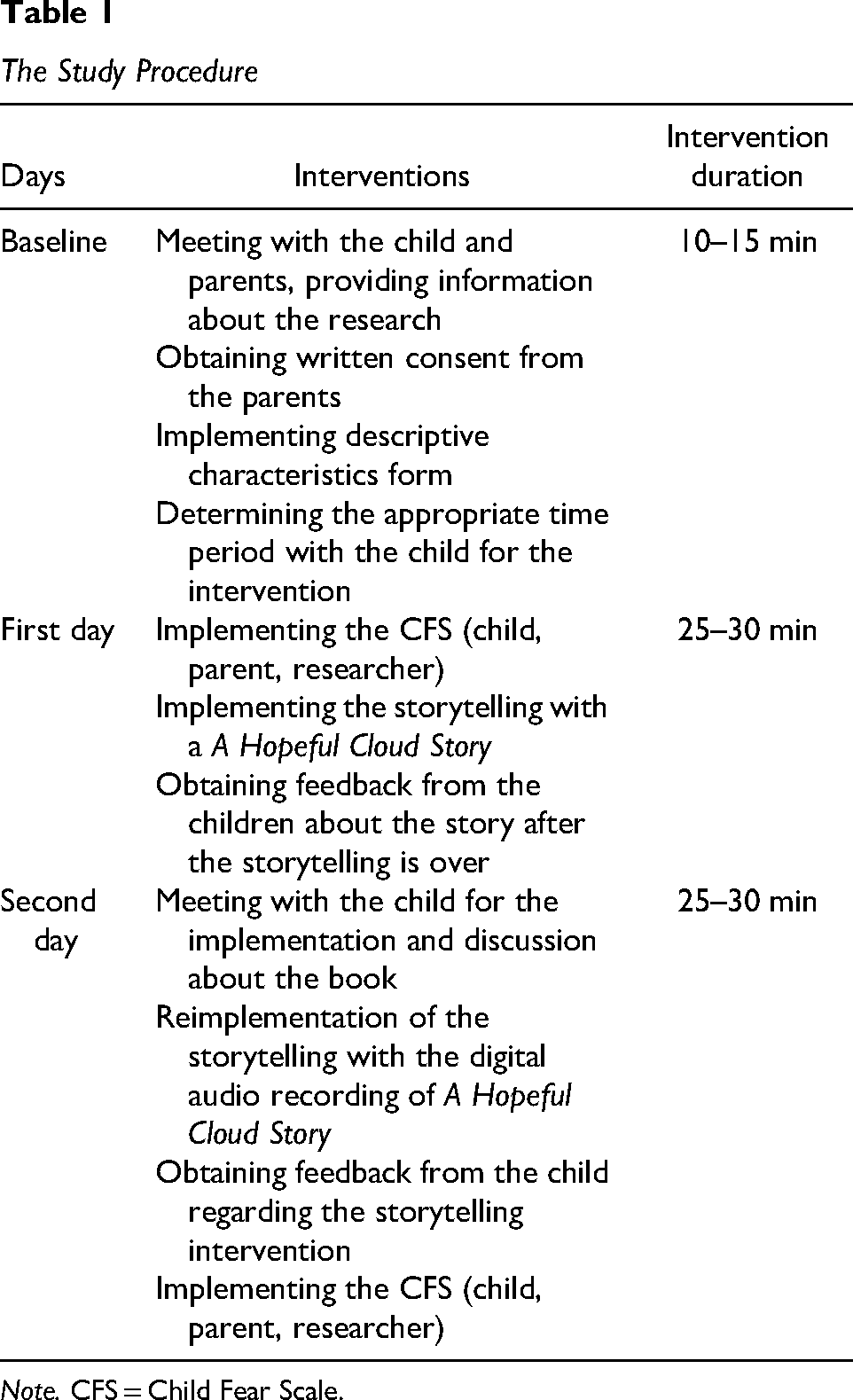
The nurse researcher visited the children and parents in the ward and provided information about implementing the study procedures. Then, a plan was made with the children and parents about the appropriate time. On the first day, storytelling was implemented by the researcher by reading the story with the child, together with the visuals in the printed book. The intervention was implemented in the child's room and during a period with minimal interruptions. The researcher provided the storybook for each child individually. On the second day, the digital audio recording of the story created by the researcher was played to the child. After the child completed the study, the book was given to the child as a gift. The implementation plan of the study is given in Table 1.
The Study Procedure
Note. CFS = Child Fear Scale.
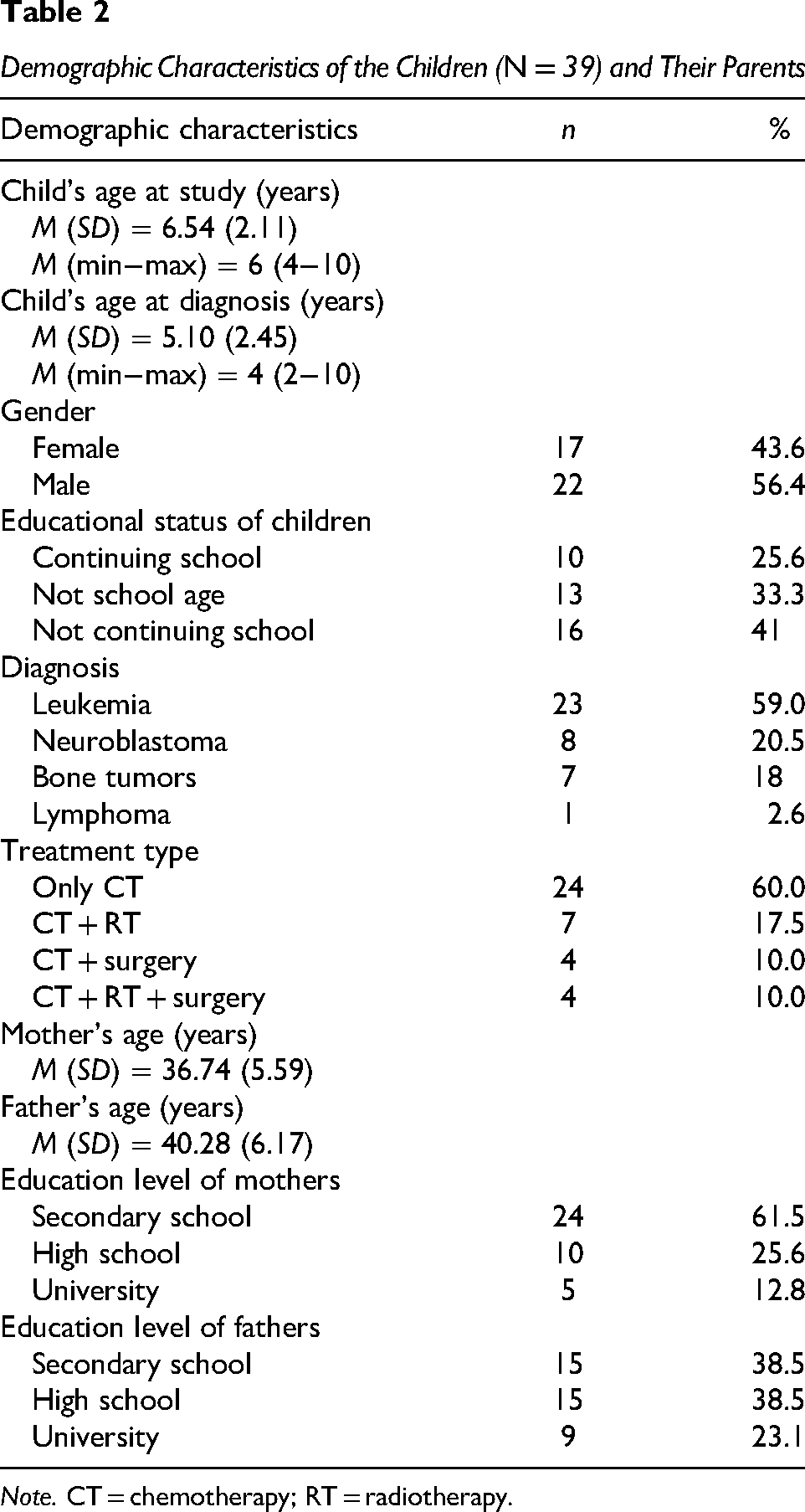
Demographic Characteristics of the Children (N = 39) and Their Parents
Note. CT = chemotherapy; RT = radiotherapy.
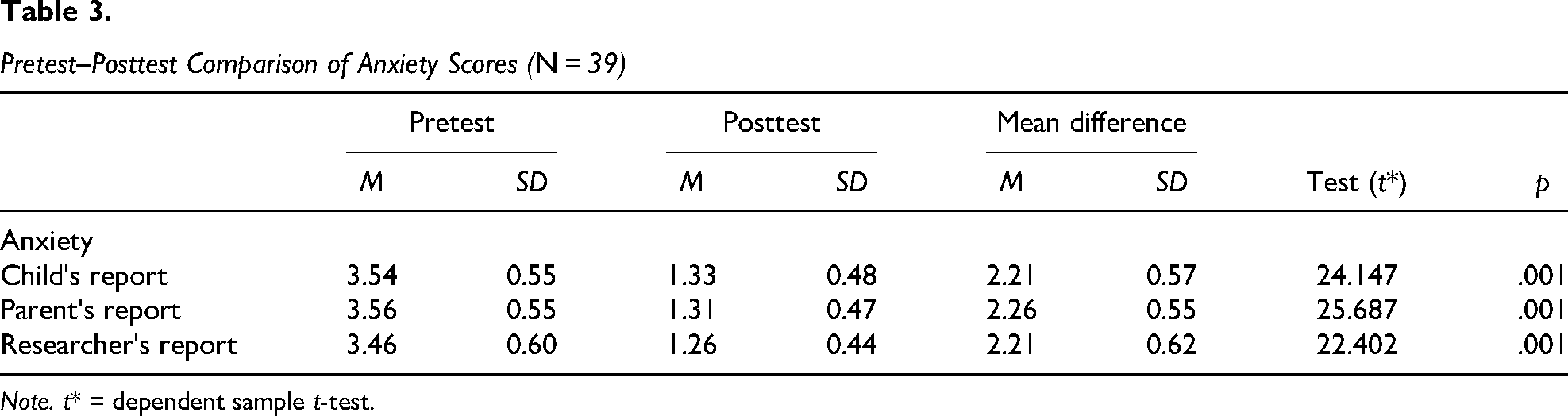
Pretest–Posttest Comparison of Anxiety Scores (N = 39)
Note. t* = dependent sample t-test.
Storytelling
This study implemented a storytelling intervention with children receiving cancer treatment using the A Hopeful Cloud Story with verbal and digital techniques. A Hopeful Cloud Story features Umut, who is in the hospital after a cancer diagnosis, and his new friend, Bulut. It is a story that helps Umut manage his longing for his brother by imagining with the help of his new friend, the cloud “Bulut,” how his emotions change positively. This story aims to embody how to cope with the changes caused by being hospitalized for cancer treatment and to help children express their anxiety. The story book consists of 33 pages. Each page of the story contains visuals related to the text. An expert in child psychology wrote the story, and the visuals were designed by an illustrator appropriate for this age group. The rights to use the story belong to the Hope Foundation for Children with Cancer (KAÇUV) association.
Verbal Narration. Verbal storytelling is the transmission of a story using sounds, images, or words. In verbal storytelling, the narrator conveys the story to the listener using the physical qualities of the spoken word (e.g., rhythm, tone of voice) and the nonverbal language of the body (e.g., gaze, gestures, facial expressions). Verbal storytelling often involves improvisation, but it can also be done through narration on printed material (Berkowitz, 2011; Haigh & Hardy, 2011; Yılmaz, 2023). In this study, A Hopeful Cloud Story was read to the child by the researcher using the verbal narration method with the printed book. The child was allowed to examine the book and its illustrations during the storytelling.
Digital Narration. Digital storytelling is a creative process that combines traditional storytelling with digital technology such as computers, video cameras, and voice recorders. Digital stories are 3–5 min narratives prepared with media elements such as sound, images, video, music, and animation to enhance the story's clarity, memorability, and appeal to audiovisual perceptions (Erdoğan & Altay, 2022; Gubrium, 2009; Ohler, 2013; Yılmaz, 2023). Since children today are exposed to digital technology before printed materials from early childhood, digital storytelling can be engaging. The researcher voiced A Hopeful Cloud Story and recorded it as a 5-min audio file, creating a digital story. The voice recording of the story was created using the voice recorder feature of the Samsung Galaxy A23 mobile device. The emotional expressions in the text were voiced in a way that reflected the story. The child was allowed to examine the book and its illustrations during the storytelling.
Ethical Considerations
Written approvals were obtained from Toros University Non-Invasive Ethics Committee (Ref. No.: 26.04.2023/44), Çukurova University Hospital Chief Physician, and Pediatric Oncology Department to conduct the study. Verbal assent was obtained from children who agreed to participate in the study, and written consent was obtained from their parents. Permission was received from the KAÇUV to use the storybook in this research and to create a digital audio recording.
Data Analysis
Data were analyzed using the IBM SPSS Statistics Standard Concurrent User Version 26 (IBM Corp., Armonk, New York, United States) statistical package program. If the absolute skewness value is below ±2.0 and the kurtosis value is below 7.0, the data are considered to be normally distributed (Kim, 2013). Accordingly, the variables used in the study were found to be normally distributed. Furthermore, the Shapiro–Wilk normality test results determined that the data were normally distributed (p > .05). Parents, children, and the researcher were treated as distinct informants, each providing complementary perspectives on child anxiety. The level of cross-informant agreement between these perspectives was evaluated using The Intraclass Correlation Coefficient (ICC). When parents, children, and the researcher were considered as different perspectives, agreement across informants was excellent for the posttest assessment (ICC = 0.943, 95% CI: [0.903–0.968]) and moderate for the pretest assessment (ICC = 0.697, 95% CI: [0.484–0.831]). These findings suggest that the reports are complementary rather than interchangeable. A paired-samples t-test was used to compare the pretest and posttest. A p value of <.05 was considered statistically significant.
Results
The demographic characteristics of the children and parents are presented in Table 2. The mean age of the children was M (SD) = 6.54 (2.11) years, and the majority were male (n = 22, 56.4%). Most of the children were diagnosed with leukemia (57.5%), and 60% of them were receiving chemotherapy as the sole intervention. The mean age of the mothers was M (SD) = 36.74 (5.79) years, and the mean age of the children's fathers was M (SD) = 40.28 (6.17) years. The majority of the mothers were primary school graduates (61.5%), and the majority of the fathers were secondary school graduates (38.5%) (Table 2).
According to the children's reports, the mean anxiety score was M (SD) = 3.54 (0.55) in the pretest and M (SD) = 1.33 (0.48) in the posttest. The children's mean anxiety score decreased statistically significantly by M (SD) = 2.21 (0.57) units in the posttest (t* = 24.147, p < .001). According to the parents’ assessments, the children's mean anxiety score was M (SD) = 3.56 (0.55) in the pretest and M (SD) = 1.31 (0.47) in the posttest, showing a statistically significant decrease (p < .001). According to the researcher's assessment, the mean anxiety score was M (SD) = 3.46 (0.60) in the pretest and M (SD) = 1.26 (0.44) in the posttest. In the posttest, the mean anxiety scores showed a statistically significant decrease of M (SD) = 2.21 (0.62) units (t* = 22.402, p < .001) (Table 3).
Discussion
Within the framework of atraumatic care, the use of supportive and therapeutic communication methods is considered an important component of pediatric nursing practice (Törüner & Büyükgönenç, 2023). Storytelling has been suggested as one such approach that may help children express emotions, understand their experiences, and reduce distress during hospitalization (Erdoğan & Altay, 2022). In this study, the effect of storytelling on the anxiety levels of children with cancer was examined.
The findings of the present study indicated that children's anxiety scores decreased significantly after the storytelling intervention according to the reports of children, parents, and the researcher. The consistency of the decrease across these three perspectives suggests that the intervention may have contributed to a reduction in observable anxiety-related behaviors. These findings are consistent with previous studies reporting that storytelling and narrative-based activities may help reduce anxiety and negative emotions among hospitalized children (Anggraini, 2022; Kanchan et al., 2015). Similarly, Altay et al. (2017) reported that storytelling combined with drawing activities reduced anxiety levels in children with cancer. Although these studies used different storytelling formats, the overall findings support the potential value of narrative-based approaches in pediatric oncology care settings.
One aspect that distinguishes the current study from some previous research is the structure and content of the story used in the intervention. While other studies have used fairy tales or fables primarily as a distraction technique (Anggraini, 2022; Haristiani et al., 2022), the story used in this study was developed around an imaginary character and focused on a situation that children with cancer may experience, particularly feelings related to separation from siblings. Addressing this theme through a hopeful narrative may have allowed children to identify with the character and reflect on their own experiences. In this way, storytelling may support emotional expression and help children make sense of difficult experiences associated with illness and treatment.
The observed reduction in anxiety scores may be explained by several possible mechanisms. Storytelling can create a supportive and engaging interaction between the child and the storyteller, providing a safe environment in which the child can relax and temporarily shift attention away from stressful medical experiences. In addition, narratives that include positive and hopeful elements may help children reframe their experiences and promote feelings of comfort and reassurance. Previous research has also suggested that storytelling may contribute to emotional regulation by enabling children to process fears and uncertainties through symbolic representation (Sit et al., 2021). Although the present study did not directly measure these mechanisms, they may help explain the reduction in anxiety observed after the intervention.
From a clinical perspective, the findings suggest that storytelling may be a useful supportive intervention in pediatric oncology settings. Storytelling is a simple, low-cost, and easily applicable method that can be incorporated into routine nursing care. Integrating storytelling into pediatric oncology practice may help create a more supportive hospital environment and may assist nurses in reducing children's emotional distress during treatment. Additionally, providing nurses with training on age-appropriate storytelling techniques could further support the implementation of holistic and family-centered care approaches.
Strength and Limitation
This study's results are important because few studies in Türkiye use storytelling as a therapeutic method in children diagnosed with cancer. By performing the procedure on days when there are no invasive medical procedures, invasive interventions that may cause anxiety are controlled. It supports the strength of the results obtained. However, this study has several limitations that should be considered when interpreting the results. First, there was no control group, which weakens the results’ reliability. The use of a one-group pretest–posttest design without a control group limits the ability to attribute the reduction in anxiety solely to the storytelling intervention. Second, the children's treatment type and chemotherapy phase were not considered sampling criteria. The type and phase of treatment may influence their anxiety levels, thus affecting the study results. Third, the study was conducted with a relatively limited sample from a single clinical setting, which may restrict the generalizability of the findings to other pediatric oncology populations or healthcare contexts. Additionally, the short-term assessment of anxiety following the intervention does not allow conclusions regarding the long-term sustainability of the observed effects. Finally, although anxiety was assessed from multiple perspectives (children, parents, and researchers), the subjective nature of anxiety measurement may introduce reporting bias. Future studies using randomized controlled designs and long-term follow-up assessments are recommended to strengthen the evidence base and support the broader adoption of storytelling as an evidence-based nursing practice in pediatric oncology care.
Conclusion
In conclusion, the findings of this study suggest that storytelling may be associated with reduced anxiety levels among children with cancer. As a supportive and non-pharmacological approach, storytelling may contribute to improving the emotional well-being of children undergoing cancer treatment. Nurses can use storytelling before or during stressful procedures to enhance emotional comfort and promote coping. Further research is needed to confirm these findings and to explore how storytelling interventions can be systematically integrated into pediatric oncology care. Developing structured storytelling protocols tailored to children's developmental levels and cultural backgrounds may further improve the effectiveness of this intervention.
Footnotes

Author Contributions
Merve Kurt: conceptualization, investigation, methodology, data curation, original draft preparation, and writing—review and editing. Tuba Arpaci: conceptualization, investigation, methodology, and writing—review and editing, supervision.
Funding
The authors received no financial support for the research, authorship, and/or publication of this article.
Declaration of Conflicting Interests
The authors declared no potential conflicts of interest with respect to the research, authorship, and/or publication of this article.
Data Availability Statement
The data that support the findings of this study are available on request from the corresponding author. The data are not publicly available due to privacy or ethical restrictions.