







Abstract
Creating music increases student engagement, and drawing on students’ background knowledge is a respectful way to value students’ lived experiences. By challenging students to create music for the context of a video game world, teachers can build on students’ previous knowledge and bridge that knowledge to the elements of music and creating music for specific contexts and purposes. This column outlines a project for fourth graders to create video game music for specific contexts within the game.
Keywords
Do you want to increase the engagement of your students in music class? Do you want to teach the National Core Arts Standards? You should consider planning a lesson around creating video game music!
The Create component of the National Core Arts Standards for fourth grade asks students to generate music ideas within given tonalities and meters. They then select and organize those music ideas into a musical work to express intent and connect to a definite purpose and context.
MU:Cr1.1.4b Generate musical ideas (such as rhythms, melodies, and simple accompaniment patterns) within related tonalities (such as major and minor) and meters. MU:Cr2.1.4a Demonstrate selected and organized musical ideas for an improvisation, arrangement, or composition to express intent, and explain connection to purpose and context. MU:Cr2.1.4b Use standard and/or iconic notation and/or recording technology to document personal rhythmic, melodic, and simple harmonic musical ideas. (National Coalition for Core Arts Standards, 2014)
This is a lot of words that feel complicated and confusing to some music teachers! In this column, I will explain a project to have students create music for the context of a video game world using some collaborative composition work to meet these standards. I will also discuss why video game music is a good choice for fourth-grade students through the lens of culturally responsive teaching (CRT).
Giving students time and space to create can feel messy and chaotic to teachers who are used to very structured, direct instruction. However, research shows that when students spend time actively making music and playing instruments, they have increased engagement with the content. Roberts (2015) found that students had the highest engagement with novel, kinesthetic, creative activities that were structured in a way to give students efficacy in their own success. Creating video game music is a student learning project that can meet all of these criteria.
Why Video Games?
Why video game music? CRT posits that students learn best when teachers respect and value their lived experiences and cultural knowledge. According to Zaretta Hammond (2015), CRT is when teachers “recognize students’ cultural displays of learning and meaning making and respond positively and constructively with teaching moves that use cultural knowledge as a scaffold to connect what the student knows to new concepts and content” (p. 15). This is a mindset that teachers cultivate (McEvoy & Salvador, 2020) considering not only the content being taught but how it is taught and what kind of learning community is created in the music classroom (Abril, 2013). Instead of directly instructing students in the content, teachers and students co-construct learning based on previous knowledge and experiences (Beegle, 2010). CRT “is a comprehensive approach to demonstrating understanding of who students are (and who we are, as teachers), how, and why they operate in the world, and then making decisions about what will be learned based on this information” (Walter, 2018, p. 25).
By using video game music as a platform from which to create, teachers are validating students’ lived experiences and building a connection to music outside the classroom. This provides a space for children in the curriculum (Wiens, 2015). It also allows students to build a new skill (generating music ideas and organizing them into a musical piece) within the comfort of something that is familiar to them (video game music).
Making It Work
Creating music can be noisy and chaotic. Especially at first, students need lots of time to explore with sounds and patterns before they can generate meaningful ideas. This can feel frustrating to a teacher who expects students to be able to compose neat four-measure phrases from the beginning. Cooper (2005) suggests that students will be most successful with composition activities if they are given multiple encounters with composition; if they are guided by the teacher; if they are given constant encouragement and specific feedback; and if they are in a safe, supportive learning environment. Coss (2019) concurs that students need practice in exploring music, making aesthetic decisions, and notating music ideas. Therefore, teachers who are trying composition activities for the first time should be encouraged to not give up if the music products are not quite what was expected. Continue to build in time for students to explore musically and practice notating their music ideas.
Practical limitations to creating in the music classroom include the amount of instruments; the cubic yardage of sonic space and the noise levels of the room; the amount of time teachers see students; and the support that different students need in order to be successful at an open-ended, creative project. When I think of “creating music,” I usually think of pitched instruments, but music can be created with drums, rhythm sticks, or body percussion. Students can be encouraged to use “six inch sound” to keep their instrument sound quiet and “ear breaks” can be used for everyone if the classroom gets too loud (Coss, 2019). Composition projects can be stretched over multiple class periods, and students can be encouraged to explore different forms of iconic notation for ease in saving and documenting their music ideas.
Video Game Music Project
In this project, the first step is to generate music ideas for a specific context. Video games often have different “worlds” that the characters explore, and a common element of video games is to have some sort of “boss fight” where the player fights a stronger character to complete the level. Usually, the music is different for each world- the music for a boss fight will sound different than when the character is just exploring a virtual space. Therefore, students will generate music ideas for three contexts: a boss fight, in a cave or underground, and exploring or adventuring.
First, as a class, we discussed what kinds of sounds would go with each context and set the melodic and rhythmic parameters for generated sounds. For example, one class decided that the music to go with a boss fight should be allegro or presto and forte. They suggested that drums and aggressive, driving sounds would be appropriate. In contrast, they decided that music to go with the underground cave scene should be in a minor key and much softer and slower. This is an area where teachers can rely on students’ background knowledge and consult them as the “experts.” Students should be empowered to define and discuss the musical elements that contribute to the feeling of each context.
Next, students worked alone or in pairs to generate and notate as many music ideas as they could to possibly go with those different contexts. Different iconic notation strategies were available: students could use prestickered glockenspiels to create tonal patterns for the minor-key cave world; they could use rhythm cards to lay out to create rhythms for their drums for the boss fight; they could write letter names found on the xylophone bars; they could also choose to use standard notation to write their ideas (Figure 1). If students’ music ideas were created using manipulatives, I took pictures of each idea and then printed out those pictures. At my school, we have multiple classes in a grade, and all of the ideas were saved for all of the students to use in the next step.
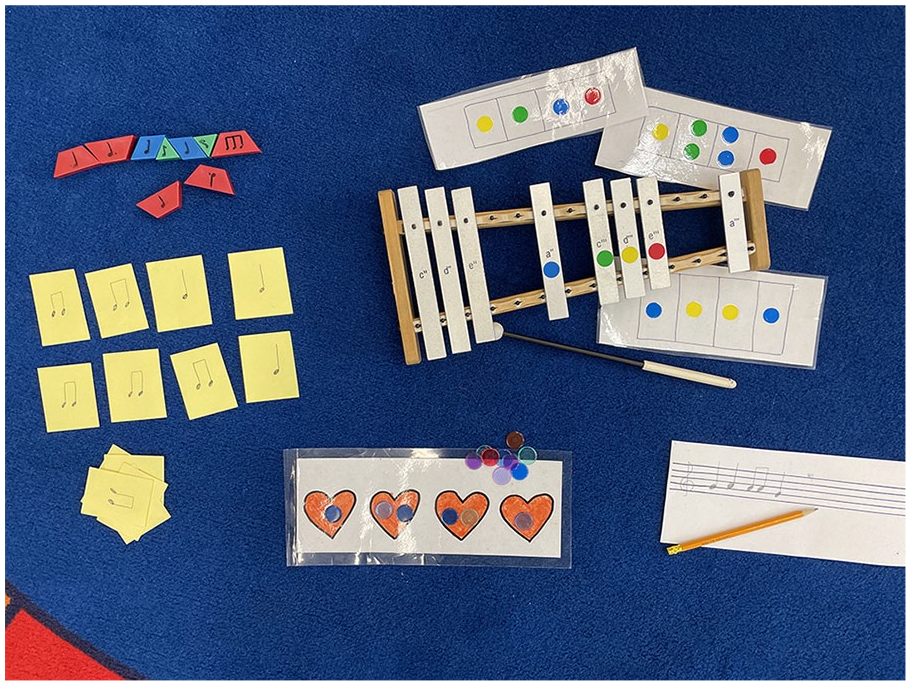
Examples of music notation strategies.
On the next day, students were presented with each context (boss fight, underground, and exploring) and all of the different music ideas that were collected for that context. Students then selected which context they wanted to use for their music creation, and chose two or more music ideas to organize into a form to create their composition. During this step, I again allowed students the choice to work alone or in pairs or small groups, to respect different types of learners. Depending on time, students could present their work at the end of this lesson or spend more time getting feedback and refining their work and share during a subsequent lesson (Figure 2).
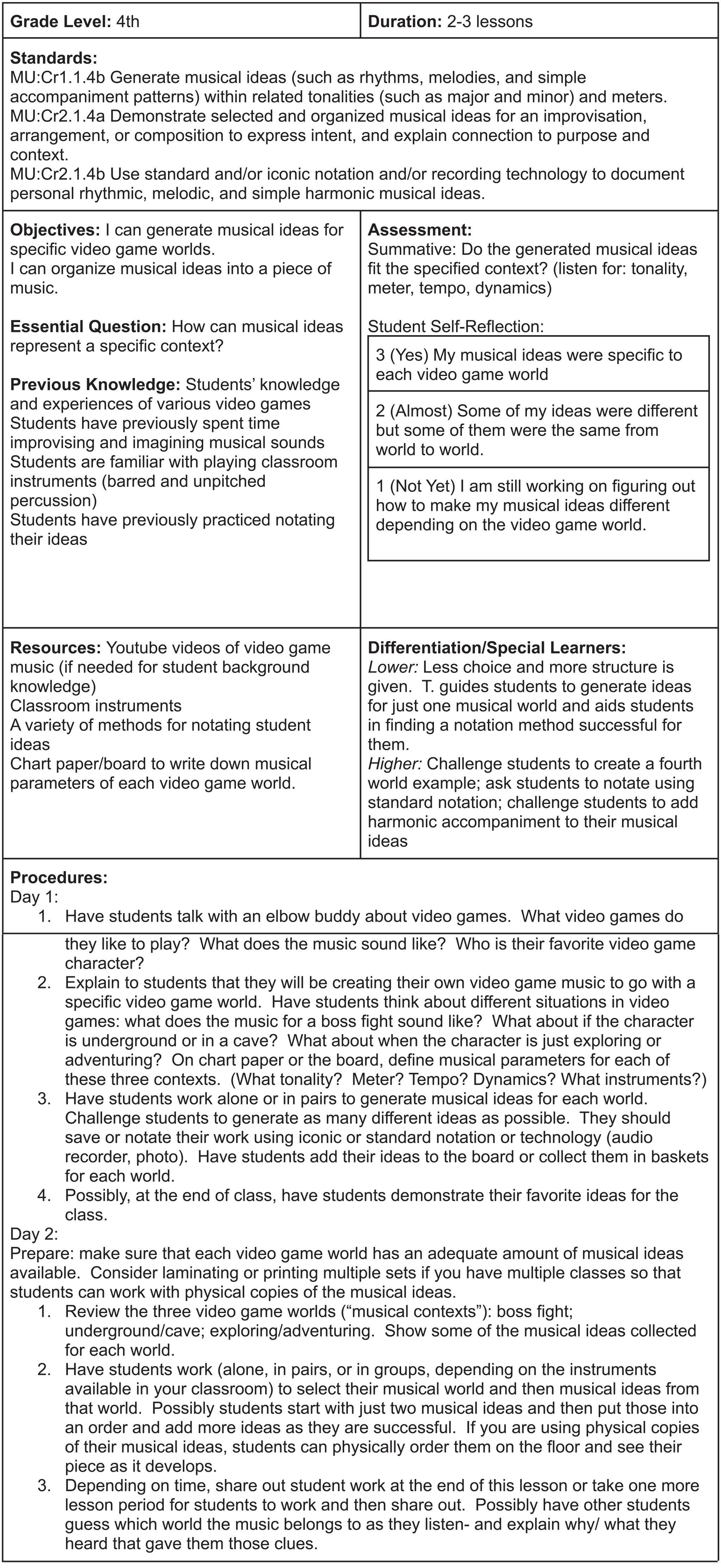
Lesson plan: Music for a boss fight.
Technology could easily be integrated into this project by having students record their music ideas and then use simple audio editing software like Audacity to put those music ideas in order. Students could also create short music ideas on a web-based program like Google Chrome’s Song Maker and then order those ideas to create a longer music work. Students could also share music ideas they generate or give each other feedback using a video-sharing program like Flipgrid.
For learners who need more structure and support, I worked together with the students to select their music context and the music ideas they would use. For some students, I provided one music idea and had them select a second one, and then put them in a simple ABAB pattern. Using many different forms of notation also increased engagement and success for many students; some students who struggled to quickly identify letter forms were very successful at notating and reading ideas using colored stickers. Many learners also appreciated using physical manipulatives to put in order to generate rhythmic ideas.
In conclusion, creating music does not have to be chaotic and scary. I encourage teachers to try ceding creative control to the students and see what wonderful ideas can emerge when students’ previous knowledge is respected and built on to create new music pieces.
Footnotes
Declaration of Conflicting Interests
The author declared no potential conflicts of interest with respect to the research, authorship, and/or publication of this article.
Funding
The author received no financial support for the research, authorship, and/or publication of this article.
