







Abstract
Music surrounds us and students have plenty of experience in passive listening. However, they need to be deliberately taught how to deeply and critically listen to music. The National Core Arts Standards do not specifically measure listening as a skill but to evaluate musical works, critical listening skills are essential. This article outlines considerations for teaching this invisible skill and provides ideas for student responses to their listening to make the invisible process of listening visible and accessible to teachers to assess and evaluate.
Music surrounds us every day; we hear it in the car, in the store, and in our houses. We hear music in movies and TV, in video games, and on online platforms like Instagram, TikTok, and YouTube. Our students are constantly hearing music but need to be taught how to deliberately listen to it. Listening is a skill not directly measured in the National Core Arts Standards but involved in all three artistic processes of Create, Perform, and Respond, as students evaluate what they hear and give feedback to others: MU:Cr3.1.4 Evaluate, refine, and document revisions to personal music, applying teacher-provided and collaboratively-developed criteria and feedback, and explain rationale for changes. MU:Pr5.1.4a Apply teacher-provided and collaboratively-developed criteria and feedback to evaluate accuracy and expressiveness of ensemble and personal performances. MU:Re9.1.4 Evaluate musical works and performances, applying established criteria, and explain appropriateness to the context. (National Coalition for Core Arts Standards, 2014)
To evaluate the music being created or performed, students must be able to listen critically and thoughtfully and then articulate what they hear. Evaluating music requires deep, thoughtful listening and this “critical listening” is a skill that needs to be directly taught and practiced in our classrooms (Bell, 2018). Listening is a skill that must be practiced and taught but does not need to take up all of the lesson time to work it in.
Lesson Example
It’s Tuesday morning and a second-grade class has just arrived to Music. After washing their hands, checking in by moving a magnet to show their current emotional level, and reciting the class norms, the students have grabbed a clipboard and pencil or white board and marker and chosen a spot to sit or stand and it’s time to start class with some music listening.
Mx. Teacher reminds students of the Listening Norms that they developed together at the beginning of the year—during the 30 seconds of listening, students have agreed to hold still and be very quiet. They may choose to close their eyes or look at the word wall but they have agreed as a class that this isn’t the time to try to be silly and distract others.
Mx. Teacher reminds students that during this first listening, they shouldn’t try to listen too closely but should think about how the music makes them feel. They start the music and the class settles, listening quietly. When the music stops, Mx. Teacher asks students to take 43 seconds to quietly share with their elbow partners what they noticed.
After they get the class’s attention, Mx. Teacher instructs the class to listen more deeply this time and to either remember a list or write down some terms from the word wall that they hear. The musical excerpt is played again and Mx. Teacher adds some silent wait time at the end for students to copy down some terms because they know that second graders are capable writers but not very fast.
This time they ask students to stand up and choose a partner. As the students compare their lists, they should circle anything they have in common. Mx. Teacher asks them to stick a post-it on the word wall term that seems most important or most interesting.
Finally, they instruct students to take 15 seconds to think about how they will move to the music and then move back to their spots when the music is played. Students take the 30 seconds of music to move through the space, but are all back at their spots when the music stops.
Mx. Teacher then highlights some of the terms on the word wall that are covered in post-it notes. “Oh! Adagio! Who can remind me what adagio means? And who remembers the song that we learned yesterday that was adagio?” And with that seamless transition, the class is on to other things and Mx. Teacher knows that their class is developing needed critical listening skills for their upcoming focus on rehearsing and evaluating the music the class is preparing for their spring performance.
Classroom Culture
Critical listening takes focused attention. It is important to build a classroom culture with established norms and expectations for behavior while listening so students “can listen attentively and deeply” (Robison & Culp, 2021, p.18). Different kinds of music in different contexts ask for different behaviors while listening and it is important to distinguish critical listening from the background listening that happens when music is turned on while students are working, or while riding in a car, or from the participatory kind of listening that might happen at a lively concert or social musicking context. Students should be included in setting the norms for classroom critical listening activities, empowering them to co-create knowledge (Johnson, 2011). For instance, students can help decide norms for how students should hold their bodies while listening (can they lie on the floor? Can they stand up? What about moving around?) and what kind of external noise is acceptable (is it easier or harder to listen carefully when people are talking and whispering?).
Musical Considerations
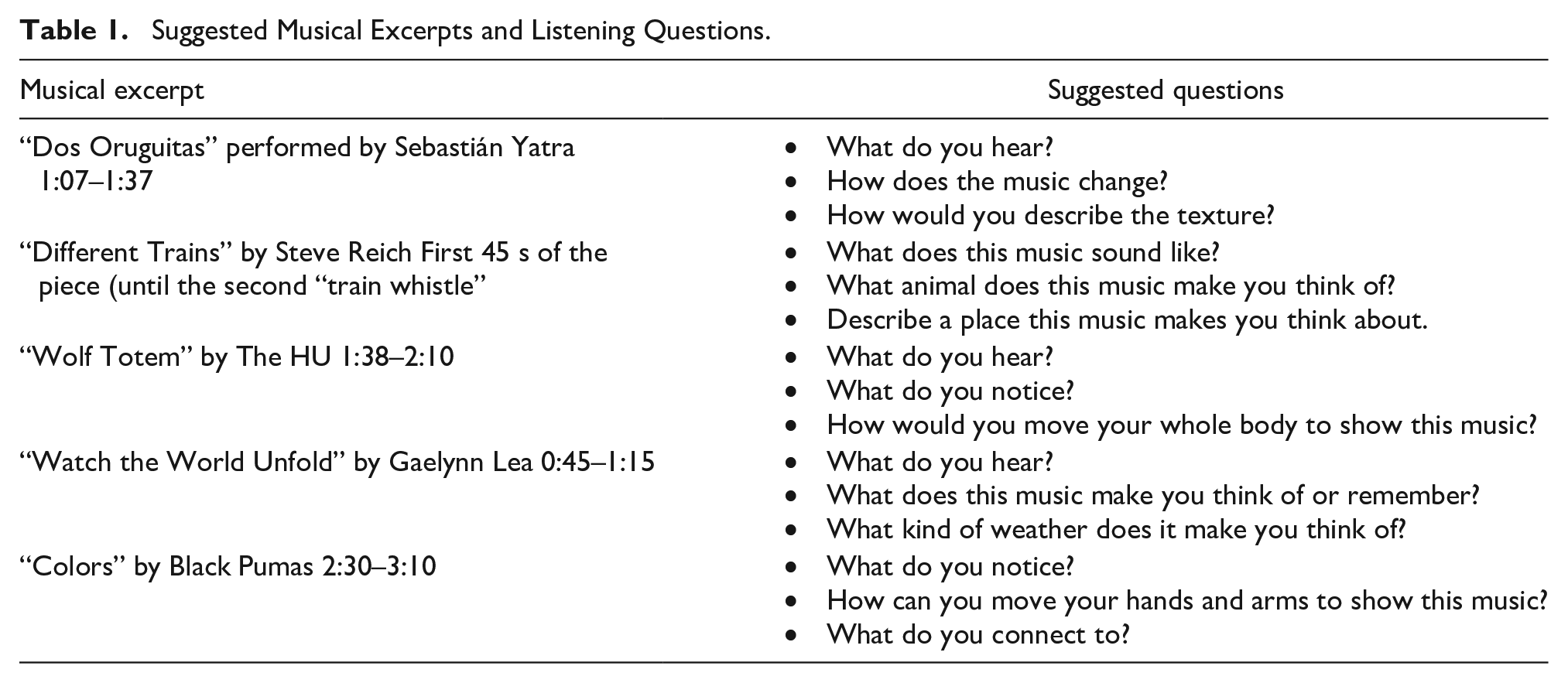
As students develop the dispositions and skills needed to listen critically, they build stamina to listen to longer excerpts of music. However, at first it is suggested that teachers select short, rich musical sections (around 30 seconds long) and use those same sections of music for repeated listening (Bell, 2018). It is also suggested that in a classroom where students are co-creators of knowledge, students have input into what pieces of music are chosen for deep listening activities (Beach & Bolden, 2018) (Table 1).
Suggested Musical Excerpts and Listening Questions.
Students also need to develop a vocabulary of descriptive words and musical terms to discuss what they hear in accurate detail. One common strategy to teach vocabulary in an elementary classroom is to use a word wall where many words and terms are collected and posted for students to reference. Merely posting a word wall does not teach the words, however, teachers must include activities where those words are directly taught (Hatch, 2022).
Another way to teach vocabulary is to focus on one element of music at a time. Although visual art and music are not exactly the same, we share very similar standards, and perceiving art and being able to discuss the elements present are very similar to being able to listen to and talk about music. The art teacher at my school developed a spiral curriculum where her students examine a piece of art for a few minutes at the start of each class period. Over the course of the year, the students revisit the same piece of art 4 or 5 times and each time explore different elements of art or go deeper in evaluating the artistic work. This same thing could be done in a music class, where students respond to a very short excerpt of music each time and only focus on one or two elements of music, such as dynamics and tempo; or dynamics and timbre.
Revealing Hidden Thinking
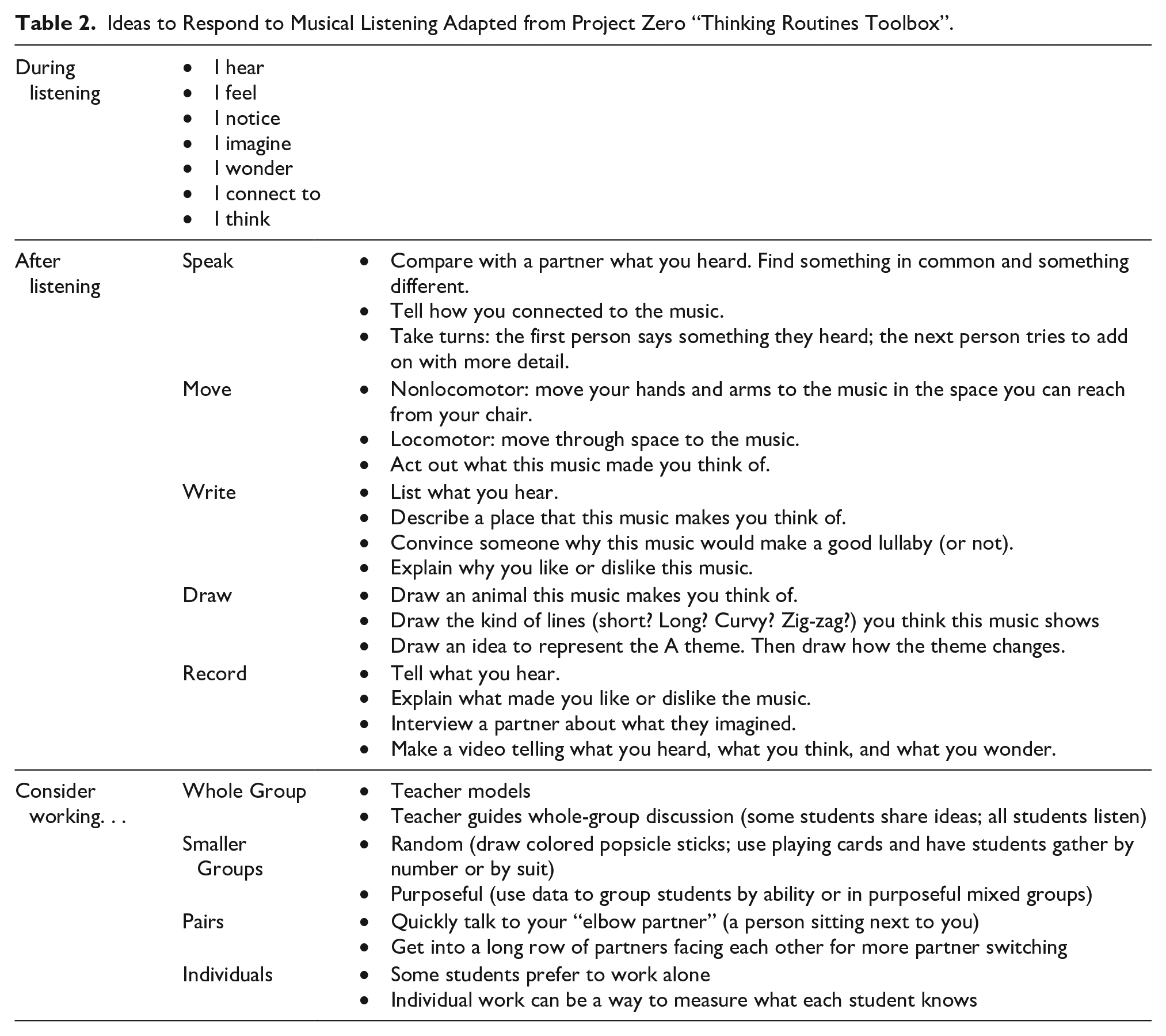
Unlike creating or performing music, which have external, measurable output, listening is a very private, internal process. To teach and assess listening skills, there must be some output and some way for students to show what they are thinking about (Beach & Bolden, 2018; Kratus, 2017; Vasil, 2020). Also unlike performing music, which is very focused on accuracy, listening to music produces an infinite number of different interpretations (Lehman, 2021). Therefore, instead of trying to guide students to one correct answer when critically listening, teachers should nurture divergent thinking with many possible responses and ways to make visible what students hear and think (Kratus, 2017).
After listening, students can work alone or in small groups to process what they heard, in spoken words, movement, writing, or art. Students could even use technology such as SeeSaw or FlipGrid to record an audio or video response to their listening or could interview each other (with or without audio recording technology) to explore what other students heard and thought about (Gruenhagen, 2017). Also consider what would happen if we gave students choice to select their own activity. Would our classrooms really be that chaotic if some students were writing, some were drawing, and some were recording their ideas using technology?
For more ideas on making hidden thinking visible, explore the Thinking Routines Toolbox available through Harvard University’s Project Zero (“Project Zero’s Thinking Routines Toolbox,” 2022) (Table 2).
Ideas to Respond to Musical Listening Adapted from Project Zero “Thinking Routines Toolbox”.
Conclusion
In conclusion, by setting norms for critical listening time and intentionally teaching musical terms, we can set students up for success in learning to think deeply about the music they hear. Listening is an ongoing skill that should be practiced deliberately and often to build students’ stamina and capacity for critical hearing so that they can use their listening skills as they give feedback to peer musical creations and evaluate class performances as specified in the National Core Arts Standards (2014).
Footnotes
Declaration of Conflicting Interests
The author(s) declared no potential conflicts of interest with respect to the research, authorship, and/or publication of this article.
Funding
The author(s) received no financial support for the research, authorship, and/or publication of this article.
