







Abstract
Energetic and electric, samulnori is a contemporary formalization of traditional Korean percussion music known as p’ungmul. A description will be offered of the music, and of key musician, Master Kim Duk Soo who has dedicated himself to the design and dissemination of this highly regarded genre. A learning pathway on Korean traditional samulnori, developed to encompass the five dimensions of World Music Pedagogy, is detailed, and resources and classroom adaptations of instruments are provided.
American music education is internationally known for its bands, choirs, orchestras, and for the goal of providing students an array of culturally diverse musical experiences (Kang & Yoo, 2016; McCarthy, 1997). Many nations look to and learn from the American emphasis on concert-programming and lesson-planning. In the 1980s, American music education embraced an array of expressive practices from Asia, Africa, and its diaspora, Latin America, Europe, and the Pacific Islands (Anderson & Campbell, 2010; Volk Tuohey, 2004). This expansion has served as a model internationally for growing intercultural music programs based on the American model (Ho, 2016). While recognizing the strengths of American music educators to diversify school repertoire, there has been a growing realization that many more musical cultures deserve a place in the curriculum. Students gain immeasurably in understanding music as expressing cultural identity and social power, in addition to recognizing it as a human phenomenon of considerable diversity.
For many musical and cultural reasons, Korean samulnori 사물놀이 fits well into school music classes. It is a rhythmically powerful music, vocally and chorally robust, fiercely energetic, and replete with dramatic changes of timbre and dynamics (Hesselink, 2012). It is contemporary musical form, in current practice today, and deeply rooted in Korean cultural aesthetics and folk practices (Howard, 2015). It is riveting music, which appeals to students’ own energies and preferences for percussive rhythms. It is music of the people of a nation with a long-standing American alliance. South Korea and the United States share 70-plus years of international cooperation in economic, political, and military spheres. American citizens of Korean heritage are an important demographic within the U.S. mosaic of cultural communities. Close to two million Americans trace their ancestry to Korea, and the United States is home to the largest Korean population outside of Korea.
This article is one of a series on the topic of Teaching Music Culturally. It is an acknowledgment of the convergence of music, education, and culture in K–12 and undergraduate curriculum and instruction, and of the pressing professional need to give accent to intercultural understanding through experience and study of global cultures. We offer a description of samulnori, and of its founder and leading proponent, Master Kim Duk Soo, and then feature a learning pathway based on the five dimensions of World Music Pedagogy (WMP) so that students can learn the music via listening, participatory musicking, and creative involvement and can come understand the uses, functions, and meanings of the music by South Koreans. We highlight the value of teaching music and culture, in tandem, and suggest resources and learning pathways for supporting students in their journey toward becoming musically attuned and culturally compassionate.
Preparations
The Music
Korean music is an accumulation of more than 5,000 years of Korean life, thought, and culture (B. W. Lee & Lee, 2007). Long-standing traditional Korean music is sounded on plucked zithers, flutes and double-reed instruments similar to oboes and by powerfully expressive singers. “Gut 굿,” the source for both p’ungmul 풍물 (farmers’ music) and samulnori, suggests that traditional Korean music derived from ritual ceremonies that featured the songs and rhythms of agricultural laborers (Hesselink, 2006). This ritual music was gradually shaped into music to which all were invited to play in fixed segments as well as in an improvisatory manner. Music 음악 in Korea was traditionally a comprehensive art that combined singing, dancing, and instrumental music in performance. This cross-arts experience has been continued in the performance of historic genres as it is also reflected in today’s world-famous K-pop musicians such as BTS. South Korean musicians are crossing cultural boundaries in their artistic practices, reaching audiences with spectacular concerts of popular music, traditional folk and court (classical) music performances, newly fashioned experiential media-arts experiences, and high caliber displays of Western classical music by Western-trained musicians.
“Four objects” (samul) and “play” (nori) are the essence of samulnori 사물놀이, a traditional Korean instrumental form with deep roots in Korean tradition (Howard, 2015). In essence, the reference is to the four instruments that are played by samulnori musicians. Samulnori consists of two gongs and two drums, so that the ensemble can be comprised of as few as four players or as many players as there are gongs and drums to go around. A double-reed instrument known as Taepyongso may join the percussion instruments, and there have been memorable contributions by singers, called Binari, to the practice. The performance of samulnori will frequently feature the spirited and voluminous vocalization of rhythms by the players. The sounds of the four core instruments have been compared to four natural elements that characterize the climate and weather: Rain-Changgo (hourglass drum) 장고, Thunder-Kkwaenggwari (small gong) 꽹과리, Wind-Ching (big gong) 징, and Clouds-Puk (barrel drum) 북. The rhythmic drive of samulnori has propelled the genre into international circles of interest, engaging percussionists across the world and delighting audiences who find themselves exhilarated by this electrically charged music (Lee, 2018).
The Culture
As Korea is situated in close proximity to Japan, China, and Russia, it quite naturally shares some overlapping cultural, linguistic, and artistic characteristics (Armstrong, 2014). Yet it also knows its own distinctive history of over a thousand years of documented accomplishments in the arts, science, and technology. For 75 years, North Korea and South Korea have been established as two separate nations, the second of which is a liberal democracy and one of the greatest economies in the world, the home of Samsung, LG, and Hyundai (Han & Hahm, 2010). South Korean culture, known as Hallyu, or the Korean wave, is evident in the immense global popularity of Korean drama, movies, television “soaps,” and music (such as K-pop). South Korea is a country of scholars, and there is a nationwide enthusiasm for education and learning. More than most countries, South Korea has flourished as a result of the diligence of its citizens, their respect for others, and their willingness to shape influences from outside their nation to fit the uniquely Korean sensibilities (Hahm, 2020).
The Music Master
In 1978, Master Kim Duk Soo 김덕수 co-founded (with three other members) the Korean percussion ensemble SamulNori. Master Kim grew up in a musical household, influenced by his virtuoso father. A child prodigy, at the age of seven, he was awarded the prestigious President’s Award in Korea’s National Folk Music Contest. He later studied musical theory and learned to play a variety of traditional Korean instruments. He is recognized today as one of the 50 “most influential figures” in Korea, an innovative artist-musician whose SamulNori ensemble gave rise to samulnori, a whole new musical genre. His work, while innovative and modern, maintains a connection to Korea’s agrarian practices of the past, as well as to the spirituality of traditional Korean rituals. Master Kim has applied his artistry by creating new music for SamulNori, studying the music and instruments (especially percussion instruments) of other musical traditions, researching the traditional music of Korea, and providing educational opportunities for students to learn Korean traditional music. About 30 years ago, Master Kim Duk Soo established SamulNori Hanullim, a nonprofit organization, through which he hopes to realize his three-fold objective of creating new music based on traditional Korean rhythms, refining its methodology and pedagogy, and training of the next generation of musicians.
A WMP Learning Pathway for Samulnori
WMP is a way forward, through listening, for developing student knowledge of culturally unfamiliar music and evolving their cultural and intercultural understanding (Campbell, 2018). WMP is not “just” listening, and yet listening is central to learning the music of oral traditions and cultures (like samulnori). Through repeated listening opportunities in the order of Attentive, Engaged, and Enactive Listening, students are drawn into the music becoming familiar with its elemental features. Their curiosity grows as to why the music sounds the way it does, who the musicians are, and how the music functions within a given cultural community. Attentive listening is directed and focused through a teacher’s questions on musical features, while engaged listening is the active participation by a listener in some extent of music-making (by singing a melody, tapping a rhythm, moving to a dance pattern). Enactive listening is the performance of a work such that through intensive listening, the music is re-created in as stylistically accurate a way as possible. Listening is the foundational base of five dimensions consisting of musical participation, performance, and creative activities, all of which are enhanced and made more purposeful through the integration of language, stories, and cultural meanings that serve to wrap the musical experiences into a more holistic understanding of music’s cultural significance (Campbell & Lum, 2019).
WMP offers students a full slate of musical involvement, which forms the basis of learning that is both musical and intercultural in process and outcome. What follows are suggestions for the application of WMP in teaching and learning Korean samulnori. This WMP Learning Pathway highlights “Pyoldalgori,” the most recognizable section of a notable SamulNori composition known as “Youngnam nongak.” (Pyodalgori originated from chanted segments in the pyolkutnori section of Chinju Samchonpo nongak “farmer’s culture” of the Youngnam region.). This composition is traditionally performed as a prayer, a wish, or a hope for a bountiful harvest during the Ch’usok fall harvest holiday. The featured music offers a grouping of four cycle of four beats each (totaling 16 beats in all). It begins slowly and quietly and then accelerates in the performance of the same rhythm, ultimately arriving into a chant and instrumental response section.
Attentive Listening. Listen repeatedly to a brief excerpt of the samulnori piece, “Pyoldalgori” (별달거리) https://www.youtube.com/watch?v=7Gc1fuziOOE&t=754s (5:58 to 7:05). Before each listening occasion, ask only one question in order to focus the listening attention of the students. Some exemplary questions follow:
Q: What instruments do you hear? (A: Kkwaenggwari–a small gong, Ching–a large gong, Changgo–an hourglass drum, Puk–a barrel drum)
Q: From what materials are the instruments made? (A: The gongs are made of metal, while the drums are made of cow-hide leather–sometimes sheep or horse leather for one side of Changgo.)
Q: Choose an instrument to listen to: Can you pretend to play it while listening? (A: Various. Note that the Puk, the barrel drum, is playing the fundamental “backbone rhythm” in this fast-moving music, and so will be the easiest of the instruments to follow. The Changgo produces a more elaborated rhythm from the two sides of the drum (and with two different mallets). The detailed rhythm of the Kkwaenggwari is challenging to follow, while the Ching provides the ringing cycle on the first beat of every four-beat grouping.)
Q: Does the music sound the same? Or does it change? How? (A: The same rhythm pattern repeats, while the dynamics and tempo intensify in order to create the tension toward the climax of this section.)
Q: Do you hear the chanting of Korean words? Listen for them (beginning at 6:47). (A: Yes/No.)
Q: As you listen to the Korean words, can you think about the message? (A: They convey a farmer’s happiness in having an abundant harvest, and the beauty of a bright and full “harvest moon” appearing in the evening sky.)
2. Engaged Listening. Listening repeatedly to the same brief excerpt (5:58 to 7:05), and for every listening opportunity, invite students to become musically involved in these ways.
* Show the pulse in a grouping of four, using body percussion to pat on pulse 1/clap on pulse 2–3–4.
* Show the pulse in a grouping of four but using a different set of body percussion gestures.
* Try tapping, patting, and clapping with the rhythms of the gongs and drums.
* Try patting the drum parts and clapping the gong parts of the rhythms.
* In small groups, notate the rhythms in standard western notation (or invent graphic notation).
* As a whole group, perform the drum and gong rhythms together.
* Focus on the chanting that begins at 6:47, listening carefully to the phonemes that stand out in the stream of chanted syllables. As this is oral tradition music, challenge students to find the phonemes that stand out for them.
* Note that the sound of the chanting does not appear to correspond with the printed verse below, for several reasons: The chanting is at a rapid tempo and is percussive in ways that a straight-ahead spoken recitation of the words would not be. Furthermore, this east coast style, called Youngnam nongak, further distances the sound of the chanting from the words within the verse. So, while the phonemes may not seem to match the actual chanted verse, it appears below as “Korean Chant” and its English translation.
Korean Chant/English Translation (Translation—Lee, 2018) Ha-nul-po-go Pyo-rul-tta-go Ttang-ul-po-go Nong-sa-chik-ko
Look up at the sky and seize the stars, Look down at the ground and till the earth.
Ol-hae-do Tae-p’ung-i-yo Nae-nyon-e-do P’ung-nyon-il-se This year’s harvest is abundant, next year let it also be so. Ta-ra-ta-ra Pal-gun-ta-ra Tae-nat-ka-chi Pal-gun-ta-ra Moon, moon, bright moon, moon as bright as daylight. O-dum-so-ge Pul-pi-chi U-ri-ne-rul Pi-ch’wo-chu-ne! In the darkness, your light gives us illumination!
3. Enactive listening. As the opportunities to listen and participate continue, the rhythms become familiar so that the piece can be performed on instruments with the recording, and then without the recording. Follow these steps.
* Distribute drums and metallic instruments (gongs, triangles, and bells) and objects (metal pots, pans, and lids).
* Practice playing the instruments to these rhythms.
* Through multiple listening, play the rhythms along with the recording.
* Share the notation of the rhythmically chanted phrases. Note that this rhythm, and the words/syllables have already been the focus of earlier listening, but that the notation graphically depicts what was already learned by ear.
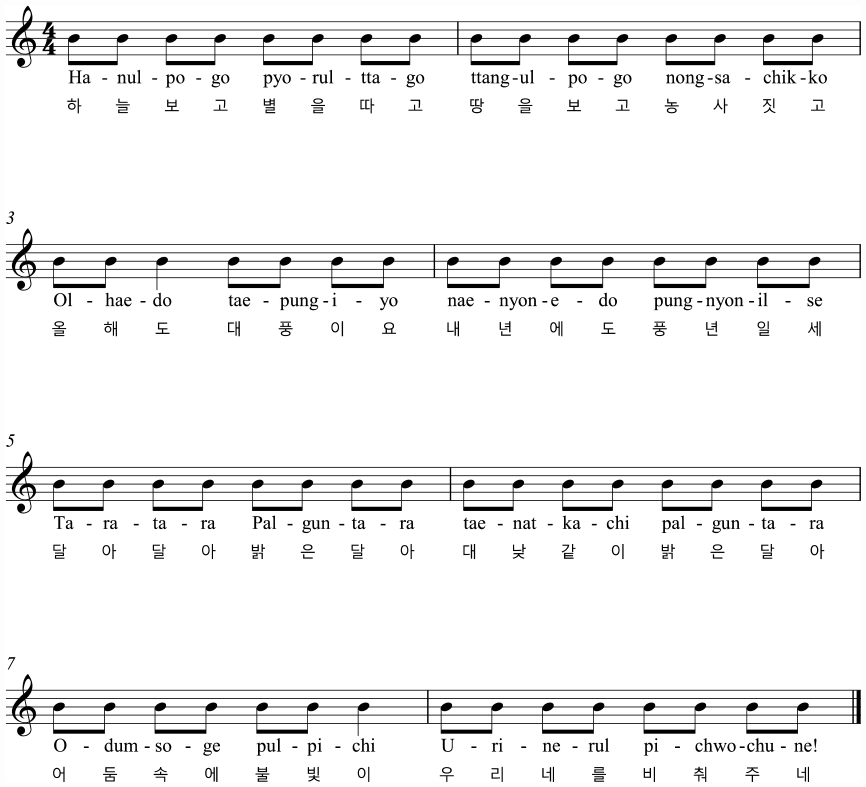
Pyoldalgori Chanting.
* Review the translation of the rhythmically chanted verse (See Engaged Listening.)
* With the recording, play the rhythms on instruments and chant the words/syllables (at 6:47).
* There is now the option of sharing the notation of the rhythms that students have already learned by listening.
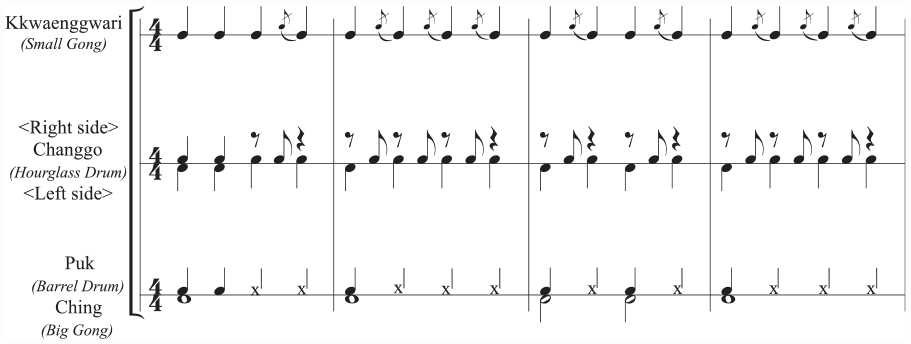
Pyoldalgori Rhythms.
* Without the recording, perform the instrumental rhythms and the vocalized chant.
* Switch from playing (and chanting) with and without the recording.
* Prepare for a performance of this samulnori piece: Extend the music by repeating the rhythms multiple times, performing it at times at a very soft dynamic level, and at medium and loud levels.
4. Creating Samulnori. Because students have learned the samulnori piece, they can now be invited to create a new (but related) composition, following these steps.
* As warm-up, clap or play four-beat rhythms that are immediately imitated by the group. Vary the complexity of the rhythms, from steady beats to subdivisions of the beat, to syncopated rhythms.
* Invite students to take a few minutes to explore different four-beat rhythms for their instruments. Ask individuals to share their rhythmic inventions, which can be immediately imitated by the group.
* Challenge students to explore and invent 16-beat rhythms (four groupings of four beats, or four four-beat rhythms), sharing these rhythms for immediate imitation, as above.
* Divide into small groups of four, each with two gongs (or metallic objects) and two drums.
* Ask students of the small groups to create one 16-beat rhythm that can be played by the gongs and drums, determining which pulses and rhythmic groupings are played by gongs, by drums, and by both gongs and drums. Share them.
* In the same small groups, ask students to create an eight-beat set of words that can be chanted rhythmically. Share them. Provide an example such as this one to motivate students, giving two syllables to each of the eight beats, with no rests or breaks: “sa-mul-no-ri rhy-thms, Play the rhy-thms of the sa-mul-no-ri.”
* Suggest that students continue in their small groups to put together their own samulnori piece, featuring first their eight-beat instrumental rhythm and then their eight-beat rhythmic chant together in an order that allows repetition and dynamic variation. For example, referring to the Instrumental Rhythm as “A” and the Rhythmic Chant as “B,” students can organize the performance of their created phrases in this way:
Loud: A A B A Loud-to-Soft: A A B A Soft-to-Loud: BB AA.
5. Cultural integration. Clarify the meaning and context of samulnori by offering opportunities for students to delve into Korean cultural history, contemporary South Korean society, the performing arts of South Korea, and the ensemble itself. These video-links will transport students to the “Korean-ness” of samulnori, giving attention to the ancient cultural roots of the vibrant music, its vigorous and athletic outdoor dancing, and aspects of the rituals which prompted the artistic form within the lives of rice-farmers in Korean agricultural society. Moreover, their viewing of Korea and Koreans today will enliven an understanding of how a very early art form, p’ungmul, has experienced a renaissance that draws Koreans to partake in making the music (p’ungmul) and receiving and responding to the artistry of the artistic practice of samulnori.
* Explore the essence of Korean cultural history: See UNESCO series.
https://ich.unesco.org/en/state/republic-of-korea-KR?info=elements-on-the-lists%20[ich.unesco.org]
*Learn about Korea: The Ministry of Foreign Affairs of South Korea.
* Consider the vitality of South Korean society today: Korea Tourism Organization.
* Discover the traditional performing arts of South Korea: Daily Gugak from the National Gugak Center. (* Gugak–Korean Traditional Performing Arts)
https://www.youtube.com/watch?v=ziLSMGzxS_w&list=PLqbN8ij7QcZ3LfBQ71XOuAzx-fyZ7h17P&index=1
https://www.youtube.com/playlist?list=PLqbN8ij7QcZ3LfBQ71XOuAzx-fyZ7h17P
*Explore nongak as music, dance, and ritual in rural farming communities: UNESCO.
* Deepen knowledge of South Korean Samulnori: SamulNori Hanullim, Gugak Broadcasting Foundation.
https://www.youtube.com/watch?v=aCXlBQ6QZ3o&t=266s (Featuring Master Kim Duk Soo)
https://www.youtube.com/watch?v=7Gc1fuziOOE&t=754s (Note at 16:43; the traditional Korean dance with hat known as “Sangmo”)
https://www.youtube.com/watch?v=9aYm5VtNXWo:WonkwangDigitalUniversity. (Note at 2:10: Kim Duk Soo Instructional video)
Learning Cultural Knowledge Through Samulnori
The promises of a journey into samulnori are both musical and cultural knowledge, particularly when teachers foster a progression of events meant to deepen student experience in the music’s sonic structures and sociocultural meaning. As they listen repeatedly to a musical selection, learners grow musically, intellectually, and emotionally, particularly when they progress from listening (and viewing) into the performative practice of playing, chanting, moving, and inventing new possibilities based within the cultural aesthetic of the music. When cultural considerations are given attention, music becomes a holistic experience as well, with students discovering answers to questions. Here are some questions: Where does the music come from? What is the purpose of the music? How old (or new) is it? When/Where is it performed? and Who are the performers, the composers, and the master musicians? Ultimately, music becomes more meaningful to learners when its sonic experiences are wrapped into knowing how it reflects people’s beliefs, behaviors, and values.
With this WMP Learning Pathway for samulnori can come an understanding of Korea, Koreans, and Korean music. This musical form references the high regard Koreans place on nature, with its leather drums representing the earth and its metallic sounds alluding to the heavens. With its origin in the outdoor ceremonies and celebrations of farmers, samulnori calls attention to Korea’s long history as an agricultural society that recognizes the harmony of the human and the divine, of humanity and the heavens. With its attention to repeating rhythms that are variously performed at different dynamic levels, and that can be elaborated upon by creative musicians, samulnori represents Korea’s penchant for sustaining traditions while also honoring change. At times, in contemporary renditions of samulnori, when the gongs and drums are joined by other instruments—from Korean to Western-styled melodic instruments, Korea’s identity as both ancient and contemporary is celebrated. In school music classes, experiences in samulnori guarantee both the musical and intercultural understanding of students who progress through the five dimensions of WMP.
Resources
Instruments of the samulnori ensemble (Kkwaenggwari, Ching, Changgo, and Puk) can be purchased from the following sources:
https://www.hanullimmusic.com (in Korean)
http://210.122.35.100/english/index.htm (in English, but ordering in Korean)
Korean Performing Arts Institute of Chicago (KPAC)
Footnotes
Declaration of Conflicting Interests
The author(s) declared no potential conflicts of interest with respect to the research, authorship, and/or publication of this article.
Funding
The author(s) received no financial support for the research, authorship, and/or publication of this article.
