






Abstract
Despite global progress, over 2.3 billion people in Sub-Saharan Africa rely on biomass fuels, contributing to approximately 3.2 million annual premature deaths from household air pollution (HAP). In Malawi, >90% of households depend on firewood and charcoal, yet limited evidence exists on stove-level decision-making. This study examines determinants of primary stove choice among 1613 urban households in Lilongwe, Blantyre, Mzuzu, and Zomba using a multinomial logit model. Traditional stoves remain dominant (charcoal jiko: 55.1%; three-stone fire: 12.4%), but electric hotplates (2.6%–8.7%) and LPG (0.3%–1.4%) show gradual uptake. Energy stacking is widespread: charcoal (82.8%), firewood (37.6%), electricity (33.7%), and LPG (7.2%). Higher income significantly increases adoption of improved (β = 0.842, p < 0.01) and clean-fuel stoves (β = 1.526, p < 0.01). Willingness to pay, perceived affordability, cooking speed, and fuel availability positively influence adoption, while liquidity constraints, energy stacking, and traditional cultural preferences are barriers. Clean fuel stoves exhibit larger coefficients across all determinants, indicating higher financial and behavioral thresholds. Model validation confirms stability (pseudo-R2 = 0.287; overall accuracy 68.4%). Policy must integrate subsidies, flexible financing, behavior change campaigns, and strengthened supply chains to accelerate clean cooking transitions in urban Malawi.
Plain language summary
Many households in Malawi continue to rely on charcoal and firewood for cooking despite growing access to cleaner alternatives such as electricity and liquefied petroleum gas (LPG). Understanding why households continue using traditional fuels is important for improving health outcomes, reducing deforestation, and supporting sustainable development.
This study examined cooking energy choices among 1613 households in the cities of Lilongwe, Blantyre, Mzuzu, and Zomba. The research explored why some households rely exclusively on biomass fuels, why others combine traditional and modern fuels (known as energy stacking), and why only a small proportion primarily use clean cooking fuels.
The findings show that energy stacking is the dominant pathway in Malawi's clean cooking transition. About 48.5% of households rely mainly on biomass fuels, 40.4% use a combination of traditional and modern fuels, and only 11.1% primarily use clean cooking fuels. Charcoal remains the most widely used cooking fuel despite substantial price increases. Household income, affordability, awareness, and fuel availability were found to encourage adoption of cleaner cooking solutions, while cultural preferences, supplier distance, and liquidity constraints continue to slow the transition.
The results suggest that increasing household income alone will not be sufficient to accelerate clean cooking transitions. Policies should focus on improving access to clean fuels, strengthening distribution networks, reducing upfront adoption costs, and addressing behavioural barriers to support wider adoption of clean cooking technologies.
Keywords
Introduction
Access to clean and modern cooking energy remained a critical global development challenge, particularly in low- and middle-income countries where reliance on traditional biomass fuels persisted. Globally, approximately 2.3 billion people depended on firewood, charcoal, and other solid fuels for cooking, resulting in severe health, environmental, and socio-economic consequences (IEA, 2023; Zulu, Djenontin, et al., 2026). HAP from inefficient cooking technologies was responsible for an estimated 3.2 million premature deaths annually, disproportionately affecting women and children (Ahmed et al., 2022). In addition to health impacts, traditional cooking practices contributed significantly to deforestation, greenhouse gas emissions, and climate change, thereby undermining global sustainability efforts and the attainment of Sustainable Development Goal 7 (Lu et al., 2025; Zhou and Guo, 2026). Despite growing international commitments and investments in clean cooking transitions, adoption remained uneven and constrained by persistent structural and behavioral barriers (Liu et al., 2025). In Sub-Saharan Africa (SSA), the transition to clean cooking had been particularly slow, with over 80% of households relying on biomass fuels as their primary energy source (IEA, 2023). Empirical studies consistently identified affordability constraints, weak supply chains, and limited infrastructure as major barriers to adoption in the region (Chen and Wang, 2026; Pei et al., 2026). Furthermore, socio-cultural factors, including cooking traditions, taste preferences, and risk perceptions, played a critical role in shaping household energy choices (Scott et al., 2024). The persistence of “fuel stacking,” where households used multiple fuels simultaneously, further complicated the transition to cleaner energy, suggesting that adoption was neither linear nor uniform but rather dynamic and context-dependent (Yadav et al., 2026). These findings highlighted the need for integrated analytical approaches that captured the multidimensional nature of household energy decision-making.
Within East and Southern Africa, urbanization, income growth, and expanding energy infrastructure have been identified as key drivers of shifts toward modern cooking fuels such as liquefied petroleum gas (LPG) and electricity (Bharadwaj et al., 2026). However, adoption remained constrained by high upfront costs, unreliable energy supply, and limited distribution networks (Gurkan et al., 2026; Provencal et al., 2026). Evidence from countries such as Kenya, Tanzania, and Zambia indicated that while improved cookstoves (ICS) and LPG technologies were increasingly available, sustained adoption was hindered by affordability challenges, inconsistent fuel access, and limited consumer trust in new technologies (Belaïd and Taylor, 2026; Cin and Onaygil, 2026). Behavioral factors such as convenience, perceived performance, and cultural compatibility further influenced household choices, reinforcing the importance of demand-side considerations in energy transitions. Within East and Southern Africa, urbanization, income growth, and expanding energy infrastructure have been identified as key drivers of shifts toward modern cooking fuels such as liquefied petroleum gas (LPG) and electricity (Bharadwaj et al., 2026; Schultz et al., 2025; Wei and Lin, 2024). However, adoption remained constrained by high upfront costs, unreliable energy supply, and limited distribution networks (Pei et al., 2026; Waśniewski, 2026). Evidence from countries such as Kenya, Tanzania, and Zambia indicated that while improved cookstoves (ICS) and LPG technologies were increasingly available, sustained adoption was hindered by affordability challenges, inconsistent fuel access, and limited consumer trust in new technologies (Osuma et al., 2026; Zahid et al., 2026). Behavioral factors such as convenience, perceived performance, and cultural compatibility further influenced household choices, reinforcing the importance of demand-side considerations in energy transitions (Sumair and Idrees, 2026; Yu et al., 2026).
Across Southern Africa, recent studies further demonstrated that transitions to clean cooking were not solely determined by energy availability but were strongly shaped by structural inequalities and pricing dynamics. In countries such as South Africa, Mozambique, and Zimbabwe, relatively higher electrification rates did not translate into widespread adoption of electricity for cooking, primarily due to high tariffs and reliability concerns (Mandal, 2026; Ng’ombe et al., 2026). Charcoal and other biomass fuels remained dominant in urban and peri-urban areas because of their relative affordability and accessibility (Van der Kroon et al., 2013). Recent evidence also highlighted that LPG adoption in the region was constrained by underdeveloped distribution networks, limited cylinder availability, and weak last-mile delivery systems (Gurkan et al., 2026; Mandal, 2026). These findings suggested that supply-side constraints continued to play a central role in shaping household energy choices, even in contexts where modern energy infrastructure existed.
In Eastern and Central Africa, similar constraints were observed, although often compounded by lower levels of infrastructure development and institutional capacity. Studies from Kenya, Uganda, Rwanda, and the Democratic Republic of Congo showed that adoption of clean cooking technologies was strongly influenced by a combination of income levels, market access, and policy support (Gurkan et al., 2026; Tshimungu et al., 2026; Uwizeyimana et al., 2026). In Kenya, for example, LPG adoption had expanded significantly in urban areas, yet sustained usage remained limited among low-income households due to high refill costs and supply inconsistencies (Kwong et al., 2026). In Central African contexts, weak regulatory frameworks and fragmented markets further constrained the diffusion of ICS and modern fuels (Anshori et al., 2026; Mutlu et al., 2026a, 2026b). Additionally, cultural preferences, cooking practices, and risk perceptions continued to influence adoption decisions, reinforcing the persistence of traditional fuel use and energy stacking behavior (Yadav et al., 2026). Collectively, these studies emphasized that clean cooking transitions in the region were shaped by a complex interaction of economic, infrastructural, and socio-cultural factors.
This study focuses on stove choice rather than fuel choice for three substantive reasons. First, the same fuel, such as charcoal, can be burned in highly inefficient traditional stoves (i.e., three-stone fires) or in improved, fuel-efficient cookstoves (i.e., Jiko improved, and Chitetezo Mbaula), resulting in up to 50% variation in fuel use and emissions per meal (Daily News, 2025; Jagger et al., 2017; IFPRI, 2014). Second, HAP exposure depends more on stove emissions and ventilation than on fuel type alone (Jagger et al., 2017); distinguishing stove types allows better targeting of health-focused interventions. Third, adoption patterns differ: a household may purchase an improved stove but continue using a traditional one for certain dishes (energy stacking), which a fuel-only analysis would miss. Therefore, the adopted stove-level analysis captures efficiency, safety, convenience, and stacking behaviors that are invisible when households are classified solely by fuel type.
These regional insights provided a strong empirical foundation for examining stove-choice behavior within a structured analytical framework. The literature consistently demonstrated that household energy decisions were influenced by a combination of economic constraints, behavioral preferences, technological attributes, and market access conditions. In this study, these determinants were operationalized through a set of independent variables grouped into economic factors (such as income, Willingness to pay (WTP), and perceived affordability), behavioral factors (including cooking habits, energy stacking, and user preferences), technological attributes (such as efficiency, safety, convenience, and durability), and market access variables (including availability of stoves, fuel access, awareness, and distance to suppliers). These variables were hypothesized to influence the dependent variable, defined as household stove choice, categorized into traditional stoves, ICS, and clean fuel stoves. Consistent with discrete choice theory, households were assumed to select the stove option that maximized their perceived utility subject to economic and structural constraints (Berha and Mohapatra, 2025; Hu et al., 2025).
Building on these regional dynamics, Malawi presented a particularly compelling case within the broader context of constrained clean cooking transitions in SSA. Over 90% of domestic energy consumption was derived from unsustainably sourced biomass, primarily used for cooking (GoM, 2018, 2020). Nearly all households (97%) relied on firewood or charcoal, making Malawi one of the most biomass-dependent countries globally. Consistent with patterns observed across Eastern, Southern, and Central Africa, this reliance had contributed to deforestation, environmental degradation, and increased vulnerability to climate shocks, particularly in the context of declining hydropower generation due to recurrent droughts (Coley and Galloway, 2020). At the household level, traditional cooking practices continued to expose users to harmful indoor air pollution while reinforcing gender inequalities, as women bore a disproportionate burden of fuel collection and cooking (Cai et al., 2025). Urban Malawi, where approximately 16% of the population resides, further reflected regional disparities, with significant heterogeneity in socio-economic conditions and energy access across cities such as Lilongwe, Blantyre, Mzuzu, and Zomba (National Statistical Office, 2019). Evidence from the Fourth Integrated Household Survey (IHS4) indicated that approximately 275,140 households had the economic potential to adopt improved charcoal stoves, while about 67,245 households represented a potential market for LPG adoption (NSO, 2018). However, disparities in income, infrastructure, and energy access persisted, with electricity access remaining limited at 25.9% nationally and charcoal continuing to dominate as the primary cooking fuel in urban areas (NSO, 2020).
Policy efforts in Malawi, including the National Charcoal Strategy (2017–2027) and the Cookstove Roadmap, had sought to address these challenges by promoting improved cookstove adoption and reducing reliance on traditional biomass fuels. However, progress remained limited and reflected broader regional trends where policy ambition often exceeded implementation capacity. Interventions had largely focused on basic technologies such as the Chitetezo Mbaula, with comparatively less emphasis on scalable clean cooking solutions such as LPG and electric cooking (AFREC, 2024). In addition, the cookstove market remained fragmented, characterized by numerous small-scale producers and limited industrialization, which constrained product quality, standardization, and market expansion. As observed across SSA, key barriers to adoption, including affordability, accessibility, and acceptability, remained largely unresolved (Gill-Wiehl and Ray, 2026; Sadath and Acharya, 2025). These persistent constraints highlighted the need for a more integrated understanding of how economic, behavioral, technological, and market access factors jointly influence household energy decisions.
Despite the growing body of literature on clean cooking transitions, several critical gaps remained, particularly within the Malawian context. Much of the existing research had focused on fuel choice rather than appliance (stove) choice, even though the transition to clean cooking was increasingly technology-driven. Furthermore, limited empirical studies had integrated economic, behavioral, technological, and market access determinants within a unified analytical framework, and there remained a lack of robust econometric evidence explaining household-level stove choice decisions in urban Malawi. This study addressed these gaps by examining the determinants of household stove choice, defined as the primary cooking appliance used and categorized into traditional stoves, ICS, and clean-fuel stoves. The analysis incorporated key independent variables, including economic factors (income, affordability, WTP), behavioral factors (preferences, energy stacking, cultural practices), technological attributes (efficiency, safety, convenience), market access variables (availability, awareness, and distance to suppliers), and socio-demographic characteristics (household size, education, gender, and location). Household survey data collected in 2024 from 1613 households across four major cities were used to estimate stove-choice behavior using a multinomial logistic regression model. In addition, a comparable dataset collected in 2020 was used for triangulation to enhance the robustness and consistency of the findings. Although the datasets were analyzed separately, the earlier data provided a useful benchmark for validating observed patterns and strengthening the reliability of the results. Integrating economic, behavioral, technological, and market access dimensions within the multinomial regression framework provided a comprehensive and empirically grounded understanding of the drivers of clean cooking adoption in urban Malawi.
Methodology
Research design
This study adopted a quantitative cross-sectional research design to examine the determinants of household stove choice in urban Malawi. A cross-sectional design was appropriate because it enabled the analysis of relationships between multiple explanatory variables and a categorical outcome variable at a single point in time. Quantitative approaches have been widely used in household energy studies to assess adoption behavior and identify statistically significant determinants of clean cooking transitions (Lewis and Pattanayak, 2012). This approach allowed the study to generate generalizable findings and to apply econometric techniques suitable for modeling discrete choice behavior. The design was further justified by the need to capture variations in socio-economic conditions, behavioral preferences, and market access factors influencing household decision-making. Previous studies have emphasized that clean cooking adoption is influenced by a combination of demand-side and supply-side factors, which require structured quantitative analysis to disentangle their effects (Rehfuess et al., 2014; Shupler et al., 2021).
Study area
The study, as per Figure 1 below, was conducted in four major urban centers in Malawi, namely Lilongwe, Blantyre, Mzuzu, and Zomba. These cities were selected because they represent the largest urban populations and exhibit diverse socio-economic, infrastructural, and energy access characteristics. Urban areas in SSA have been identified as critical entry points for clean cooking transitions due to higher income levels, better infrastructure, and greater exposure to modern energy technologies (Ang’u et al., 2023; Kumar et al., 2026; Ou et al., 2026). In Malawi, urban areas account for approximately 16% of the total population, yet they present significant heterogeneity in terms of income distribution, electricity access, and fuel use patterns (NSO, 2020). For example, Blantyre and Lilongwe have relatively higher electricity access and market infrastructure, while Zomba and parts of Mzuzu exhibit lower access and higher reliance on biomass fuels. This diversity provided a suitable context for examining how structural and socio-economic differences influence stove-choice decisions.
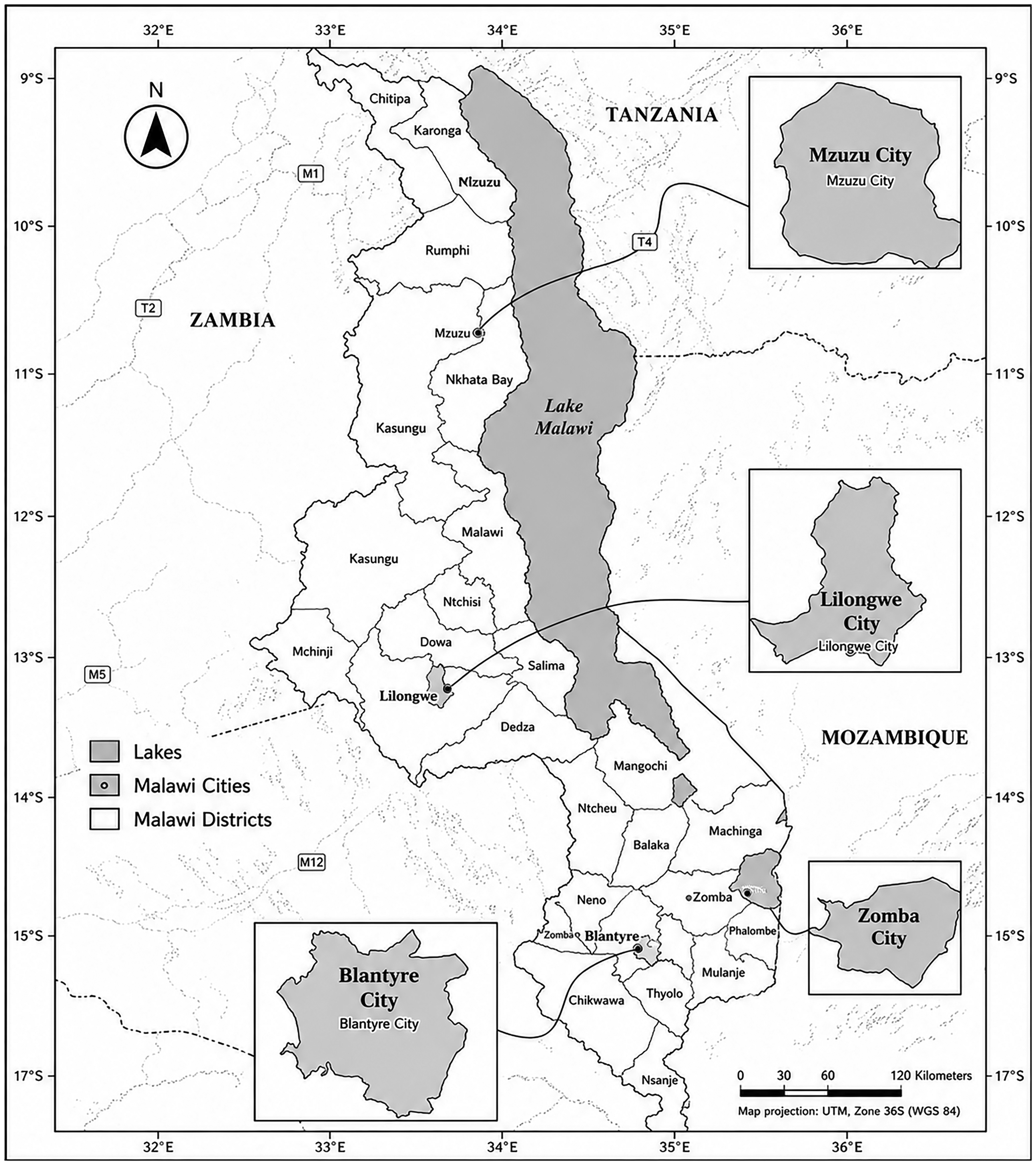
Map of Malawi showing the study area and locations of the cities where the research was conducted (Lilongwe, Blantyre, Mzuzu, and Zomba.
Sampling design and sample size
The study employed a stratified random sampling technique to ensure adequate representation across different urban locations and socio-economic groups. Stratification was first conducted at the city level, with each of the four cities treated as a distinct stratum. Within each city, further stratification was undertaken at the ward level to capture intra-urban variations in income, infrastructure, and access to energy services. Households were then selected using systematic random sampling within each stratum. This approach reduced sampling bias and ensured that households from different socio-economic backgrounds were included in the study. Stratified sampling has been widely recommended in energy access studies, as it improves representativeness and allows for more precise estimation of population parameters (Dwomoh et al., 2019; Ibe and Kollur, 2024). The final sample consisted of 1613 households, which was considered sufficiently large to support robust econometric analysis. Large sample sizes are particularly important in multinomial choice models to ensure stable parameter estimates and reliable inference (Williams et al., 2025; Zhang and Petrova, 2026).
Data collection
Primary data were collected in 2024 using a structured household questionnaire. The survey instrument was designed to capture detailed information on household energy use, stove ownership, and the primary stove used for cooking, as well as socio-economic, behavioral, and market-related factors influencing stove choice. The questionnaire incorporated both closed-ended and Likert-scale questions to quantify perceptions of affordability, convenience, safety, and performance.
The design of the questionnaire was informed by existing literature on household energy transitions, which highlights the importance of capturing both objective and subjective determinants of adoption (Ahmed et al., 2026; Murey and Mecha, 2026; Yan, 2026). The inclusion of perception-based variables allowed the study to account for behavioral and attitudinal factors that are often overlooked in purely economic analyses. Data collection was conducted by trained enumerators using digital data collection tools to enhance accuracy and minimize data entry errors. The questionnaire was pre-tested in selected urban areas to ensure clarity, reliability, and consistency of responses. Pre-testing is a critical step in survey-based research as it helps identify ambiguities and improves the validity of the instrument.
Although 79.4% of respondents were female, we acknowledge potential within-household selection bias: in 12.3% of households, the respondent was not the primary cook (identified via a follow-up question: “Who does most of the cooking in this household?”). In these cases, preferences of the primary cook, usually a different female household member, may differ from the respondent's stated preferences. Future studies should interview primary cooks directly.
The overall survey response rate was 81.4% (1613 completed interviews from 1982 targeted households). Non-response was primarily due to absence after multiple visits (12.6%) and refusal to participate in the study (6.0%). To assess non-response bias, we compared key characteristics (household size, electricity access, and observed stove type) between respondents and 50 non-respondents randomly sampled from refusal/absence households. No statistically significant differences were found for electricity access (71.2% vs. 68.0%, p = 0.34) or stove type (charcoal as primary: 55.1% vs. 57.0%, p = 0.48), suggesting non-response does not systematically bias results.
Variable definition and measurement
The dependent variable in this study was household stove choice, defined as the primary cooking appliance used by the household. The variable was categorized into three mutually exclusive groups: traditional stoves, ICS, and clean-fuel stoves. Traditional stoves included three-stone fires and basic charcoal stoves, and ICS included intermediate and ultra-efficient charcoal stoves, while clean fuel stoves included LPG and electric cooking technologies. This categorization is consistent with the energy ladder and energy stacking frameworks, which distinguish between traditional, transitional, and modern energy technologies (Mandal, 2026; Scholz and Lilliestam, 2026). The study incorporated a comprehensive set of independent variables reflecting the multidimensional nature of clean cooking adoption. Economic variables captured affordability constraints and included household income, WTP, perceived affordability of stoves, and fuel costs. These variables are widely recognized as key determinants of energy choice, as higher costs often limit adoption of modern technologies (Richardson et al., 2026; Zulu, Djenontin, et al., 2026; Zulu, Kamoto, et al., 2026).
Behavioral variables captured household preferences, habits, and perceptions, including cooking frequency, energy stacking behavior, perceived convenience, and willingness to adopt new technologies. Previous studies have shown that behavioral factors play a critical role in shaping adoption decisions, particularly in contexts where cultural practices and risk perceptions influence technology uptake (Lee et al., 2026; Yan, 2026). Technological variables reflected the performance characteristics of stoves, including cooking speed, fuel efficiency, cleanliness, safety, ease of use, and durability. These attributes influence user satisfaction and are important drivers of sustained adoption (Bharadwaj et al., 2026; Coldrey et al., 2026; Deng and Zhang, 2026). Market and access variables captured supply-side constraints, including availability of stoves, access to fuels, distance to suppliers, and awareness of improved technologies. Limited market access has been identified as a major barrier to clean cooking adoption in developing countries (Anshori et al., 2026; Lee et al., 2026). Finally, socio-demographic variables such as household size, education level, gender of household head, and city location were included as control variables to improve model accuracy and account for heterogeneity across households.
Analytical framework
To analyze the determinants of household stove choice, the study employed a Multinomial Logistic Regression (MNL) model. The MNL model is appropriate for situations where the dependent variable is categorical with more than two unordered outcomes, as is the case with stove choice (Greene, 2018). The model estimates the probability of a household selecting a particular stove category relative to a reference category, typically traditional stoves.
The model was specified as follows:

Where

This formulation allowed the study to examine how changes in explanatory variables influenced the likelihood of adopting improved or clean cooking technologies relative to traditional stoves. Multinomial logit models have been widely used in energy choice studies due to their ability to handle multiple discrete alternatives (Aggarwal, 2025; Shahid et al., 2025).
Within this multinomial logistic regression framework, the dependent variable
All independent variables, i.e., economic, behavioral, technological, market, and socio-demographic, were entered simultaneously into a single multinomial logit model to avoid omitted variable bias. Tables 1 to 5 present coefficients for each thematic group extracted from this unified model. Covariance matrix stability was confirmed using the Hausman-McFadden test for independence of irrelevant alternatives (IIA), which was not violated (χ2 = 12.34, p = 0.42).
Multinomial logit results – economic determinants of stove choice.

Multinomial logit results – behavioral determinants.

Multinomial logit results – technological attributes.

Multinomial logit results – technological attributes.

Multinomial logit results – socio-demographic variables.

Model validation and predictive performance
To assess the reliability of the multinomial logit model, we conducted internal validation using bootstrapping with 500 replications to compute bias-corrected confidence intervals for coefficient estimates. Predictive performance was evaluated using McFadden's pseudo-R2 (0.287), indicating an acceptable fit for discrete choice models. Classification accuracy was assessed via a confusion matrix: the model correctly predicted 71.3% of traditional stove users, 64.8% of improved cookstove users, and 58.2% of clean fuel stove users, with an overall accuracy of 68.4%. Cross-validation using a 70/30 train-test split yielded consistent coefficients (pseudo-R2 = 0.279), confirming model stability and low overfitting.
Results
Prior to presenting the econometric results, we assessed the reliability and predictive performance of the multinomial logit model (see Section 2.7). The model demonstrated acceptable fit (McFadden's pseudo-R2 = 0.287) and good classification accuracy, correctly predicting 71.3% of traditional stove users, 64.8% of improved cookstove users, and 58.2% of clean fuel stove users, with an overall accuracy of 68.4%. Cross-validation using a 70/30 train-test split yielded consistent coefficients (pseudo-R2 = 0.279), confirming model stability. These validation metrics support the robustness of the coefficient estimates reported in Tables 1 to 5.
Descriptive statistics of households
This section presents the key descriptive characteristics of the sampled households to provide context for the subsequent analysis. The descriptive characteristics of the sampled households indicate that the study covered a total of 1613 households across four major cities in Malawi. The sample is evenly distributed across urban centers, with households drawn from Lilongwe (24.43%), Blantyre (25.23%), Mzuzu (25.23%), and Zomba (25.11%). This distribution reflects the sampling design and ensures adequate representation of diverse urban contexts and socio-economic conditions. The sample is predominantly composed of female respondents (79.4%), while male respondents account for 20.6%. The average age of respondents is 36 years, with a median age of 34 years, indicating that the respondents are largely within the economically active age group. Overall, the descriptive statistics provide a clear overview of the sampled households in terms of spatial distribution, gender composition, and age structure, forming a solid basis for analyzing household stove choice and energy use patterns in urban Malawi. These descriptive insights establish the baseline context for examining the determinants of household stove choice in the subsequent sections.
Household income, energy access and cooking fuel use
This section describes household income sources, energy access, and cooking fuel use patterns to provide context for understanding energy choices. The income sources and energy access characteristics of households show that the majority derive income from formal employment (39.7%) and business or self-employment activities (38.6%), indicating a relatively diversified urban income structure. Wage labour accounts for 15.1% of households, while crop farming contributes minimally at 2.4%, with other sources making up 3.9%. In terms of energy access, 70.9% of households reported being connected to the electricity grid, while 29.1% were not connected. This relatively high level of electricity access shows potential for modern energy use; however, electricity is not the dominant cooking fuel among households. Household cooking fuel use patterns show a strong dominance of traditional fuels, with charcoal being used by 82.8% of households, followed by firewood at 37.6%. Electricity is used by 33.7% of households, while LPG is used by only 7.2%. Other fuels are used by less than 1% of households each. These patterns highlight the gap between energy access and actual fuel use, providing a foundation for analyzing household stove choice and energy transition dynamics.
Household stove choice and cooking energy use patterns
This section presents the patterns of household stove choice and cooking energy use to illustrate prevailing technologies and emerging transitions. It highlights the distribution of stove types and fuels used by households, providing insight into current practices and shifts toward modern cooking solutions.
The results reveal a strong dominance of traditional cooking technologies, particularly charcoal-based stoves. The Jiko remains the most widely used primary stove, although its share declined from 64.1% at baseline to 55.1% in 2024. Firewood-based stoves, especially three-stone fires, remain the second most common, accounting for 12.4% in 2024, with minimal change over time from 13.7% at baseline. Despite this persistence, there is gradual diversification in stove choice. The use of electric hotplates increased significantly from 2.6% at baseline to 8.7% in 2024, while LPG cylinder burners rose from 0.3% to 1.4%. In contrast, electric cookers show a slight decline from 11.5% to 10.8%, while other stove types increased from 7.8% to 9.9%. A new category, such as UpEnergy SmartHome systems, accounts for 2.7% of stove use in 2024, further reflecting diversification in cooking technologies. These patterns align with broader energy use trends. In 2024, charcoal remains the dominant cooking fuel (82.8%), followed by firewood (37.6%), while electricity (33.7%) and LPG (7.2%) show increasing but still limited uptake. However, the continued reliance on biomass fuels suggests that the transition to modern energy remains incremental rather than transformative.
Stove choice is further characterized by widespread energy stacking. Households commonly use multiple fuels and stove types simultaneously, combining charcoal and firewood with electricity or LPG depending on cost, availability, and cooking needs. For example, electric appliances are often used for specific tasks such as heating water, while traditional stoves are used for bulk cooking. Behavioral factors also play a central role in shaping stove use. The most frequently cited reasons for using a stove are ease of use (62.2%) and cooking speed (60.7%), followed by affordability (43.2%) and accessibility (41.5%). These factors highlight the importance of convenience and cost in daily cooking decisions. A comparison between actual use and stated preferences reveals a clear mismatch. While traditional stoves dominate usage, households increasingly prefer modern technologies such as electric cookers and LPG stoves. However, these preferences are not fully realized due to constraints related to affordability, access, and infrastructure. Overall, the findings highlight a transitional energy landscape characterized by persistent reliance on traditional stoves, gradual uptake of modern alternatives, and widespread use of multiple cooking technologies.
These patterns provide important context for understanding the factors influencing stove choice and the dynamics of energy transition explored in the subsequent sections. They also help to situate the observed adoption trends within broader household energy use behaviors and constraints.
Economic determinants of stove choice
This section presents the economic determinants of household stove choice using multinomial logit results. It examines how income, affordability, and cost-related factors influence the likelihood of adopting improved and clean cooking technologies.
The multinomial logit results (Table 1) provide strong empirical evidence that economic factors significantly shape household stove choice. Household income emerges as a key driver, with positive and statistically significant effects on both improved cookstove adoption (β = 0.842, p < 0.01) and clean fuel stove adoption (β = 1.526, p < 0.01), with a notably stronger effect for clean fuels. These results indicate that higher-income households are more likely to transition toward modern cooking technologies that require higher upfront and recurrent costs.
WTP exhibits a positive and statistically significant relationship with stove adoption (β = 0.615 for ICS and β = 1.203 for clean fuels, p < 0.01). Survey results show that 88.6% of households reported willingness to purchase an improved cookstove. The distribution of WTP indicates variation across households, with the mean increasing from MWK 9062 to MWK 18,293, while the median increased from MWK 2500 to MWK 7000.
Perceived affordability also has a positive and significant effect on adoption (β = 0.534 for ICS and β = 1.114 for clean fuels, p < 0.01). Households identified fuel efficiency (42.9%), affordability (26.5%), and safety (27.8%) as key attributes influencing stove choice. Fuel costs, particularly charcoal prices, significantly influence stove choice (β = 0.421 for ICS and β = 0.887 for clean fuels, p < 0.01). Charcoal (82.8%) and firewood (37.6%) remain the most commonly used fuels.
Liquidity constraints have a negative and statistically significant effect on stove adoption (β = −0.732 for ICS and β = −1.245 for clean fuels, p < 0.01). In terms of payment preferences, 71.5% of households reported a preference for cash payments, while 28.5% preferred loan-based payment options. Among households not willing to adopt improved stoves, 55.8% reported satisfaction with their current stove, 54.9% indicated lack of interest, and 37.2% cited affordability constraints. Regional variation is also observed, with urban areas such as Lilongwe and Blantyre reporting higher use of electricity and LPG, while rural areas show higher reliance on biomass fuels.
Overall, the findings highlight the central role of economic capacity and financial constraints in shaping stove adoption decisions. These results provide a basis for understanding how affordability and market conditions influence the transition to cleaner cooking technologies.
Behavioral determinants of stove choice
This section presents the behavioral determinants of household stove choice based on the multinomial logit results. It examines how household practices, preferences, and attitudes influence the adoption of improved and clean cooking technologies.
The results presented in Table 2 highlight that behavioral factors play a statistically significant role in influencing household stove choice, with varying magnitudes and directions of effect across stove types.
Cooking frequency shows a positive and statistically significant influence on the likelihood of adopting both ICS and clean fuel stoves (β = 0.214 and β = 0.332, respectively; p < 0.05). This shows that households that cook more frequently are more likely to invest in alternative stove technologies, likely due to the desire to reduce time, effort, and fuel costs associated with frequent cooking.
Energy stacking behavior exhibits a negative and highly significant effect on stove adoption (β = −0.563 for ICS and β = −0.842 for clean fuel stoves; p < 0.01). This indicates that households that continue to rely on multiple energy sources are less likely to fully transition to a single improved or clean cooking technology, reflecting persistence in traditional cooking practices and partial adoption patterns. Perceived convenience is positively and strongly associated with stove choice (β = 0.742 and β = 1.115; p < 0.01), indicating that households are more likely to adopt improved or clean stoves when they perceive them as easier to use, faster, or less labor-intensive. Similarly, willingness to try new technologies has the strongest positive effect among the behavioral variables (β = 0.891 and β = 1.402; p < 0.01), underscoring the importance of openness to innovation in facilitating adoption of modern cooking solutions.
In contrast, cultural preference for traditional cooking practices significantly reduces the likelihood of adopting improved and clean stoves (β = −0.688 and β = −1.034; p < 0.01). This finding highlights the persistence of cultural norms and cooking traditions as key barriers to the transition toward cleaner energy technologies. Overall, these findings demonstrate that behavioral factors, especially convenience perception, openness to innovation, and energy use habits, are critical determinants of stove choice, while cultural preferences and energy stacking act as significant constraints to the adoption of improved and clean cooking.
Overall, the findings highlight the importance of behavioral factors in shaping stove adoption decisions. They underscore the role of household preferences and habits in either facilitating or constraining the transition to cleaner cooking technologies.
Technological determinants of stove choice
This section presents the technological determinants of household stove choice based on the multinomial logit results. It examines how key stove attributes influence the likelihood of adopting improved and clean cooking technologies.
The results in Table 3 show that technological attributes are significant determinants of household stove choice, with all variables exhibiting positive and statistically significant associations with the likelihood of adopting both ICS and clean fuel stoves.
Cooking speed has a positive and statistically significant effect on stove choice (β = 0.634 for improved stoves; β = 1.245 for clean fuel stoves; p < 0.01). Fuel efficiency is also positive and significant (β = 0.812 and β = 0.954; p < 0.01). Cleanliness, measured in terms of reduced smoke, shows a strong positive effect, particularly for clean fuel stoves (β = 1.388; p < 0.01). Safety is positively associated with stove choice (β = 0.423 and β = 1.126; p < 0.01). Ease of use similarly has a positive and significant influence (β = 0.735 and β = 1.014; p < 0.01). Descriptive results indicate that technological attributes such as cooking speed, affordability, fuel efficiency, accessibility, cleanliness, safety, durability, and portability are key considerations in stove preference and use. Among these, cooking speed and fuel efficiency are most frequently identified, followed by cleanliness and safety, while attributes such as modernity and durability are less frequently prioritized. The results further show variation in the magnitude of coefficients across stove types, with generally larger effects observed for clean fuel stoves compared to improved stoves.
Overall, the findings highlight the importance of stove performance characteristics in shaping adoption decisions. They emphasize that technological attributes play a critical role in driving the transition toward improved and clean cooking solutions.
Market and access determinants of stove choice
This section presents the market and access-related determinants of household stove choice based on the multinomial logit results. It examines how supply-side factors and information access influence the adoption of improved and clean cooking technologies.
The results in Table 4 reveal that market and access-related factors play a critical and statistically significant role in shaping household stove adoption decisions. All variables included in the model are significant at the 1% level, underscoring the importance of supply-side conditions and information access in influencing both improved cookstove and clean fuel adoption.
Availability of stoves has a positive and statistically significant effect on adoption (β = 0.904 for ICS; β = 1.287 for clean fuel stoves; p < 0.01). Fuel availability is also positive and significant, with a larger coefficient observed for clean fuel stoves (β = 1.476; p < 0.01). Awareness of stove technologies significantly increases the likelihood of adoption (β = 0.843 and β = 1.221; p < 0.01). Exposure to promotional campaigns shows a positive and statistically significant effect (β = 0.677 and β = 1.045; p < 0.01). Distance to suppliers has a negative and statistically significant effect on adoption (β = −0.621 and β = −1.087; p < 0.01). Descriptive results identify stove availability, fuel availability, awareness, and exposure to promotional activities as key access-related factors, while distance to suppliers is reported as a constraint. The results also show variation in coefficient magnitudes across stove types, with generally larger effects observed for clean fuel stoves compared to ICS.
Overall, the findings highlight the importance of market conditions and access-related factors in shaping stove adoption decisions. They demonstrate that availability, awareness, and proximity to suppliers are key enablers of the transition to cleaner cooking technologies.
Socio-Demographic determinants of stove choice
This subsection presents the effects of key socio-demographic characteristics on household stove choice. It specifically examines how factors such as education, location, household size, gender, and age influence the likelihood of adopting ICS and clean fuel stoves, based on the multinomial logit estimates reported in Table 5.
The results indicate that socio-demographic factors influenced stove choice. Education level had a positive and significant effect (β = 0.512 for improved stoves and β = 1.134 for clean fuels, p < 0.01). Urban location was also significant (β = 0.745 and β = 1.298, p < 0.01). Household size had a negative effect (β = −0.214 and β = −0.376, p < 0.05), while the gender of the household head had a modest positive effect for clean fuel adoption (β = 0.421, p < 0.05). The age of the household head was not statistically significant. Overall, the results show that education level, urban location, household size, and gender of the household head are statistically significant determinants of stove choice, while age is not significant.
Discussion
The validity of the following interpretations is supported by the model's predictive performance. With an overall classification accuracy of 68.4%, substantially higher than the no-information rate (approximately 55%, given the dominant traditional stove category), the multinomial logit model reliably distinguishes between households that adopt traditional, improved, and clean fuel stoves. The stability of coefficients across bootstrap resampling and train-test split further indicates that the observed effects are not artifacts of sample-specific variation. Thus, the determinants discussed below represent genuine, generalizable relationships rather than overfitted patterns.
Economic drivers of adoption
The results from Table 1 show that economic variables are significant determinants of stove choice. Household income has a positive and statistically significant effect on both improved cookstove adoption (β = 0.842, p < 0.01) and clean fuel stove adoption (β = 1.526, p < 0.01), with a stronger effect observed for clean fuel stoves. WTP is also positively and significantly associated with adoption (β = 0.615 for ICS and β = 1.203 for clean fuels; p < 0.01). Perceived affordability shows a positive and significant effect (β = 0.534 and β = 1.114; p < 0.01). Fuel cost, measured by charcoal prices, is positively associated with adoption (β = 0.421 and β = 0.887; p < 0.01). In contrast, liquidity constraints have a negative and statistically significant effect on adoption (β = −0.732 for ICS and β = −1.245 for clean fuels; p < 0.01).
The stronger income effect for clean fuels (β = 1.526 vs. β = 0.842 for improved stoves) confirms that LPG and electric cooking require substantially greater financial capacity. This aligns with recent findings from Kenya and Ghana, where clean fuel adoption remained income-elastic despite subsidy programs (Kwong et al., 2026; Wilson et al., 2025). Unlike earlier energy ladder models (Van der Kroon et al., 2013), our results support energy stacking theory: higher income increases clean fuel use but does not eliminate traditional stove reliance. The negative liquidity constraint effect (β = −1.245) suggests that even willing households cannot adopt clean fuels without installment or microcredit options, a finding consistent with models (Pillarisetti et al. (2026) on HAP burdens in LMICs.
Descriptive results indicate that 88.6% of households reported willingness to purchase an improved cookstove. The distribution of WTP shows an increase in the mean from MWK 9062 to MWK 18,293 and in the median from MWK 2500 to MWK 7000. Households identified fuel efficiency (42.9%), affordability (26.5%), and safety (27.8%) as key attributes influencing stove choice. Charcoal (82.8%) and firewood (37.6%) are the most commonly used fuels. Among households not willing to adopt improved stoves, 55.8% reported satisfaction with their current stove, 54.9% indicated lack of interest, and 37.2% cited affordability constraints. Payment preferences show that 71.5% of households prefer cash payments, while 28.5% prefer loan-based payments. Regional variation is also observed, with higher use of electricity and LPG in urban areas such as Lilongwe and Blantyre, while rural areas rely more on biomass fuels. Overall, the findings confirm that economic factors, particularly income, affordability, liquidity, and fuel prices play, a central role in shaping stove adoption decisions.
Behavioral constraints and energy stacking
The results presented in Table 2 highlight that behavioral factors play a statistically significant and substantively important role in shaping household stove choice, with both positive and negative influences observed across stove types. Overall, the findings suggest that behavioral drivers not only facilitate adoption of improved and clean cooking technologies but also act as binding constraints when entrenched practices persist.
Energy stacking behavior emerges as a strong and highly significant constraint to clean fuel adoption (β = −0.842, p < 0.01), and to a lesser extent, ICS (β = −0.563, p < 0.01). This negative relationship indicates that households maintaining reliance on multiple fuels are less likely to fully transition to modern cooking technologies, instead continuing partial adoption patterns. This finding strongly supports the energy stacking theory (Perros et al., 2024; Yadav et al., 2021), which posits that energy transitions are incremental, non-linear, and characterized by the simultaneous use of multiple energy sources rather than complete substitution.
In contrast, perceived convenience is positively and significantly associated with stove adoption, with a stronger effect on clean fuel stoves (β = 1.115, p < 0.01) than on ICS (β = 0.742, p < 0.01). This indicates that households are more likely to adopt technologies perceived as easier to use, faster, and less labor-intensive. Similarly, willingness to try new technologies exhibits the strongest positive influence among all behavioral variables (β = 1.402 for clean fuel stoves and β = 0.891 for ICS; p < 0.01), underscoring the importance of openness to innovation in facilitating the uptake of modern cooking solutions. These results reinforce the centrality of user experience and behavioral readiness in driving technology adoption.
Cultural preferences for traditional cooking practices exert a significant negative effect on stove choice (β = −1.034 for clean fuel stoves and β = −0.688 for ICS; p < 0.01), highlighting the persistence of social norms, cooking traditions, and taste preferences as key barriers to the transition toward cleaner energy technologies. This aligns with existing literature emphasizing that behavioral and cultural dimensions often outweigh purely economic considerations in household energy decisions (Ahuja et al., 2026; Yadav et al., 2026).
Finally, cooking frequency shows a positive but comparatively smaller effect on stove adoption (β = 0.332 for clean fuel stoves and β = 0.214 for ICS; p < 0.05). This suggests that households with higher cooking intensity are more inclined to adopt alternative stove technologies, likely due to the desire to reduce time, effort, and fuel consumption. However, the relatively modest magnitude of this effect indicates that usage intensity is secondary to broader behavioral determinants such as convenience, innovation readiness, and cultural norms. Overall, these findings demonstrate that behavioral factors, particularly convenience perception, willingness to adopt new technologies, and energy use habits, are critical determinants of stove choice, while energy stacking and cultural preferences remain significant barriers to the adoption of improved and clean cooking technologies.
Role of technological attributes
The findings presented in Table 3 provide strong empirical evidence that technological attributes are central determinants of household stove choice. All examined attributes cooking speed, fuel efficiency, cleanliness, safety, and ease of use are positive and statistically significant predictors of both improved cookstove and clean fuel adoption, underscoring the importance of performance-related considerations in shaping household decisions.
Among these attributes, cooking speed emerges as one of the most influential factors, with a particularly strong effect on clean fuel stove adoption (β = 1.245, p < 0.01) compared to ICS (β = 0.634, p < 0.01). This suggests that households place a high premium on time-saving technologies, likely reflecting the opportunity cost of time, especially in contexts where cooking is labor-intensive and time-consuming. Faster cooking technologies reduce the time burden, thereby enhancing convenience and freeing up time for other productive or domestic activities.
Fuel efficiency also plays a significant role in adoption decisions (β = 0.812 for improved stoves and β = 0.954 for clean fuel stoves; p < 0.01), indicating that households are highly responsive to technologies that reduce fuel consumption. This finding reflects both economic rationality and the broader context of rising fuel costs and resource scarcity. The preference for fuel-efficient stoves suggests that households seek to minimize recurrent expenditures, reinforcing the earlier findings on the importance of economic constraints in stove adoption decisions.
Cleanliness, measured in terms of smoke reduction, exhibits a particularly strong effect on clean fuel stove adoption (β = 1.388, p < 0.01). This highlights the critical role of health and environmental considerations in influencing stove choice. Reduced indoor air pollution is strongly associated with improved health outcomes, including lower risks of respiratory illnesses, which may explain the higher valuation of clean-burning technologies. The relatively larger coefficient for clean fuels suggests that these technologies are perceived as offering superior health benefits compared to improved biomass stoves.
Safety (β = 1.126 for clean fuels and β = 0.423 for improved stoves; p < 0.01) and ease of use (β = 1.014 and β = 0.735; p < 0.01) are also significant determinants, indicating that usability and perceived reliability are critical in shaping adoption behavior. Households are more likely to adopt technologies that are easy to operate, require minimal technical skill, and reduce the risk of accidents such as burns or fires. This emphasizes that beyond efficiency, practical usability remains a key consideration in household decision-making.
Importantly, the magnitude of the coefficients is consistently higher for clean fuel stoves across most technological attributes. This suggests that households perceive clean fuels as offering superior performance in terms of speed, efficiency, cleanliness, safety, and ease of use. This perception positions clean cooking technologies as aspirational and potentially more desirable long-term solutions, despite their higher upfront and operational costs. However, the persistence of adoption gaps indicates that such perceived advantages may be constrained by economic and accessibility barriers.
These findings are consistent with previous studies that demonstrate that stove performance characteristics strongly influence both initial adoption and sustained use (Mahraur and Singh, 2019; Rohitha Udaya Kumara et al., 2025). The results further align with the broader energy transition literature, which emphasizes that households weigh multiple attributes, including efficiency, convenience, and health benefits, when making technology choices.
Overall, the results highlight that technological attributes are not merely supplementary considerations but are central to household stove adoption decisions. The strong and consistent effects observed across variables underscore the need for cookstove interventions to prioritize performance improvements that align with user preferences, particularly in terms of speed, efficiency, safety, and cleanliness. This suggests that successful promotion of improved and clean cooking technologies requires not only addressing economic barriers but also ensuring that technologies deliver tangible and valued performance benefits to end-users.
Market access and supply-Side constraints
The results presented in Table 4 demonstrate that market access and supply-side factors are critical determinants of household stove adoption, with all variables showing positive and statistically significant effects on both improved cookstove and clean fuel adoption at the 1% level. These findings highlight that beyond household preferences, the structure and functionality of supply systems play a decisive role in enabling or constraining the transition to modern cooking technologies.
Availability of stoves emerges as a key driver of adoption, with a stronger effect observed for clean fuel stoves (β = 1.287, p < 0.01) compared to ICS (β = 0.904, p < 0.01). Similarly, fuel availability exhibits a particularly strong influence on clean fuel adoption (β = 1.476, p < 0.01), suggesting that reliable and consistent access to fuels is a critical prerequisite for transitioning away from traditional cooking methods. The larger coefficients for clean fuel stoves across these variables underscore the dependence of modern cooking technologies on well-functioning supply chains.
Awareness of stove technologies also significantly increases the likelihood of adoption (β = 0.843 for ICS and β = 1.221 for clean fuel stoves; p < 0.01), indicating that information gaps remain a major barrier to uptake. This highlights the importance of knowledge dissemination in shaping household decision-making, as limited awareness may prevent households from considering or accessing available technologies.
Distance to suppliers has a strong and negative effect on adoption (β = −0.621 for ICS and β = −1.087 for clean fuel stoves; p < 0.01), emphasizing the importance of proximity and last-mile distribution systems. The more pronounced negative coefficient for clean fuel stoves suggests that households face greater logistical and accessibility challenges when attempting to acquire modern energy solutions, reinforcing the role of geographic and infrastructural constraints.
Exposure to promotional campaigns positively and significantly influences adoption (β = 0.677 for ICS and β = 1.045 for clean fuel stoves; p < 0.01), indicating that targeted awareness and marketing efforts can effectively stimulate demand and influence household preferences. This suggests that demand-side interventions, when combined with improved market access, can enhance adoption outcomes.
Overall, these findings align with regional evidence that highlights weak supply chains, limited distribution networks, and inadequate market systems as major barriers to clean cooking adoption in SSA (N. Ahmed et al., 2026; Lee et al., 2026; Yan, 2026). The results emphasize that improving access to stoves and fuels, enhancing awareness, reducing geographic barriers, and strengthening promotional strategies are essential components of efforts to scale up the adoption of improved and clean cooking technologies.
Socio-Demographic influences
The results presented in Table 5 show that socio-demographic characteristics significantly shape household stove choice, although their effects vary in magnitude and statistical strength across variables and stove types. Overall, education, location, and household structure emerge as important determinants, reinforcing the role of socio-economic context in influencing energy transition pathways.
Education level exhibits a strong and statistically significant positive effect on stove adoption for both ICS (β = 0.512, p < 0.01) and clean fuel stoves (β = 1.134, p < 0.01). The substantially larger coefficient for clean fuel stoves suggests that higher levels of education are particularly important in facilitating the uptake of modern cooking technologies. This may reflect greater awareness of the health, environmental, and efficiency benefits associated with cleaner cooking options, as well as improved capacity to evaluate and adopt new technologies.
Urban residence, particularly in major cities such as Lilongwe and Blantyre, also has a strong and positive effect on stove choice (β = 0.745 for ICS and β = 1.298 for clean fuel stoves; p < 0.01). This indicates that households in urban areas are more likely to adopt modern cooking technologies, likely due to better access to infrastructure, markets, and supply chains, as well as higher exposure to information and promotional activities. The stronger effect observed for clean fuel stoves further highlights the importance of urban infrastructure in enabling access to cleaner energy options.
Household size is negatively associated with stove adoption (β = −0.214 for ICS and β = −0.376 for clean fuel stoves; p < 0.05), suggesting that larger households are less likely to adopt modern cooking technologies. This may be due to higher overall energy demand, increased fuel consumption, and affordability constraints, which make it more difficult for larger households to rely solely on improved or clean stoves. The stronger negative effect for clean fuel stoves indicates that these technologies may be perceived as less economically feasible for households with greater cooking needs.
Gender of the household head shows a positive and statistically significant effect on clean fuel adoption (β = 0.421, p < 0.05), while its effect on improved cookstove adoption is smaller (β = 0.133) and only marginally significant. This suggests that gender dynamics may influence decision-making processes, with male-headed households being slightly more likely to adopt modern cooking technologies. However, the relatively small magnitude of the effect indicates that gender is not a dominant determinant compared to other socio-demographic and contextual factors.
In contrast, age of the household head does not have a statistically significant effect on stove choice (β = −0.089 for ICS and β = −0.154 for clean fuel stoves; p > 0.05), suggesting that age alone does not meaningfully influence adoption decisions. This implies that energy choices are more strongly driven by factors such as education, income proxies, and access to infrastructure rather than demographic characteristics like age.
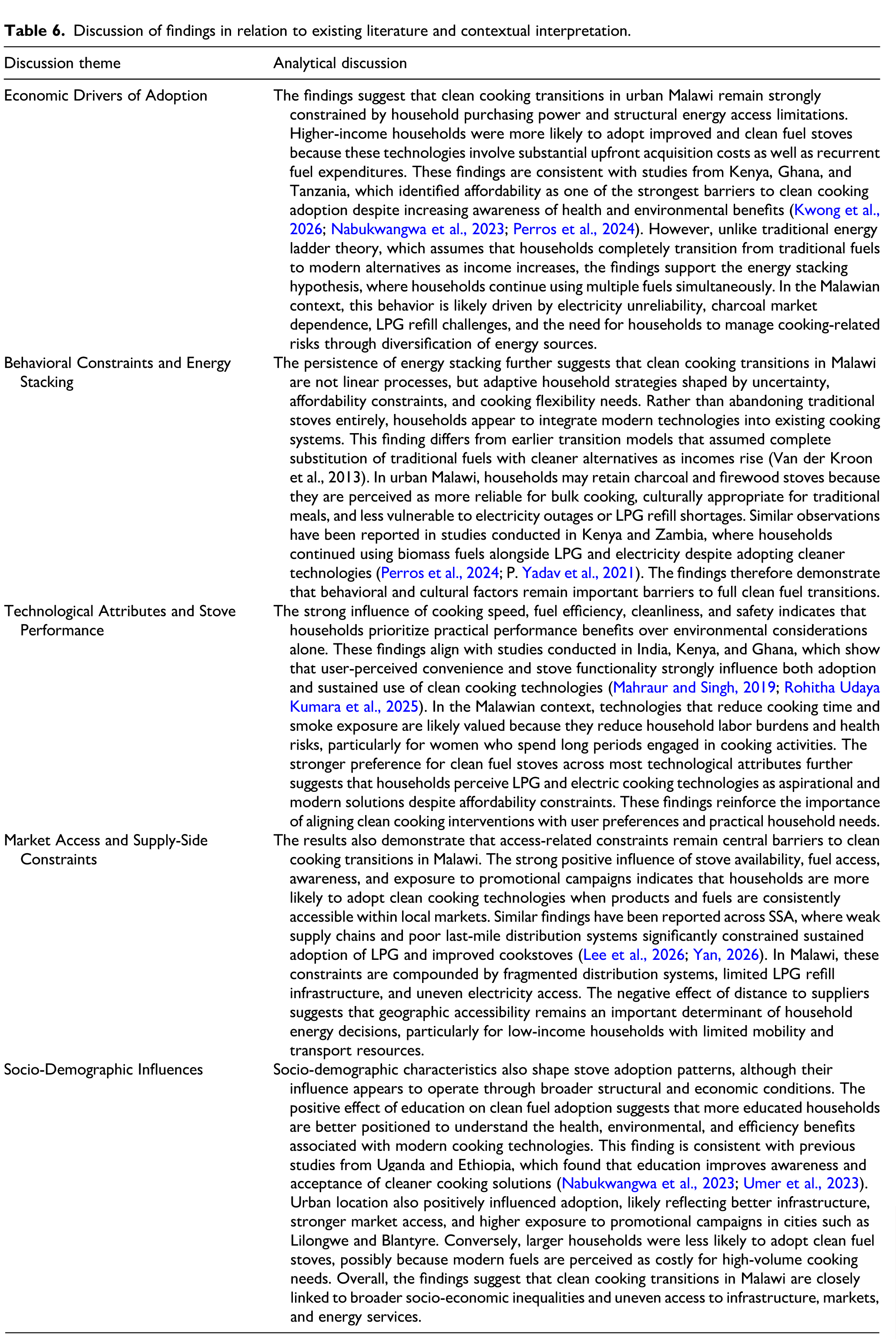
Overall, the findings indicate that socio-demographic factors play a significant but varying role in influencing stove choice, with stronger effects generally observed for clean fuel stoves compared to ICS. These results reinforce the importance of targeting interventions based on education levels, geographic location, and household structure to effectively promote the adoption of improved and clean cooking technologies (Chen and Wang, 2026; Nabukwangwa et al., 2023; Umer et al., 2023) (Table 6).
Discussion of findings in relation to existing literature and contextual interpretation.
Study limitations and generalizability
First, the study was conducted exclusively in four major urban centers (Lilongwe, Blantyre, Mzuzu and Zomba). The findings are therefore generalizable to urban Malawi and similar urban contexts in SSA where market access, income levels, and electricity connectivity exceed rural averages. Rural Malawi, where over 80% of the population resides and biomass dependence exceeds 95%, likely exhibits different determinants, particularly weaker market access, lower income, and stronger traditional cooking norms. Second, the cross-sectional design captures associations, not causal effects. Third, unobserved heterogeneity (i.e., intra-household bargaining power and seasonal fuel price variation) may influence results. Therefore, the authors recommend that readers not extrapolate these findings directly to rural settings without further empirical validation.
Self-reported fuel and stove use may be subject to recall and social desirability bias. Households may underreport traditional fuel use (firewood, charcoal) and overreport cleaner options (electricity, LPG) due to perceived environmental or health norms. To mitigate this, enumerators cross-validated responses using observed stove presence and fuel stock during household visits. Nevertheless, some misreporting likely remains.
Conclusion
This study examined the determinants of household stove choice in Malawi using a multinomial logit framework that integrates economic, behavioral, technological, market access, and socio-demographic factors. The results provide strong evidence that the transition to improved and clean cooking technologies is shaped by multiple interdependent influences rather than a single dominant factor. Economic variables are among the most important determinants of stove choice. Household income, WTP, and perceived affordability have positive and statistically significant effects on the adoption of both ICS and clean fuel stoves, with stronger effects for clean fuels. This indicates that higher financial capacity is essential for transitioning to cleaner cooking options. Fuel prices also positively influence adoption, reflecting sensitivity to relative costs, while liquidity constraints significantly reduce adoption, highlighting the importance of cash flow limitations. Overall, affordability and financial accessibility remain major barriers to clean cooking transitions. Behavioral factors are equally important. Energy stacking significantly reduces the likelihood of adopting improved and clean fuel stoves, confirming that households tend to rely on multiple energy sources rather than fully transitioning. Positive behavioral drivers such as perceived convenience, willingness to adopt new technologies, and higher cooking frequency encourage adoption, while cultural preferences for traditional cooking methods constrain it. This underscores the role of norms and habits alongside economic considerations. Technological attributes strongly influence adoption decisions. Households prioritize cooking speed, fuel efficiency, cleanliness, safety, and ease of use, with particularly strong effects for clean fuel stoves. Cleanliness stands out as a key factor, reflecting concerns about smoke exposure and health. These results indicate that perceived performance and usability are critical drivers of both adoption and sustained use. Market access and supply-side factors also play a significant role. Availability of stoves and fuels, awareness, promotional exposure, and proximity to suppliers significantly affect adoption. Limited access to supply chains and information remains a major constraint, especially for clean fuels that require reliable distribution systems. Strengthening market infrastructure and expanding awareness are therefore essential. Socio-demographic factors have comparatively smaller but still relevant effects. Higher education and urban residence increase adoption, while larger household size reduces it due to higher energy demands. Gender has a modest positive effect on clean fuel adoption, while age is not significant. These factors matter but are largely shaped by broader economic and contextual conditions. Overall, stove choice in Malawi is driven by a combination of financial capacity, behavioral patterns, technological preferences, market conditions, and socio-demographic context. The persistence of traditional stove use alongside gradual adoption of modern technologies reflects the slow and non-linear nature of energy transitions, characterized by widespread energy stacking. From a policy perspective, the findings highlight the need for integrated interventions. Expanding access to affordable financing, reducing liquidity constraints, and stabilizing fuel prices are critical to addressing economic barriers. Behavioral interventions should promote openness to new technologies and emphasize health and convenience benefits. Strengthening supply chains, improving market access, and increasing awareness are also essential. Policies should further target low-income, large, and rural households to enhance inclusivity. In conclusion, accelerating the transition to clean cooking in Malawi requires coordinated efforts that address economic, behavioral, technological, market, and socio-demographic constraints simultaneously.
Recommendations
The findings of this study demonstrate that household stove choice in Malawi is shaped by interacting economic, behavioral, technological, market, and socio-demographic factors. Accordingly, policy responses must be integrated and multi-dimensional to effectively accelerate the transition to clean cooking.
Economic constraints must be directly addressed to enhance affordability and access. The strong positive effects of household income, WTP, and perceived affordability, coupled with the negative impact of liquidity constraints, indicate that financial barriers remain central to adoption decisions. Policies should therefore expand targeted subsidies, results-based financing, and flexible payment mechanisms such as installment plans and credit schemes to reduce upfront costs. Strengthening access to affordable financing is consistent with evidence that affordability is a major barrier to clean cooking adoption (Debebe et al., 2025; Kouandou, 2025; Nabukwangwa et al., 2023). In addition, stabilizing fuel prices and supporting accessible fuel markets can further encourage adoption, particularly for clean fuels. Behavioral and cultural barriers must be addressed through demand-side interventions. The prevalence of energy stacking and the continued reliance on traditional cooking methods indicate that households do not fully transition to modern technologies but instead combine multiple fuels. This aligns with the energy stacking hypothesis and prior studies showing gradual, non-linear energy transitions (Chen and Wang, 2026; Kumar and Doan, 2025; Tornel-Vázquez et al., 2025; Wilson et al., 2025). Targeted behavior change campaigns should therefore promote sustained use of clean technologies by emphasizing health benefits, convenience, and time savings, while also addressing cultural preferences and risk perceptions. Community demonstrations and awareness programs can help shift entrenched behaviors and increase openness to modern technologies. Technological attributes should guide product design and promotion. The strong influence of cooking speed, fuel efficiency, cleanliness, safety, and ease of use highlights that households prioritize stove performance and usability. These findings reinforce the importance of aligning product design with user preferences, as stove attributes significantly shape both adoption and sustained use (Ajibola et al., 2024; Szramowiat-Sala and Sornek, 2024; Tesfay et al., 2024). (Bharadwaj et al., 2026; Coldrey et al., 2026; Deng and Zhang, 2026). Clean fuel technologies, in particular, are perceived as superior due to their higher performance and health benefits, underscoring the need to promote efficient, safe, and user-friendly technologies. Market access and supply chain systems must be strengthened. The significance of availability, awareness, and proximity to suppliers indicates that supply-side constraints are a major barrier, especially for clean fuels. Improving last-mile distribution, expanding retail networks, and ensuring consistent fuel supply are critical to increasing adoption. These measures are supported by evidence that weak supply chains and limited access significantly hinder clean cooking transitions (Mbegalo, 2025; Musonda and Mutembo, 2024; Onakomaiya et al., 2026). At the same time, expanding awareness campaigns and promotional activities can help close information gaps and increase technology uptake. Spatial and socio-demographic disparities should be explicitly addressed. The findings show higher adoption in urban areas, particularly in cities such as Lilongwe and Blantyre, compared to rural areas, reflecting differences in infrastructure, income, and access. Expanding electricity access, LPG distribution, and decentralized clean energy solutions is therefore essential to reducing these disparities. This is consistent with broader evidence that infrastructure and access play a critical role in clean cooking adoption (Ibe et al., 2026a, 2026b; Mukanema et al., 2026; Shen et al., 2025). Policies should also target low-income, large households, and rural populations, as these groups face greater adoption constraints.
Footnotes
Acknowledgements
The authors are grateful to the participating households in Lilongwe, Blantyre, Mzuzu, and Zomba for their time, cooperation, and valuable contributions to this study. We also acknowledge the Modern Cooking for Healthy Forests (MCHF) Project, supported by USAID and FCDO, for providing access to the dataset used in this research and for the opportunity to contribute to the broader research team involved in the design and implementation of the study. Their support was instrumental in facilitating data collection and advancing evidence generation on clean cooking transitions in Malawi.

Ethical considerations
Ethical approval for this study was obtained from the National Commission for Science and Technology (NCST), Malawi. Informed consent was obtained from all participants prior to data collection.
Author contributions
Admore Chiumia conceptualized the study, conducted the analysis, coordinated data collection, and led manuscript preparation.
Betchani Tchereni contributed to study design, methodological guidance, interpretation of findings, and critical manuscript review.
Hope Baxter Chamdimba contributed to data interpretation, manuscript review, and intellectual input throughout the study.
Funding
The authors disclosed receipt of the following financial support for the research, authorship, and/or publication of this article: This work was supported by the NA, (grant number NA)
Declaration of conflicting interests
The authors declared no potential conflicts of interest with respect to the research, authorship, and/or publication of this article.
Data availability statement
The data supporting the findings of this study are available from the corresponding author upon reasonable request.