






Abstract

The Chinese Journal of Transnational Law joins a distinguished tradition of transnational law periodicals. This began six decades ago, in 1964, when the Columbia Journal of Transnational Law (CJTL) built on one of the very first student-edited international law journals published in the United States and took its current name. 1 These 60 years have brought tectonic political, economic, sociological and technological transformations to the international community. This now consists of circa 50 more sovereign states and five billion more people than when the late Professor Wolfgang Friedman took the helm of the CJTL in the mid-1960s. The last few decades have also witnessed the gradual setting up of an ever-maturing and increasingly complex system of global governance. This new global landscape is defined by a proliferation of international institutions, including a plethora of new international adjudicative and semi-adjudicative bodies, and the rise of numerous functionally diversified international legal regimes, which have become deeply intermixed with every domestic legal system. All of this has fostered an expansion of the transnational legal space, and its related colossal challenges, beyond the wildest dreams of the early proponents of transnational law when they sought to encompass under the new terminology ‘all law which regulates actions or events that transcend national frontiers. Both public and private international law are included, as are other rules which do not wholly fit into such standard categories’. 2
The rise of China features prominently among the greatest transformations the world has witnessed in the last few decades. China's current position as ‘the world's largest economy (on a purchasing power parity basis), manufacturer, merchandise trader and holder of foreign exchange reserves’ 3 is the outcome, according to the World Bank, of ‘the fastest sustained expansion by a major economy in history’. 4 This historically unique development has greatly impacted the manner in which China engages with the transnational legal world while increasingly reshaping it in the process. 5 Furthermore, China's long-term grand strategy of sustaining its peaceful rise/development 6 has deeply transformed the field of transnational legal education in China, 7 where there are currently circa 650 universities offering law degrees.
Academic law journals published by Chinese universities have played a crucial role in modernizing the world of professional legal scholarship, both in China and also increasingly beyond it. In the international and comparative area, following in the footsteps of中国国际法年刊 (Chinese Yearbook of International Law) founded in the early stages of the opening up and reform period in 1982, a great number of academic journals have also been established, including several ‘Chinese’ English-language ones, starting with the Chinese Journal of International Law in 2002 and followed by others such as the Chinese Journal of Comparative Law in 2013. The Chinese Journal of Transnational Law (Chinese JTL) is proud to join this distinguished family of Chinese law journals and to further enable dialogue and in-depth debates among members of the transnational ‘invisible college’ with an ability to inspire policies and increasingly also to shape the law that, as Mirabeau presciently told us, ‘one day will rule the world’. Moreover, the Chinese JTL's mandate also includes advancing transnational legal education and nurturing legal scholarship of the highest quality both in and about China, Asia and across the developing world.
Over the last 60 years, in both theoretical and practical terms the field of transnational law has come of age. In doing so, it has grown to become further diversified into new transnational legal fields and specializations so as to address new transnational challenges, including environmental and criminal-related ones. 8 The publication of circa 20 transnational law journals over the last six decades has fundamentally contributed to this flourishing development. Retracing the historical evolution and mapping the contemporary global landscape of transnational law journals are long overdue. Two distinct phases may be distinguished in this largely neglected part of the nascent global history of international law journals. 9
As Map 1 illustrates, the first phase was from the early rise of the ‘transnational’ label on law journals in the United States in the mid-1960s to the relative fall of transnational law journals in the United States in the early 1990s with two of them indeed subsequently dropping the term ‘transnational’ from their mastheads. Moreover, as Map 1 also shows, 25 years would pass until a new U.S.-based academic journal ventured to take up the ‘transnational’ label in its title in 2016.
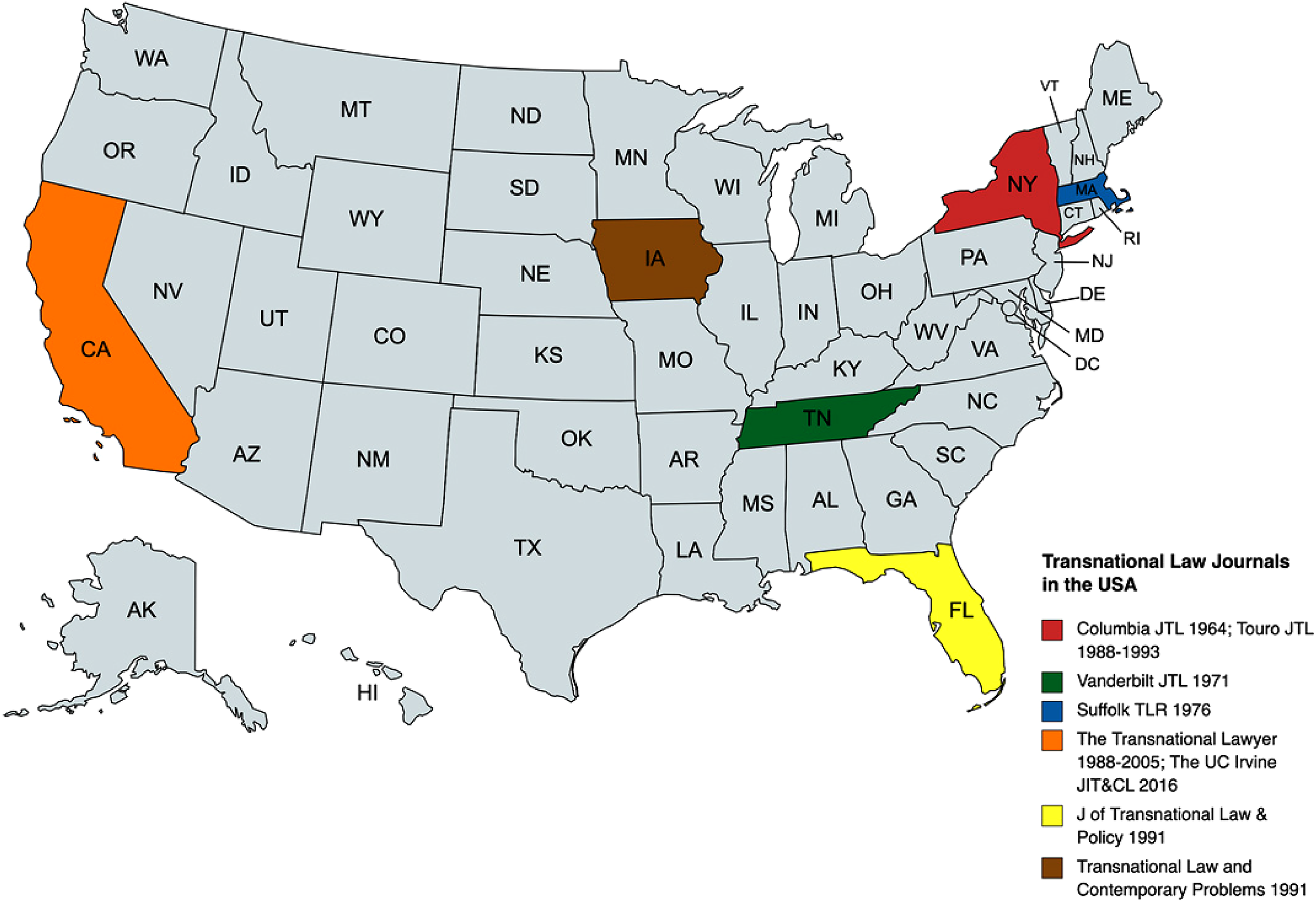
Transnational Law Journals in the USA.
Fortunately, the withering of the ‘T-word’ experienced in law reviews published in the United States was paralleled by a second phase of the global revival of the transnational label, which the Chinese JTL aims to further bolster. Indeed, as Map 2 shows, since the mid-1990s several transnational law journals have been published in the United Kingdom, the Netherlands, Spain, Canada, China, Italy and Indonesia. This, in turn, has resulted in the number of transnational law journals published outside the United States now being greater than that of those existing in their birthplace. Compared to the early generation of journals, this new batch of journals has followed a pattern of specialization which is, furthermore, consonant with the general evolution of international law journals in recent decades. 10 This pattern of specialization mirrors the expansion of the transnational legal domain in the spheres of transnational environmental, criminal and commercial law, and even transnational Islamic law and practice and transnational dispute settlement. While it is remarkable that this emerging global trend has yet to be extended to Africa, South America, Central and Eastern Europe and most of the Asia Pacific region, the geographical gap further justifies the Chinese JTL's mandate to also pay particular attention to both Asia and the developing world in its thematic coverage.
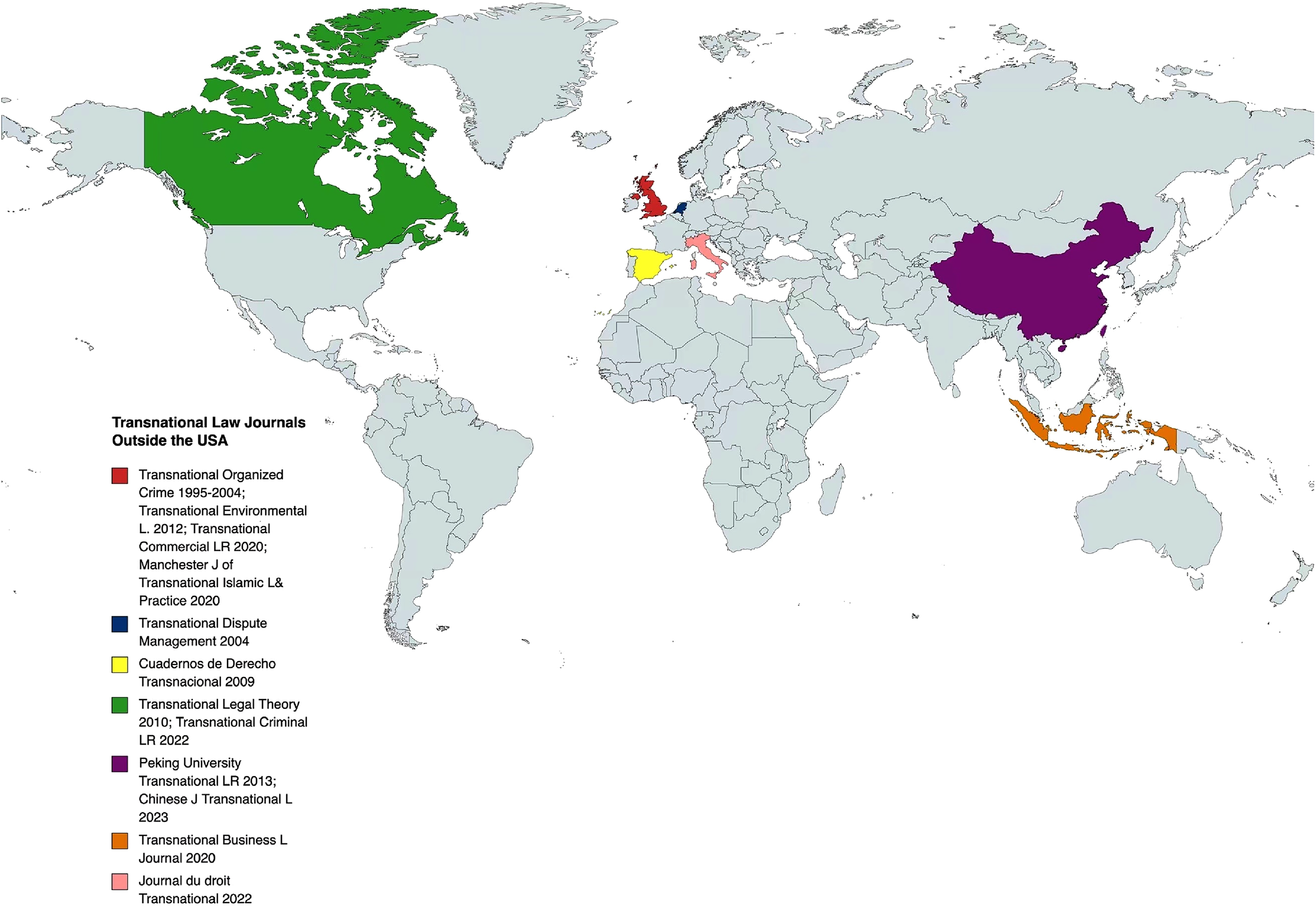
Transnational Law Journals Outside the USA.
The Chinese JTL is not the first journal of transnational law in English published in China, 11 but it is the first journal of its kind in China that aims to address internationally emerging transnational challenges that transcend geographical boundaries. The Chinese JTL indeed takes a thematic approach to addressing global challenges from the perspective of transnational law, which is broadly defined to cover international law (public and private), international economic law, comparative law, the interaction between domestic and international law, and any other legal field possessing a cross-border element. Its aims and scope are, moreover, designed in a way that reflects and respects the diversity of views and opinions born out of the particular experiences of different legal regions and countries. However, it does so while providing a forum to enable analysis and a better understanding of matters and perspectives related to China, Asia and developing nations on international and transnational legal issues and their influence in shaping correlated global legal developments and scholarly debates. Moreover, the Chinese JTL welcomes not only traditional doctrinal and theoretical legal research on transnational law but also contextual and interdisciplinary research. Although the Chinese JTL focuses on contemporary matters in its aspiration to be a forum for the latest debates on transnational legal studies, it also welcomes submissions inspired by in-depth historical perspectives that by illuminating the past cast new light on present developments.
One of the remarkable additional features of the Chinese JTL is that it is one of the very few transnational law journals that is not self-published by a university or research centre. The Chinese JTL is instead managed and curated by a world-leading professional academic publisher, SAGE, in close partnership with Wuhan University, which celebrates its 130th anniversary in 2023, and its Institute of International Law, which is known as the ‘cradle of talents’ in international law in China. Moreover, the Wuhan University School of Law (established in 1909) is currently ranked among the top 100 law schools worldwide, and second only to Tsinghua Law School in mainland China. 12 A proof of its long-term leadership and commitment to professionalization of legal education and legal scholarship in China is that since 1983 alone faculty members of the Wuhan Law School have been in charge of the publication of no less than 12 different law journals in either Chinese or English language under the auspices of Wuhan University.
Wuhan University has also been at the forefront of international legal education in China since the mid-1940s, and in particular, since late Professor HAN Depei (1911–2009) founded its Institute of International Law, the first in any Chinese university, nearly half a century ago in 1980. To pay tribute to the lasting memory of its distinguished forefathers, the Chinese JTL will, alongside its regular sections, include one devoted to the texts of distinguished guest lectures by world-leading specialists named after three great Chinese international law masters from Wuhan University: ZHOU Gengsheng, HAN Depei and YAO Meizhen. Building on this strong international tradition, in its commitment to serve our global readership and stimulate its intellectual creativity in confronting an array of ever-pressing transnational challenges, the Chinese JTL furthermore counts on the invaluable support of the highly reputed members of its international scientific and advisory boards spanning a network comprising circa 30 leading universities and research centres around the world.
As we are now about to embark on the long-term implementation of our editorial mandate, we do so in the hope that our esteemed global readership may find it useful and enriching to ponder the contents of the Chinese JTL for many years to come. On my own behalf, and also on that of my Co-Editor-in-Chief, Professor Sophia Tang, and the other distinguished members of the Chinese JTL's managing board, please accept our collective pledge, which is accompanied by a respectful bow in the tradition of Asian culture, to strive in our work for the Chinese JTL to fulfil the motto of Wuhan University: ‘自强, 弘毅, 求是, 拓新’ (‘self-improvement; perseverance; truth-seeking and innovation’).