







Abstract
Background
Impacts of youth-focused culinary nutrition programs on home food environment and food security are not well known.
Objective
Objectives were: (1) assess the influence of a culinary nutrition program on home food environment and food security; and (2) determine whether program format influenced outcomes.
Methods
This descriptive study of a longitudinal observational cohort included survey data from caregivers whose children participated in a youth-focused or family-focused culinary nutrition program. To evaluate ordinal outcome changes, means were calculated at baseline and program exit for the entire sample and stratified by program design.
Results
191 caregivers participated. Caregivers reported improvements in thinking about healthy food choices (P = .03), using “Nutrition Facts” labels (P < .001), and using MyPlate (P < .001) to choose foods. Household food security also improved (P = .03). Differences by program format were observed.
Conclusions
This study identifies important associations between participation in youth-focused culinary nutrition programs and the home food environment as well as household food security.
Keywords
Introduction
Culinary nutrition education programs for youth are an effective approach to improve dietary patterns among children and adolescents. 1 These programs have gained popularity in recent years while also demonstrating favorable impacts on actual and perceived cooking skills, attitude towards cooking, and diet quality.2-4 In spite of consistently positive effects on youth participants, it is unclear whether and how these programs impact the home food environment and household food security. Children are more likely to actively participate in home meal preparation after completing a cooking class, indicating that culinary programs can influence child cooking behaviors in the home. 5 However, caregivers are largely responsible for managing home food availability, shaping food attitudes, and modeling eating behaviors for their children. 6 Given the influential role of both household food security 7 and the home food environment on child dietary habits, 8 it is essential to explore whether and how culinary nutrition programs for youth might impact these factors.
Flint Kids Cook, a youth-focused culinary nutrition education program developed by a team of dietitians, chefs, researchers, and pediatricians, was created in October 2017 in the low-income, urban community of Flint, Michigan. A virtual family-based version of Flint Kids Cook was introduced in January 2021 following the COVID-19 pandemic. This version, Flint Families Cook, uses recipes and nutrition materials from Flint Kids Cook to teach youth and their families how to prepare healthy meals. Together, these programs have reached over 700 youth in and around Flint. Related research has focused entirely on the impacts of Flint Kids Cook and Flint Families Cook on youth participants.2,3 No assessment of program effects on household factors, including caregiver-reported home food environment or household food security has been completed. This preliminary study sought to: (1) assess the impact of Flint Kids Cook and Flint Families Cook on caregiver-reported outcomes related to home food environment and household food security; and (2) explore whether outcomes varied by program format (youth-only versus family-based).
Material and Methods
Interventions
Flint Kids Cook is an in-person culinary nutrition education program for youth led by a chef and dietitian in a farmers’ market kitchen. 3 Flint Kids Cook includes 6 weekly 90-minute class sessions, and each class explores a different food group from the United States Department of Agriculture’s (USDA’s) MyPlate. In class, students work in groups of 3-5 to cook 2 recipes that represent the week’s food group and engage in related nutrition education activities. At the end of each class, students receive recipes and cooking tools, such as measuring cups, cutting boards, and whisks, to encourage cooking at home. Students are also provided with 2 take-home kits during the program that contain a recipe and ingredients to prepare at home. Additionally, recipes prepared during classes are packed in disposable containers for youth to share with their families at home. The class ends with a special dinner that students prepare for their families. Only youth participate in the class, but caregivers may watch from the hallway outside the kitchen. Research has demonstrated an association between participation in Flint Kids Cook and improvements in youth cooking self-efficacy, cooking attitudes, and health-related quality of life. 3
Flint Families Cook is a virtual adaptation of Flint Kids Cook, with overlapping recipes and nutrition curriculum. Flint Families Cook was developed during the COVID-19 pandemic to reach children and families while in-person classes were unavailable, 2 and the program remains an option for families. The virtual Flint Families Cook class includes 5 weekly 90-minute class sessions taught on Zoom. During class, children and their families follow along live with a chef and dietitian to cook 2 recipes that represent the food group highlighted in class. Before each class, families receive an ingredient box delivered by a local food hub. The amount of food provided in the ingredient box is similar to that of one in-person group.
Data Collection
Youth were eligible to join Flint Kids Cook if they were age 8-18 years, spoke English, and had not previously taken the class. Families were eligible to participate in Flint Families Cook if they had a child(ren) age 8-18 years, spoke English, and had not previously participated in either of the cooking programs. Flint residency was not a program requirement, but most participants (62.3%) lived in Flint. Both classes were offered to participants for free. The current study received exempt status from Michigan State University (MSU) Institutional Review Board. Written caregiver consent and written or implied child assent were obtained.
After providing consent, caregivers completed surveys to assess demographic characteristics, home food environment, and household food security. Caregivers completed surveys via a secure digital platform (MSU Qualtrics). Baseline data were collected prior to the first class and follow-up data were collected on or up to ten days after the final class. Flint Kids Cook caregivers completed assessments from July 2022 through October 2025. Flint Families Cook caregivers completed assessments from February 2022 through June 2025.
Primary Outcome Measures
Home Food Environment
To understand the impact of Flint Kids Cook and Flint Families Cook on home food environment, researchers constructed a survey using related questions from previous instruments. Six questions were extracted from an 8-item survey that evaluated caregiver-reported family meal frequency and mealtime characteristics in the past 7 days. 9 These items were scored on a Likert scale as “never (0), 1-2 times/week (1), 3-4 times/week (2), 5-6 times/week (3), or 7 times/week (4)” (sample question was, “During the past seven days, how many times did your child eat dinner in front of the TV?”).
Nine questions were extracted from a validated 164-item instrument that measured socioenvironmental factors that influence child fruit and vegetable consumption as reported by caregivers. 10 Items were scored on a Likert scale as “never (0), sometimes (1), often (2), always (3)” (sample question was, “How sure are you that you can regularly involve you child in preparing fruits and vegetables?”).
Three questions were extracted from the 15-item CalFresh Healthy Living Plan, Shop, Save & Cook Checklist to assess whether nutrition was considered during meal planning and preparation. 11 Items were scored on a Likert scale as “never (0), seldom (1), sometimes (2), most of the time (3), and almost always (4)” (sample question was, “How often do you use MyPlate to make food choices?”).
Household Food Security
Household food security was measured using the US Household Food Security Module: Six Item Short Form (National Center for Health Statistics). 12 The household raw score was calculated by totaling the number of affirmative responses to six questions, with scores ranging from 0-6 (interpreted as 0-1=high/marginal food security; 2-4=low food security; 5-6 very low food security).
Statistical Analysis
Means with standard deviation and frequencies with percentages were calculated to describe characteristics and outcomes at baseline and program exit. To evaluate changes in ordinal outcome variables, means were calculated at each time point for the entire sample and stratified by program design (Flint Kids Cook versus Flint Families Cook). Means were compared using Wilcoxon Signed Rank Sum Test.
To evaluate differences between Flint Kids Cook and Flint Families Cook, distributions of the following variables were stratified by program design: caregiver gender (female versus other), race (Black, White, not Black or White), education (some college or less, Associate’s Degree or trade school, and college graduate or higher), age, and residency in Flint (Flint, non-Flint).
The study was initially designed to evaluate child-reported outcomes; however, the sample size of 191 had sufficient power to detect unadjusted changes in caregiver outcomes. This does not eliminate the possibility that the sample does not represent the target study population. Researchers did not adjust for confounding so there is a threat of confounding bias in the results.
Results
Demographic Characteristics
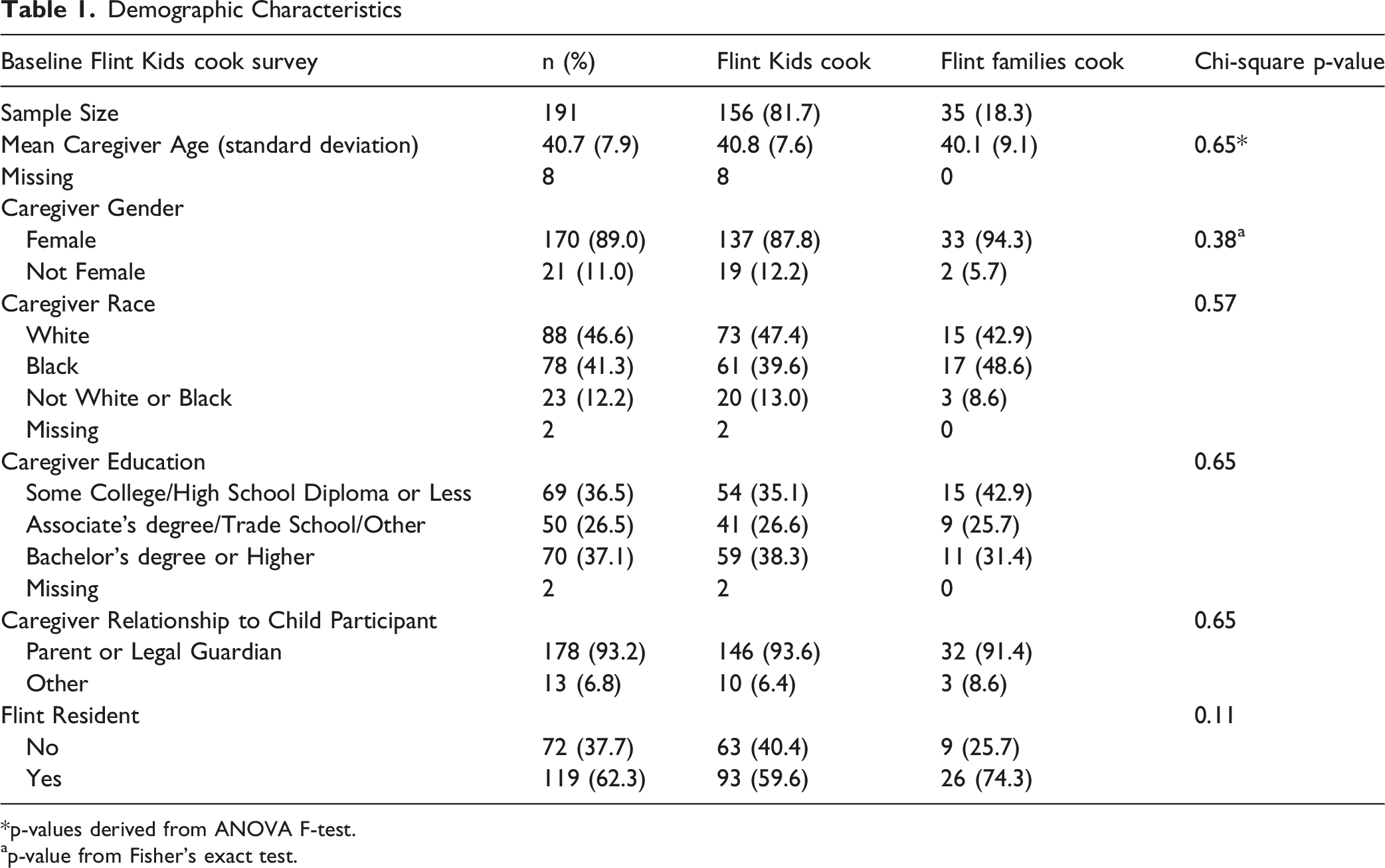
*p-values derived from ANOVA F-test.
ap-value from Fisher’s exact test.
Caregiver-Reported Home Food Environment and Household Food Security
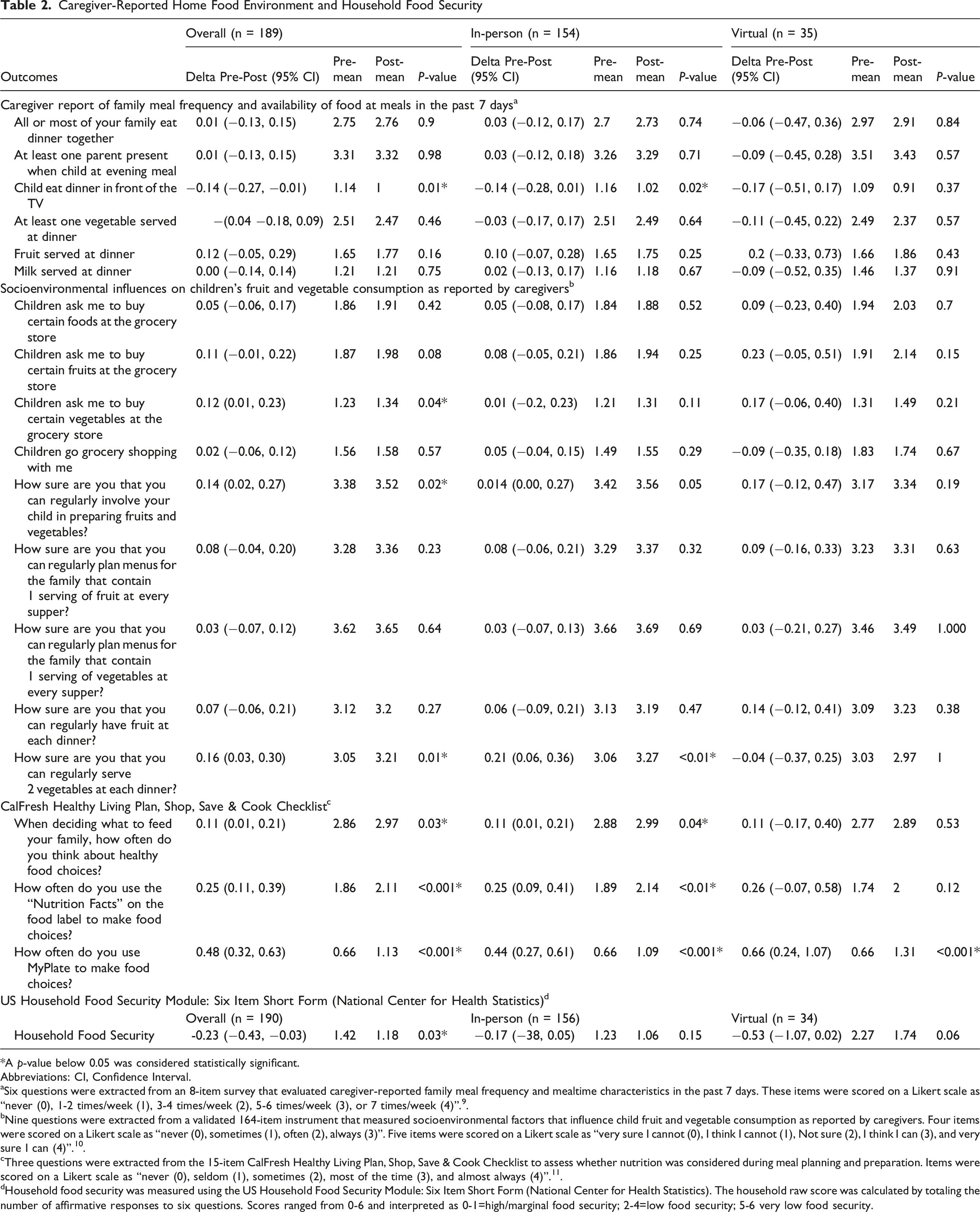
*A p-value below 0.05 was considered statistically significant.
Abbreviations: CI, Confidence Interval.
aSix questions were extracted from an 8-item survey that evaluated caregiver-reported family meal frequency and mealtime characteristics in the past 7 days. These items were scored on a Likert scale as “never (0), 1-2 times/week (1), 3-4 times/week (2), 5-6 times/week (3), or 7 times/week (4)”. 9 .
bNine questions were extracted from a validated 164-item instrument that measured socioenvironmental factors that influence child fruit and vegetable consumption as reported by caregivers. Four items were scored on a Likert scale as “never (0), sometimes (1), often (2), always (3)”. Five items were scored on a Likert scale as “very sure I cannot (0), I think I cannot (1), Not sure (2), I think I can (3), and very sure I can (4)”. 10 .
cThree questions were extracted from the 15-item CalFresh Healthy Living Plan, Shop, Save & Cook Checklist to assess whether nutrition was considered during meal planning and preparation. Items were scored on a Likert scale as “never (0), seldom (1), sometimes (2), most of the time (3), and almost always (4)”. 11 .
dHousehold food security was measured using the US Household Food Security Module: Six Item Short Form (National Center for Health Statistics). The household raw score was calculated by totaling the number of affirmative responses to six questions. Scores ranged from 0-6 and interpreted as 0-1=high/marginal food security; 2-4=low food security; 5-6 very low food security.
Similar to the overall sample, caregivers of Flint Kids Cook participants reported significant improvements in thinking about healthy food choices (P = .04), using the “Nutrition Facts” label (P < .01), and using MyPlate (P < .001) to make food choices. They also reported reductions in children eating in front of television (P = .02). Flint Kids Cook caregivers further reported an increase in feeling sure they could serve 2 vegetables at a main meal regularly (P < .01).
Flint Families Cook caregivers, although a small proportion of the overall sample, reported significant increases in using MyPlate (P < .001) to make food choices. Caregivers in this group also reported marginally significant improvements in household food security (p = 0.06).
Discussion
The current study fills important gaps in literature related to the impact of youth-focused culinary education programs on caregiver-reported home food environment and household food security. Of note were significant improvements in caregiver-reported considerations regarding nutrition when planning and preparing meals for the household. Both Flint Kids Cook and Flint Families Cook include nutrition education and activities that highlight the importance of healthy eating. USDA MyPlate is central to the programs with each food group serving as the class topic. 2 Results suggest that across programs, caregivers began to consider USDA MyPlate when preparing meals for their household. Fewer than one-third of US adults are familiar with MyPlate and less than one-tenth have attempted to follow its recommendations. 13 It is essential to consider the implications of this among children who depend on their caregivers to purchase and prepare healthy foods and model healthy eating behaviors. Future research should explore whether and how youth-focused culinary nutrition education programs may improve nutrition awareness among caregivers.
Caregivers reported significant improvements in household food security. This improvement in food security was notable among Flint Families Cook participants who received an ingredient box each week that encouraged families to cook together at home. Because income is known to positively influence fruit and vegetable intake, 14 program participation may have disproportionately benefited children who lived in food insecure households. Approximately 6.5 million children in the US currently endure food insecurity and its devastating consequences, including substandard dietary intake, 7 adverse health and behavioral issues, 15 and poor academic performance. 15 Culinary nutrition education programs for youth could be implemented in other low-income communities across the country to help combat increasing rates of food and nutrition insecurity among children.
Caregivers whose children participated in Flint Kids Cook noted improvements in regular involvement of children in preparing fruits and vegetables and regularly having 2 vegetables at each dinner. Previous research has indicated that parental dietary habits and food modelling positively impact youth fruit and vegetable intake. 6 Moreover, availability of food in the home, household rules, and caregiver encouragement contribute to youth fruit and vegetable intake. 6 Although future research is needed, these early findings suggest that participation in Flint Kids Cook may be associated with positive changes in home food availability and caregiver encouragement that support greater fruit and vegetable intake.
This study has limitations. The study was small and included only one geographic area, limiting generalizability of results. Moreover, a control group was not included which limits the ability to confirm causation. There is potential for reporting bias, as outcome data were reported by caregivers.
Conclusions
The current study identifies important associations between culinary nutrition education programs directed at youth and the home food environment, particularly in relation to caregivers’ consideration of nutrition when planning meals, as well as household food security. If replicated, findings may reveal new benefits of youth-focused culinary nutrition education programs.
Footnotes
Acknowledgements
The research team would like to thank Chef Sean Gartland and Chef Tina Wilder for their contributions to the development and implementation of the programs.

Ethical Considerations
The current study received exempt status from Michigan State University (MSU) Institutional Review Board on May 21, 2018.
Consent to Participate
All caregivers provided written informed consent and all youth provided written or implied assent prior to enrollment in the study.
Funding
The authors disclosed receipt of the following financial support for the research, authorship, and/or publication of this article: This work was supported by the Stephanie H. and David A. Spina Family Foundation.
Declaration of conflicting interests
The authors declared no potential conflicts of interest with respect to the research, authorship, and/or publication of this article.
Data Availability Statement
The datasets generated during and/or analyzed during the current study are available from the corresponding author on request.