







Abstract
Is creativity good, bad, or neutral? Although creative outcomes can serve malevolent purposes, we argue the underlying processes that support creative expression—what we call here the Creativity Ethos—lean toward the good in human nature. The dimensions of this Ethos can be metaphorically grouped under three main colors, Blue, Yellow and Red, related to cognition and personality, socioemotional interactions, and motivation, respectively. Blue processes are flexibility and openness, Yellow processes are perspective-taking and compassion, and Red processes are passion and inspiration. In the end, a well-developed Creativity Ethos can be compared to a rainbow that showcases how different colors valorize each other; further, they can all be enhanced through co-creation, leading to emergent changes in the world. However, there are also cases in which these components are underdeveloped, which may lead to less benevolent outcomes via profiles we call the “idle activist,” “selfish CEO,” and the “potential fanatic.” We end with reflections on why discussions of the Creativity Ethos are important not only for positive and humanistic psychology, but for any discipline, including Possibility Studies, interested in developing wise and humanizing forms of creativity.
Keywords
[I]n spite of everything I still believe that people are really good at heart. I simply can’t build up my hopes on a foundation consisting of confusion, misery, and death. I see the world gradually being turned into a wilderness, I hear the ever approaching thunder, which will destroy us too, I can feel the sufferings of millions and yet, if I look up into the heavens, I think that it will all come right, that this cruelty too will end, and that peace and tranquility will return again.
Is creativity good, bad, or neutral? One’s first instinct may be to offer an instinctual answer of “good.” In Science, Technology, Engineering, and Mathematical (STEM) areas, creativity spurs on advances and economic development (Florida, 2014). Artistic creativity is linked with a plethora of physical and mental health benefits (De Petrillo & Winner, 2005). Creative workers tend to be both more successful (Clapham et al., 2005) and better able to cope with life’s stressors (Goncalo et al., 2015).
However, a deeper consideration may bring less positive associations. There are already models of creativity that highlight its potential for evil acts (D. H. Cropley et al., 2008) or moral neutrality (Kapoor & Kaufman, 2022). Creativity’s connection to dark and evil actions is well-established (A. J. Cropley et al., 2010). Although the actual connection between creativity and mental illness is murky and often distorted (J. C. Kaufman, 2014), there is evidence of a link, at least at Big-C levels (Simonton, 2014).
Such construct duality appears present across all usages of creativity. Consider the Five A’s (Glăveanu, 2013), which explores the interdependence between creative actors, audiences, actions, artifacts, and affordances. If we examine the benevolence or malevolence of creativity from this perspective, each A can support both interpretations. The actor can be a serial killer, heroic rescuer, conniving manipulator, kind helper, or everything in between. The artifact could be a cure for cancer or a deadly virus, a new system for growing crops or a new enhancement for a machine gun. The audience could be doctors learning new life-saving treatments or neo-Nazis learning new ways to spread hate. The action and the affordances used are largely tools in service of the actor, artifact, and audience. The creative actor, artifact, or audience may be neither instinctually better nor worse than their less-creative counterparts.
There is a difference, however, between pure neutrality, in which there is an equal chance for a good or bad intention or outcome, and something that is broadly neutral yet may slightly tilt toward benevolence or malevolence. In this paper, we will argue that although the construct of creativity is neutral, people who consistently demonstrate creative traits and abilities should have a slight inclination toward good. In highlighting specific components of creativity, we draw from classic componential models (Amabile, 1983, 1996; Sternberg & Lubart, 1995) and relevant research. We synthesize these disparate parts into a tripartite of cognition and personality; socioemotional interactions with others (which is essential for the domain of humanity); and motivation, which form a gestalt we call the Creativity Ethos. The Creativity Ethos is not comprised of all of the pieces needed to be creative, nor is it particularly predisposed to any particular creative domain or eminence level. We will instead hone our focus to those constructs that we believe contribute not only to making someone more creative, but also more creative in a prosocial, positive, or transformative way (e.g. Sternberg, 2021a, 2021b; Sternberg & Chowkase, 2021).
We will use the metaphor of colors to capture both the unity and diversity of processes within the Ethos. At the core are the primary colors: Blue, Yellow, and Red. Blue comprises the individual differences related to cognition and personality that contribute to the Creativity Ethos. We will emphasize the constructs of openness and flexibility. Past studies have shown that blue is implicitly associated by laypeople with being secure (Wexner, 1954), relaxed (Sutton & Altarriba, 2016), and less dominant (Wang et al., 2014); these attributes have been found to be (loosely) connected to openness (Ainsworth, 1958) and flexibility (Carmody et al., 2009). Yellow, which is implicitly associated with happiness, joy, and friendliness (Sutton & Altarriba, 2016), we connect with socioemotional interactions with others. We start here with the constructs of perspective-taking and compassion. Finally, Red is strongly linked to passion (Sutton & Altarriba, 2016). It represents the motivational components of the Creativity Ethos, with specific attention devoted to inspiration and passion. We do not maintain that every set of two constructs represent the only ones for each color in the Creativity Ethos, but rather the ones that we believe are the most representative. See Figure 1 for a visual representation of the Creativity Ethos.
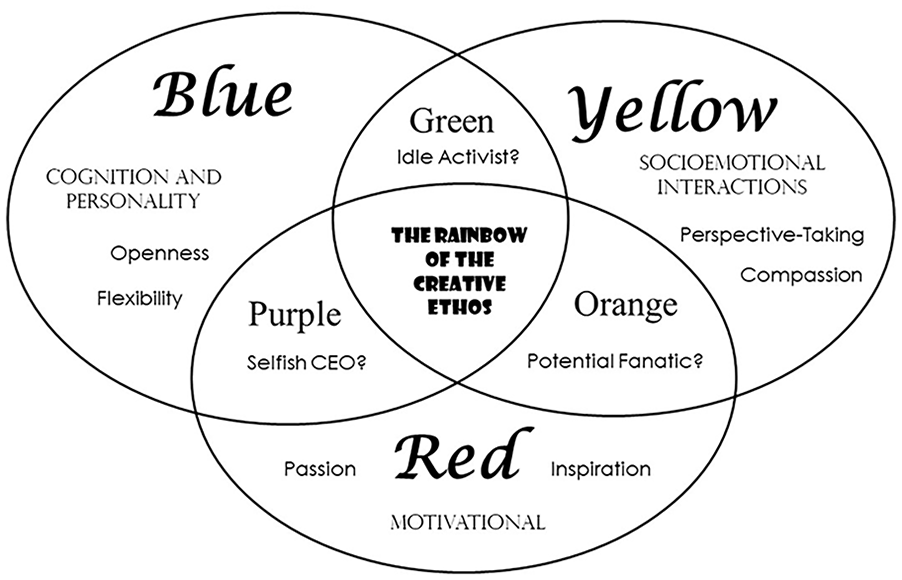
The creativity ethos.
In what follows, we will consider each one of these six constructs that comprise the three interlocking colors of the Creativity Ethos—flexibility, openness, perspective-taking, compassion, inspiration, and passion—and discuss (a) their meanings and related processes; (b) their contribution to creativity as discussed in past and present theories and research; (c) their contribution to positive outcomes, if relevant, as discussed in past and present theories and research; and (d) their inter-relation with other constructs in the Creativity Ethos. We will then highlight different combinations of colors and what may happen when people reach all three (the metaphorical rainbow).
We consider this new framework and its theoretical and empirical underpinnings to be important not only for creativity research but also Possibility Studies. Just like in the case of creative work, explorations of the possible can have positive, negative, or neutral consequences (and be intended to have these consequences). While the possible can be engaged in malevolent or destructive ways, the mere “possibility of experiencing the possible”—a fundamental dimension of the human condition—has a range of benefits for individuals and societies as a whole. In the recent Manifesto published in this journal (see Glăveanu, 2022), some of these benefits, from psychological health to community engagement, have been alluded to. But a warning was also formulated as the principle of not romanticizing the possible. The present article takes the case of creativity, one of the main processes behind our propensity to discover and enact new possibilities, and examines whether affirming the positive over the negative, under specific conditions, can be supported conceptually and empirically. Our provisional answer—yes—has consequences for our understanding of why and how engaging with the possible matters—and matters greatly—for self, others, and world.
The creativity ethos
Blue: Personality and cognition
Flexibility
Flexibility has many meanings. In the creativity literature, it is most commonly used to denote cognitive flexibility, which is often considered part of executive functioning (Miyake et al., 2000). It centers around being able to shift from one task or mode of thought to another one (Pringle & Sowden, 2017). This usage is related to how the term is implemented in the assessment of divergent thinking (e.g. Plucker et al., 2011), in which it is calculated via the number of different categories a person uses when responding to an open-ended question. More generally, cognitive flexibility designates using large and inclusive categories and being able to move from one to another. Being cognitive inflexible is to be rigid; attributes such as extreme partisanship (regardless of political party) is associated with such inflexibility (Zmigrod et al., 2020). Cognitive flexibility represents (with persistence) one of the two anchors of the dual pathway to creativity model (Nijstad et al., 2010). Persistence is needed for creativity but, as with the previously mentioned resiliency, more valence-neutral.
Flexibility also has other meanings in psychology. It can be seen as a trait related to personality, which helps people adapt to different or changing environments, maintain a life balance, and understand their personal values (Kashdan & Rottenberg, 2010). Relatedly, Ikizer and Ramírez-Esparza (2018) propose social flexibility as a specific sub-category (being able to shift between, adapt to, and understand different social environments). The concept of attentional flexibility, in which people are able to focus and shift their attention to different tasks, has also been considered (Murdock et al., 2013).
Flexibility can lead to many positive outcomes beyond creativity. War veterans with higher psychological flexibility, for example, have been shown to have better adjustment after combat (Elliott et al., 2019) and fewer posttraumatic symptoms (Meyer et al., 2019) than veterans with less psychological flexibility. Similarly, the construct can reduce the impact of early life trauma on subsequent depression and PTSD (Richardson & Jost, 2019). Psychological flexibility can also contribute to physical well-being, such as being associated with faster rehabilitation from injuries (DeGaetano et al., 2016) and better response to therapy for chronic pain (Lin et al., 2018). Cognitive flexibility can equally impact psychological well-being; it is a moderator of the relationship between having trait anxiety and experiencing depressive symptoms (Wang et al., 2019) and between stress and seeing the positive side of negative events (Wei et al., 2019). Furthermore, older individuals who are cognitively flexible are more likely to have a healthy social life (Aghajani & Samadifard, 2019).
Additional positive benefits have an impact beyond the creator. High flexibility, for example, is conceptually associated with decreased prejudice and stereotyping (Groyecka, 2018; Luria & Kaufman, 2017). Recent empirical studies have shown that that stimulating creative flexible thinking can help increase intercultural sensitivity (Groyecka et al., 2020) and reduce prejudice (Groyecka-Bernard et al., 2021), stereotype activation (Sassenberg & Moskowitz, 2005), and negative outgroup attitudes (Winter et al., 2021). Other work has shown that interventions to reduce stereotyping enhanced cognitive flexibility (Gocłowska & Crisp, 2013; Gocłowska et al., 2013). This impact was particularly salient for those with a low need for structure (Gocłowska et al., 2014), which makes sense given that having a high need for structure has been found to be negatively associated with cognitive flexibility (Van Hiel & Mervielde, 2003).
Whether someone is switching between different types of thinking, adjusting to changes in the environment, conceptualizing broadly diverse approaches to a problem, or being an adaptable person, most of the nuances of flexibility contribute to the Creativity Ethos. It is often seen as being interrelated with openness (Baas et al., 2013; DeYoung et al., 2005), the next construct in our Blue category.
Openness
Openness is one of the components of the Big Five theory of personality (Feist, 2019), along with emotional stability, conscientiousness, agreeableness, and extraversion. Sometimes it is split into subcomponents, such as openness to fantasy, esthetics, feelings, actions, ideas, and values (Costa & McCrae, 1992). More recently, it has been split into two facets, openness to experience and openness to intellect (DeYoung, 2006). There are numerous other possible ways that the personality factor can be divided or analyzed (DeYoung, 2015). 1
When openness is measured, many facets are emphasized: appreciating beauty, nature, and art (DeYoung et al., 2007); the pursuit of knowledge, reflection, and intellectual challenge (Goldberg et al., 2006); the qualities of curiosity and imagination (Soto & John, 2017); and a predisposition for adventure, emotionality, and liberal values (Costa & McCrae, 1992). Whether one is offered a new opportunity, confronted with a new idea, provided with an esthetic experience, or given the chance to do a different activity, someone who is open is inclined to say “yes.”
Openness is highly correlated to creativity across a wide variety of measures (Feist et al., 2017). These extend to self-reported creative activities (Jauk et al., 2014), creative self-efficacy (Karwowski et al., 2013), divergent thinking performance (Asquith et al., 2022), and rated creative products (Maslej et al., 2014). It is important to note that because most measures of openness are reliant on questions about imagination and esthetics, these types of connections are not necessarily surprising (Martindale, 1989). At the facet level, openness to experience is more likely to correspond to artistic creativity and openness to intellect is more likely to relate to scientific creativity (S. B. Kaufman, 2013).
Beyond its connection to creativity, the process of openness is associated with many positive attributes. If we look at the research on people who are high on openness, we begin to see the profile of someone who is a citizen of the universe. For example, openness is correlated with environmental concern (Hirsh, 2010), pro-environmental behavior (Markowitz et al., 2012), and prosocial behavior in general (Mlčák & Záškodná, 2008). For one, open people are less likely to engage in negative behavior. For example, prejudice is seen as a product of right wing authoritarianism and social dominance orientation (Altemeyer, 1998). Openness is a negative predictor of prejudice, in part because people who are open are less likely to believe in right wing authoritarianism (Sibley & Duckitt, 2008) or social dominance (Hamer et al., 2019).
Relatedly, openness is associated with tolerating other people having different beliefs (Butrus & Witenberg, 2013). Combined with high flexibility, high openness predicted which people were more likely to show interest in images that presented schema violations (such as a penguin in the desert), which is again associated with higher tolerance (Gocłowska et al., 2017).
Sparkman et al. (2019) conducted two studies to examine this relationship in depth. Openness was consistently linked with beliefs in multiculturalism (acknowledging and valuing difference) across both studies. Openness works in tandem with perspective-taking, a part of Yellow which has significant cognitive aspects. If people engage in taking the perspective of those from different ethnic or cultural backgrounds, then they will be less likely to endorse colorblind beliefs (which emphasize that people are all ultimately the same). If people take a larger, more general approach to perspective-taking, then they are more likely to endorse colorblind beliefs.
Yellow: Socioemotional interactions
Perspective-Taking
Perspective-taking and related phenomena have received considerable research attention in recent decades (e.g. Singer, 2006), although perceptual and conceptual perspective-taking have been studied for a much longer time (Taylor, 1988). Although perspective-taking is distinct from empathy, they both concern the social and psychological processes we use to understand other people’s thoughts, feelings, and experience of the world. Perspective-taking is often concerned with the perceptual and cognitive aspects of these efforts to “read” the mind of others, whereas empathy refers primarily to experiencing the emotions of other people (Decety & Jackson, 2006). Although there is work documenting the differences between empathy and perspective-taking (Stietz et al., 2019), we will refer to perspective-taking here as an umbrella term designating those acts of re-positioning oneself—perceptually, cognitively, emotionally, and/or socially—in the “shoes” of someone else.
Perspective-taking is intimately related with creativity. It has been demonstrated, for instance, that this process helps actualize the benefits of diversity in team creativity by fostering information elaboration (Hoever et al., 2012). Perspective-taking influences prosocial motivation which, in turn, strengthens the association between intrinsic motivation and creativity (Forgeard, 2022; Grant & Berry, 2011). Educational intervention programs focused on perspective-taking can increase creative output (Doron, 2017). There are various explanations for these findings; one, for example, proposes a deep level connection between the creative process and the act of taking the perspective of others as well as placing the resulting perspectives in dialog (Glăveanu, 2015). Creativity involves the capacity to de-center from one’s position and point of view and be able to engage with differences in perspective. Indeed, both mundane and historical expressions of creativity require at the most basic level the ability to understand the needs, thoughts, and feelings of one’s audience.
Perspective-taking is associated with a wide range of other benefits as well. At an individual level, there are reliable connections between altruism and perceptual, social, and moral perspective-taking (Underwood & Moore, 1982). At a group level, perspective-taking has been found to decrease stereotype expression, stereotype accessibility, and in-group favoritism (Galinsky & Moskowitz, 2000). Finally, at a societal level, there is a strong relationship between the predisposition to cooperate and the ability to take the emotional perspective of other people (Johnson, 1975). More broadly, our capacity to take the perspective of others has been conceptually related to our agency (Gillespie & Martin, 2014) and well-being in personal relationships (Kellas et al., 2017).
Perspective-taking opens us up to the experience of other people. In doing so, it both makes us sensitive to a range of new ideas and helps us build intersubjectivity and mutual understanding. Like any process, there can also be “dark sides” to perspective-taking; for example, it might increase egotistic reactions when we imagine that the other has bad intentions, in contexts of competition (Epley et al., 2006), and it can reinforce rather than bridge radical differences under specific circumstances (Catapano et al., 2019; Glăveanu & de Saint Laurent, 2018). It is for these reasons that we emphasize the “cumulative good” aspect of the Creativity Ethos. Each construct and color is broadly positive, but the genuine benevolent push comes strongest as they interact with each other and produce those emergent effects.
Compassion
Compassion shares common ground with perspective-taking and empathy (indeed, there is overlap; see Bengtsson et al., 2016). But where perspective-taking is being able to see from another’s point-of-view and empathy is being able to experience other people’s emotions (Goetz et al., 2010), compassion goes a step further. When someone has such feelings, they are also moved by them (Haidt & Morris, 2009)—often moved in such a way that facilitates action (Cuff et al., 2016). Although empathy can include cognitive and physical components (e.g. Raine & Chen, 2018), compassion is usually seen as primarily affective, or based in emotions (Stellar et al., 2017).
Compassion is distinct from self-compassion; the latter construct means feeling compassion for one’s self and not being overly harsh or self-critical (Neff, 2003). Self-compassion has been found to be associated with divergent thinking (Zabelina & Robinson, 2010) and artistic accomplishments (Verger et al., 2022). It is associated with positive attitudes toward others, such as romantic partners (Zhang et al., 2020) and family members (Lathren et al., 2021), as well as theoretical altruism (Welp & Brown, 2014). However, we see self-compassion’s place in the Creativity Ethos as more a result of its close relationship to compassion, as opposed to its stand-alone attributes.
Scholarship on creativity and other-focused compassion is less plentiful. Peng et al. (2017) found that high leader compassion can moderate the negative effects of workplace loneliness on employee creativity. Hur et al. (2018) found employee compassion served as a mediating variable between employee views of their organization’s corporate social responsibility and their individual creativity.
Other benefits of compassion have been studied in greater detail. Compassion is linked to emotional intelligence, openness, and humility (Sinclair et al., 2020), higher marital quality (McDonald et al., 2020), being better able to forgive (Baker et al., 2017), and equitable behavior (Zhao et al., 2017). Gilbert’s (2015) proposed dual components of compassion, courage and wisdom, further highlight the benefits of efficacious compassion. Courageous compassion is what inspires people to take a moral stand even at personal risk or to place themselves in danger to try and save someone’s life. Yet the component of wisdom ensures that such efforts are not in vain. Gilbert (2015) uses the example of someone jumping into a river to save another as being courageous—but if they do not know how to swim, it is not a wise action. Wisdom has been proposed as a mechanism by which people choose to use their creativity for benevolent or malevolent purposes (Sternberg, 2021a, 2021b). Someone who is high on both components of compassion will not only want to help but will also ascertain the best way in which they can help.
Compassion can be closely associated with motivation. For example, a study of positive emotions found that compassion was linked to the motivational goals of helping others and the tangible outcome of actually behaving in a way that helps others (Yih et al., 2020). Forgeard and Mecklenburg’s (2013) reciprocal model highlights how different aspects of creativity and interacting with others impact not just creativity but also reinforce one’s motivation for engaging in creative acts. They align motivation across two processes: the standard intrinsic-extrinsic locus and whether one’s orientation is toward self or others. Extrinsic-self is focused on a more selfish outcome (which they label Gain), but the other three reflect prosocial goals: Growth (intrinsic-self), Giving (extrinsic-others), and Guidance (intrinsic-others). This connection brings us to the last color in the Creativity Ethos, Red, comprised of passion and inspiration.
Red: Motivation
Passion
Passion is defined as enjoying, valuing, and even identifying with engaging in a particular activity (Vallerand, 2008). The Dualistic Model of Passion distinguishes between obsessive and harmonious passion (Vallerand et al., 2003). For the rest of the paper, when we talk about passion as part of the Creativity Ethos, we mean harmonious passion, which is passion that is autonomous, controllable, and not in conflict with other components of a person’s life.
Passion, specifically harmonious passion, has been found to be associated with workplace creativity (Pollack et al., 2020) creative self-efficacy (Puente-Díaz & Cavazos-Arroyo, 2017), and peer recognition of creativity (Grohman et al., 2017). Passion also helps mediate the connections between creativity and both autonomy (Liu et al., 2011) and an innovate cognitive style (Luh & Lu, 2012). Further, passion is strongly associated with intrinsic motivation (Curran et al., 2015), which is itself heavily tied into creativity (Hennessey, 2019).
Passion (again, specifically harmonious passion) is also connected to other positive outcomes. These include another Creativity Ethos component, openness (Dalpé et al., 2019). In addition, being passionate about a cause—in this study, humanitarian—is associated with increased physical health and satisfaction with that cause (St-Louis et al., 2016). Passion has also been found to be significantly associated with a wide variety of positive outcomes, such as subjective well-being (Philippe et al., 2009) and life satisfaction, self-esteem, and lower anxiety (Curran et al., 2015). In the workplace, passion was associated with positive affect, self-efficacy, and general positive attitudes and psychological states (Pollack et al., 2020).
Someone who is passionate about helping others, also known as engaged living, will see beneficial effects for both themselves and, hopefully, society (Froh et al., 2010). There is some evidence that simply having your existing passions emphasized and reinforced can lead to an increase in prosocial feelings and behaviors (Thomaes et al., 2012). For example, passion is associated with higher levels of organizational citizenship behavior (Burke et al., 2015; Ho et al., 2018).
As with other constructs that are part of the Creativity Ethos, passion is not fully benevolent. However, much of the “dark side” of passion is restricted to obsessive passion; harmonious passion is typically, at worst, a neutral concept. As we have discussed, the true power in the Creativity Ethos is in the interlocking connections between the colors. Passion, as part of Red, is the spark that can help guide an idea into a reality. It can further lead to inspiration, the other component of Red.
Inspiration
Etymologically, inspiration comes from the Latin inspirare which means “to breathe into” (in plus spirare or “to breathe,” also related for the word for “spirit”), “to be filled” or “to inflame.” As such, when inspired, the individual is motivated to act in order to release the tension often caused by being filled with new ideas and projects. Where exactly these ideas come from has been a subject of reflection throughout history, with the first conceptions of inspiration, in Antiquity, pointing outside the person and toward the divine (Hart, 1998) and contemporary approaches grounding it firmly within the individual mind and especially within cognitive processes (Oleynick et al., 2014). It remains, in any case, a key marker of inspiration-driven creative expression throughout the centuries.
When it comes to the scientific study of inspiration, we are first presented with an important distinction between “being inspired by” and “being inspired to.” These two inter-related facets point us to the dual nature of inspiration as both a receptive and activate state, one in which the need to act in and on the world comes out of a period of immersion, of letting oneself be guided by people, places, events and ideas coming out of the world itself. This is how, for example, Thrash and Elliot (2003) identified as the three key components of inspiration “motivation (e.g. activation, energy), evocation (e.g. feeling overtaken, uncontrol, attraction from the object, openness), and transcendence (e.g. positivity, enhancement, clarity)” (p. 873). Later, the two authors associated transcendence and evocation with “being inspired by” and approach motivation with “being inspired to” (Thrash & Elliot, 2004). Ultimately, the readiness to act, including act creatively, requires both a reflective and explorative component.
And, indeed, there is considerable research connecting creativity and inspiration. For instance, Okada and Ishibashi (2017) examined in different experimental studies whether viewing or copying prior examples impacts artistic creativity. What they discovered was that copying unfamiliar abstract drawings led to more original outputs and that, in all cases, both copying and viewing artwork with an unfamiliar style had a positive effect on creative production. The key questions is: were the creators inspired by the encounter with unfamiliarity before getting to work or were the initial ideas they had the ones that inspired them? In other words, does inspiration come before or after a creative idea is born? There are arguments that support both views. Hart (1998) for instance, based on a phenomenological study, saw inspiration as waiting for new ideas to emerge. Thrash et al. (2010) proposed, on the contrary, that the inspiration to create is “a motivational state that is evoked in response to getting a creative idea and that compels the individual to transform the creative idea into a creative product” (p. 470). Both of these views can be right. On the one hand, “being inspired by” makes us receptive to the world around us, including the creations of others, while “being inspired to” comes out of the eagerness to turn an initial idea into a something concrete.
Moreover, inspiration is associated with much more than creativity alone. Thrash and Elliot (2003) documented a series of empirical connections between inspiration and the behavioral activation system (as further evidence concerning the importance of this phenomenon for action), the personality factors of extraversion and openness to experience (Milyavskaya et al., 2012, also found slight correlations with agreeableness and conscientiousness), intrinsic motivation, work mastery, perceived confidence, self-esteem, and optimism.
As part of the Creativity Ethos, inspiration has the crucial role of deriving motivation from being open and flexible and also from the perspectives and situation of others (grasped through perspective-taking and exercising compassion), and, in this way, potentially fueling long-term passions. When inspired, we become “receptive to new, emerging perspectives, and alert as to what their possibilities might be for both thought and action” (Glăveanu, 2019, p. 5); it is precisely this exploration of possibilities that fills us with the enthusiasm and motivation to engage with the world and with the problems or issues at hand. Without the spark of inspiration, many of these impulses would remain in the spheres of imagination, desire, and emotion.
Complete and incomplete ethos palettes
The Creativity Ethos is formed when Blue, Yellow, and Red are all present at once. Although the combination of all colors together is typically black (in the subtractive model) or white (in the additive model), we prefer a less literal interpretation that all of the colors together instead present a rainbow—a display of distinct processes that “collaborate” in endowing creators with openness, kindness, and creative spark.
What happens when people are “missing” one or more of the colors altogether? Some people will have none of the three dimensions particularly well-developed. Given how closely creativity is linked to many of the processes (such as openness [Feist, 2019] and flexibility [Nijstad et al., 2010]), such people may not be particularly creative in the first place. Conversely, if they nonetheless engage in creative action, a lack of perspective-taking and compassion may lead them toward darker expressions (Kapoor & Kaufman, 2022). Perhaps, without passion and inspiration, their work will never fully manifest itself.
Another option is that people may be missing specific colors of the Creativity Ethos or have them underdeveloped. Perhaps the most common dimension for people to be missing is Red. These are people who are open and flexible enough to be willing to act (Blue) and who have the perspective-taking and compassion to want to use their creativity to connect with others (Yellow), but then do not actually do so. There are many possible reasons why people may be lacking Red, from the Bystander Effect (Johnson et al., 2019) to “Slacktivism” (i.e. expressing one’s views on social media but not following through with off-line work; Kwak et al., 2018) to decision inertia (Jung et al., 2019). We call this Green combination “Idle Activists.” They have good intentions without the follow-through.
Then there are other people who have Blue (which allows them to be open and amenable to new ideas and people) and Red (which has them raring to go), yet are missing Yellow (which lets them feel and understand others). We label this Purple combination “Selfish CEOs.” They can cognitively understand concepts and needs that they do not share with others, and they have the wherewithal to get thing done, but they are lacking other people’s perspectives and, with that, compassion. These are the people who in the aftermath of a tragedy rush to copyright relevant slogans, sell quickly-produced souvenirs, or promote questionable cures.
Finally, there are people with Yellow and Red, who have the desire to help and the impetus to act. However, without Blue, they may end up being rigid and surprisingly closed-minded. Their eventual contributions may certainly end up being positive ones, but there is a notable risk of their creative energy leading to negative outcomes. People low on Openness are more likely to have authoritarian beliefs (Hotchin & West, 2018), and (as noted earlier) those who are cognitively inflexible are more prone to extremist attitudes (Zmigrod et al., 2020). They care about others, or at least care about specific groups, and act on this drive without much reflection. We call this Orange combination “Potential Fanatics.”
Reaching the rainbow
What happens once people have reached the full palette of Blue, Yellow, and Red? Sometimes, one reaches this rainbow point and then continues on to create alone—often with an internalized audience in mind (e.g. Glăveanu, 2013). Such a path is an absolutely valid one. Yet on some creative journeys, there is one more step. One’s inspiration is contagious and becomes entangled with that of other people. Such interactions with others can potentially lift a creator to choose to co-create with others.
If we reflect further on what it means to actually act creatively in and on the world, we will soon discover that, unlike what the myth of the lone genius might suggest (Montuori & Purser, 1995), we do not create exclusively “in the head.” Similarly, neither do we express our creativity in complete isolation from other people and, more generally, the environment that makes up human society and culture. At the mini-c, personal level of creativity, meaningful ideas can be kept to one’s self (Beghetto & Kaufman, 2007), but to reach the little-c point of everyday creativity (or higher), some aspect of communication is needed (J. C. Kaufman & Beghetto, 2009).
We often work in groups or teams when generating and implementing ideas (e.g. Reiter-Palmon, 2017), yet the meaning of co-creation doesn’t stop at groupwork or even at collaborating with other people. At a deeper level, to co-create means to act as part of a system—material and technological, social, cultural, and symbolic—in which creativity itself is an emerging outcome of more than one dimension or interaction alone; in other words, more than the famed “sum of parts.”
It has been argued before that all creative outcomes are, ultimately, the product of collaboration (Barron, 1995). Such a notion is easy to grasp if we reflect on the fact that: (a) any act of personal creativity depends on a wider (and largely invisible) division of labor within society to produce, at the minimum, the tools used by creators in their work (Becker, 1982); and (b) creators are at all times engaged in an explicit or implicit dialog with the perspectives of others, including the perspectives of others on their own work (Dewey, 1934). As such, the connectivity we are discussing here can be part and parcel of every creative act.
It is important to note that we are not denigrating individual creativity. There are many valid reasons one can hit the Creativity Ethos rainbow and prefer to create alone. Perhaps a creator wants to avoid unnecessary distractions (Liu et al., 2020) or to protect their ideas from intellectual theft (Ku et al., 2009). Some domains may not lend themselves to co-creation, and others may simply feel that they can best maximize their creativity by maintaining control, having a consistent voice, and being able to seek the full extent of their personal vision. These are all valid decisions.
We see co-creation, then, not as part of the Creativity Ethos but as a possible and largely beneficial addendum (and, in some cases, a catalyst for people to develop missing colors in their palette). Such connectivity may lead to further positive outcomes which have been studied for decades. For example, Simmel (1949) saw sociability as fundamentally linked to leading creative lives within society. Winnicott (1971) considered relations with others as a key marker not only of play and creativity, but also of healthy psychological development. Indeed, more recent scholarship shows that co-creation can be empowering (Steen, 2013), can increase happiness (Pera & Viglia, 2015), and foster value creation (Prahalad & Ramaswamy, 2004).
Even beyond such benefits, recognizing the motivation to connect specifically for creative action can open creators up to considering ethical questions concerning their own practice and its subsequent outcomes. Being mindful that one creates with and for others, and not only for the self, increases the importance of togetherness and the sense of social responsibility (Glăveanu, 2017) that are often associated with the Creativity Ethos as described above.
Ultimately, we see all the components discussed before as being consistent with this type of connectivity and ethical engagement with others and with the world (including with the natural environment). Being open and flexible (Blue) sets the basis for de-centering from one’s fixed or preconceived ideas. Perspective-taking and compassion (Yellow) help us understand and even feel the experience of those around us. Passion and inspiration (Red) drive us to act in relation to them. Co-creation can enable us to invite others to help reach mutually creative aims. These aims, whenever the Creativity Ethos is engaged, are as much personal as they are social and ethical.
Looking forward
It is easy to note how creativity can be used in a wide variety of evil, selfish, and dark acts. There are arguments that can be made for the creativity of anyone from Adolf Hitler to the 9/11 terrorists to Charles Manson (D. H. Cropley et al., 2008; Kapoor & Kaufman, 2022). We are in no way denying such possible outcomes. Instead, we argue that creativity and benevolent, positive actions share enough common individual traits, abilities, interpersonal interactions, and motivating factors that people who are creative (in ways that leverage the synergies between what we call here Blue, Yellow and Red processes, whether as a trait, ability, or mindset) will lean a little to the side of goodness.
The relationship between creativity and wisdom can offer further insight (Lynch & Kaufman, 2019). Wisdom is, in part, considered to be the ability to juggle different interests (from one’s own to other people’s) in seeking out the common good (Sternberg, 2019). From a theoretical perspective, wisdom should ideally work in tandem with creativity (Sternberg et al., 2021). The perceptions of the general public, however, vary sharply; wise people and wise decisions are not necessarily seen as being creative (D. H. Cropley et al., 2014; Sternberg, 1985).
What does the research say? Studies of workers in organizations have shown that wisdom is positively related to creative performance (Kalyar & Kalyar, 2018). A longitudinal study of women found that creativity and wisdom had common antecedents, such as complexity and openness (Helson & Srivastava, 2002); further, Fournier et al. (2018) found that both wisdom and creativity were associated with narrative coherence and need fulfillment (both of which are associated with finding meaning; see also J. C. Kaufman, 2018).
The idea of wise humanizing creativity, or creative action that is driven by ethical concerns, has been proposed and implemented in curricula (Walsh et al., 2017). It is notable that this concept has as one of its central goals to promote co-creativity as part of the learning process. This kind of creativity enables possibility thinking (Cremin et al., 2006) and should be a desired goal well beyond early education.
Some of the different processes have been studied in relation to each other, resulting in existing connections that we have tried to highlight in our description of the Creativity Ethos. We make no claim that we have identified every construct that comprises our Blue, Yellow, and Red dimensions. We would love to see scholarship that examines these constructs in relation to both creativity and prosocial and moral behavior, as well as research that explores additional constructs that should be included.
Research on benevolent creativity is extensive in places and surprisingly sparse elsewhere (e.g. J. C. Kaufman, 2023). For example, creativity has been a core tenet of humanism, but often in a qualitative, holistic way—and it is studied primarily as it relates to the field’s emphasis on personal growth, freedom, and transcendence (Waterman, 2013). Positive psychology includes creativity as a strength, but primarily as one that leads to tangible outcomes that can enhance well-being. It is telling that one of the seminal positive psychology papers criticizes humanism for perceived self-centeredness (Seligman & Csikszentmihalyi, 2000). As it has evolved, positive psychology certainly continues to encompass creativity but its primarily focus is on “balanced” strengths that help others (Bacon, 2005). Thus, specific work about concepts related to the Creativity Ethos often falls in between the two approaches that would seem to be best positioned to tackle such scholarship. This is precisely why a new and transdisciplinary field like Possibility Studies is best placed to explore different sides of the debate and consider the question posed by the Creativity Ethos in relation to other phenomena like agency, imagination, play, anticipation, and utopian thinking, to name a few.
It is absolutely possible that, for all of the theoretical and broad connections we have outlined here, further empirical studies will indicate the exact opposite of our Creativity Ethos or point to entirely new processes needed for it to reveal its full potential. Some current research suggests that beyond creativity potentially being used for evil, creative people may be more likely to engage in unethical or dishonest behavior (Baucus et al., 2008; Beaussart et al., 2013). However, the link between creativity and immoral actions was mediated by the individual’s moral identity (Zheng et al., 2019). There is much yet to learn—and the knowledge that emerges will not necessarily tell the happy narrative that we are embracing.
However, just like Frank (1989), who we quoted at the beginning of the article, we cling to hope. Even in these dark times, when every day seems to bring news of pandemics, bias, violence, and ecological destruction, people have a core of goodness. And creative action is one of the main ways we have to connect to this core and strengthen it. If, perhaps, this statement is not true of all people, we at least propose that the Creativity Ethos enables such benevolence to resound for most creators in this world.
Footnotes
Acknowledgements
The authors would like to thank Allison B. Kaufman for her assistance and Alan S. Kaufman for his valuable suggestions on an earlier draft of the manuscript.
Declaration of conflicting interests
The author(s) declared no potential conflicts of interest with respect to the research, authorship, and/or publication of this article.
Funding
The author(s) received no financial support for the research, authorship, and/or publication of this article.

Data sharing
Not applicable—no new data generated, or the article describes entirely theoretical research.