







Abstract
Liminality is a sociological construct that describes the process of identity transitions and group assimilations that occurs over time as a function of rites of passages. Liminal Commitment Theory (LCT) represents an extension of an analysis of the psychological factors that motivated people to search over a decade for a bronze treasure chest hidden in the Rocky Mountains. LCT postulates that many seductive factors that motivate treasure hunting generalize to other equally “unattainable” goal pursuits. Unattainability in this theory is defined by the goal’s distal nature and markedly low public or personal estimate of achievability. The aspiration may be viewed as laudable or unsettling, and outcomes can vary from monumental achievements to utter hardship. A central tenet of the theory is that meaningful long-term commitments occur in a stepwise leveling process with transitions through serial impasses into increasingly sophisticated plateaus of competence. LCT examines the psychological needs, traits, and environmental contingencies that compel people to pursue lofty objectives. The Fenn treasure hunt was relied upon to illustrate how LCT principles might account for audacious goal pursuits.
Liminal Commitment Theory arose from a study (A. R. King, 2021) of psychological factors that drove more than 400,000 people between 2010 and 2020 to search the Rocky Mountains for a medieval Romanesque bronze treasure chest worth over a million dollars (Fenn, 2010). LCT is about people who strive to achieve big things despite relentless daily frustrations encountered at every turn. Treasure hunts may be of trivial import in the sweep of human experience, but many of the same seductive (approach) and disillusionment (avoidance) factors in Fenn’s chase may generalize to other lofty goal pursuits. While searchers seldom attain the unattainable, displaced rewards can be found along the way if disaster can be avoided on these metaphorical adventure trails. LCT speculates about factors that differentiate these favorable and unfavorable outcomes. A central tenet is that meaningful long-term commitments occur in a stepwise leveling process with transitions through serial impasses into increasingly sophisticated plateaus of competence. Tenets of the theory will be presented and followed by a description of how these principles might apply to the Fenn treasure hunt community.
Possibility Studies & Society challenges scholars to envision the full range of human potential as it exists in a world of formidable constraints (Glăveanu, 2023). LCT focuses on those who actively pursue improbable or unattainable goals. The criterion of “unattainability” in LCT is defined by the goal’s distal nature and markedly low public or personal estimate of achievability. The objective should be fairly definitive and a permanent fixture in the imagination of the chaser. Mental consumption is a hallmark of LCT, but time commitments will differ among chasers over time. Perceptions of attainability will vary by person and challenge, but the phenomenological experience will be similar. All searchers seek that rarefied air where the impossible seems possible. So the pursuit of an unattainable goal can be bold and public, or quiet and private. Both paths lead to equally consequential impacts in the lives of and go with chasers. While ambitious objectives are often lauded, unattainable goal pursuits may be ridiculed as a foolhardy waste of time and effort. Chase communities are described as “arenas” in this theory, and ambitious goal pursuits will often occur within the context of a career trajectory. The ultimate cost-benefit balance of any long-term pursuit will vary by chaser and aspiration. LCT attempts to understand this unusual human phenomenon and the psychological factors that drive outrageous goal pursuits.
The audacious quests of LCT include qualitatively different pursuits. People from all walks of life chase long-term goals despite nil prospects of attainment. These pursuits often begin as common fantasies of lifetime achievement. The odds of an aspiring high school student becoming a head of state are incalculable. Gifted athletes know that a Hall of Fame career is unlikely. The young bass guitarist can only dream of life-long celebrity. First generation college students can only imagine graduation so far down the line? The haggard cold case detective only fantasizes about cracking the most vexing case. The lab chemist feels like an imposter when praised for achievements that will likely never come. The theater novice can only taste Broadway, and a lonely high school student can only fantasize about fellowship and romance shining his or her way.
The reality is that unattainable goals are sometimes actually attained. President Kennedy challenged NASA engineers to achieve the impossible. “We choose to go to the moon. We choose to go to the moon in this decade and do the other things, not because they are easy, but because they are hard (Fishman, 2019).” Diseases do get cured, monumental engineering projects get completed, atoms get cracked/fused, genomes get decoded, Olympic gold metals get won, crimes get solved, mysteries get deciphered, terrorists get chased to the end of the earth, college degrees get earned, terminal illnesses get cured, addictions get checked, and some podcasts do go viral. Confucius reportedly even warned “the person who says it cannot be done to not interrupt the person doing it.” The starting point of LCT lies in the reality of possibility.
Chase psychology
Any chase of an unattainable goal requires inordinate time, energy, money, and even physical and/or psychological risk. What makes chasers more inclined than skeptics to brave the uncertainty in pursuit of such an elusive prize? Is the behavior driven by aberrant cognitive, personality, or developmental factors that may elude awareness and control? Is the person in the grips of delusional and/or manic processes? The enthusiasm of chasers may seem pathologic to some observers. Behavioral addictions are thought to account for unquenchable desires that inflict hardship (e.g. preoccupation, risk exposure, responsible activity abandonment, loss of control, deceitfulness, tolerance, withdrawal, continuation despite psychosocial costs, etc.). Chase obsessions often alienate the person from others. Chase consumption can be wilting to the disinterested, and the personality eccentricities of chasers often set them apart from others.
The most sustainable incentive for ambitious goal pursuit is always the inherent value of the activity itself. Gordon Allport described propriate striving as a drive arising from internalized values that eventually outweighs external rewards. “Propriate striving confers unity upon personality, but it is never the unity of fulfillment, of repose, or of reduced tension” (Allport, 1955, p. 67). Alfred Adler theorized that the driving force of personality was striving for superiority. It was a “great upward drive” that provided a never-ending “impetus from minus to plus” (Adler, 1930, pp. 398–399). Maslow (1943, 1954) described a similar motive in his concept of maximized (self-actualized) human potential. He contrasted this heterostatic (tension induction) motive with more fundamental homeostatic (tension reduction) desires to simply satisfy basic physiological and safety needs. The mission was simple for those at the top of his hierarchy (Maslow, 1954/1987, p. 22). “Musicians must make music, artists must paint, poets must write if they are to be ultimately at peace with themselves. What humans can be, they must be. They must be true to their own nature.” He estimated that only 1% of the public achieved self-actualization (e.g. Albert Einstein, Abraham Lincoln, Thomas Jefferson, Eleanor Roosevelt, Albert Schweitzer, Mahatma Gandhi, etc.). One explanation for the rarity of self-actualizers was fear of the unknown and a natural preference for safety over risk. His claim was that society stifled actualization through relentless criticism and invalidation.
Fenn (2010, 2013, 2017) spoke eloquently about the value of adventure and discovery in life. He referred to this animating drive as the thrill of the chase. It allows chasers to weather confusion, uncertainty, and unremitting external obstacles and frustrations. Two quotes personified the value he placed on ambitious goal-pursuits. “If you haven’t been consumed by something in your life, I think you deserve another turn” (Mysterious Writings, 2018, p. 1). He also often quoted Pascal (1653) to emphasize his point that meaning and purpose came from the pursuit, rather than the attainment, of goals. “They never knew that it was the chase they sought and not the quarry” (Mysterious Writings, 2013, p. 1). While Pascal’s account of this primal desire fell short of virtue, it aptly captured Fenn’s sentiment that challenges should be savored even if the prize seemed unattainable.
Trait kindling
Personality researchers have linked generalized cognitive/emotional/behavioral response tendencies (traits) to a wide range of outcomes. Trait dimensions overlap in their content domain so few account for unshared variance in any behavior pattern. The central question for LCT is not why lofty goals are appealing to a subset of people. The more challenging question is how behavioral momentum is acquired and maintained despite serial frustrations and impasses. The transcendence of impasses over time seems to crystalize a form of commitment that becomes self-sustaining. An unclearly specified constellation of traits predisposes some chasers to persist and grow stronger in the face of daily frustration.
The drive to pursue an unattainable goal may be activated by trait dispositions such as achievement motivation, competitiveness, risk taking, entrepreneurial spirit, sensation seeking, ambitiousness, delay of gratification, or others. There is no shortage of trait candidates for kindling the LCT commitment gradient. Intelligence may also play an important role in academic (Bardach et al., 2023) or creative (Karwowski et al., 2021) pursuits. The ability to delay gratification has been linked for decades to achievement (Casey et al., 2011). Openness to experience has been linked to enhanced ingenuity in cross-sectional (L. A. King et al., 1996) and longitudinal (Feist & Barron, 2003) research. Risk-taking is central requirement of loftier goal pursuits with complex links to life history antecedents (Wang et al., 2009). Extraversion may lower physiological reactivity under stress (O’Riordan et al., 2023), but neuroticism and conscientiousness seem to constrain freer forms of mental expression (Lebuda et al., 2021). Bardach et al. (2023) even posited that the perfectionism of conscientiousness could distract cognitive resources away from performance. Competitiveness may catalyze some goal-pursuits (Xie et al., 2023), and entrepreneurial spirit (Epezagne Assamala et al., 2022) might enhance the drive for discovery. A cluster of associated personality traits (e.g. internal locus of control, stress tolerance, self-efficacy, risk-taking, etc.) have been found to share variance in achievement outcomes (Feng et al., 2023).
The DSM-V-TR (American Psychiatric Association, 2022) documented a prevalence rate of Bipolar Disorder (~ 1%) that was substantially over-represented (8%) among creative artists (composers, musicians, painters, authors, poets, architects, actors, eminent achievers, etc.). The detrimental impact of manic (Bipolar I) and hypomanic (Bipolar II) mood inflation on information processing appears to vary in a curvilinear function (Akiskal & Akiskal, 1988; American Psychiatric Association, 2022; Murray & Johnson, 2010). While the extreme mood swings of Bipolar I (mania) and II (hypomania) disorders are pathologic by definition, the biochemistry that predisposes bipolarity may liberate and enhance creative processes at subclinical levels (Richards et al., 1988; Simeonova et al., 2005). Hypomanic personality traits elevate the diagnostic risks of bipolar disturbance (Kwapil et al., 2000; Meads & Bentall, 2008) but also enhance performance in some creative tasks (Furnham et al., 2008; Guastello et al., 2004; Shapiro & Weisberg, 1999). A. R. King (2021) administered the Hypomanic Personality Scale (HPS-20; Eckblad & Chapman, 1986; Meads & Bentall, 2008) to chasers in the Fenn treasure hunt. Those attributes (e.g. boundless energy, optimism, happiness, extraversion, confidence, euphoria, disinhibition, etc.) were associated with significantly greater chase appeal (commitment, satisfaction, knowledge, tenure, and behavioral addiction potential). HPS-20 scores were restricted in this sample (only 3.3% with high risk) so the upper reaches of a possible curvilinear relationship could not be evaluated.
Approach and avoidance gradients
Traits such as risk-taking, sensation seeking, competitiveness, openness to experience, and hypomanic tendencies represent neuropsychic substrates that form early in life to organize and facilitate generalized goal pursuits. The impetus of these behavior patterns will ebb and flow with underlying needs (e.g. attention, affirmation, respect, power, security, perfection, curiosity, etc.) that are tempered by partial goal attainments. Needs and traits animate and compel action, but situational cues are necessary to refine behavioral tactics over time. Adaptive behavior flows from a confluence of drive, organization, and directionality.
Approach and avoidance gradients provide a mechanism to achieve directionality in human and animal behavior (Dollard & Miller, 1950). Neutral stimuli form associations via classical conditioning with experiences that previously induced pleasure or pain. Pavlov’s dogs salivated to a bell referred to as a conditioned stimulus (CS) after its pairing with meat powder as an unconditioned stimulus (UCS). The salivary reaction to the meat powder is reflexive and unlearned (unconditioned) at the outset. Learning occurs when previously neutral stimuli come to elicit reactions due to their association with unconditioned visceral and emotional reflexes. Sexual seduction cues (CS) elicit arousal before actual physical contact (UCS). Children flinch before the hypodermic needle (CS) inflicts its rude puncture (UCS). Neutral stimuli in classical conditioning become safety (approach) or threat (avoidance) cues (conditioned stimuli) through their mere association with formative life events. The power of a CS to approximate the emotional impact of an UCS occurs as a function of its physical proximity and temporal contiguity with the originating trigger. Situational fields become densely planted with seductive and repelling conditioned stimuli that guide behavior over time.
The probabilities of future actions increases or decreases as a function of the consequences of past behavior (operant conditioning). Each step closer to a goal object is partially reinforced by conditioned stimuli that approximate earlier pleasurable encounters (approach gradient). Conversely, each step away from threat cues reduces anxiety associated with the earlier aversive event (avoidance gradient). Every situation in life provides direction through threat (avoidance) and safety (approach) cues that push and pull us based on our idiosyncratic learning histories. Avoidance gradients tend to be steeper and more compelling in the animal kingdom. The avoidance of threat seems more adaptive as a motive than the pursuit of pleasure.
Approach and avoidance drives compete when threat and safety cues become associated with the same target. Imagine a dog running back and forth close to the ocean surf. The pup has recollections of fun in the water, but a prior mishap also scares him. The dog may freeze five feet away from the water where the approach and avoidance drive strengths intersect. The dog would likely move back and forth trying to decide whether to retreat or throw caution to the wind. The outcome of this encounter would alter the slopes of his next water encounter. Human approach and avoidance gradients can be altered as well by mere observation of models who navigate similar demand characteristics (Zogmaister, Brignoli, et al., 2023; Zogmaister, Vezzoli, et al., 2023).
The safety and threat cues in LCT are framed around the seductive versus disillusioning aspects of the goal objective. Approach cues might include rule clarity, game fairness, skill sets, social support, task familiarity, resource availability, reward magnitude, competition intensity, and myriad other factors that might encourage continuation. All performers understand the power of moment-to-moment audience feedback to enhance or deflate motivation. Imagine the avoidance slope for a standup comic after exposure to a dead silent audience. The specter of ridicule can haunt even the most confident chaser. The physical, social, financial, and ego threats of goal pursuits can be pronounced. Figure 1 depicts the normative (homeostatic) drive exhibited by people when considering pursuit of an unattainable goal (left panel). Contrast these drive mechanisms to the delay in conflict by a chaser driven by heterostatic motives (right panel). This latter cohort may rely on sources of inspiration (music, movies, books, videos, articles, etc.) that romanticizes their chase in its earliest stages. Heterostatic drives welcome stress and tension in goal pursuits. Seductive (approach) cues may outweigh threat (avoidance) disincentives. Safety and threat cues would increase in number and valence as a function of ground search outcomes. Approach and avoidance drives are equal (maximum conflict) at gradient cross points (impasses). Gradients are individualized with their slopes arising from trait-state interactions.
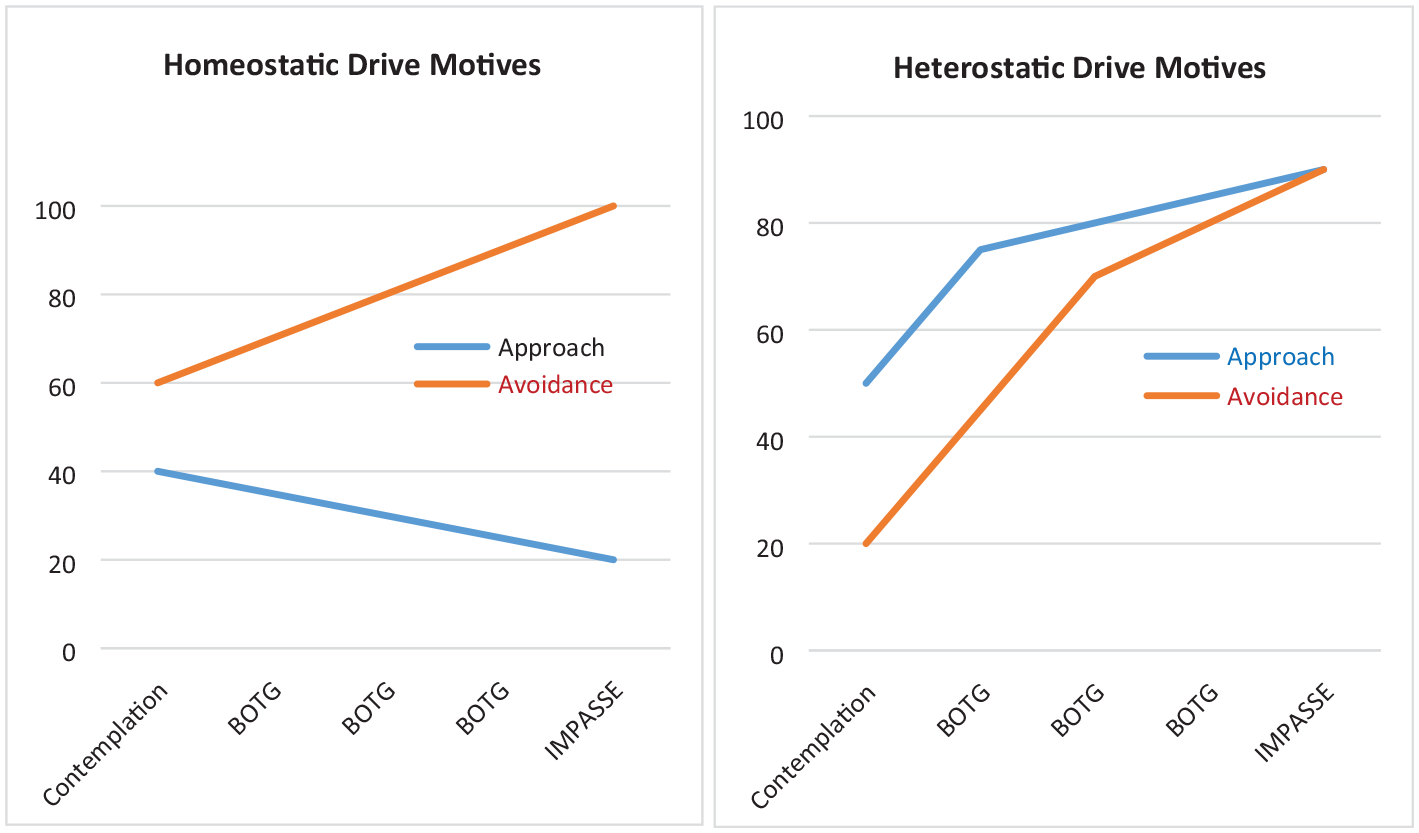
Homeostatic versus heterostatic approach-avoidance gradients for lofty goal objectives.
Long-term behavioral persistence and momentum (Nevin & Grace, 2000; Smith & Greer, 2023) is thought to require operant contingencies formed from complex schedules of reinforcement and punishment. Learning history appears decisive in the pursuit of unattainable goals. While the intermittence and unpredictability of reinforcement increases resistance to extinction, the acquisition of behavior without the delivery or promise of reward is hard to achieve. The sequencing of incentives over time appears to be of special importance to gamblers who may discount long-term risks and reward possibilities (Weatherly & Dixon, 2007). Chasers who pursue unattainable goals also appear to discount the costs and risks of their pursuits. For example, big early rewards in gambling may not inspire continuation as much as intuition might suggest (Weatherly et al., 2004). The rewards that sustain the pursuit of unattainable goals may occur at later inflection points on the commitment gradient. The development of behavior such as gambling, or perhaps the pursuit of an unattainable goal, likely involves idiosyncratic, even counterintuitive, rewards that are relied upon to manage daily mood regulation (Weatherly et al., 2010).
Heterostatic drives
The generalized influence of traits on behavior gets diluted in powerful situations where conditioned stimuli are especially potent and predictable. In weaker situations, traits are the best predictor of movement toward a goal object. It would be a wise bet to predict that almost everyone approaching a red light will stop on cue. Knowledge of a person’s trait structure would not likely add to predictive accuracy. Predicting the behavior of patrons at a Mardi Gras parade would be more challenging since the environmental rewards and punishments are so loosely drawn. In powerful situations, people act similarly to one another. In weak situations, there’s much variation given the range of personality traits that drive and direct behavior. Psychologists recognize the importance of trait (personality) by state (situation) interactions in understanding most complex forms of behavior. Both traits and situational contexts seem critical in understanding the acquisition and maintenance of long-term commitments.
Maslow (1943) differentiated homeostatic from heterostatic needs and traits in his motivational hierarchy. He speculated that only a subset of people were driven by actualizing tendency which often induced stress in the pursuit of maximized human potential. He referred to this motivational base as heterostasis. While chasers also thrive under pressure, less assuming people seek security and tension reduction (homeostasis) as the preferred choice of action. The artist Prince said it best when called in a torrential downpour to assess his commitment to a scheduled Super Bowl halftime performance. “Can you make it rain harder (Greene, 2020)?”
The thrill of the chase
Scaling the commitment gradient
The acquisition and maintenance of novel behavior such as audacious goal pursuits likely involves the interaction of trait predispositions and environmental contingencies. Some of these factors may be evident in the process described by A. R. King (2021) in the Fenn treasure hunt as scaling the commitment gradient. The Fenn treasure hunt community can serve as an exemplar of unattainable goal pursuit. LCT will now be applied in the analysis of this unique treasure hunting subculture.
Chase contemplation
Assimilation into a chase community requires a progression of choices that align personal identify with the interests, values, and purposes of fellow travelers. While many people pursue reasonable career ambitions, the grandiose goals in LCT may wisely be left unspoken in the respective chase community. Van Gennep (1908/1992) described identity evolution as fluid and turbulent involving plateaus achieved through defining rites of passage. A. R. King (2021) adapted this liminality concept to describe the phases of commitment for searchers in the Fenn treasure hunt (Figure 2, left panel). Mountain climbing provides an apt analogy for scaling the LCT commitment gradient (right panel). Completion of the three LCT phases constitutes a single cycle (trail) of the liminal commitment gradient. Impasse resolutions, with or without displacements, initiate new lifetime cycles.
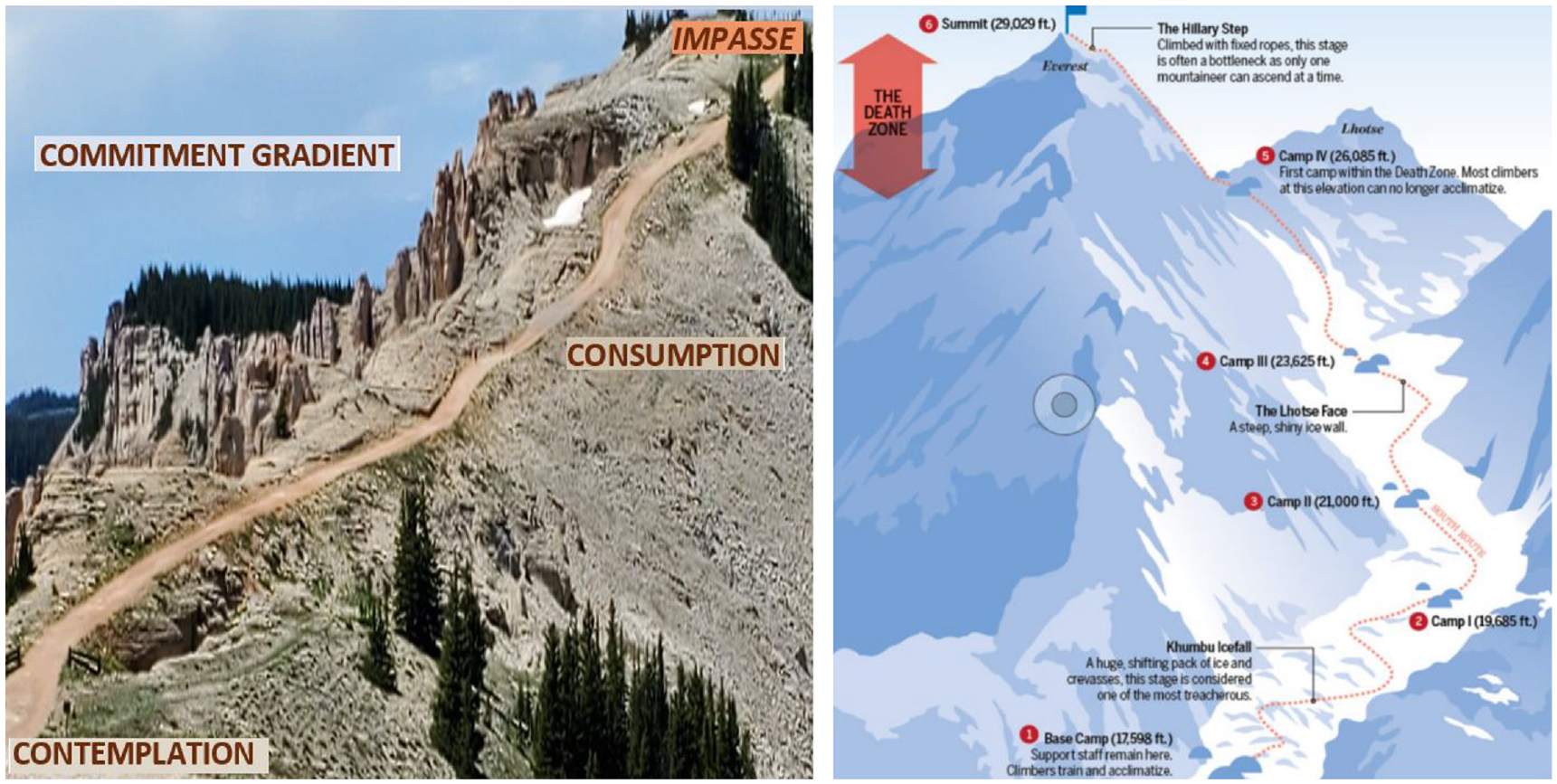
Liminal commitment gradient trails and plateaus.
Progress scaling the liminal commitment gradient is not linear. Cycles are separated by plateaus where major impasse in cycles have been transcended. Progress ascending the liminal commitment gradient is step-wise with achievements marked by increasingly sophisticated plateaus of confidence and competence. After celebration, a new trail greets the chaser with the promise that recommitment will take them even farther up the metaphorical mountain. Chase eldership is defined by the number of plateaus that have been surmounted. The ascent of Mount Everest provides an apt metaphor for the death zone risks of obsession that accompany some LCT commitments. Once encamped (plateaued), mountain climbers can dismiss the travailles of the past leg with a focus on impending concerns. Leveling liberates mental resources for the next ascent.
The Preliminal (Contemplation) Phase involves reorientation of attentional and perceptual processes toward fantasies of unattainable goal pursuit. The imagination of the chaser must be captured and teased. Pedestrian routines and static reward contingencies yield to preoccupation and consumption. Thought content begins to orbit the core riddles and dilemmas of a chase, and the gravitation pull of the unattainable goal becomes inescapable. Chasers often recall the youthful excitement of their earliest contemplation of the challenge. The possibilities seemed endless. By definition, others likely dismissed the objective as folly, and fears of ridicule often smother enthusiasm for budding aspirants. Other chastened chasers learn to flirt silently with their fantasy. A sober analysis of the pros and cons often follows, and one early rite of passage might involve seeking the counsel of a community member. Such overtures will be fraught with ego risks. Conditioned stimuli will be associated with either affirmation or rebuke eventualities. The steeper avoidance gradient at the outset can snuff out commitment before it has much of a chance to takes hold.
Chase consumption
The starting gun for the active Liminal (Consumption) Phase will be signified by psychological embrace of the unattainable goal. The risk/reward ratio has been assessed as favorable, and the searcher begins to exhibit behavior testifying to the commitment. Any demonstrable act designed to test or advance the chase in LCT is referred to as a boots on the ground (BOTG) experience. These activities require the chaser to publically commit to the challenge which is viewed by self or others as audacious. The term represents demonstrable motion in pursuit of the goal. Militaristic terms such as BOTG and reconnaissance (surveilling a location before entering the wild) were relied upon by Fenn searches since physical daring was often required in that chase. The term “arena experience” (AE) might have greater appeal for applications of LCT that are less physically demanding in nature. BOTG/AE encounters provide a barometer of behavioral momentum in long-term goal pursuits. Major BOTG challenges are referred to as rites of passage. The surmounting of these challenges will heighten the approach drive and eventually level the chaser at an achievement plateau. A rite of passage that ends in failure is referred to as an impasse. Such events can produce crushing emotional letdowns referred to in the Fenn chase as a walks of shame. Major impasses can seem insurmountable and threaten the viability of the entire quest. BOTG success and impasse resolutions enhance the potency of approach cues encountered in future ascents.
Table 1 provides examples of qualitatively different goal objectives in LCT. People in all walks of life pursue long-term goals despite personal or public estimations of nil attainability. Many involve fantastic career aspirations with others having idiosyncratic appeal. Prize competitions may be easiest to understand given their discernible odds of success. Winning the lottery would not usually qualify as a LCT objective (too effortless, random, and proximal), but auditioning for the reality show Survivor might constitute both an unattainable goal and early BOTG. LCT goals represent mountains that may never be summited, but chasers are somehow still committed to make the climb. The pursuit may be bold and public or quiet and private. Whatever its manifestations, each challenge will be equally consequential to the chaser.
Qualitative differences in the nature of unattainable goals.
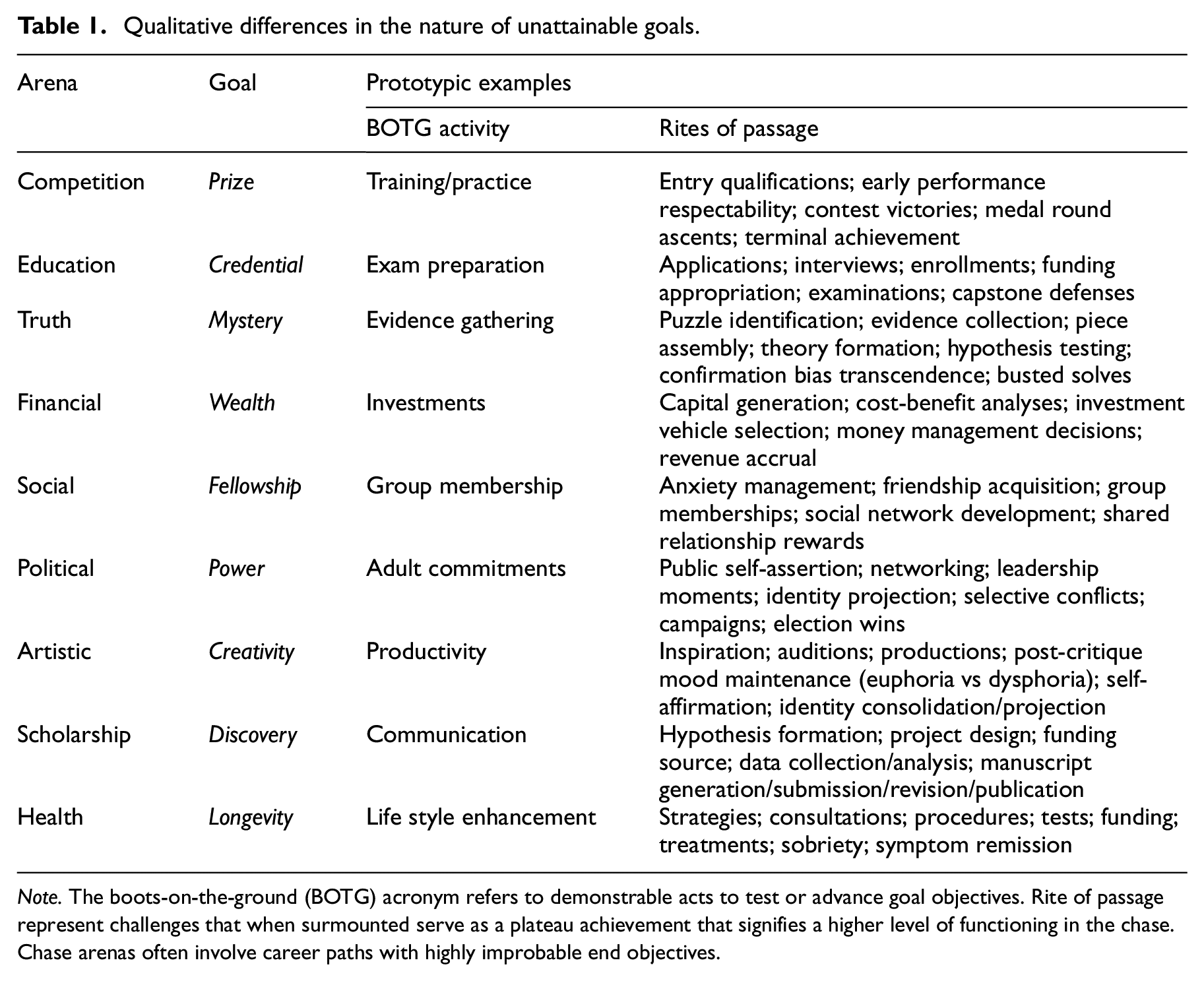
Note. The boots-on-the-ground (BOTG) acronym refers to demonstrable acts to test or advance goal objectives. Rite of passage represent challenges that when surmounted serve as a plateau achievement that signifies a higher level of functioning in the chase. Chase arenas often involve career paths with highly improbable end objectives.
Rites of passage (BOTG tests) might include running for office, a sport team try out, enrollment in college, a journal article submission, a theater audition, a bass guitarist rock concert gig, a dating overture, the launch of a podcast, or other necessary challenges. A creative poem solution and initial wilderness search (rite of passage) established legitimacy and viability in Fenn’s chase. When transcended, rites of passage catapult the player into more prominent arena exposure. They provide traction and resistance to extinction despite later inevitable disappointments. They constitute the fabric of the commitment gradient. The process of identity expansion through graded rites of passage requires tolerance for the disorientation, instability, and ego risk that the liminal phase poses. The uncertain psychological processes of identity transitions, boundary crossings, and subcultural group identification have been discussed in other social science contexts (Bettis & Mills, 2006; Haydon, 2019; Mulenga, 2019).
Recommitments become progressively easier over cycles. Chase commitments are most vulnerable during the early contemplation and consumption phases when the full range of impediments are encountered. Evidence of commitment will vary by chaser and goal. Chases usually involve some sort of training regimen that prepares the aspirant for upcoming BOTG encounters. It could involve a course of study, skill development, physical training, resource allocation, or myriad other preparatory steps that vary in sophistication. Chase enthusiasm may seem unbridled in the early cycles. Early consumption may be associated with a mix of emotions (exhilaration, sheepishness, pride, confusion, anxiety, trepidation), and the childlike vitality of the intrepid chaser may be contagious to others. Talk is likely fresh, urgent, and welcome. Indiana Jones and his helpers are packed and ready to join the adventure of a lifetime. The thrill of the chase is at maximum intensity.
A subset of chasers are woefully unprepared to take up the gauntlet of their quest. Of concern are searchers who exhibit information processing deficits that from the outset detract from meaningful progress. Forrest Fenn estimated that 7% of his community was not of sound mind. “I mean, I get emails that are incoherent, or they talk about things that are far out. Jiminy Christmas, I just don’t know (Listen Notes, 2017).” The 7% moniker was christened in his chase to identify unstable searchers who were destined for confusion, frustration, and failure. Conspiracy theorists fall conceptually into this same category. Displaced rewards may be harder to secure among this vulnerable subset beset by anger and confusion.
A. R. King (2021) identified a different concern regarding Fenn chasers who were “exuberant” when estimating their prospects for rapid success. A sizable percentage of his sample (21.9%) estimated their odds of success at 90% or greater. A more sober third of his sample believed there was less than a 1% chance of their success. Concern was raised that all but perhaps one of these exuberant chasers were destined for bitter disappointment. Public assertions of being the “lead searcher” occurred frequently and were referred to as “crowing” in that chase community. Other folks bragged about the genius of instant solutions that fell embarrassingly outside of the search zone parameters. Risk probability assessment accuracy has always varied wildly in the general public and are influenced by a host of emotional and information processing influences (Kahneman et al., 1982). Exuberance in Fenn’s chase was associated with trait impulsivity. Extreme attributes such as unusual beliefs, impulsivity, and exuberance may constitute independent risks for those in pursuit of unattainable goals. LCT asserts that chases should optimally be savored. Confusion and frustration are antithetical to that higher purpose.
LCT recognizes that unrealistic commitments often end in calamity. The harm of a chase usually comes from loss of control in the pursuit. Adverse consequences have been enumerated as risk indicators of behavioral addiction (American Psychiatric Association, 2022). Subsets of the Fenn chase community identified symptoms that have been associated with the loss of behavioral control seen in behavioral addictions (A. R. King, 2021): Preoccupation (can’t get chase off mind), 42.7%; Risk Exposure (acceptance of personal, physical and financial risks and threats not previously experienced), 27.2%; Sacrificing Activities (that were meaningful prior to the chase), 19.4%; Loss of Control (inability to limit or discontinue thoughts about the chase and BOTGs), 17.5%; Continued Investment (of time and effort despite relationship, financial, medical, or social strains made worse by the chase), 15.5%; Tolerance (need to spend more and more time to feel satisfied in chase research and/or social sessions that get longer and longer), 15.0%; Withdrawal (sadness/anxiety/irritability when chase is taken away, like in the off-season), 15.5%, Self-Medication (use of the chase to relieve negative mood or feelings), 13.6%; and Deceitfulness (lying to loved ones, employers, or others about the amount of time, expense, and/or risk associated with the chase), 7.8%. Roughly 10% of this chase sample identified enough symptoms (>4) to warrant concern about possible behavioral addiction.
Chase impasses
The Aliminal (Impasse) Phase of LCT is distinguished by BOTG failures that constitute inflection points in the chase. One sage Fenn searcher remarked that treasure hunting was thrilling, especially for youth, until the chest was not found. Impasses are major events that freeze behavioral momentum. They usually occur in the aftermath of a failed BOTG and require resolution to proceed. Imagine a chaser of a world chess championship title who feels maximally prepared for a tournament that ends with only one victory. Something went horribly wrong, and that impasse needs to be resolved before recommitment can occur. The originating fantasy then seems cringeworthy. Walks of shame constitute the loneliest moments in any chase. They build character and optimally redirect chasers toward more promising mountain trails. The initial charm of the chase among friends and others has dissipated, and the horizon seems far off in the distance. A crushing impasse can rattle the viability of the whole pursuit. The progression from novice to chase elder requires the transcendence of many of challenges. Each impasse feels like a return to the bottom of the mountain. The normalization of failure is essential for behavioral momentum to be maintained. Elder chasers become gradually immunized to the demoralization of failed BOTGs. They have come to rely on internal drive mechanisms and an approach gradient that is steeper than natural avoidance tendencies. The humility of imperfection can be liberating. Another elder Fenn chaser laughed off his many failed BOTGs with the claim that he knew better than most where the chest was not hidden. False pride steepens avoidance gradients. It can be empowering to allow oneself to fail along with other mortals.
Impasses are resolved through LCT defense mechanisms that include discontinuation, doubling down, displacement, reformulation, and/or transcendence. Disillusioned chasers often cry foul. The targets of their animus allegedly lied, misled, or cheated them out of opportunities to succeed. Some resignations will be framed as merely a hiatus, and other searchers will retire quietly while minimizing their footprints in the sand. Discontinuation is by far the most likely outcome for chasers encountering an impasse. Searchers can cut their losses and escape the trap of humbled ambitions. A credible excuse for resignation is easier to find early in a chase.
Stubborn chasers often double down on the merits of their strategies and tactics. Some searchers simply refuse to concede to the indignity of an impasse. They convince themselves that failure was actually victory in disguise, and they recommit to the same ideas that led them down the rabbit hole. Fenn chasers often returned repeatedly to the same general location given fears that an oversight had occurred during a prior BOTG. The discrediting of a chase solution can constitute a curiously deep ego insult. While reaffirmation delays the walk of shame, the chaser is usually just biding time until anger and frustration force them to punish their community through discontinuation. While doubling down on a solution is risky, the coping response is not always maladaptive. For example, the man who found the Fenn chest returned to his target area 25 times over the 2 years of his chase (Barbarisi, 2020).
Chase eldership
The Postliminal (Eldership) Phase is defined by the number of impasses transcended over time. The successful pursuit of an unattainable goal appears to occur in a step-wise, rather than linear, process. The cycle separation points constitute plateaus of achievement where leveling has occurred. Eldership status arises from self-sustaining pursuit.
Impasses are often dissipated through a displacement process that secures rewards beyond the value of the unattainable goal. The initial objective becomes less important when other tangible benefits flow from the pursuit. These displaced rewards can prove even more consequential that the original quarry. The high school quarterback becomes a sports coach. The physician aspirant becomes a successful biochemical engineer. The cold case detective becomes a paperback novelist. The presidential aspirant becomes a political science professor. The unrecognized painter opens a popular gallery for other emerging artists. The doctoral dropout becomes a journalist who writes about developments in his previous area of specialization. The high school loner becomes a social influencer who chronicles the lives of alienated subscribers. The impoverished kid who dreams of fortune builds a non-profit charity to help poor families. The aspiring bass guitarist’s helps his son make it to musical stardom. The addict becomes a counselor. The dying patient chronicles his end of life in a bestseller that inspires millions.
The collateral achievements of a chaser may be as substantive as the primary goal that animated them. An optimal coping strategy in response to an impasse is reformulation. Those rare chasers who actually attain the unattainable do so by transcending impasses over time. They apply alternative strategies when a thwarted pathway is busted. They avoid overreliance on a single tactic in their pursuit. Successful chasers are exceedingly patient and spend inordinate time just thinking. Solutions often come in “aha” moments that emerge in dreams, on the treadmill, or playing with their child. Ross (2023) emphasized the generative power of serendipitous accidents in creative expression. Wise creators understand that unintended, surprising, and disruptive “missteps” can trigger some of the most productive moments of pause and reflection. Successful chasers are receptive to ideas and poised to recognize potential breakthroughs when they present themselves. Success occurs in leaps of insight rather than linear motion. A focus on immediate experience enhances life satisfaction (Sobol-Kwapinska, 2009) and minimizes distractions posed by future challenges in critical situations. Apollo 13 mission director Gene Kranz popularized the wisdom of maintaining focus when confronting an impasse. “Let’s work the problem, people. Let’s not make things worse by guessing (Bateman, 2014).”
The most sustainable reformulation cycles emerge when the chase provides deeper meaning and purpose in life. Allport’s propriate striving is evident when the primary goal becomes less important than the internalized rewards associated with its pursuit. External rewards help magnify enthusiasm, but behavioral momentum will be best preserved by an abiding fascination with the subject matter. The transcendent rewards of a chase are internalized and insulated from environmental demand characteristics. Forrest Fenn sought adventure, exploration, nature, fellowship, intellectual challenge, and living fully in the moment.
Chase epilogue
The Codaliminal (Epilogue) Phase of a chase would be summoned by the actual attainment of the unattainable goal. The personal achievement of an unattainable goal would likely constitute a peak experience in life (Maslow, 1954/1987). For others, finishing tied for second place may be hard to accept. That eventuality includes chasers who find themselves aged out of viability for selected challenges (e.g. mountain climbing, the Olympics, modeling fame, other aspirations with real demand requirements). Confusion and bitterness is common for all but the most transcendent chasers. The epilogue mandates unsettling identity realignment, and only memories remain for crestfallen searchers lost in reveries of what should have been. Their counterfactual reconstructions (Mandel, 2003) provide a natural salve for the final and longest walk of shame. The emotional acceptance of failure seems to come easier when failures are most decisive (Medvec et al., 1995). Fenn chasers with solves in the wrong state may have had quicker resolution than counterparts searching unsuccessfully in Yellowstone. Some chasers will remember their adventure with pride rather than lament. The displaced rewards will justify the sacrifices of their failed pursuit. For those transcendent searchers the thrill of the chase will be an extended moment in time when they actualized their potential.
Fenn community insights
The Fenn community provided insights into the attitudes and behavior of elder chasers. Most survey respondents were in the chase over 4 years with an average of 4 hr a week of active involvement. Half the sample completed five or more wilderness ground searches, and a quarter of the sample logged over 10 BOTGs. Half the sample completed solitary wilderness searches. Most spent over $1,000 searching for their Holy Grail, and they seemed to have a whale of a time doing so (80% said positive impact on their lives). The majority were older and financially stable. Resource availability may often elevate the approach gradient for lofty goal pursuits. The prevalence of adverse childhood experiences was no higher than that observed in the general population.
Maslow (1954/1987) observed that conformity pressures often undermined high aspirations. Over a quarter of the Fenn chasers described negative feedback from family and friends. Half of a non-searcher national sample in the A. R. King (2021) analysis believed the treasure chest was never even hidden by Fenn. Around 15% claimed it was a “huge con to make money from gullible people.” Conversely, over 85% of the chase community sample estimated a probability of over 90% that the chest was hidden as promised. An essential element of a consuming commitment is fundamental trust in the legitimacy and attainability of the objective. Cynicism as a personality trait that drenches the fire of possibility. The launch of consuming ambitions may well require early childlike trust in the potentialities. Strong-willed and independent personalities in the Fenn chase suspended their disbelief long enough to learn about the man and his challenge. A basic element of trust and curiosity seemed to dampen their initial suspicions. As it turned out, the chest was real and available for the taking from the very start.
Hypomanic Personality Scale (HPS-20) scores provided the best predictor of long-term commitment (average standard score from years of involvement, hours/week, and BOTG count) in the Fenn treasure hunt. Those attributes seemed to heighten chase commitment, appeal, satisfaction, knowledge, and behavioral addiction risk. Searchers identified with higher HPS-20 scores seemed to really enjoy their long-term involvement in the chase. LCT speculates that hypomanic attributes enhance the stamina, optimism, and joyfulness needed to sustain chasers through serial impasses. A related premise is that there is an unclearly specified hypomania threshold where the attributes become counterproductive or destructive.
Trait scores from the Personality Inventory for the DSM-5 (PID-5; Krueger et al., 2012) were examined as well in the Fenn analysis. Grandiosity was unrelated to chase commitment. This trait has been linked to passive and unproductive behavioral styles. Laziness is not a strong attribute of high achievers, and hostility appeared to detract from longevity as well. Angry chasers were inclined to discontinue in response to frustrations. The traits of risk taking and impulsivity appeared problematic as well. The average male searcher scored 0.88 standard deviations above the population mean in their risk taking penchants. This was the only PID-5 trait elevated in the chase sample. It was associated with significantly more encounters with bears, snakes, cougars, wolfs, buffalo, and/or potentially life-threatening water or height threats. Impulsive searchers were also more likely to encounter BOTG risks. They also showed heightened exuberance and behavioral addiction risks. Impulsivity may well be a disadvantage for goal pursuits that require judgment and restraint. Attention seeking in this sample seemed unrelated to chase outcomes. Nearly 7% scored high on unusual beliefs, and this subset was also more likely to report risky encounters during ground searches. Eccentric individuals can be more open to experience and experimentation than others, but illogical thinking can lead to confusion that detract from commitment and performance in the long run.
Premises and possibilities
LCT posits a number of broad connections between psychological needs, traits, learning contingencies, and audacious goal pursuits. This article provided an overview of how trait and situational interactions might influence the acquisition and maintenance of novel behavior over time. Future exploration of these possibilities could come from both theoretical and empirical analyses of the following nexuses.
(1) Only a small subset of people in society pursue unattainable goals. Few will achieve their dream, but many will find displaced rewards that justify their long-term commitments. The stress of a chase will place vulnerable searchers at risk of physical or psychological harm.
(2) The optimal motives for long-term goal pursuits will be internal (propriate striving) rather than external (prize magnitude). The chase should optimally have higher value than the quarry. Tension induction (heterostasis) rather than reduction (homeostasis) is a better motivational base for the pursuit of ambitious goals. Fenn chasers were inspired, rather than discouraged, by claims the chest may stay hidden 1,000 years. Hypomanic personality attributes may magnify the appeal and commitment to lofty challenges. While these attributes may inspire ambitious goal pursuits, a chase could constitute a stressor that potentially triggers a bipolar episode. The risk of behavioral addiction may also be higher in this cohort.
A. R. King (2021) relied on the HPS-20 as a subclinical hypomania indicator, but other psychometric indices warrant testing as well. The MMPI-3 (Ben-Porath & Tellegen, 2020), PAI (Morey, 1991), and MCMI-IV (Millon et al., 2015) all provide bipolar risk indicators. The new MCMI-IV Turbulent scale appears most consistent with LCT predictions. The personality pattern associated with this scale was described by the test developers as follows (Millon et al., 2015): “. . . typically energetic and buoyant in manner and prone to vigorous pursuits of happiness. The high energy and generally positive attitude can show considerable characterlogical strengths. Patients with less integrated variations may be prone to scatteredness, overstimulation, over-animation, and an inability to maintain balance within their environment, which can adversely affect their relationship with others (p. 4).”
(3) The benefits of trait attributes will likely vary by chase arena (Table 1). Delay of gratification, bipolar attributes, risk taking penchants, and other traits may strengthen resolve in competitive pursuits. Risk-taking is an essential component of audacious goal pursuits, and the developmental roots of this trait alone have proved challenging to disentangle (Wang et al., 2009). Other traits may be essential for different goal objectives. Intelligence would be of special value in the education, scholarship, financial, and truth arenas. Extraversion and sociability may advance social, and political pursuits. Artistic objectives may benefit from introversion, withdrawal, and openness to experience. LCT proposes that there are optimal trait-arena matches that could be revealed through systematic investigation.
(4) PID-5 traits such as hostility, impulsivity, distractibility, grandiosity, anhedonia, anxiousness, depressivity, callousness, deceitfulness, unusual beliefs, eccentricity, perceptual dysregulation, rigid perfectionism, suspiciousness, and withdrawal may be counterproductive to ambitious distal goal pursuits. Sociopathy itself is distinguished by hedonism, sensation seeking, and nonconformity which might fuel impulsive fantasies in competitive arenas. Egocentricity seems inconsistent with long-term commitments that have to be sustained through recurrent frustration. There may be value in anger and hostility when the quarry is some sort of vindication for perceived disrespect. Darker emotions may help a person prevail through selected impasses, but coarse attitudes will more typically detract from long-term success in most endeavors.
(5) Scaling the commitment gradient requires a disproportionate balance of approach over avoidance drive stimuli before, during, and after BOTGs. The avoidance gradient will always be formidable, and chasers must prevail in early commitment cycles to remain viable. Early support may come from mentors, loved ones, role models, media, and other sources. Situational factors such as security, privacy, resource availability, freedom of movement, absence of competing psychosocial demands, and other forms of support may prove critical in the early stages. Chase rewards are likely to be distributed unevenly on compound intermittent schedules that disguise their predictability. The duration, tactics, and rigors of LCT assents will be uncertain with a paucity of early rewards and breakthroughs. Reactions to initial impasses and walks of shame may best reveal chaser preparedness for the long haul. Elder chasers learn to resolve crises gracefully over time. Variables that warrant attention include the timing, frequency, and intensity (mood catharsis) of early BOTGs and impasses. The chase histories of elder chasers may prove illuminating. Idiographic analyses might reveal optimized learning curve parameters with trait-state interactions that nurture persistence over time. The contingency that optimally maintains a quest is that rewards come in uncertain and mysterious ways.
Footnotes
Acknowledgements
No acknowledgments were identified for this project.
Author contribution
Alan King conceptualized and designed the project, reviewed and revised the narrative, and was accountable for all aspects of work ensuring the integrity and accuracy of the manuscript as submitted.
Declaration of conflicting interests
The author declared no potential conflicts of interest with respect to the research, authorship, and/or publication of this article.
Funding
The author received no financial support for the research, authorship, and/or publication of this article.
Informed consent
This was a theoretical article with no participants that would require informed consent.
