







Abstract
The current Special Issue is dedicated to possibilities of maintaining and enhancing of new knowledge production function of universities, with a focus on the social sciences. It starts from the assumption that our contemporary university administration systems have become inflexible due to their bureaucratic overgrowth of regulations of university studies. From that follows the need to create new conditions to knowledge incubators—groups of researchers united with goals of innovation in a given field. The different contributions cover the relevance for knowledge incubation improved funding possibilities, new technologies (AI), and general intellectual atmosphere in universities. This atmosphere is generated through a set of local social norm systems about inclusion <> exclusion of participants in different places on university territories, the demand structures of assignments, plagiarism tests, and organization of examinations. All these super-curricular structures enhance the fixed knowledge transfer functions of higher education in contrast to new knowledge incubation. The latter is particularly important in the social sciences since new ways of understanding human beings within societies are needed. Contributions to this Section also outline the socio-political constraints upon knowledge incubation. Paradoxically it can be the application for and success in gaining research funding that can curtail innovation in ideas in the social sciences.
New knowledge should always be possible. And universities should be places where the possibility for new knowledge is cultivated. In this Special Section we collectively explore different practical aspects of university education to find out what promotes new knowledge, and what limits it from innovation. Paradoxically it is the excellence in mastery of the existing knowledge—the “textbook knowledge”—that ossifies the existing knowledge space and closes it to innovation. Yet it is precisely the function of innovation that universities need to promote among the young souls who are eager to advance their understandings.
Knowledge incubators
Similarly to the recent terminology of IT startups as incubators—the minimal concentration locations where minimal numbers of inventors of new technologies come together with the goal of creating maximum innovation in technologies. We can think of knowledge incubators in similar terms—scholars unified with intention of creating new breakthroughs in their fields. Yet these start-ups of knowledge innovation need to be located somewhere—which brings academic institutions into the picture. Technological innovations are flexible as to their location—the profit motive leads them to be at times autonomous, and at other times embedded in academic institutions. In contrast to IT startups the knowledge incubators in the social sciences are not united by profit motivation. Neither can be the academic institutions where they belong. The latter expect from scholars extra-scientific success—rapid financial success (getting grants) or publicity—rather than the slow and uncertain process of creating new ideas.
Still the two kinds of incubators have much in common. As the small start-up companies are characterized by minimum bureaucracy and maximum striving for creating an innovative product that could bring them high profits, so is there a place for similar creative micro-collectives of knowledge makers. But where is that place? Can our contemporary universities accommodate to such foci of innovation? The direction of development of knowledge indicators groups that need maximum free resources and universities’ increasing bureaucratic over-control of their limited resources seem to be on a collision course.
Guided innovation: Structure of guidance toward new knowledge
All education is guided—by the knowledge providers to future knowledge creators. It involves the delicate balance of acquisition of the already present basic knowledge and its loose “open ends”—where the knowledge is only tentative and where the new generations of knowledge creators are expected to work on its acquisition. This is done via multi-level set of constraints in the educational system combining the arena of where new knowledge is to be created (Zone of Free Movement) with where its search is considered unproductive (Zone of Inhibited Action) and Zone of Promoted Action (Von Fircks, 2024, this issue). But whose decision is it to consider some search for knowledge unproductive? How can an act of border control of one social norm (e.g. “only large samples render scientific data”) set up the Zone of Inhibited Action to psychology students who understand the need for qualitative study of deep individual cases?
The Zone of Inhibited Action is brought into the practices of psychology education in brutal ways, as Rack (2024, this issue) shows how the link of psychology knowhow taught in universities with students’ personal experiences is prohibited. Consequently psychology students are discouraged from linking what they learn in psychology classes with their own personal lives—while they are expected to be able to link these with the personal lives of others (e.g. psychotherapy clients) in their professional roles as psychologists. It is as if a case of a moral imperative “DO NOT KNOW YOURSELF!” is put into psychology teaching settings in order to become a professional role actor in psychology. That such imperatives fail in practice is inevitable (as Devereux, 1967 describes personal lives of anthropologists in the field) yet psychology curriculae in contemporary universities seem to start from this act of alienation.
Alienation leads to formalization of knowledge pursuits where the formal certification of the student (by degrees) becomes the primary goal. The result is instrumental use of the knowledge as it is required, rather than efforts to create new knowledge beyond any requirements. Increasingly universities subject student papers to “plagiarism tests”—but not to tests of innovations in the papers. Low or absent plagiarism does not guarantee readiness of innovation since a set of existing ideas can be re-combined in unique ways yet not leading to innovation.
The antecedents: The rift between conventional and progressive education in schools
The antecedent to the issue of knowledge incubators at university level can be traced back to that of schooling—more precisely to the contrast between Progressive Education and its conventional counterpart (Matusov, 2009, 2022). The paradoxical unity of teacher control and teachers’ encouragement of creative thinking is a puzzle that makes dialogical approaches to pedagogy inherently complicated—yet desirable for the sake of knowledge incubation.
Universities are receivers of educational activities of the schooling systems that the students have experienced before in their course of studies. The issue of ethics of rule following—rather than new knowledge creation—is the primary focus. Honor codes, plagiarism tests, and exclusion of cellular phones from exams attempt to limit the knowledge discourses to what the pupils have made their own—rather than test for the skills of acquisition of new ideas. As Mark Smith emphasizes … when students and novice scholars violate academic integrity norms, either intentionally or unintentionally, considering ethics or not, it seems specious to simply judge students for cheating their learning or just trying to skirt institutional authority for their own career gains. In violating norms of academic integrity, students and novice scholars may be acting upon “particularized” ethical considerations that differ from institutionally sanctioned moral universal values. At the very least, their actions must be considered in the situated context of summative assessments, credentialism, and the exigencies of grant deadlines and pressures for publishing faced by early career researchers (Smith, 2024, p. 661)
What in conventional pedagogics qualifies as violations of academic order take on an almost opposite function in the context of knowledge incubators. The usual violations of norms are irrelevant, as the creative demands of new knowledge make crossing some of the borders necessary. There can be no “cheating” of the phenomena for which new procedures of understanding are being sought—simply because the new norms in relation to which “cheating” is to be determined are not yet in place. In fact, the use of the existing normative imperatives may thus create obstacles for new knowledge generation, as the history of discovery of the elliptical form of planetary orbits in the beginning of the 17th century by Johannes Kepler demonstrate (Valsiner, 2023). Kepler had to struggle long time in this thinking with the religious imperative “orbits must be circular” until he realized the data indicate otherwise. The move from one geometric model (circle) to another (ellipse) seems simple to us now, but in the beginning of the 17th century it meant not only a change of an axiom but also a breach in the prevailing ethical norm. The form of ethics needed for invention is thus the ethics of expanding, rather than following, the existing rules. 1
Subjective contexts to creativity promotion: Beyond fear and inferiority feelings
Intellectual creativity is easily curbed by limits that penetrate the inner core of human self. Struppe-Schanda (2024) illustrates the intricate nature of fear—about the use of a kitchen in a university—that can create a barrier for intellectual interdependency of students and faculty. Analyses of implicit access barriers between social role carriers—undergraduate students, masters students, doctoral students, and faculty—are important indicators for the understanding of the affective context of the study environment in a university. 2 If there are different space zones for “faculty only” or “doctoral students only” the hierarchical formal structure of the university becomes emphasized by daily practice. In a prestigious university in Europe that has functioned over 800 years there are restrictions on walking on the lawn in between buildings (Figure 1). Such restrictions emphasize minimal social power differences among the students and the non-students—tourists who come in crowds to see the historical glory of the university. At the same time it fortifies the minimal social power differential between senior and junior member of the staff.
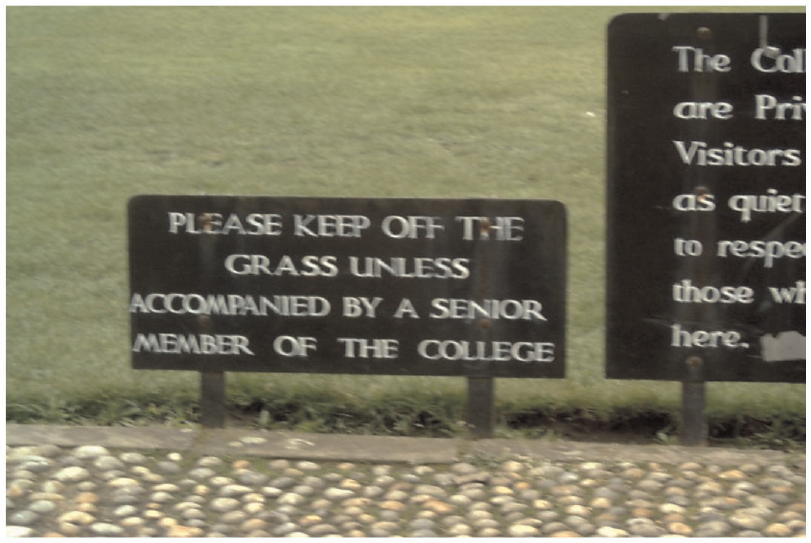
Non-rational dominance-focused restrictions on ordinary actions.
Such small—and sometimes exotic-action regulations within university territories are not simple oddities that institutions set up for no reason. These are parts of differentiation rituals of different social roles within the institution—granting the teachers some privileges of trivial kind fortifies the teacher > student local social power hierarchy. The social structure of a university can be studied as a structural whole (e.g. Daniels, 2010) where the intellectual atmosphere of the place is guided by non-curricular organizational rules. These may guarantee the maintenance of the primary teaching functions of transfer of existing knowledge to the students. Yet at the same time it inhibits the creative enthusiasm of the young and the intellectual eagerness of the no-longer-so young in new knowledge incubation.
What solutions that would support knowledge incubation in universities are possible? The general humanization of the knowledge co-construction where the participants from various levels of knowledge and university roles come together in problem-focused seminars is one of the possible solutions. Turning examinations into arenas guiding to new knowledge construction (Eckerdal, 2018) is another. Exercising one’s intellect facing previously unsolved problems would be a direct enhancement of knowledge incubation. Doing it in international teams (Tateo et al., 2022) is another way toward widening of the knowledge horizons. New knowledge has no country borders and benefits from the differences between societies.
Striving toward intelligence: But why the artificial one?
Alternative possibility that has emerged is the use of Artificial Intelligence. The technological development of AI has been proceeding over decades, but in the 2020s we see its commercial propagation to the focus of attention of wide audiences. The role of AI in knowledge creation is a nice challenge. Saccenti et al. (2024, this issue) demonstrate convincingly that the ChatGPT is a new and powerful tool to assist in peripheral tasks in human academic work, but not in actual knowledge incubation. They systematically test the production solutions of ChatGPT giving it specific academic tasks, demonstrating how the re-combination of different socially practiced phrases in new texts leave the superficial illusion of novelty of the whole message. Artificial Intelligence can re-combine presentations of knowledge but stops at the task of incubation of new knowledge. The reason for this limitation is simple—the computer power to access existing representations can lead to both expected and unexpected re-combinational outcomes, but cannot represent the moment of emergence of the new knowledge.
The active promotion of AI systems in society has made universities apprehensive. The possibility that the regularly required student essays become produced by AI seems a haunting attack on the role of students in combining ideas from different sources in their essays by their natural personal wisdom. This danger is imminent in knowledge re-combination tasks but absent in knowledge creation tasks. In the latter the AI remains as much of an auxiliary tool as various text correction programs have shown to be useful. As long as the AI programmers have not produced algorithms to generate analogues of human intuition in computers the AI remains an inferior solution to knowledge creation.
The source for all innovation: Funding and its curious ways of knowledge control
Last-but not least—the emergence of new knowledge depends on resources. Mayer (2024, this issue) raises the crucial issue of how universities handle the needs of funding in relation to knowledge incubation Toomela (2024, this issue) provides a passionate and incisive analysis of administrative practices concerning resource acquisition and allocation in universities of today. Instead of generating new knowledge young university professors are expected to gain their funding from external sources, entering into a vicious circle of economic survival in academia with lucky moments of accomplishing their research goals. From the perspective of knowledge incubators that creates a paradox—success in grant applications declared to be for new knowledge depends on circumnavigating the already existing knowledge. It puts fate control over innovation in the social sciences into the hands of institutions that provide funding, and the rules they use to evaluate grant applications.
How to analyze a university in its function of innovation: The Curiosity Index
Let us invent a critically relevant indicator of universities—the Curiosity Index. It is a hypothetical analytic tool to characterize the given university’s focus on opening the minds of students for further inquiry after the exams are done.
Consider a hypothetical university that gives a higher education degree to students after they have passed exams in 100 subject matters. Usually it is the grades that are paid attention to at the graduation. Such attention signifies the fixed achievement focus of the university—indicating that all courses are taken, all exams passed, and all diplomas issued. Yet we know nothing about the actual impact of the whole course of studies. The latter is possible to discover only after each of the curricular items is over, on the basis of triggered curiosities of the students expressed in the direction of further course selection and their independent research projects. Education becomes functional after it has been assessed (Valsiner, 2017) as it needs to lead to the possibilities of creating novelty on the basis of the known.
The proportion of courses (of the presumed 100) that give evidence of such triggers of curiosity is the indicator of the quality of the given university. If that proportion is 0% then we have an institution of higher learning that blocks any innovation. The graduates of such university may be highly knowledgeable of their fields—but unable to develop anything new in these fields beyond yet another re-organization of existing knowledge. Such a university is similar to religious cults where “the truth” is meticulously followed and no innovations are tolerated contrast, if the curiosity index of a university approached 100% (all courses trigger curiosity) we deal with an institution of higher learning that builds up possibilities for further novel creations. Here new knowledge can be created. The Curiosity Index can vary from 0 to 100, reflecting the general extent of openness of a given university to innovation. Instead of all various productivity indexes used currently to rank order universities around the World (e.g. The Shanghai Index 3 ), it is the Curiosity Index that would tell the whole story about the intellectual productivity of the higher education system. Even if accumulative—treating all courses equally—it focuses on the psychological conditions for creating possibilities for knowledge creation in the future.
Conclusion: Possibility without probability for knowledge incubation
In the case of knowledge incubators the ethics of education becomes ethics of discovery. It would be deeply unethical to use existing resources for reification of the existing knowledge—exemplified by the vague label of “research literature” and re-iterated by “literature reviews”—as authoritative. Instead, it is the effort to go beyond the existing state of knowledge that is the social imperative for knowledge incubators. The leading epistemologist of our contemporary Amerindian psychology Danilo Guimaraes has succinctly outlined the nature of innovative research: Knowledge construction is a ritualized practice in different cultural traditions. The ability to learn from cosmic and social experiences is a basic condition for the person to live and to contribute with other living beings, creating favorable environments for health and wellbeing. To a large extent, people learn from the observation of regularities and irregularities in the cosmic and social environment: first perceptions create the imagined expectancy of something to happen again. Ruptures on the expectancy is a signal that something exceeds the previous comprehension of the experience, demanding new reflection. Most of the times, this kind of regular process is not explicitly or verbally communicated, remaining at the personal level, related to what is called the common sense of the ordinary people. The social sharing of the personal knowledge assumes a conventional, community-based and, sometimes, institutional shapes. (Guimaraes, 2022, p. 901)
Ritualized practices of knowledge creation take different forms that can be analyzed as to their affordances for innovation. These are embedded within social institutions—universities, publicly funded research institutes, or private profit-oriented companies. The support for the key moment in knowledge creation—rupture in the previous ways of understanding—remains easily unsupported in institutions. The latter prefer order to the disorder—even if temporary—of the ruptures that lead to new insights. Bureaucratization of small local procedures in university management is the via regia to intellectual unproductivity of the universities—despite the sincere efforts of the participants in the practice of teaching.
If an university becomes a factory of producing certificates of existing knowledge and pasting them upon the graduating students then knowledge incubators cannot emerge within these institutions. In contrast—for technological innovations the current “AI boom” has re-connected the high technology incubators with universities. Yet the conventional university education is challenged by the fear of the new tool—attempting to outlaw it, or subordinate it to the existing knowledge re-combination structures. What is forgotten is the possibility for creating new knowledge, and replacing it with mastery of already existing one.
Footnotes
Declaration of conflicting interests
The author declared no potential conflicts of interest with respect to the research, authorship, and/or publication of this article.
Funding
The author received no financial support for the research, authorship, and/or publication of this article.
