







Abstract
In this article, I explore cultural conceptions and practices of digital literacy articulated in three distinct areas of social action in Singapore, a technology-dense nation. Using qualitative content analysis and interviews with 33 esports players, I compare governmental digital literacy initiatives, grassroots esports programming, and individual players’ narratives and DIY practices. I show that governmental initiatives emphasize functional and protectionist competencies such as technical know-how, computational thinking, and risk mitigation, while grassroots esports programs and individual player practices connect players to a broader range of digital-relevant competencies, including technical, informational, productive, creative, problem-solving, critical thinking, collaborative, and communicative knowledge and skills. The findings represent DIY participatory practices and cultures as crucial but underappreciated milieux in which young people develop competencies that are increasingly necessary for networked life in a digital society. I couch my analysis within a discussion of the entanglement of grassroot and DIY practices with dominant culture.
Introduction
Once treated as separate spheres of the political economy (Hinman, 1978), work and play have become increasingly intertwined, with digital technologies playing a major role. Since the early 2000s, scholars have documented new forms of digital labor, many of which are temporary and/or precarious, including digital gold farming (Dibbell, 2007), freelance news blogging (Ross, 2013), sponsored influencing (Abidin, 2016), gig work (Woodcock and Graham, 2020), and livestreaming (Johnson, 2024), among others. Research has also produced changing notions of leisure and play (Scholz, 2012) in relations to digital technologies and work. Kücklich's (2005) “playbor,” for example, fuses the notions of intrinsically motivated and voluntary fun with economically productive and exploitable labor. Another concept, Romero et al.'s (2015) “serious play,” emphasizes the calculated, deliberate application of play methods to improve the outcomes of labor. In the case of videogame play and content creation, Taylor (2015, 2018) has noted the significance not just of digital technologies but also of DIY participatory cultures in affording opportunities for individuals to convert their leisure passions into working careers. A common feature in such research is at least an implicit acknowledgement that particular sorts of digital competencies are more valued or deemed necessary than others.
This article examines the kinds of knowledge and skills valued in a digital society and compares how they are cultivated through government initiatives, grassroots institutions, and DIY practices. It does this through a focus on competitive videogaming or esports in Singapore, a technology-dense nation with a developing esports ecosystem. Focusing on esports highlights the importance of DIY practices and cultures in contemporary digital societies. Formal institutions such as schools are obvious sites for teaching twenty-first century competencies or “digital literacy” (Audrin and Audrin, 2022), and in Singapore and elsewhere, governments implement educational programs to develop people's digital literacy at the national level (Kusumastuti and Nuryani, 2020). But grassroots organizations, participatory cultures, and networked DIY practices also foster the development of a wide range of digitally relevant knowledge and skills (Jenkins, 2009). Whether scrolling through one's social media feed, managing emotions in the face on online trolling, or thinking about career prospects as a professional video gamer, having an awareness and ability to take account of contemporary digital technologies and their significant influence in society is of real and practical importance.
Given the massive influences that digital media and technologies have on everyday life, it's important to understand where and how relevant digital knowledge and skills are learned and practiced by young people. It is also important to recognize that certain digital knowledge and skills are not objectively better or worse than others but that they are made culturally meaningful by different groups of social actors. Using esports in Singapore as a case study, this article compares nationwide top-down government initiatives intended to upskill or reskill the general public with grassroots, DIY, leisure-based digital literacy development through esports participation. In the following sections, I first review the concept of digital literacy and link it to both the Singaporean and esports contexts. Then, after a brief note on methods, I compare the opportunities that government initiatives, grassroots esports organizations, and DIY play provide for the development of digital knowledge and skill development that are useful for life in a digital society. Finally, I conclude with a discussion that links the study to larger issues around culture, learning, and play. As governments implement programs to develop people's digital skills and competencies, it is important to understand the learning that occurs organically in leisure cultures. Empirically, the study sheds light on formal and informal mechanisms within Singapore society that facilitate digital literacy development, as well as the kinds of digital literacy that are important within each type of mechanism. The focus on esports not only enables some thick description of that learning, it offers a more nuanced look at cultural discourses that define digital literacy in prescriptive ways. Finally, the study shows the extent to which esports players are cognizant of what they are learning and thus serves as a response to traditional narratives that link videogaming primarily to social and/or psychological problems (Ferguson et al., 2011).
Digital literacy and esports
Literacy scholarship has developed significantly over the years. Scholars have moved away from a narrow emphasis on reading and writing text toward more holistic views that consider a range of practices influenced by culture, society, and technology (Hagood, 2014). “Literacy is about how we negotiate meaning (as opposed to ‘read and write’) as we aim to achieve particular communicative goals within the norms and values of our communities. A literate person must have an intimate understanding of the group's shared ways of thinking, believing, feeling, valuing, and acting” (Weninger, 2023: 198). With the explosion of digital technologies starting in the late-20th century, a variety of literacy-relevant terms emerged, including twenty-first century skills, e-skills, twenty-first century competencies, and digital competencies. These are now often encapsulated by the concept of digital literacy (Iordache et al., 2017; Tan et al., 2017) because of the ubiquitousness of digital media and technologies and their relevance across the fabric of everyday life.
In Singapore, it is practically impossible to engage in many aspects of everyday life without some degree of digital literacy. The use of technological devices is an essential part of day-to-day routines. Digital skills are necessary to complete school or work assignments, order and pay for goods and services, and access government and healthcare resources (Erh, 2023). Increasingly, there are industry demands for advanced abilities to work with evolving technologies such as artificial intelligence (Rahman et al., 2024). But as Weninger's (2023) definition above suggests, digital literacy is more than just the ability to use technology. It encapsulates a range of associated competencies. Collaborating with classmates or coworkers not only involves using online platforms but social and communication skills for teamwork. A young person who can traverse digital platforms and cultures fluently can more readily innovate and express creativity. Staying in touch with friends and family, participating in taste-based communities, and keeping up with current events and trends all require the ability to navigate digital interfaces and information-rich resources. Critical-thinking, social, and ethical knowledge and skills are also necessary in a world increasingly characterized by partisanship, toxicity, and questionable media content (Schrier, 2021). Digital literacy can help to improve inclusion and security, while a lack of those skills puts individuals at risk of being marginalized or excluded. Digital literacy today thus involves technical, informational, productive, creative, problem-solving, critical-thinking, collaborative, and communicative competencies that experts in education, technology, government, and business sectors (among others) agree are crucial to contemporary life (Lombana-Bermudez et al., 2020; Martin, 2006).
Importantly, digital literacy is not a universalist concept but is culturally and contextually bound. In Anglophone and European countries, middle-class parenting and teaching styles tend to encourage independence and exploration and to foster individuality, creativity, self-reliance, and critical thinking. Meanwhile, Asian countries traditionally emphasize teacher-directed instruction, memorization, and conformity of results, a style known in China as “teaching by hand-holding” (Greenspan, 2008). This has translated to rather narrow and conservative definitions of digital literacy in Singapore, where Chinese culture dominates. The government has historically used a definition of digital literacy that is more concerned with technical proficiency and risk mitigation than with sociocultural practice. When comparing Singapore's digital literacy policies to multiple international frameworks, Chew and Soon (2021) found that Singaporean policies focused on productive technical and information skills (how to search online; how to complete digital transactions) and risk awareness (how to protect your identity and assets; how to avoid falling for or spreading fake news) to the exclusion of broader social, creative, communicative, or critical capacities.
Games research offers a different view on digital literacy compared to Singapore's top-down, policy-driven version. As videogames and then multiplayer online games became mundane parts of everyday life in the 1990s and 2000s, studies found that they cultivate a wide array of competencies. Players practice critical thinking, collaboration, and collective decision-making as they analyze complex situations, negotiate strategies and tactics, navigate online sources to assemble and interpret information, and manage social relationships (Qian and Clark, 2016; Steinkuehler, 2010). Such learning and thinking skills, practical or “life” skills, and social skills are relevant not just to gameplay but to digital life in the twenty-first century more broadly (Dede, 2010). Learning Through play is a bottom-up and peer-driven process that contrasts traditional formal in-school learning. Many young people's most powerful learning experiences occur in informal “affinity spaces” in which participants are constantly motivated by a variety of social forces to acquire or refine knowledge and skills (Gee, 2004, 2018). Such affinity spaces are structured by DIY participatory cultures wherein young people develop and practice technical, collaborative, communicative, strategic-thinking, and problem-solving skills while engaging in leisure content that is personally meaningful (Zhong et al., 2022).
Esports is a fast-flourishing form of digital entertainment with strong participatory elements (Chou et al., 2023; Hamari and Sjöblom, 2017). Individuals and teams compete against each other across a range of videogame genres, titles, and platforms. The major features of esports are afforded through electronic hardware and software systems. Gameplay is frequently livestreamed and/or video-recorded for esports enthusiasts to watch on platforms such as YouTube and Twitch.tv (Johnson, 2024). The esports metagame is found across the internet and social media platforms. Esports participation thus requires breadth of digital knowledge and proficiency. The knowledge and skills gained through videogaming and esports align with formal digital literacy education more broadly (e.g., Steinkuehler, 2010; von Gillern, 2021). We therefore need to consider the kinds of twenty-first century competencies that can be learned through DIY esports participation.
Research context
Singapore is a small island city-state in Southeast Asia, located between Malaysia and Indonesia. Digitalization has been a central part of national policy since at least the 1980s (Erh, 2023), with ministries initiating or rescaling digital infrastructures and policies to create or maintain a digitally literate and skilled workforce that is able to adapt to and participate in that development. The disruptions associated with the COVID-19 outbreak in 2020 highlighted the need to further strengthen citizens’ preparedness for digital work (Amankwah-Amoah et al., 2021). Government taskforces were set up to accelerate citizens learning new skills and securing technology-related employment, as well as encouraging additional small companies, particularly those affected by the outbreak, to become digital. Government organizations, initiatives, and programs emphasize formal instruction and structured learning environments as optimal contexts for learning digital skills.
Despite this rather open and embracing view of digital technologies and their everyday significance, Singapore society and culture do not treat all digital technologies equally. Video games in particular have had a mixed history. On the one hand, there were a series of moral panics in the 1990s and 2000s linking videogaming to school truancy, computer addiction, and aggression (Khoo et al., 2005). On the other hand, scholars published research showing that games could provide new and unique opportunities for in-school learning and youths’ moral and character development (Khoo 2012). Nevertheless, esports has developed against a dominant cultural view that videogames are more likely to contribute to social problems than to benefit families and youths (Jiow et al., 2018; Williams and Chua, 2021). Grassroots efforts to normalize competitive gaming emerged in response, with older ex-professional and activist players creating grassroots organizations that have sought to support younger players. At the same time, many players simply rely on themselves, their friends, and the distributed knowledge present in digital culture to improve their esports-relevant expertise DIY-style. Through play, they pick up relevant digital skills and knowledge and thus improve their digital literacy. But what kinds of competencies do they develop and how do they compare to the kinds of digital literacy preferred by government?
Methods
To answer that question, I relied on two research methods. The first involved qualitative content analysis. Student assistants and I collected governmental data from websites, social media platforms, and public documents starting in 2021 to identify relevant government and DIY esports initiatives that focused on twenty-first century competencies. We started by searching the websites of Singapore governmental organizations to identify those that promoted digital skills development. We did something similar for initiatives publicized by local esports associations. During this phase, we purposively sampled information regarding digital skills, how they were taught, the reasons for learning them, and the populations they targeted. We downloaded publicly available descriptions of initiatives, programs, and courses that focused on upskilling or reskilling people's digital competencies. We made notes about what skills would purportedly be acquired or outcomes that would be achieved through participation.
Second, we interviewed 33 participants in the Singapore esports scene. We began recruiting from a local esports association and expanded outward to hear from a wide variety of esports participants. Participants ranged from enthusiastic leisure players to aspiring, current and retired professionals, grassroots leaders, and other people affiliated with esports. In addition to playing esports games, many interviewees talked about livestreaming or shoutcasting (i.e., commentating on livestreamed matches) and being active on gaming media platforms like Discord or in gaming subreddits. Interviewees were predominately male (7 females, 26 males) and were mostly in their early-20s to early-40s. Interviews lasted 45–150 min. For the publicly available institutional data, I have named ministries/organizations but only discuss program and course data in aggregate form. For the interview data, I have pseudonymized participants’ names by using a random letter plus number (e.g., A3, 2Q) to maintain the confidentiality of their identities and of the knowledge and opinions they shared.
The findings are descriptive and quasi-comparative. First, I look at the initiatives and programs developed by Singapore ministries responsible for digital up/reskilling. Second, I describe grassroots efforts to cultivate young people's technical, analytical, interpersonal, and ethical competencies through esports programming and professionalization. Third, I draw on interview data that show how esports participants developed technical, analytical, communicative, creative, and productive competencies through self-directed learning, disciplined practice, group play, and related activities such as streaming, commentary, and content creation.
Governmental digital literacy initiatives
The Singapore government placed a heavy emphasis on technical skills and competencies to help ensure people remain economically competitive in a rapidly changing, technology-driven economy. Digital literacy initiatives addressed structural challenges such as an aging workforce and the digitalization or automation of jobs in many sectors. Two governmental ministries were primarily responsible for such work: the Ministry of Education (MOE) and the Ministry of Digital Development and Information (MDDI), known before July 2024 as the Ministry of Communications and Information. A third institutional actor, the Infocomm Media Development Authority (IMDA), was a statutory board under MDDI. Each managed specific initiatives, plans, and/or policies.
Ministry of Education
As part of national digitalization efforts, MOE started designing digital literacy curricula from primary through tertiary education levels, leading in 2020 to the official launch of the National Digital Literacy Program. The program favored functional and protection or safety orientations vis-à-visdigital literacy. 1 Protectionism began in primary school with a focus on “cyber wellness”—that is, learning to use digital media safely and responsibly—alongside functional skills such as computational thinking and visual programming. In secondary school and junior college, computational thinking and computing courses were further enhanced, while higher education curricula continued to push baseline digital competencies (i.e., more computational thinking), added AI competencies for cyber-security, logistics, manufacturing, and finance, and continued strengthening cyber wellness and digital wellbeing. In 2024, MOE expanded digital literacy to cover nine competencies (see Figure 1). Notably, the focus remained primarily oriented toward protectionist (#1–2) and technical-functional (#3–9) competencies.
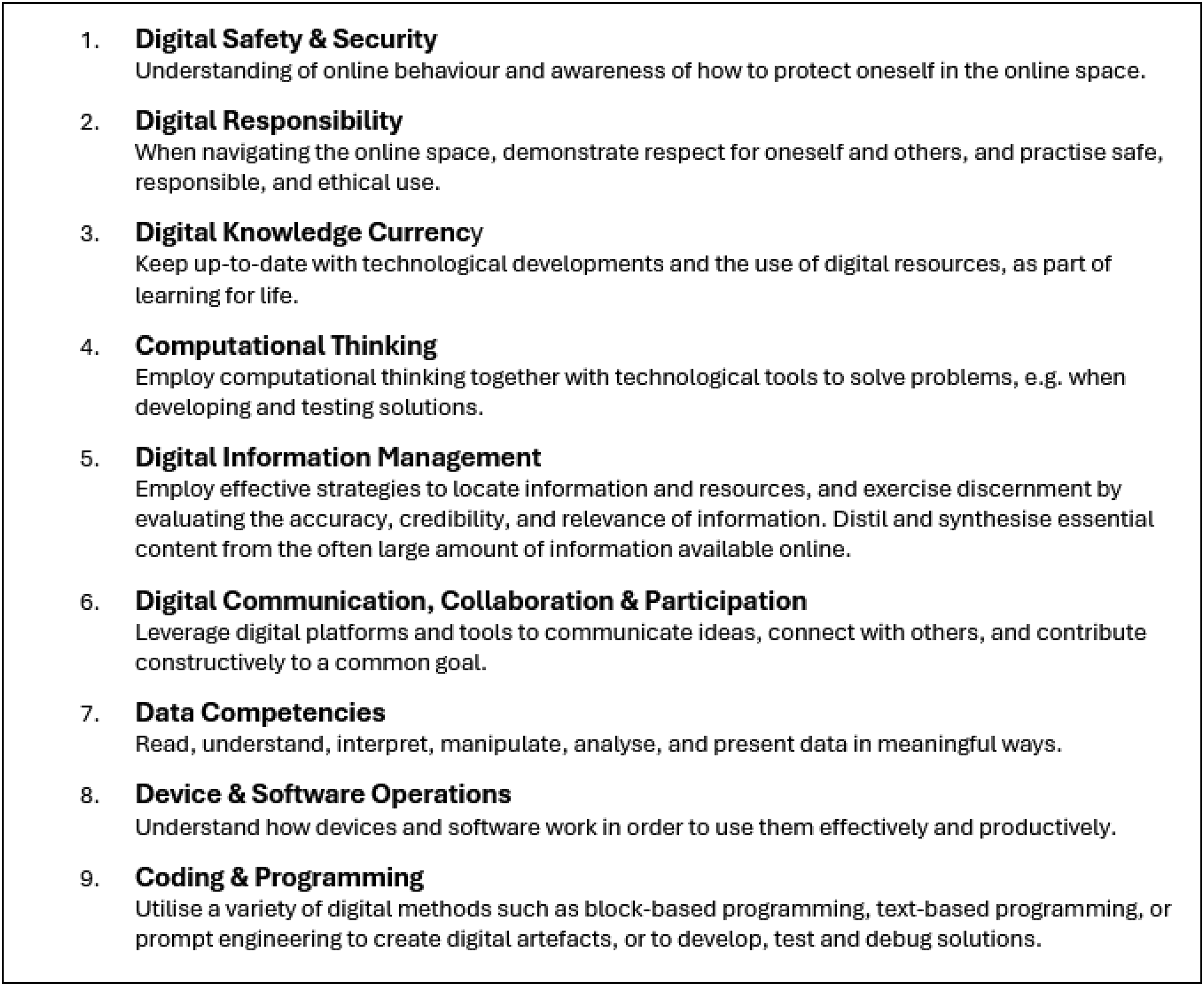
Ministry of Educations 9 digital competencies.
Ministry of Digital Development and Information
Singapore's MDDI oversaw initiatives and programs that “ensure that Singaporeans…are equipped with: digital access (internet connectivity and digital devices needed for participation in digital society); digital literacy and skills, and have the confidence, and motivation to use technology in their daily lives” (Ministry of Digital Development and Information, 2025). “Smart Nation” was a flagship initiative to promote digitalization, launched in 2014 as a transformative strategy to harness technology for economic competitiveness. Its main pillars were Digital Economy, Digital Government, and Digital Society (Smart Nation, 2022). The Digital Society pillar was responsible for the Digital Readiness Blueprint 2 that strategized digital literacy programming for all citizens. Smart Nation often organized tech-related talks and workshops for target groups such as children, working adults, young parents, and senior citizens. The MDDI introduced the Digital Media and Information Literacy Framework 3 in 2019 with a set of strategic and common goals for other organizations and program developers to strive for. Keeping with the government's dominant discourse, the framework focused on creating awareness of the practical benefits and risks that digital technologies might entail. This included, as examples, how digital media apps and platforms work and how to stay safe online by utilizing information wisely.
The IMDA's Singapore Digital Society Report 2023 listed five digital skills deemed essential for daily living (see Figure 2). Three of the five were functional skills. (a) and (b) were technical and focused on being able to use a computer or mobile device and being able to search for information online. Skills (c) and (d) were more transactional. Although (c) appeared more social at first blush, the report characterized this skill as the basic ability to communicate online without any consideration of larger sociocultural considerations such as the topic being discussed, or the identities or relationships of/among those involved. Skill (e) was a combination of protectionist skills predicated on risk mitigation (don’t get scammed; don’t be deceived by rumors or fake news) and collectivism (promote harmony; be a positive online influence).
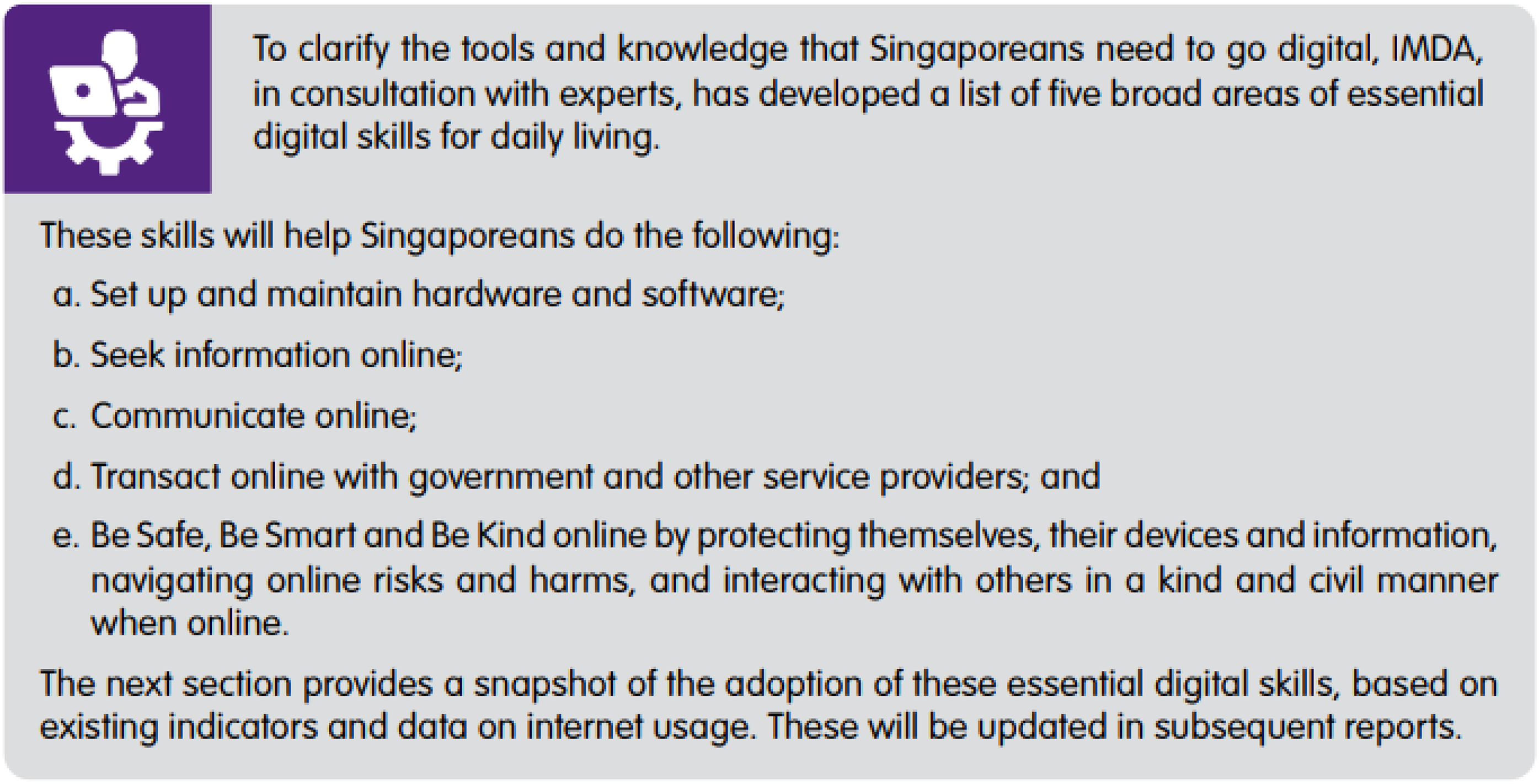
Essential digital skills for daily living.
Under MDDI, the IMDA initiated multiple programs aimed at digitalization, such as “Digital for Life,” which introduced technologies in citizens’ day-to-day lives (Infocomm Media Development Authority, 2022). It focused particularly on vulnerable populations such as senior citizens, low-income families, and persons with disabilities, providing opportunities to experiment with and learn how new technologies could influence the way one lived, learned, and worked. Other initiatives included SG Digital, which sought to accelerate the adoption of digital technologies among citizens and businesses, and TechSkills Accelerator, a workforce development program to (re)train professionals for jobs in technology sectors (ibid.).
SkillsFuture was a governmental initiative launched in 2015 to empower Singaporeans with “opportunities to develop their fullest potential throughout life, regardless of their starting points” (SkillsFuture, 2022). It offered a credit system that citizens aged 25+ could use on a range of training courses to improve a variety of knowledge and skills. SkillsFuture represented perhaps the broadest governmental attempt to provide all postschool-aged citizens with a broad and relevant set of digital upskilling and reskilling opportunities to make them future-ready. Reviewing twenty-two courses found using the keyword “digital” on the SkillsFuture website during 2021–22 revealed that the most common topics in course descriptions aligned with functional and protectionist notions of digital literacy, such as programming and coding, e-commerce and marketing, and data protection and cybersecurity. Nontechnical literacies were typically collapsed under the term “critical core skills” and included communication, collaboration, problem-solving, creative thinking, and self-management (SkillsFuture 2024). That basket of skills, however, was not well represented in the governmental data we collected.
The persistent emphasis on technical and functional skills highlights the extent to which digital literacy was intended to prepare citizens for a rapidly growing digital economy. National discourse has long framed the country's small size and population as constraints to the nation's survival and security. Because the country possesses very little in the way of natural resources, citizens are its most vital resource and they, alongside financial and technological infrastructures, must be constantly improved to enhance the country's economic stability and potential (Calder, 2016). The Singaporean government has made constant efforts to digitalize the nation under the assumption that building digital capacities will give the nation competitive advantages in the global economy (Hoe, 2025). With this, they can present the nation as a leader in digital innovation, leveraging technological advancements and its highly educated future-ready population to continue to attract foreign investment and thus to further socioeconomic development.
Thus, the government supports digital literacy for its transactional rather than its expressive capacity. Digital literacy serves as a form of human capital development predicated on a neoliberal logic in which state investments in the population will ensure economic growth. In short, top-down digitalization and digital literacy policies and programs represented neoliberal strategies that would benefit the state's position within global capitalism over and above individual's communicative, collaborative, critical, or creative capacities. Turning next to the case of esports, I explore how grassroots and player practices developed digital literacies within the context of the state's dominant economic imperatives.
Grassroots esports initiatives and digital literacy
Despite the mass penetration of networked and mobile computing in households and of competitive games into popular culture around the world, Singaporean esports players harbored concerns that governmental and institutional support was both too slow and too conservative to enable them to develop sufficient skills to be competitive internationally (Williams and Chua, 2021; Williams et al., 2025). Part response to cultural skepticism and part forward thinking, a handful of enthusiastic older players with a shared love of games and a DIY ethic began working to grow the esports ecosystem in the country in the mid-2000s. They were committed to supporting players’ gaming aspirations while also facilitating players’ future readiness for roles in the digital economy.
Founded in 2008, the Singapore Cybersports & Online Gaming Association (SCOGA) was a nonprofit organization focused on advancing esports via education, community, and opportunity. Their explicit goal was “to provide opportunities and equip people with essential skills and values, enabling them to pursue their aspirations and build rewarding careers” (Singapore Cybersports & Online Gaming Association, n.d.). Some of their work was oriented toward esports professionalization, for example, through performance training. In addition, SCOGA offered a variety of workshops and programs to support amateur and leisure players’ learning of technical, soft, and career development skills. Moreover, and in line with governmental interests in promoting digital upskilling across social groups and the life course, they implemented programs for vulnerable populations including at-risk youth and senior citizens, using gaming as an enjoyable pathway to learn about digital hardware and software while also engaging in communal and prosocial behaviors.
The Singapore Esports Association (SGEA) was founded in 2018 as a charitable organization and the national governing body for esports. It partnered with the National Youth Council (an autonomous agency under MCCY) to offer workshops, panels, and internships to teach young people about the esports ecosystem, including professional play, nonplayer career roles, event operations, and content creation. Its development programs functioned similarly to SCOGA's, but it had a top-down governance component that emphasized regulating youth participation in and through sanctioned esports events.
SCOGA's and SGEA's programs went beyond the functional and protectionist perspectives common in governmental initiatives to include broader digital competencies. Training classes encouraged the analysis of information-rich systems, the design of adaptive strategies, and the refinement of individual as well as team-based performances through constant peer feedback. Activities such as optimizing character- and deck-builds for single-player games and planning offensive and defensive measures for multiplayer games required players to interpret data, anticipate outcomes, and make tactical decisions. These exercises cultivated analytical reasoning and problem-solving abilities while reinforcing habits of discipline, focus, and time management. SCOGA's programming also invested heavily in what it called twenty-first century career skills. In team-based workshops, participants developed coordination and leadership through specific practices such as speaking clearly, listening actively, and recognizing how verbal and nonverbal signals could influence team dynamics. Structured activities and group discussions encouraged empathy, adaptability, and consensus-building, while structured reflection on integrity, sportsmanship, and resilience reinforced the moral dimensions of digital participation. The programming they offered implicitly conceived digital literacy beyond technical proficiency to include relational and ethical capacities.
Recognizing that most esports participants would never become paid professional players, SCOGA offered learning opportunities in media and operations, exposing participants to the infrastructures that sustain digital media. Trainees learned to plan events, manage resources, and operate livestreaming and broadcast systems. Such experiences extended digital literacy into the creative and logistical domains of media and work. There was a workshop offering practical training on self-presentation and personal branding on digital platforms, while an esports journalism course designed with media industry partners introduced participants to news writing, interviewing, and information ethics. Teenage participants learned to develop story angles, verify and validate sources, and practice responsible reporting—important skills to learn in the face of growing issues around bot journalism and fake news. Both SCOGA and SGEA had protectionist-oriented programming that addressed cyber wellness and safe gaming as well, including gaming etiquette, toxicity and cyberbullying, addiction and time management, and privacy management when gaming and streaming. They taught participants to identify and reflect on toxic behaviors and to engage in positive interactions instead, as well as how to manage time spent gaming against other (e.g., family and school) commitments. This fitted within a larger commitment to safe sporting to which all participants were taught to contribute.
These examples illustrate how grassroots esports initiatives functioned vis-à-vis national digital literacy campaigns by maintaining a balance between state logics of productivity and safety, and youth logics of play and aspiration. Framing esports in the language of skills, employability, and lifelong learning, organizations like SCOGA demonstrated themselves to be legitimate educational actors rather than just groups of gamers. They showed how videogame enthusiasts could produce a robust, interest-driven environment that fostered a variety of digital competencies necessary for confident participation in digital culture and society. Their curricula integrated strategic, communicative, creative, and ethical forms of learning alongside functional and safety-oriented forms. Rather than ignoring dominant economic imperatives, they rearticulated symbols such as future-readiness and productivity within the affectively engaging context of esports to make digital learning simultaneously attractive to young esports players and as demonstrably transferable to other aspects of life in a digital society.
Players’ DIY practices and digital literacy
Success in esports requires the deployment of a wide range of twenty-first century knowledge and skills, including communicative and collaborative skills (Nielsen et al., 2019; Tang, 2018), critical thinking (Hsu and Wang, 2010), and creative and productive competencies (Pellicone and Ahn, 2017). While grassroots institutions helped to facilitate players’ digital literacy development, most never took advantage of such programs and instead developed relevant knowledge and skills “along the way” (Coon et al., 2024, p. 358). As one interviewee put it: “I’ve been playing games for like 15 years. I take away so many things. I know how to lead, manage, all that kind of thing. […] To me, it's always a very good learning platform, no matter what game you play, you can learn something. And until this day, I’m still learning something new” [T4, interview]. That “something” could be segmented into technical, critical/analytical, communicative/collaborative, creative, and productive dimensions.
First, participants talked about their self-directed learning and in situ practice of technical skills in relation to game mechanics (e.g., mechanical execution, reaction speed, multitasking), digital app fluency (e.g., user interfaces and settings, streaming setups), and event production (e.g., organizing local or internet-based DIY tournaments, troubleshooting hardware and network issues, and operating audiovisual setups under time pressure). Players refined their in-game mechanical skills through repetitive practice routines. Players who were also streamers and content producers taught themselves to navigate platform software on Discord and Twitch and how to leverage social media tools for publicity and audience engagement.
A second aspect of digital literacy that players repeatedly described was critical and analytical. Interviewees stressed real-time analysis during gameplay, becoming adaptable under pressure, and learning from their mistakes. They learned to question what they saw happening on the screen, to recognize strategic patterns—a process one respondent likened to playing “multi-dimensional chess” [R8, interview]—to anticipate opponents’ moves, and to make rapid decisions when it counted. More than half of players talked about going online to keep up with game updates, dominant strategies, and shifts in the metagame. This required learning to locate and evaluate external information sources such as wikis, guides, YouTube and Twitch videos, Reddit posts, and live pro streams. A few players talked about learning to be skeptical toward some online content, which might be posted by content creators trying to monetize players’ thirst for knowledge: “you have to be a bit discerning…YouTube how-to-play guides usually just are meant for hype…” [J3, interview]. Those same players decided which content was credible by triangulating from multiple sources or through discussions with fellow players.
A third dimension involved communicative and collaborative competencies. A few players found part-time work as shoutcasters and described learning to neutralize their local accents or to enunciate differently for international viewers, to control their pacing and tone, and to mix play-by-play analysis with color commentary. These changes not only improved their communicative competencies but their connections to esports consumers as well. Among player groups, team-based gaming demanded precise communication, active listening, and some degree of mutual trust. As one interviewee remarked, esports was “a very good platform…to practice communication skills [and find] the courage to speak up in a team environment” [D0, interview]. Some players talked about searching for teammates they could get along with and otherwise having to manage interpersonal tensions, as well as to give or receive criticism constructively. One interviewee described importing a message–noise–receiver model, which he had learned in a marketing course, to critique his teammates in a way that wouldn’t trigger overdefensiveness or other negative reactions. Several players explicitly credited the esports community for transforming them from introverted individuals into confident community members. They talked about learning to be “forgiving” in the face of defeat instead of “blowing up” or acting toxically, which is a serious problem in digital environments more broadly (Nexø, 2024; Recuero, 2024).
Fourth, interviewees talked about developing creative digital competencies that had strategic and expressive aspects. Playing games was a creative practice for strategic self-improvement in itself: “game-based learning is…using a game to teach some skills” [6C, interview]. Creativity was visible in their experimentation and improvisational practices. During gameplay, strategic creativity manifested as “out of the box” problem-solving [D0, interview] such as testing unconventional team compositions and surprising opponents with unexpected tactics. In terms of expressive creativity, players who also shoutcasted or created social media content talked about learning to design engaging narratives, craft storylines, and develop attractive presentation styles to better connect with viewers. One interviewee compared his shoutcasting to being an author: “stories allow us to…be transported into another world…. It's the exact same experience…when we watch esports” [P9, interview]. Another player with shoutcasting experience mentioned learning to build up key moments in a match through emotional and humorous expressions to heighten viewer engagement.
Fifth and last, digital gameplay developed productive competencies that encompassed things such as discipline, self-management, persistence, and emotional resilience. Competitive players talked about rigid self-training schedules (“the grind”) and of balancing gaming with study, work, or family. Their success, they said, depended on building routines, managing their time, and being consistent in the long term rather than sporadically productive. Top players had a professional mindset—they set goals, committed themselves to being reliable, maintained focus over time, and cultivated resilience in the face of defeat and criticism. More than one player was clear about learning to take “hard work” and “self-improvement” seriously and reminisced about the benefits of scrimmaging with friends or classmates after school on a regular basis during their high school years. Such effort not only paid off when playing esports but in life more generally: “the takeaway is that you train your mind to think in a certain way that will actually help you beyond, whether it is in your work, in school….” [M5, interview].
Where government frameworks defined what digital skills citizens should have, and grassroots organizations structured how those skills might be taught, players demonstrated the DIY development of a host of twenty-first century competencies organically through everyday practices of play. Players clearly engaged in functionally oriented digital literacy practices yet typically framed them in terms of enjoyment rather than “up-skilling.” Being digitally literate was less about readiness for future labor markets and more about identifying with or demonstrating competence within the context of esports itself. Perhaps most importantly, players demonstrated their awareness of how gameplay afforded the learning and practice of a wide variety of digital knowledge and skills—far beyond what government initiatives promoted—and how they were relevant to their everyday lives.
Discussion and conclusion
Digital technologies are fundamentally changing the nature of work and leisure for many people in Singapore and, indeed, the world (Cho 2015; Johnson and Woodcock 2019). In this article, I have explored how Singaporeans develop knowledge and skills relevant to future careers in the nation's knowledge-based digital economy by looking at digital literacy learning through three layered contexts: macro government-led initiatives; meso grassroots organizations; and micro leisure-based practices. Public documents from government-led initiatives showed the extent to which the country's official digital literacy initiatives have heavily centered on preparing citizens for work in a rapidly digitalizing economy while mitigating the risks associated with individuals’ digital practices (Chew and Soon, 2021). The government has been both aware and proactive regarding the importance of having a digitally literate population. Yet, governmental planning represented a view of reality in which formal, top-down education-oriented policies and an emphasis on technical proficiency and safety were best. Those policies fit comfortably within Singapore's meritocratic culture, which promotes and supports formal education and measurable outcomes as indicators of both national progress and personal worth (Cheang and Choy, 2024). Singapore culture is dominated by economic pragmatism and therefore has tended to treat leisure practices as potential distractions from more productive endeavors (Ho et al., 1998). As a result, activities like videogaming are not typically viewed as legitimate pathways to improved digital preparedness for the future.
Top-down education initiatives have always partly been about teaching citizens dominant cultural ideologies and worldviews, while informal networks and participatory cultures often embody a DIY ethos that emphasizes learning in ways “that do not align with mainstream political agendas and their associated societal and cultural values” (Bennett and Guerra, 2023: 3). This assertion partially bears out in the case of esports in Singapore. Grassroots organizations and esports players both communicated clear alignment with dominant ideologies, yet were also aware of video games’ significance in contemporary youth culture and took advantage of the diverse set of twenty-first century competencies that could be learned through competitive play. Digital literacy was thus not only about knowing how to use digital technologies in technical terms but about understanding larger sets of relationships among digital technologies, cultural meanings, relationships, and behaviors.
At the macro level, digital literacy programming was a morally regulative project. While framed as inclusive and empowering, lifelong-learning initiatives shifted responsibility for responding to the realities of economic precarity onto individuals. Top-down digital literacy curricula encouraged citizens to know how to operate functionally within a digital system, but not necessarily how to interpret, critique, or transform that system for their own personal benefits. Research has suggested that esports participants treat play as either a goal in itself or as a means to personal satisfaction (Martončik, 2015). Nevertheless, games research has shown how much people learn through everyday videogaming practices and experiences, enjoying play while achieving more serious life goals (Zhong et al., 2025). Esports thus exemplifies the importance of a DIY ethos for digital literacy and learning by highlighting how participants can build skills through self-directed, interest-driven play and peer collaboration.
In contrast to neoliberal logics seeking to increase the productivity of workers and thus improve the functioning of capitalism (Tulloch and Randell-Moon, 2018), esports participants might be compared to “gamification from below” (Woodcock and Johnson, 2018); that is, enacting forms of play that subvert work or otherwise avoid participating in labor in the ways expected by those in power. While esports is not synonymous with gamification, DIY esports players reappropriate play to make life under capitalism more bearable, meaningful, or navigable. This is not about “resistance” per se but rather about how young Singaporeans, as keen users of digital technologies, negotiate their place within a system in which citizenship has become analogous to productivity (Thaiyalan and Choo, 2024). Esports not only provides DIY strategies for digital literacy, it problematizes traditional boundaries between work and play.
Comparing governmental, grassroots, and DIY practices revealed both similarities and differences in their interpretations of digital literacy. MOE curricula and MDDI initiatives emphasized the importance of functional literacy skills such as computational thinking, problem-solving, and data analytics, and of protectionist-oriented competencies such as cyber security and intercultural harmony. To a lesser degree, they addressed “core competencies” such as leadership and communication. This finding aligns with other recent research on national digitalization programs vis-à-vis digital literacy (Chew and Soon, 2021). Grassroots esports initiatives and individual participation in esports did not devalue such things. Rather, they addressed them head-on along with other important sociocultural issues such as interpretive competency, teamwork, responsibility, and innovation. These topics represent the complex sociotechnical realities of networked digital life, where critical thinking, empathy, and improvisation are just as valuable as technical mastery or scam avoidance. My analysis supports DIY understandings of the importance of both collective and individual practices among groups whose interests and goals may not fully align with conventional cultural imperatives, while acknowledging that grassroots and DIY relationships with dominant culture are complex. Digital literacy cannot be fully understood through top-down or formal frameworks alone. Informal, DIY esports represents an underappreciated field in which young people make themselves more future-ready in an era of unprecedented social change.
Footnotes

Ethical approval and informed consent statements
All interviewees provided written informed consent to participate in the study. The research was approved by Nanyang Technological University's Institutional Review Board (#IRB-2020-10-001).
Funding
The author disclosed receipt of the following financial support for the research, authorship, and/or publication of this article: The research was supported by a grant from the Singapore Ministry of Education’s Academic Research Fund (#RG50/20).
Declaration of conflicting interests
The author declared no potential conflicts of interest with respect to the research, authorship, and/or publication of this article.
Data availability statement
Data are archived in Nanyang Technological University's Digital Repository and may be made available upon written request to the corresponding author.