







Abstract
Climate change is a significant security concern in the 21st century. This study is specifically focused on the interplay between climate change and domestic security within the U.S. context but is of relevance to other countries that are vulnerable to climate change impacts. The study comparatively explores mainstream environmental security literature and U.S. homeland security academic literature on climate-security nexus and establishes three things as follows. First, there is a relatively small but growing body of literature that explores the nexus between climate change and U.S. homeland security. Second, contemporary homeland security academic literature primarily frames climate change as a threat multiplier but does not account for maladaptation, which this article argues is a key aspect of the climate-security nexus including within the U.S. context. Third, maladaptation is already increasingly being accounted for within mainstream environmental security literature in addition to the threat multiplier aspect of the nexus. The article advances knowledge on climate-security nexus within homeland security field by proposing a comprehensive conceptual framework that would enable U.S. homeland security academics to account for both threat multiplier and maladaptation aspects of the climate change problem in their analysis. The article concludes with recommendations for future research.
1. Introduction
This article conceptualizes and presents a comprehensive framework for understanding the relationship between climate change and domestic security within the U.S. context. The Intergovernmental Panel on Climate Change (IPCC) defines climate change as “change in the state of the climate that can be identified (e.g., by using statistical tests) by changes in the mean and/or the variability of its properties and that persists for an extended period, typically decades or longer” (IPCC, 2012, p. 557). According to the United Nations Framework Convention on Climate Change, climate change has both natural and human causes (IPCC, 2012; United Nations, 1992). However, evidence from several decades of scientific study shows that anthropogenic climate change is currently the most dominant driver of climate change (IPCC, 2022). Bernauer (2013) succinctly summarized the climate change problem by stating that: Vastly increased emissions of so-called greenhouse gases (GHGs), most of all carbon dioxide and methane, which emanate from the burning of fossil fuels and from agriculture and forestry, have led to higher concentrations of GHGs which, in turn, contribute to higher surface temperatures on our planet by trapping additional energy within the atmosphere; and higher temperatures tend to have various negative implications for nature and humans, including more severe droughts, floods, extreme weather events, and sea-level rise. (p. 422, italics added)
Today, climate change is recognized as a major global security concern alongside pandemics, political violence, and the rise in number of refugees and internally displaced persons among others (see e.g., Adger et al., 2014; Asaka, 2021; Asaka & Oluoko-Odingo, 2023; Busby, 2018; Dabelko, 2003; Floyd & Matthew, 2013; Ide et al., 2023; Koubi, 2019; McDonald, 2013; Swain & Öjendal, 2018; Swain et al., 2023). Still, some scholars have warned against framing the environment—including climate change—in security terms for several reasons including, but not limited to, hindrance to international cooperation (Deudney, 1990) and what Warner and Boas (2019) call “the danger of ‘overselling’” (p. 1483). Indeed, Floyd (2015) concedes that, “politicians have been known to use the term environmental security and the language of securitization as a shield to hide behind, without taking suitable action on securing the environment or the climate” (p. 281). But McDonald (2021) affirmed that, “the linkage between climate change and security is difficult to contest regardless of how one conceptualizes security. Therefore, we need to engage with climate-security relationship rather than simply advocate ‘escaping’ a security framing” (p. 6, italics added).
In line with the position taken by McDonald (2021), this article aims to contribute to knowledge on the interplay between climate change and domestic security. Understanding domestic security implications of climate change is an area of research interest for an increasing number of academics (see e.g., Busby, 2008; Busby, et al., 2013; Greaves, 2021; Ide, 2023; Lewis, 2009; McDonald, 2013; Moran, 2011; O’Sullivan & Ramsay, 2015; Ramsay & O’Sullivan, 2013; Trombetta, 2008). For example, a 2023 Australian study found that, among other things, climate change is very likely to disrupt the country’s critical infrastructure (Ide, 2023).
In the United States, as far back as 2008, Joshua Busby—one of today’s foremost U.S.-based climate-security nexus scholars—was already arguing that, “That climate change potentially poses a direct threat to the U.S. homeland and its overseas interests suggests that the subject warrants serious attention” (Busby, 2008, p. 470). Since then, there has been a growing body of academic literature that explore the link between climate change and U.S. homeland security (see e.g., Butts, 2014; Lanicci & Ramsay, 2014; Lanicci et al., 2017; O’Sullivan, 2015; Ramsay et al., 2021b). This body of knowledge frames domestic security as homeland security (see Section 2 of the article for further discussion on this) and establishes that climate change negatively impacts U.S. homeland security through its threat multiplier effect on already existing hazards, risks, and/or threats (see e.g., Lanicci & Ramsay, 2014; O’Sullivan, 2015; O’Sullivan & Ramsay, 2015; Ramsay & O’Sullivan, 2013). For example, O’Sullivan (2015) framed climate change as a disaster risk multiplier and further argued that climate change will be the most important threat to U.S. homeland security in future if action is not taken to address it in good time.
Evidently, climate security literature within the homeland security field is in variance with the same literature within mainstream environmental security field to the extent that the former only focuses on threat multiplier aspect of climate-security nexus. Contemporary climate security literature within mainstream environmental security field not only explores security threat multiplier effects of climate change, but also increasingly accounts for security concerns associated with maladaptation (see e.g., Antwi-Agyei et al., 2018; Barnett & O’Neill, 2010; Dabelko et al., 2013; Neset et al., 2019). To this end, it is argued that by currently not focusing on maladaptation, the field of homeland security is missing a key aspect of the climate-security nexus that has major significance for U.S. vulnerability to impacts of climate change.
It is against such a background that this article focuses on the U.S. context and specifically seeks to contribute toward advancement of knowledge on the interplay between climate change and U.S. homeland security. The scope of the article is limited to U.S. homeland security studies. Homeland security practice is outside the scope of the current analysis. To this end, the article accomplishes two things as follows. First, the article provides an overview of current knowledge on climate-security nexus within the growing U.S. higher education field of homeland security studies. Second, it proposes a comprehensive conceptual framework that accounts for both threat multiplier and maladaptation aspects of the climate-security nexus within the U.S. context thereby advancing knowledge within the growing field of homeland security studies. Although the article is focused on the United States, the proposed conceptual framework has relevance for understanding the interplay between climate change and domestic security in other countries that are vulnerable to impacts of climate change.
The article is organized into six sections including the introduction. Section 2 discusses the evolution of U.S. domestic security overtime. Section 3 situates the article within mainstream environmental security literature. Section 4 reviews U.S. homeland security field-specific environmental security literature and shows that the literature is in significant variance with mainstream environmental security literature regarding conceptualization of climate-security nexus. Section 5 puts forth a comprehensive conceptual framework for understanding the relationship between climate change and homeland security within the U.S. context. Finally, Section 6 provides a conclusion and recommendations for future research.
2. Evolution of understanding of the U.S. domestic security overtime
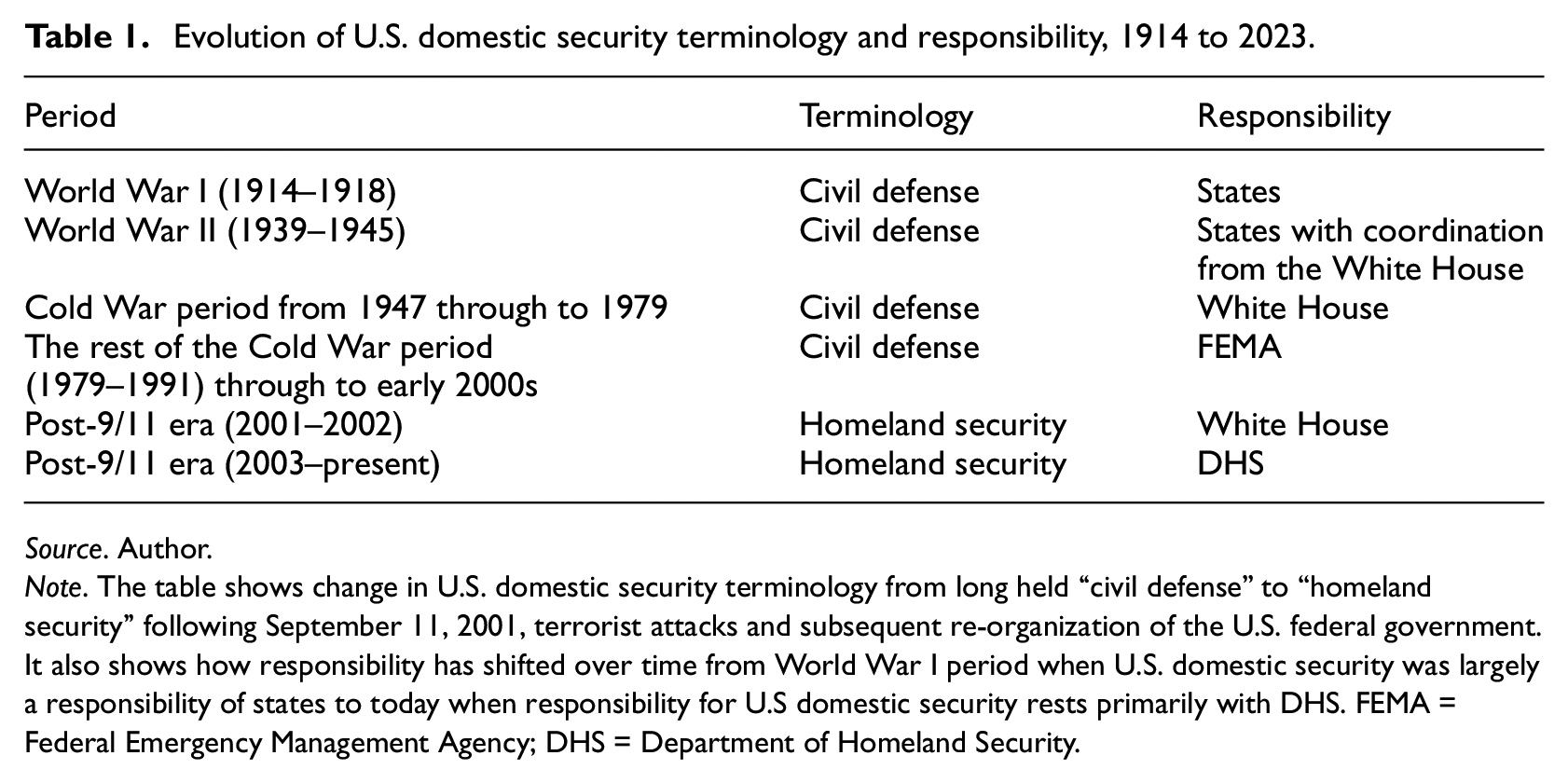
In the United States, the idea and practice of domestic security has long been rooted in state security. Over the years, both the understanding and management of U.S. domestic security has evolved considerably based largely on the federal government’s response to cataclysmic events (Asaka & Denham, 2023). For instance, throughout the two world wars and much of the Cold War period, U.S. domestic security was characterized as “civil defense” (Oliver et al., 2021). Today, U.S. domestic security is conceptualized and practiced as “homeland security,” which has also evolved considerably over the past two decades in terms of scope from its original primary focus on terrorism to encompass all-hazards (Asaka & Denham, 2023; Reese, 2013). Table 1 provides a summary of the evolution of U.S. domestic security terminology and responsibility over time.
Evolution of U.S. domestic security terminology and responsibility, 1914 to 2023.
Source. Author.
Note. The table shows change in U.S. domestic security terminology from long held “civil defense” to “homeland security” following September 11, 2001, terrorist attacks and subsequent re-organization of the U.S. federal government. It also shows how responsibility has shifted over time from World War I period when U.S. domestic security was largely a responsibility of states to today when responsibility for U.S domestic security rests primarily with DHS. FEMA = Federal Emergency Management Agency; DHS = Department of Homeland Security.
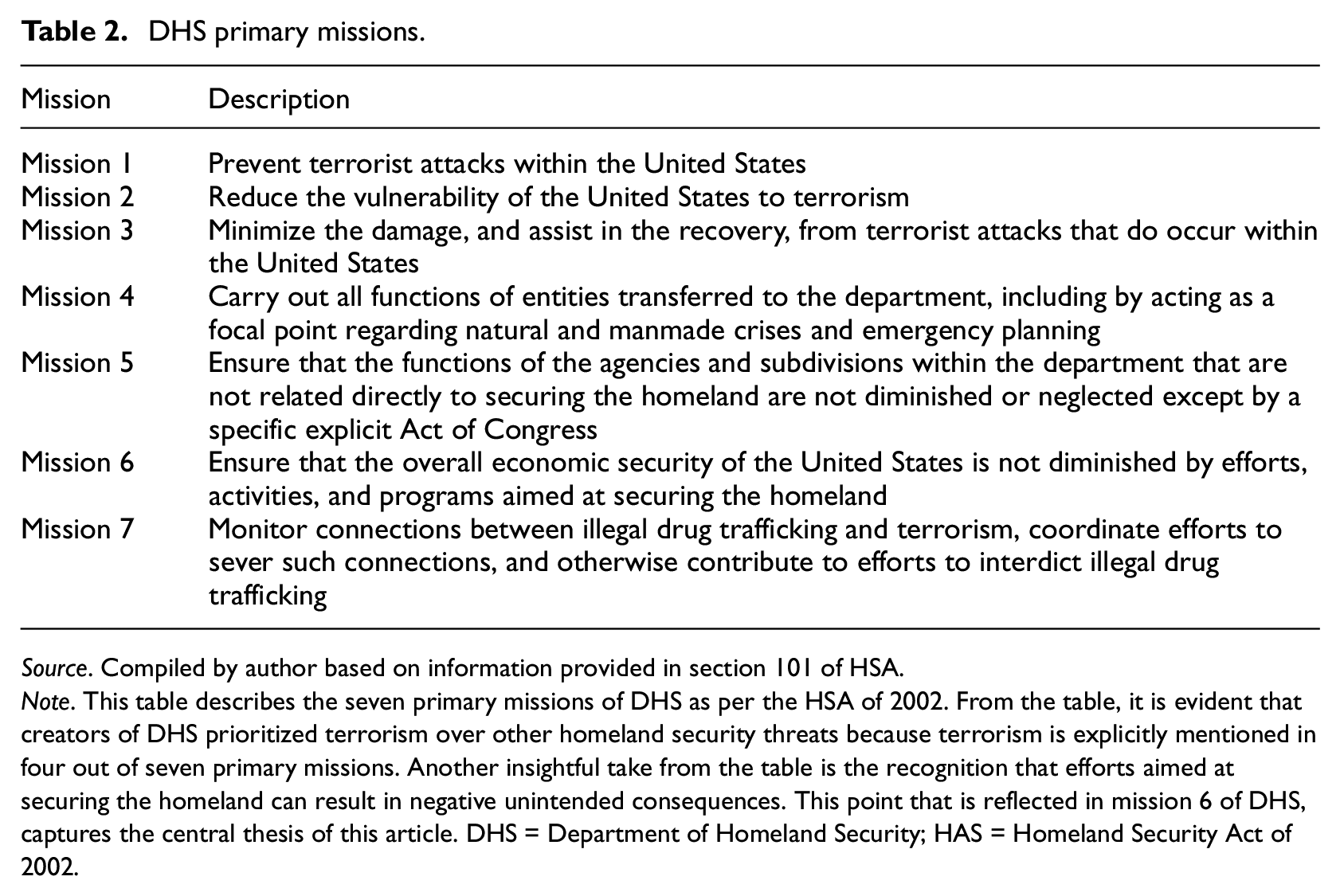
In the aftermath of Al Qaeda terrorist attacks of September 11, 2001, which killed more than 2,600 people at the World Trade Center, 125 at the Pentagon, and 256 on the four planes involved in the attacks (National Commission on Terrorist Attacks Upon the United States, 2004), President George W. Bush created the Office of Homeland Security to “develop and coordinate the implementation of comprehensive national strategy to secure the United States from terrorist attacks” (The White House, 2001). In addition, he set up the Homeland Security Council to advise and assist “the President with all aspects of homeland security” (The White House, 2001). The following year, Congress passed the Homeland Security Act of 2002 (HSA) that President Bush signed promptly into law effectively establishing DHS (The White House, 2002). Table 2 details the seven primary missions of DHS at the time of its creation as stipulated in section 101 of HSA.
DHS primary missions.
Source. Compiled by author based on information provided in section 101 of HSA.
Note. This table describes the seven primary missions of DHS as per the HSA of 2002. From the table, it is evident that creators of DHS prioritized terrorism over other homeland security threats because terrorism is explicitly mentioned in four out of seven primary missions. Another insightful take from the table is the recognition that efforts aimed at securing the homeland can result in negative unintended consequences. This point that is reflected in mission 6 of DHS, captures the central thesis of this article. DHS = Department of Homeland Security; HAS = Homeland Security Act of 2002.
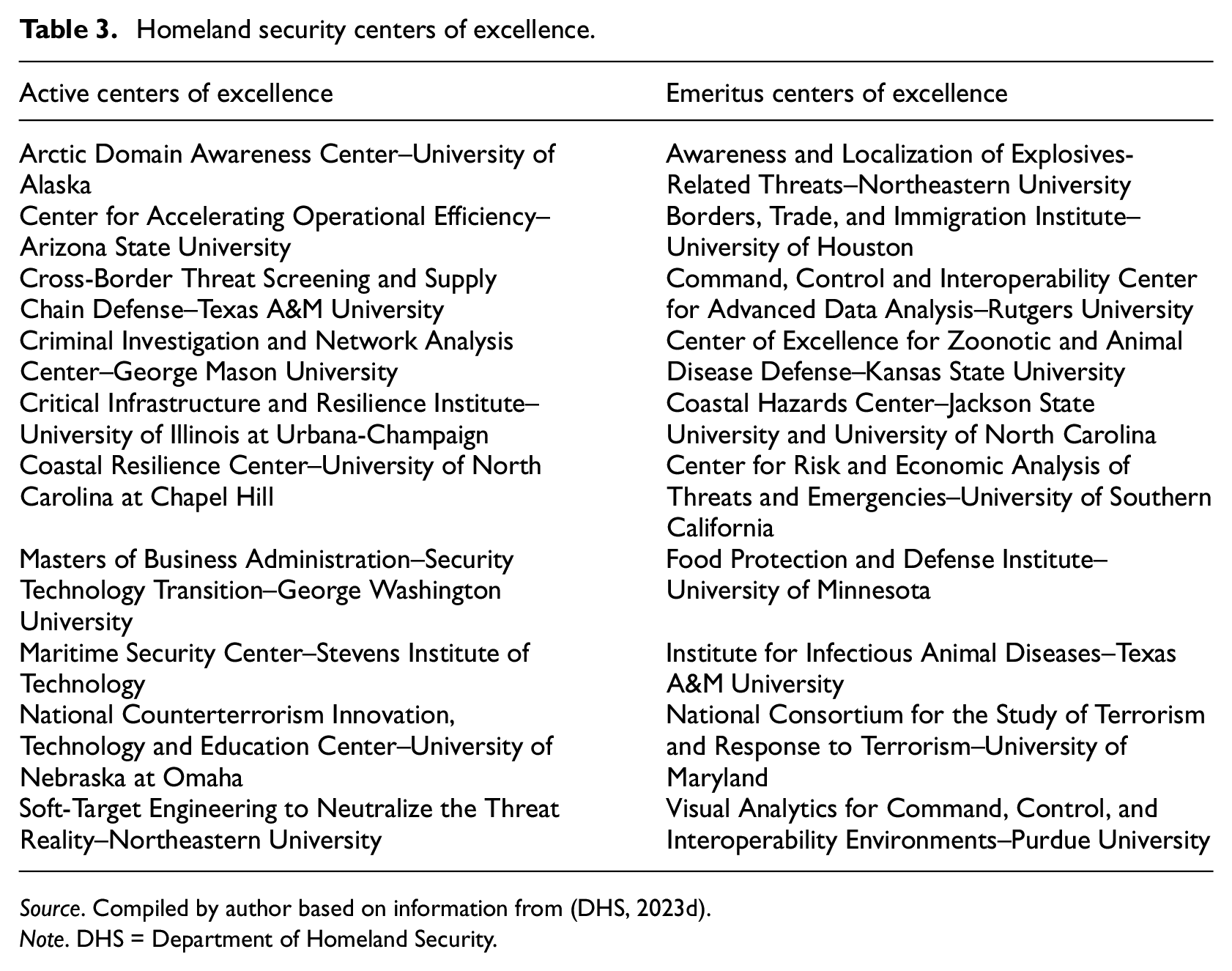
The foregoing happenings in the homeland security policy sphere were followed by concomitant developments in the academic world. For instance, U.S. universities and colleges began offering homeland security academic programs in the aftermath of 9/11 and establishment of DHS. Homeland security studies has since emerged as field of inquiry that encompasses multiple disciplines and continues to undergo maturation (Asaka, 2023b; Ramsay & Renda-Tanali, 2018; Ramsay et al., 2021a). Today, the DHS Office of University Programs oversees partnerships with U.S. universities and colleges aimed at streamlining “access to the expertise of the nation’s universities and colleges to address pressing homeland security needs” (DHS, 2023a). For example, the DHS centers of excellence are “university-led research networks that anticipate threats and challenges to” homeland security (DHS, 2023a). Table 3 provides a list of active and emeritus centers of excellence.
Homeland security centers of excellence.
Source. Compiled by author based on information from (DHS, 2023d).
Note. DHS = Department of Homeland Security.
A little over a decade prior to the establishment of DHS, President Bush’s father—President George H. W. Bush—signed the Global Change Research Act of 1990 into law thereby effectively establishing the U.S. Global Change Research Program (USGCRP) as a “comprehensive and integrated United States research program which will assist the Nation and the world to understand, assess, predict, and respond to human-induced and natural processes of global change” (USGCRP, 2022, p. 4). The idea of creating a federal program solely charged with the study of global change was mooted during President Ronald Regan’s last term in office following Dr. James Hansen’s 1988 testimony to the U.S. Senate Committee on Energy and Natural Resources where he warned of the dangers of climate change; specifically its effect on the intensity and frequency of weather extremes (U.S. Senate Committee on Energy and Natural Resources, 1988). At the time, Dr. Hansen was the Director of the National Aeronautics and Space Administration Goddard Institute for Space Studies, and he warned that climate change can make future extreme weather events more frequent and intense if the greenhouse effect caused by high concentration of greenhouses gases in the atmosphere is not addressed in good time.
On the policy side, over the past two decades, U.S. homeland security policy has evolved from its original overemphasis on terrorism to today’s all-hazards approach (Asaka & Denham, 2023; DHS, 2023c; Oliver et al., 2021; Reese, 2013). As mentioned earlier, changes in homeland security theory and practice have largely been driven by cataclysmic events. For instance, change in the homeland security threat landscape from a narrow focus on terrorism to a broad focus on all hazards has been attributed to the catastrophic 2005 Hurricane Katrina, 2012 Hurricane Sandy, and 2017 Hurricane Harvey among other extreme weather events (Asaka & Denham, 2023; O’Sullivan, 2015). An all-hazards approach broadens homeland security threat landscape to include not only terrorism but also weather extremes (e.g., heat waves, cold spell, cyclones, derecho, drought, heavy rainfall, and floods among others), technological failures/accidents (e.g., the 2023 East Palestine Ohio train derailment), sea level rise, earthquakes, volcanic eruptions, wildfires (e.g., 2021 Dixie fire), and pandemics (e.g., COVID-19 pandemic) among others. Consequently, current U.S. homeland security policy frames climate change as a homeland security issue (Asaka & Denham, 2023). For instance, the 2021 DHS climate action plan—part of Biden administration’s whole of government efforts to tackle climate change impacts—states, in part, that “Climate change endangers national security and DHS’s mission of safeguarding American people, our homeland, and values” (DHS, 2021, p. 1). Moreover, DHS was recently admitted as the newest member of USGCRP—a clear sign that the U.S. federal government considers climate change a significant homeland security policy concern (DHS, 2023b). Finally, the recently released third quadrennial homeland security review report identifies climate change as one of nine evolving challenges for homeland security missions (DHS, 2023c).
Evidently, within both U.S. homeland security academic and policy circles, climate change is considered a threat multiplier that, on one hand, increases the likelihood of present hazards/threats/risks happening and, on the other hand, aggravates the aftereffects of the same when they happen with concomitant increase in vulnerability of people and critical infrastructure and key resources (CIKRs) to loss and damage related to climate change impacts (Butts, 2014; Warner & van der Geest, 2013).
3. From environmental security to climate security
The inaugural editorial piece of Environment and Security journal correctly notes, in part, that “Our complex, globalized world has created an environment that presents new challenges to countries striving for peace and security” (Swain et al., 2023, p. 1). The connection between environment and security has been a topic of research interest to social scientists since at least the 1980s (Conca & Dabelko, 2010; Dabelko, 2003; Hough, 2014), but the term “environmental security” has been around in the U.S. context since at least the 1970s (Floyd, 2010). Moreover, while attributing emergence of the field of environmental security to “decline of the East-West standoff that permitted the ‘luxury’ of considering ‘threats’ perceived to be less immediate than nuclear war,”Dabelko (2003) argued that a focus on the 1960s and 1970s—a period he termed “the prehistory of environmental security”—is paramount if one is to truly “understand the evolution of environmental security” (p. 52, italics added). That said, the link (or lack thereof) between climate change and security has only received significant attention from social scientists over the past two decades (Daher et al., 2018; Koubi, 2019; Uexkull & Buhaug, 2021). Figure 1 shows trends in the relative use of the phrases “climate security” and “environmental security” in English books over time.
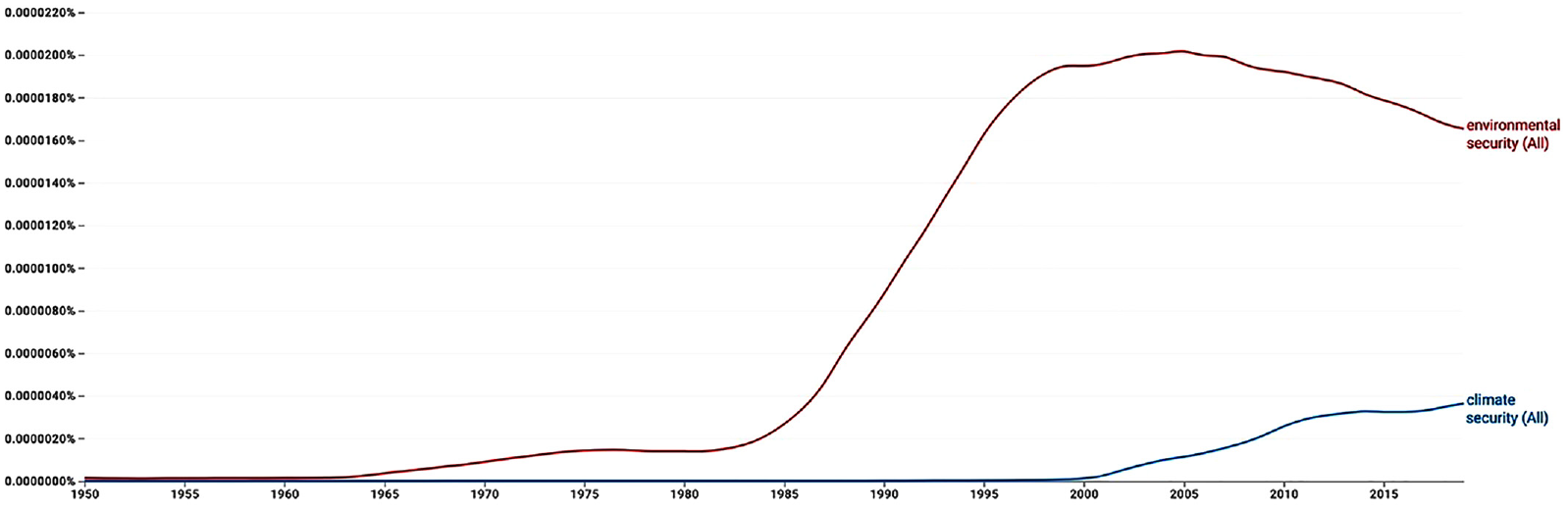
Trends of “climate security” and “environmental security” in English books, 1950 to 2019.
The currently growing climate and security nexus literature was preceded by social science research on the nexus between the environment and natural resources, on one hand, and conflict and peacebuilding on the other (Conca & Dabelko, 2002; Dabelko, 2003; Floyd & Matthew, 2013; Homer-Dixon, 1999; Obi, 1997; Trombetta, 2008; VanDeveer, 2003; VanDeveer & Dabelko, 2001; Weinthal & Johnson, 2018). This early work established that the Environment and natural resources have the potential to contribute to both conflict and conflict resolution (see e.g., Balag’kutu et al., 2018; Ide et al., 2023; Koubi, 2019; Krampe et al., 2021; UNEP, 2015) and paved the way for the current work on climate-security nexus (see e.g., Abrahams, 2021; Amster, 2018; Asaka, 2021; Busby, 2018; Cóbar et al., 2022; Daher et al., 2018; Dalby, 2018; Hill & Martinez-Diaz, 2020; Ide et al., 2014; Koubi, 2019; Swain & Öjendal, 2018; Swain et al., 2023). Taking referent object of security as the reference point, McDonald (2013) mapped out four different framings of climate-security nexus within the extant literature including human security with people as the referent object, national security with nation-state as the referent object, international security with international community as the referent object, and ecological security with ecosystem as the referent object.
Physical and social science literature on the causes and impacts of climate change establish that there are at least two mechanisms by which climate change has a bearing on security namely the threat multiplier mechanism (see e.g., The CNA Corporation, 2007) and backdraft mechanism (see e.g., Dabelko et al., 2013).
3.1. The threat multiplier mechanism
Under this mechanism, climate change has a multiplying effect on existing security threats. As captured in James Hansen’s statement to Congress, climate change has the potential to worsen existing threats such as weather extremes (see U.S. Senate Committee on Energy and Natural Resources, 1988). Recent climate science studies establish that climate change contributes to increased intensity and frequency of tropical cyclones such as hurricanes with a concomitant increase in associated rainfall and flooding (Elsner, 2006; Keelings & Ayala, 2019; Mann & Emanuel, 2006; Risser & Wehner, 2017). Moreover, disaster studies literature establishes that, by increasing the frequency of certain climate-linked hazards such as the Atlantic hurricane as established by the physical science literature, climate change increases disaster risk (Glasser, 2020). In addition, a 2007 U.S. national security implications of climate change study found, among other things, that: Climate change acts as a threat multiplier for instability in some of the most volatile regions of the world … Unlike most conventional security threats that involve a single entity acting in specific ways and points in time, climate change has the potential to result in multiple chronic conditions, occurring globally within the same time frame. Economic and environmental conditions in already fragile areas will further erode as food production declines, diseases increase, clean water becomes increasingly scarce, and large populations move in search of resources. Weakened and failing governments, with an already thin margin for survival, foster the conditions for internal conflicts, extremism, and movement toward increased authoritarianism and radical ideologies. (The CNA Corporation, 2007, p. 6)
Furthermore, in the context of U.S. homeland security, Butts (2014) noted that “Climate change is an environmental security issue that is already having impact on U.S. national security interests and homeland security” (p. 276). Contemporary homeland security studies literature on environmental security primarily frames climate change as a threat multiplier. For instance, while making the case for integrating environmental security into the field of homeland security studies, Ramsay and O’Sullivan (2013) pointed out that climate change “is often disruptive … and contributes to changes in extreme weather events” that are known to have devastating impacts on U.S. homeland security (p. 2). O’Sullivan (2015) provided that: Extreme weather-related global disasters such as floods, blizzards, droughts, wildfires, and hurricanes are increasingly common, deadly, and costly around the world; and what had once been assessed as rare natural weather events are becoming both more frequent and more intense due to climate change. (p. 184)
Further clarifying the threat multiplier effect of climate change, O’Sullivan (2015) noted that, “climate change and other environmental drivers will increasingly magnify or help trigger negative security outcomes, sometimes with feedback loops, as some of these security outcomes will in turn magnify negative environmental security drivers and outcomes” (p. 185). In their influential piece, Lanicci and Ramsay (2014) developed a conceptual framework for understanding the interplay between climate change and homeland security within the U.S. context, which they applied to a case study of the impact of Hurricane Katrina on the U.S. Gulf Coast. The framework dubbed “the environmental security cascade model” borrows from The CNA Corporation 2007 report and provides that “extreme environmental events”—increasingly made more frequent and intense by climate change—generate “destabilizing effects,” which in turn translate to security implications in the affected contexts (Lanicci & Ramsay, 2014, p. 153).
Moreover, while conflict and political violence literature finds no clear-cut causal link between climate change and conflict (see e.g., Asaka, 2021; Benjaminsen et al., 2012; Buhaug, 2010; Buhaug et al., 2014; Ide et al., 2014; Theisen et al., 2011, 2013; Uexkull & Buhaug, 2021), the same literature establishes that climate change contributes to conditions that either fuel existing conflict or are favorable to conflict (re)emergence (see e.g., Abrahams, 2021; Asaka, 2021; Mach et al., 2019; Theisen et al., 2011). In their East African-focused study investigating where the interplay between climate change and conflict is likely to occur, Ide et al. (2014) concluded that the climate-conflict nexus is likely to play out in areas that are already highly exposed and vulnerable to climate change while at the same time in high risk of violent conflict onset. In essence, climate change worsens security problems within countries and among populations that are already experiencing a significant degree of vulnerability and exposure to traditional and non-traditional security threats (Asaka, 2021; Ayanlade et al., 2023; Busby, 2022; Ide et al., 2014; Matthew, 2014; Scheffran et al., 2012).
3.2. The backdraft mechanism
Unlike the threat multiplier mechanism, this mechanism is particularly concerned with unintended negative consequences of climate change adaptation and mitigation. According to its original conceptualization, backdraft refers to the potential of climate change adaptation and mitigation efforts to inadvertently contribute to new conflicts and/or exacerbate existing ones (Dabelko et al., 2013). Geoff Dabelko—a leading backdraft scholar—noted that: efforts to reduce our carbon footprint and lower our vulnerability to climate change … If designed or implemented without consideration for conflict potential, unforeseen negative spillover effects might damage economic development prospects, undermine political stability, or fray the social fabric of communities. (Dabelko, 2013, p. 3)
Dabelko recommended that policy decisions regarding climate change adaptation and mitigation should: Recognize that all interventions have the potential to exacerbate or alleviate existing tensions … Improve communication and collaboration across communities and disciplines, from climate science and natural resource management experts to international development entities and the military …and Identify and implement climate change programs that can support peacebuilding initiatives. (Dabelko, 2013, p. 4, italics added)
Recently, some environmental security scholars have attempted to add nuance to the backdraft concept. For example, Swatuk et al. (2020) distinguished between, on one hand, unintended negative consequences that do not result in negative feedbacks on the state, and, on the other hand, unintended negative consequences “of state-initiated climate action on domestic non-state actors that result in negative feedbacks on the state” (p. 1). Swatuk et al. (2020) employed the phrase “boomerang effect” to describe the latter.
Notably, because of backdraft’s particular focus on conflict especially internal conflicts, much of the backdraft literature remains predominantly focused on countries that are currently experiencing intra-state conflict(s) and/or post-conflict countries. Invariably, such conflict and post-conflict contexts are found in what is commonly referred to as the Global South. Therefore, it is no wonder that the concept has gained little traction, if any, within environmental security literature focused on Global North contexts such as the United States.
In the context of this article, the backdraft mechanism concerns security implications of climate action in a broad sense and, therefore, not limited only to conflict potential of climate action (Dabelko et al., 2013). Barnett (2022) provided that, for climate change adaptation initiatives to succeed “Sometimes adaptation requires a good idea advanced by dedicated actors,”“sometimes it happens because institutions and their embedded actors do their job,” and yet other times adaptation “happens because firms and banks do what they do, for better and of course for worse” (p. 1111). That said, climate change maladaptation remains a real challenge. The latest IPPC report—the sixth assessment report—highlights maladaptation as a significant and growing concern (IPCC, 2022).
Maladaptation refers to a scenario where climate action (or inaction) produces the opposite result of what they were intended to achieve thereby leading to worsening of existing security problem(s) or emergence of new kinds of security problems either within or outside the context where such action (or inaction) occurred (Barnett & O’Neill, 2010; Schipper, 2020). Barnett and O’Neill (2010) identified five types or pathways of climate change maladaptation including actions that “increase emissions of greenhouse gases, disproportionately burden the most vulnerable, have high opportunity costs, reduce incentives to adapt, and set paths that limit the choices available to future generations” (p. 211). Recent climate change maladaptation literature provides that maladaptation can also take any of three forms including rebounding vulnerability, shifting vulnerability, and/or eroding sustainable development (Antwi-Agyei et al., 2018; Neset et al., 2019). In other words, maladaptive action or inaction can contribute to vulnerability on-site, vulnerability off-site, and/or undercut sustainable development gains with less than desirable implications for human security and national security including violent conflict, food insecurity, and internal displacement among others (Antwi-Agyei et al., 2018).
4. Climate change and homeland security
Homeland security is concerned with the protection of U.S. people and CIKR from all hazards (Asaka & Denham, 2023). The DHS defines, CIKR as “the assets of the United States essential to the nation’s security, public health and safety, economic vitality, and way of life” (DHS, 2018). Several sectors within the United States are designated as CIKR including: Chemical; Commercial facilities; Communications; Critical Manufacturing; Dams; Defense Industrial Base; Emergency Services; Energy; Financial Services; Food and Agriculture; Government Facilities; Health and Public Health; Information Technology; Nuclear Reactors, Materials, and Waste; Transportation Systems; and Water and Wastewater Systems (DHS, 2013).
The United States is also home to a diverse group of people with varying levels of exposure to various kinds of homeland security hazards, risks, and threats based on the geographic location where each of these people live, and varying degrees of vulnerability to the same based on ethnicity, gender, health, and economic status among other factors. For example, Americans who call the U.S. Gulf Coast home are at a higher risk of hurricanes compared to those who live in the Mid-West due to geographical factors. The Mid-West is far removed from the Gulf Coast. Hence, at best, the Mid-West can only experience the after-effects of a significantly strong hurricane (e.g., heavy rainfall and associated floods). Moreover, environmental justice and climate justice literature establishes that, across the United States, minorities and the poor are on average more vulnerable to environmental pollution, climate change, and disasters than other demographics (see e.g., Bullard & Wright, 2012; Fitzpatrick & Spialek, 2020). The fourth U.S. National Climate Assessment—the most recent assessment as of the time of writing this article—also affirms that U.S. minorities are disproportionately at risk of climate change impacts (USGCRP, 2018).
Therefore, climate change has emerged as a major homeland security issue that differentially impacts both the CIKR and people of the United States (Asaka & Denham, 2023; DHS, 2023c). The burgeoning homeland security scholarly literature on the topic primarily frames climate change as a homeland security threat and/or risk multiplier (see e.g., Asaka, 2023b; Asaka & Denham, 2023; Butts, 2014; Lanicci & Ramsay, 2014; Lanicci et al., 2017; O’Sullivan, 2015; Ramsay & O’Sullivan, 2013, 2021). In other words, climate change indirectly impacts U.S. homeland security through its effect(s) on known homeland security threats such as terrorism and weather extremes among others (Asaka, 2021; Lanicci & Ramsay, 2014).
In studying domestic security implications of climate change in the U.S. context, several U.S. homeland security scholars have employed different conceptual models/frameworks to explain the nexus between environmental factors (including climate change) and homeland security (see e.g., Butts, 2014; Lanicci & Ramsay, 2014; Lanicci et al., 2017; O’Sullivan, 2015; Ramsay & O’Sullivan, 2013). It is also important to note here that, in the specific case of climate-security nexus, most of these frameworks borrow heavily from dominant mainstream environmental security frameworks particularly the “resource scarcity model” and “threat multiplier model” (Adger et al., 2014; Homer-Dixon, 1999). A prominent example in the homeland security academic literature is the “cascade model” (Lanicci & Ramsay, 2014).
The cascade model provides that the interplay between the environment and security occurs through a cascade of effects whereby extreme environmental events including climatic anomalies (such as storms, floods, droughts, heat wave, cold spell, wildfires, earthquakes, tsunamis, and volcanic eruptions) produce destabilizing effects on society (such as water insecurity, food insecurity, increased risk of epidemics, and loss of livelihood) that in turn contribute to negative security implications for people, CIKR, and statecraft (including state failure, terrorism, mass migration, resource-based conflicts, and regional tensions) (Lanicci & Ramsay, 2014; Lanicci et al., 2017). For example, in the aftermath of Hurricane Katrina, the levee system designed to protect the city of New Orleans from storm surge failed, resulting in catastrophic floods beyond the scope of what would have happened had the levee system worked as intended (Schipper, 2020). In other words, the flooding associated with the levee system failure added onto flooding from Hurricane Katrina leading to enormous losses and damages (Knabb et al., 2023; Schipper, 2020; Sills et al., 2008). According to the National Hurricane Center (NHC), Katrina contributed to nearly 1,400 deaths across four states including Louisiana, Mississippi, Alabama, Florida, and Georgia (Knabb et al., 2023). The NHC ranks Katrina as the costliest hurricane “with an estimated $186.3 billion in damage compared to Harvey’s $148.8 billion” (Knabb et al., 2023, p. 13), and third deadliest hurricane after the 1900 Galveston, Texas hurricane that killed at least 8,000 people, and 1982 Lake Okeechobee, Florida hurricane that killed over 2,500 people (Knabb et al., 2023). In their 2014 study, Jennifer Irish, Alison Sleath, Mary Cialone, Thomas Knutson, and Robert Jensen concluded that “the amount and extent of damage would have been less severe had Hurricane Katrina taken place under c. 1900 climate and sea level conditions” (Irish et al., 2014, p. 647). In essence, inferring that climate change made Hurricane Katrina worse both in terms of its intensity and effect.
But as already established in the preceding section of this article, the relationship between climate change and security goes beyond the threat multiplier mechanism. Action and/or inaction aimed at tackling climate change and its impacts on people and CIKR sometimes produce negative unintended consequences with implications for security (Antwi-Agyei et al., 2018; Barnett & O’Neill, 2010). For instance, in their empirical analyses of climate change maladaptation in California’s agricultural and energy sectors, Juliet Christian-Smith et al. (2015) found that responses to the 2007 to 2009 California drought “increased emissions of greenhouse gases, had high environmental opportunity costs, and led to a reduced incentive to adapt” (p. 492). A related study examining farmers’ climate adaptive and maladaptive actions in the U.S. state of Iowa concludes that: many Iowa farmers are increasing their use of adaptive practices and decreasing use of maladaptive ones. However, many Iowa farmers are also increasing their use of pesticides and agricultural drainage, two maladaptive actions that can lead to major harms to … water quality. (Upadhaya & Arbuckle, 2021, p. 13)
Water quality is a critical dimension of water security—a necessary condition for homeland security (Herrmann & Robiou, 2004; Murray, 2004).
In their study of the federal crop insurance program designed to protect U.S. farmers from extreme heat among other perils, Annan and Schlenker (2015) concluded that “The federal crop insurance program gives farmers a disincentive from engaging in possible adaptation strategies to cope with extreme heat thereby exacerbating potential losses” (p. 266). In essence, the federal crop insurance program contributes to the moral hazard phenomenon with implication for U.S. homeland security considering that agriculture is 1 of 16 sectors identified by the DHS as a U.S. critical infrastructure sector. In the context of this article, moral hazard refers to a scenario where insurance produces a maladaptive outcome (Patsch et al., 2023; Rowell & Connelly, 2012).
Last but not least, Dauphin Island, Alabama presents yet another example of maladaptation within the U.S. context. In their case analysis of the island, Patsch et al. (2023) provided that because of FEMA’s National Flood Insurance Program (NFIP) and other post-disaster assistance programs among others: residential building on the island has steadily increased, with homes on the West End becoming increasingly larger and more extravagant. After each devastating hurricane or tropical storm, including Hurricane Katrina in 2005 which destroyed 90% of the homes on the West End and breached the island, rebuilding resumed, and new houses were added. (p. 3)
In other words, much like the federal crop insurance program, NFIP has produced moral hazard in the case of Dauphin Island with implications for U.S. homeland security.
In summary, current homeland security academic literature primarily frames climate change as a multiplier of disaster risks and/or threats associated with natural and man-made hazards. Figure 2 provides a schematic depiction of the interplay between climate change and homeland security based on current knowledge within the U.S. higher education field of homeland security studies.
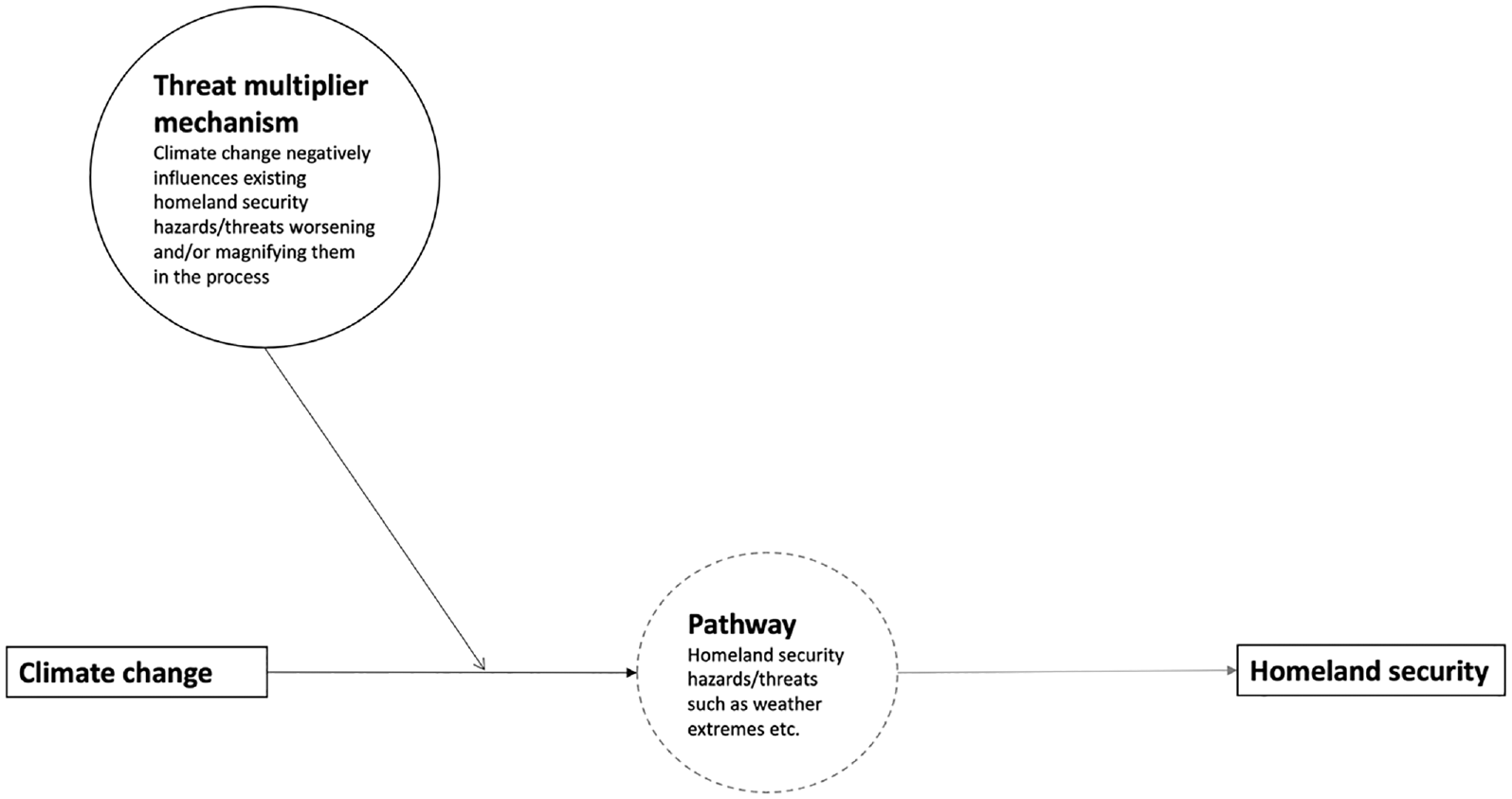
The “old” conceptual model of climate change and homeland security nexus.
This figure shows the arguably outdated one-dimensional conceptual framework that current understanding of the interplay between climate change and homeland security is based on. The figure establishes that climate change impacts homeland security indirectly by influencing existing homeland security hazards, risks, and/or threats. Therefore, existing hazards, risks, and/or threats act as the pathway that links climate change and homeland security.
A significant flaw of the current climate change and homeland security nexus conceptual frameworks is that they are one-dimensional and narrow in scope. In other words, as shown in Figure 2, the focus is primarily on the threat multiplier mechanism. However, as the preceding literature review has shown, current knowledge on the climate-security nexus point to a two-dimensional relationship in which “threat multiplier” and “backdraft” mechanisms sit on opposite ends of the spectrum, respectively. Thus, within the context of homeland security studies, there is a shortfall with regard to current knowledge on the relationship between climate change and homeland security. This finding is in tandem with the finding of a recent review of special reports for the IPPC’s sixth assessment cycle, which established that, “the climate change research community has not yet achieved a consistent framework for assessment of complex climate change risks” (Simpson et al., 2021, p. 491)
Consequently, this article argues that homeland security studies’ literature needs updating to take both mechanisms into account if the field is to provide students, academics, policymakers, and even the public with meaningful and nuanced understanding of the interplay between climate change and homeland security. The next section attempts to fill the above identified knowledge gap in homeland security academic literature by putting forth a comprehensive climate-security nexus framework for homeland security studies by tapping into insights from related fields of study including environmental security and peacebuilding.
5. Toward a comprehensive conceptual framework for homeland security studies
The foregoing discussion has revealed at least four important points as follows. First, climate change poses significant challenges to U.S. homeland security. Second, both homeland security scholars and policymakers currently recognize and are grappling with, the fact of climate change and its impacts on U.S. people and CIKR. Third, current understanding of climate change and homeland security nexus is based solely on the threat multiplier mechanism. Finally, there exists a significant variance in the understanding of climate-security nexus between, on one hand, mainstream environmental security academic literature on the climate-security nexus and, on the other hand, U.S. homeland security academic literature on the same. This section contributes toward bridging of the identified gap in knowledge between the two bodies of literature with regard to climate-security nexus.
Security is both a contested and, to a large degree, context-specific concept (Asaka, 2023a). In other words, security means different things to different people and security challenges vary from place to place. The identified shortfall in knowledge on climate-security nexus within homeland security literature is better understood within this context. In other words, while mainstream environmental security and homeland security analyses may be focused on different contexts (i.e., the former tends to be predominantly internationally oriented, while the latter is U.S. focused), both the threat multiplier and backdraft mechanisms of the climate-security nexus are applicable in the U.S. context. Thus, any U.S. focused climate-security nexus analysis that does not account for both mechanisms falls short.
Therefore, it is critical to recognize that homeland security problems associated with climate change can emanate from “upstream” (i.e., climate change induced concerns such as increased frequency and intensity of Atlantic hurricanes that are known to negatively impact water security, energy security, and food security among others) and/or “downstream” (i.e., climate action-related concerns such as the “moral hazard” where, e.g., availability of flood insurance leads some flood affected people to rebuild in flood plains) (see e.g., Müller et al., 2017; Schäfer et. al., 2019). Thus, both threat multiplier and backdraft mechanisms deserve attention if real safety and protection from climate change related homeland security threats is to be realized within the U.S. context.
Indeed, to some degree, the founders of DHS recognized that measures aimed at securing the homeland can be counterproductive and compromise homeland security if not well thought out. Their foresight is captured in the sixth mission of DHS, which concerns ensuring “that the overall economic security of the United States is not diminished by efforts, activities, and programs aimed at securing the homeland” (USC, 2002, p. 2142). Yet as the literature review has established in this article, U.S. homeland security scholars primarily concern themselves with the threat multiplier mechanism in their analysis of climate-security nexus. The absence of backdraft mechanism from such analyses means that contemporary homeland security literature is missing a key aspect of the climate-security nexus that has major significance for U.S. vulnerability to impacts of climate change. It is against such a backdrop that this article proposes a comprehensive conceptual framework, which accounts for both mechanisms (i.e., threat multiplier and backdraft). Figure 3 is a schematic representation of the proposed comprehensive conceptual framework for understanding climate-security nexus within the context of homeland security studies.
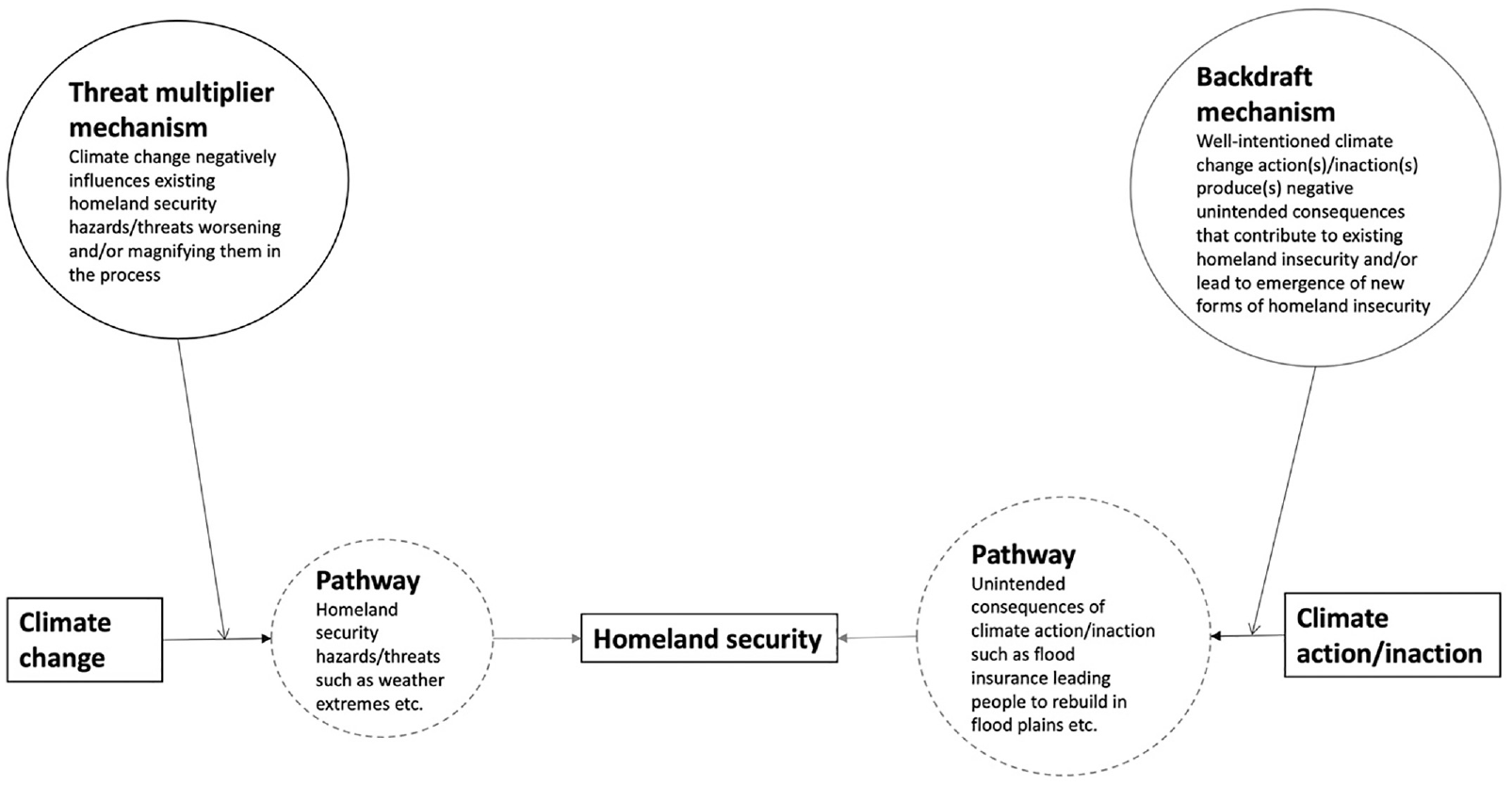
The “new” conceptual model of climate change and homeland security nexus.
The figure shows a two-dimensional conceptual framework for understanding the interplay between climate change and homeland security. On one hand, climate change indirectly impacts homeland security through its negative influence on homeland security threats. On the other hand, societal action(s) and/or inaction(s) aimed at addressing climate change impacts can in turn negatively impact on homeland security if such action(s) and/or inaction(s) produce negative unintended consequences. In essence, as Figure 3 shows the “new” framework accounts for both threat multiplier and backdraft mechanisms of the climate-security nexus. In so doing, this “new” framework improves on existing narrow and one-dimensional frameworks such as the cascade model.
Specifically, the proposed comprehensive conceptual framework achieves at least three milestones as follows. First, by accounting for the two mechanisms involved in climate-security nexus, the “new” framework advances homeland security scholarship on the nexus and puts the field at per with mainstream environmental security field in terms of current knowledge on the subject. Second, unlike the “cascade model,” the “new” framework puts maladaptation at the center of homeland security considerations pertaining to climate change thereby drawing attention to a very important concern that was hitherto not given the level of attention it deserves at least within the context of U.S. homeland security. Finally, because it accounts for both threat multiplier and backdraft mechanisms of the climate-security nexus, the “new” framework makes it possible for homeland security practitioners to have a much needed comprehensive and nuanced understanding of climate change-related homeland security concerns in the United States.
6. Conclusion
Climate change is a significant homeland security concern. This article has shown that there is a growing body of literature within homeland security studies that explore the security implications of climate change in the U.S. context. Moreover, the article has also established that, by focusing primarily on climate change threat multiplier effect, the existing homeland security academic literature is currently in variance with mainstream environmental security academic literature that is increasingly accounting for both threat multiplier and backdraft mechanisms. Recognizing and affirming the link between climate change and homeland security, the article has put forth a comprehensive conceptual framework that accounts for threat multiplier and backdraft mechanisms thereby contributing to a growing body of scholarship that stresses the value of comprehensive and contextualized approach to understanding security implications of climate change.
In summary, on one hand, climate change indirectly impacts U.S. people and CIKR through its negative effects on homeland security hazards, risks, and threats. On the other hand, climate action (or inaction) can contribute to homeland insecurity if such action (or inaction) produces negative unintended consequences that contribute to vulnerability on-site, off-site, or drive degradation of sustainable development progress. Therefore, homeland security studies scholarship should account for both aspects of the climate-security nexus if the field is to contribute toward achieving homeland security policies and practices that safeguard U.S. people and CIKR from the vagaries of a changing climate.
Looking ahead, future climate-security nexus research within the U.S. homeland security studies field should focus on at least two areas to both complement the proposed conceptual framework and guide future U.S. homeland security policy and practice. First, there is presently a dearth of studies that document cases of maladaptation within the United States. Knowledge of maladaptation is integral to the success and effectiveness of the proposed comprehensive conceptual framework. Therefore, future studies should focus on documenting cases of maladaptation in the U.S. context. Second, beyond documenting maladaptation, such studies should also provide in-depth case analysis to bring about understanding of the conditions and/or factors that enable/drive maladaptation within the U.S. context. Understanding drivers and/or enablers of maladaptation is an important first step toward ensuring that future climate change adaptation initiatives do not lead to maladaptation because maladaptation puts U.S. people and CIKR in harm’s way.
Finally, this article presents at least two notable limitations and/or potential shortcomings. First, scope of the proposed conceptual framework is limited to the United States even though it is potentially applicable to analysis of domestic security implications of climate change elsewhere; particularly, in similar contexts experiencing vulnerability to climate change impacts. Second, the article analyzes climate-security nexus using a predominantly state-centric homeland security analytical framework, which some critical scholars would argue potentially contributes to militarization of climate change (see e.g., Enloe, 2010; Gilbert, 2012; Jorgenson et al., 2010; Surprise, 2020).
Footnotes
Acknowledgements
I am grateful to Ashok Swain, Tobias Ide, and the two anonymous reviewers for their invaluable feedback, and Manish Nainwal for editorial assistance.
Funding
The author received no financial support for the research, authorship, and/or publication of this article.