






Abstract
This practitioner reflection examines how generative AI is reshaping everyday consumer decisions in Singapore's platform-dense retail environment. Drawing on an autoethnographic vignette of a smartphone purchase conducted through ChatGPT on 4 March 2026, it focuses on three interrelated phenomena: the cognitive mechanisms through which AI mediates the consumer decision process, the structural dynamics by which generative engine optimisation shapes what consumers are shown, and the market transparency implications for Singapore as an illustrative tropical platform market. The paper's contextual contribution is not that all features observed are uniquely tropical, but that tropical environmental exposure, regional platform temporality, and cross-border retail fragmentation intersect in ways that create distinctive blind spots in AI-generated recommendations. The paper contributes conceptually through the ‘answer layer’ construct, contextually through its grounding in Singapore's platform-retail environment, and practically through consumer, seller, and policy recommendations. The limitations of a single-case, subjective interpretation are acknowledged.
Keywords
Context and background
I write as both a practitioner and a researcher. I operate an e-commerce venture in consumer electronics in Singapore, teach marketing, and digital economy modules at undergraduate and postgraduate levels, and hold a doctorate researching AI-augmented consumer decision-making and memory. This dual positioning, as seller and buyer, educator and learner, shapes what follows.
Singapore provides a concentrated setting for this analysis: internet penetration stood at 96.0% in early 2024, with cellular mobile connections substantially exceeding the population (Kemp, 2024). Its retail landscape is characterised by pricing that shifts rapidly across official brand stores, telco bundles, and third-party marketplace sellers, creating conditions in which information currency is itself a competitive advantage. Teo and Yeong's (2003) study of the digital consumer decision process in Singapore's online marketplace offers a useful baseline; the current paper extends their analysis to AI-mediated advice as a further layer of information intermediation.
Singapore constitutes a distinctive analytical site because three conditions intersect here in ways that individually exist elsewhere but combine locally. The first is tropical environmental exposure: heat, humidity, and direct equatorial sun create device-specific performance requirements, such as sustained thermal management and peak-nit outdoor brightness, that are rarely foregrounded in the global review corpus generative AI draws upon. The second is regional platform temporality: flash-sale architectures compress the window between ‘best deal’ and ‘expired deal,’ making time-sensitive information currency a structural feature of the retail environment (Hendra and Adiwijaya, 2026; Lamis et al., 2022). The third is cross-border retail fragmentation: Singapore's parallel-import marketplaces offer local-set and export-set variants of the same device at different price points with materially different warranty and service outcomes. These three conditions are not uniquely tropical. Their significance lies in their simultaneous presence within a single, platform-dense, AI-mediated purchase environment. Together, they create a local verification problem that an answer engine ranking primarily on price-to-specification grounds cannot resolve: climate suitability may be omitted because it rarely appears in the global review corpus; promotion-linked prices can change rapidly and therefore require time-stamped verification; and apparently cheaper devices may carry warranty regimes that change the effective cost of ownership. Susanto et al. (2023), studying Indonesian m-commerce users, find that perceived risk, trust, efficiency, and functional benefit shape satisfaction; perceived risk, trust, and functional benefit also directly influence price sensitivity, while efficiency operates through satisfaction and continuance intention. This indicates that m-commerce evaluations extend beyond headline price, a dynamic that answer engines optimised for specification comparison may systematically underweight.
The challenge this creates is cognitive. Consumers want ‘best value now’, but value is multi-dimensional: performance, battery life, camera quality, warranty, and after-sales support. The cognitive load of evaluating these attributes across multiple channels (Paas et al., 2003) accumulates into decision fatigue (Baumeister et al., 1998). Generative AI is increasingly taking over the comparison tasks consumers find taxing (Gerlich, 2025), compressing multi-tab research into a single conversational query. Figure 1 visualises this shift.
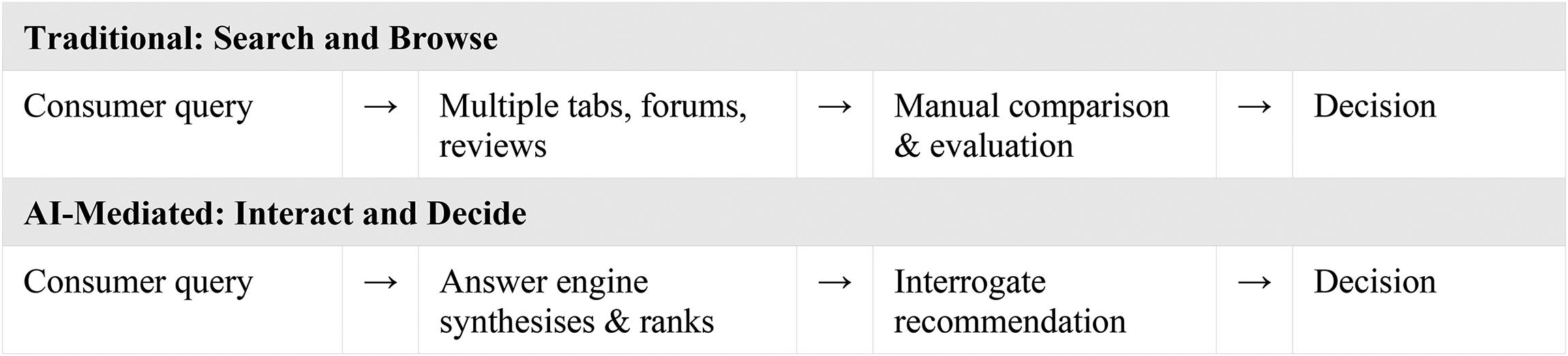
The consumer decision journey compressed. AI mediation delegates search and initial evaluation to the algorithm, shifting consumer agency from information gathering to recommendation interrogation.
Approach and practice description
Decision trace of the AI-assisted smartphone purchase (ChatGPT, 4 March 2026, web search enabled).
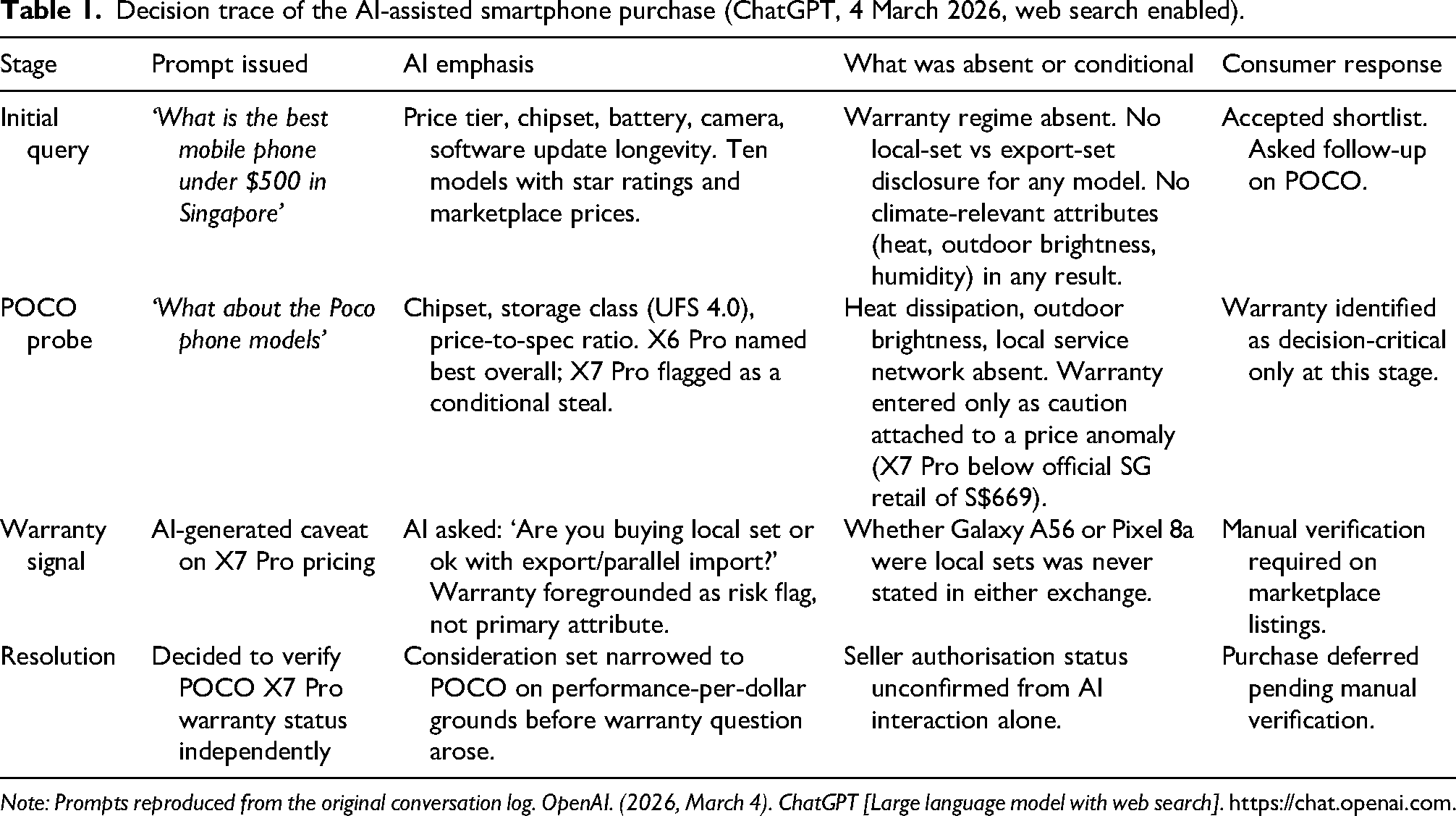
Note: Prompts reproduced from the original conversation log. OpenAI. ( 2026 , March 4). ChatGPT [Large language model with web search]. https://chat.openai.com.
This did not feel like a traditional search. It felt like consulting a product strategist. The AI produced a ranked shortlist with rationale and a narrative hierarchy. It did not merely provide facts; it shaped the decision-making process by foregrounding certain attributes while de-emphasising others, unless I asked. The key challenge shifted from ‘Which phone is best?’ to ‘What is this recommendation made of?’
Insights and lessons learned
Future outlook and recommendations
Closing reflection
Buying a phone should be mundane. Yet the process revealed how quickly generative AI is becoming everyday decision infrastructure in Singapore's tropical platform market. It compresses complexity into clarity. Sometimes this is helpful. Sometimes it is premature. And as GEO matures, the question ‘What's best?’ may become inseparable from ‘What is most retrievable and citable?’
What surprised me most was not the quality of the AI's recommendations, which were broadly sensible, but how quickly I was willing to trust them. The conversational format created an intimacy that a list of search results never could. That ease of trust is precisely what makes transparency and literacy so urgent.
What the interaction log reveals most clearly is a sequencing problem. The question that mattered most for a Singapore buyer, local set or export set, arrived last. It appeared not as the opening frame but as a conditional caveat, prompted by a price anomaly rather than surfaced as decision-critical from the start. For consumers who do not probe, that question may never arise.
My takeaway is not to reject generative systems but to approach them as powerful intermediaries. Like earlier internet technologies, their effects are shaped by the social and economic structures in which they operate (Curran et al., 2016). The conversation about AI, consumer autonomy, and market fairness needs to happen now, before the answer layer becomes too entrenched to reshape.
Footnotes

Funding
The author received no financial support for the research, authorship, and/or publication of this article.
Declaration of conflicting interests
The author declared no potential conflicts of interest with respect to the research, authorship, and/or publication of this article.