







Abstract
Energy is a resurgent topic in geography and cognate fields, but its theoretical development and empirical exploration have been uneven. I argue that centering transmission as an analytical lens — rather than treating it as incidental to extraction, generation, and consumption — brings the multi-scalar spatial politics of energy systems into the foreground through attention to circulation. This article reviews work on transmission from energy geographies, science and technology studies, and the histories of energy, technology, and the environment, identifying four main themes. First, transmission is used as a lens to examine larger energy metabolisms and how the circulation of electricity entrenches spatial relations. Second, transmission is an instrument of state territorialization, both within and across borders. Third, transmission, as a particular form of electricity capital, is subject to specific regimes of accumulation and regulation. Finally, transmission lines can become objects of social contestation that entangle multi-scalar politics of energy transition, electrification, and development. The article concludes by identifying areas for further research — empirical, theoretical, and policy-oriented — through which scholarly attention to transmission can inform energy geographies, energy studies, and human-environment geography more broadly.
Keywords
Introduction
Energy has emerged as a resurgent topic in geography and cognate fields, taking on new analytical and policy significance at the convergence of climate change, energy security, environmental, energy, and climate justice discourses. Energy geography's key analytical contribution is in arguing that energy is not an exogenous input to landscapes and political economies, but mutually constitutive of the spatial and political forms of everyday life (Bridge et al. 2013; Cederlöf 2021; Mitchell 2013; Solomon and Calvert 2017). This article brings together work on an oft-overlooked part of energy systems: high-voltage transmission.
Energy systems generally do not produce and consume electricity in the same places; instead, they depend on networks of transmission infrastructure to carry electricity from centralized sites of generation to distribution points, from where it is transported to sites of consumption. Transmission has taken on new urgency with the climate crisis, with the US National Academy of Sciences warning that the “single greatest risk to a successful energy transition during the 2020s is the risk that the nation fails to site, modernize, and build out the electrical grid” (National Academies of Sciences, Engineering, and Medicine 2023, 9). Yet despite its growing centrality to energy transitions, previous reviews have identified transmission as a gap in the energy geographies literature. Distinguishing “infrastructure/transmission” from “extraction/production” and “consumption,” for example, Baka and Vaishnava (2020) found that the broad category of “infrastructures and transmission” represents only 3 percent of energy geography articles published across forty journals between 2015 and 2019, including work on both the transmission sector and energy infrastructures more generally (e.g., Bridge, Özkaynak, and Turhan 2018).
While Baka and Vaishnava are correct in arguing that transmission is understudied across their sampled journals in the period studied, I argue that transmission is less an absolute gap in the literature and more a missed connection. For one, this relative lack of attention to transmission within energy geographies belies a longer engagement with transmission from related fields of energy studies that extends back at least to Young's 1973 book Power Over People (Young 1973, with a second edition in 1992). Drawing inspiration from Thomas Hughes's seminal Networks of Power (Hughes 1983) and the metabolic frameworks of scholars like Cronon (1991), Swyngedouw (1996), and Gandy (2002), science and technology studies (STS) scholars and historians of energy, technology, and the environment have produced several book-length manuscripts on transmission infrastructures (Cohn 2017; Jones 2014; Needham 2014; Wellstone and Casper 1981, 2003). This greater attention to transmission among STS and historians points to transmission's centrality to the emergence of energy systems: by following transmission, we can tell stories about how energy systems and practices come to be.
Beyond these disciplinary silos within energy studies, transmission is often implicit in geographic work on energy extraction, generation, consumption, and contestation, even as researchers do not always identify the transmission sector itself as their topic of study (though see Vogel and McCourt 2020; outside of geography, see also Gold 2019; Bakke 2016). Transmission, after all, is one concrete medium through which electricity takes a spatial form. In drawing out the spatial insights of transmission, this article has three objectives.
In the section, “Thinking with transmission,” I argue that centering transmission as an analytical lens — rather than treating it as incidental to extraction, generation, and consumption — brings the multi-scalar spatial politics of energy systems into the foreground. By following the infrastructure “in the middle” of electricity systems, attention to transmission underscores how the circulation of electricity across distances co-constitutes the construction of space, power, and capital, which takes on increasing relevance as energy systems are transformed by decarbonization and electrification.
In the section, “Making connections: Major themes in electricity transmission,” I demonstrate this analytical potential by synthesizing work on electricity transmission from energy geographies, STS, and the histories of technology, energy, and the environment, identifying four main themes that arise from transmission's circulatory nature. First, by virtue of its position in broader energy systems, attention to transmission foregrounds the metabolisms of electricity systems and how these metabolisms co-produce space. Second, emerging from this role in (re)producing the spatialities of energy systems, transmission infrastructure can act as a mechanism of state territorialization, both internally and externally to state borders. Third, transmission infrastructure entrenches the power of electricity capital as it circulates electricity as a means of (re)production and accumulates value. Fourth, the multi-scalarity of transmission infrastructure makes it a key site of contestation, acting as a vehicle for coalition-building across scales and amplifying calls for justice and reform.
Throughout these sections, I also place transmission in dialogue with oil and gas pipelines, which serve as another form of linear energy transport infrastructure. Pipelines have been a more salient topic of scholarly, activist, and policy attention, driven by opposition to unconventional fossil fuels and carbon-intensive systems more generally, as well as (especially indigenous-led) protests against pipelines (see, e.g., Barry 2013; Bosworth 2022; Estes 2019; Mitchell 2013). Many dynamics noted in this literature are shared by transmission. At the same time, transmission's specific materiality, politicization, regulation, and role in energy transitions make it more than just an electric analog for pipelines, pointing to the need to compare the dynamics of circulation across energy types. While a full comparison of transmission and pipelines is outside the scope of this article, I identify certain points of departure for future work.
This article acknowledges that its synthesis, like the literature it reviews, is largely confined to the Global North, especially the United States and Canada. In part, this is indicative of the geographic bias of the energy geographies literature as a whole (see Baka and Vaishnava 2020), though this too is changing among geographers (e.g., Allan, Lemaadel, and Lakhal 2022; Hornborg, Cederlöf, and Roos 2019; Silver 2015; Yenneti, Day, and Golubchikov 2016) and energy historians (e.g., Adebayo 2023; Chatterjee 2020; Montaño 2021). This also reflects the histories of the electrical grid as an “American technology” driven by charismatic individuals like Thomas Edison and Samuel Insull (Bakke 2016; Cohn 2017; Hughes 1983), and when the US grid has been subjected to transnational comparison, it has often been contrasted only with other Global North countries (e.g., Hughes 1983). While this article includes, when possible, perspectives and case studies from the Global South and other areas of the Global North, this empirical bias toward North America has conceptual implications for what the energy transmission literature can tell us, as discussed in greater detail in the concluding section.
Thinking with transmission
What is the value of adopting transmission as an analytical lens for energy systems? Attention to transmission requires attention to circulation, both as a physical process where electricity as a commodity is transported and as a political economic process where surplus value is accumulated by producing electricity as a commodity and selling it for a profit. Transmission can therefore be used as a lens to understand the infrastructure that moves electricity from its point of production to its point of consumption, as well as how this process of energy transportation is made politically and economically viable by and for electricity capital and the state.
First, it is useful to distinguish transmission within the broader category of energy transport (see Table 1). The transmission sector is just one component of a broader landscape of energy transport that also includes contentious infrastructure like pipelines and emerging technologies like utility-scale energy storage. The transportation of electricity in large, centralized grids is accomplished in two stages, transmission and distribution. If distribution lines are the two-lane roads that carry local traffic, transmission lines are the interstate highways that speed traffic across space to a few select exits. Taking the United States as an example, transmission lines typically operate at voltages between 125 and 765 kV, whereas distribution lines typically operate between 4 and 35 kV (Energy Information Administration, n.d.), with the size of the towers and the width of the corridors varying accordingly, from wooden poles to multi-story metal pylons.
Transmission and related terms.
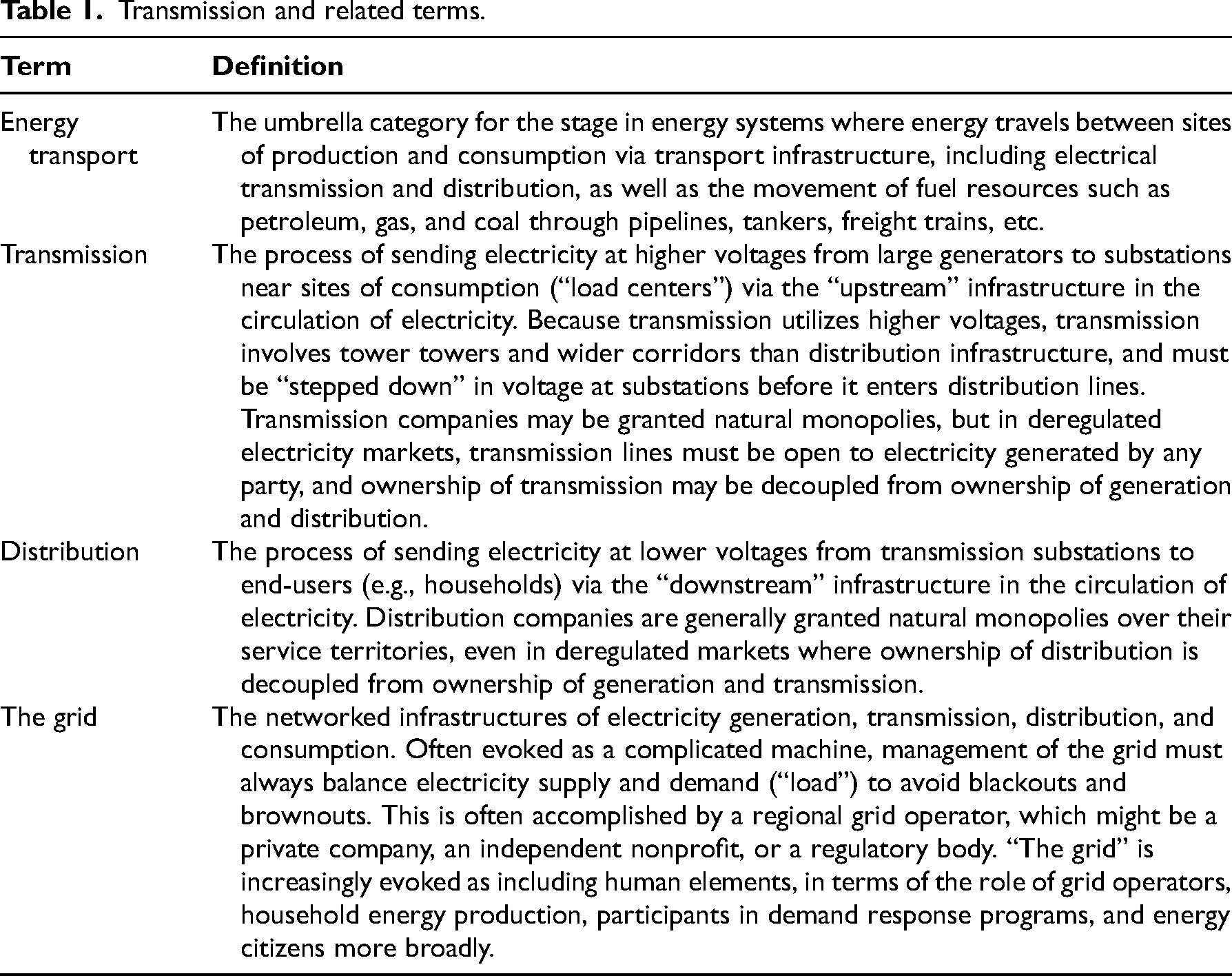
The electricity industry and regulators also tend to treat transmission as a distinct component of the energy sector. In places where the electricity sector has been restructured away from a natural monopoly model, transmission companies are decoupled from generation and distribution companies. In this regulatory model, transmission infrastructure must be open to electricity generated by any company, often moderated by an independent grid operator, whereas distribution companies tend to retain monopolies over their service territories and are regulated by the state.
Transmission's ability to circulate electricity across long distances gives it a particular spatial economy. Transmission lines are spatially fixed, capital intensive, and typically involve the use of rights-of-way or eminent domain to gain access to longitudinal tracts of land. Transmission is used when it is advantageous to generate electricity far from its sites of consumption. In some cases, this is because generation depends on a remote flow resource (e.g., a hydroelectric dam or off-shore wind farm) or because it is more economical to generate electricity from a stock resource near the site of extraction (e.g., a mine-mouth coal plant). More generally, transmission allows electricity generation to be spatially displaced from consumption, so that areas with high demand (e.g., urban centers) do not need to concentrate their electricity supply nearby, but can instead take advantage of different property values, regulatory regimes, and geographic and meteorological conditions outside of metropolitan areas.
The transmission sector therefore enables a spatially diffuse energy system based on large-scale generation, whether renewable or carbon-intensive. Whereas any system short of household-level energy independence would require some degree of distribution infrastructure, transmission infrastructure is necessitated by a system preference for centralized energy generation and continent-spanning grids.
In turn, transmission is a key sector for understanding the shifting geographies of low-carbon energy transitions. Sites of renewable generation are often located far from load centers and from existing fossil-fuel generation, requiring the development of new transmission lines. However, transmission increasingly acts as a bottleneck for onboarding renewables (National Academies of Sciences, Engineering, and Medicine 2023). The rapid proliferation of new generation projects means that many grid operators have long queues for interconnection, and associated transmission development can represent a secondary front of resistance for renewable development already facing opposition at the site of generation. Transmission is therefore both a prerequisite and a flashpoint for decarbonization.
Transmission also plays a role in other sorts of energy transitions, enabling widespread electrification in historical and contemporary contexts across the Global North and South. Expanding regional and national grids can bring economic development and quality of life improvements, particularly for rural, informal, or otherwise marginalized communities previously excluded from the benefits of reliable and affordable electricity. However, transmission may bring with it the reproduction of centralized control over electricity and the commodification of household energy use. In both the Global North and South, an investment in transmission can have the effect of blocking investments in microgrids, energy storage, energy efficiency, and household or community energy production, further entrenching the power of electricity capital and state formations.
Finally, the urgency often associated with transmission development brings with it specific justice concerns for transmission-impacted communities that are not necessarily shared by distribution or other grid infrastructures. In some cases, new or expanded transmission infrastructure represents a locally unwanted land use, justified based on broader societal needs for decarbonization, electrification, or economic development, raising key issues of distributive, cosmopolitan, and spatial justice. While these contestations are not unique to transmission, transmission can represent a particularly visceral example of the juxtaposition between local impacts and broader benefits, because transmission bisects one place to deliver electricity elsewhere without directly connecting to host communities. Environmental and social impact assessment processes ill-suited to the prospective impacts of transmission development and the technomanagerial politics of grid governance further contribute to issues of procedural and recognition justice, where the public may have limited avenues for involvement with transmission planning, financing, siting, and operation.
Making connections: Major themes in electricity transmission
This review synthesizes work on high-voltage transmission infrastructure from the field of energy geographies, as well as from STS and the histories of energy, technology, and the environment. By embodying how electricity provision is a spatial and circulatory process embedded within centralized infrastructure networks, transmission can anchor an analysis of what Sovacool, Carley, and Kiesling (2024, 3) call “energy justice through a ‘whole systems’ lens” rather than focusing primarily on energy extraction, production, or consumption. This review identifies contributions along four major themes: (1) energy metabolisms and the production of space; (2) state territorialization; (3) electricity capital and accumulation; and (4) social contestation and justice.
Energy metabolisms and space
Arguing for a geographical understanding of energy transition, Bridge et al. (2013, 333) argue that energy systems are constituted spatially: the components of the system are embedded in particular settings and the networked nature of the system itself produces geographies of connection, dependency, and control. Transmission infrastructure is central to these “networks,” both in the literal sense and in the way they channel society's broader energy metabolisms to and from some places while avoiding others.
By energy metabolism, this article refers to how the flow of energy (broadly construed) mutually transforms nature, space, and society: how energy resources, profits, and externalities circulate (or fail to circulate) through socioecological systems, how spaces are transformed (or fail to be transformed) through these processes of circulation, and how these (failed or successful) transformations condition present and future possibilities (Cederlöf 2021; Clark and York 2005; Harrison and Popke 2018; Swyngedouw 1996). As Cederlöf (2021, 71) argues, “the distribution of various energy forms is not a politically neutral process, but one where political and economic actors attempt to organize energy flows through infrastructures to achieve social visions; to maintain or contest social relations; and to engage in contingent everyday practices of energy use.
Andrew Needham's (2014) Power Lines exemplifies this approach. Needham uses powerlines as a method to trace the creation of metropolitan Phoenix and the greater US Southwest via the siphoning of water, hydroelectricity, and coal from extractive hinterlands, particularly from the Hopi and Navajo (Diné) reservations. Long-distance transmission allows Phoenix to be developed as a “clean sky” manufacturing center by displacing the environmental and social externalities of hydroelectric development, coal mining, and coal-fired electricity generation to energy peripheries, tethering extractive hinterlands to consumptive centers by embedding these relations in the landscape. In effect, transmission decouples the appearance of sustainability for urban consumers from the experiences of socioecological degradation far outside the city: while pipelines are typically synonymous with fossil fuels, transmission (and electricity itself) is fuel-neutral. In Needham's telling, Phoenix and the modern Southwest emerge as regional entities held together by a network of powerlines and associated aqueducts, well pumps, canals, and coal slurries. If Phoenix is the metabolizing body, transmission lines are the metabolic pathways that circulate resources, profits, and externalities unevenly across the region. 1
This metabolic approach to energy systems, returning to Cederlöf (2021, 74), insists that energy “is not an object but a spatiotemporal relation,” circulating in accordance not only with the laws of physics but also with the logics of profitability and market efficiency — and potentially in accordance with the prerogatives of energy democracy and just energy transitions. The transmission literature highlights three main effects of these “relations.” The first is the increasing centralization of power that accompanies the development of large-scale energy systems, with energy capital and state formations taking on major influence, which is dealt with in greater detail in the following sections.
The second effect is the bypassing of certain spaces and communities by the benefits of energy access, exemplified most viscerally by transmission infrastructure that passes overhead of households and communities that remain off-the-grid involuntarily, particularly in Global South contexts. While transmission is often promoted as a means of increasing energy access and affordability, transmission infrastructure itself is useless to households without a concomitant investment in distribution infrastructure.
For example, work by Jonathan Silver and collaborators on splintered urbanism has emphasized the uneven development of electricity systems in many Global South cities, with a focus on the failure of infrastructural buildout to deliver reliable and affordable electricity as a basic amenity (Salamanca and Silver 2022; Silver 2015, 2021). In this work, at issue is less the bulk transport of electricity to market and more the equitable and accessible distribution of electricity to end-users — in other words, more about distribution than transmission, though both reflect uneven investments in electricity infrastructure.
The third effect is the role that transmission plays in producing unevenness across space as energy is extracted, generated, circulated, and consumed. Writing about Hydro-Quebec, Desbiens (2013, 40) quotes Bill Namagoose, executive chief of the Grand Council of the Crees of Quebec, to describe the “two ends” of a hydroelectric line: There's the luxury end, the comfortable end. Lights, heat, cooking, there's music coming out of the other end of the line. But at our end of the line, we don't hear music. We hear massive destruction. Dynamiting of our rivers, dynamiting our cliffs, dynamiting our land, blowing up our land. Huge, monstrous vehicles ravaging the land. That is what we hear at the other end of the line.
Transmission becomes emblematic of uneven exchange, as electricity simultaneously brings “luxury” to consuming communities and “destruction” to producing communities, many of whom remain unconnected to the grid in the case of the Cree. Jones (2014), focusing on the US Mid-Atlantic states, similarly argues that powerlines work as “dissociating technologies” that create “landscapes of intensification” in which increasing energy usage is encouraged by social and political policies that generate demand, but also by the cognitive and socioecological distancing enabled by transmission infrastructure.
This attention to the unevenness produced by these metabolic assemblages can ironically lead scholars to fix their attention to either the “end of the line” and not the connections in between. Transmission is more than just a metaphor for metabolism. While Needham (2014) provides a detailed account of the spatial, ecological, and sociopolitical politics of resource extraction and consumption, for example, he pays surprisingly little attention to the physical powerlines themselves.
This reflects, in part, how transmission is a technology that annihilates space, sending electricity near-instantaneously across vast distances in a way that ties peripheries to centers while also obscuring the socioecological transformations of ever-growing energy metabolisms. However, there is room for the literature on transmission — and energy geographies more broadly — to engage with work on logistics to complicate the smoothness of this circulation (Chua et al. 2018; Cowen 2014, 2020). In his discussion of a “logistical fix,” for instance, Danyluk (2018, 639) argues that: … the accumulation of capital — and, by extension, the reproduction of capitalist social relations — hinges on the creation of particular kinds of spatial arrangements … [Capital] must fashion landscapes that are appropriate to the production, circulation, and realization of surplus value … Insofar as the built environment is a locus of investment and an object of exchange, space also becomes enlisted in the accumulation process as capital itself. (see also Harvey 1985)
The “enlisting” of space is, of course, always incomplete, even with the circulation of a commodity like electricity. By focusing on the frictions that arise in the transmission of electricity — both in the transformation of host communities and landscapes, but also the risks of wildfires, blackouts, protests, and sabotage — future research can problematize the technocratic illusion of a seamless grid.
State territorialization
The state is prominent in transmission development through the granting of rights-of-way, the use of eminent domain, the treatment of transmission as natural monopolies, and the role of nationalized energy companies and state energy planning (Cohn 2017; Hirsh 1999; Hughes 1983; Jones 2014; Wuebben 2019). Because energy utilities deliver a basic amenity, they often assume a peri-state status even in contexts when they are not directly state-owned, and the state may delegate decarbonization targets to energy capital via power purchasing agreements. Beyond state-capital dynamics, discussed in greater detail in the following section, transmission is evoked in the literature as an instrument of state territorialization: a mechanism for laying claim to space, resources, and influence both within and beyond borders.
Speaking to energy infrastructure more broadly, Bridge, Özkaynak, and Turhan (2018) argue that infrastructure acts as “veins of territory,” through which the circulation (or lack thereof) of energy co-constitutes national territoriality and subjectivities. Transmission infrastructure does political work for the state that exceeds the technical capacity to move energy. In some cases, transmission and associated energy infrastructure development is positioned as a prerequisite for state formation and independence, for instance in the former Soviet Union (Westphal, Pastukhova and Pepe 2022), European Economic Area (Hansen and Moe 2022), Laos (Dwyer 2020; Green and Baird 2020), Israel-Palestine (Fischhendler, Herman and Anderman 2016), Quebec (Desbiens 2004, 2009, 2013), and post-colonial east Asia (Chatterjee 2020), as grid infrastructure takes on nationalist character amidst concerns over energy security, autonomy, developmentalism, and nation-building.
Further research in this vein can draw on existing scholarship on pipelines, canals, and other linear infrastructures of extraction to consider how electricity transmission may operate as an “infrastructure of empire” (Cowen 2020) that entrenches state and capital presence in frontier areas (Enns, Bersaglio and Sneyd 2019) and indigenous territories (Curley 2021; Spice 2018). For Pasternak and Dafnos (2018), for example, Canadian state territoriality is coproduced through the ability to secure the circulation of commodities via transport infrastructures like pipelines. The protest of pipelines by indigenous nations then becomes an “emergency” for the state, not only because of the disruption of oil as a commodity but also because protesting the pipelines acts as a way of protesting the settler state's claims to indigenous lands and resources.
Understanding how such “emergencies” arise around transmission lines could provide a lens for understanding how electrification and the interconnection of renewables offer opportunities to (further) territorialize new energy frontiers, as transmission enables the networking of remote sites for solar, hydropower dams, and on-shore and off-shore wind into national energy grids. While geography has long studied conflicts over stock resources like coal, oil, or uranium, how might conflicts around sovereignty and the extraction of renewable flow resources differ? For instance, the verticality of the resource flows increasingly targeted for energy expansion — most notably off-shore wind — present connections to the expanding literature on vertical and volumetric territory (Billé 2020; Huber and McCarthy 2017; Kama and Kuchler 2019), as expanding transmission networks make it possible to territorialize airflows and marine waterways as geopolitical assets.
If the territorializing capacities of transmission act internally within the state's borders, transmission can also act externally as a geopolitical instrument. Because the circulation of energy occurs across borders, powerlines can extend one state's influence over another, though the literature is divided between what Vakulchuk, Overland, and Scholten (2020) term the “renewed conflict” and “reduced conflict” camps. Because transmission infrastructure is spatially fixed and capital-intensive, and because access to reliable and affordable energy has become a basic need, states cannot so easily “unplug” when conflict arises. While this has primarily been noted with pipeline infrastructure rather than electricity transmission (e.g., conflicts with Russian gas imports; see Bouzarovski, Bradshaw, and Wochnik 2015), increasing demands for electrification and clean energy, as well as innovations in transmission technology that allow for longer and thus more interconnected transmission systems, may lead to more interstate conflict.
Some scholars have argued that energy transition and widespread decarbonization can lead to reduced conflicts via interconnection by international electricity grids (Blondeel et al. 2021; Vakulchuk, Overland, and Scholten 2020). This is attributed both to renewable energy's purported democratizing and decentralizing properties and to the greater flexibility of electricity interconnections, which can be more easily rerouted than petroleum pipelines in response to hostilities. For Thaler and Hofmann (2022), however, cross-border electricity systems ultimately force states into an “impossible energy trinity” where they must choose between the competing goals of energy security, sustainability, and sovereignty (see also Baird and Quastel 2015; Fischhendler, Herman, and Anderman 2016; Hansen and Moe 2022).
In other cases, this “trinity” can be expanded to include humanitarian and decolonial concerns, with transnational electricity transmission serving to implicitly endorse conflict and occupation. As Allan, Lemaadel, and Lakhal (2022, 49) describe in the case of Western Sahara and Moroccan exports to the European Union and other West African countries: … energy developments in occupied Western Sahara are about more than producing energy. They stake a colonial claim on a contested land and implicate foreign powers in this claim. That is, the Moroccan regime uses energy to recruit allies for its colonial project.
The geopolitics of transmission, particularly of low-carbon energy like Western Sahara's solar and wind, is therefore more complex than a simple binary between “renewed” and “reduced” conflicts.
Read together with transmission's contributions to energy metabolisms, attention to the circulatory nature of transmission foregrounds how state claims to space are embedded in their control over the flow of resources within and across borders. At the same time, electricity challenges geopolitical and symbolic borders: moving fluidly across transnational transmission lines, “implicating” interconnected grids with “contested” electrons, and intermingling national electricity networks as neighboring states seek to share the benefits of different grid assets.
Electricity capital
Luke and Huber (2022) introduce electricity capital as “a faction of capital” (1701) and “the nexus of state, regulatory, and financial relationships that shape private accumulation through electricity provision” (1700). They justify the distinctiveness of this faction based on electricity's role as a means of production, electricity provision's specific politicization as a “public service,” and its position at the conjunctions of the climate crisis, energy poverty, and economic development. As the liminal space between electricity production and consumption, transmission circulates capital by circulating electricity as a means of (re)production.
Most fundamentally, transmission has been productive as a space for considering the unique properties of electricity as a “quirky” (Özden-Schilling 2021) or “uncooperative” (Luke and Huber 2022, drawing from Bakker 2003) commodity. Electricity is “not matter but a flow” (Özden-Schilling 2021, 11), itself immaterial but deeply embedded in the material infrastructure of wires and cables, making electricity as a commodity and the grid as infrastructure difficult to disentangle. If we follow Anusas and Ingold (2015) in arguing that electricity's infrastructure “establishes an ultimately controlling apparatus, which secretly and inconspicuously organizes and directs the course of corporatized life from beneath (infra) the realms of everyday awareness” (550, italics in original), the (im)materiality of electricity and its centrality as a basic amenity give transmission (and distribution) owners major control over the means of (re)production. As electrical current flows along a gradient of electrical potential, the transmission sector accumulates value by circulating that electricity from sites of high supply to sites of high demand.
At the same time, electricity's (im)material characteristics present challenges for capital, which it attempts to manage through transmission infrastructure. Pending innovations in battery technology, electricity is difficult to store, so electricity production and consumption must be essentially perfectly managed within a grid to prevent blackouts or brownouts (Luke and Huber 2022; Özden-Schilling 2015, 2021). Given this lack of temporal flexibility, long-distance transmission offers spatial flexibility, connecting distant sites of generation and consumption to keep supply and demand in constant balance. This is seen as especially important with a switch to low-carbon sources, which are seen as more intermittent and variable than fossil fuel resources: as per a common industry refrain, transmission offers the ability to build a grid bigger than the weather. In turn, this offers a “flexibility fix” for capital by “facilitating the flow of electricity across space, allowing free mobility for capital across the landscape within which the grid extends” (Angel 2022, 921).
In this vein, transmission projects can act as a spatial and socioecological fix for capital (Ekers and Prudham 2017, 2018; Harvey 1985) as the construction of transmission infrastructure can serve to address capital's endemic crises through large-scale investment, facilitating greater circulation of electricity as a commodity, and enabling decarbonization amidst the climate crisis. While electricity transmission has been noted as a potential examples of this tendency (e.g., Luke and Huber 2022; McCarthy 2015), there have been few other studies that focus on transmission specifically (cf. Angel 2022; Fearn 2023; Spivey 2020).
Work on pipelines points to the potential productivity of applying the socioecological fix framework to transmission, with work exploring the role of pipelines in questions of reserve replacement and environmental impact assessments (Zalik 2015), demands for corporate transparency (Barry 2013), partnerships with conservation organizations (Enns, Bersaglio, and Sneyd 2019), or articulation with futures markets (Simpson 2019). Applying this framework to transmission would allow insights into how the spatial politics of fixed energy infrastructure shifts with electrification and decarbonization, as transmission enables or constrains widespread capital switching from fossil to renewable infrastructures (McCarthy 2015). What conflicts arise when “a ‘fix’ for capital [is not] a ‘fix’ for the climate” (Luke and Huber 2022, 1705)?
The complexities of electricity as a commodity and the power it vests in capital are conditioned by specific regulatory regimes, for instance electricity capital's status in some service areas as a natural monopoly. However, what was once a “textbook case” for regulation has increasingly been opened to competition (Breslau 2024, 2021; Hirsh 1999; Özden-Schilling 2021; Vogel 2020). In deregulated US states, for instance, ownership of generation, transmission, and distribution is separated. Transmission companies maintain ownership of transmission lines, but their operation is ceded to regional transmission operators who decide what generation will run, usually decided through regional wholesale electricity markets. In effect, this leads the transmission system to be partially socialized, but with access controlled by a third-party regulator guided by market principles (cf. Chatterjee 2020).
These grid operators, in turn, largely act as a technocratic “fraternity of experts” (Cohn 2017; see also Özden-Schilling 2016, 2021), generally unelected with little public oversight or participation, who manage supply and demand for electricity generators and utilities. This intermediate layer of decision-making between private capital and the state insulates electricity capital from calls for grid decarbonization and energy democratization. While these technomanagerial bodies are becoming targets for activists (e.g., Shankman 2022, 2023), their role in energy systems and decarbonization has yet to be systematically analyzed by energy geographers (though see work by Breslau 2024, 2021; Harrison 2022; Özden-Schilling 2015, 2021).
Amidst calls to reorganize how interstate electricity transmission is governed to be more similar to pipeline permitting (e.g., The Editorial Board 2023), there is a need to better understand the current system and the functioning of regional grid operators in relation to energy capital as quasi-state actors (see the work of the Regional Transmission Organization Governance initiative; RTOGov n.d.), particularly amidst calls for energy democracy, utility municipalization, and state ownership (Becker, Angel, and Naumann 2020; Luke and Huber 2022; Paul 2018).
Finally, more work needs to be done to situate the work of transmission as a subset of electrical capital in producing and reinforcing classed and racialized patterns of energy poverty and precarity. This reflects in part the analytical and sectoral distinctions between transmission and distribution, with distribution infrastructure leading more directly to questions and contestations over energy access, availability, and poverty. However, as Luke (2022) demonstrates, the politics of rate-hikes and their disproportionate impact on lower-income communities of color cannot be so easily divorced from “upstream” infrastructural investments and policies by utility companies, including investments in new or upgraded transmission. Bouzarovski and Simcock (2017) argue that such “end-use energy injustice … is a deeply geographical phenomenon” (645) rooted in the infrastructures that circulate (or fail to circulate) electricity to socioeconomically — and spatially — marginalized households.
Work by Conor Harrison (Harrison 2013a, 2013b, 2017, 2022) has similarly interrogated the role of utilities in the uneven development of energy system infrastructure and the “downstream” impacts of these developments on marginalized ratepayers. Focused on rural areas of the US South, Harrison's work reminds us that the rural geographies of transmission are also racialized ones. It is the regulatory environment between utility companies and the state — from the natural monopoly model to fragmented patchworks of electricity deregulation — that makes possible what Luke (2022, 1767) terms “racialized electricity capital as a state-supported circuit of accumulation.” In failing to circulate electricity reliably and affordably, transmission is entangled in larger projects of racial, class, and colonial exclusion.
Social contestation and justice
Building from its connections to spatially uneven metabolisms, state power, and capital accumulation, transmission development has always been and continues to be a site of social contestation. Two factors differentiate conflicts over transmission from other controversial energy projects.
The first, stemming from electricity's (im)materiality, is that conflicts over transmission lines are generally more focused on the qualities of the infrastructure rather than the energy being transmitted, whereas concerns over pipelines, for instance, are often de facto concerns about oil or gas and the risk of leakage. While early work on high-voltage transmission raised concerns over the human and ecological health impacts of electromagnetic fields (Young 1973, 1992), following improvements in line design and regulations, subsequent studies have found these risks to be negligible, even if health impacts and ambient noise remain an occasional concern of abutters (Wuebben 2019; though also see Sovacool, Carley, and Kiesling 2024). This complicates justice claims that often rest on ecological and epidemiological hazards to nearby human and more-than-human communities, instead pointing toward transmission as a spatial burden.
Speaking to its spatiality, the second factor is that transmission is linear, posing both site-specific impacts and cumulative impacts along routes that cross multiple property lines, ecosystems, and jurisdictional boundaries, sometimes transnationally, which in turn complicates project planning and permitting. Cumulative impacts tend to be the dominant concerns of host communities, making conflicts over transmission into conflicts over and across landscapes.
Transmission infrastructure by definition traverses some communities and landscapes to deliver energy to other places without (directly) delivering energy to the spaces it bisects, imposing the burden of what is often locally unwanted landscape change for the benefit of the broader system's energy needs. Electricity transmission corridors sometimes raise concerns about habitat fragmentation (Strevens, Puotinen, and Whelan 2008), but the dominant public discourse has focused on the impacts of “visual pollution” (Wuebben 2019; see also Kroot 2020; Vandehey 2013; Wuebben 2017). While powerlines can be buried to minimize visual impacts, with added benefits for storm resilience and fire prevention, this increases the costs of construction for electricity capital (Kroot 2024). Other than a short-lived attempt to design more aesthetic powerlines, Wuebben (2019) explains that this has led to narrow solutions of pushing communities to learn to ignore powerlines or displacing them to less-powerful communities less likely to succeed in opposing their construction.
The multi-scalarity of transmission complicates the procedures of transmission siting and permitting, encompassing hyperlocal negotiation around property easements, municipal master plans, state permitting, regional grid planning, federal regulation, and international climate targets. Many of the rationales given for opposition to transmission stem from real or perceived privileging of certain governance scales over others, especially between rural and urban areas (Naumann and Rudolph 2020; Tate 2021; Wellstone and Casper 1981).
Pied (2021), for instance, attributes rural opposition to transmission development in western Maine to an anti-establishment politics that views public access to Maine's forests as jeopardized by “insider” coalitions of large landowners, power companies, politicians, and government agencies. Pied argues that these concerns go beyond right-wing populism in rural politics, “revealing a nonpartisan frustration with the growing power of capital and the willingness of the state to enable this power” (294). This reflects a growing frustration with the technomanagerialism of grid governance and energy planning and speaks to broader critiques that environmental, energy, and climate justice needs to reach beyond the state in pursuit of its goals (Pulido, Kohl, and Cotton 2016).
In turn, the different scalar framings from which transmission can be evaluated have been a strategic resource for decision-makers in constraining public contestation. Accusations of the Not-In-My-Backyard movement (NIMBYism), for instance, operate to paint local contestation to new energy infrastructure as selfish and thus dismissible when weighed against the broader energy needs of society (Bell, Gray, and Haggett 2005; Bell et al. 2013; Burningham 2000; Devine-Wright 2009), contributing to tensions between the urgency of decarbonization and the slow work of public participation (Kroot 2024; Newell, Geels, and Sovacool 2022; Skjølsvold and Coenen 2021; Wahlund and Palm 2022).
While these dynamics are common across energy infrastructures, transmission's specific unevenness between (typically rural) host communities and (typically urban or suburban) load centers, as well as its enabling role in the interconnection of new energy resources, makes multi-scalarity central to siting controversies. In some cases, the multi-scalarity of transmission can pose important avenues for coalition-building that empower diverse publics. Contentious transmission projects in exurban areas have been the locus of rural populist organizing (Kroot 2020; Pied 2021; Wellstone and Casper 1981; cf. Bosworth 2022), drawing together unlikely coalitions of farmers, retirees, second-home owners, tourism workers, environmentalists, and indigenous activists. The multiple scales of transmission, in turn, impact project acceptability and support: Devine-Wright and Batel (2017) found that in the United Kingdom, greater social acceptance of new transmission lines was correlated with greater degrees of extra-local place attachment.
However, transmission's technomanagerialism has insulated the sector from some of the politicization that has become common for energy extraction, generation, and consumption, contributing to contestations over transmission development being framed around narrow questions of acceptability. Batel, Devine-Wright, and Tangeland (2013) draw from transmission conflicts in the United Kingdom and Norway to argue that the language of “acceptance” reflects a top-down approach to transmission development where the public is expected to passively adopt plans from electricity capital, the state, and grid operators. Reframing discussions of transmission development toward garnering “support” begins to re-orient governance questions toward fair compensation for hosting locally unwanted but socially necessary infrastructure, gaining community buy-in, and greater democratization of energy planning (see also Neukirch 2020; Sovacool, Carley, and Kiesling 2024). While the literature on NIMBYism has tended to focus on questions of distributive justice, greater attention should be paid to questions of procedural justice in how decisions are made in the first place, which is exacerbated by the ambivalence about whether hosting a transmission line constitutes an environmental burden.
Following work on contestations around energy production and consumption (Avila et al. 2022; Bouzarovski and Simcock 2017; O'Sullivan, Golubchikov, and Mehmood 2020; Sareen and Haarstad 2018; Yenneti, Day, and Golubchikov 2016), there is therefore room to apply the concept of spatial justice to transmission. As Bouzarovski and Simcock (2017, 642) explain: The concept of “spatial justice” requires both the description and evaluation of spatial inequalities as well as an examination of the geographical processes through which these injustices are (re)produced … Space is not a neutral container within which the social world “happens” — rather, it is socially constructed through social relations and practices, and space in turn constitutes those very relationships and practices. Therefore, space not only provides a backdrop for the manifestation of inequalities, but also actively produces and maintains them (see also Soja 2009).
Such a spatial justice approach to transmission would require a systemic analysis of the power dynamics that produce certain spaces as sites of energy transportation and not others. For example, transmission siting typically relies on right-of-way easements, many of which were initially granted to transmission owners under very different circumstances, such as rural electrification. Because transmission owners can access their existing transmission rights-of-way for free, they often propose redeveloping larger-scale projects in these smaller rights-of-way, using access rights originally granted for local benefits to industrialize corridors for the benefit of distant load centers. The presence of one infrastructural burden justifies the siting of others, leaving rural host communities with “altered landscapes and continued peripherality” (O'Sullivan, Golubchikov, and Mehmood 2020, 5).
Transmission, however, also demonstrates how spatial justice might be in productive tension with the concept of cosmopolitan justice. Cosmopolitan justice is “based on the principle that everyone is a citizen of the world” (Droubi, Heffron, and McCauley 2022, 10; see also Delina and Janetos 2018; Heffron, McCauley, and Sovacool 2015; Iwińska, Lis, and Mączka 2021; Jenkins et al. 2021) and thus that justice questions must always be debated across all scales, local to global. In this view, debates over justice around transmission siting and permitting encompass not only host communities along the line but also the ripple effects across the globe, from the sourcing of supply chains to the emissions accrued or reduced by the proposed transmission and the electricity it carries. As Droubi, Heffron, and McCauley (2022) argue more broadly, this cosmopolitanism makes it incredibly challenging to balance the local concerns central to spatial justice against dispersed impacts, positive and negative, across the globe, far outside the nominal jurisdictions of regulatory and permitting authorities.
Particularly when it is developed to facilitate low-carbon energy transitions, transmission may embody these tensions between spatial justice for host communities and cosmopolitan justice in the face of global climate change — while also pointing toward ways to reconcile these normative mandates. For instance, existing transmission rights-of-way can be made to carry additional electricity without expanding the visual footprint for host communities through line burial or the use of advanced reconductoring and “grid-enhancing technologies” — alternatives sometimes resisted by electricity capital as unnecessary costs when developers can use their existing overhead rights-of-way for free. More fundamentally, siting and permitting procedures that prioritize spatial justice for host communities may in fact be a path toward cosmopolitan justice, to the extent that they preempt costly delays and project cancellations due to local opposition (Kroot 2024).
Similarly, transmission can act as a bridge between spatial and cosmopolitan justice claims when it acts as a medium for scale-jumping, allowing marginalized communities at the point of extraction or energy generation to connect with parties “downstream” in the energy system, paralleling anti-pipeline movements (Bosworth 2022; Estes 2019). Indigenous Cree and Inuit activists protesting hydroelectric development on the Great Whale River in Quebec, for instance, targeted consumers and decision-makers along proposed powerlines in New York and Vermont, which ultimately led to the defeat of the planned dams (Cooren 2001; Desbiens 2013; McRae 2004). While such coalition and solidarity building are not unique to transmission, the materiality of the connection between communities and landscapes along the line provides a medium for organizing across scalar framings of just energy systems.
Conclusions, missed connections, and new directions
This article has argued that transmission infrastructure has much to tell geographers about energy's metabolic assemblages, centralizing power dynamics, regimes of accumulation, and social contestations. The transmission sector is less of an absolute gap in the energy geographies literature and more of a missed connection, with work spread between different literatures and tackling specific projects, protests, and places rather than synthesizing insights on the sector. In centering transmission as a means to analyze the circulation of electricity, this article is a starting point for thinking with transmission as a discrete moment in energy systems.
Four main themes are apparent from existing work on transmission. First, transmission is a metabolic relation that shapes and is shaped by spaces it traverses, the commodity it circulates, and the externalities it displaces. Second, transmission territorializes state power by enabling a spatially extensive energy system, acting both within and across borders to exert claims over electricity production and provision. Third, transmission provides specific insights into the circulation of electricity capital, electricity as a commodity, and the regulatory regimes that arise at the confluence of private capital and public service. Finally, transmission is the target of social contestation: spanning scales, complicating governance, and at times enabling cross-scalar coalitions and solidarities even as existing powers work to constrain public participation and maintain transmission as a technocratic concern.
What next for energy transmission? Perhaps most importantly, more research is needed on transmission in the Global South. This gap is conceptual as well as empirical. The contemporary politics of transmission in the Global North is typically one where universal access to energy is assumed, with new transmission infrastructure proposed and contested amidst a pre-existing energy geography, economy, and bureaucracy. For parts of the Global South (as well as marginalized areas of the Global North) lacking reliable access to electricity, transmission may be imbricated in very different discourses of economic development and poverty alleviation (e.g., Adebayo 2023; Chatterjee 2020; McEwan 2017), as compared to the dominant discourses in the Global North that emphasize decarbonization and grid reliability (e.g., Harrison 2022; Özden-Schilling 2021). Can advancements in transmission infrastructure help the Global South “leapfrog” carbon-intensive energy systems, allowing countries with low rates of electrification to harness resources like wind or solar? Or does reproducing the Global North's grid — and its classed and racialized patterns of landscape transformation and cost burdens — risk foreclosing the potential benefits of microgrids, community energy, and household energy production?
Research must also grapple with the immediate impacts of transmission infrastructure on the landscape. There is a need for work that not only deploys transmission as a lens to consider energy systems as scale- and space-making projects but also analyzes the socioecological transformations inherent to transmission infrastructure itself. New transmission projects are often framed as “green” because of the energy they circulate or the fossil generation they (potentially) displace, without analyzing the sustainability impacts of the infrastructure itself. What are the impacts on human and more-than-human communities when a transmission corridor bisects them? Further research on this topic would provide an avenue for transdisciplinary collaboration with ecologists, economists, and environmental psychologists, while also providing much-needed data for energy planners, government officials, and community activists considering transmission development in their landscapes.
If new transmission lines are to be a central component of state and capital visions for energy transitions, greater research and policy work needs to be directed toward understanding their impacts beyond just being “ugly.” Beyond obscuring other potential socioecological impacts of high-voltage transmission, this emphasis on powerlines as “visual pollution” (Wuebben 2019) bolsters accusations of NIMBYism that work to paint local communities as irrational or selfish actors incapable of participating in energy governance processes because of their supposed-inability to act in the public interest, what scholars in STS have called the “public deficit model” (Welsh and Wynne 2013; Wynne 1992). This contributes to narratives that these mechanisms of public participation are obstacles to rapid decarbonization, and thus that these mandates should be relaxed, removed, or relocated to federal (rather than subnational or local) jurisdiction (e.g., The Editorial Board 2023), effectively curtailing public participation to expedite project development.
Finally, conflicts over transmission development have tended to focus on distributive justice rather than other justice frameworks, such as procedural, spatial, or cosmopolitan justice. Energy planners and the public need analyses of transmission conflicts that go beyond narrow questions of acceptability (Batel, Devine-Wright, and Tangeland 2013) or simplistic narratives of a zero-sum game for local versus nonlocal stakeholders — particularly when the development of clean energy transmission is framed as a direct alternative to an investment in oil and gas pipelines. By engaging with concepts such as energy justice and energy democracy, future studies can situate transmission infrastructure not only as locally controversial projects but also as deeply political infrastructures through which multi-scalar control over landscape transformations, public participation, and visions for energy futures is contested.
Footnotes
Acknowledgements
The author is grateful for feedback on earlier drafts of this article from James McCarthy, as well as from participants at the 2023 Nature-Society Workshop at Temple University. The author also thanks the editor and three anonymous reviewers for their feedback.
Declaration of conflicting interests
The author declared no potential conflicts of interest with respect to the research, authorship, and/or publication of this article.
Funding
This work was funded in part through the National Science Foundations Human-Environment and Geographical Sciences Doctoral Dissertation Research Improvement Program (award #2400991), the Edna Bailey Sussman Foundation Special Merit Award, and Clark University's Smith Fund Dissertation Enhancement Award. The author is also grateful for the support of the National Science Foundation Graduate Research Fellowship and the Jack Kent Cooke Foundation Graduate Scholarship.
